
THE BOYS’ FESTIVAL

The carp’s the boldest, noblest fish, they say:
When he braves danger, naught his course can stay;
He’ll shoot up waterfalls, if in his way.
The carp’s possessed of a manly mind:
If beneath deadly knife he himself doth find,
Death he meets without quiver of any kind.
Cloth carp are made so winds may through them blow:
The prayer unsaid is that boys as they grow,
May have no mind to think thoughts that none should know.
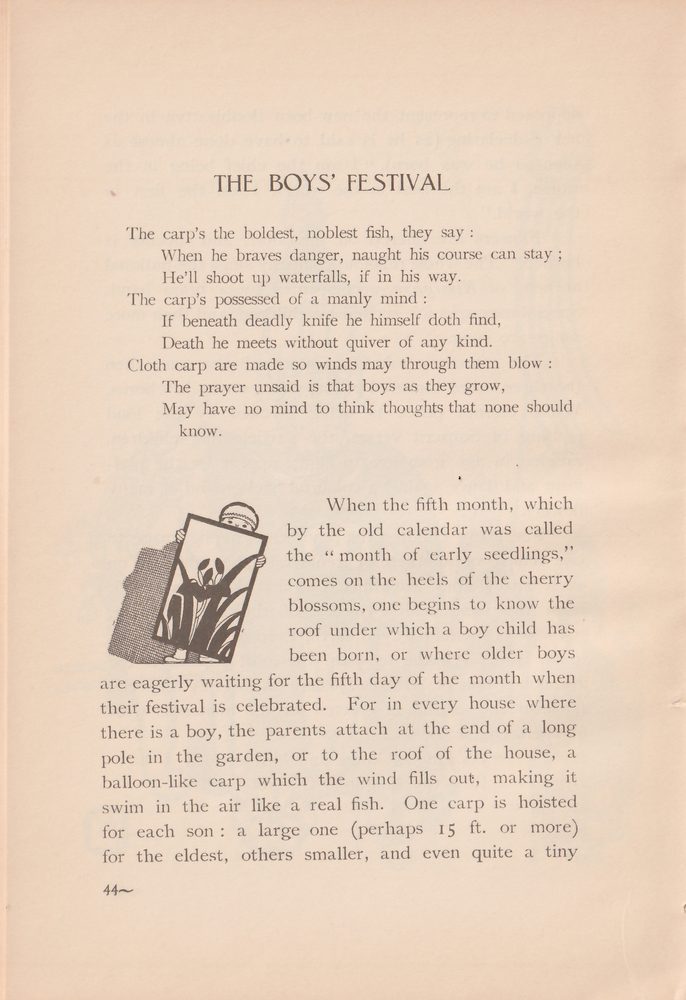
When the fifth month, which by the old calendar was called the “month of early seedlings,” comes on the heels of the cherry blossoms, one begins to know the roof under which a boy child has been born, or where older boys are eagerly waiting for the fifth day of the month when their festival is celebrated. For in every house where there is a boy, the parents attach at the end of a long pole in the garden, or to the roof of the house, a balloon-like carp which the wind fills out, making it swim in the air like a real fish. One carp is hoisted for each son: a large one (perhaps 15 ft. or more) for the eldest, others smaller, and even quite a tiny
one if there is a baby boy in the family. The traditional idea of celebrating this festival is to stress the parental prayer that the boysPrinted: thboys e may grow brave and strong, and become as great as some of the illustrious dead whose figures are displayed in the houses on this day.
More than one explanation has been offered of the origin of the custom of flying carp streamers. Perhaps the first to come to the minds of the Japanese is that which attributes to this fish the qualities of high mettle and fearless courage. The carp is often represented by artists in the act of leaping up a waterfall. The streamer is designed to represent this fish in the pious hope that the boy may grow to acquire that dashing boldness with which the finny hero is popularly credited, a thought not unnatural in the olden days when many boys had to make their way to name or fortune by means of the sword.
When telling of the virtues of the carp, it is always said that this dashing fish is unflinching and fearless when facing death. It is a matter of common knowledge that when the carp is laid upon the carving board and touched with the flat of a knife, it at once ceases to move, as if resigned to its fate. This is precisely the kind of composure with which every samurai was expected to face his end. Death was regarded as the best proof of true manhood. It is because of the same sentiment that the Japanese have always found a fascination in the cherry blossoms, which after a few days of blooming, and in the midst of their full glory, flutter to the ground when the fatal winds come to summon them to their early end.
According to another version, the carp represents the spirit which protected the Empress Jingū, the Queen-Admiral—the Artemis of Japan—in her expedition against the Koreans. When her fleet crossed the straits, a carp is said to have risen out of the waves and guided it across the water. Because of this event, the carp seems to have been enshrined at the Otokoyama Shrine, near Kyoto. This is the shrine of the deity Hachiman, the name by which Emperor Ōjin, the son of the Queen-Admiral, became known after his death. It has been customary ever since to distribute at this shrine charms shaped like a carp.
The custom of flying carp streamers high up on poles, however, began probably more than two hundred and fifty years ago. It originated as an expression of rivalry on the part of the common folk against the armed classes who used to display outside their dwellings on this day war streamers, lances, long-handled scimitars, and all other sorts of arms. The common burghers, who could make no show of deadly arms, but who were none the less concerned for the welfare of their male children, are said to have hit upon the idea of hoisting paper carp which, if not exactly awe-inspiring, could be made in any dimensions and therefore be more imposing than anything in the samurai’s armoury.
It is now a general rule to display a number of manly figures in houses where there are boy children, in much the same way as the dolls are set out on the girls’ day in March. The two figures always to be met with are those of the Empress Jingū, whose Korean expedition, as stated above, is related to the use of carp
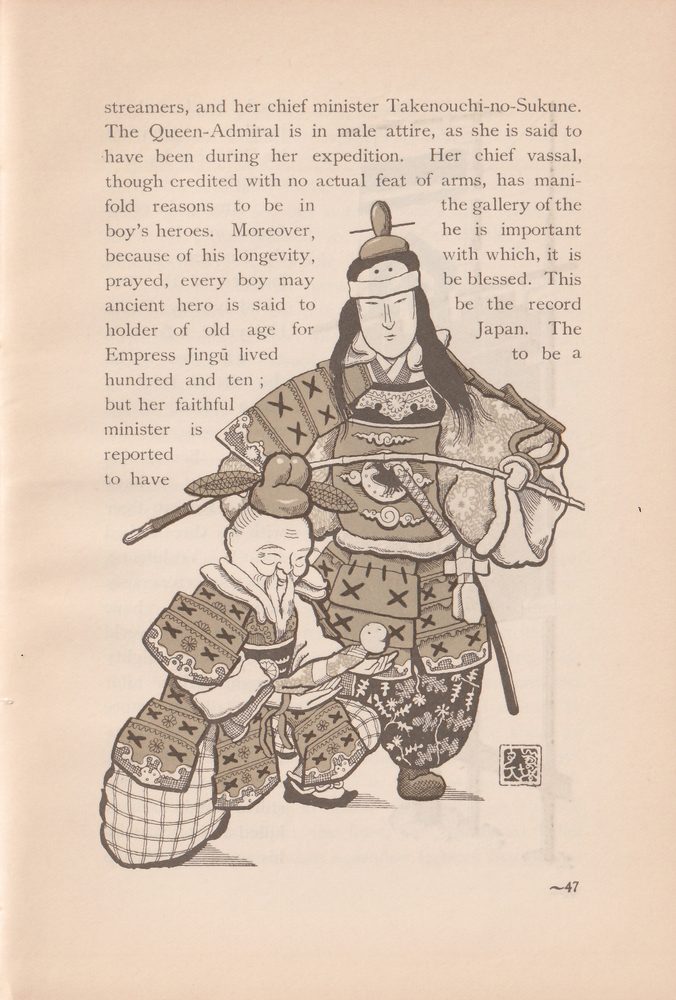
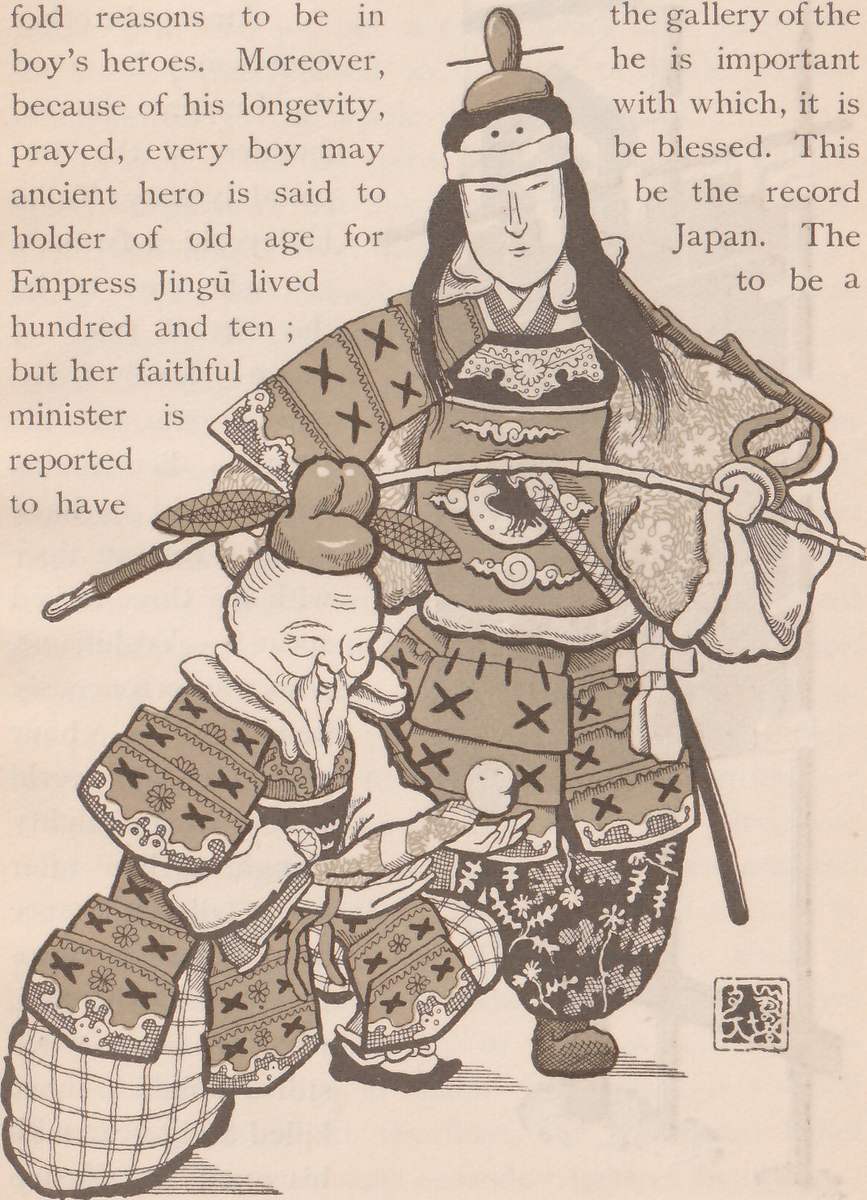
streamers, and her chief minister Takenouchi-no-Sukune. The Queen-Admiral is in male attire, as she is said to have been during her expedition. Her chief vassal, though credited with no actual feat of arms, has manifold reasons to be in the gallery of the boy’s heroes. Moreover, he is important because of his longevity, with which, it is prayed, every boy may be blessed. This ancient hero is said to be the record holder of old age for Japan. The Empress Jingū lived to be a hundred and ten; but her faithful minister is reported to have
lived to be three hundred, surviving his Empress by two centuries.
Among the other figures may be noted the Emperor Jimmu, founder of the Imperial dynasty; Taikō Hideyoshi, a farmer’s son who rose to be the virtual ruler of Japan; Katō Kiyomasa, one of his trusty lieutenants, who is said to have killed a Korean tiger with his three-forked spear; Yoshitsune, who was erroneously believed to have emerged into world history as the mighty Genghis Khan after his disappearance from Japanese history; Sakata Kintoki, who is said, when still a child, to have killed a big bear with his axe; and Momo-
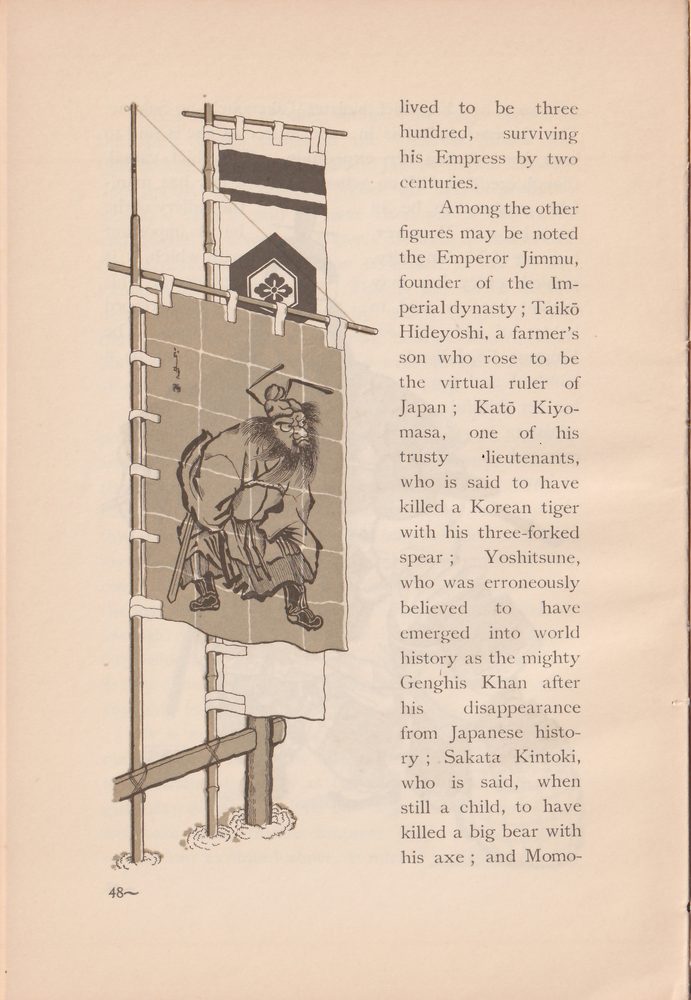
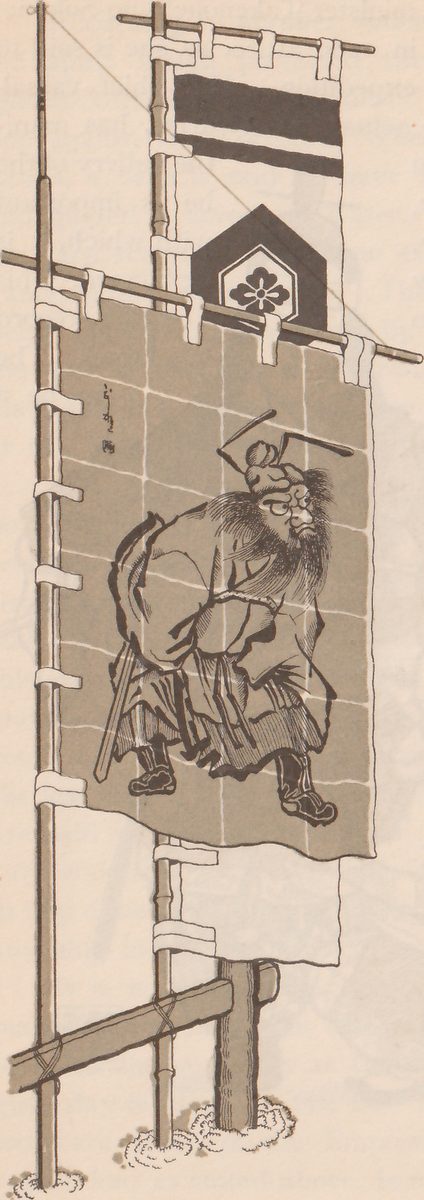
tarō, of nursery fame, who, though born of a peach, led a highly successful expedition against an island of predatory monsters. One figure never absent is that of the Chinese hero Shōki, of forbidding mien. In addition there are set out armour-boxes and streamers like those formerly used on the field of battle, to add a martial air to the whole display.
In fact, a martial spirit is predominant in all the figures displayed; but this is not difficult to understand, since the whole festival was conceived in the olden days when a man was thought to count for nothing unless he belonged to the honourable armed profession, and when the only road to glory was by arms.
When a boy is born, this festive day of May in his first year is regarded as an important occasion. Relatives and family friends are invited to dinner. Though there is no drink or food peculiar to this festival, the guests are expected to do justice to all the dishes under which the table groans, and to drink freely of the inevitable saké, to celebrate the day in the proper manner and spirit. The infant boy is unwittingly the centre and hero of the day’s festivities.
The Boys’ Festival is also known as the “Iris Festival.” This plant has since olden days been credited with medicinal properties. It is a national custom to place the leaf of the iris on the eaves of the house to keep away evil spirits and bodily ailments. The boys are bathed in the “Shōbu-yu,” or “Iris hot-bath,” on this day to instil courage in them. This plant is steeped in the saké drunk at the feast, the traditional belief being that the wine thus seasoned induces health.
The boys, who are too young to feast with the grown-ups, generally have a good time elsewhere. As befits the stern sex, they go out of doors; there is no particular indoor game to keep them at home. Kite-flying is generally the approved form of amusement at this time of the year.
It may be with manly pride that they observe their kites soaring as high into the air as their spirits do from the thoughts of the feast in which they are heroes. It may be with even a greater pride that they stand watching the fair carp streamers, floating high above and sweeping to and fro as the winds of heaven blow through their open bodies. It is perhaps not improbable that the boys in this hour feel their breasts swell with a live sense of the true manhood the streamers symbolize, and promise themselves that they will be as brave as the carp and as free from dark thoughts as the fish is said to be, with a mind to harbour only the noblest of manly sentiments.
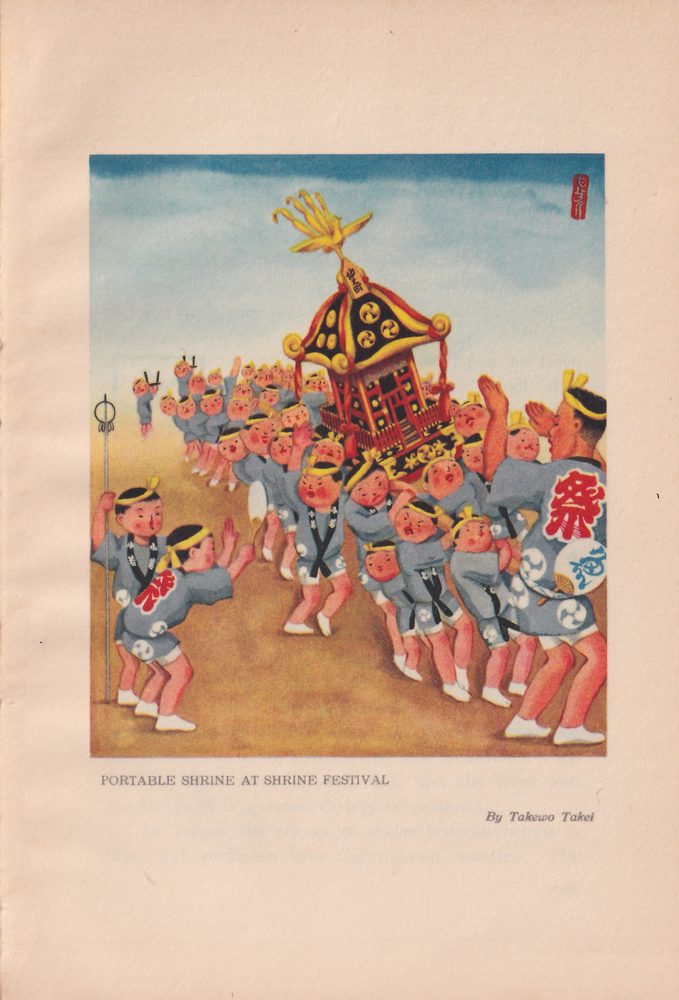
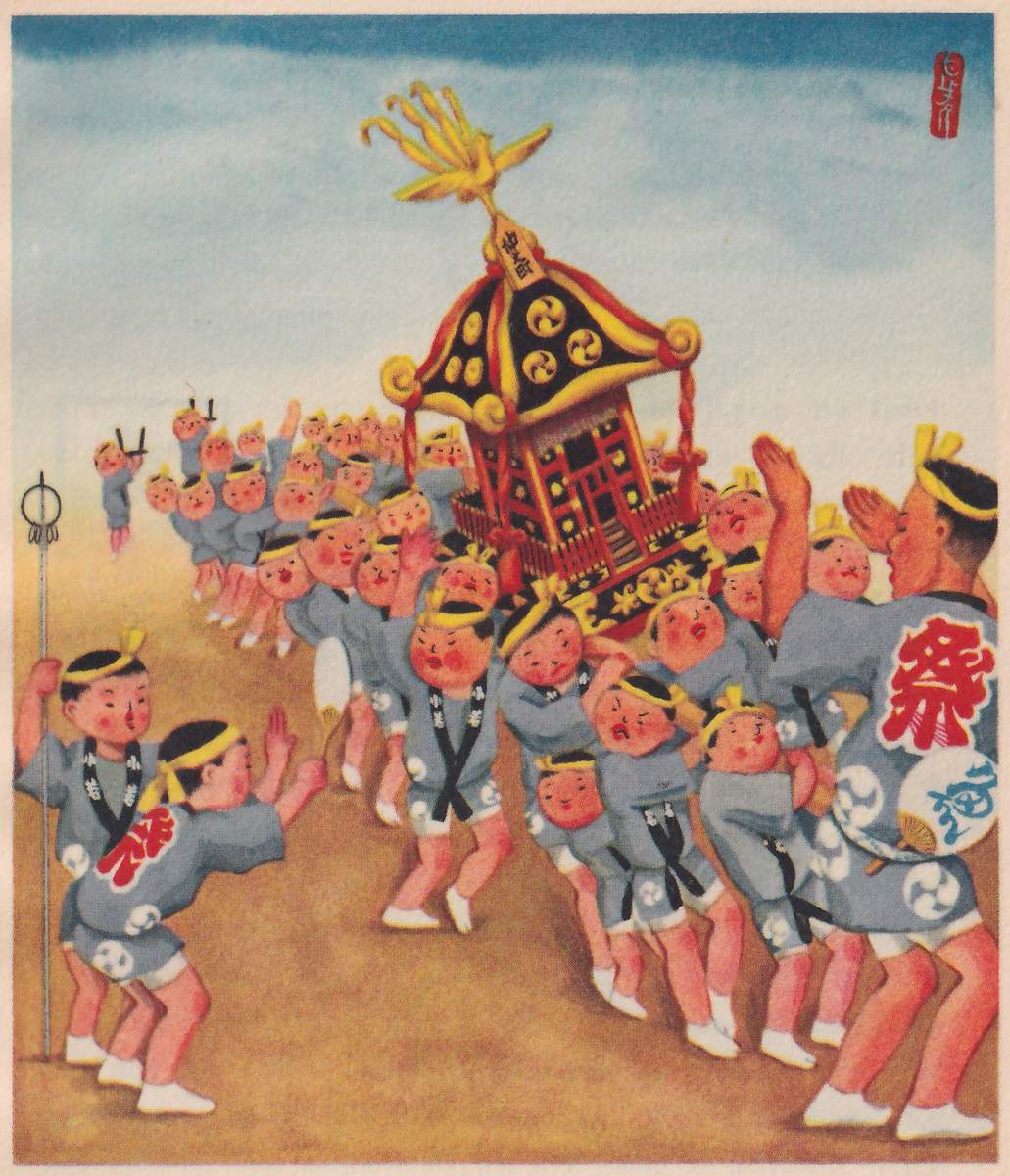
By Takewo Takei