
THE DOLL FESTIVAL
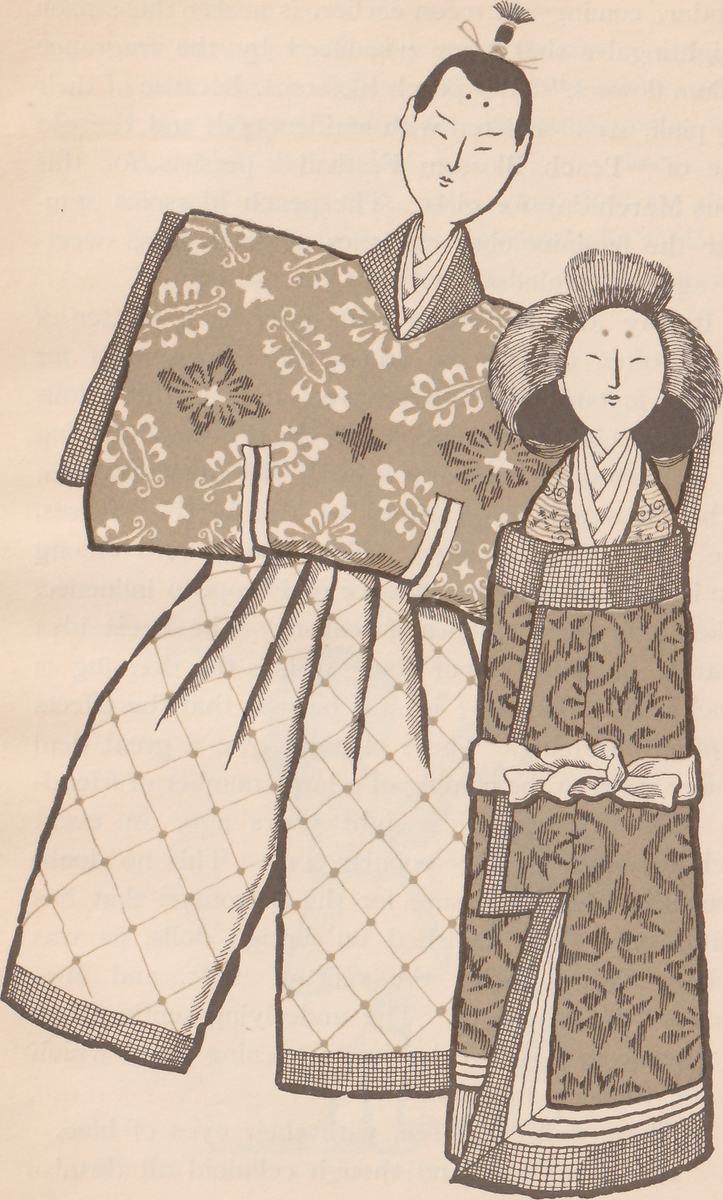
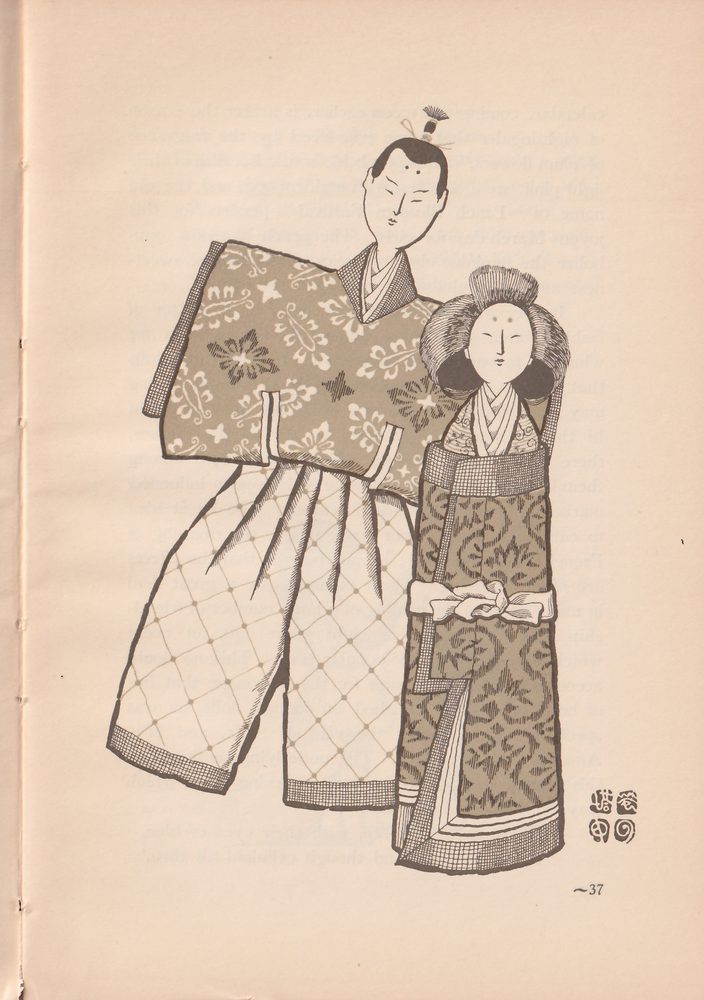
Although a very ancient custom, the Doll Festival did not become a national institution in the true sense of the term before the second quarter of the 18th century, when the Shōgun Yoshimune, the 8th of the Tokugawas, whom history knows as a prolific father, made much of the custom for the benefit of his teeming nursery. These dolls are not the every-day dolls with which children play, but ceremonial dolls, a family heirloom, as many of them are handed down from generation to generation. Usually a set consists of at least fifteen dolls. According to the usage now generally followed, they are arranged either on five or seven shelves one above the other. On the topmost shelf are placed the Prince to the left, and the Princess to the right. These dolls are attired as members of the Imperial Court used to be in olden times, and their costumes are not unlike those used at present on certain ceremonial occasions. This noble pair are placed before a folding screen of gold, with a lantern at each side and, in the centre, a tray on which stands the festooned sacred tree.
The second shelf from the top is given over to three maids of honour. They are represented as ready to serve saké. The third shelf is occupied by five
musicians, each holding an instrument. The fourth shelf holds a pair of guardsmen, and the fifth three footmen.
Wherever space permits there is placed a dainty assortment of offerings. A pair of trays are loaded with red and blue confetti-like sweets. Then a pair of lozenge-shaped trays are for rice-cakes of like shape. On a pair of small tables are placed rice-bowls, side-bowls, soup-bowls and the inevitable chopsticks with which to eat all the good things in these dishes.
To add colourful touches, a tiny cherry-tree and a tiny orange-tree, both in full bloom, are placed on the lowest shelf. From the ceiling a flowery ball of artificial cherry blossom and another of orange blossom are hung, each with a long silken cord trailing from it.
The Doll Festival is never complete without “white saké.” It is provided not only for the benefit of the dolls, but also for the members of the family and visitors who take part in the day’s celebration. This white drink is sweet and quite strong enough to warm even grown-up hearts, as it contains more alcohol than ordinary beer. For children it is portioned out in small and harmless measures.
Many interpretations are given to the festival. Families observe it to encourage filial piety, ancestor worship, and loyalty; but above all else, to express parents’ love for their children, their joy and pride in them, and their desire to please them.
The Doll Festival is often called the “Peach Blossom Festival.” When the lunar calendar was in general use, the third month saw the blooming of peach blossoms—hence this name. The month of March of the solar
calendar, coming one moon earlier, is nearer the season of nightingales that come “seduced by the fragrance of plum flowers.” But peach blossoms, because of their light pink, are associated with maidenhood, and the old name of “Peach Blossom Festival” persists for this joyous March day for girls. The peach blossoms symbolize the feminine characteristics of gentleness, sweetness and peacefulness.
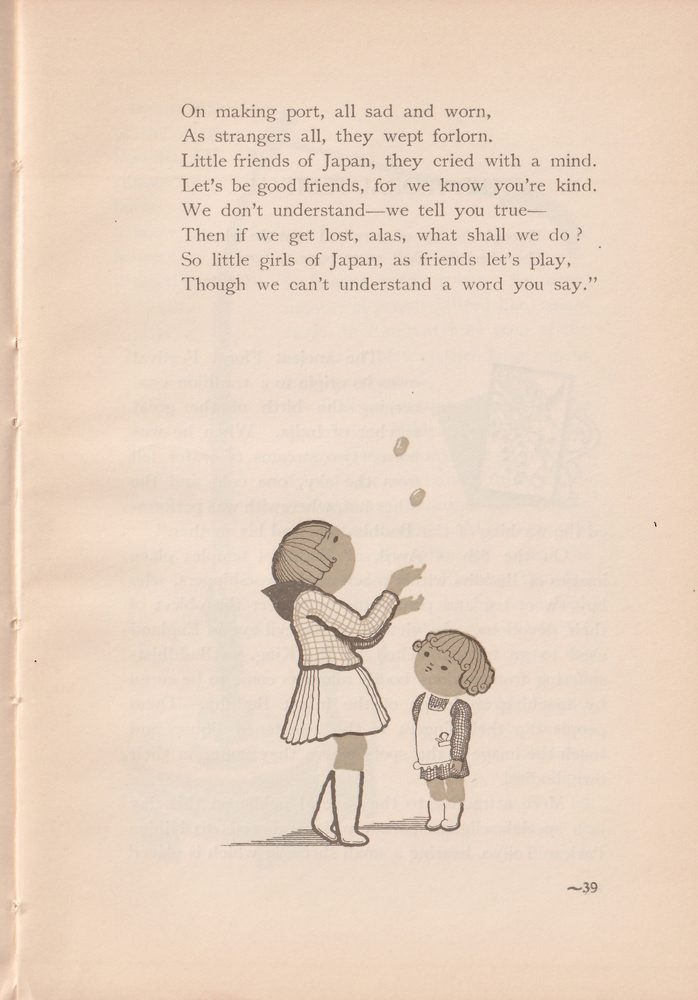
It may also be added that girls, as a matter of fashion, often make room among the above dolls for whatever favourite dolls they have. It is in these dolls that changes in the conception and the art of doll-making may be noted in comparison with the ancient types. In the faces and expressions, as also in the dresses, there are marked changes. Most conspicuous among them is the indisputable evidence of European influence, marked in growing touches of realism. The latest idea to catch the fancy of our young girls is the dressing of French dolls in kimono; it must be said that the effects are often charming. These changes owe a great deal in many cases to the coming of a large number of friendship dolls from America eight years ago, an event which produced a very popular song. This no doubt accounts in a large measure for the patronage that has of late come to be lavished on foreign dolls, as was specially shown during the visit of “Mr. and Mrs. America” in July 1935. The underlying sentiment of this popular song is revealed in its opening lines, which may be translated as follows:—
“These dolls, you see, with their eyes of blue,
Are American, and though celluloid all thru,’
On making port, all sad and worn,
As strangers all, they wept forlorn.
Little friends of Japan, they cried with a mind.
Let’s be good friends, for we know you’re kind.
We don’t understand—we tell you true—
Then if we get lost, alas, what shall we do?
So little girls of Japan, as friends let’s play,
Though we can’t understand a word you say.”