
THE FIRST DAY OF THE HORSE
Either in the town or country no day dawns or closes in Japan but to the note of a horn; for twice or even thrice a day, rain or shine, men go about selling bean-curd, and as they go their rounds they blow their horn-shaped tin trumpets. That is not all; when they come nearer, they will be heard to cry “tōfu” (bean-curd), and occasionally in addition, “aburage,” meaning bean-curd fried, and “ganmodoki,” a product whose name is a puzzle even to many Japanese, and of which we shall say more later. Once in every twelve days these street vendors will be heard to cry “aburage” with an additional announcement that it is the Day of the Horse. On the Horse Day a ceremony is observed at the Inari shrine. At an Inari shrine, foxes, which are sacred servants of the deity Inari, expect to be treated with aburage, their avowed weakness being for fried things. From a bean-curd vendor to hungry foxes may indeed seem a far cry. But people are reminded every twelve days of the aburage with which these hungry beasts are to be treated. If a man is not disposed to be such a fox fancier as to remember every day of the Inari festival, he generally makes a point of celebrating the First Day of the Horse, which is in February each year.
On this day special ceremonies are held at Inari shrines throughout the country. People travel long distances to attend these events at temples dedicated to the Inari deity.
Thus it happens that Reynard is affiliated to the horse. As far as the horse is concerned, this relationship is an accident pure and simple. He who was later to be enshrined as Inari is said first to have made his appearance on the First Day of the Horse in the second month of the 4th year of Wadō, which was the year 711 of the Christian era. The sacred apparition took place somewhere in the province of Yamashiro, now known as Fushimi, in the eastern part of Kyoto city. So to this day the place continues to be the mainspring of sacred influences emanating throughout the realm for the benefit of those who believe in the great powers of Inari.
The Inari deity is said to dispense all things in clothing, food and dwelling. No men or women engaged in business or agriculture may therefore hope for good fortune unless they pay their devotions to this tutelary deity.
The pious Reynard who figures so prominently at every Inari shrine won divine recognition about a century after the potent deity made his appearance near Kyoto. A pair of aged foxes who lived with their five children in Mount Funaoka, north of the Imperial Palace of Kyoto, were so inspired that they repaired to the Inari shrine at Fushimi and implored to be taken into the divine family, that they might become helpful in dispensing divine protection to mankind. Upon
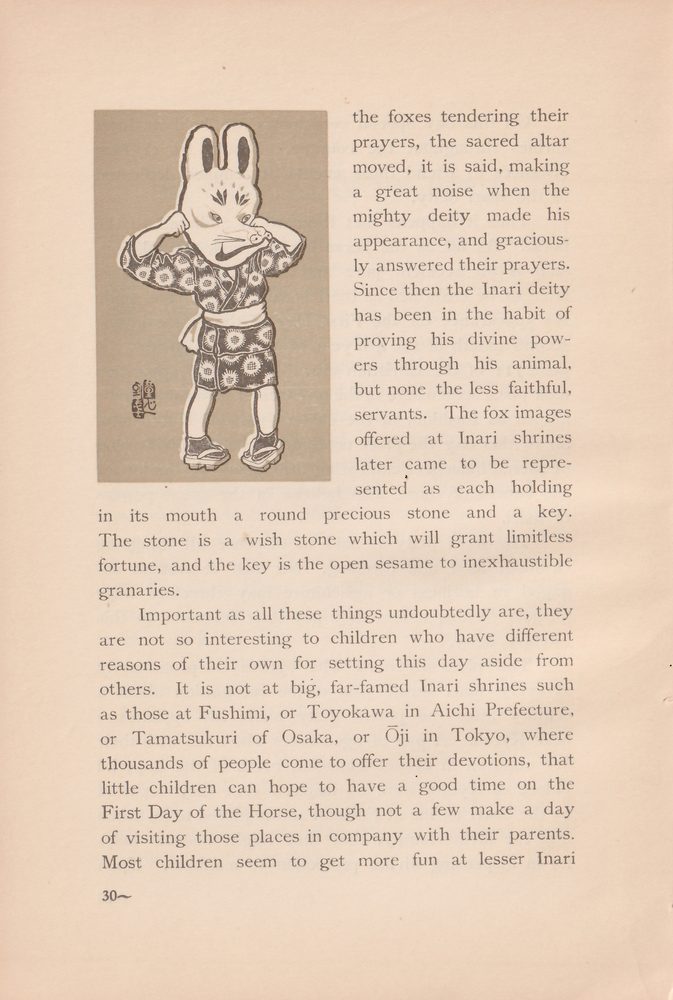
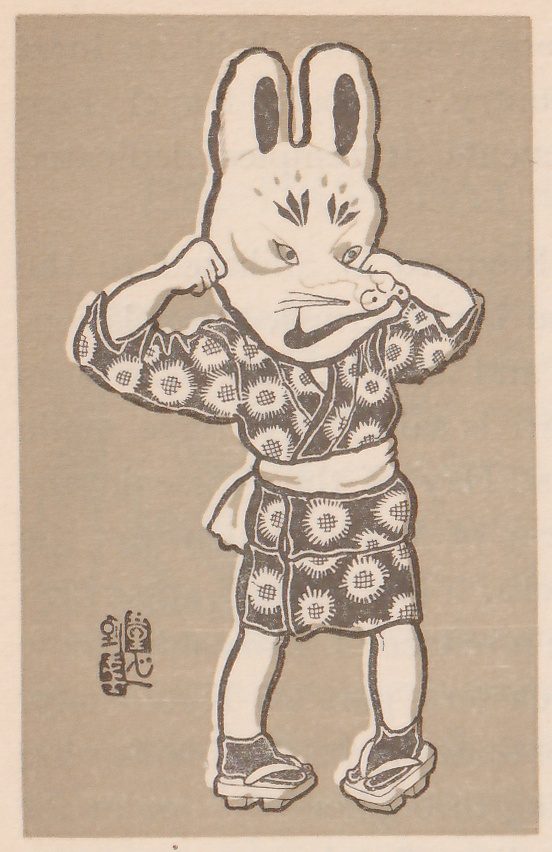
the foxes tendering their prayers, the sacred altar moved, it is said, making a great noise when the mighty deity made his appearance, and graciously answered their prayers. Since then the Inari deity has been in the habit of proving his divine powers through his animal, but none the less faithful, servants. The fox images offered at Inari shrines later came to be represented as each holding in its mouth a round precious stone and a key. The stone is a wish stone which will grant limitless fortune, and the key is the open sesame to inexhaustible granaries.
Important as all these things undoubtedly are, they are not so interesting to children who have different reasons of their own for setting this day aside from others. It is not at big, far-famed Inari shrines such as those at Fushimi, or Toyokawa in Aichi Prefecture, or Tamatsukuri of Osaka, or Ōji in Tokyo, where thousands of people come to offer their devotions, that little children can hope to have a good time on the First Day of the Horse, though not a few make a day of visiting those places in company with their parents. Most children seem to get more fun at lesser Inari
shrines, where they find themselves in greater intimacy with the deity and all his paraphernalia.
No town, or village for that matter, is thinkable without shrines dedicated to the Inari deity. These shrines, often of quite modest dimensions, are accessible to children. What is more, not a few homes, if possessed of enough open ground, have small shrines erected within their private enclosures. All these shrines are purified on the First Day of the Horse in February. All around the vermillion-coloured torii gate, which is inevitable at every Inari shrine, are planted banners of the same colour marked with the name of the deity. Incense is burnt before the sanctuary of the divine presence. Before a pair of foxes, placed there as if to guard the sacred place, their favourite food, aburage, and other eatables are offered on small wooden trays.
But it is not always the eatables that draw children to these shrines early in the day. It is as often the drum to be found there that greatly attracts them, to the disturbance of people living nearby. While the drum goes ruba-dub-dubbing people come to offer things on the altar. The children beat the drum in turn. In the meantime, the whole neighbourhood rests assured that the Inari deity of good material fortunes is being kept awake by the drumming, carefully taking account of the pious sentiments expressed on this day in terms of bean-cake fried in rape-seed oil for the benefit of his time-old furred servants, of the sweetstuffs for the untiring musical-minded youngsters, and of the rice boiled with red beans, as befits any day of felicitous
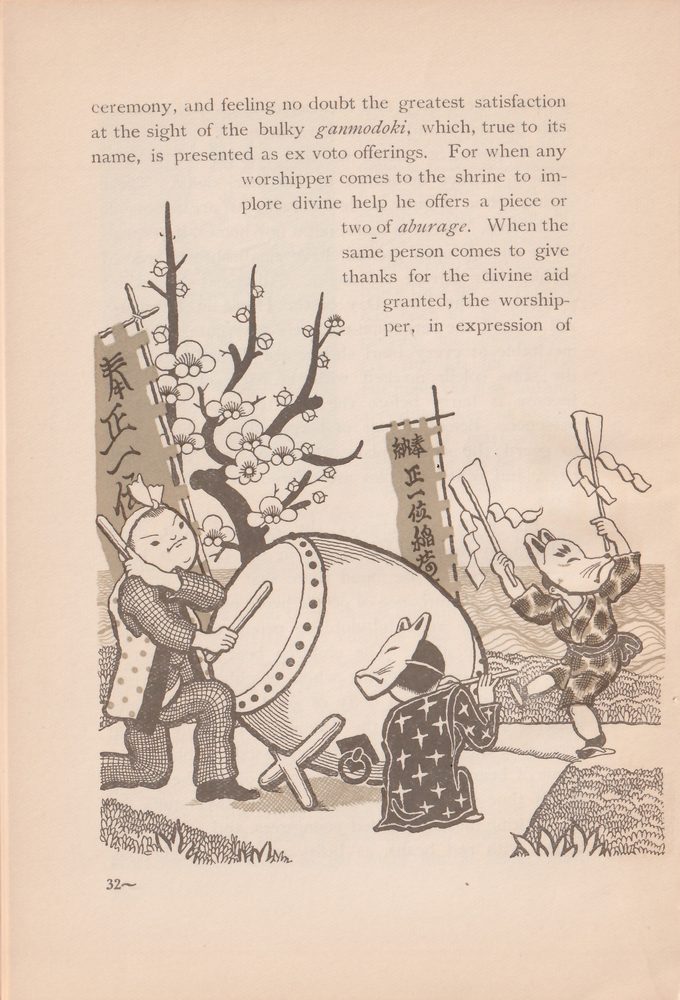
ceremony, and feeling no doubt the greatest satisfaction at the sight of the bulky ganmodoki, which, true to its name, is presented as ex voto offerings. For when any worshipper comes to the shrine to implore divine help he offers a piece or two of aburage. When the same person comes to give thanks for the divine aid granted, the worshipper, in expression of
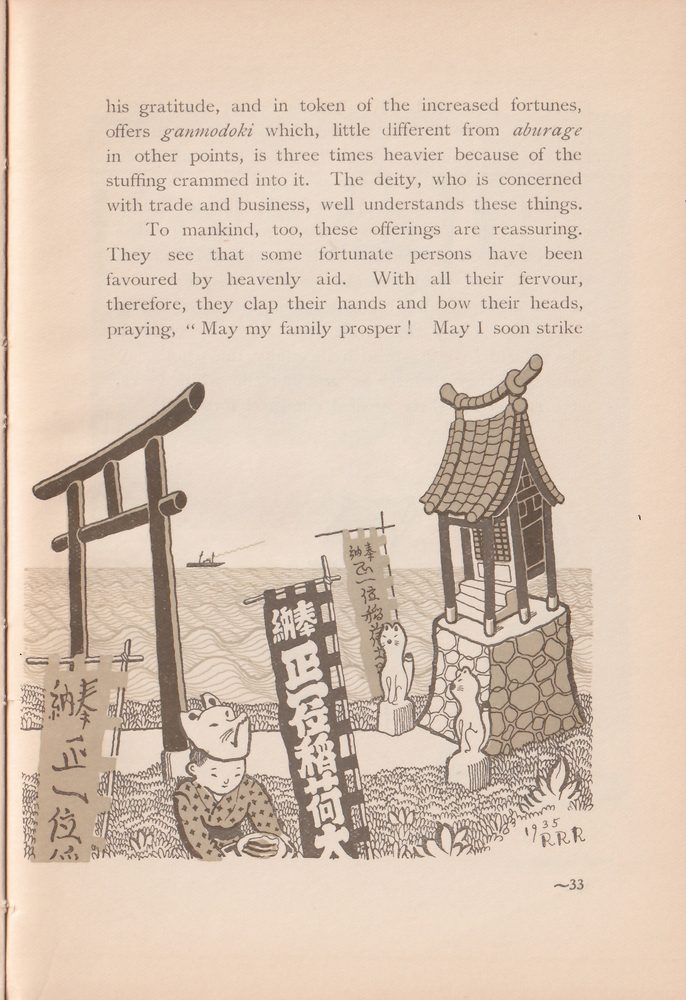
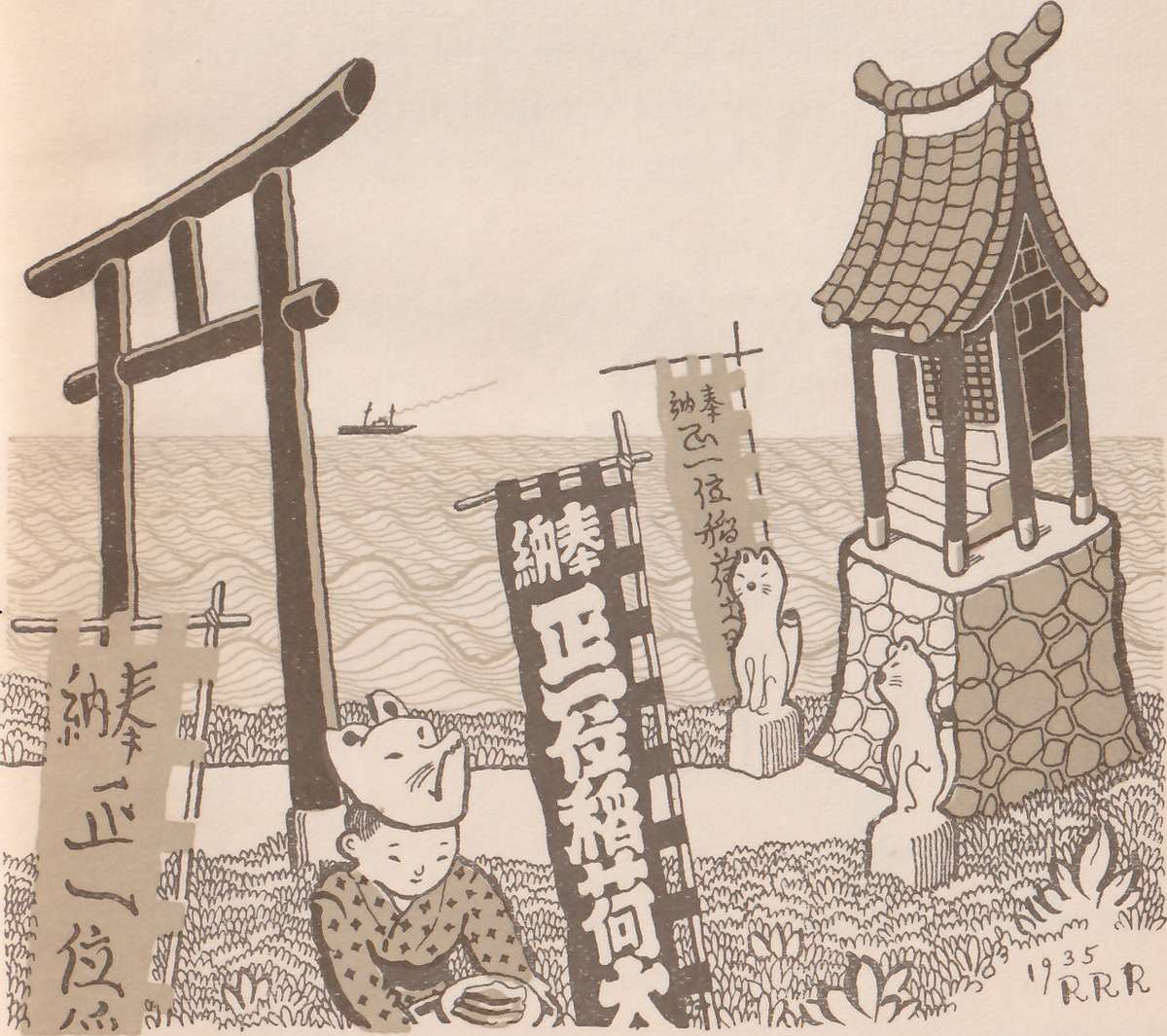
his gratitude, and in token of the increased fortunes, offers ganmodoki which, little different from aburage in other points, is three times heavier because of the stuffing crammed into it. The deity, who is concerned with trade and business, well understands these things.
To mankind, too, these offerings are reassuring. They see that some fortunate persons have been favoured by heavenly aid. With all their fervour, therefore, they clap their hands and bow their heads, praying, “May my family prosper! May I soon strike
fortune! May all bodily ailments depart from under my roof! May I climb the ladder high and yet never fall! If I have unwittingly so designed my home as in any way to offend you, may you forgive me!”
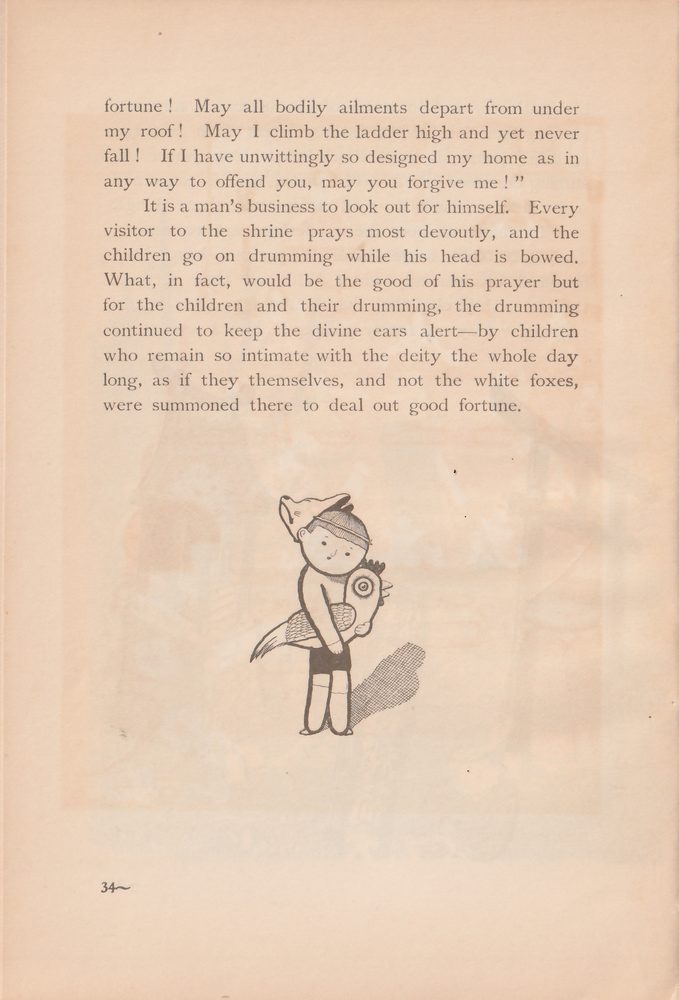
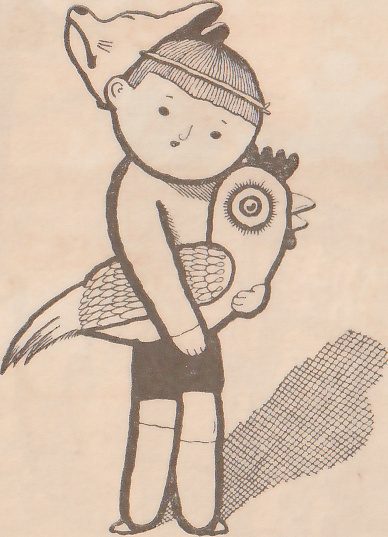
It is a man’s business to look out for himself. Every visitor to the shrine prays most devoutly, and the children go on drumming while his head is bowed. What, in fact, would be the good of his prayer but for the children and their drumming, the drumming continued to keep the divine ears alert—by children who remain so intimate with the deity the whole day long, as if they themselves, and not the white foxes, were summoned there to deal out good fortune.
By Takewo Takei