
“MAY LITTLE ONES GROW UP WITHOUT WORMS”

“He loves his child so much that he would feel no pain if the little one entered his eye.” In such terms are often expressed paternal affections in Japan. Children are brought up with the tenderest care; but there are many things of which the human mind can never be aware beforehand. Human flesh, especially young tender flesh, is heir to so many troubles. Some children, for instance, cry all the time; some babies never get fat; some boys eat four or five helpings of rice one day and will not touch a morsel the next; some girls get very peevish at times for no reason whatever; all these things, and more, used to be attributed to mischief-makers called by the generic name of “worms.” Simples were brewed to expel these worms; some could be extracted; but others could neither be found nor subdued.
One of the worst worms known to human knowledge was a species called tsutsuga-mushi, the knowledge of which was imported from Cathay through its literature and medicine. This worm is said to eat one’s heart out. So when a child grows up in good health, it is said that he grows up without having tsutsuga worms.
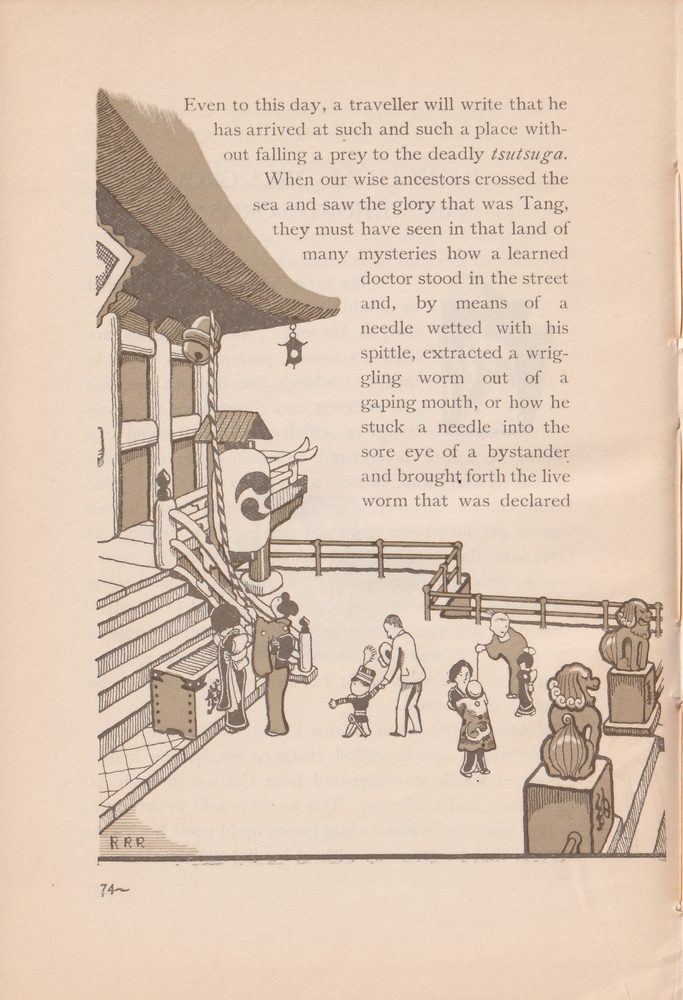
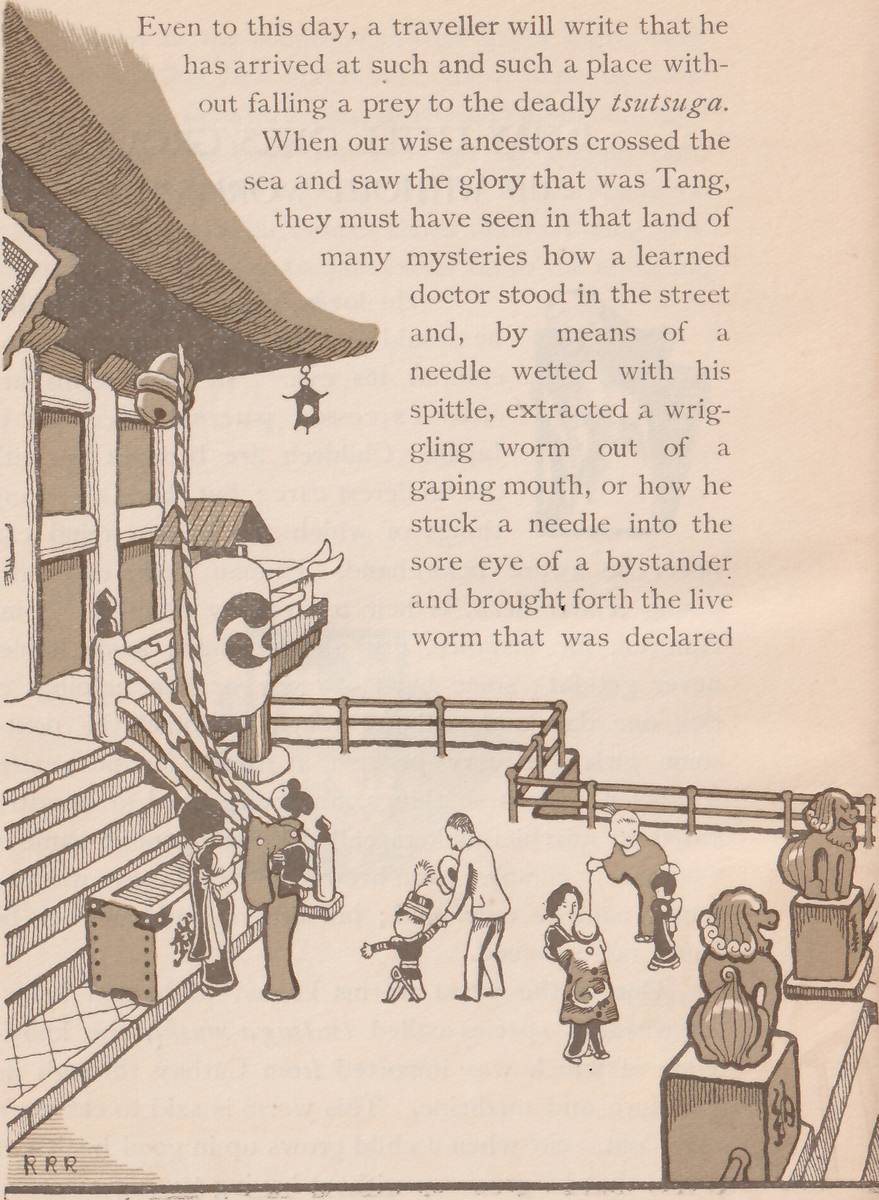
Even to this day, a traveller will write that he has arrived at such and such a place without falling a prey to the deadly tsutsuga.
When our wise ancestors crossed the sea and saw the glory that was Tang, they must have seen in that land of many mysteries how a learned doctor stood in the street and, by means of a needle wetted with his spittle, extracted a wriggling worm out of a gaping mouth, or how he stuck a needle into the sore eye of a bystander and brought forth the live worm that was declared
to have been the root of the whole trouble.
So wise parents turned to their tutelary deities for the protection of their offspring. No loving parent failed to pray that his children might grow up without worms of any kind.
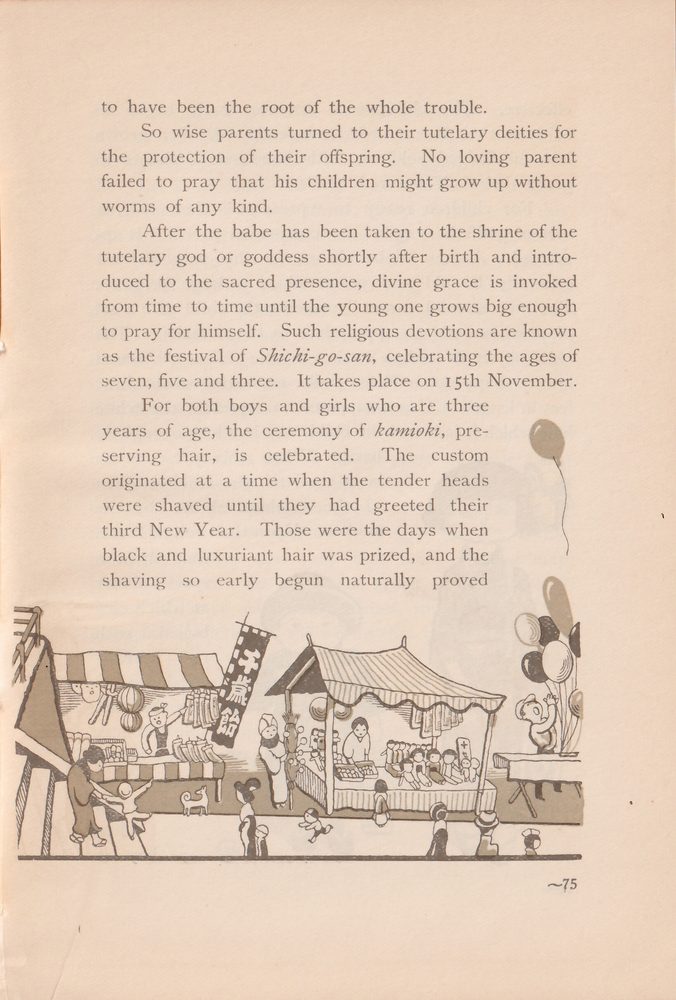
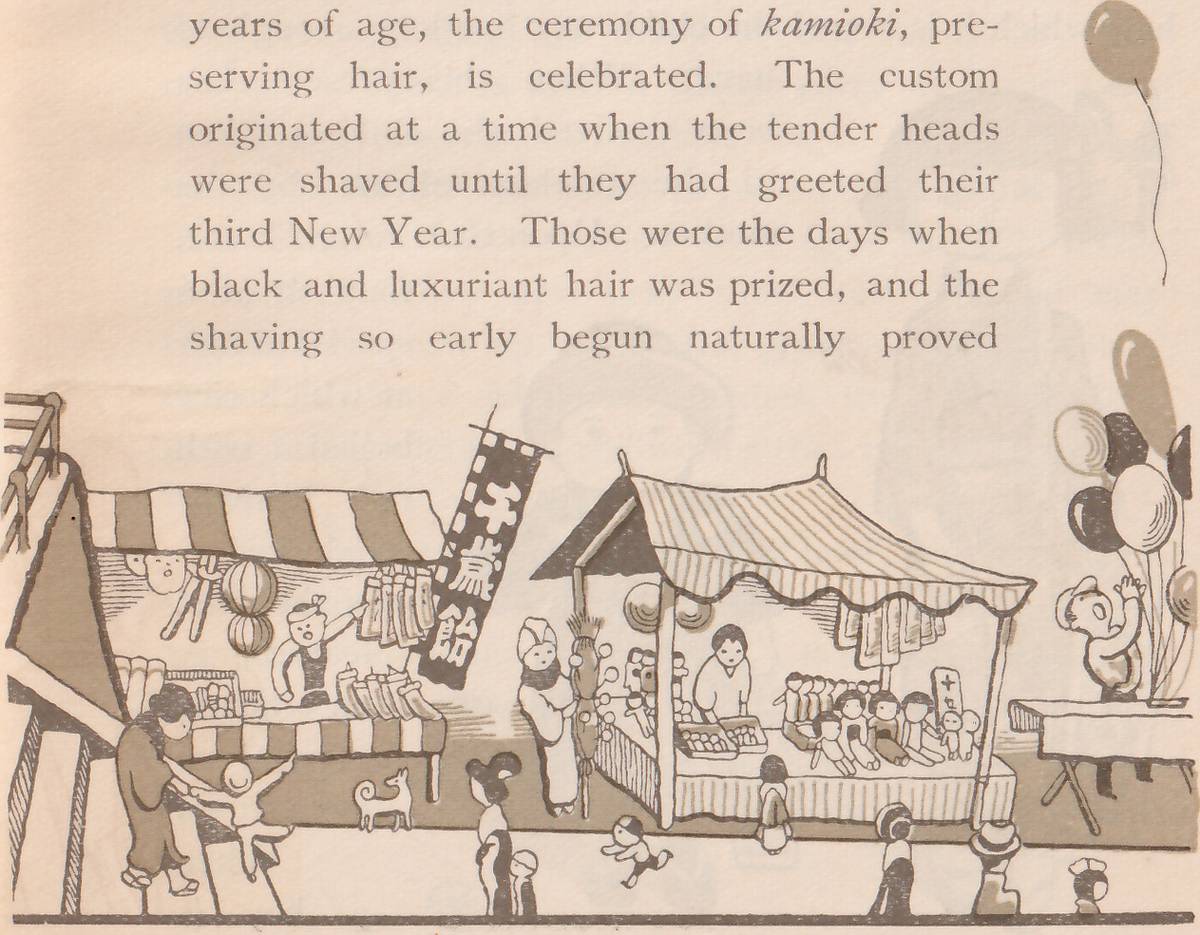
After the babe has been taken to the shrine of the tutelary god or goddess shortly after birth and introduced to the sacred presence, divine grace is invoked from time to time until the young one grows big enough to pray for himself. Such religious devotions are known as the festival of Shichi-go-san, celebrating the ages of seven, five and three. It takes place on 15th November.
For both boys and girls who are three years of age, the ceremony of kamioki, preserving hair, is celebrated. The custom originated at a time when the tender heads were shaved until they had greeted their third New Year. Those were the days when black and luxuriant hair was prized, and the shaving so early begun naturally proved
effective. The children of samurais early began to cultivate their hair in order to be endowed, when grown into full-fledged soldiers, with handsome topknots to grace their half-tonsured heads.
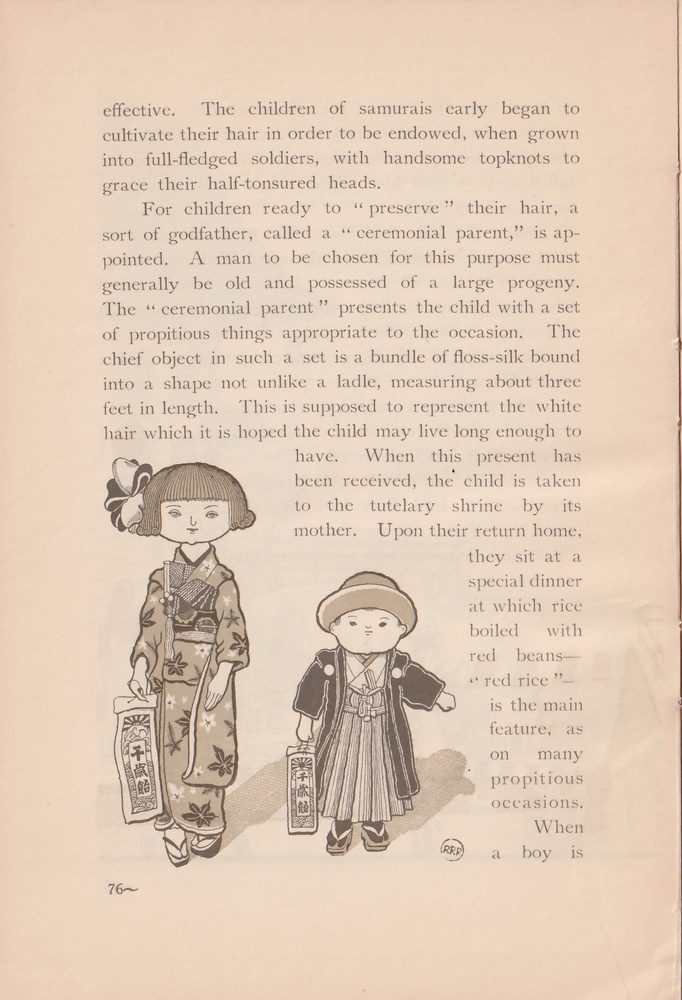
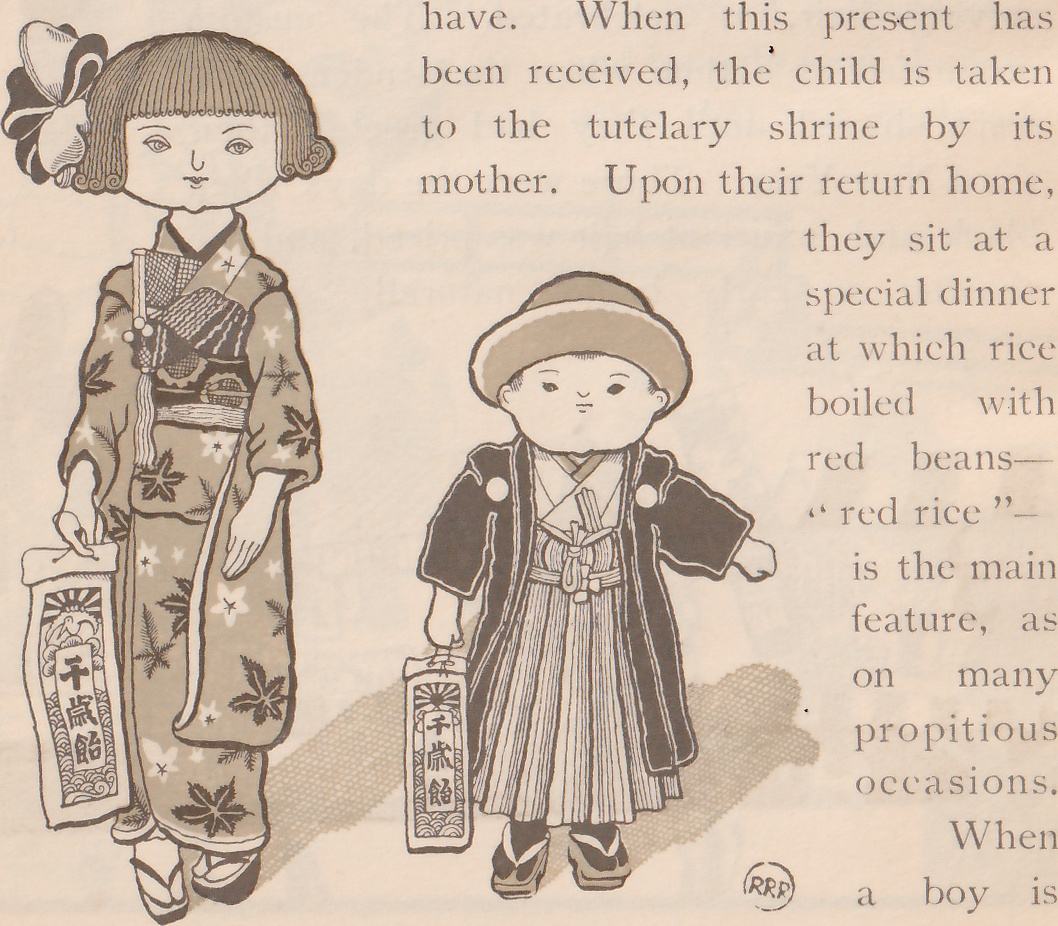
For children ready to “preserve” their hair, a sort of godfather, called a “ceremonial parent,” is appointed. A man to be chosen for this purpose must generally be old and possessed of a large progeny. The “ceremonial parent” presents the child with a set of propitious things appropriate to the occasion. The chief object in such a set is a bundle of floss-silk bound into a shape not unlike a ladle, measuring about three feet in length. This is supposed to represent the white hair which it is hoped the child may live long enough to have. When this present has been received, the child is taken to the tutelary shrine by its mother. Upon their return home, they sit at a special dinner at which rice boiled with red beans—“red rice”—is the main feature, as on many propitious occasions.
When a boy is
five years old, he performs what is called the ceremony of wearing the hakama, the pleated skirt for men. Facing the direction from which the good influence of the year is to come, the boy is dressed in his hakama. He is then taken to the shrine by his mother. On this occasion as well a special dinner is given in celebration.
When a girl is seven years old a ceremony known as obi-toki, getting rid of or changing the sash, takes place. In some places this is observed with boys as well. Up to this age children fasten the kimono in front by tying together a pair of narrow strips of cloth. On this festive day they are attired, as grown-ups are, in sash-bound kimono without these fasteners. When thus dressed, they are taken to the shrine by their mothers. There is later a dinner-party at home.
These customs, of religious origin, are observed as occasions for the expression of parental gratefulness that their children have attained such ages through divine protection. They also pray that their children may continue to grow up, under the grace of their tutelary deities, to have wholesome bodies, free from trouble, never falling victims to the worms that prey upon human hearts.
So children are taught at school and elsewhere that parental love is deeper than the sea and higher than the mountains. And the all-wise Confucius is quoted to the effect that “one’s body, hair and skin are the gifts of one’s parents; not to harm or impair any of them or any part of them is one’s first filial duty.”