
CHRISTMAS IN JAPAN
Should an American or European missionary who left these shores a decade ago come back to Japan today at Christmas, he would rub his eyes many times at the sight of what is taking place. The scene to be observed would be little different from what is observable in any Christian country at this season.
He would also find that such a change has taken place even though the majority of children still stay away from the Christian churches and Sunday schools. The Holy Scriptures are still unknown to the majority of the Japanese people, except for such stories as that of Moses leading his tribe through the parted waters, or of Noah keeping his family and animals in the Ark. This, however, in both instances, is largely thanks to the enterprising spirit of the American cinema industry. Despite all this, Christmas has been so well established in the national life of Japan that the children’s days would be almost as unthinkable without Christmas as without New Year.
It would be an unpardonable exaggeration to say that the present popularity—for it is nothing less—of Christmas is due to the work of Christian missionaries
or their Japanese followers. It would also be wrong to say that the Japanese observe the Christian holiday from any religious motives. It would, moreover, be stretching one’s imagination very far to say that the present celebration of Yuletide, nation-wide as it is, is laying the foundation for a Christian Japan.
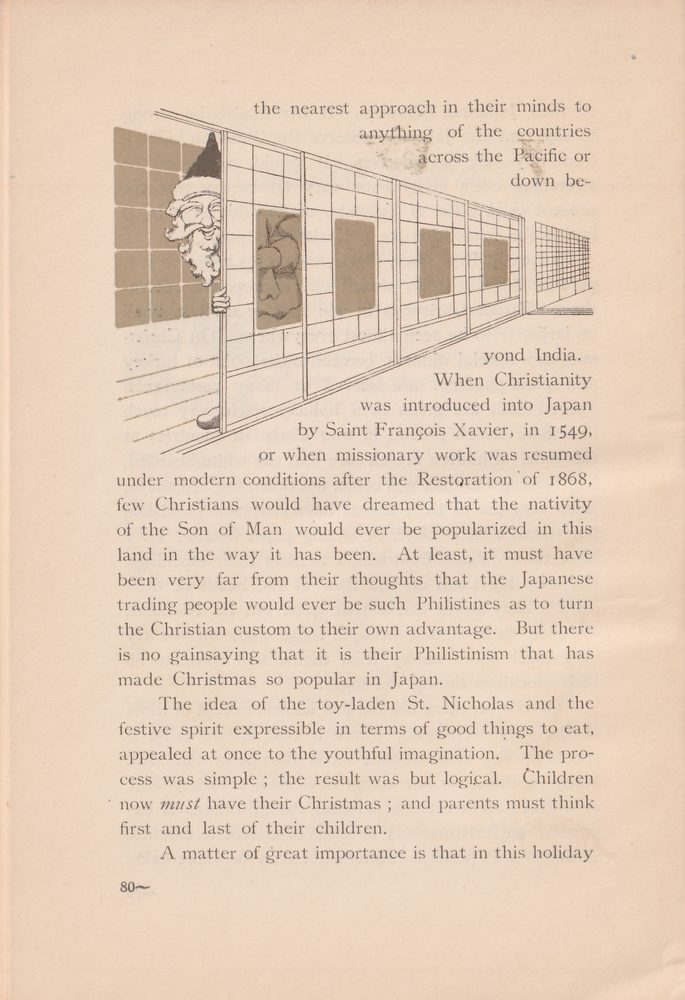
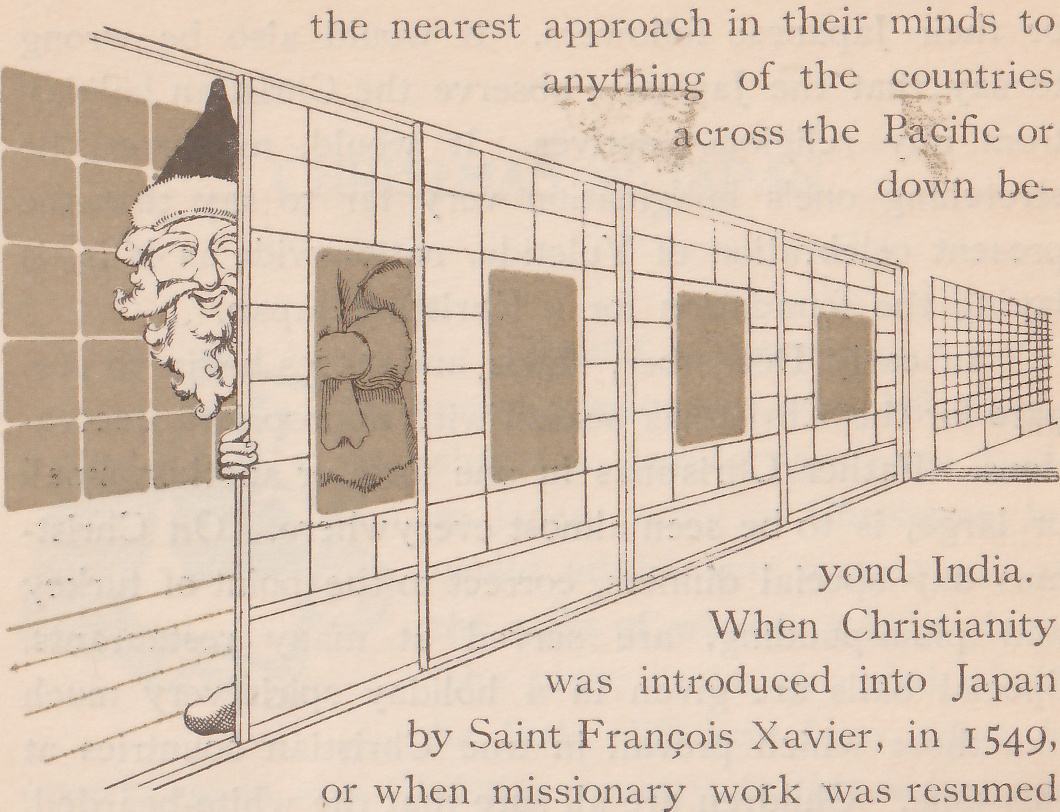
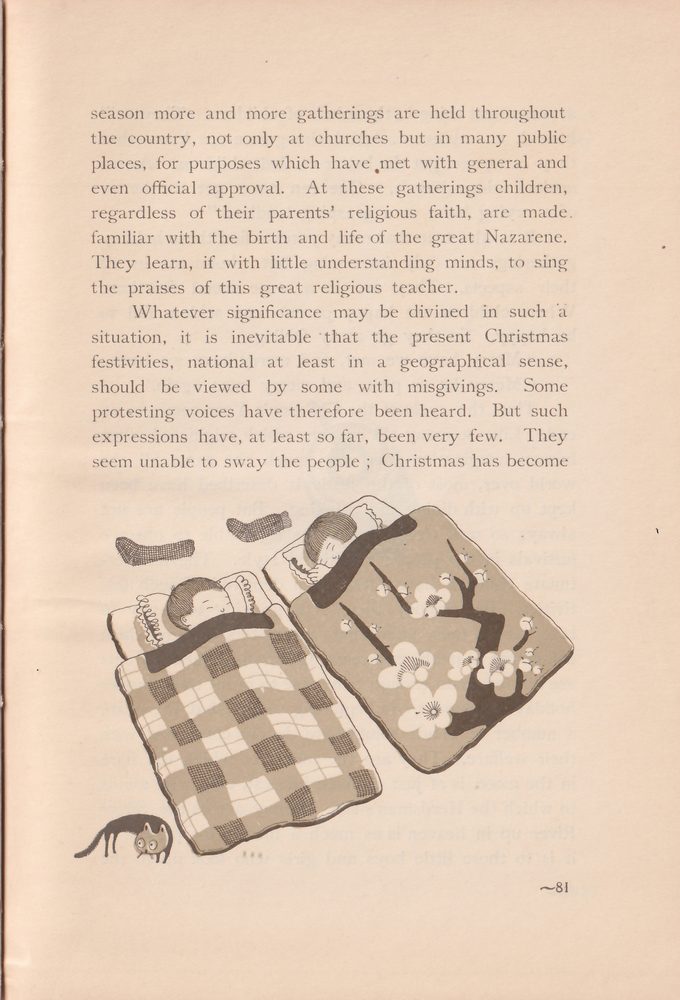
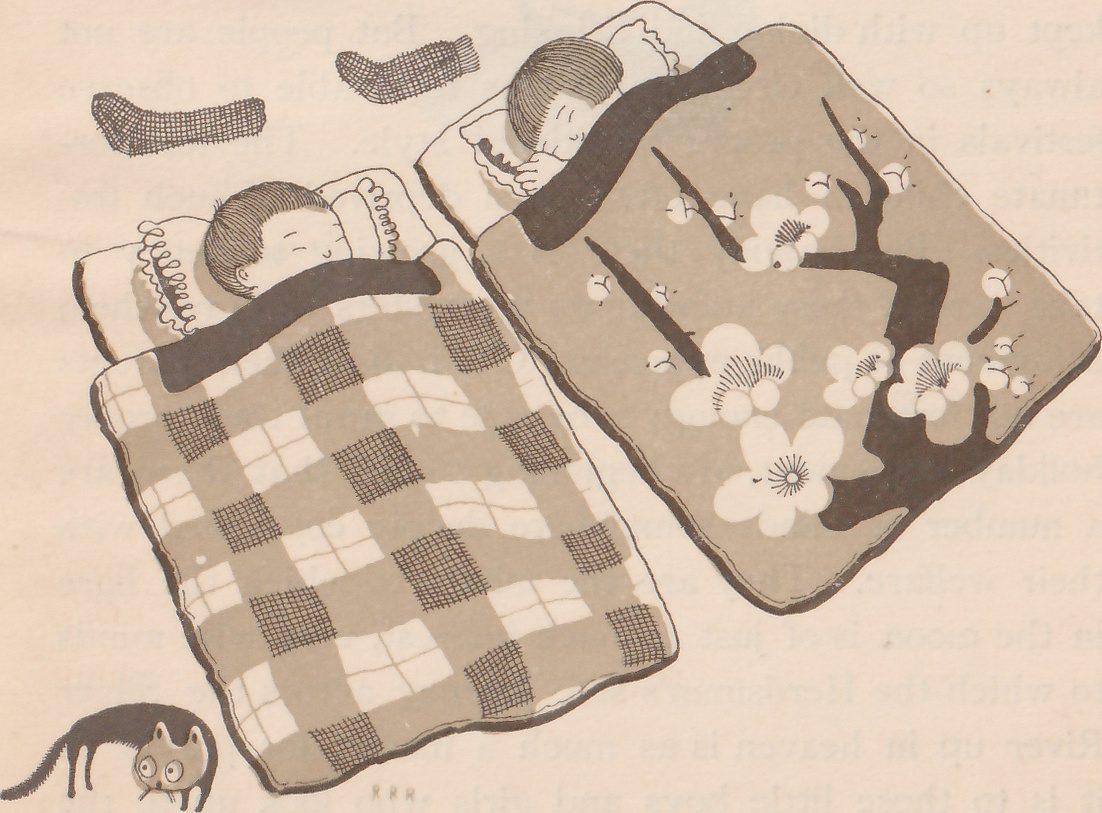
In early December, shops and stores begin to prepare for the Christmas season with appropriate decorations. Father Christmas in one form or another, small or large, is to be seen almost everywhere. On Christmas day special dinners, correct to the point of turkey and plum-pudding, are served at many restaurants. Special balls are given in a holiday spirit very much like those which prevail in true Christian countries at this time. Children are all sure that the white-bearded, bag-bearing old man will come, not down the chimneys, since very few of their homes have any such provision, but through their shōji, or sliding paper doors. They have no bedsteads from which to hang their stockings, but they lay them on the floor at the heads of their beds. They never doubt that good old St. Nicholas, foreigner as he is, and living in some unknown country very much more snowy than theirs, will come to fill their stockings during the night.
Of course, there are but few homes, except in those of the very well-to-do, where a real festive table is spread in the same manner as in Europe or America. Many mothers, for one thing, have seen a turkey only at a zoo. Nevertheless, parental thoughtfulness is expressed on Christmas day in terms of chocolate candies, caramels and, perhaps, American pastry or short cake,
the nearest approach in their minds to anything of the countries across the Pacific or down beyond India.
When Christianity was introduced into Japan by Saint François Xavier, in 1549, or when missionary work was resumed under modern conditions after the Restoration of 1868, few Christians would have dreamed that the nativity of the Son of Man would ever be popularized in this land in the way it has been. At least, it must have been very far from their thoughts that the Japanese trading people would ever be such Philistines as to turn the Christian custom to their own advantage. But there is no gainsaying that it is their Philistinism that has made Christmas so popular in Japan.
The idea of the toy-laden St. Nicholas and the festive spirit expressible in terms of good things to eat, appealed at once to the youthful imagination. The process was simple; the result was but logical. Children now must have their Christmas; and parents must think first and last of their children.
A matter of great importance is that in this holiday
season more and more gatherings are held throughout the country, not only at churches but in many public places, for purposes which have met with general and even official approval. At these gatherings children, regardless of their parents’ religious faith, are made familiar with the birth and life of the great Nazarene. They learn, if with little understanding minds, to sing the praises of this great religious teacher.
Whatever significance may be divined in such a situation, it is inevitable that the present Christmas festivities, national at least in a geographical sense, should be viewed by some with misgivings. Some protesting voices have therefore been heard. But such expressions have, at least so far, been very few. They seem unable to sway the people; Christmas has become
a permanent thing in the minds of children. They will have it at any event. And the grown-ups know that they can never get the better of their children. As an ancient adage has it, “One can never get the better of a crying babe or a grasping landlord.”
It is also true that many parents find these holiday gatherings not only interesting but wholesome in all their aspects. They are in a sense social functions. Where children are happy parents can seldom fail to be happy. So they go away feeling,
“Merry have we met, and merry have we been;
“Merry let us part, and merry meet again.”
Thus the cycle of the Children’s Year comes to an end. Like so many old customs which originated when human imagination was very much the same all the world over, most of the festivals described have been kept up with dining and drinking. But people are not always so well circumstanced as to be able to observe festivals in the proper traditional style. The less fortunate children have often been deprived of such festivities. But happily there is a growing tendency to take care of these unfortunate youngsters and give them enjoyment at public expense. Children, if their parents are not fortunate enough to be able to grant them proper holiday enjoyment, are beginning to feel that there are a number of minds somewhere deeply concerned with their welfare. They are the minds to which the hare in the moon is of just as much interest, very wise minds to which the Herdsman’s safe journey across the Silver River up in heaven is as much a matter for prayer as it is to those little boys and girls who look up to the

sky on the 7th night of the 7th moon, and pray that rain may not fall on this night to make the heavenly river rise and fill the good stars with sorrow.