
VI. SECOND CREATIVE PERIOD
Following the prosperous period of Genroku (1688–1704) the Kabuki Drama passed through a dark age until, from about 1780, it blossomed out into a second period of success. Taking over the formal beauty and excellent literary value of the Puppet Drama, and embellishing it, the Kabuki created a unique art in the form of musical drama. It appropriated the Puppet Drama to the Kabuki, harmonizing the accentuated lines of the puppets with the artistic skill of the actor, reconciling formalism with realism, thereby producing a unique result, perfectly blended. Thus, the dramatic centre moved to Edo, the present Tokyo.
STATED PERFORMANCES DURING THE YEAR
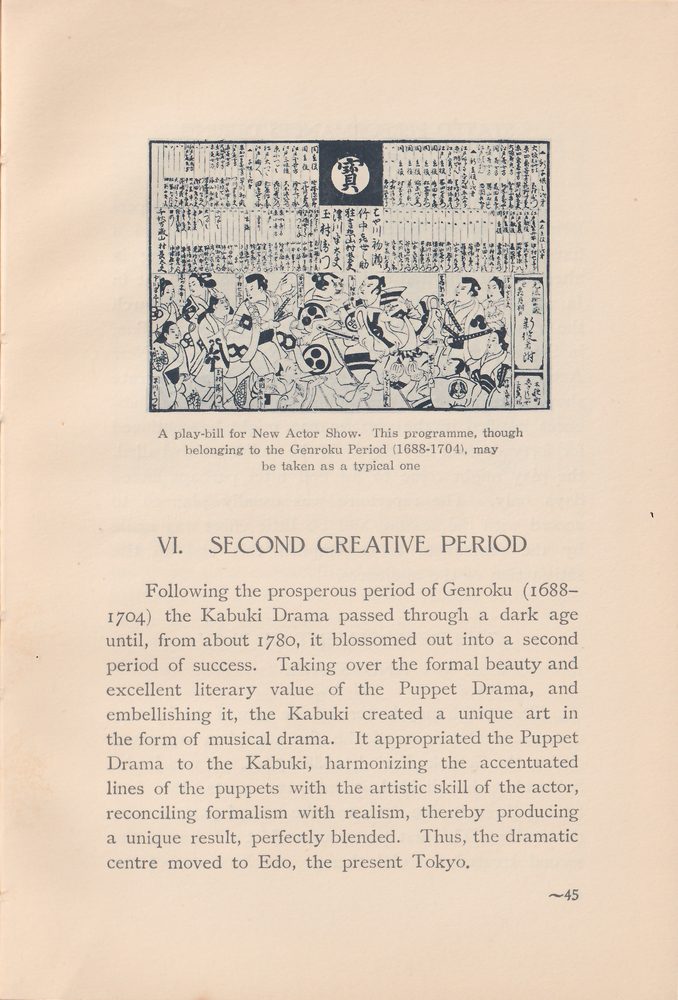
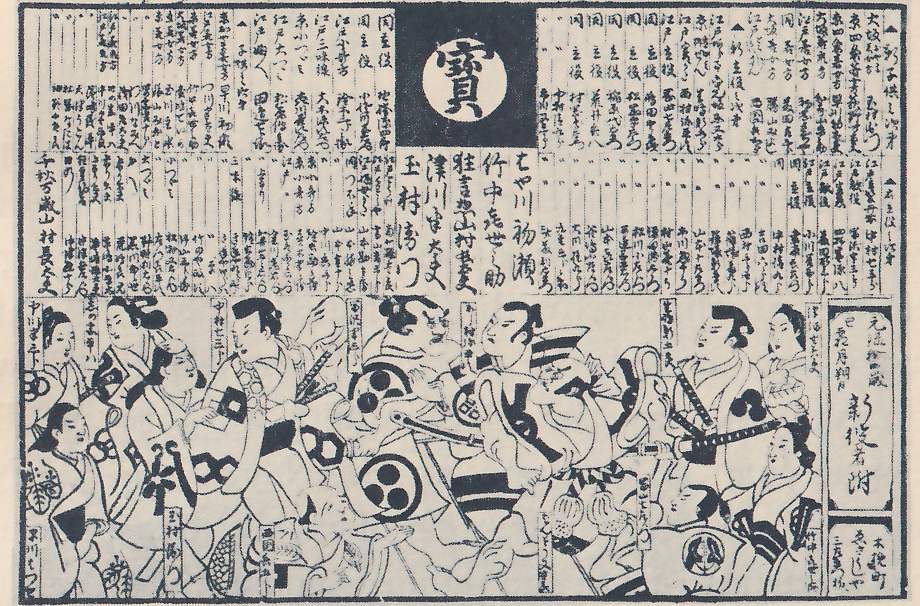
During this period the number of theatrical performances to be given during the year took on a fixed form. There were six of these, appearing in alternate months, and with prescribed names. That in January was called the Spring Show, that in March the Yayoi, in May the Fifth Month, in July the Bon, in September the Autumn, and in November the New Actor Show. The continuation of each of these separate shows depended upon the public response. If the audiences justified it, the performance might be continued for forty or even fifty days. If the audiences dwindled, the play might come to an end after perhaps fifteen days only. The repertoire was usually planned to accord with the season, and no little effort was made by the dramatists to accomplish this end to the satisfaction of the audiences.
THE DEVELOPMENT OF PLAY AND STAGE
That which may be termed the form of the modern drama, or the form of the five-act play, appeared during the Genroku Period (1688–1704). It was Jisuke Sakurada who divided it into two parts, the first having three to five acts, and the second part, two or three acts. The first part was an historic drama, the second treated a social theme. At least one of the
acts must be in the dance form. The development of the dance form characterized this age, and reached its highest point in the art of many famous actors who strove for the best bodily rhythm.
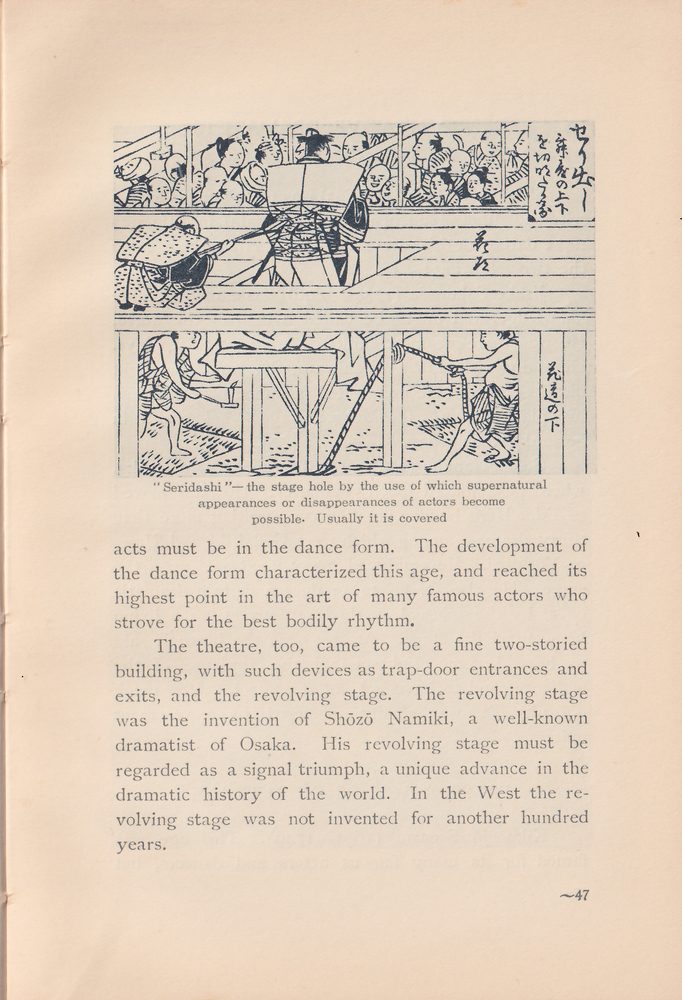
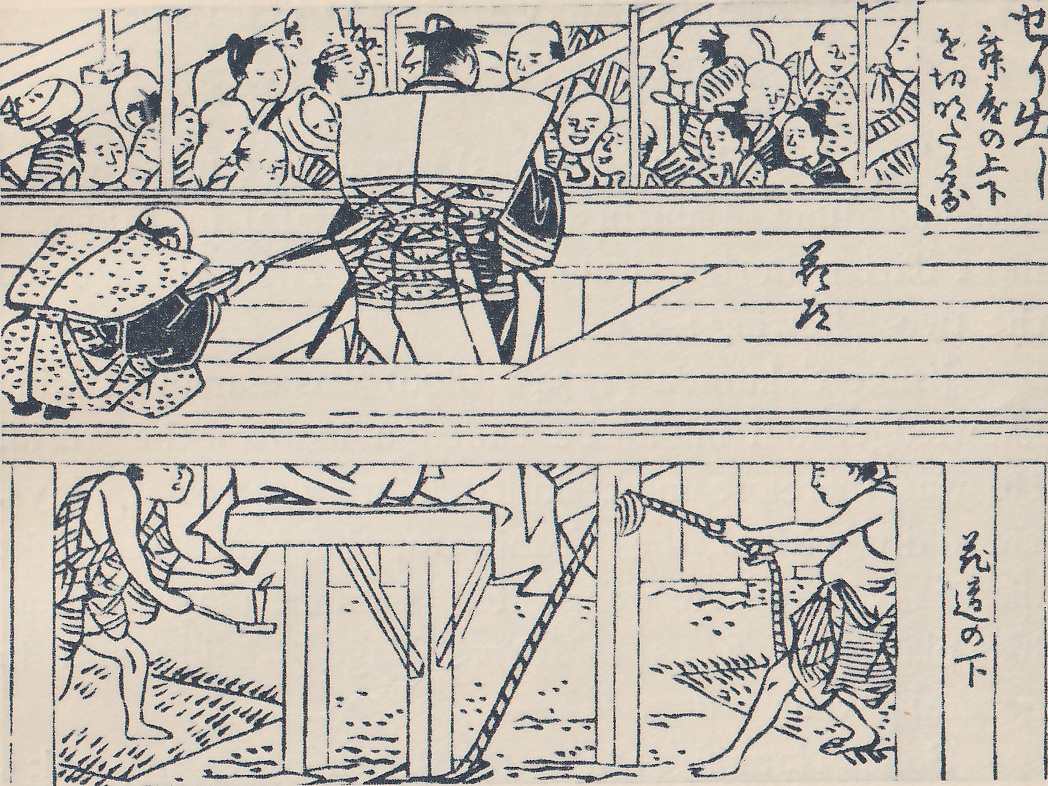
The theatre, too, came to be a fine two-storied building, with such devices as trap-door entrances and exits, and the revolving stage. The revolving stage was the invention of Shōzō Namiki, a well-known dramatist of Osaka. His revolving stage must be regarded as a signal triumph, a unique advance in the dramatic history of the world. In the West the revolving stage was not invented for another hundred years.
REPRESENTATIVE DRAMATISTS OF THIS AGE
Shōzō Namiki (1630–1693) was most famous for his wit, and Jihei Tsuuchi (Dates uncertain) in Edo was most daring in his dramatic style. After them came the two following:—
Jisuke Sakurada (1734—1806) was a man of wide knowledge, and might be called a man of the world. He was therefore most skilled in writing social plays. He daily visited the Yoshiwara, the famed red light district of Edo. He was skilled in dance play creation, his play known as “Modori Kago” being still in general favour today.
Gohei Namiki (1747—1808) was born in Osaka, where he achieved much popularity. He later moved to Edo. Here he won great success, writing more than thirty dramas, among which were Godairiki and Ume-no-Yoshibei. He employed many “extras” upon the stage. He also strove to produce a certain dramatic effect by the unusual method of introducing a living horse upon the stage. At one time the horse is said to have become frightened at the applause of the audience, and to have got out of control. After much difficulty it was finally mastered by government officers.
FAMOUS ACTORS OF THIS AGE
Kikunojō Segawa (1691—1749). This age was famed for its many famous actors and dancers, but
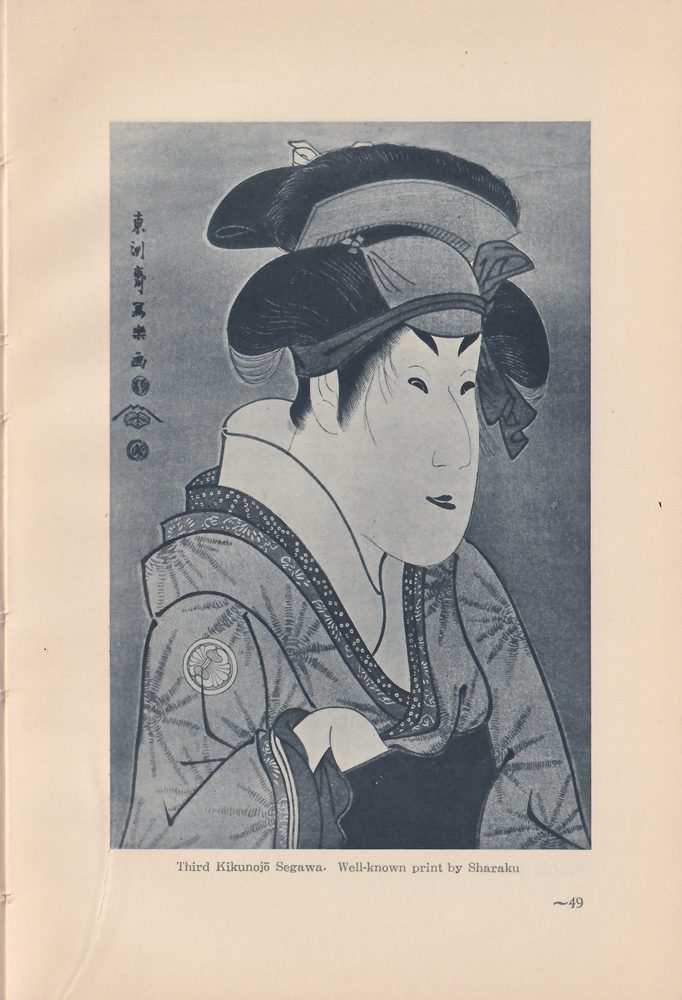
Segawa was the most brilliant of them all. His famous “Dōjōji Temple” and other dances have come down to our time. He thus laid the foundation of the dance, in the spirit of Kabuki. He was also skilful in impersonating female characters. Even at the age of sixty he could successfully impersonate a girl of fifteen or sixteen, to the amazement of his admirers. On his death-bed he took on the facial features of a woman, and thus his great career closed.
The First Sōjūrō Sawamura (?—1756) was able to give a wide variety of impersonations, the only exception being that of a young girl. The actions of the puppets in their dances are said to be in imitation of Sawamura.
In addition to these two we may mention as representatives of the earlier half of this period the Second Danjūrō Ichikawa, famous for his long-drawn-out parts and poses, and Tomijūrō Nakamura, the son of Ayame Yoshizawa, noted for his female impersonations.
The First Nakazō Nakamura (1736—1790), a man of fine physique, was skilled in the historical drama, and created a more beautiful style of stage performance. The results of his efforts toward greater dramatic beauty are to be seen today in varied stage types. (See Note 1) He was also a talented dancer, contributing much to the development of the dance drama.
Hinasuke Arashi (1741—1796) was famed in Osaka and Kyoto for his impersonation of the villain. He was specially skilled in acting the part of some famous historical villain. He was also the creator of some ironic parts.
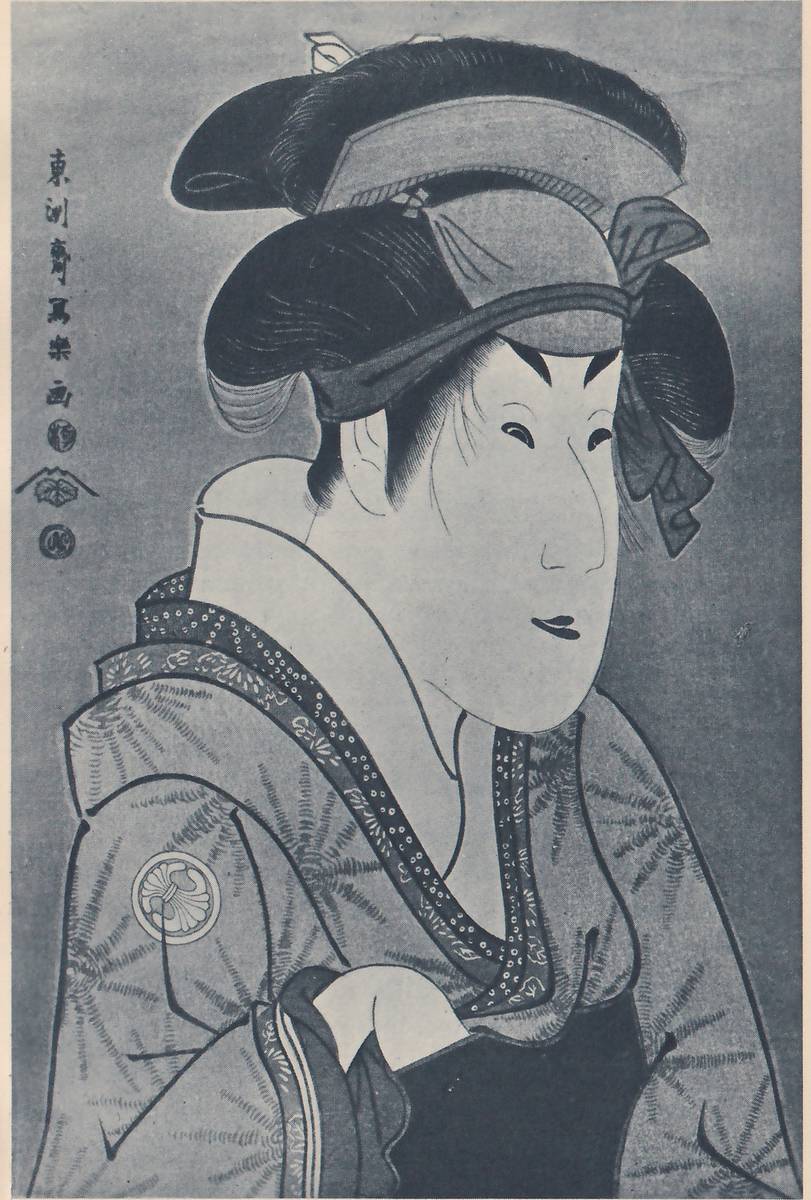
In addition to the above, to whom further reference must be sought in other publications, mention should be made of the Fifth Danjūrō Ichikawa, (See Note 2) Utaemon Nakamura, Tamejūrō Asao, the Fourth Hanshirō Iwai (in female parts), the Third Kikunojō Segawa (also in female parts). (See Note 3)
Note 1. By type we refer to certain dramatic interpretations, and the drama based upon that type.
Note 2. Although space does not permit us to do justice to the above, we feel it necessary here to add at least a few words of explanation regarding the names given to some of these famous actors, and especially of the use of the numerals in designating men of the same name. Certain actors have made a great name for themselves, and there has been an effort to preserve that name in some worthy successor. The successor would preferably be found in his son, but if no son is found worthy to bear the father’s illustrious name, some other actor, who proves worthy, is selected to succeed to the name.
Thus the name is preserved in succession from one generation to another, either by birth or by adoption. This is quite different from the common custom of transferring one’s name and fortune to the next of kin, regardless of his ability. The one who succeeds to the great name of a famous and talented actor must not only give promise of perpetuating the style of his illustrious predecessor, but he must make still further development in the fine art of representation.
Note 3. In this same series there will appear in the near future a more detailed study of the Kabuki Drama.