
III. DEVELOPMENT OF THE KABUKI DRAMA
CHARACTERISTICS OF THE KABUKI DRAMA
The stage plan of the Kabuki Drama has two elements that are peculiar to it. These are the stage approach and the revolving stage. The approach to the stage is through the audience, and is called the “Hana-michi.” This was originally adopted from the Bridge (Hashi-gakari), used as a part of the stage in the Noh Play. This is in reality an extension of the stage, and the scope of the acting is thereby increased and a number of other useful purposes served. If the stage is a house, this approach forms the verandah; if a town, it is a street; if a mountain, a road. Thus it becomes a real part of the stage setting. One important result is
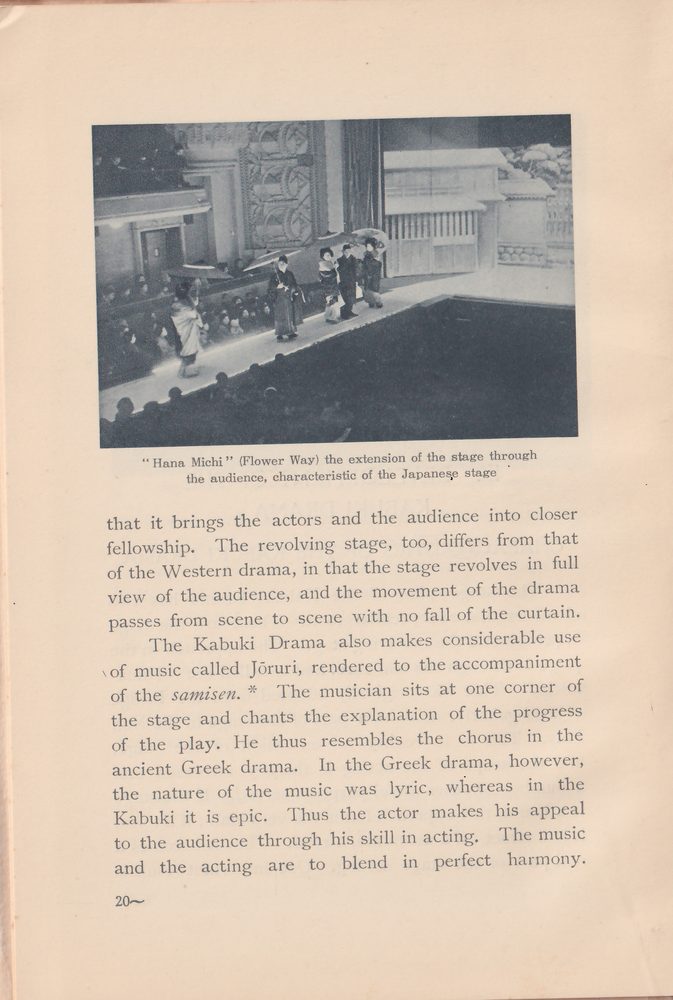
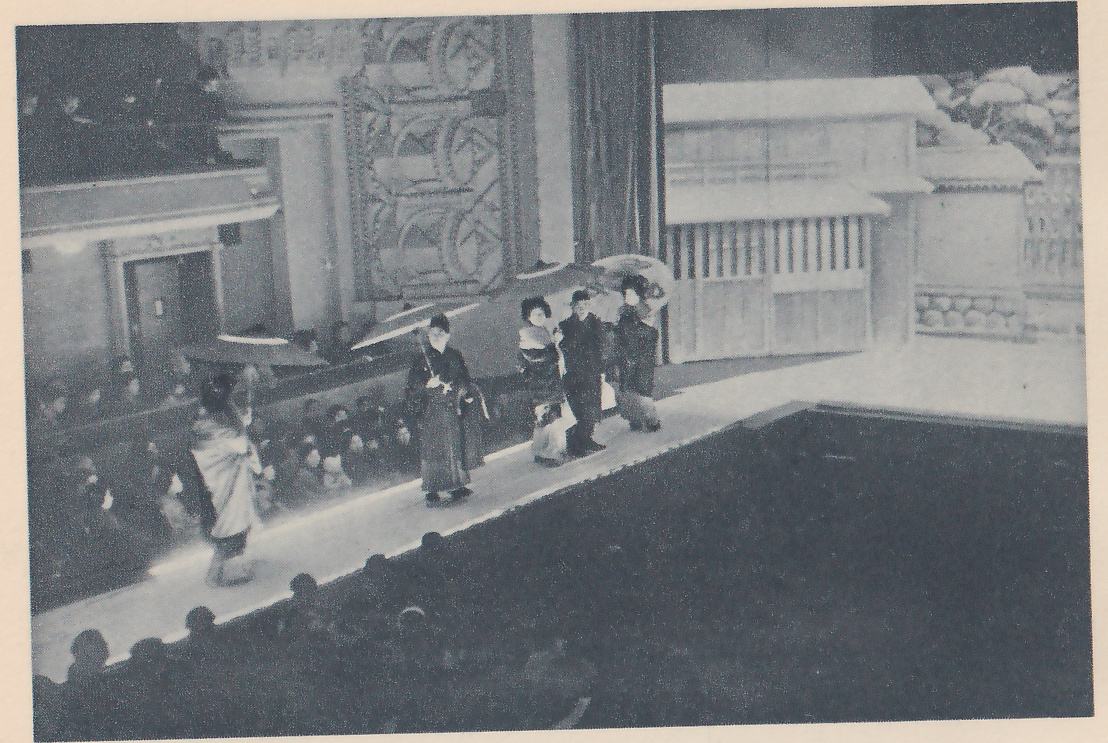
that it brings the actors and the audience into closer fellowship. The revolving stage, too, differs from that of the Western drama, in that the stage revolves in full view of the audience, and the movement of the drama passes from scene to scene with no fall of the curtain.
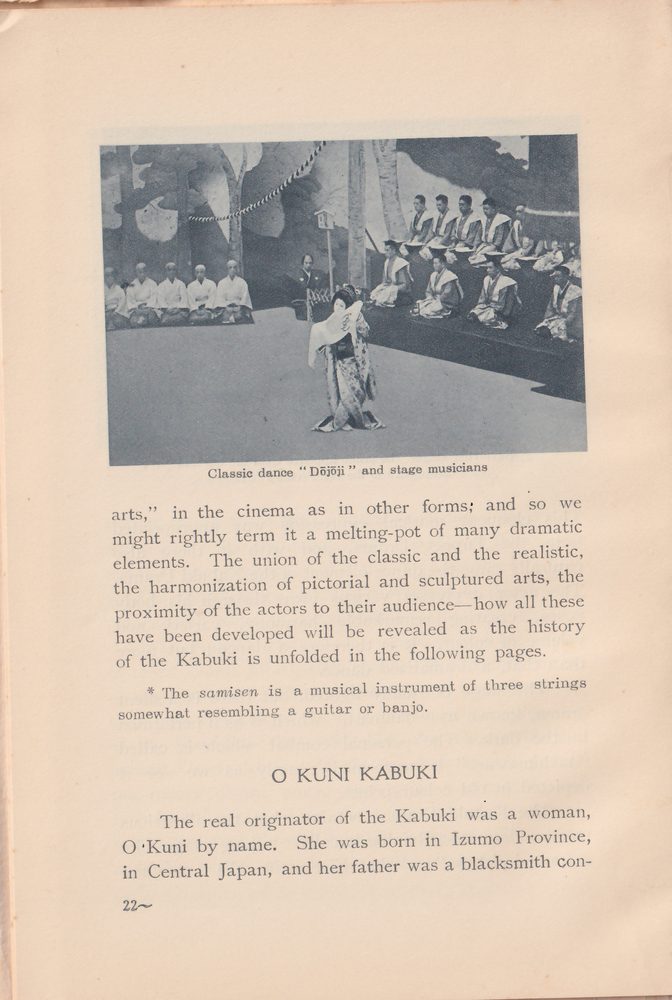
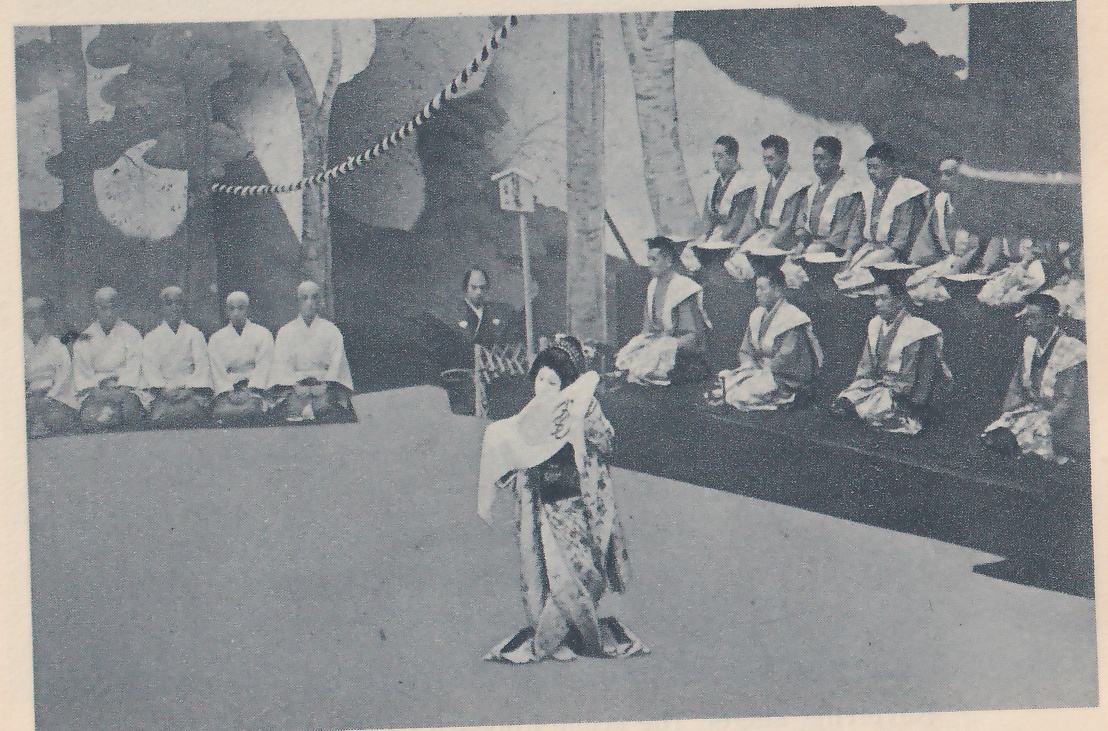
The Kabuki Drama also makes considerable use of music called Jōruri, rendered to the accompaniment of the samisen.* The musician sits at one corner of the stage and chants the explanation of the progress of the play. He thus resembles the chorus in the ancient Greek drama. In the Greek drama, however, the nature of the music was lyric, whereas in the Kabuki it is epic. Thus the actor makes his appeal to the audience through his skill in acting. The music and the acting are to blend in perfect harmony.
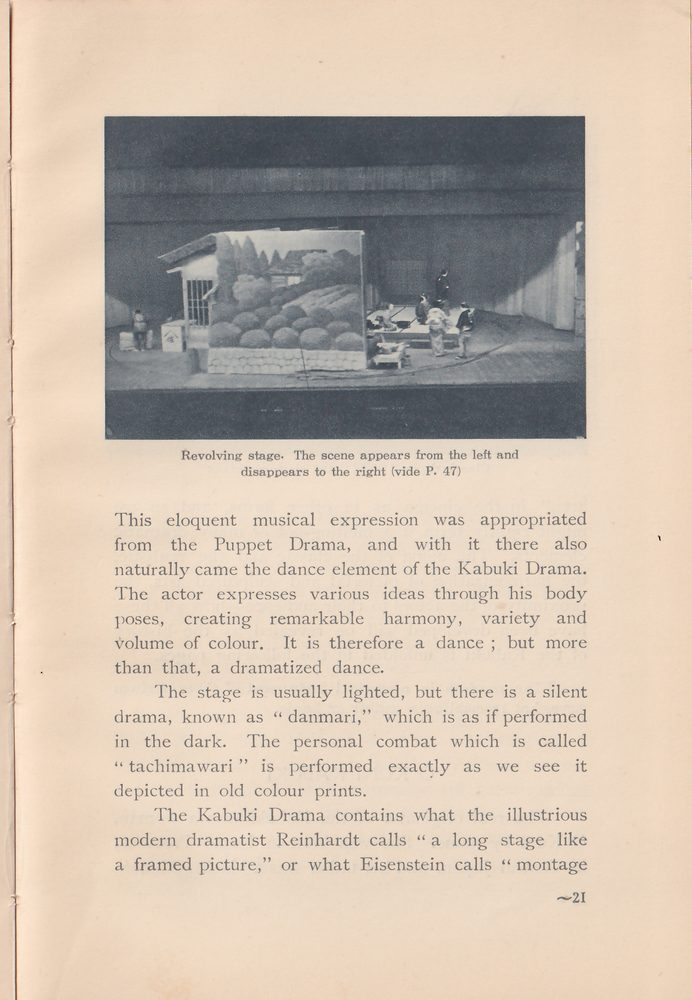
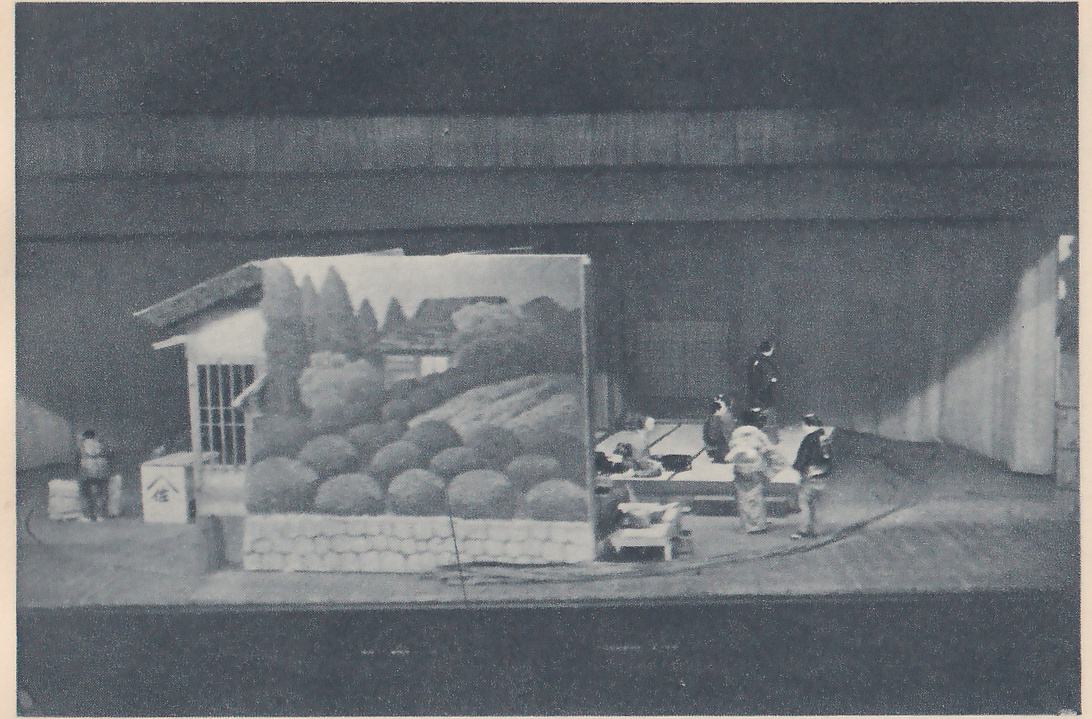
This eloquent musical expression was appropriated from the Puppet Drama, and with it there also naturally came the dance element of the Kabuki Drama. The actor expresses various ideas through his body poses, creating remarkable harmony, variety and volume of colour. It is therefore a dance; but more than that, a dramatized dance.
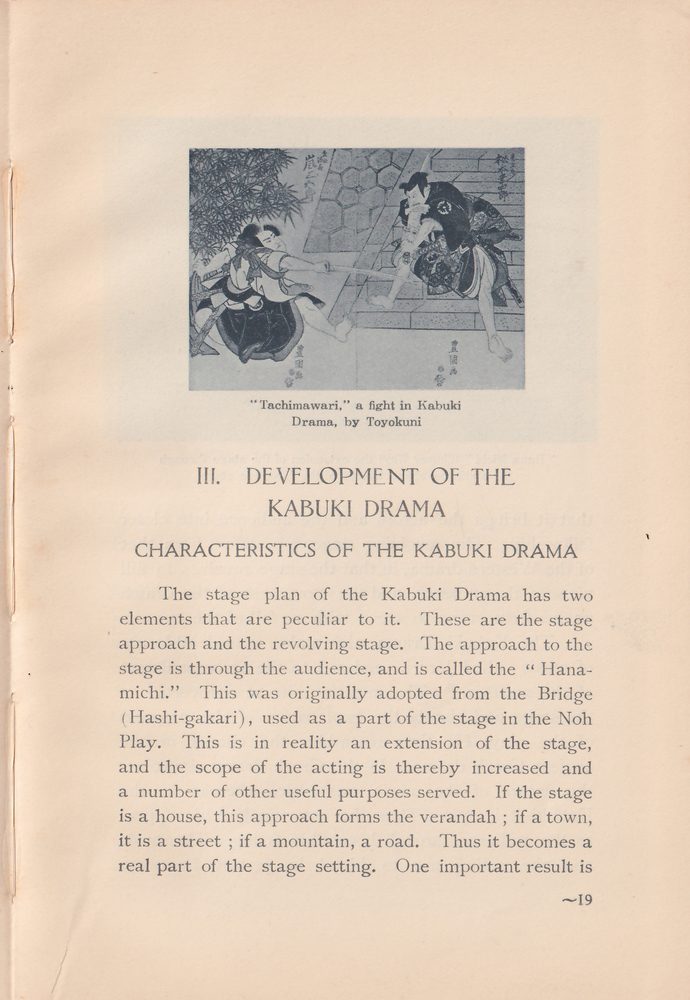
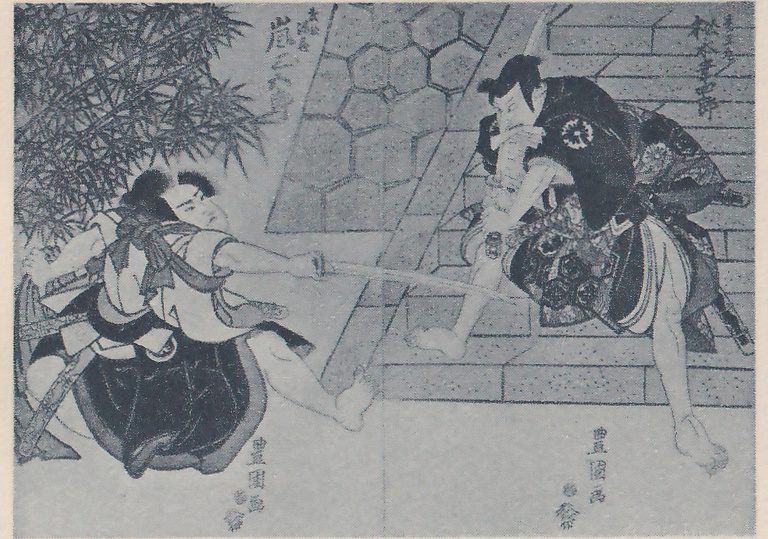
The stage is usually lighted, but there is a silent drama, known as “danmari,” which is as if performed in the dark. The personal combat which is called “tachimawari” is performed exactly as we see it depicted in old colour prints.
The Kabuki Drama contains what the illustrious modern dramatist Reinhardt calls “a long stage like a framed picture,” or what Eisenstein calls “montage
arts,” in the cinema as in other forms; and so we might rightly term it a melting-pot of many dramatic elements. The union of the classic and the realistic, the harmonization of pictorial and sculptured arts, the proximity of the actors to their audience—how all these have been developed will be revealed as the history of the Kabuki is unfolded in the following pages.
* The samisen is a musical instrument of three strings somewhat resembling a guitar or banjo.
O KUNI KABUKI
The real originator of the Kabuki was a woman, O Kuni by name. She was born in Izumo Province, in Central Japan, and her father was a blacksmith con-
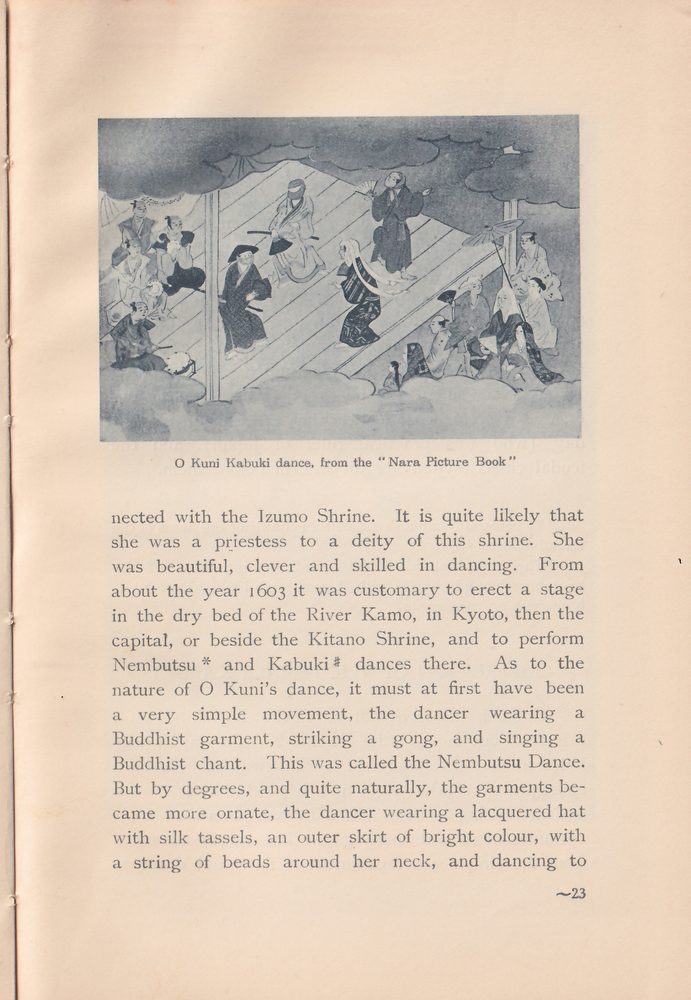
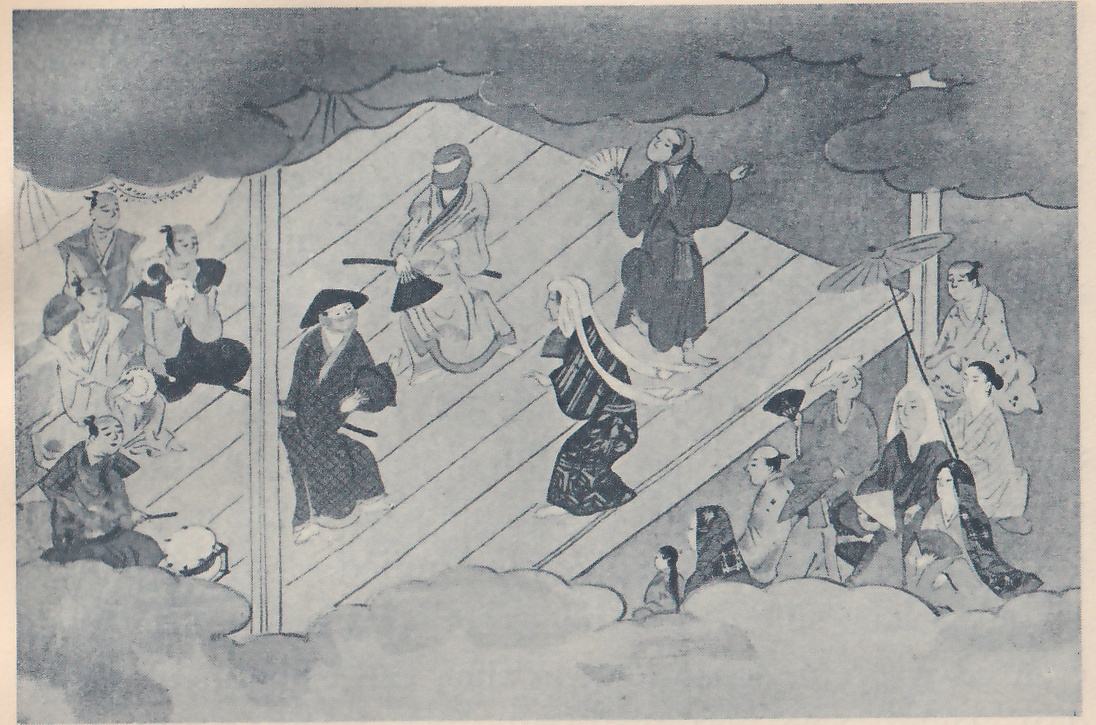
nected with the Izumo Shrine. It is quite likely that she was a priestess to a deity of this shrine. She was beautiful, clever and skilled in dancing. From about the year 1603 it was customary to erect a stage in the dry bed of the River Kamo, in Kyoto, then the capital, or beside the Kitano Shrine, and to perform Nembutsu* and Kabuki# dances there. As to the nature of O Kuni’s dance, it must at first have been a very simple movement, the dancer wearing a Buddhist garment, striking a gong, and singing a Buddhist chant. This was called the Nembutsu Dance. But by degrees, and quite naturally, the garments became more ornate, the dancer wearing a lacquered hat with silk tassels, an outer skirt of bright colour, with a string of beads around her neck, and dancing to
the accompaniment of flute and drum.
Equally famous was Sanzaburō Nagoya, O Kuni’s husband. He had been a rōnin, or wandering knight, leading a dissolute life, when he became attracted to O Kuni. He was himself possessed of much dramatic ability, and assisted O Kuni to develop her talents to the highest degree.
O Kuni also played the part of a man, with a sword in her belt, in company with professional actresses. This was the beginning of modern drama, to which the name Kabuki was applied. This O Kuni Kabuki was suited to the taste of the times, and created a great sensation, so that the Shōgun of that day (who was practical ruler of Japan), and the feudal chiefs invited her to perform before them.
* To perform Nembutsu consists in chanting the name of the Buddha.
# The term Kabuki is colloquial for something off the beaten path, and carries with it some such ideas as unusual, humorous or passionate.
SUPPRESSION OF THE FEMALE KABUKI
O Kuni, the originator of the Kabuki, was a priestess, but most of the Female Kabuki players who followed her were courtesans. This was but a natural consequence of that age, and beyond doubt, it had a demoralizing effect. The dancers came to wear costumes more and more gay. The music advanced from the simple accompaniment of flute and drum to
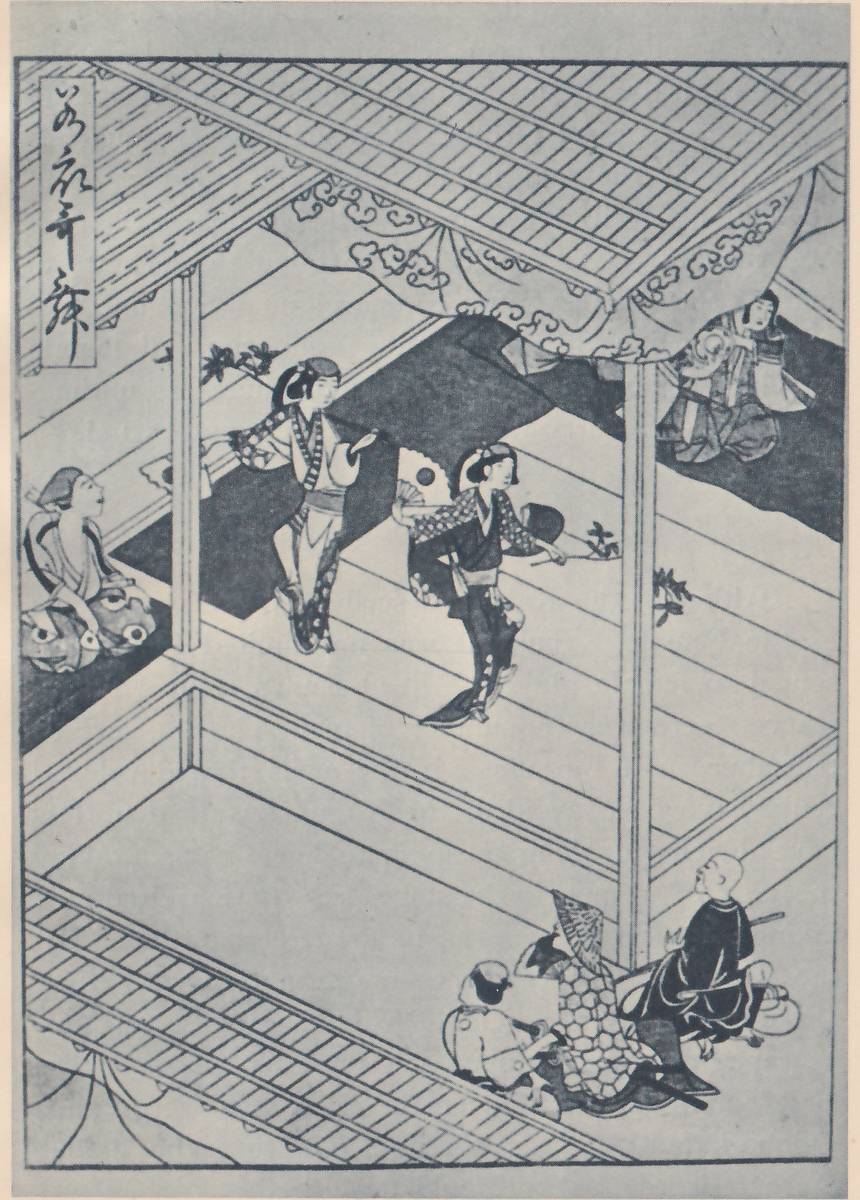
that of samisen as well. The stories, too, became more involved, and the performances more intensely dramatic. As a natural consequence many people were led astray by these actresses; fortunes were squandered; quarrels ensued, and the evil influences of the stage came to be quite generally recognized. The Tokugawa Shogunate, then in power, could not be blind to this state of affairs, and in June, 1629, the reigning Shōgun, Iyemitsu, issued a decree strictly prohibiting all female dancing. Thus, the Female Kabuki came to an untimely end, within thirty years of its creation by O Kuni.
PROHIBITION OF FEMALE PLAYERS
Although the Kabuki described above was known as the Female Kabuki, it was not limited in its personnel to female players. In O Kuni’s troupe, for instance, there were a number of male players, such as Sanzaburō and Densuke. If the evils that developed could have been avoided, the Kabuki would doubtless have developed along these same lines, women taking the part of women in the stage presentations, and men taking the part of men, as in the foreign drama. But the Tokugawa government, in its anti-female edict, forbade not only the Female Kabuki but also any appearance of actresses upon the stage as actors. Thus male actors played the female rôles, and were called “Onna-kata.” It was through this that the unique characteristics of the Kabuki developed.
Thus, during the ensuing centuries, no actress appeared upon the stage in Japan. It is only quite
recently that this custom has been changed, along with other imitations of Western styles.
To be strictly accurate, it must be admitted that actresses did sometimes appear, but in such cases no male actors were permitted, the male characters being impersonated by females. There was thus complete sex segregation on the public stage, by governmental decree. The few female troupes were among the lower classes, and made little or no contribution to the history of the drama.
YOUTH (WAKASHU) KABUKI
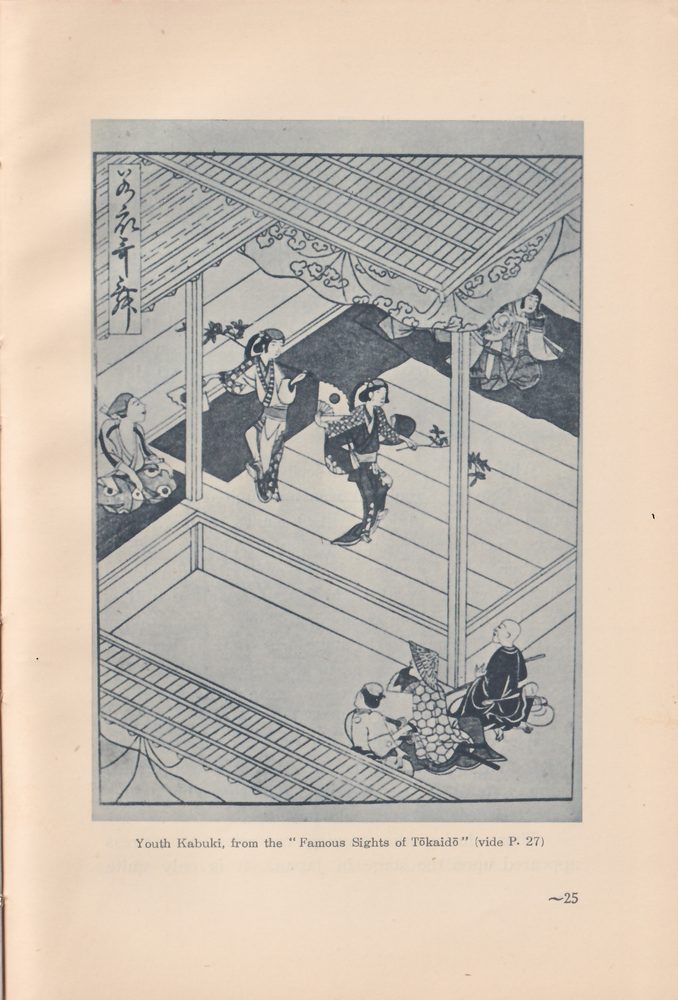
The Kabuki of young men came to take the place of the Female Kabuki. This Youth Kabuki, in its
evolution, became the Kabuki of today. Thus, if the Female Kabuki is called the parent of modern drama, the Youth Kabuki must be called its foster parent.
The Youth Kabuki had its origin even while the Female Kabuki was at its height. It was in 1617 that a man called Dansuke began to perform in Kyoto. As the Female Kabuki sought out the most beautiful women, and by their personal attractiveness tried to draw great audiences, so this emerging Youth Kabuki sought out handsome youths with which to attract their patrons. But, as had been the case with the Female Kabuki, only a short time before this, the Youth Kabuki became exceedingly demoralizing in its effects. Eventually the government of that day felt that it could be condoned no longer, and in June, 1652, issued a decree suppressing the Youth Kabuki also.
The suppression decree, just mentioned, was aimed at the elimination of the moral dangers occasioned by the participation of so many handsome young men in the dramatic presentations. As these were now forbidden to appear, and as there was a strict control in the matter of stage morality, the Kabuki Drama underwent a severe trial at this time.
The authorities treated it like a naughty step-child, kept watch over it as if it were criminal, and made it the object of petty as well as of major persecutions. Because of this the history of the stage throughout the Edo Period (1603–1868)—that of the Tokugawa Shogunate—is a fairly continuous record of hardships. Had it not possessed the affections of the common people, it might very well have disappeared along the way.
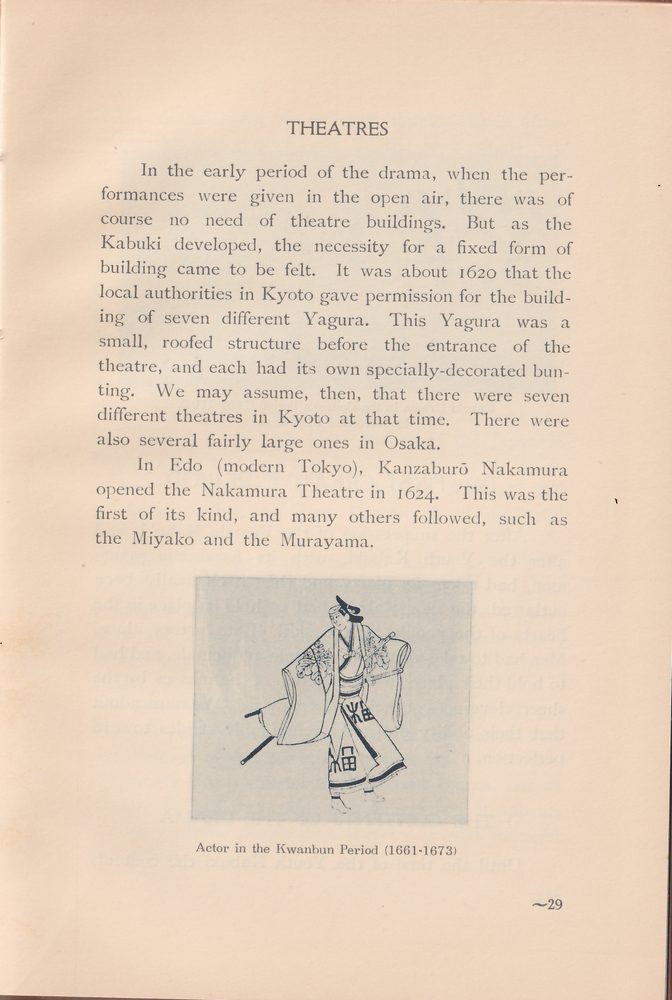
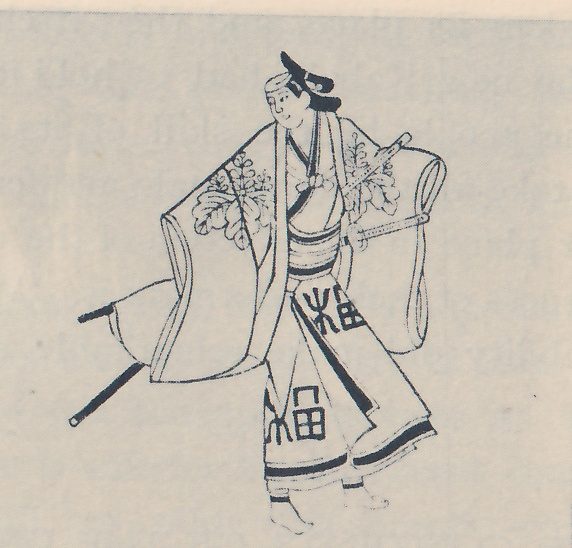
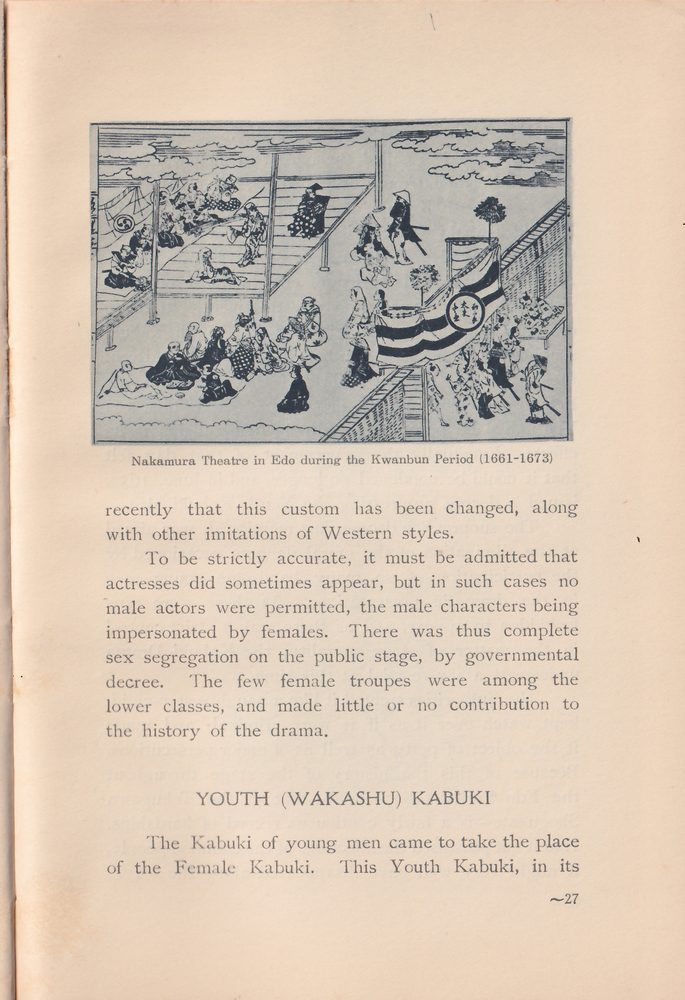
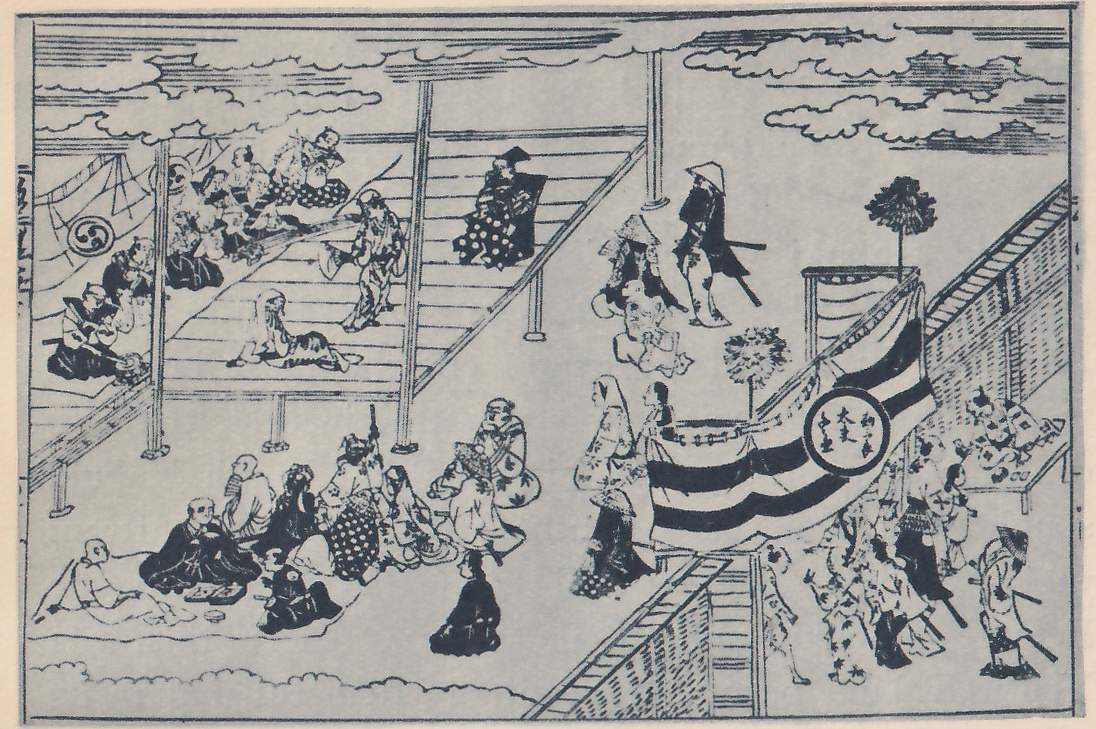
In the early period of the drama, when the performances were given in the open air, there was of course no need of theatre buildings. But as the Kabuki developed, the necessity for a fixed form of building came to be felt. It was about 1620 that the local authorities in Kyoto gave permission for the building of seven different Yagura. This Yagura was a small, roofed structure before the entrance of the theatre, and each had its own specially-decorated bunting. We may assume, then, that there were seven different theatres in Kyoto at that time. There were also several fairly large ones in Osaka.
In Edo (modern Tokyo), Kanzaburō Nakamura opened the Nakamura Theatre in 1624. This was the first of its kind, and many others followed, such as the Miyako and the Murayama.