X. NEW MOVEMENTS IN THE JAPANESE DRAMA
The Kabuki had as its background the life and thought of the Edo Period. But that period had receded never to return. Its life, customs, manners, events, and ideas had all been the materials of the Kabuki Drama. Now all that was changed. It was but natural that people in general, who were eagerly seeking new paths in response to the directions of the government of the time, should have regarded the Kabuki as an anachronism and should have demanded a drama that would portray the actual life and spirit of the age in which they were living.
THE RISE OF A NEW SCHOOL OF DRAMA
The pioneer of the drama of this period was Teiken Sudō (1866—1909), a young member of the Liberal Party who produced a political drama in 1888. In 1891 another of the same Party, Otojirō Kawakami (1864—1911) also began to produce the same kind of drama. From the dramatic standpoint these were rather crude efforts. They gradually lost political complexion and took on more of a melodramatic character. Kawakami may be called the founder of the new school. Later on, his wife, Sadayakko, well known in both Europe and America, staged performances in Paris and other European cities. The plays of Shakespeare also were produced by them. In 1903 and 1904 the Ninth Danjūrō and other
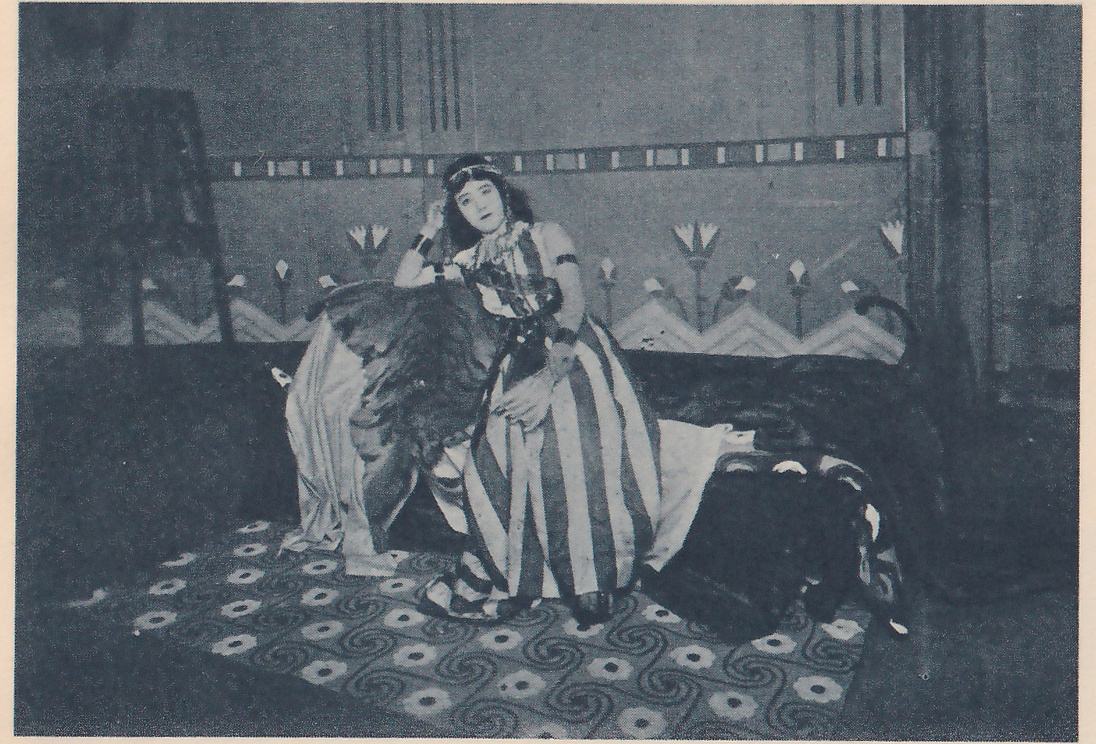
famous actors passed away. Their going opened the way for this new school to gain wide popularity, with such leaders as Minoru Takata (1872—1916) and Yōhō Ii (1871—1932).
THE TRAINING OF ACTRESSES
Since, from the time of the origin of the Kabuki as we know it, the appearance of actresses was strictly forbidden, there were almost none on the stage, even down to the year 1900, although the ordinance against their performing had long been obsolete. As previously explained, the female parts of the Kabuki Drama had been assumed by men. These actors, who affected the female style in their ordinary daily life, frequently even dressed, spoke and acted like women, and even
developed a kind of female psychology. Finally, by the year 1907, the influence of foreign culture had so penetrated even the stage that there came to be a popular demand for female acting by women themselves; and through the efforts of Prince Saionji (the present Genrō or senior statesman) the two daughters of Danjūrō Ichikawa became actresses.
In November of the same year, Sadayakko, the wife of Otojirō Kawakami, opened a school for the training of actresses. This movement went steadily on with ever-increasing momentum, so that when the Imperial Theatre* was opened in 1911, it made provision for the training of actresses on a large scale. It has thereby come about that Ritsuko Mori, Kakuko Murata, and many others are generally recognized as skilled actresses.
* Since the increase in Tokyo’s new theatres the Imperial Theatre has become the capital’s leading cinema.
BEGINNINGS OF THE MODERN DRAMA
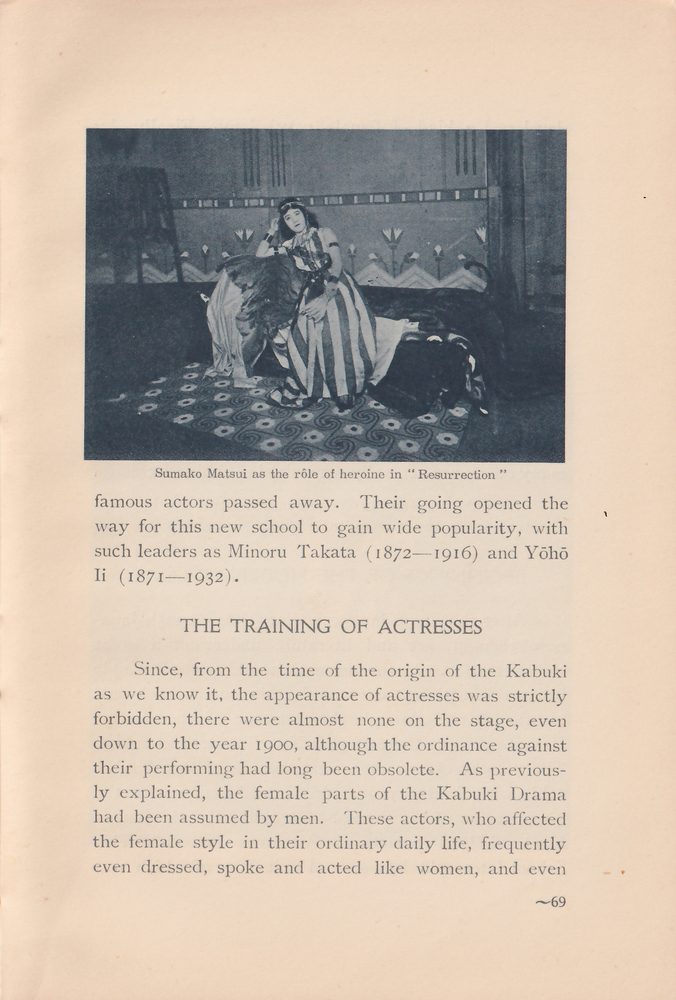
After the Russo-Japanese War (1904—1905), Japanese thought, art and literature underwent a great transformation. In the dramatic world as well people became dissatisfied even with this new school, just mentioned, and through the influence of the modern European drama there arose a New Theatre movement. The pioneer of this movement was Dr. Shōyō Tsubouchi, who, in the year 1906, formed a group for the investigation of the drama. He called this the Bungei Kyōkwai, i. e. “Society of Arts and Letters.” This School later split into several units, one of which was
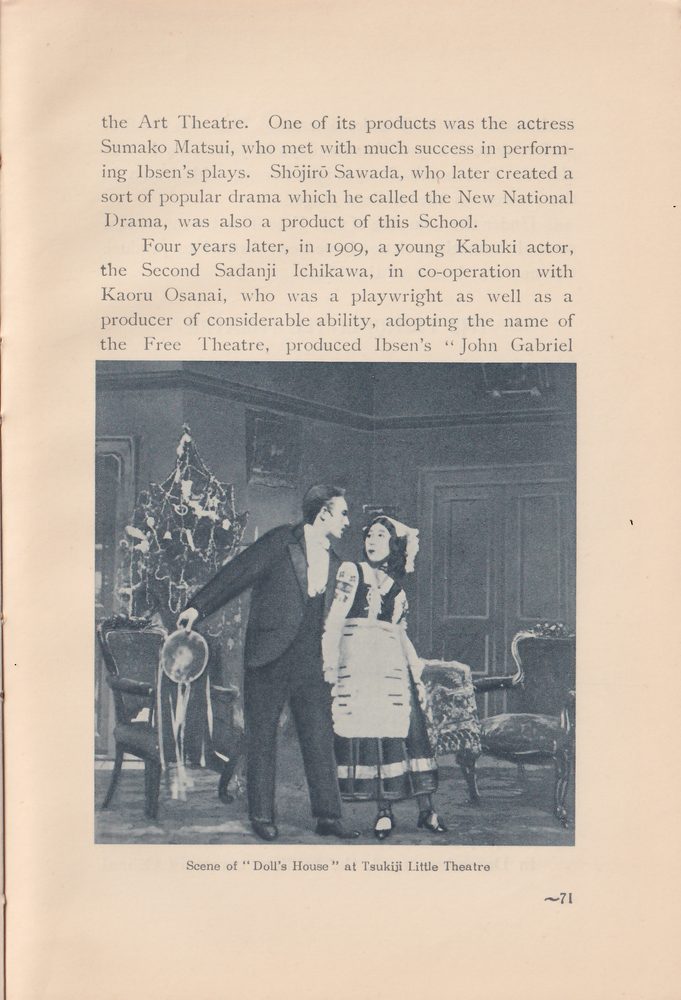
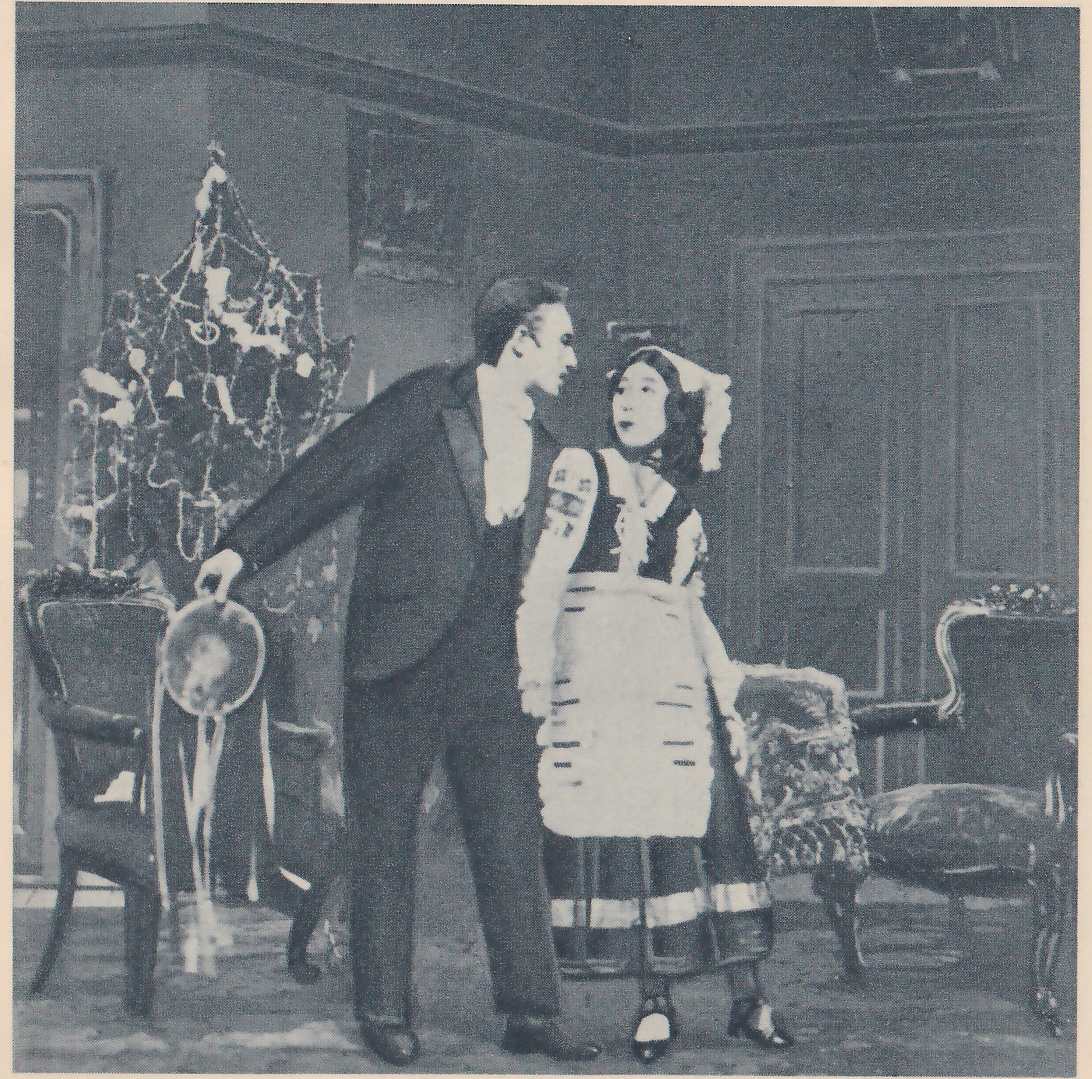
the Art Theatre. One of its products was the actress Sumako Matsui, who met with much success in performing Ibsen’s plays. Shōjirō Sawada, who later created a sort of popular drama which he called the New National Drama, was also a product of this School.
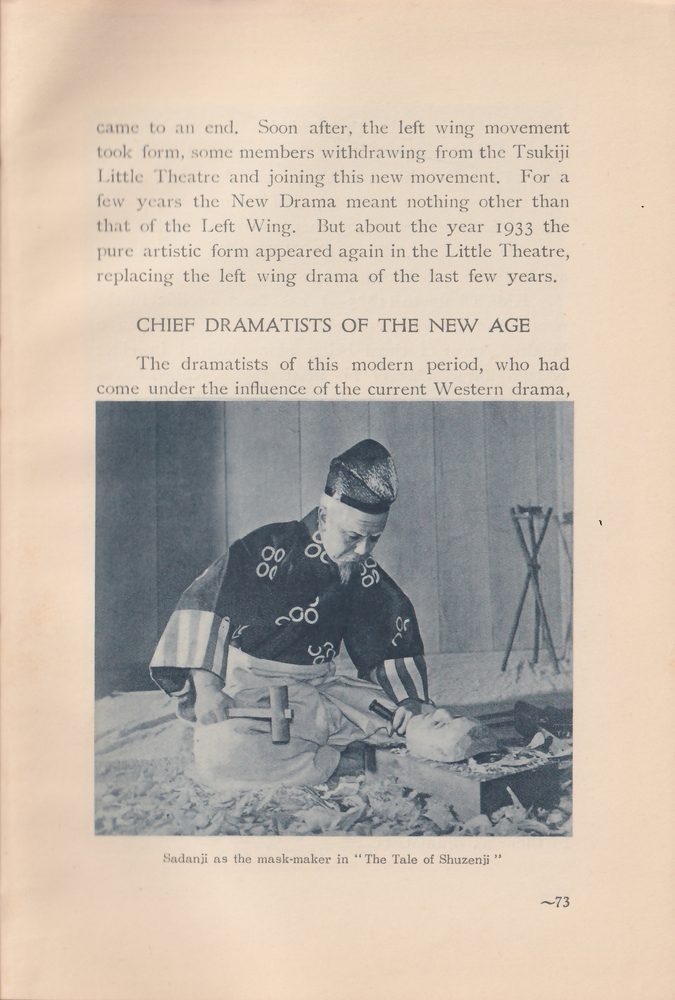
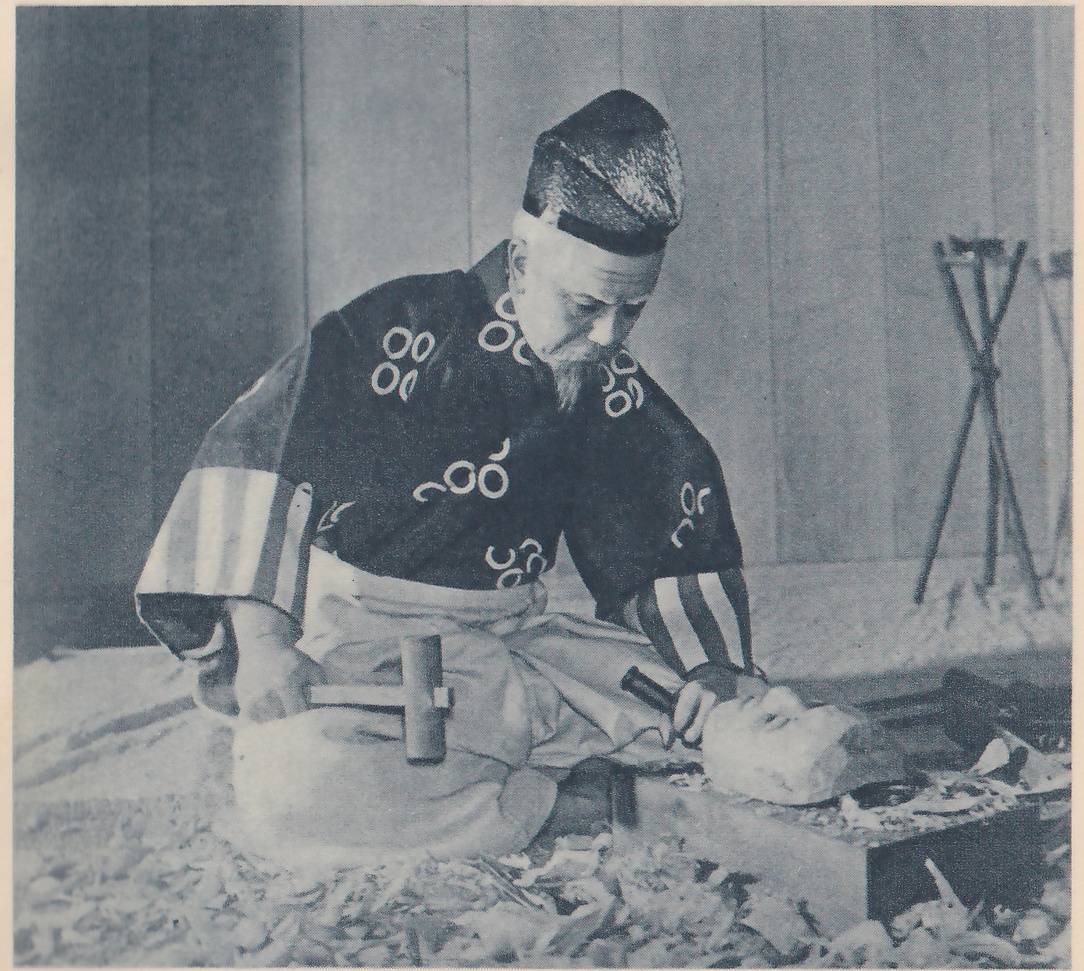
Four years later, in 1909, a young Kabuki actor, the Second Sadanji Ichikawa, in co-operation with Kaoru Osanai, who was a playwright as well as a producer of considerable ability, adopting the name of the Free Theatre, produced Ibsen’s “John Gabriel
Borkmann” at the Yūraku Theatre. This was the first performance of any of Ibsen’s plays in Japan, as it was also the first bomb thrown into her age-old drama in the interest of the modern stage.
Under the influence of this Free Theatre movement several dramatic societies have been formed to produce the modern drama of the West.
THE TSUKIJI LITTLE THEATRE
The situation was much changed after the great earthquake of September 1923, which destroyed to their very foundations all the large theatres of Tokyo, with their deep-rooted Kabuki traditions. Many of the younger actors and actresses were eager now to build new theatres that might be adapted to the new plays. The first realization of this desire was in the erection of the Tsukiji Little Theatre soon after the earthquake.
The Tsukiji Little Theatre was built primarily for the advancement of dramatic art, and with no consideration of profit, by the co-partnership of Osanai, leader in the Free Theatre movement. Their aim was to make practical use of any new knowledge that might appear in stage art, and to produce as many new plays as possible. According to their own statement it was to be “a laboratory of the drama.”
In June of 1924 the first production, Goehling’s “Seeschlacht” was given, and from that time on other plays, ranging from Ibsen to the most modern expressionists’ plays, were produced.
In December, 1928, the brilliant career of Osanai
came to an end. Soon after, the left wing movement took form, some members withdrawing from the Tsukiji Little Theatre and joining this new movement. For a few years the New Drama meant nothing other than that of the Left Wing. But about the year 1933 the pure artistic form appeared again in the Little Theatre, replacing the left wing drama of the last few years.
CHIEF DRAMATISTS OF THE NEW AGE
The dramatists of this modern period, who had come under the influence of the current Western drama,
and who felt it to be their mission to introduce this drama into Japan, were far from satisfied with any form of the Kabuki as it then existed. They would not try to reform that type of drama, but would introduce something altogether alien to it, both in contents and form. The chief dramatists of this new age may be noted as follows:—
Kidō Okamoto (1873—) has been prolific in the number of his plays. He has written more than a hundred, most of them being new material in older Kabuki form. One of his masterpieces, called “Yashaō,” was recently produced in Paris under the title, “Sculpteur de Masques.” It has also been translated into Russian. “Shinchō Ki,” the Life of Nobunaga, was long ago performed in Leningrad, Russia.
Kaoru Osanai (1881—1928) wrote “The First World,” “The Son,” “The Master,” etc., which were quite new in both form and contents.
Hiroshi Kikuchi (1889—) is perhaps the most popular present-day novelist in Japan, but has also written such plays as, “Better than Revenge,” “The Housetop Madman” and “The Father Returns.” His best works have been translated into English. It is of special note that he places more emphasis upon the theme of his play than anything else.
Beside these, Shōwō Matsui, Kichizō Nakamura, Junichirō Tanizaki, Saneatsu Mushanokōji, Yūzō Yamamoto, Mantarō Kubota, Seikwa Mayama, Hideo Nagata and Kunio Kishida are by no means inferior to them as dramatists.