
III. THEIR DIVISIONS AND FEATURES
WATER
I. Ponds
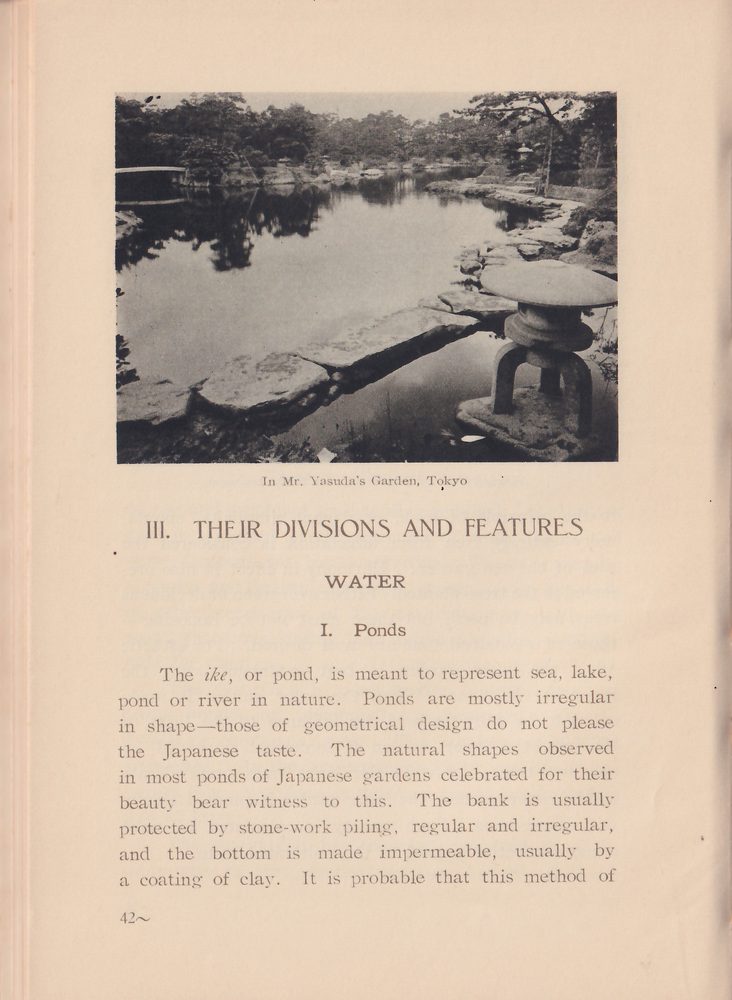
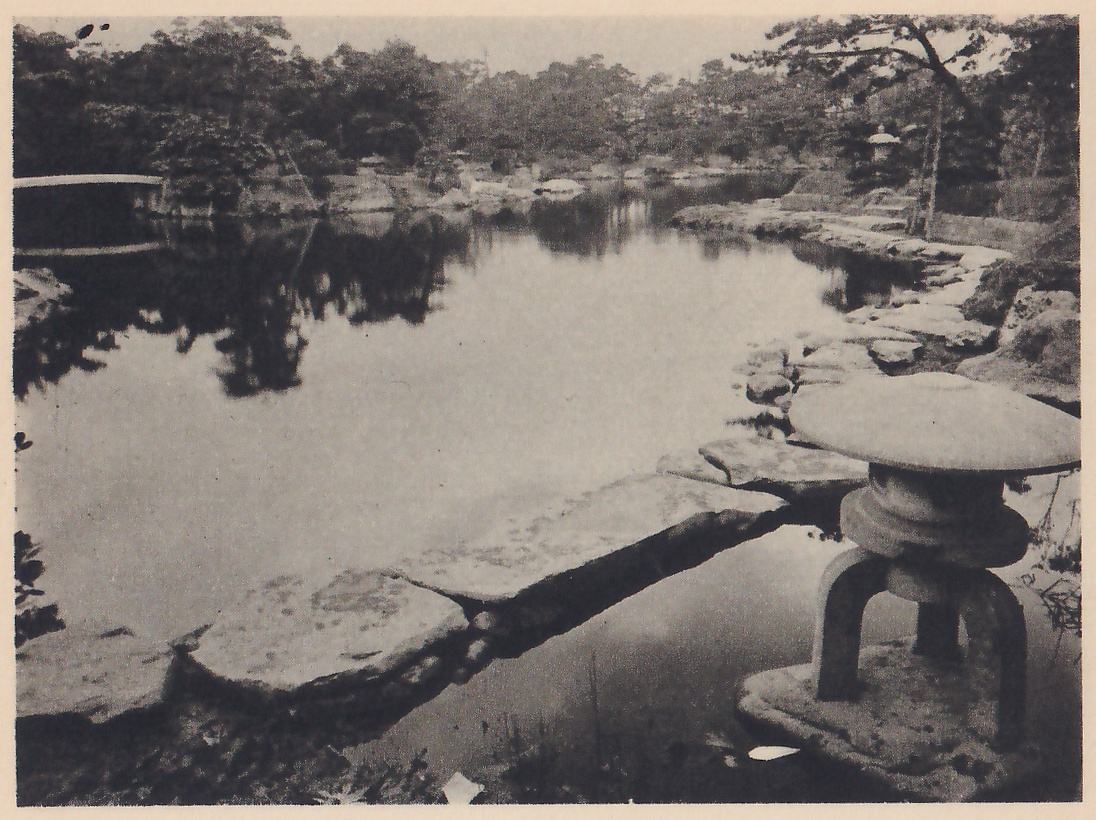
The ike, or pond, is meant to represent sea, lake, pond or river in nature. Ponds are mostly irregular in shape—those of geometrical design do not please the Japanese taste. The natural shapes observed in most ponds of Japanese gardens celebrated for their beauty bear witness to this. The bank is usually protected by stone-work piling, regular and irregular, and the bottom is made impermeable, usually by a coating of clay. It is probable that this method of
bottom construction had been in general use for ten centuries before it was superseded by the concrete method in the Meiji Era. In most cases the water of the pond is fed by either a waterfall or a stream, and if the garden happens to be near a large tidal river, water is conducted into the pond direct from the river. This has the technical advantage of affording variety to the garden view. The water level of the pond changes with the ebb and flow of the tide, which hides and reveals in turn the stones in the pond. Many examples of such garden ponds are to be seen today in Tokyo.
2. Yarimizu
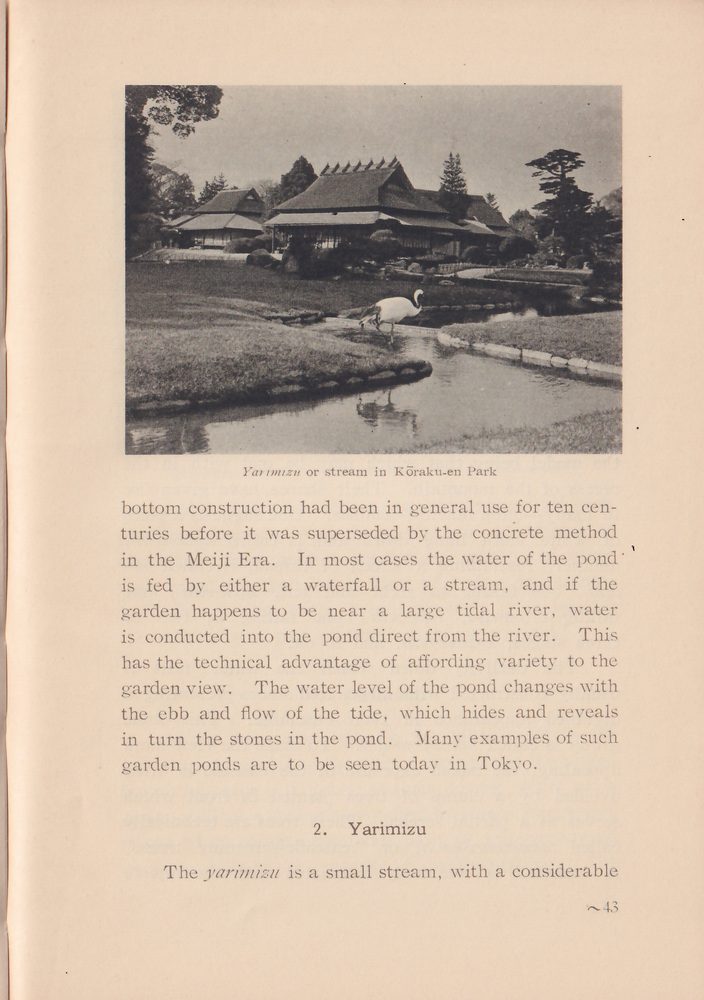
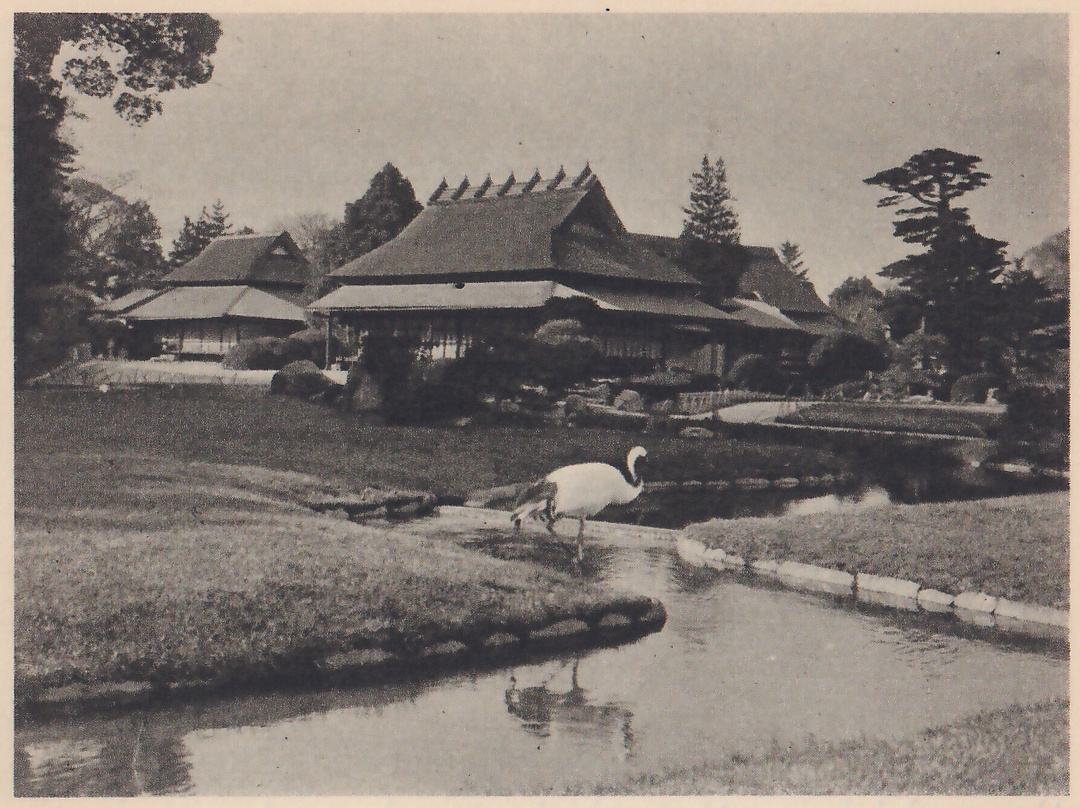
The yarimizu is a small stream, with a considerable
incline to facilitate the movement of water. In this also nature is studiously imitated. Natural stones border the banks, and the monotony of the running water is broken by fanciful stones standing in mid-stream. These stones are best to simulate a stream coursing down a valley. Streams are at times made as swift as a mountain torrent, and at others as slow as a river meandering across a plain, according to the fancy of the designer. Some streams are designed to flow into a pond; others are designed differently.
3. Waterfalls
Waterfalls are another attempt to imitate nature—the model being that which may be met with in the recess of the mountain. Their shapes have given rise to many—often fanciful—names. One suggests a piece of white cloth hung down and is called nuno-ochi; another, resembling a screen of thread, is called ito-ochi; one falling to right and left, sayū-ochi; one falling crosswise, yoko-ochi; one falling in two or three stages, kasane-ochi, and so on.
The declivity down which the water falls is usually constructed with large-sized stones presenting a dignified appearance in their ensemble. This stone group is called takizoe-no-ishi. To make the view more appealing, the naked exposure of the cascade is often avoided by a clump of trees planted in front which serves as a partial screen. These trees are technically called takisawari-no-ki, or “cascade-screening trees.” A waterfall is commonly associated with the remote
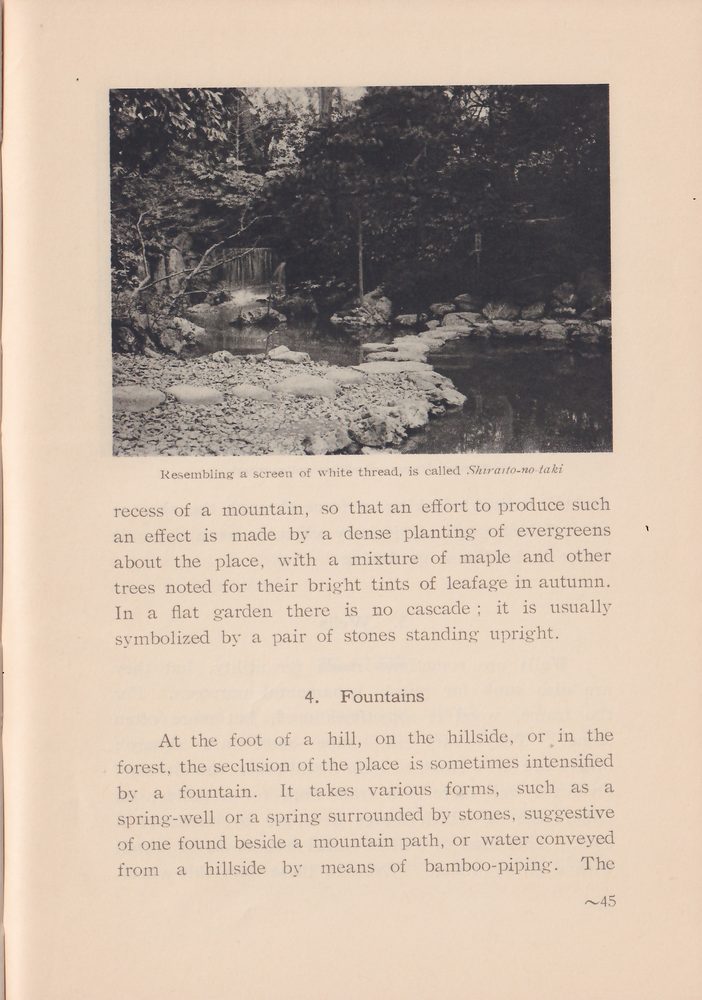
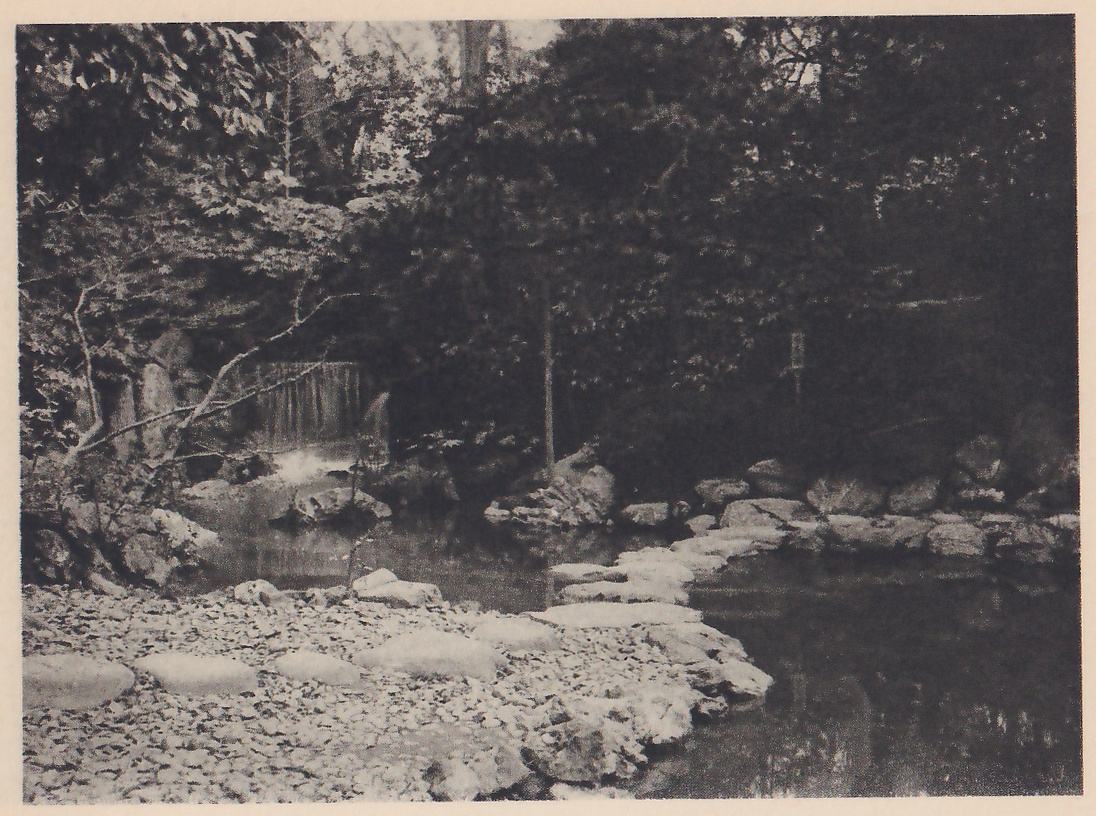
recess of a mountain, so that an effort to produce such an effect is made by a dense planting of evergreens about the place, with a mixture of maple and other trees noted for their bright tints of leafage in autumn. In a flat garden there is no cascade; it is usually symbolized by a pair of stones standing upright.
4. Fountains
At the foot of a hill, on the hillside, or in the forest, the seclusion of the place is sometimes intensified by a fountain. It takes various forms, such as a spring-well or a spring surrounded by stones, suggestive of one found beside a mountain path, or water conveyed from a hillside by means of bamboo-piping. The
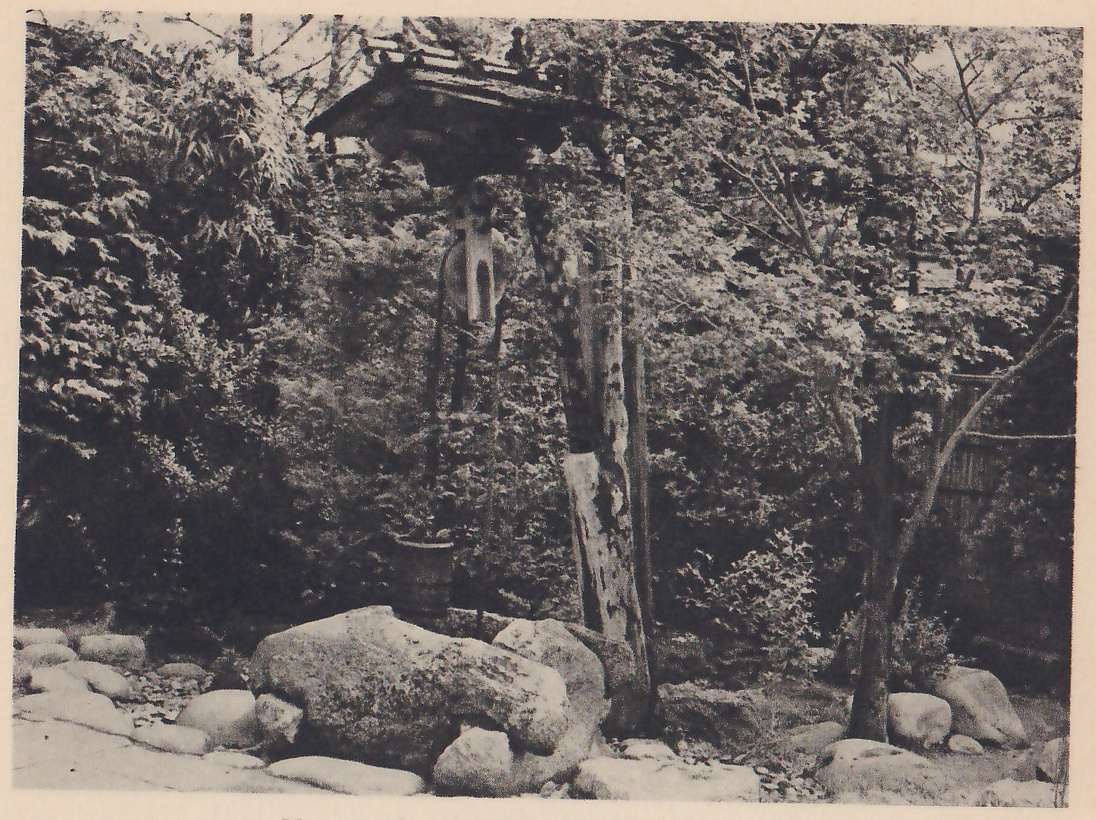
fountain, though lacking in force through the absence of sufficient pressure, is very valuable as a dynamic factor in landscape gardening.
5. Wells
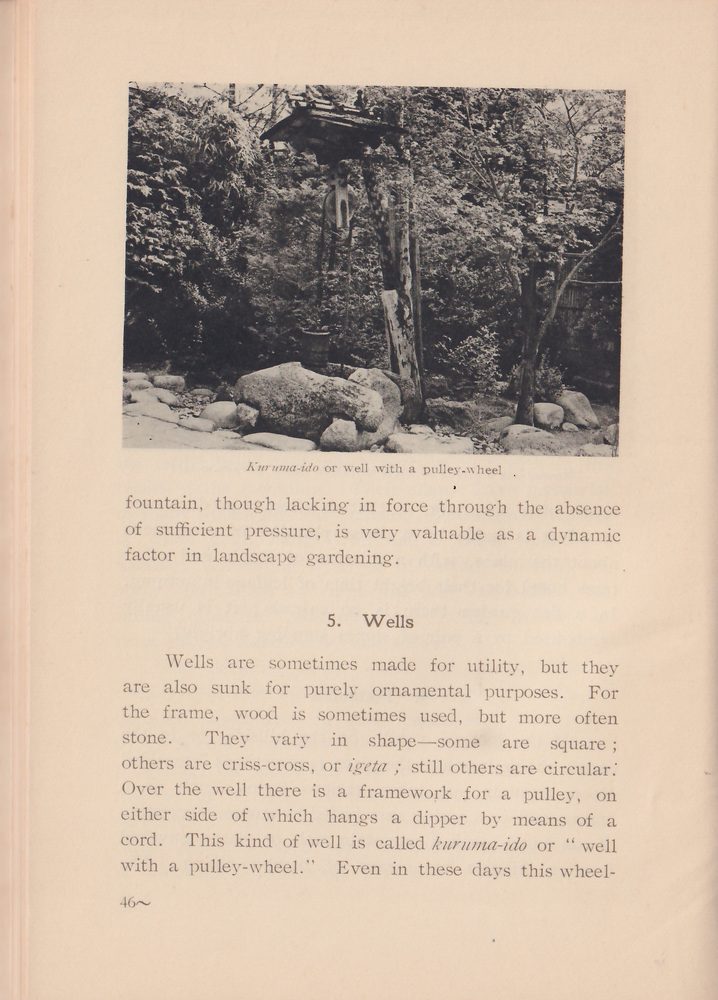
Wells are sometimes made for utility, but they are also sunk for purely ornamental purposes. For the frame, wood is sometimes used, but more often stone. They vary in shape—some are square; others are criss-cross, or igeta; still others are circular. Over the well there is a framework for a pulley, on either side of which hangs a dipper by means of a cord. This kind of well is called kuruma-ido or “well with a pulley-wheel.” Even in these days this wheel-
well is used as a decorative feature in garden design. As a garden-well is for ornament, the washing floor adjoining it is usually enclosed by a stone curb and filled with pebbles.
ISLANDS
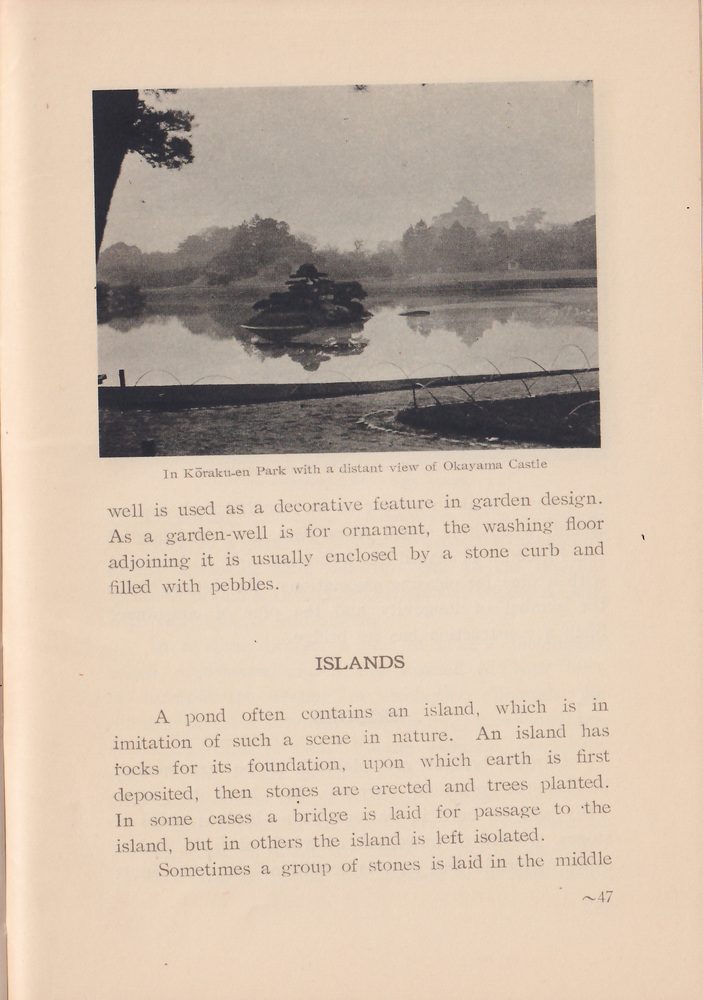
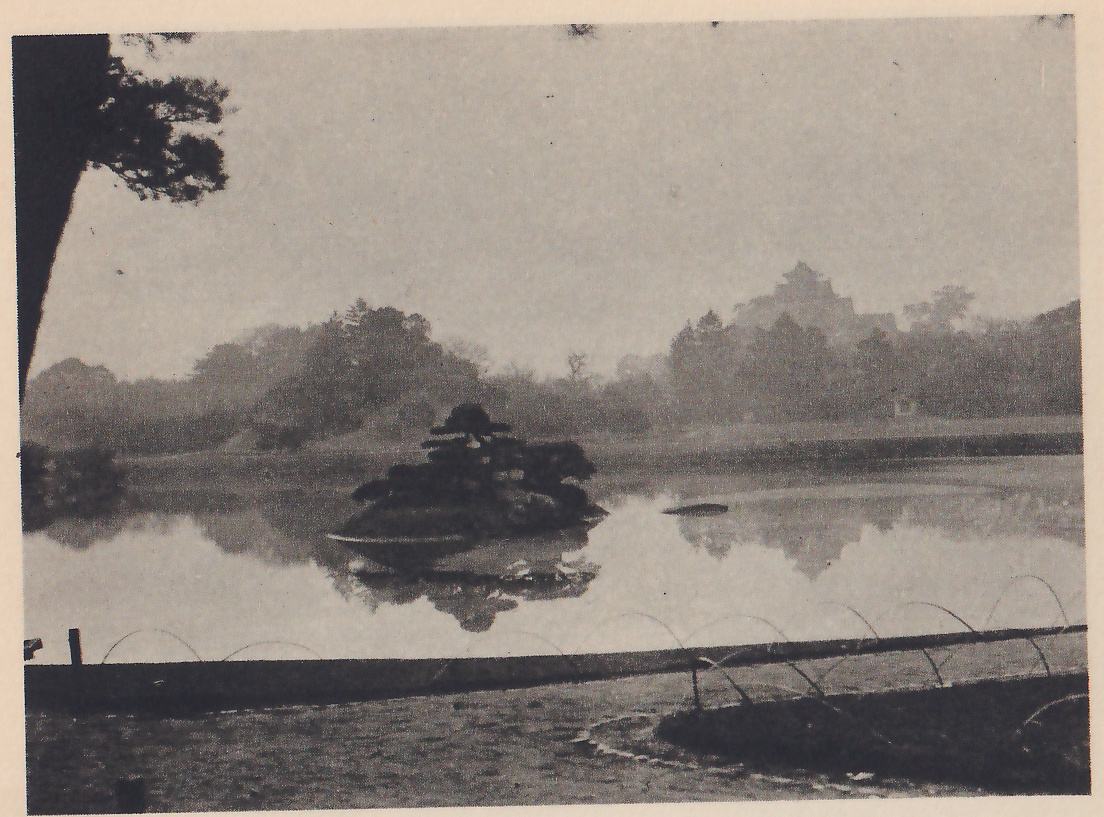
A pond often contains an island, which is in imitation of such a scene in nature. An island has rocks for its foundation, upon which earth is first deposited, then stones are erected and trees planted. In some cases a bridge is laid for passage to the island, but in others the island is left isolated.
Sometimes a group of stones is laid in the middle
of a pond so as to appear as an island. Such a stone island, when it is styled Hōrai-jima, or “the Island of the Blessed,” is shaped like a tortoise, and is decorated with a pine for pleasing associations—the tortoise being the symbol of longevity and the pine of constancy. Such a construction has no bridge.
BRIDGES
Garden bridges are planned to be ornamental, besides the practical purpose they have to serve. They may be built in various ways—bridges made of stones, worked or unworked, of wood, of earth, and of other materials, but on this condition, that they must
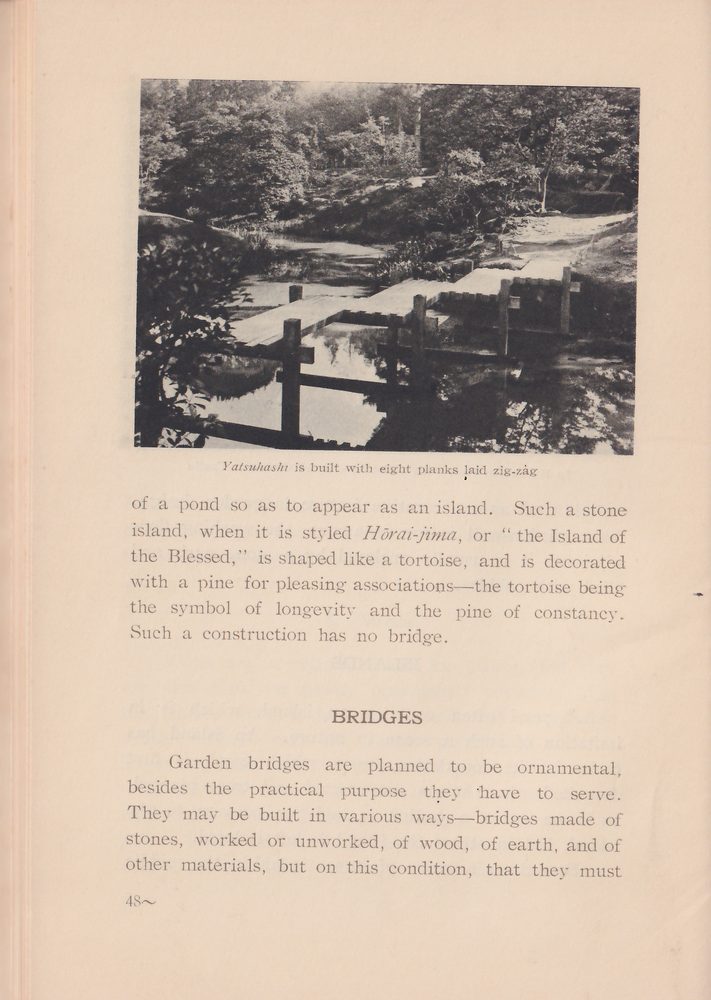
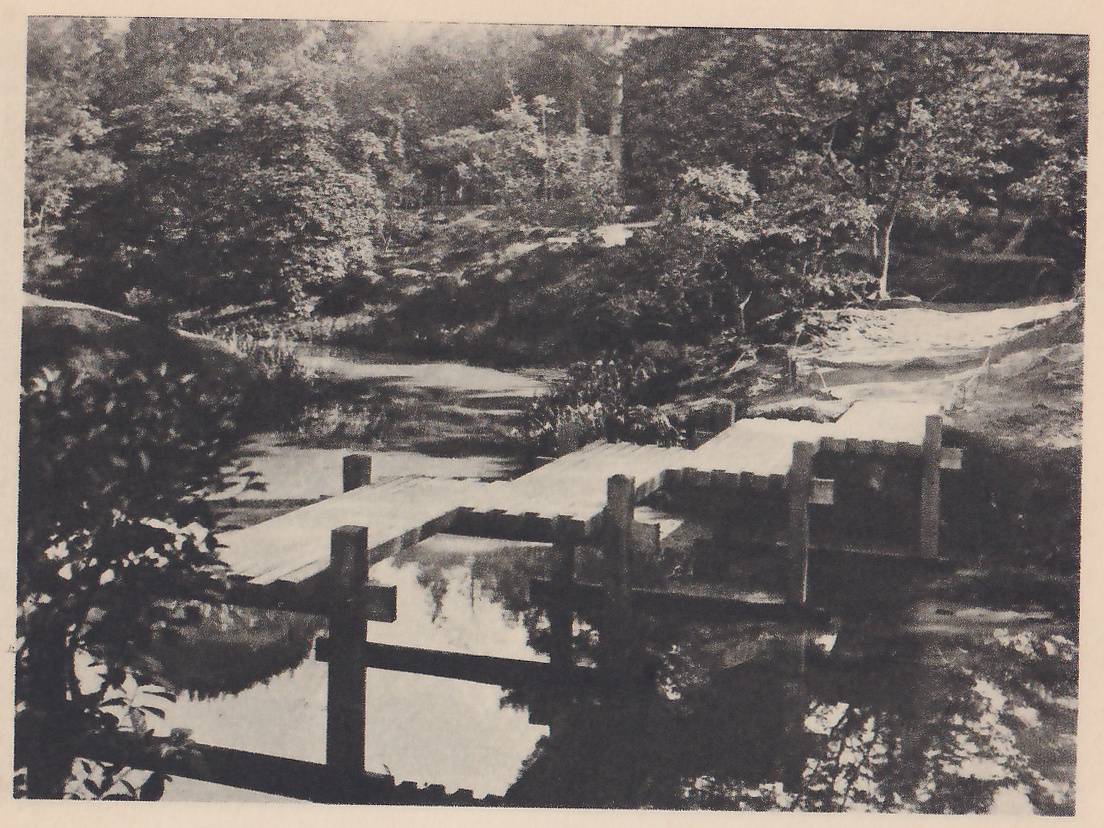
all be pleasing to the eye. Repetition of the same type of bridge in a garden is studiously avoided as monotony is less agreeable than variety. One of the unusual forms of bridge is that called yatsuhashi, which is built with eight planks laid zig-zag.
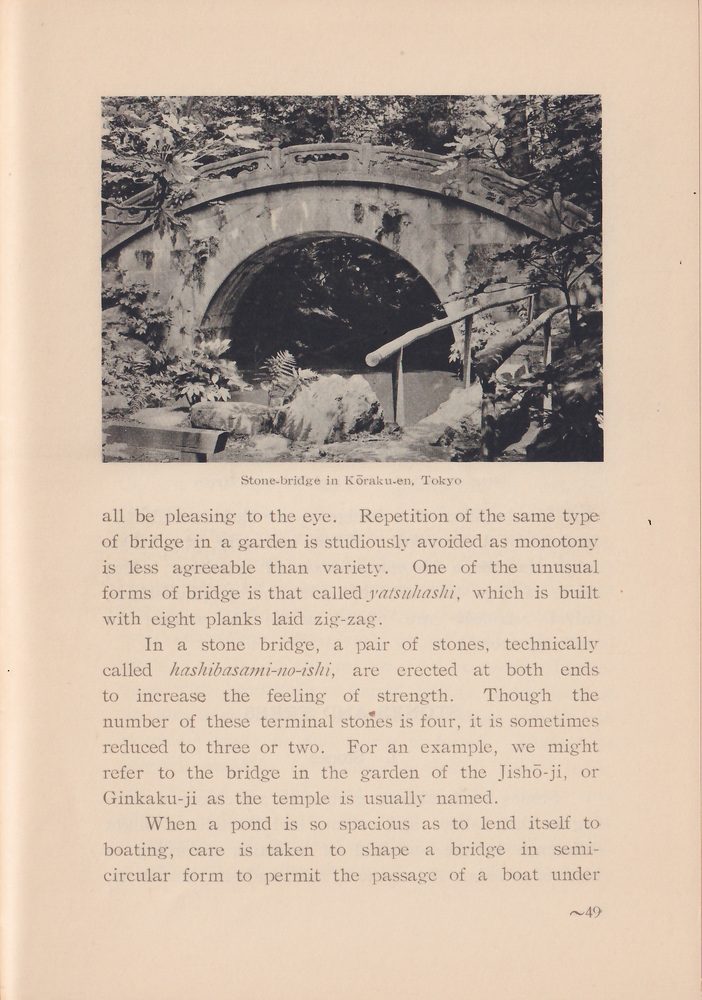
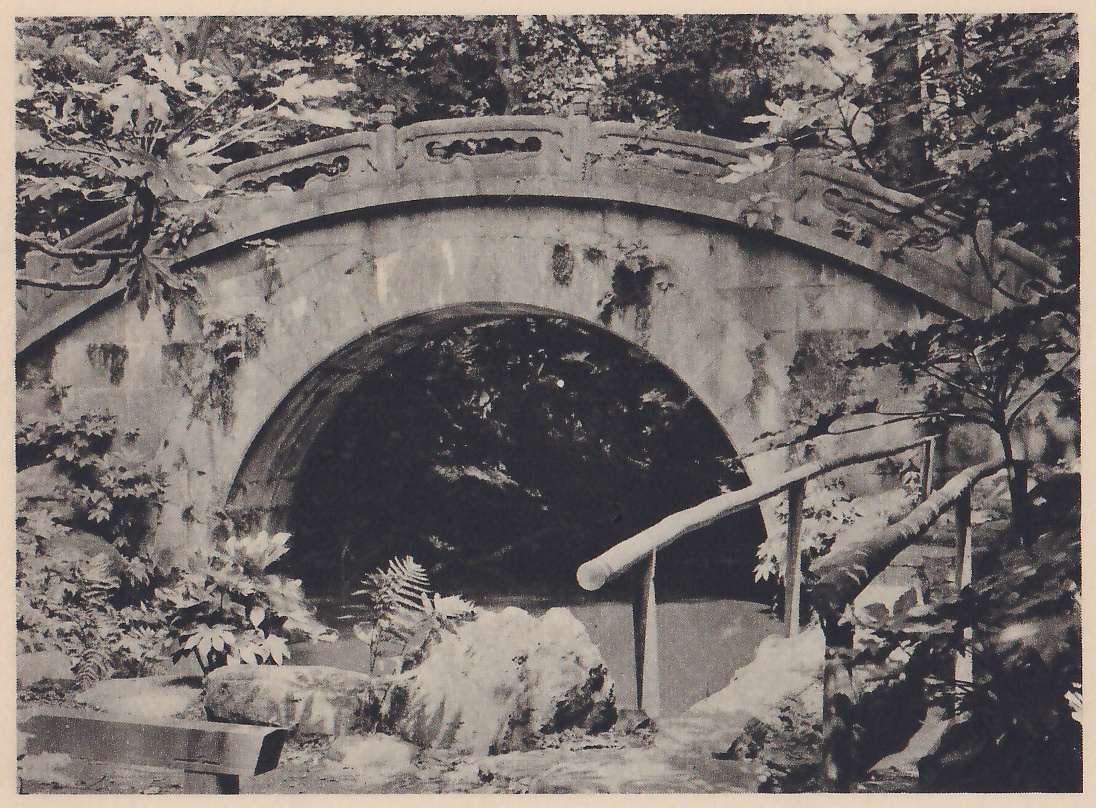
In a stone bridge, a pair of stones, technically called hashibasami-no-ishi, are erected at both ends to increase the feeling of strength. Though the number of these terminal stones is four, it is sometimes reduced to three or two. For an example, we might refer to the bridge in the garden of the Jishō-ji, or Ginkaku-ji as the temple is usually named.
When a pond is so spacious as to lend itself to boating, care is taken to shape a bridge in semicircular form to permit the passage of a boat under
it. The building of a bridge is avoided immediately in front of a waterfall. When necessary, the bridge takes the shape of maruta-bashi, a primitive bridge made of logs laid side by side; or stepping-stones, called sawatobi, are placed across the stream for walking over.
STONES AND TREES
I. Stones
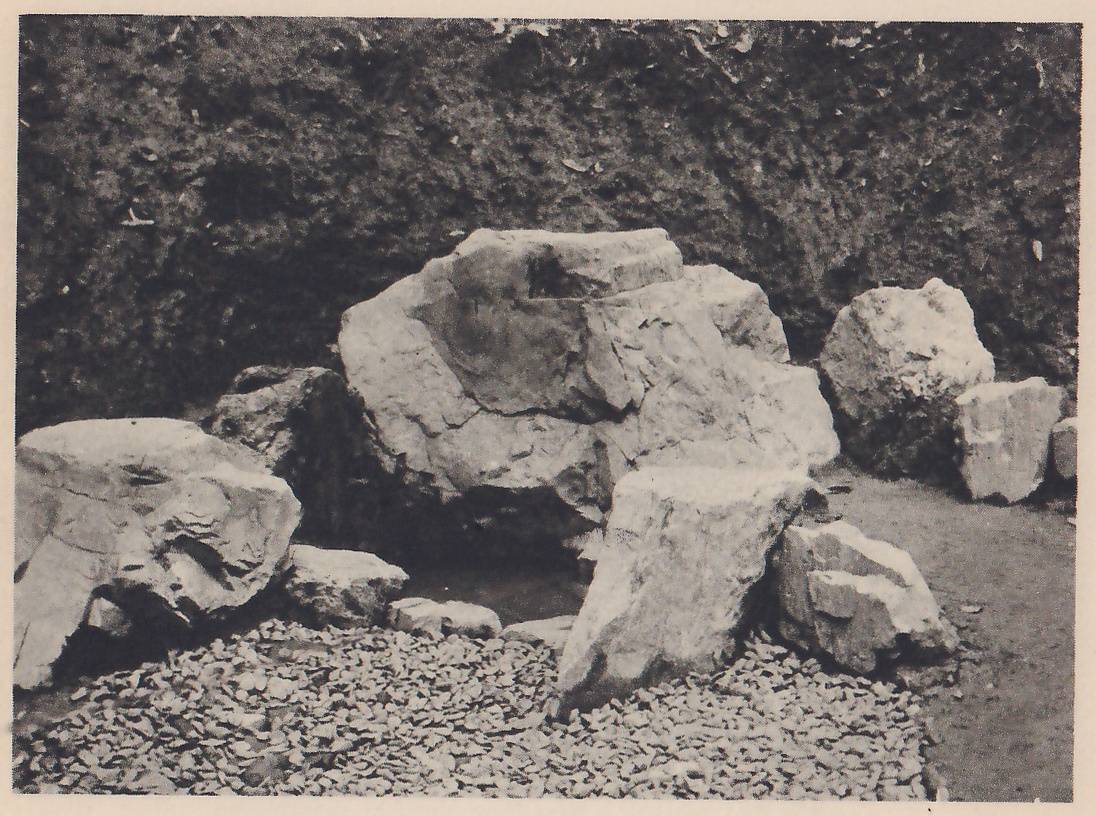
Stones for landscape gardening are chosen according to their shape and colour, and there is a slight difference in the standard of selection according to historic periods. As a general rule, andesite, hornstone,
granite, clay-slate, and chlorite schist of suitable shape are in favour.
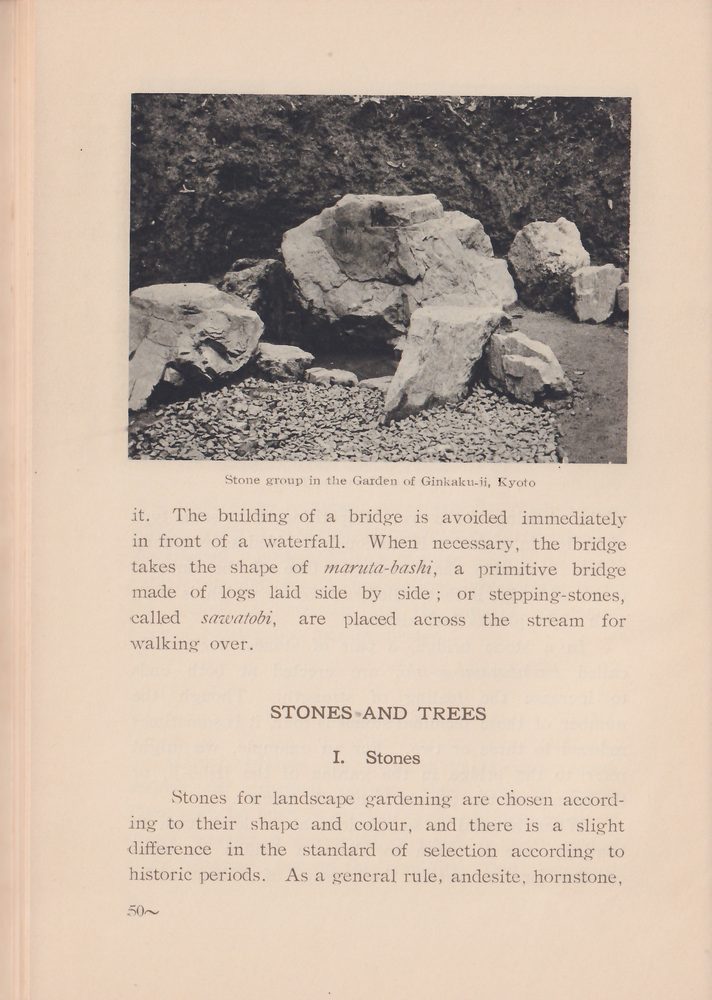
These stones are installed at points considered important in the planning of a garden. They are rarely isolated, being usually in groups of from two to five. Each group consists of stones of different height and is set on a firm foundation so that it may form a sectional centre of the landscape. Lack of stability as judged by the eye is considered a weakness, and it is carefully avoided by garden designers.
2. Trees
For garden trees both needle-leaved and large-leaved are in use. Of the former, pines come first in the list followed by such as akamatsu or red-pine, kuromatsu or black-pine, and himekomatsu (a kind of pine). Their use in gardens dates from olden times. Sugi (cryptomeria), ibuki (juniper), hinoki (chamaecyparis obtusa), sawara (chamaecyparis pisifera), kaya (torreya), rakan-maki (podocarpus chinensis), and kōya-maki (sciadopitys verticillata), all of the needle-leaved group, are also in general use. Of large-leaved trees, those with beautifully coloured foliage, those blazing out into dazzling tints in autumn, or those coming into blooming flower in season are preferred. Mochi (ilex integra), mokkoku (ternstoemia japonica), kashi (oak), shii (a kind of oak), and inutsuge (ilex crenata var. typica f. genuina) are the most widely used of the evergreens, and tsubaki (camelia) and sazanka (a kind of camelia), of the flowering trees. The favourite
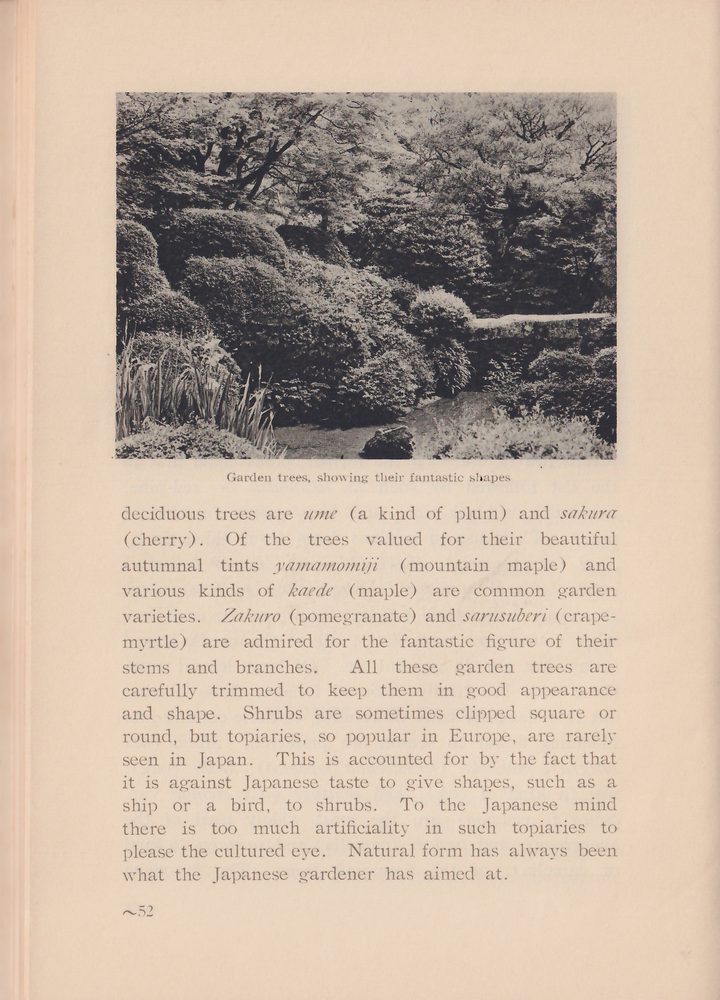
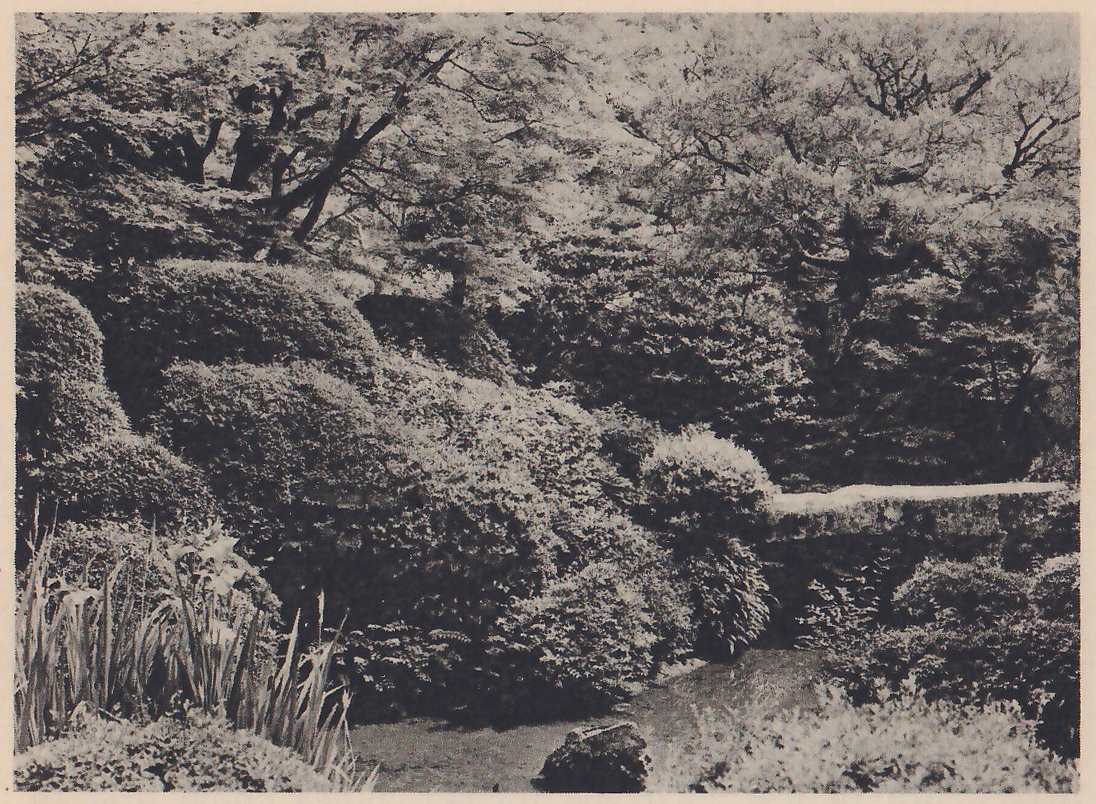
deciduous trees are ume (a kind of plum) and sakura (cherry). Of the trees valued for their beautiful autumnal tints yamamomiji (mountain maple) and various kinds of kaede (maple) are common garden varieties. Zakuro (pomegranate) and sarusuberi (crape-myrtle) are admired for the fantastic figure of their stems and branches. All these garden trees are carefully trimmed to keep them in good appearance and shape. Shrubs are sometimes clipped square or round, but topiaries, so popular in Europe, are rarely seen in Japan. This is accounted for by the fact that it is against Japanese taste to give shapes, such as a ship or a bird, to shrubs. To the Japanese mind there is too much artificiality in such topiaries to please the cultured eye. Natural form has always been what the Japanese gardener has aimed at.
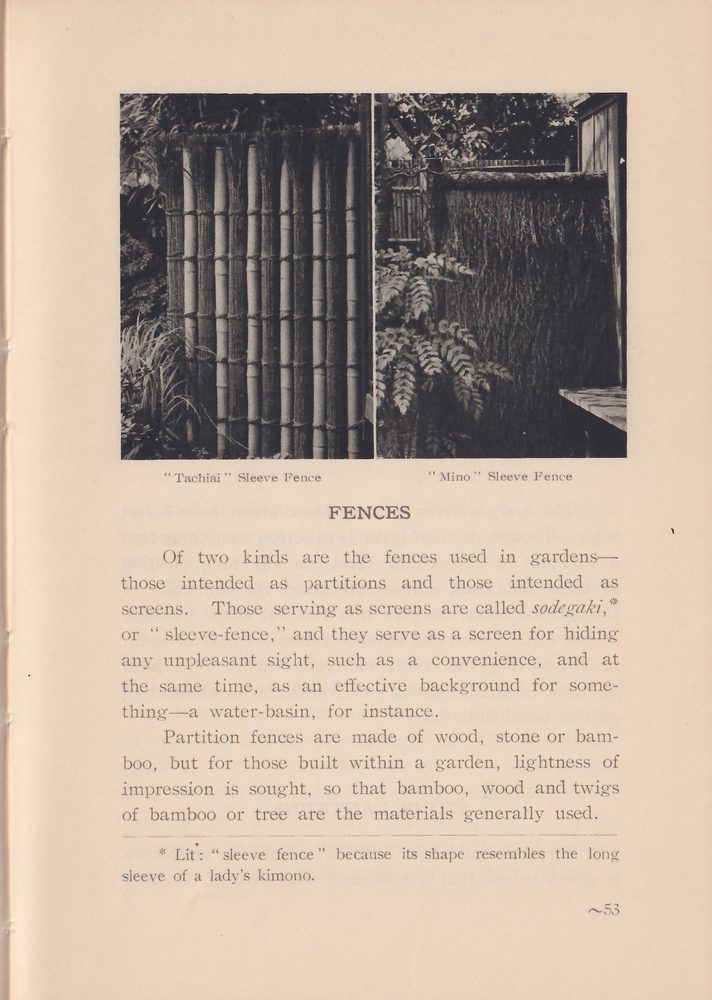
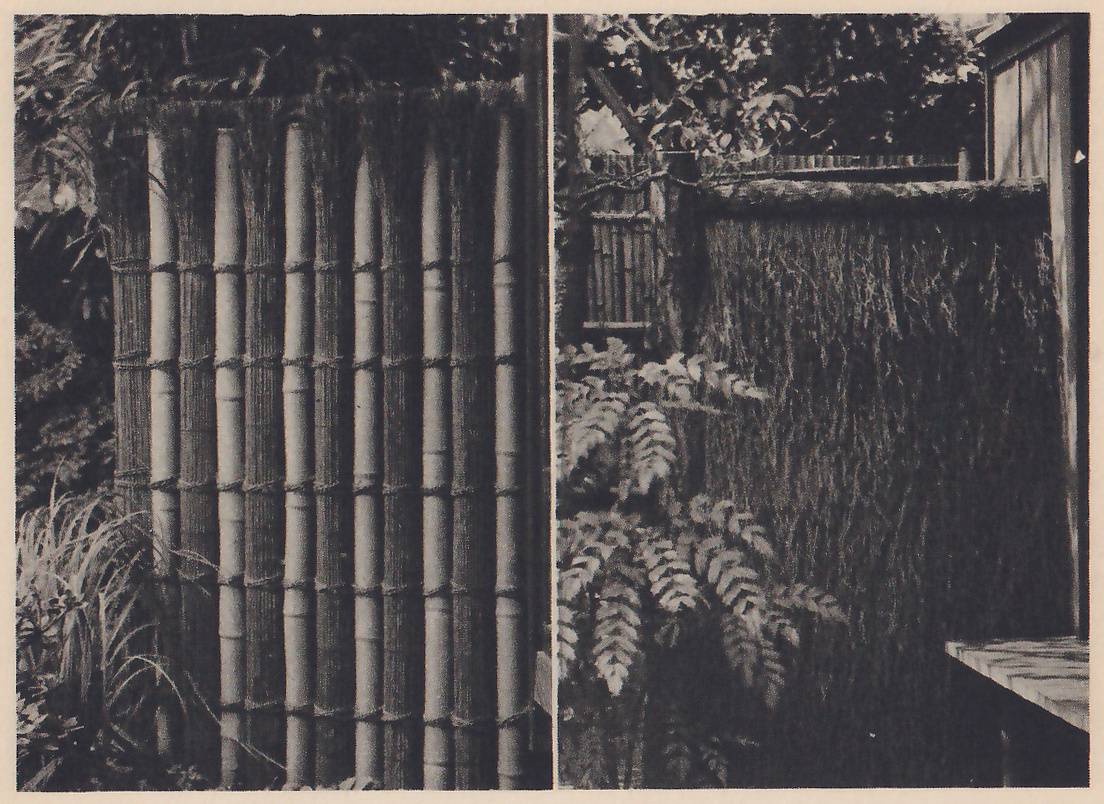
“Mino” Sleeve Fence
FENCES
Of two kinds are the fences used in gardens—those intended as partitions and those intended as screens. Those serving as screens are called sodegaki,* or “sleeve-fence,” and they serve as a screen for hiding any unpleasant sight, such as a convenience, and at the same time, as an effective background for something—a water-basin, for instance.
Partition fences are made of wood, stone or bamboo, but for those built within a garden, lightness of impression is sought, so that bamboo, wood and twigs of bamboo or tree are the materials generally used.
* Lit: “sleeve fence” because its shape resembles the long sleeve of a lady’s kimono.
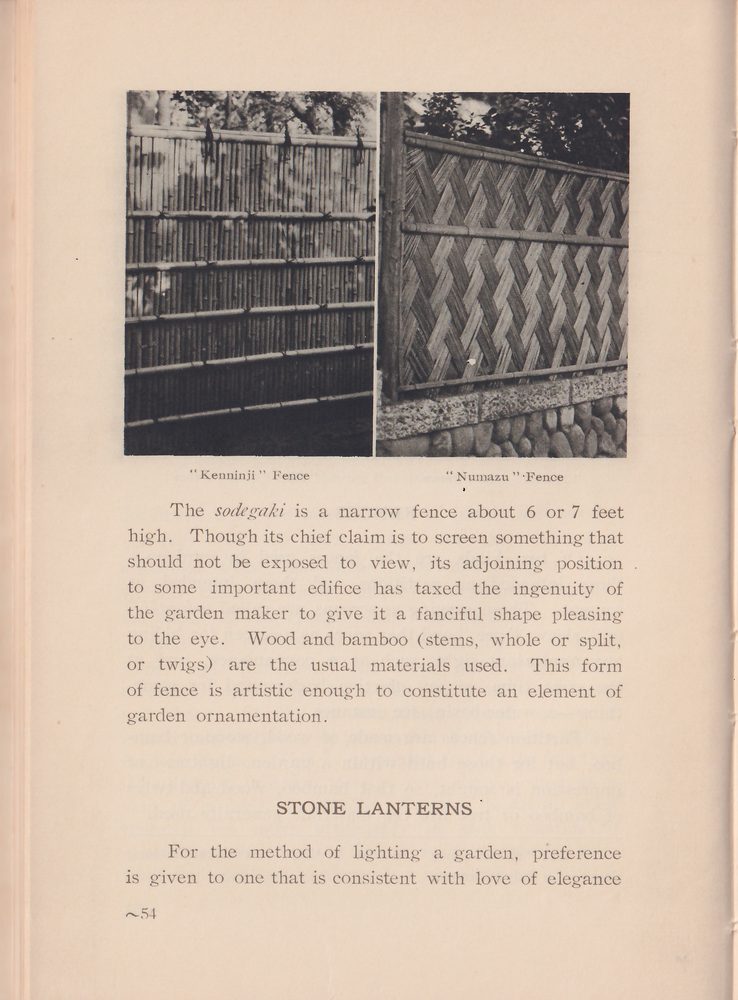
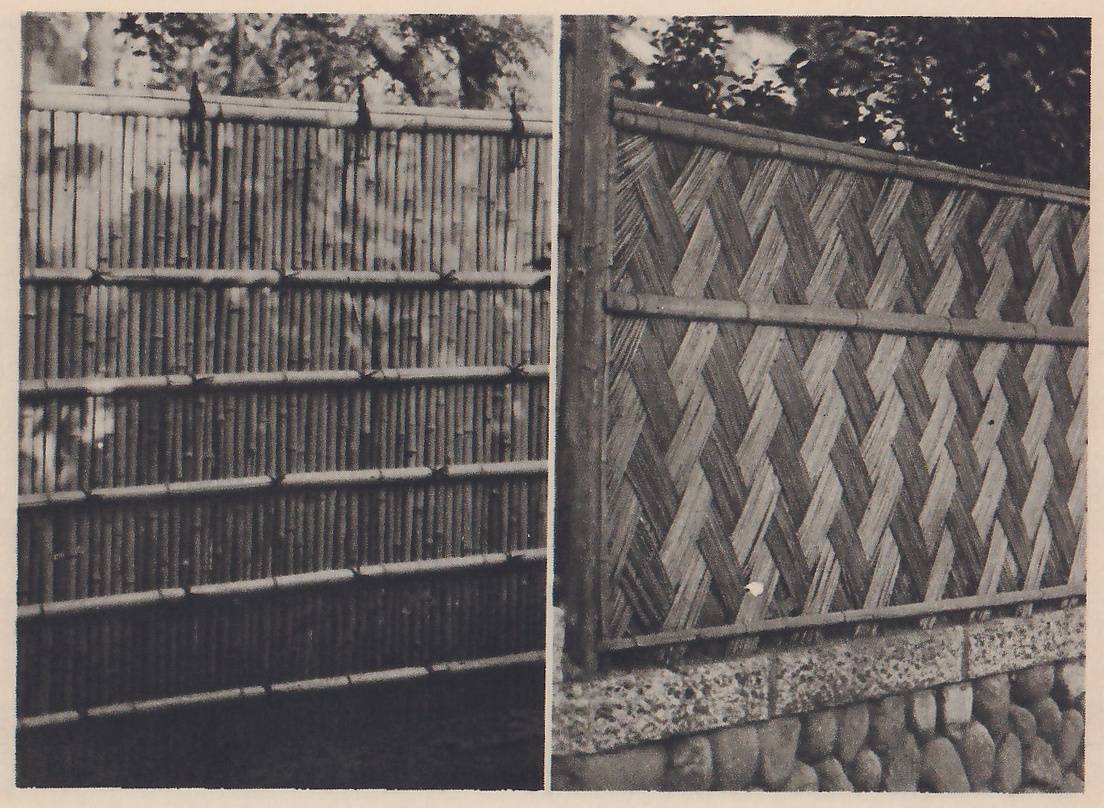
“Numazu” Fence
The sodegaki is a narrow fence about 6 or 7 feet high. Though its chief claim is to screen something that should not be exposed to view, its adjoining position to some important edifice has taxed the ingenuity of the garden maker to give it a fanciful shape pleasing to the eye. Wood and bamboo (stems, whole or split, or twigs) are the usual materials used. This form of fence is artistic enough to constitute an element of garden ornamentation.
STONE LANTERNS
For the method of lighting a garden, preference is given to one that is consistent with love of elegance
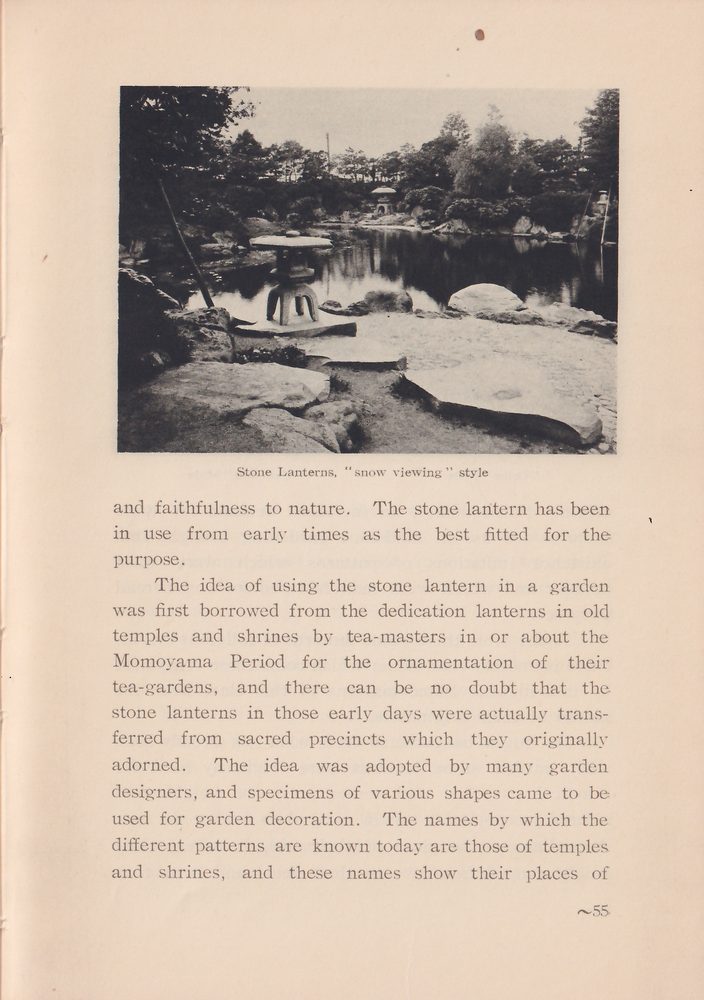
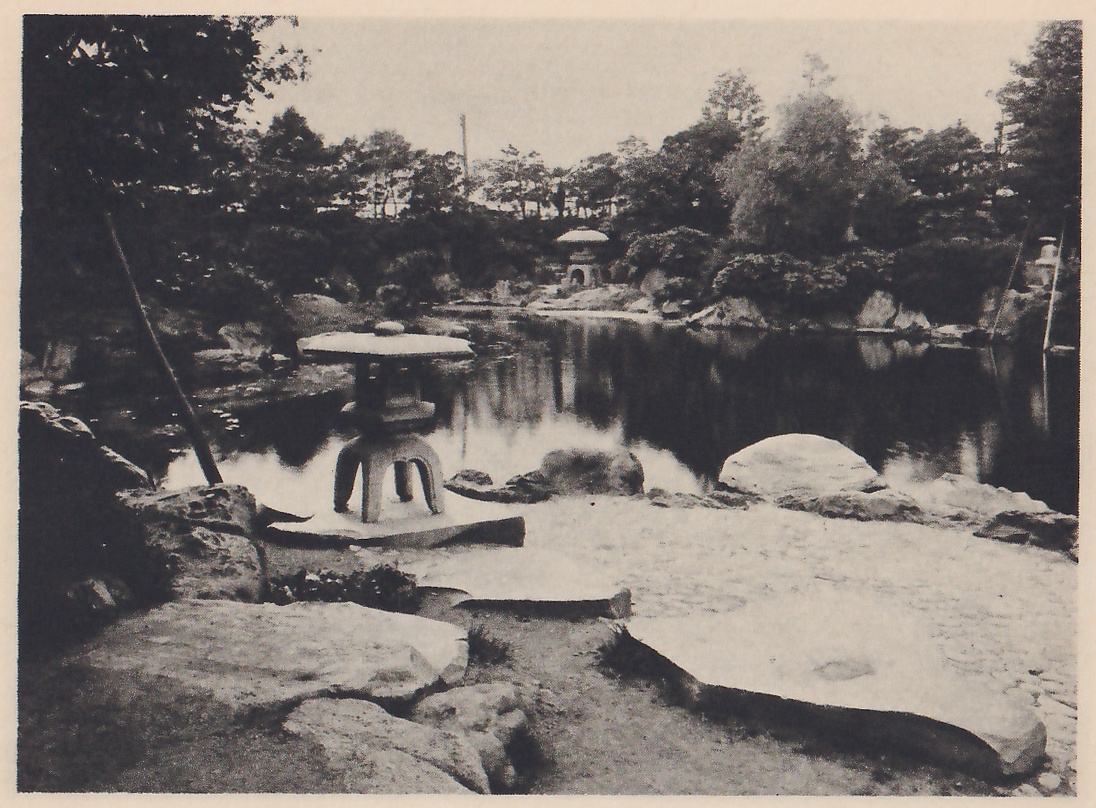
and faithfulness to nature. The stone lantern has been in use from early times as the best fitted for the purpose.
The idea of using the stone lantern in a garden was first borrowed from the dedication lanterns in old temples and shrines by tea-masters in or about the Momoyama Period for the ornamentation of their tea-gardens, and there can be no doubt that the stone lanterns in those early days were actually transferred from sacred precincts which they originally adorned. The idea was adopted by many garden designers, and specimens of various shapes came to be used for garden decoration. The names by which the different patterns are known today are those of temples and shrines, and these names show their places of
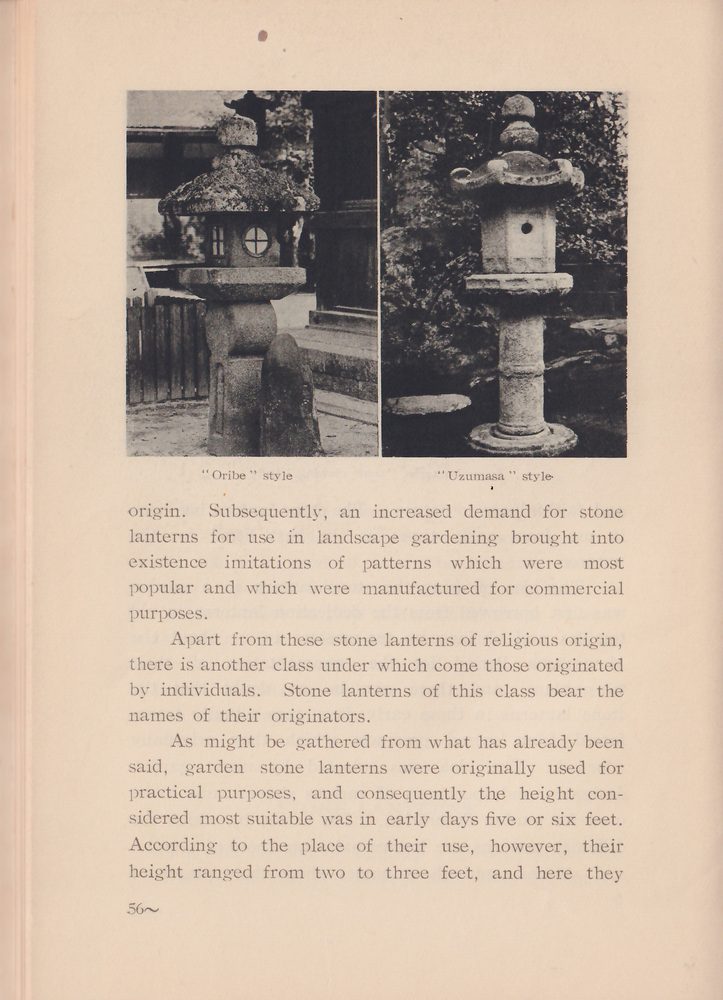
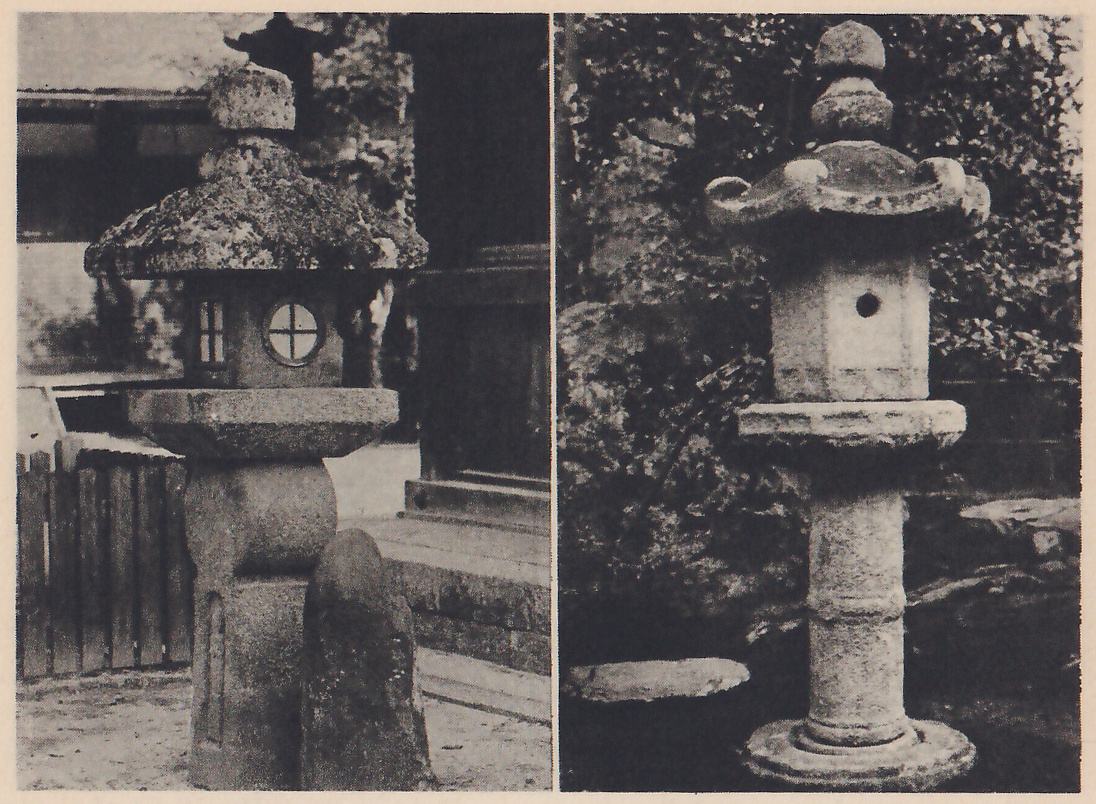
“Uzumasa” style
origin. Subsequently, an increased demand for stone lanterns for use in landscape gardening brought into existence imitations of patterns which were most popular and which were manufactured for commercial purposes.
Apart from these stone lanterns of religious origin, there is another class under which come those originated by individuals. Stone lanterns of this class bear the names of their originators.
As might be gathered from what has already been said, garden stone lanterns were originally used for practical purposes, and consequently the height considered most suitable was in early days five or six feet. According to the place of their use, however, their height ranged from two to three feet, and here they
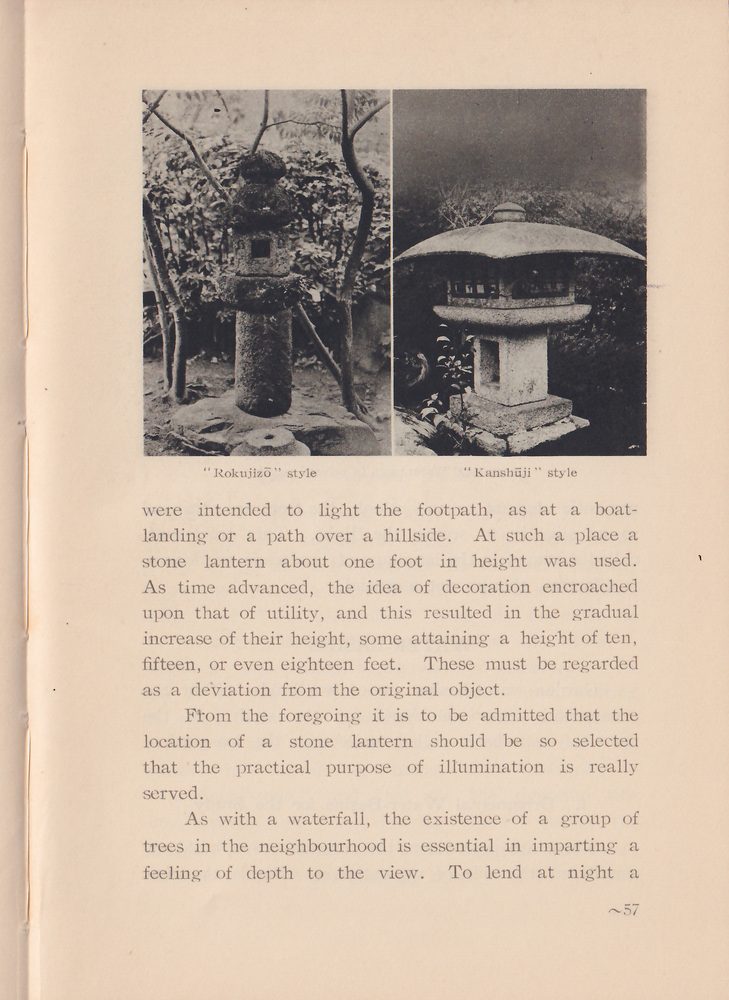
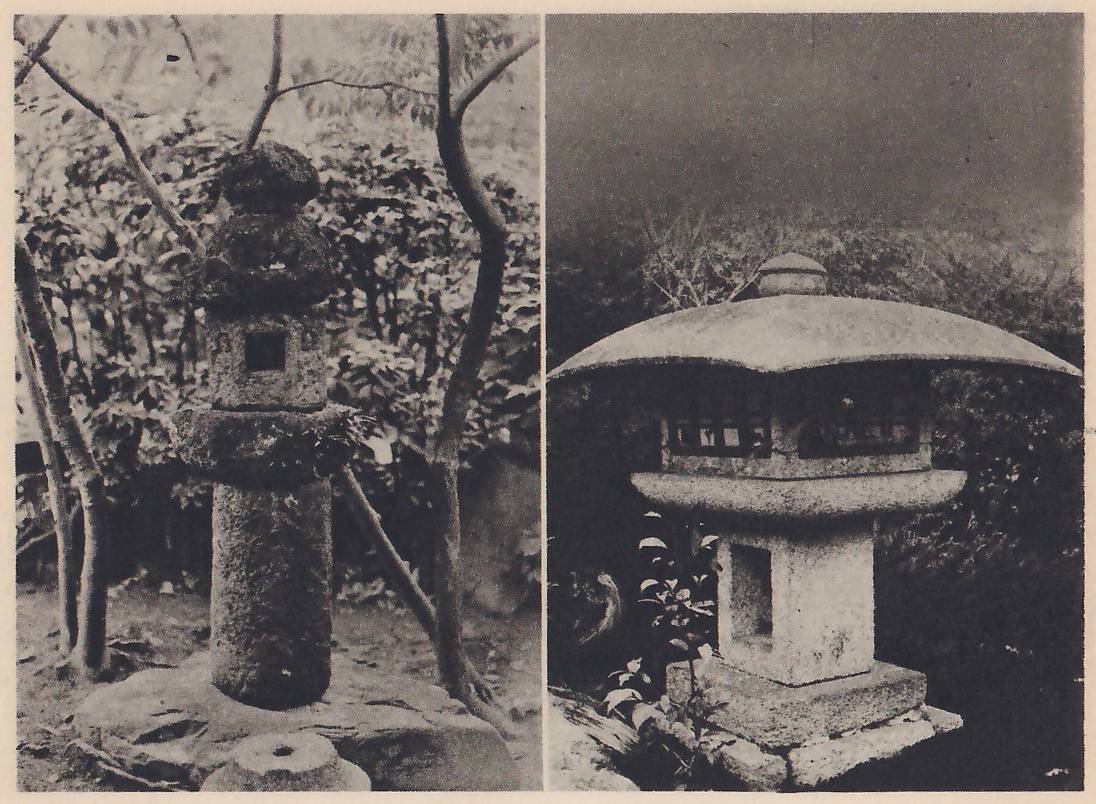
“Kanshūji” style
were intended to light the footpath, as at a boat-landing or a path over a hillside. At such a place a stone lantern about one foot in height was used. As time advanced, the idea of decoration encroached upon that of utility, and this resulted in the gradual increase of their height, some attaining a height of ten, fifteen, or even eighteen feet. These must be regarded as a deviation from the original object.
From the foregoing it is to be admitted that the location of a stone lantern should be so selected that the practical purpose of illumination is really served.
As with a waterfall, the existence of a group of trees in the neighbourhood is essential in imparting a feeling of depth to the view. To lend at night a
romantic element to an outlook, the trees are arranged so as slightly to screen the light. This treatment, called hizawari in the language of landscape gardeners, is effective, though not essential.
WATER-BASINS
Garden water-basins are of two kinds—either the ornamental kazari-chōzubachi for the study, or the practical stone-basin called tsukubai in the tea-garden.
I. Ornamental Water-Basins for the Study
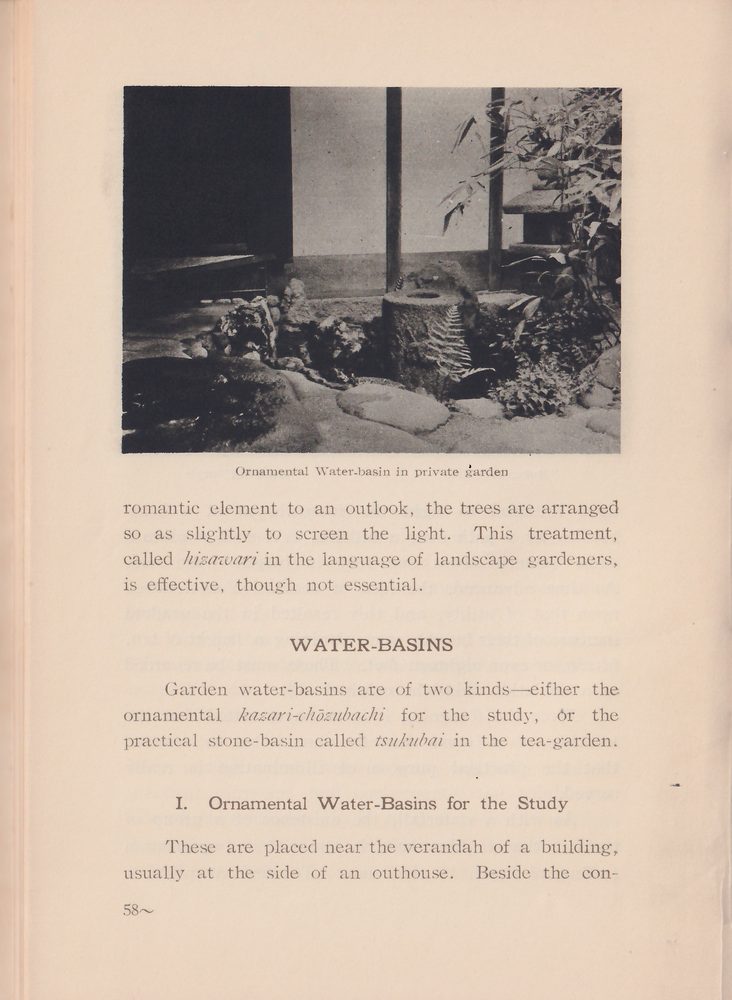
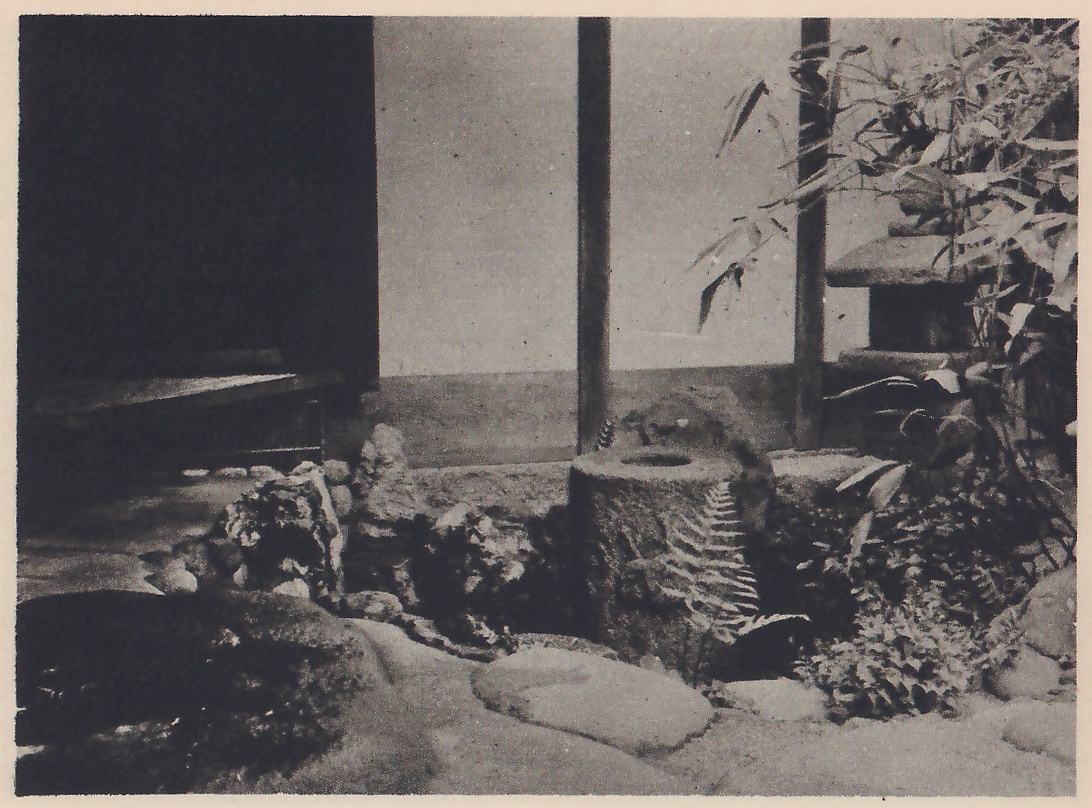
These are placed near the verandah of a building, usually at the side of an outhouse. Beside the con-
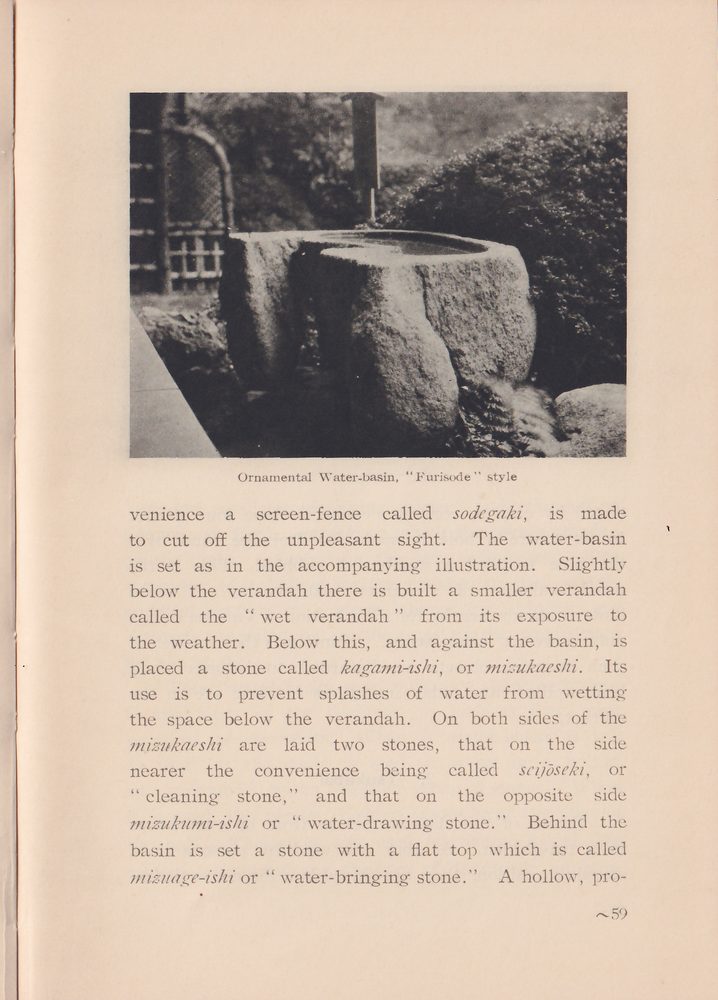
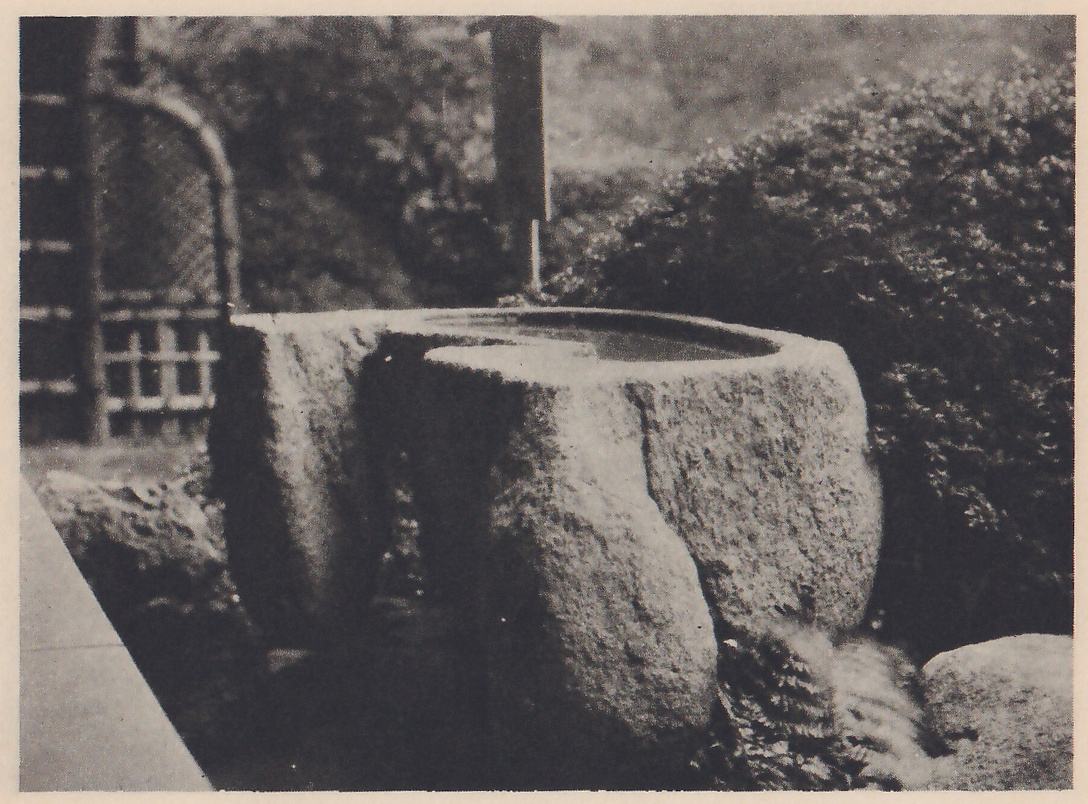
venience a screen-fence called sodegaki, is made to cut off the unpleasant sight. The water-basin is set as in the accompanying illustration. Slightly below the verandah there is built a smaller verandah called the “wet verandah” from its exposure to the weather. Below this, and against the basin, is placed a stone called kagami-ishi, or mizukaeshi. Its use is to prevent splashes of water from wetting the space below the verandah. On both sides of the mizukaeshi are laid two stones, that on the side nearer the convenience being called seijōsekiPrinted: scijōseki, or “cleaning stone,” and that on the opposite side mizukumi-ishi or “water-drawing stone.” Behind the basin is set a stone with a flat top which is called mizuage-ishi or “water-bringing stone.” A hollow, pro-
tected by clay or concrete, connects these four stones. In its centre a hole is made for drainage, and over the hole is piled a number of pebbles. This is the usual make-up of a garden water-basin. A stone lantern stands nearby for illumination. Various things may serve as water-basins. Sometimes they consist of such fanciful objects as discarded tombstones or a bridge-pillar, and today imitations of these are on the market.
2. Tsukubai
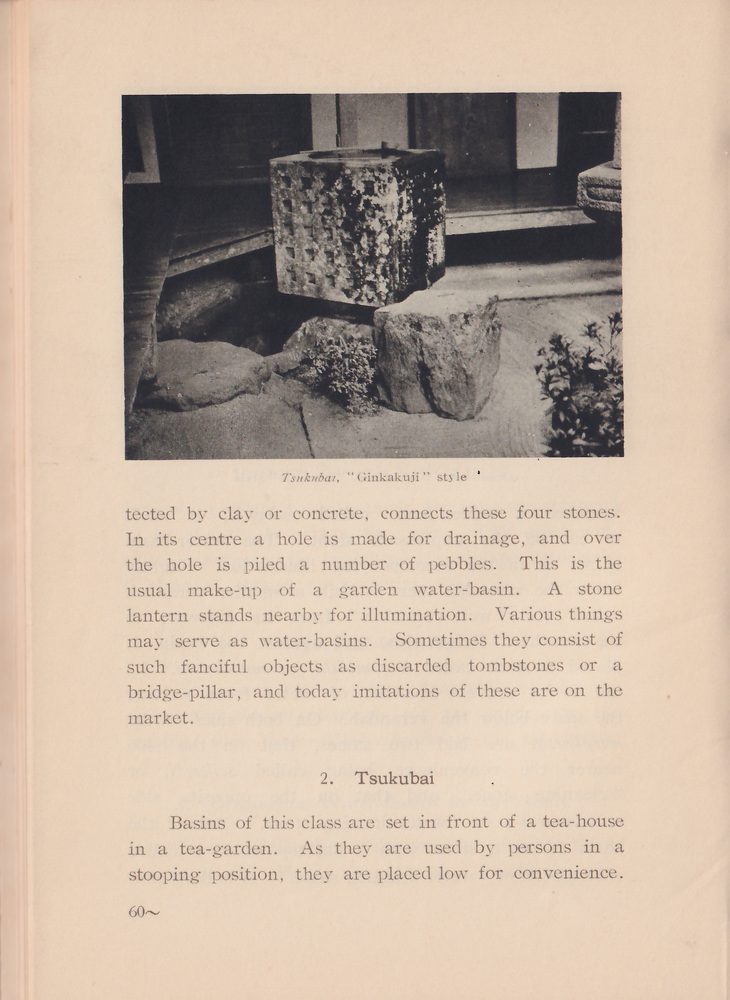
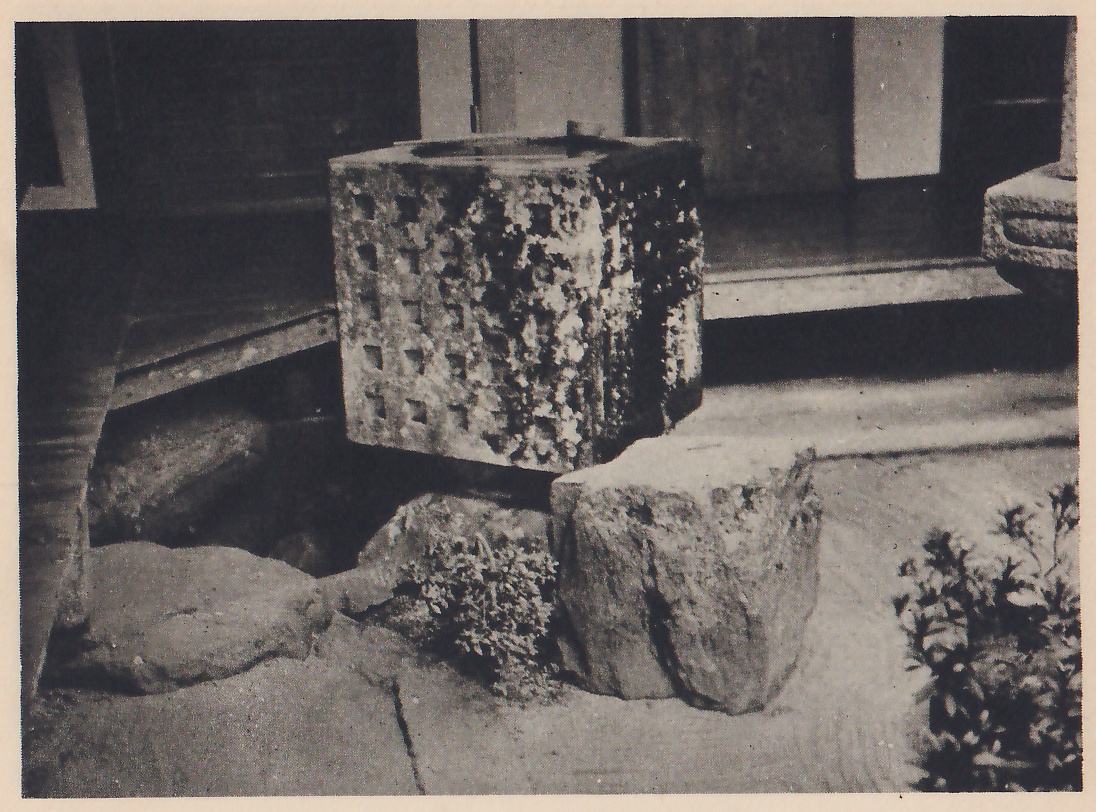
Basins of this class are set in front of a tea-house in a tea-garden. As they are used by persons in a stooping position, they are placed low for convenience.
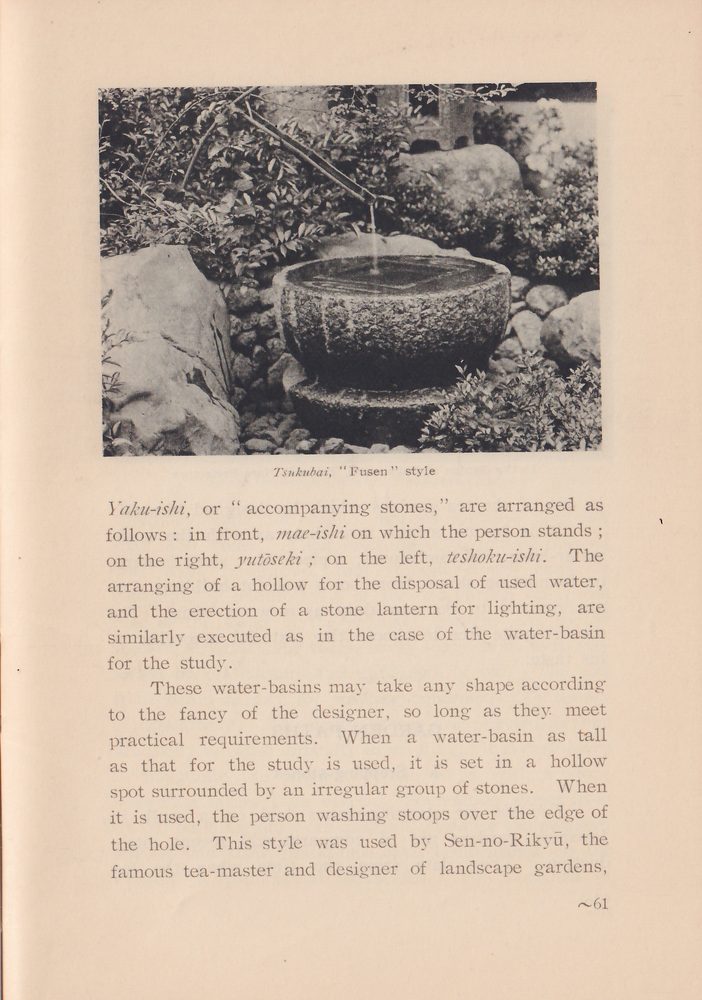
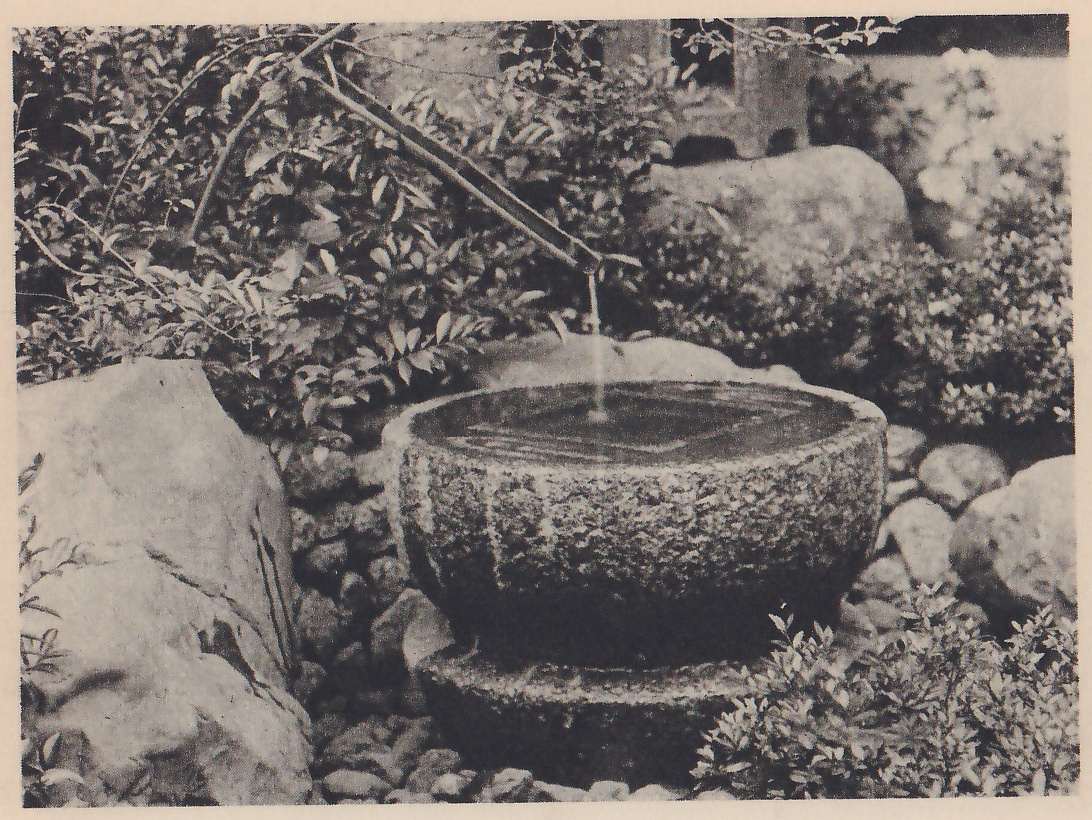
Yaku-ishi, or “accompanying stones,” are arranged as follows: in front, mae-ishi on which the person stands; on the right, yutōseki; on the left, teshoku-ishi. The arranging of a hollow for the disposal of used water, and the erection of a stone lantern for lighting, are similarly executed as in the case of the water-basin for the study.
These water-basins may take any shape according to the fancy of the designer, so long as they meet practical requirements. When a water-basin as tall as that for the study is used, it is set in a hollow spot surrounded by an irregular group of stones. When it is used, the person washing stoops over the edge of the hole. This style was used by Sen-no-Rikyū, the famous tea-master and designer of landscape gardens,
in one of the tea-gardens which he designed himself.
It is by no means rare that, as with the study water-basin, old tombstones, a piece of a stone lantern, or foundation stones from some ancient building sites are revived to do new duty as a water-basin. The user is quite free to choose the material according to his taste.
GARDEN PATHS
I. Stepping-stones
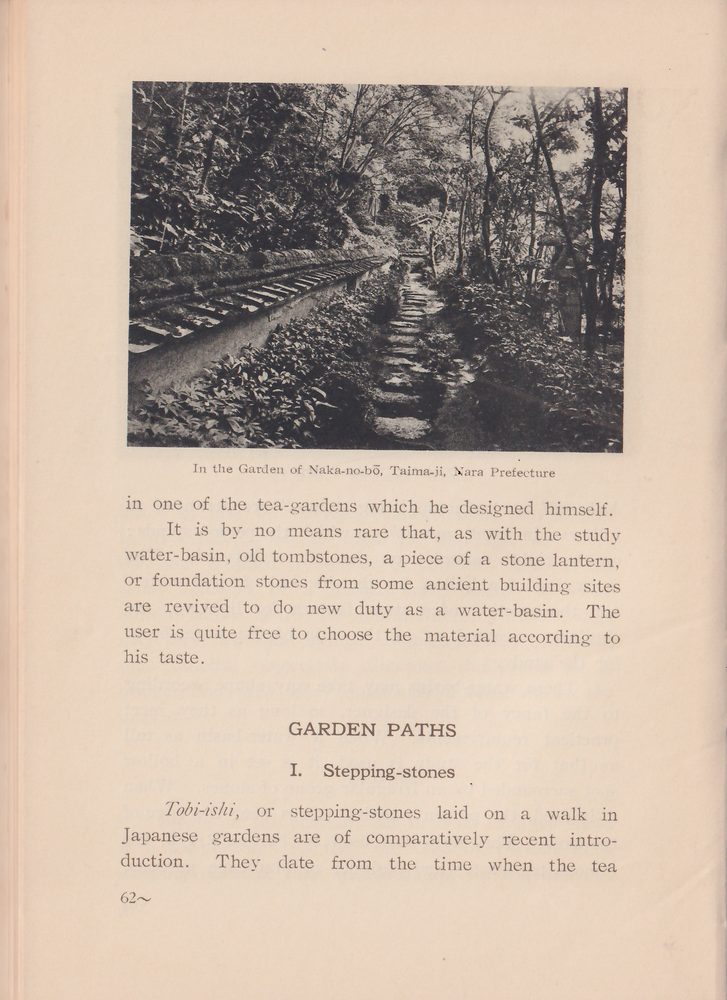
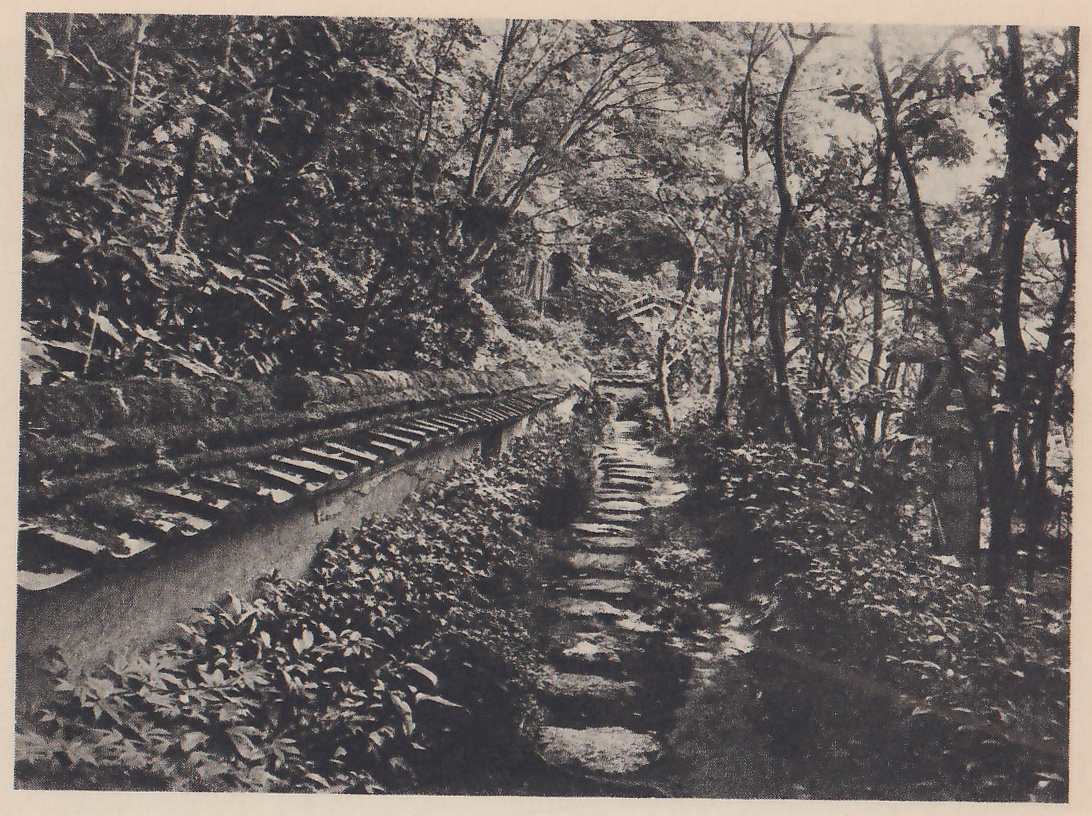
Tobi-ishi, or stepping-stones laid on a walk in Japanese gardens are of comparatively recent introduction. They date from the time when the tea
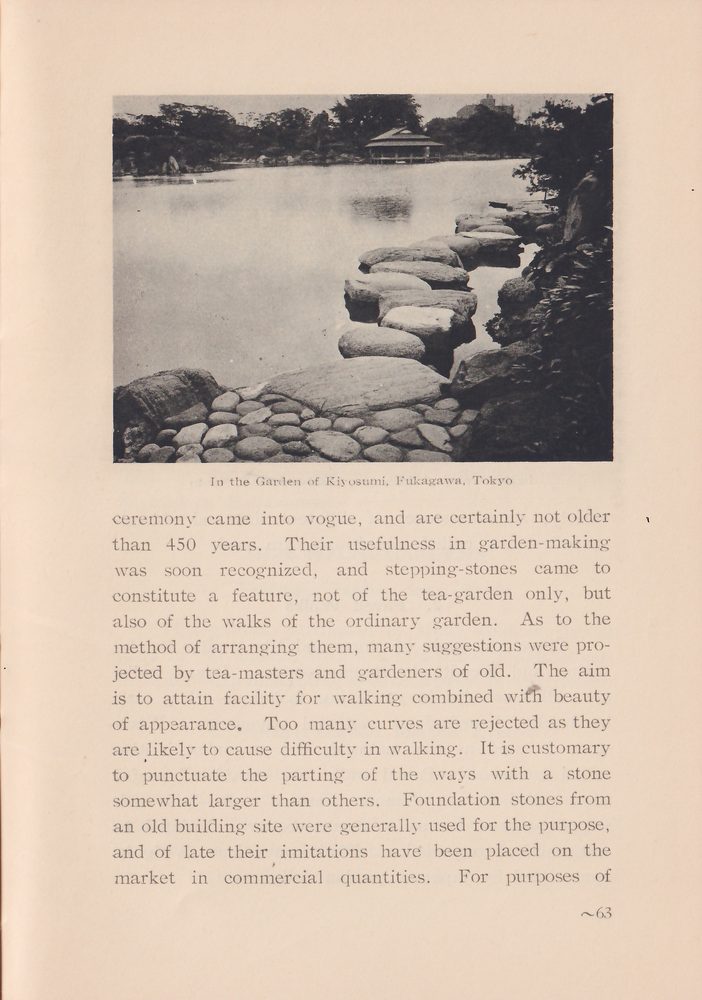
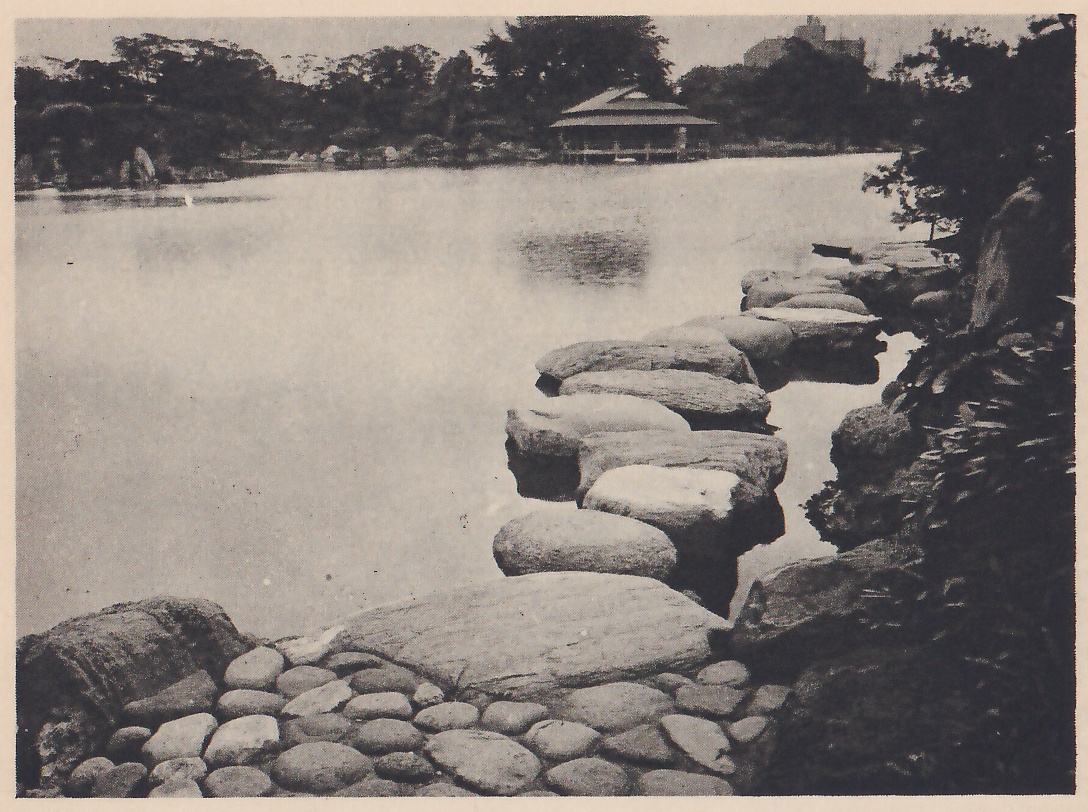
ceremony came into vogue, and are certainly not older than 450 years. Their usefulness in garden-making was soon recognized, and stepping-stones came to constitute a feature, not of the tea-garden only, but also of the walks of the ordinary garden. As to the method of arranging them, many suggestions were projected by tea-masters and gardeners of old. The aim is to attain facility for walking combined with beauty of appearance. Too many curves are rejected as they are likely to cause difficulty in walking. It is customary to punctuate the parting of the ways with a stone somewhat larger than others. Foundation stones from an old building site were generally used for the purpose, and of late their imitations have been placed on the market in commercial quantities. For purposes of
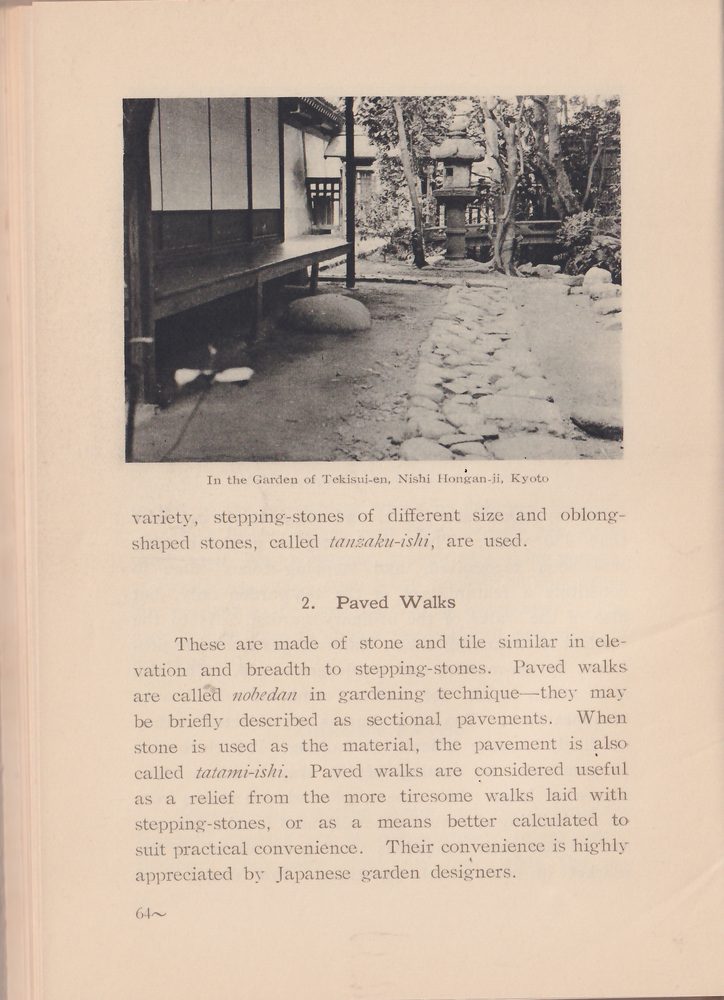
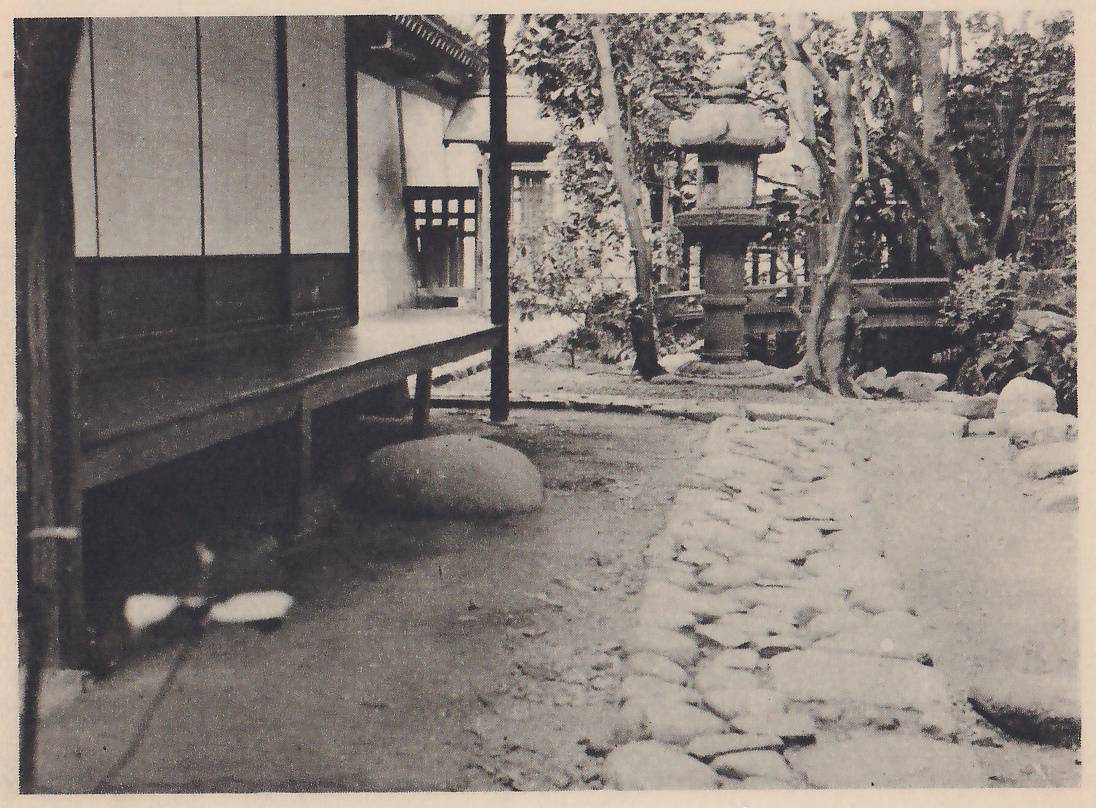
variety, stepping-stones of different size and oblong-shaped stones, called tanzaku-ishi, are used.
2. Paved Walks
These are made of stone and tile similar in elevation and breadth to stepping-stones. Paved walks are called nobedan in gardening technique—they may be briefly described as sectional pavements. When stone is used as the material, the pavement is also called tatami-ishi. Paved walks are considered useful as a relief from the more tiresome walks laid with stepping-stones, or as a means better calculated to suit practical convenience. Their convenience is highly appreciated by Japanese garden designers.