IV. A GUIDE TO FAMOUS HISTORIC GARDENS STILL EXISTING
For the information and guidance of those who desire to inspect some of the famous historic gardens of Japan, only those which have been comparatively well preserved in their original forms are selected and described here. The gardens in this guide are those constructed during the time extending from the Muromachi Period down to the Edo Period, since in the gardens belonging to that time are best shown the characteristics of the Japanese garden, and because to them in the main may be traced the beginnings of its modern development.
MUROMACHI GARDENS
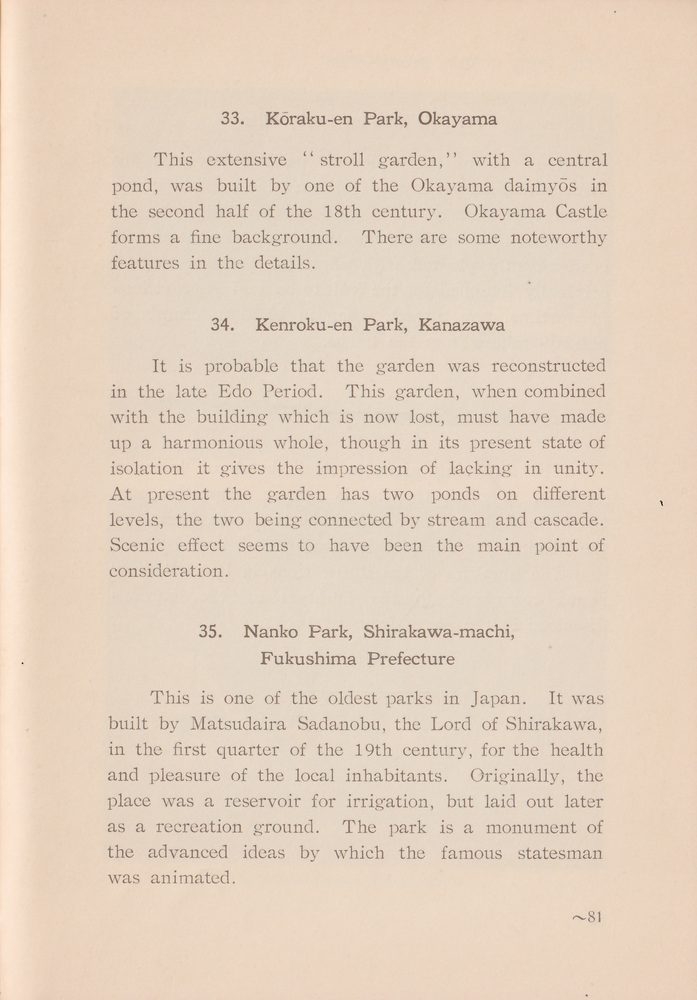
1. Tenryū-ji Garden, Saga, Kyoto
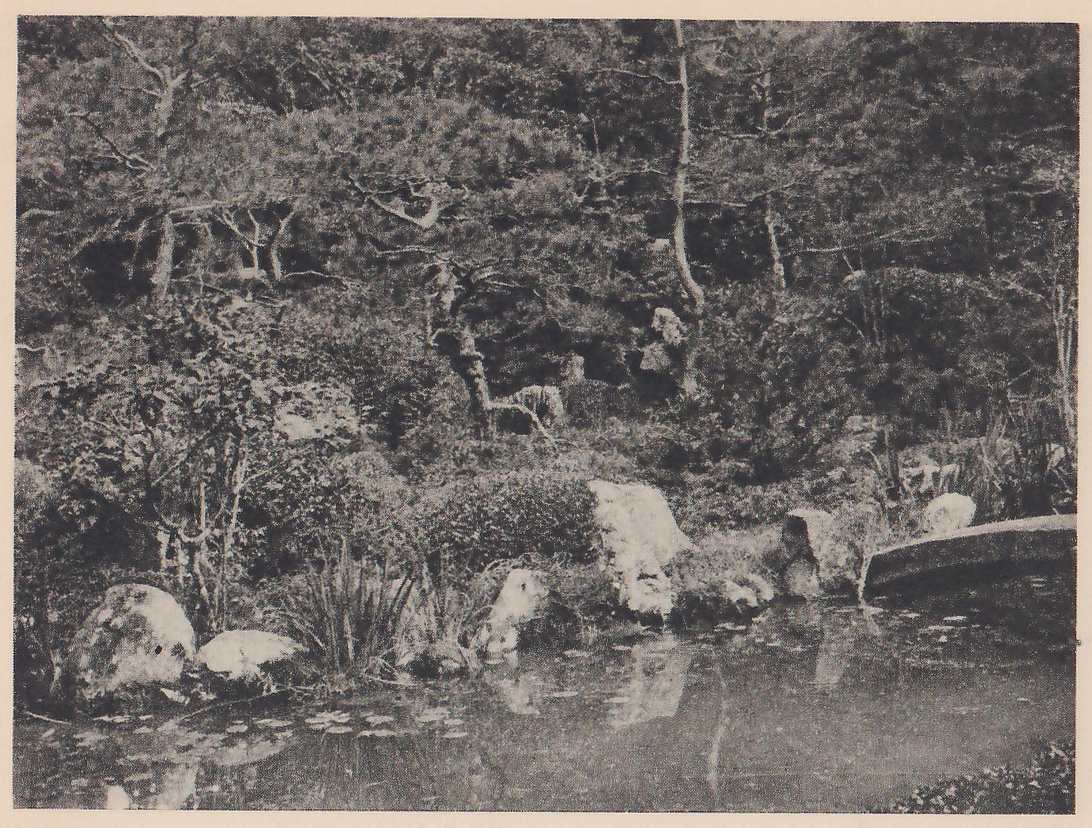
This garden, attributed to Musō Kokushi, has a pond in the middle, with a fall, a stone bridge, stones in water—all illustrating characteristics of the period.
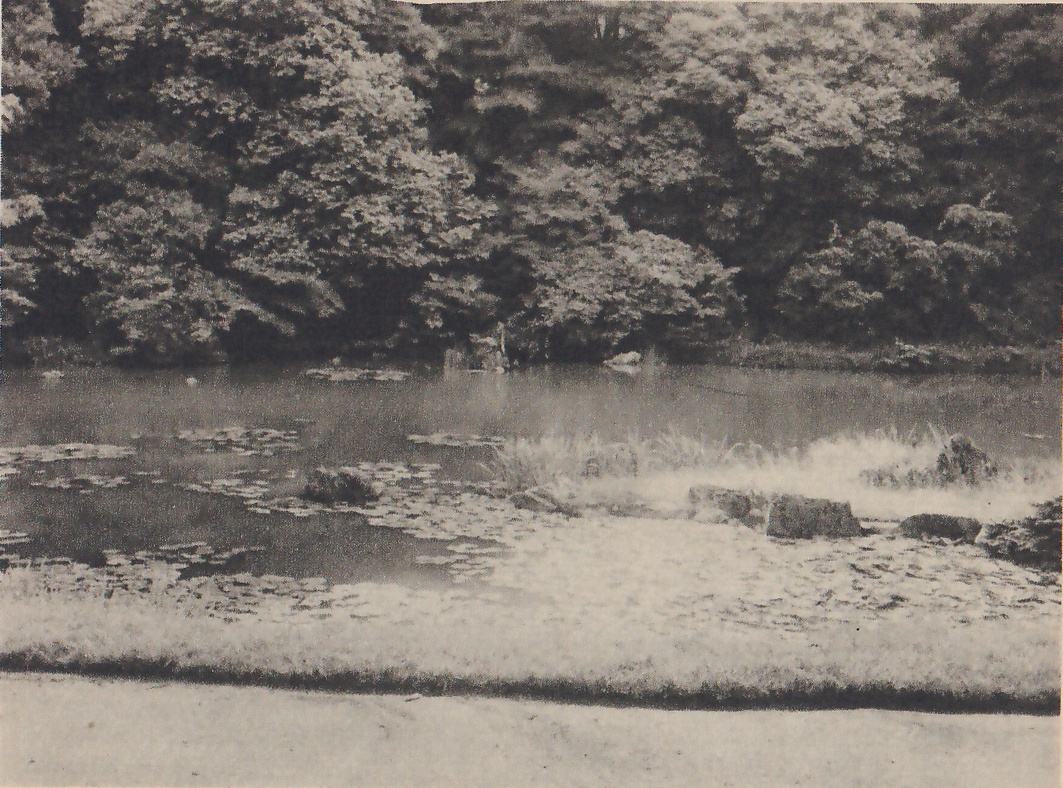
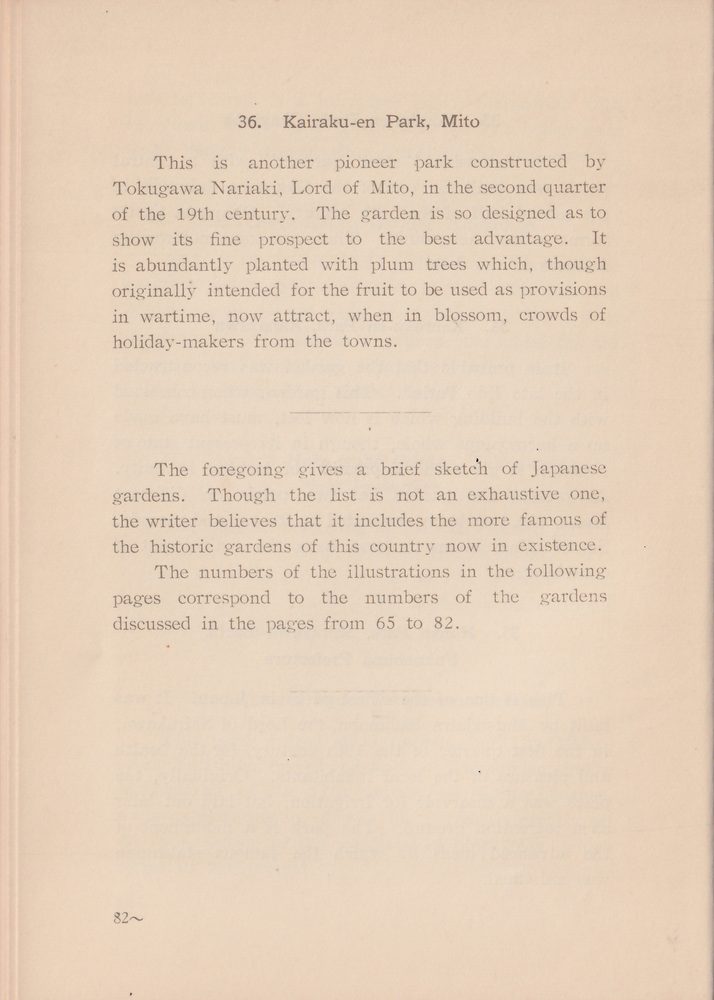
2. Saihō-ji Garden, Matsuo, Kyoto
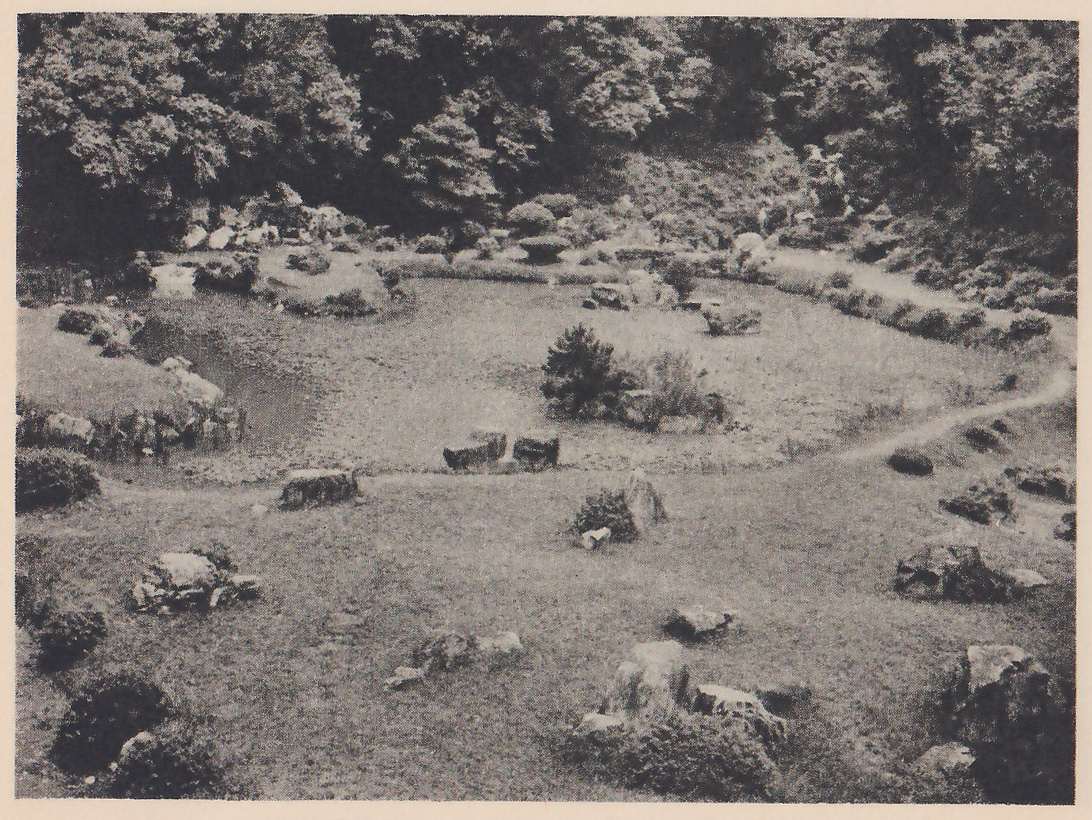
A “stroll garden” in which the natural features of the place are made to serve so that the pond appears to have geographical connection with the mountain in the background. This garden is famous for the beauty of its moss.
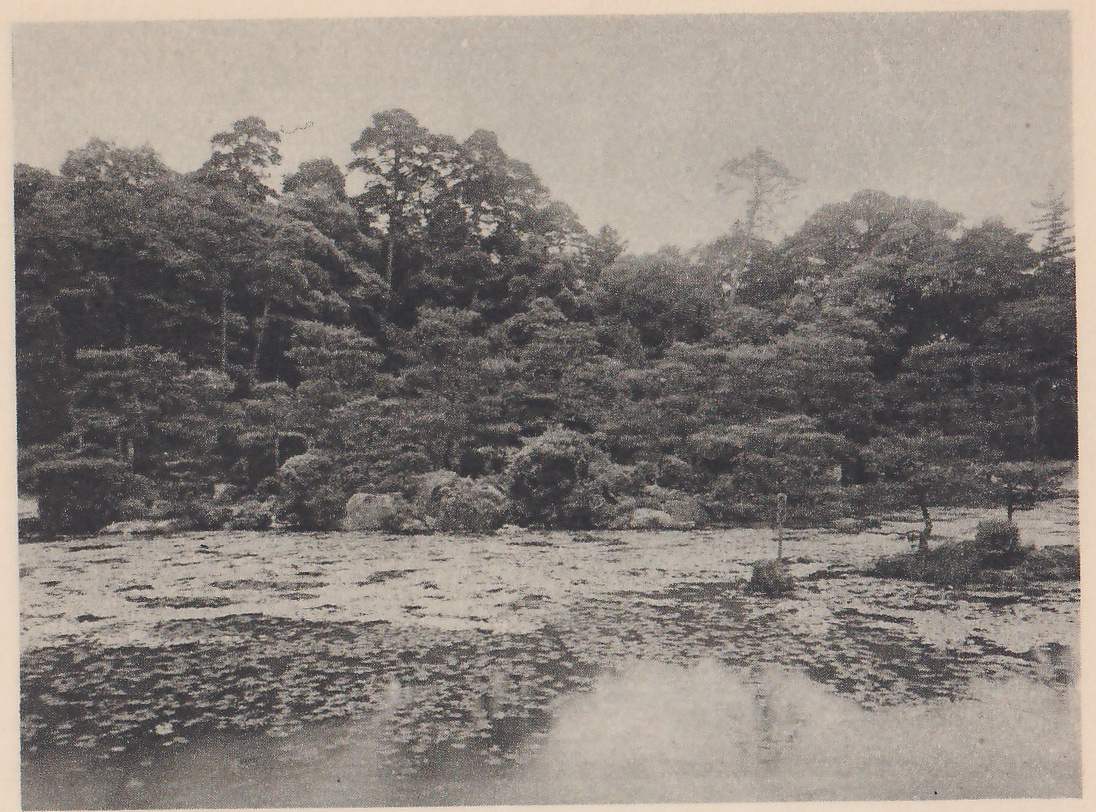
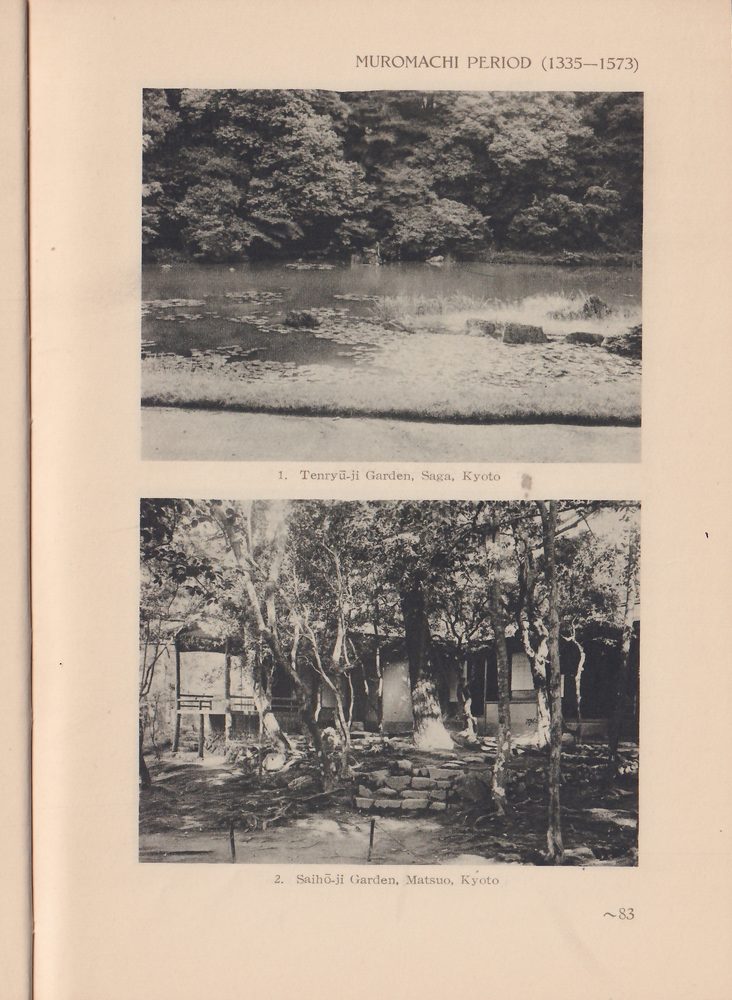
3. Rokuon-ji Garden, Kinkaku-ji, Kyoto
Built by Yoshimitsu, the third of the Ashikaga Shōguns. The garden has a pond and background of mountains. The Golden Pavilion is made the best point of observation. The contemporary characteristics of that period are in the islands and stone grouping.
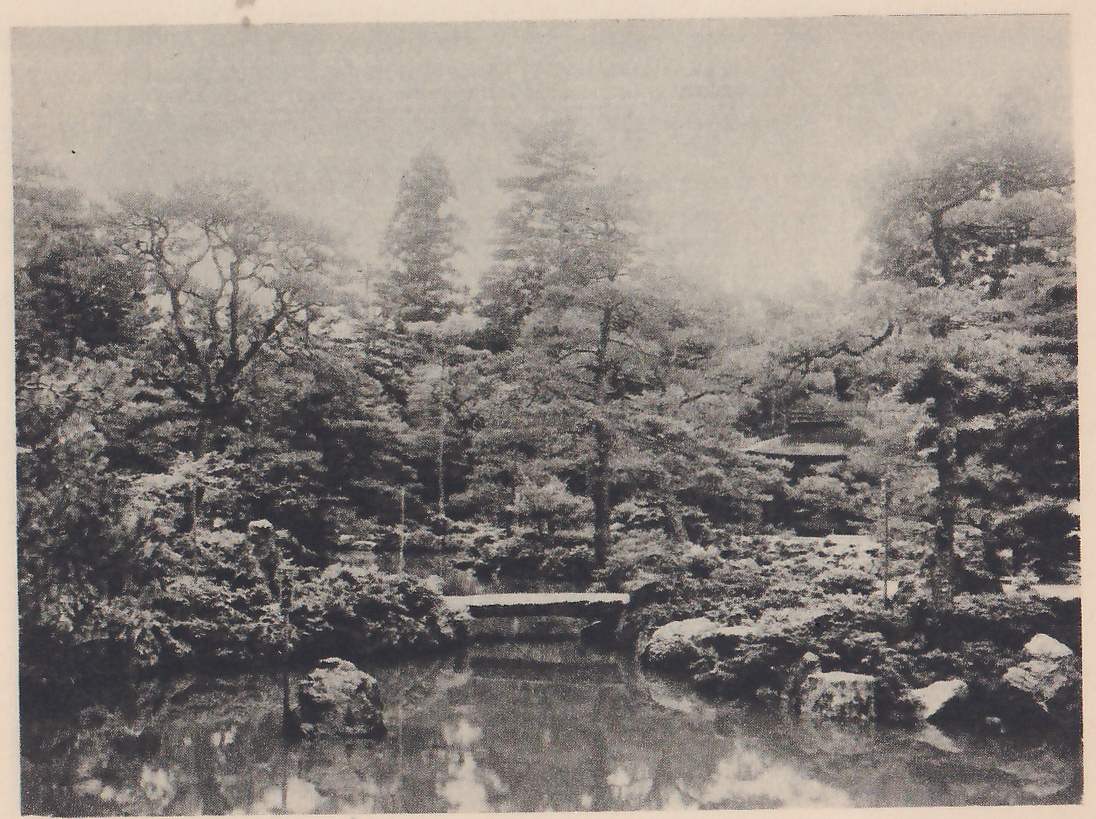
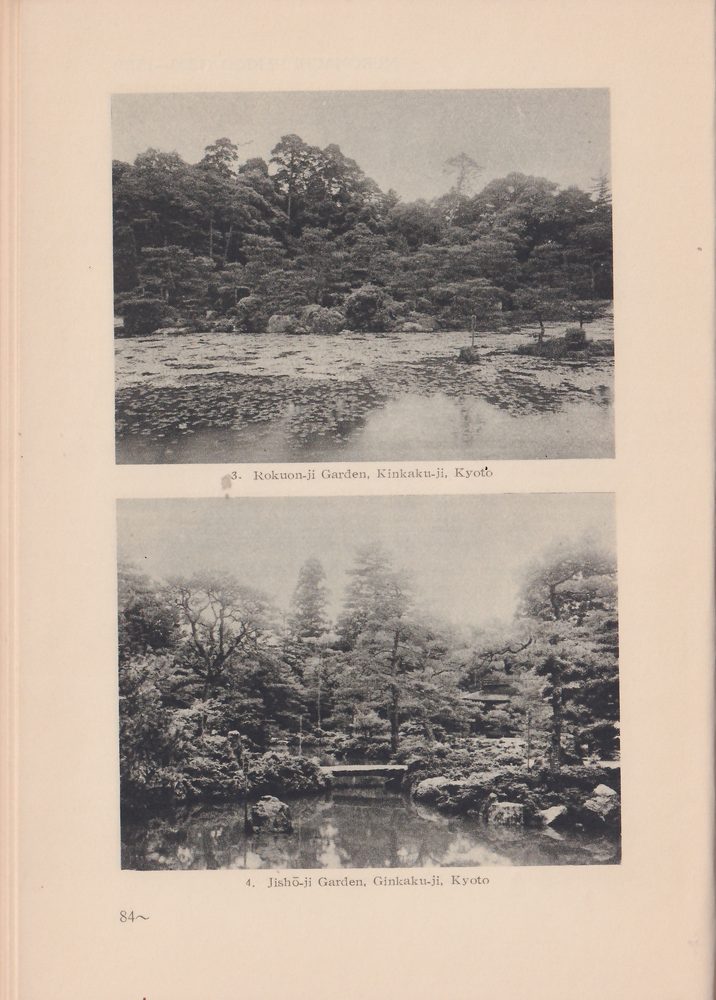
4. Jishō-ji Garden, Ginkaku-ji, Kyoto
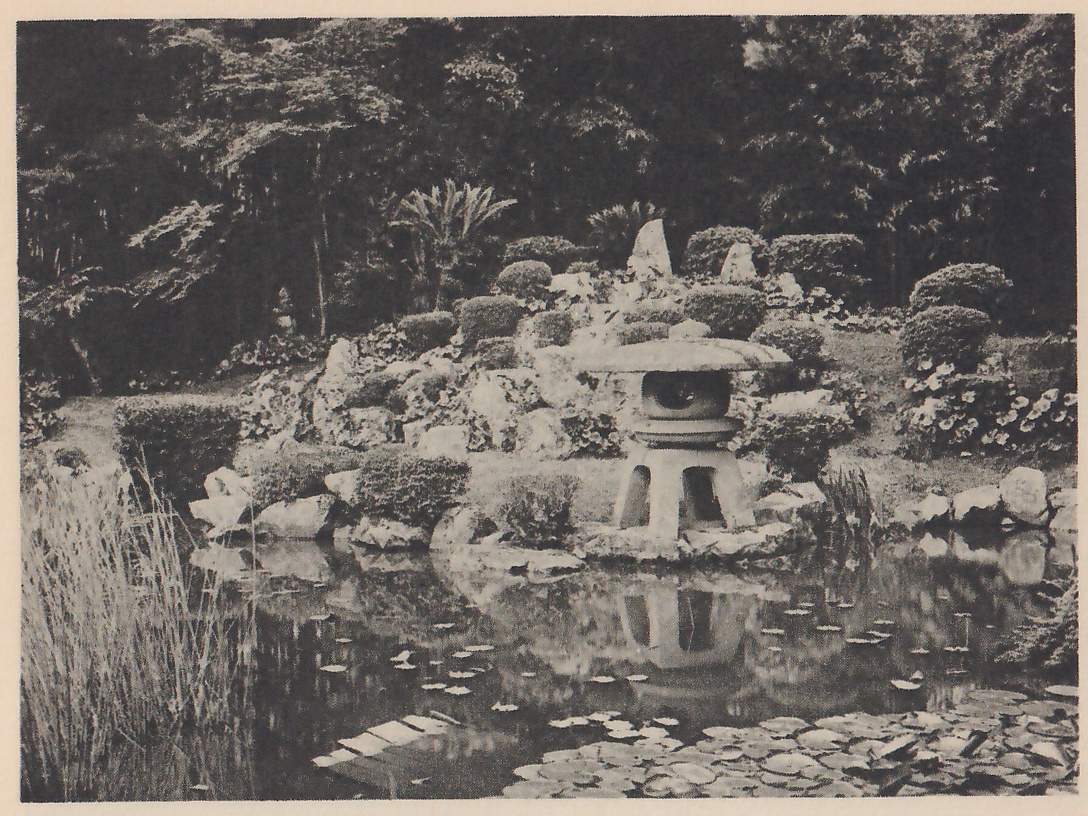
Built by Yoshimasa, the eighth of the Ashikaga Shōguns, in imitation of the Saihō-ji Garden. The pond and the mountain in the background are in beautiful harmony. It is the best preserved of the gardens belonging to the same period. Noteworthy are the stone grouping, stone bridges, and the waterfall.
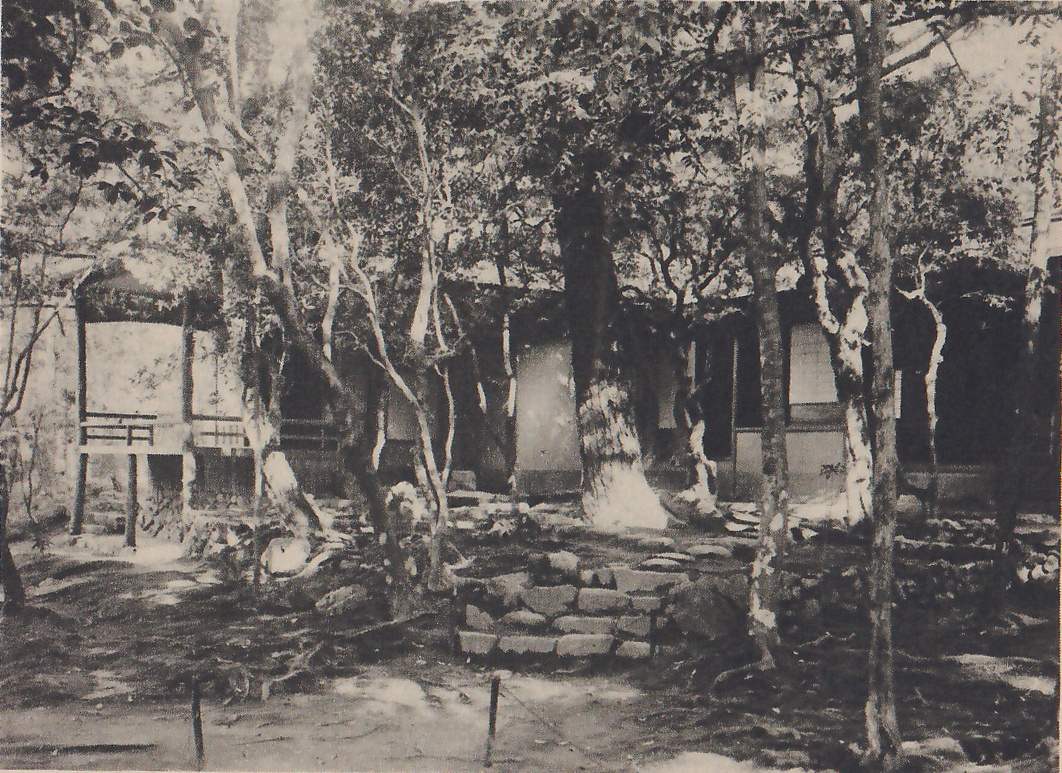
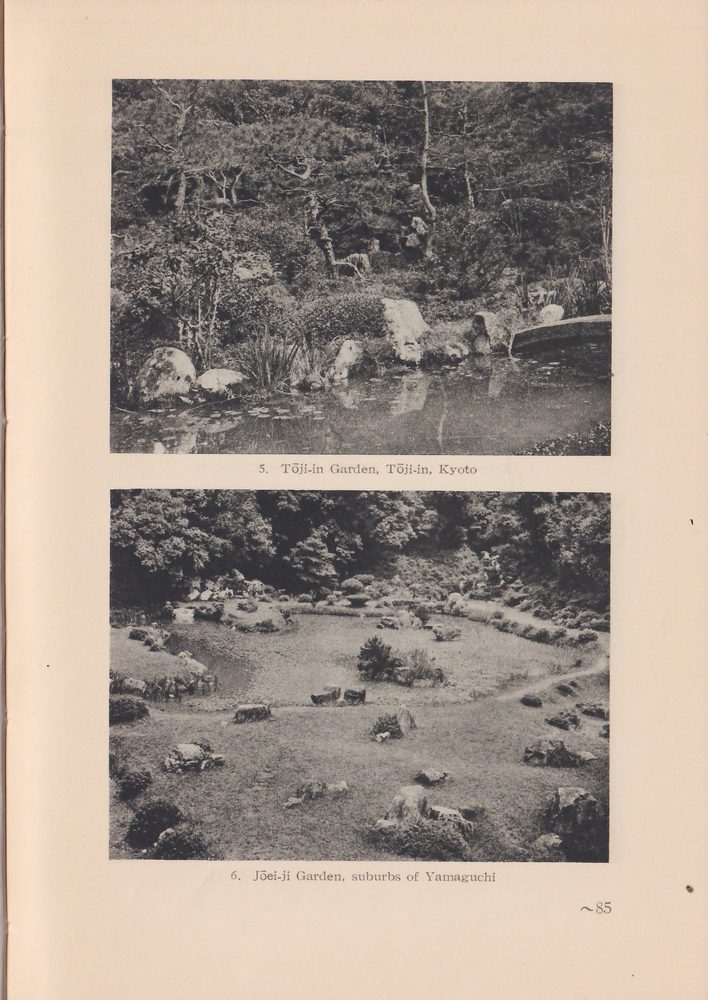
5. Tōji-in Garden, Tōji-in, Kyoto
Originally designed and executed by Musō Kokushi; later modified by Sōami. Very much out of repair, but the shape of the pond and the details of its stone grouping retain their original form. The rest-house—“Seiren-tei”—is noted for its design by Yoshimasa himself.
6. Jōei-ji Garden, Miyano-mura, Yoshiki-gun, Yamaguchi Prefecture
Tradition attributes the garden to Ōuchi Masahiro, who is said to have modelled it after the
Rokuon-ji Garden in Kyoto. Designed and executed by Sesshū, the famous priest-painter. The garden was originally attached to a villa, which no longer exists. Both the pond and the background are in Kyoto style.
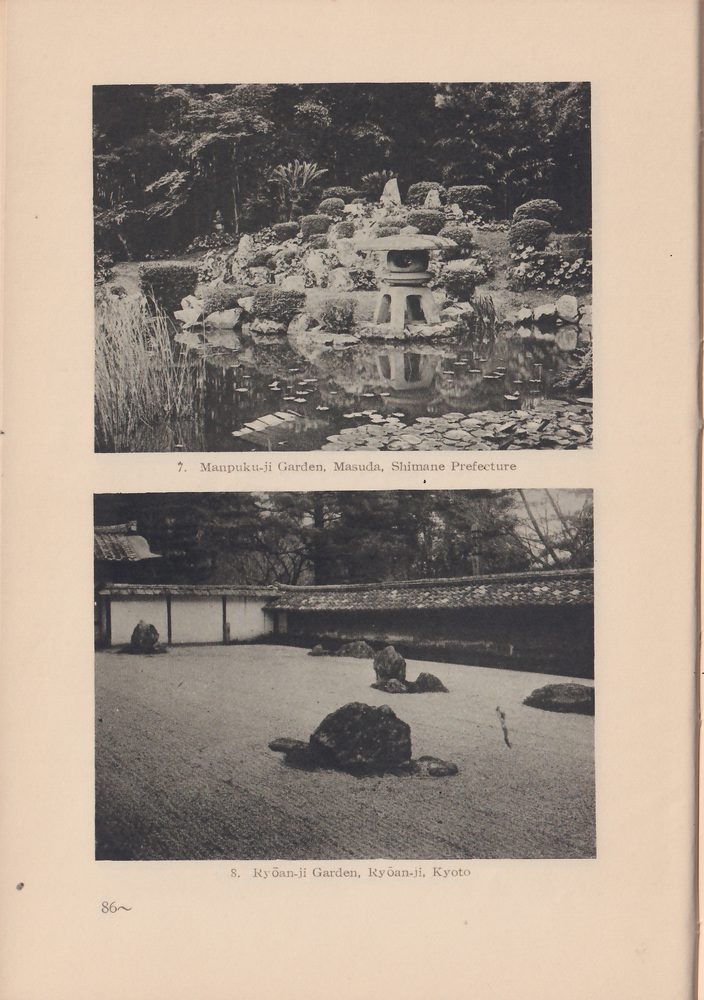
7. Manpuku-ji Garden, Masuda-machi, Mino-gun, Shimane Prefecture
Attributed to Sesshū. It has a pond and an artificial hill. Stone grouping is of considerable merit.
8. Ryōan-ji Garden, Ryōan-ji, Kyoto
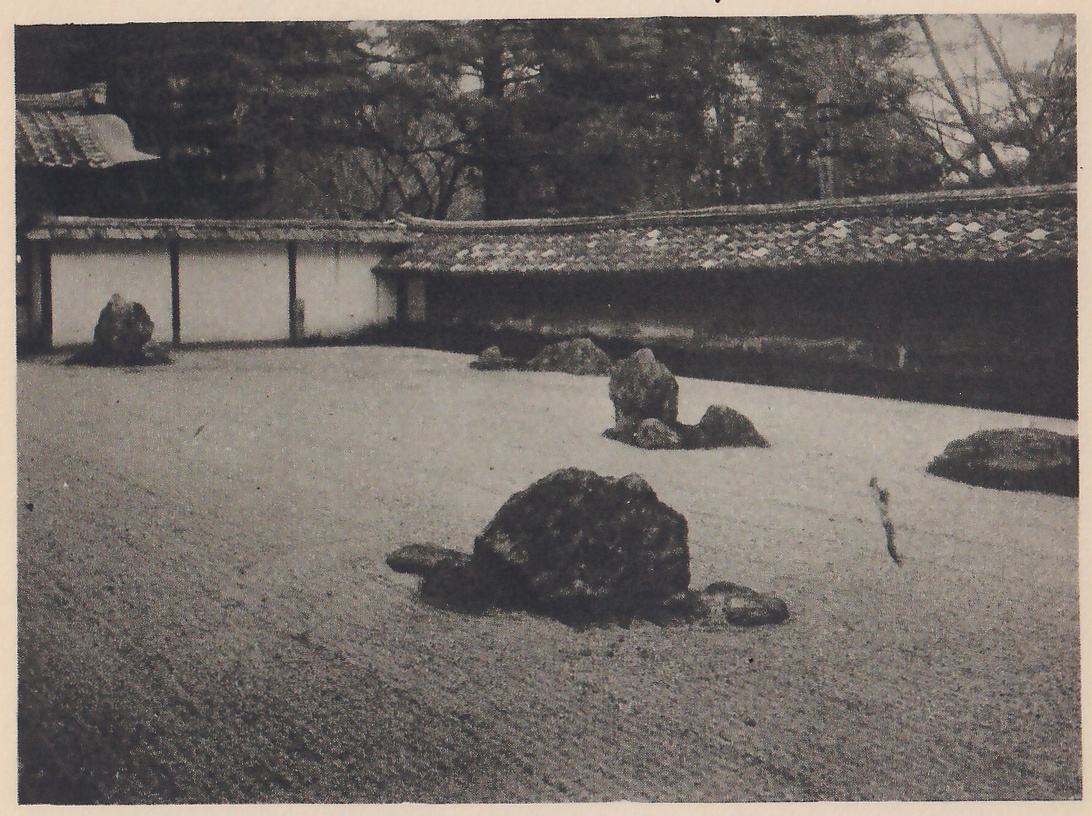
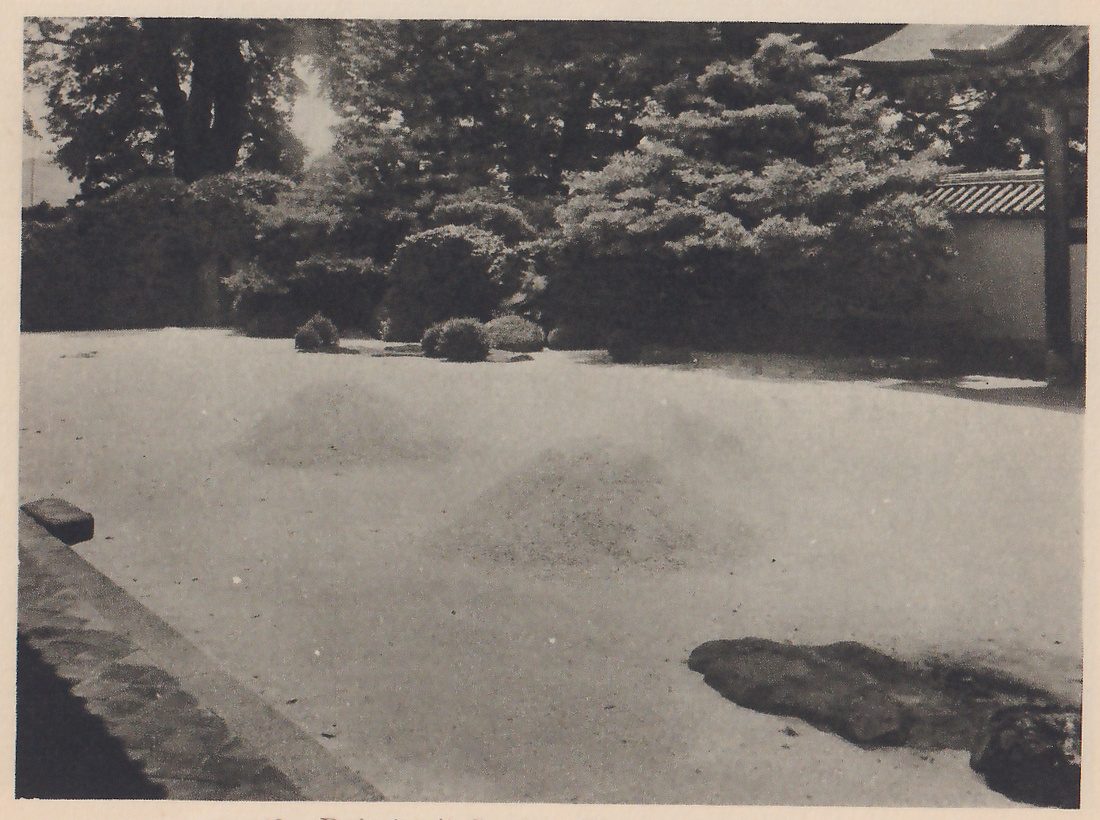
A flat garden, oblong in shape, enclosed by earthwork walls. Five groups of either two, three or five stones, totalling fifteen stones in all, are arranged, and white sand spread over the whole ground. The ensemble suggests a “tray landscape.” Attributed to Sōami.
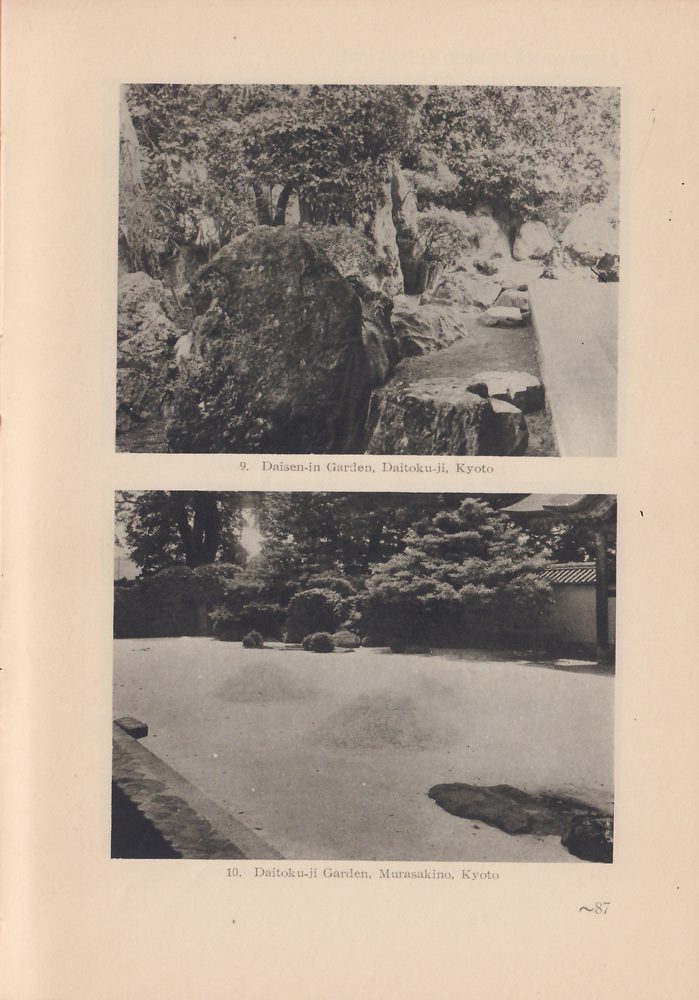
9. Daisen-in Garden, Daitoku-ji, Kyoto
A small garden attached to a study. A stream, a bridge, a waterfall, and a pond—these are all here, but no water. It may be described as a monochrome picture with three dimensions—a picture of the Chinese school in vogue in the days of Sōami, to whose ingenuity the garden is attributed.
10. Daitoku-ji Garden, Murasakino, Kyoto
This is situated south of the superior’s quarters at Daitoku-ji; a flat garden with a pair of stones in
a corner simulating the exit of a waterfall, and white sand spread all over the ground. Typical of the Zen-temple gardens of the Muromachi Period. The tradition of the temple attributes the garden to the priest Tenyū.
MOMOYAMA GARDENS
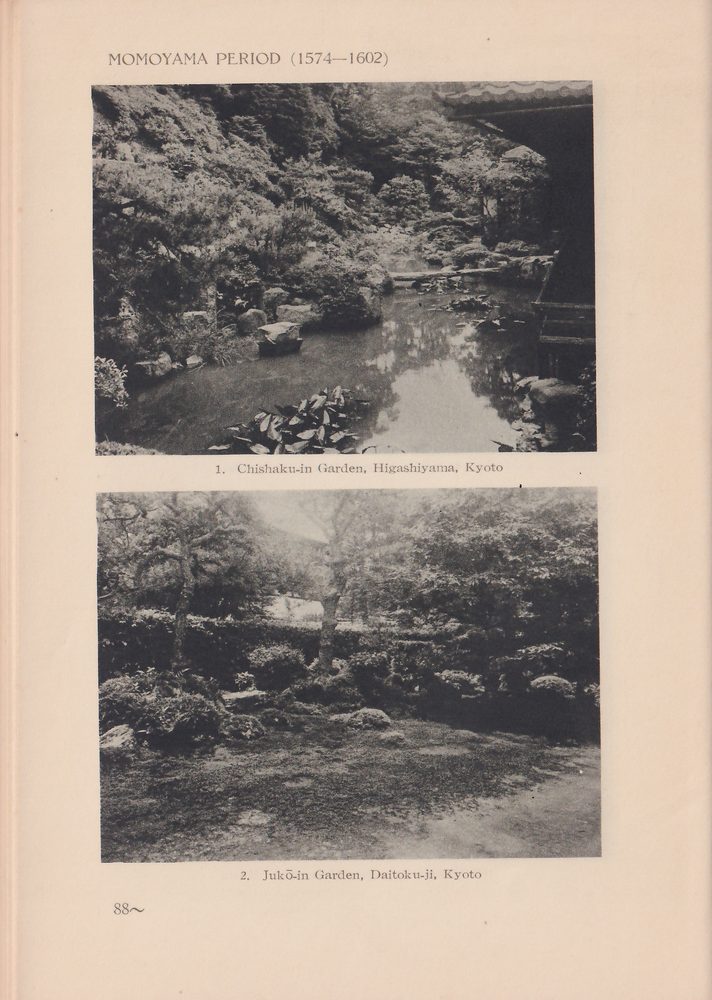
1. Chishaku-in Garden, Higashiyama, Kyoto
The garden has a pond stretching from north to south along the base of Higashiyama, on the side of which it is situated. It is chiefly intended for viewing. Old types are seen in the stone bridges. Attributed to Sen-no-Rikyū, the representative master of the tea ceremony in the Momoyama Period.
2. Jukō-in Garden, Daitoku-ji, Kyoto
Designed by Sen-no-Rikyū, according to tradition. An elegant flat garden presenting a picturesque view. Rikyū was buried in the graveyard of this temple.
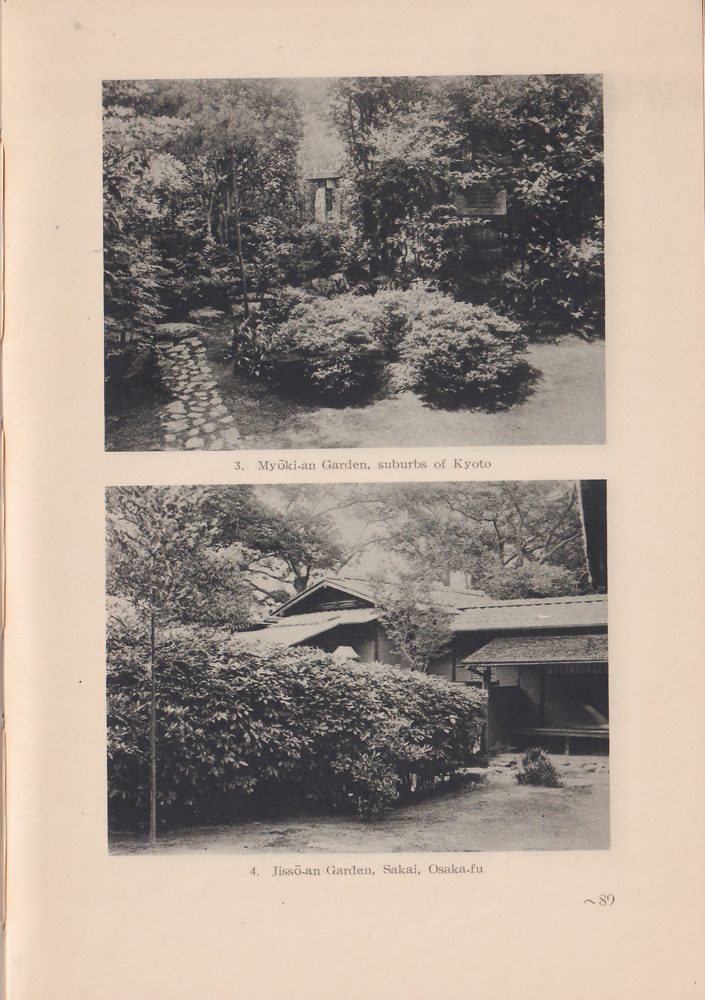
3. Myōki-an Garden, Ōyamazaki-mura, Kyoto-fu
A tea-garden said to have been constructed by Rikyū. A tea-house is still to be seen here. The stepping-stones and water-basin are plain and simple, as practical use was their purpose. Eminently esthetic and typical of the tea-garden of the Momoyama Period.
4. Jissō-an Garden, Nanshū-ji, Sakai, Osaka-fu
Transferred in the Meiji Era from another place in Sakai to the present site. The tea-garden preserves its original condition. Objects of interest: a water-basin in the shape of a kesa (surplice) and a stone lantern representing “Rokujizō,” a guardian deity of children symbolizing the six states of existence.
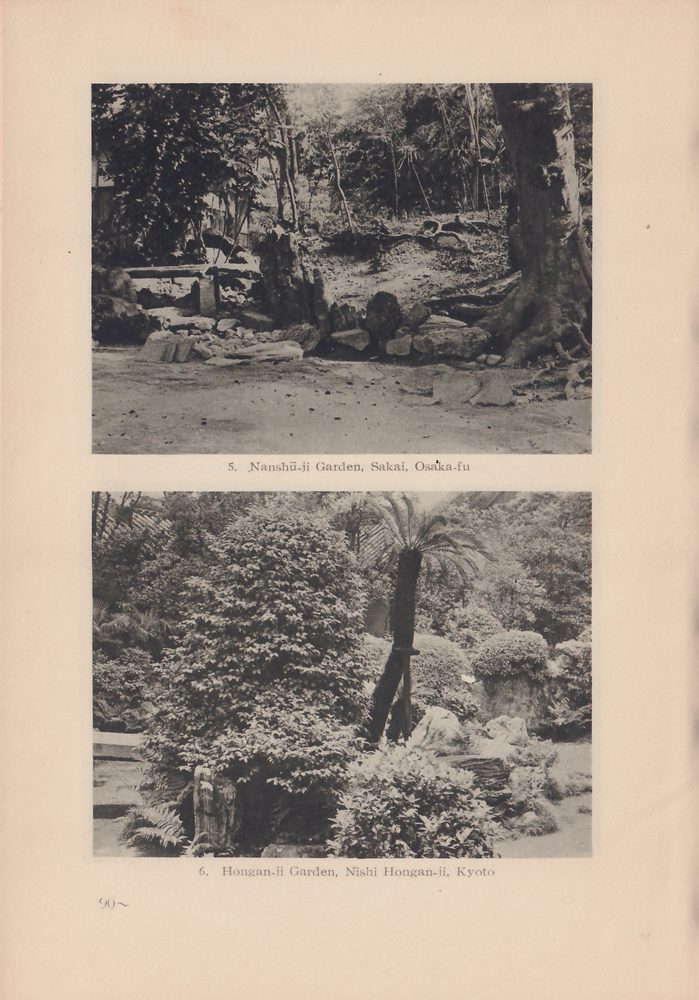
5. Nanshū-ji Garden, Minamihatago-chō, Sakai, Osaka-fu
The garden belonging to the superior’s quarters is a flat one designed chiefly for viewing. Attributed to Furuta Oribenoshō. The stone and bridge are fine specimens.
6. Hongan-ji Garden, Nishi Hongan-ji, Kyoto
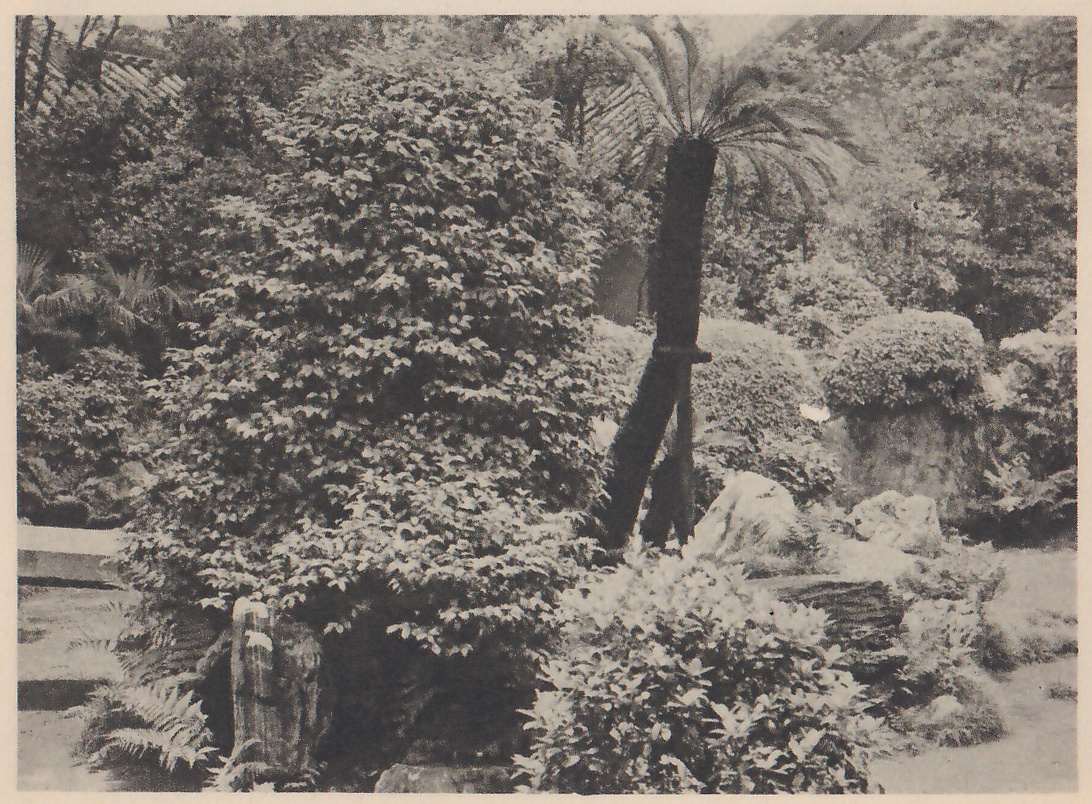
This typical castle garden was brought together with the building, from Fushimi Castle, in the Edo Period. The garden, which forms a courtyard, is complicated, as it is chiefly designed to please the eye. The characteristics of the period are plainly shown in the massive stones that make up the exit of a waterfall and the large granite bridges. In former days the garden was planted with a number of sotetsu (cycads). It is attributed to Asagiri Shimanosuke, a Fushimi gardener, according to tradition.
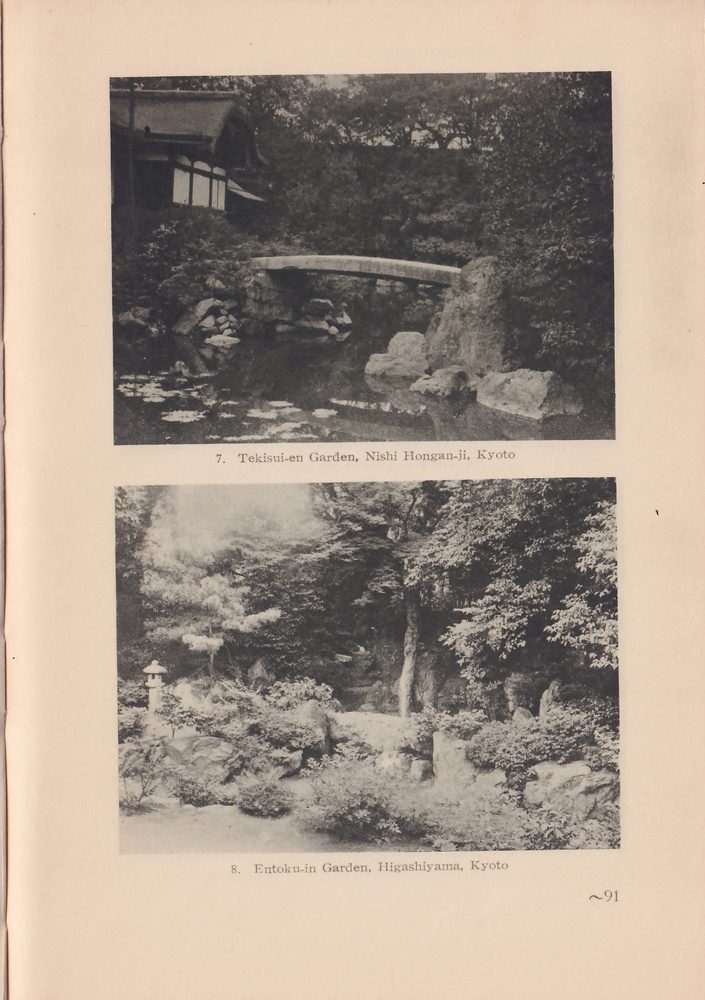
7. Tekisui-en Garden, Nishi Hongan-ji, Kyoto
This garden was transferred with the Hiunkaku
Pavilion from the Jurakudai Palace, the handsome palace of the Taikō. A large granite bridge and the bold stone grouping on the edge of the pond are eloquent reminders of the days of the great chieftain. The stone lanterns and water-basins date back to the Momoyama Period.
8. Entoku-in Garden, Higashiyama, Kyoto
A middle-sized garden with a pond as the central feature. Stones forming the fall exit and the edge of pond are of great size, as are also those used for the building of the bridge. There are indications to support the belief that the garden originally belonged to Fushimi Castle.
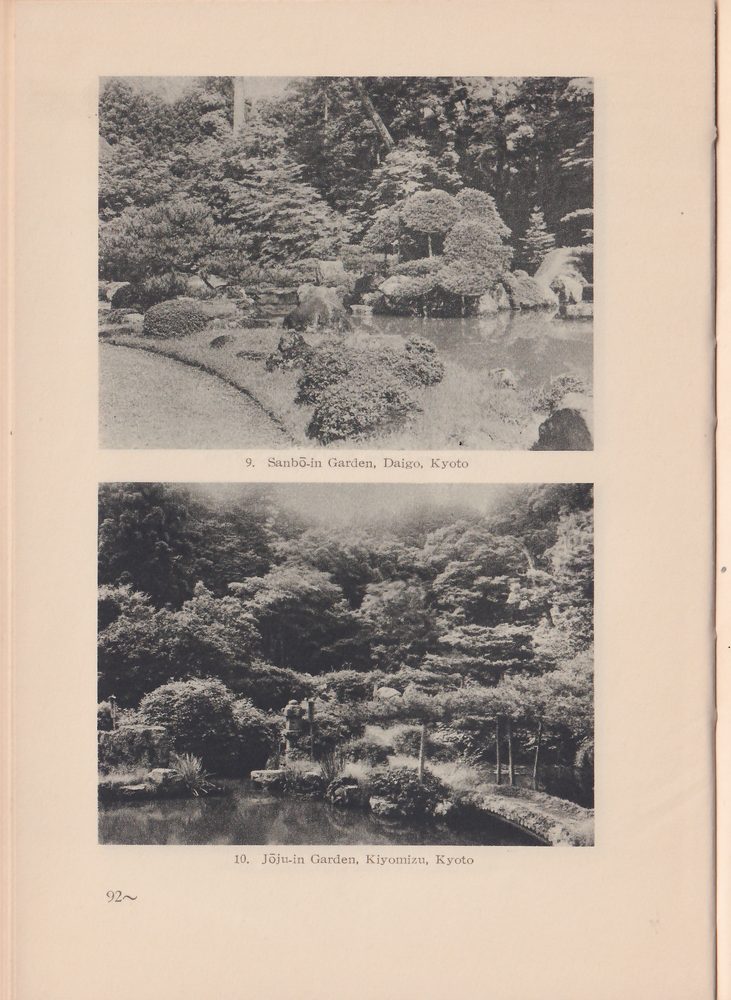
9. Sanbō-in Garden, Daigo, Kyoto
This garden is on the largest scale of the Momoyama gardens that have been preserved to this day. It is designed to be viewed from the adjoining edifice. The pond contains several islands, which are connected by various bridges of interesting design, whence a distant view of the fall is obtained. It is perhaps without equal in the wealth of the stones used.
10. Jōju-in Garden, Kiyomizu, Kyoto
The garden is in the precincts of the Kiyomizu Temple, a well-known place in Kyoto. It is a small garden in which the natural features of the place are
taken advantage of. There is a pond, and the enclosure is marked off by the hedge, the adjoining woodland being deftly used to furnish a splendid background. Objects of interest are: a large water-basin, stone lanterns, and stepping-stone—relics associated with the name of Hideyoshi.
EDO GARDENS
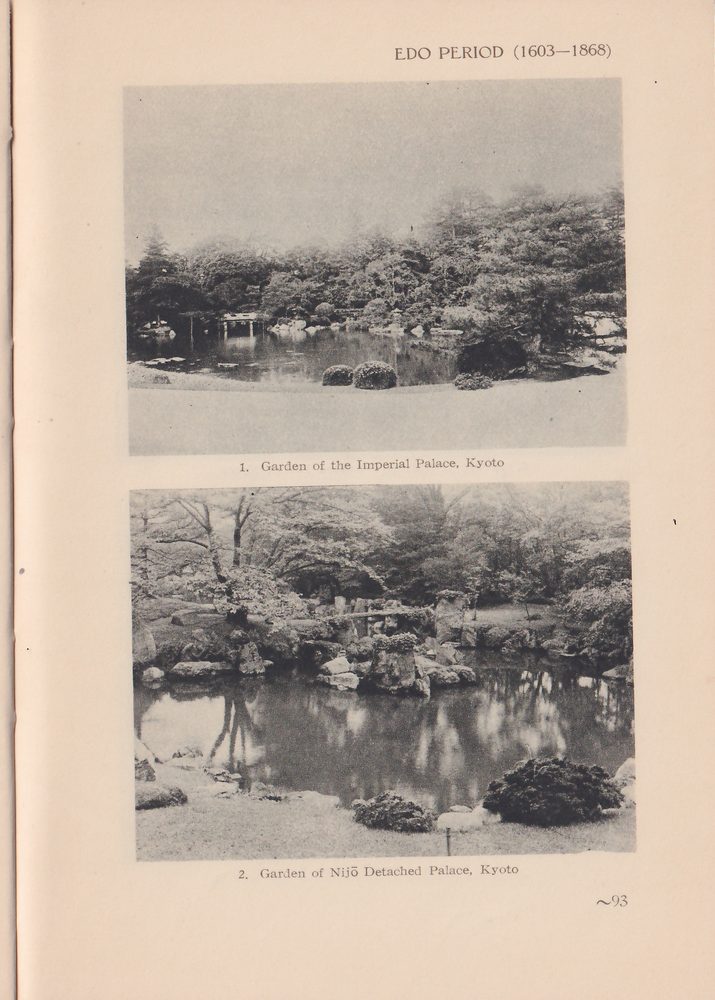
1. Garden of the Imperial Palace, Kyoto
Reconstructed after the fire of Ansei (1854–1859) toward the end of the Edo Period. The water is supplied from the River Kamo, and the garden belonging to Tsune-no-goten is a small one with stream, while Gogakumonsho is embellished with a large pond. The space between the pond and the edifice is covered with white sand. The garden is conspicuous for its dignity and elegance.
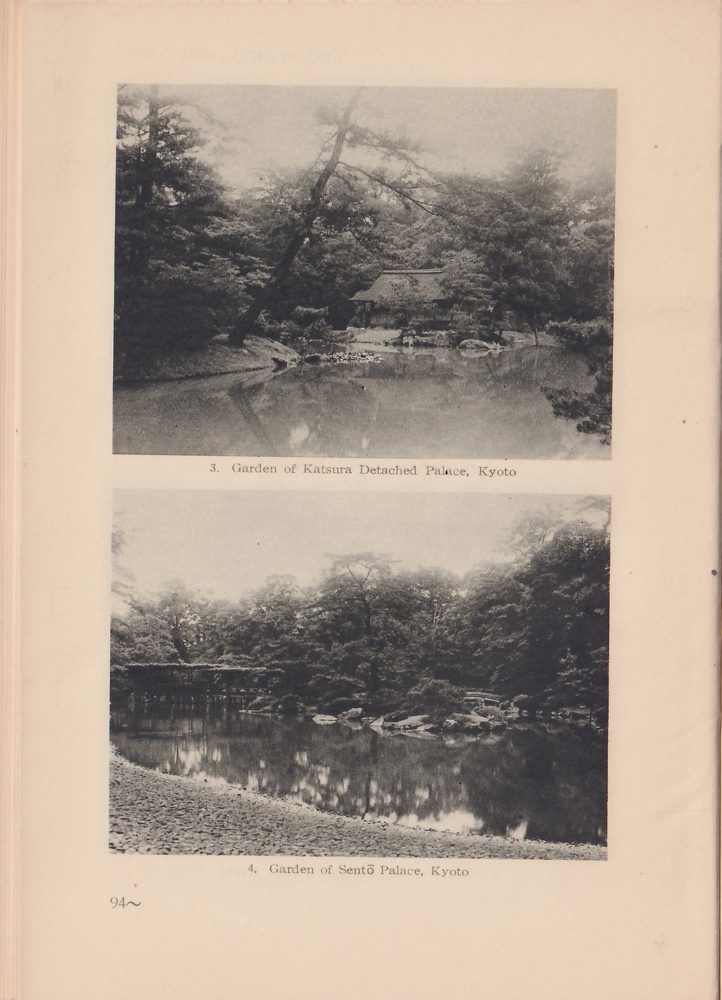
2. Garden of Nijō Detached Palace, Kyoto
Tradition says that this garden, which is said to be the work of Kobori Enshū, was made when the Jurakudai Palace of Hideyoshi was transferred here by Ieyasu in 1601. It is designed chiefly to appeal to the eye. Fine stones grouped around a pond are a notable feature. It has magnificence combined with strength, both in keeping with substantial castle architecture.
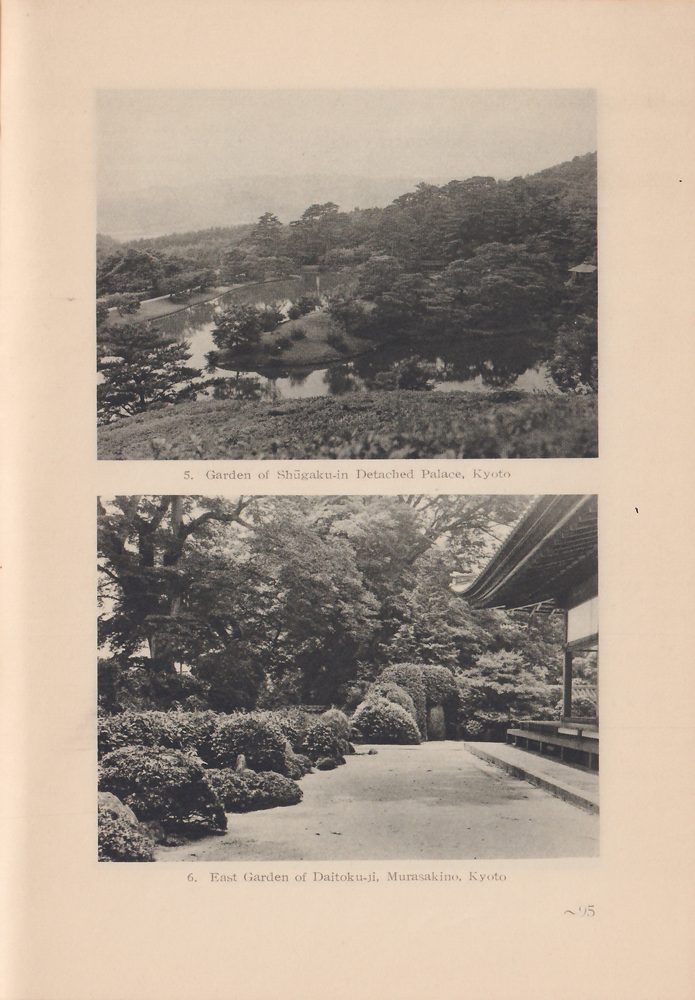
3. Garden of Katsura Detached Palace, Kyoto
Attributed to Kobori Enshū. It appears that the garden came to assume its present condition after repair during the first half of the 17th century. Natural features are entirely absent. The merit of the garden consists in the application of all the elements of the gardening technique known in the early years of the Edo Period. There is a typical “stroll garden” with a path connecting tea-houses, these paths being either studded with stepping-stones or protected by a pavement. Connection with the island is made by boat. In its excellence of planning the garden may safely be said to occupy first place among the famous historic gardens still in existence. To light up the paths, stone lanterns are used in abundance. Water-basins are of various shapes, but decoration is variably subordinated to utility.
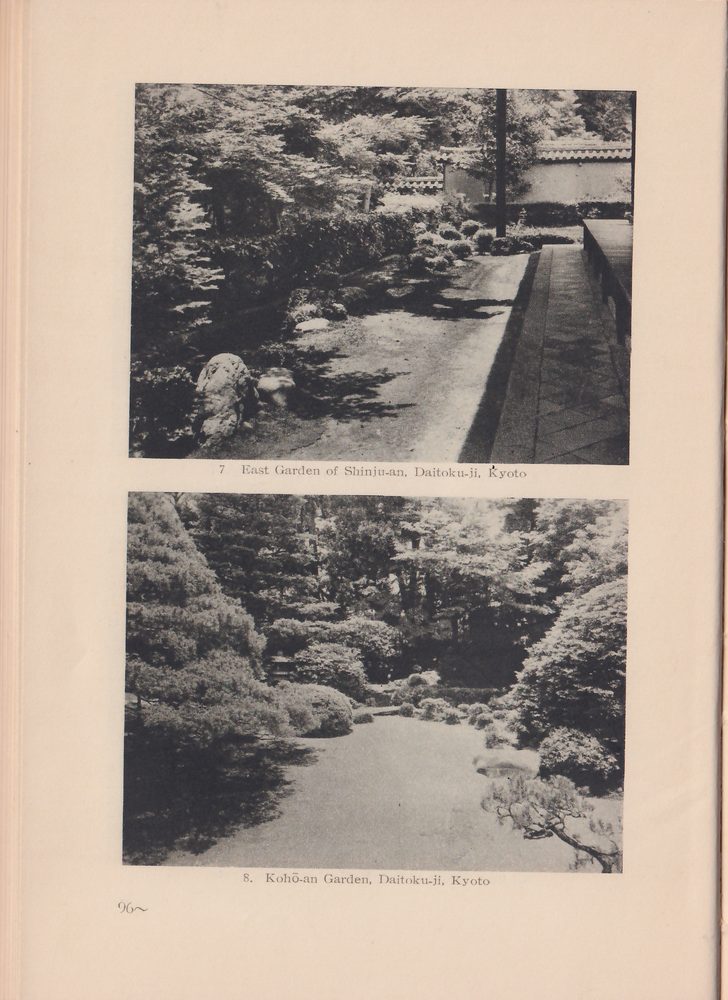
4. Garden of Sentō Palace, Kyoto
This “stroll garden” of the Enshū style is also attributed to Kobori Enshū, but it seems to belong to a later date. Extensive repairs are presumed to have been done to it in the middle of the Edo Period. There are two tea-houses.
5. Garden of Shūgakuin Detached Palace, Kyoto
The garden is now divided into three sections—
upper, middle and lower, which were originally separate gardens. Tradition says that in the making of the garden the instructions given by the retired Emperor Gomizunowo were followed throughout. The tea-houses in the middle and lower sections are very fine, though small in scale. The upper section, with a large pond in the centre, is designed for a stroll. It has an exquisite outlook because of its situation on the west foot of Mount Hiei. Many good specimens of stone lanterns and water-basins are to be found here.
6. East Garden of Daitoku-ji, Murasakino, Kyoto
This garden, which is oblong in shape, is situated east of the flat garden belonging to the superior’s quarters already mentioned. It is attributed to Kobori Enshū. There are a few small stones arranged before the verandah and with shrubs and a hedge behind. It is a “borrowed scenery” type in which the pine avenue on the River Kamo and Mount Hiei in the distance over the hedge are fancied to represent the pine grove of Miho and Mount Fuji.
7. East Garden of Shinju-an, Daitoku-ji, Kyoto
A flat garden similar to No. 6. The stone groups consisting of seven, five, and three respectively are so well known that the garden has acquired the fancy name of Shichi-go-san (Seven-five-three) Garden. It was constructed probably later than No. 6.
8. Kohō-anPrinted: Kōho-an Garden, Daitoku-ji, Kyoto
A flat garden attributed to Kobori Enshū. It is a miniature of the Eight Beauties of Ōmi to be viewed from the study, and is graceful and picturesque in effect. There are a tea-garden and some garden fixtures of interest. The gate called “Amigasa-mon” facing the main temple is well known. In the graveyard is the tomb of the designer.
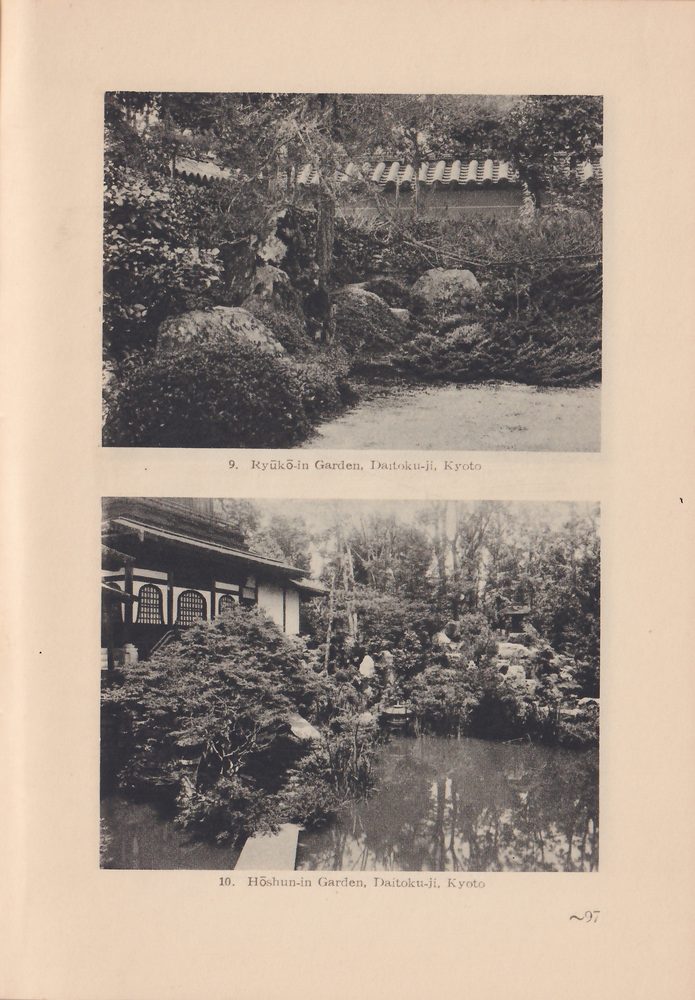
9. Ryūkō-in Garden, Daitoku-ji, Kyoto
This is also the work of Kobori Enshū. The garden has an old lantern of Korean make, which is much prized by garden lovers.
10. Hōshun-in Garden, Daitoku-ji, Kyoto
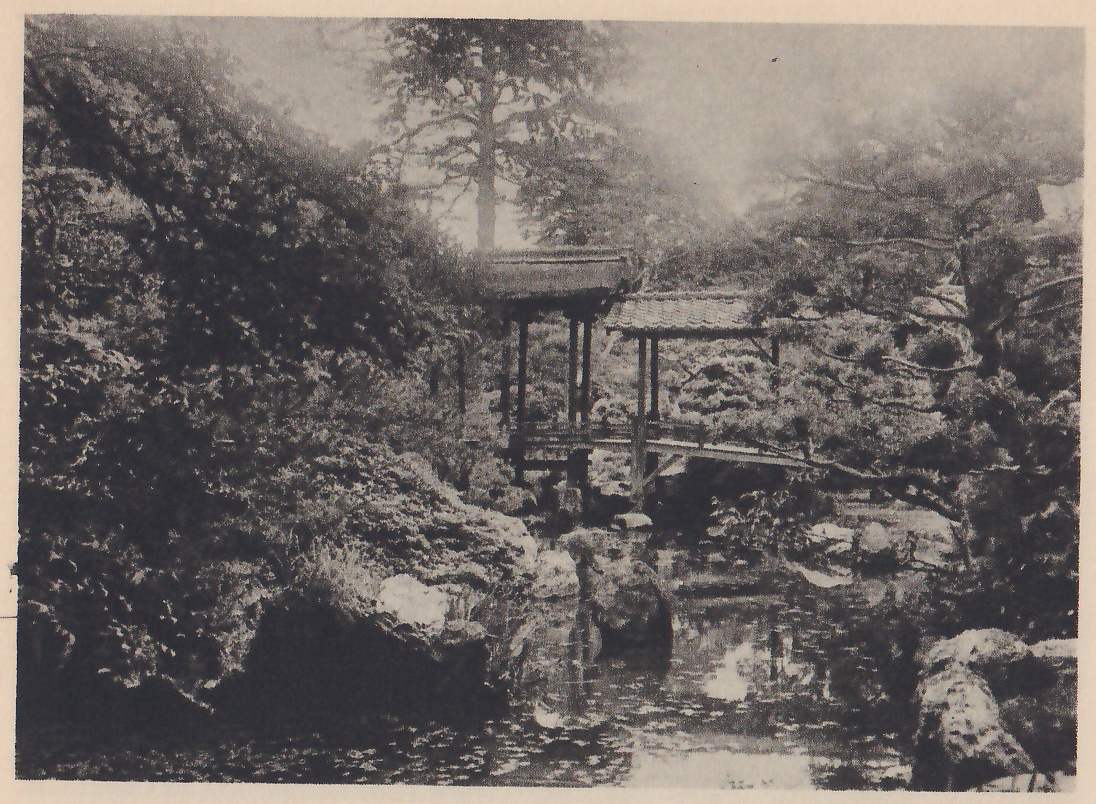
The garden in its present state is the one reconstructed in the latter part of the 18th century. In the two-storied pavilion “Tonko-kaku” and the bridge in the form of a roofed verandah called “Chōgetsu-kyō” are to be seen features of old-time design.
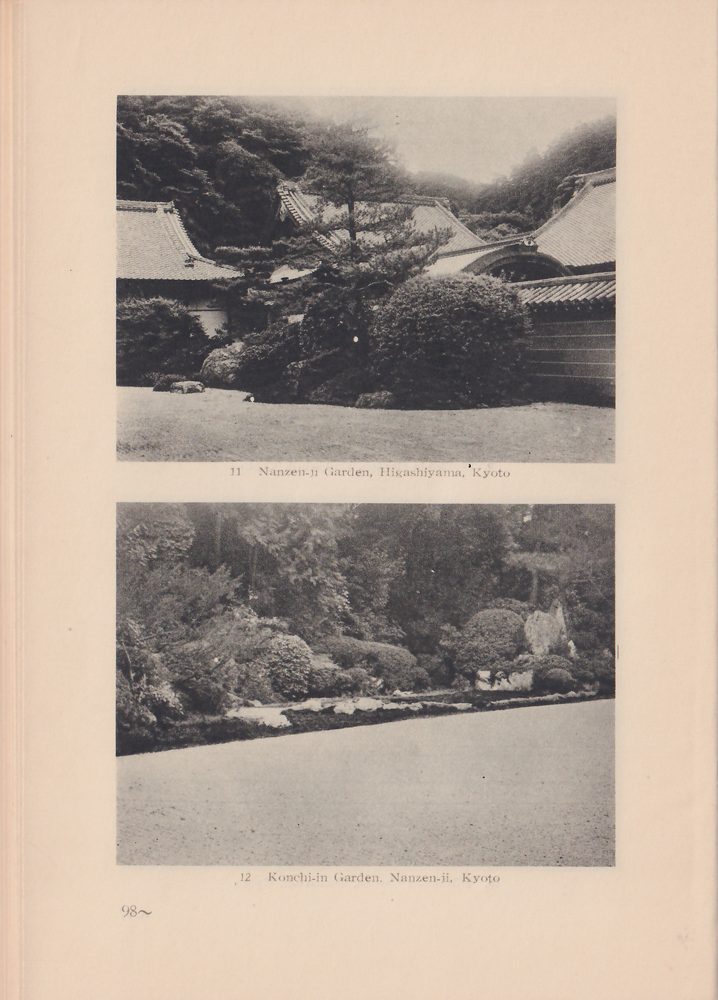
11. Nanzen-ji Garden, Higashiyama, Kyoto
This garden belongs to the abbot’s higher class living quarters. Though the edifice is of pure old Japanese style called Shinden-zukuri, the garden is a flat garden of the Edo Period, said to be the work
of Kobori Enshū. The general impression is that of a “tray landscape” with stones, trees, and white sand artistically combined.
12. Konchi-in Garden, Nanzen-ji, Kyoto
A flat garden attributed to Kobori Enshū. A “pond”—a hollow space without water—is made in front with a pair of stone groups, the one shaped like a crane and the other like a tortoise, on right and left respectively. These stone groups are combined with trees. The representation of nature is much conventionalized and produces a remarkable artistic effect. The ground is covered throughout with white sand.
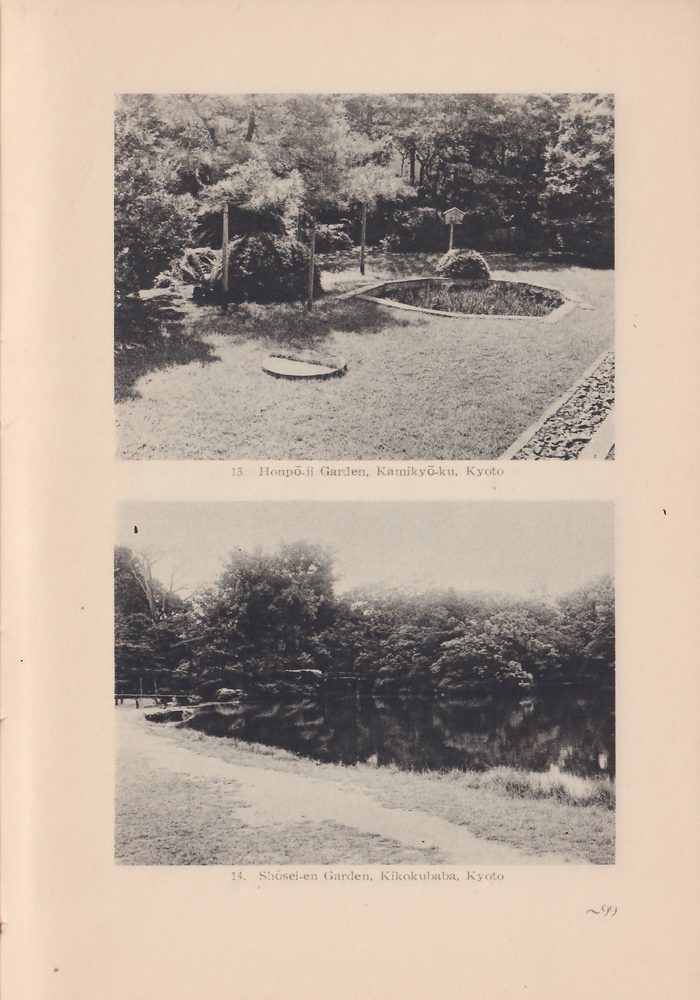
13. Honpō-ji Garden, Kamikyō-ku, Kyoto
A flat garden attributed to Hon-ami Kōetsu. The pond is designed after the shape of yatsuhashi or the eight-planked bridge, and the light-planked bridge is conventionalized for romantic effect. A deviation from the usual practice is seen by including a lawn where white sand is usually spread.
14. Shōsei-en Garden, Kikokubaba, Kyoto
Tradition says that this, a stroll garden of the Enshū style, was constructed by Ishikawa Jōzan by order of Sennyo Shōnin. A large pond with its many islands is a notable feature. There are tea-houses
scattered about the garden. The edifices bear the stamp of the designer’s originality.
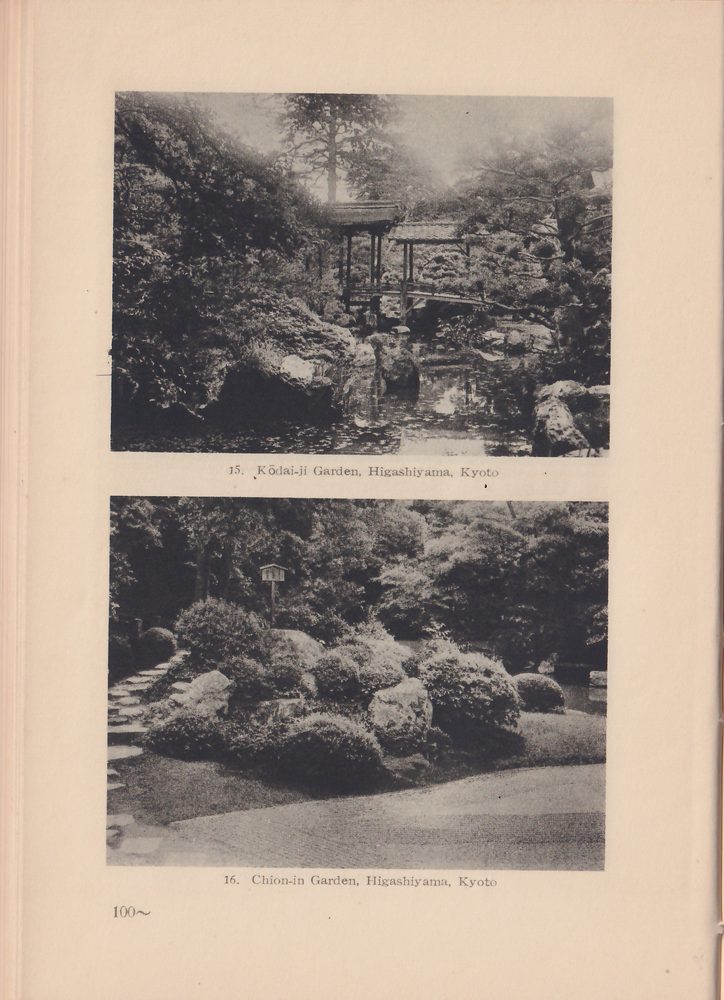
15. Kōdai-ji Garden, Higashiyama, Kyoto
This garden, said to be the work of Kobori Enshū, is built on the slope at the foot of Higashiyama. On the hill are found two tea-houses transferred from Fushimi Castle of Hideyoshi—“Shigure-tei” and “Karakasa-tei”—and some other edifices of historic interest.
16. Chion-in Garden, Higashiyama, Kyoto
Kobori Enshū is said to be the designer of this garden at the foot of Higashiyama. A pond adjoins the building, and the general effect is pronounced a great success as a scenic garden.
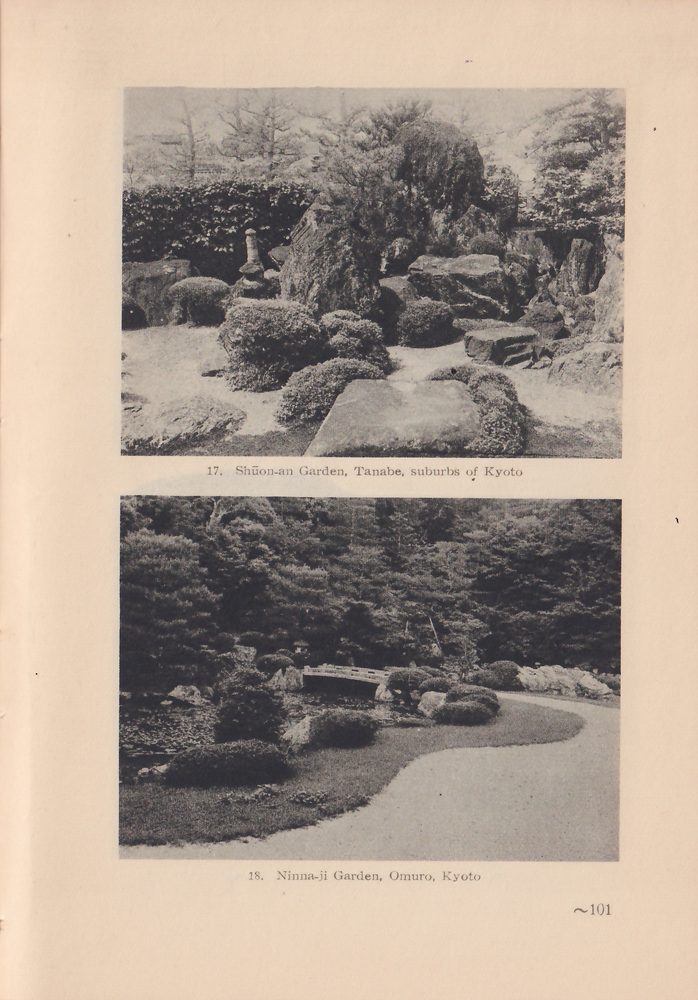
17. Shūon-an Garden, Tanabe-machi, Kyoto-fu
A rock garden with stone arrangement in a small space and with a fine outlook towards the north. According to tradition, it is the joint production of Sakawada Kiroku, Shōkadō, and Ishikawa Jōzan.
18. Ninna-ji Garden, Omuro, Kyoto
This scenic garden has a natural hill as its background, with a pond and a bridge. Two tea-houses—“Hitō-tei” and “Ryōkaku-tei”—are valued for their historic associations.
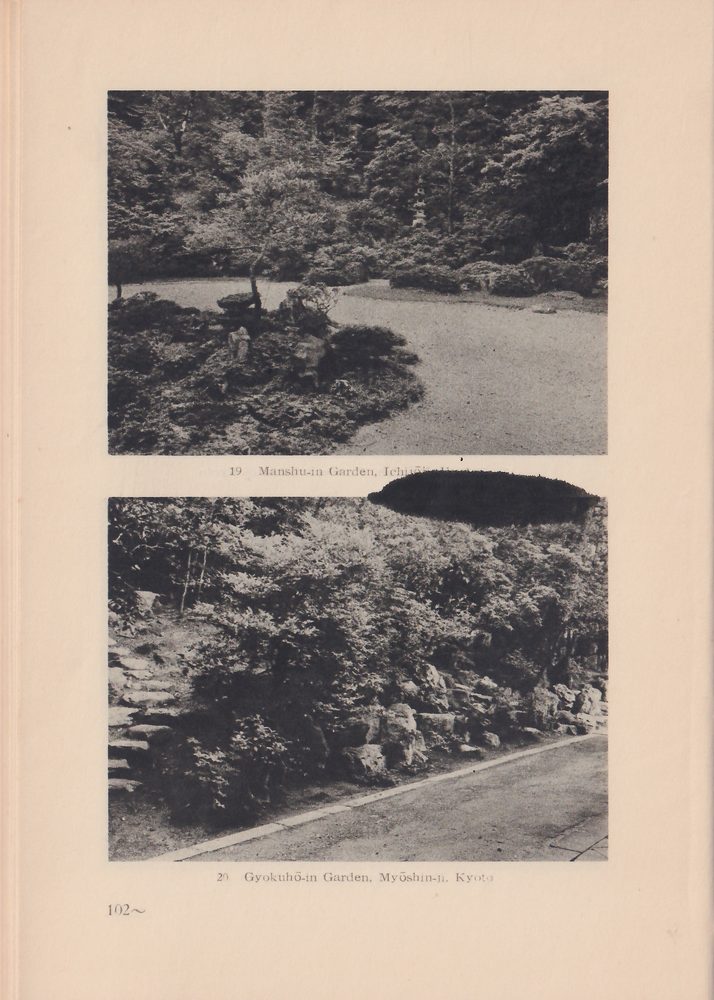
19. Manshu-in Garden, Ichijōji, Kyoto
This is a flat garden, extensive in scale and elaborate in design, attributed to Kobori Enshū, but with reserve. It contains some famous water-basins and stone lanterns.
20. Gyokuhō-in Garden, Myōshin-ji, Kyoto
This consists of two sections, very unconventional in design. The garden ornaments retain the original form dating from the mid-Edo Period.
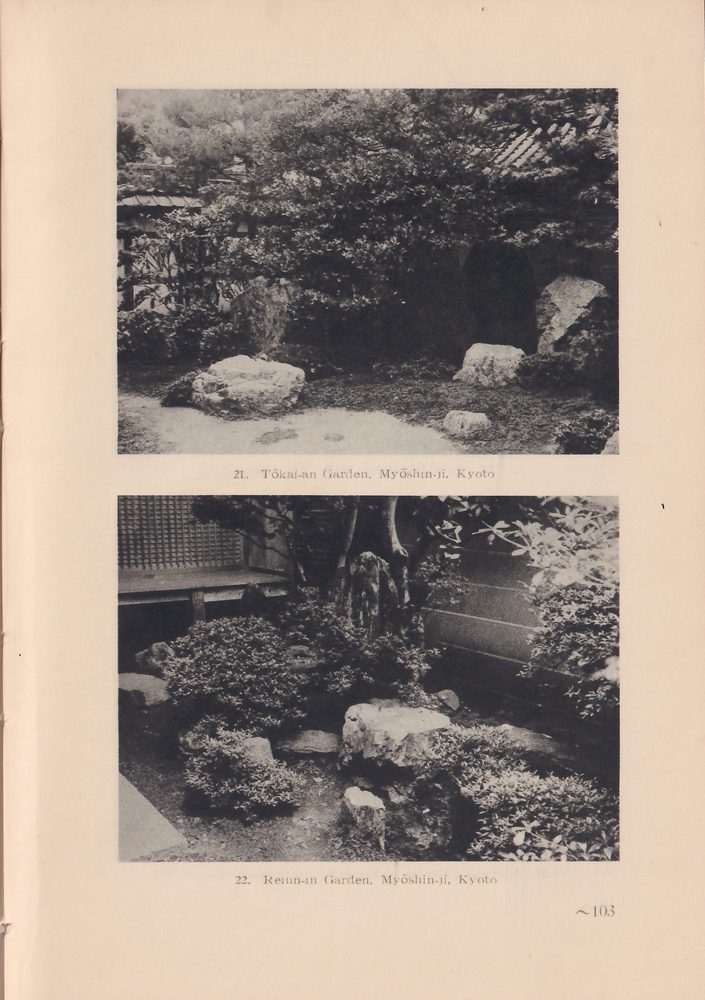
21. Tōkai-an Garden, Myōshin-ji, Kyoto
Built in 1814. The plan used in the execution of the garden is in the possession of the temple. This temple has also another flat garden with no decoration other than white sand spread all over—perhaps the most primitive type of a flat garden.
22. Reiun-in Garden, Myōshin-ji, Kyoto
An elegant little garden with a wealth of stones standing erect and characterized by their remarkable unity. It is supposed to have been built earlier than the mid-Edo Period.
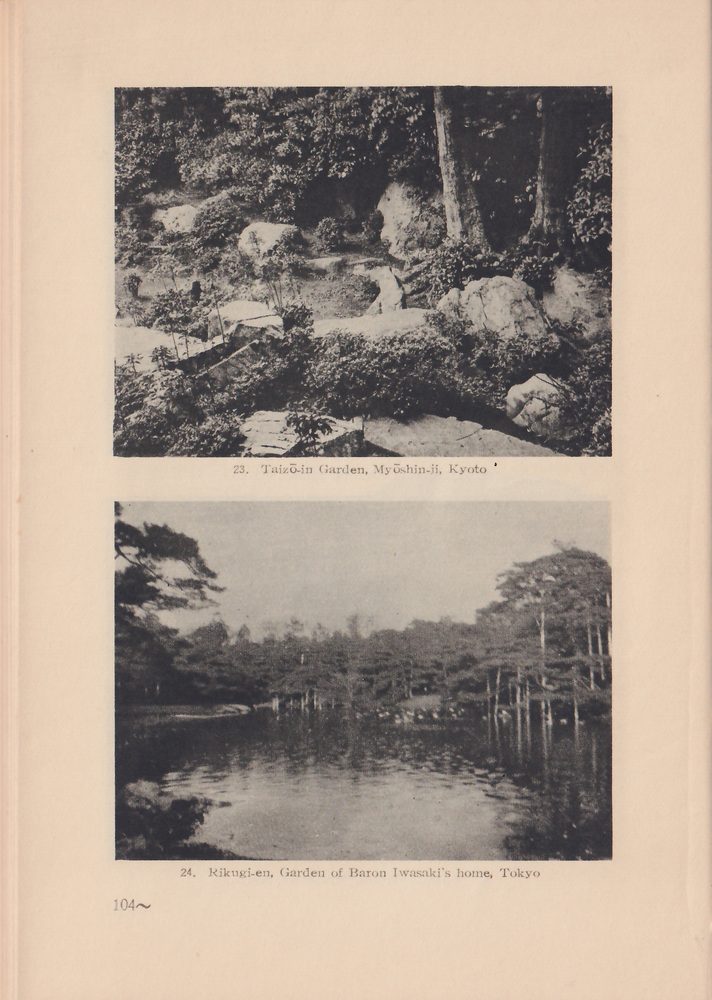
23. Taizō-in Garden, Myōshin-ji, Kyoto
Kano Motonobu, the well-known master painter, is said to be the designer of this garden. A dry pond
figures effectively in the landscape. The garden has undergone some later modification, but it may be pronounced as the finest of the Myōshin-ji Gardens.
24. Rikugi-en, Baron Iwasaki’s mansion, Hongō, Tokyo
This estate was formerly one of the homes of Yanagisawa Yoshiyasu, one of the feudal lords. The garden was made in the Genroku Period (1688–1703), and is of the “stroll-garden” type, with a pond as the centre of the composition. From the hill an extensive view of the garden and the region beyond may be commanded—a feature characteristic of the garden of the Edo Period.
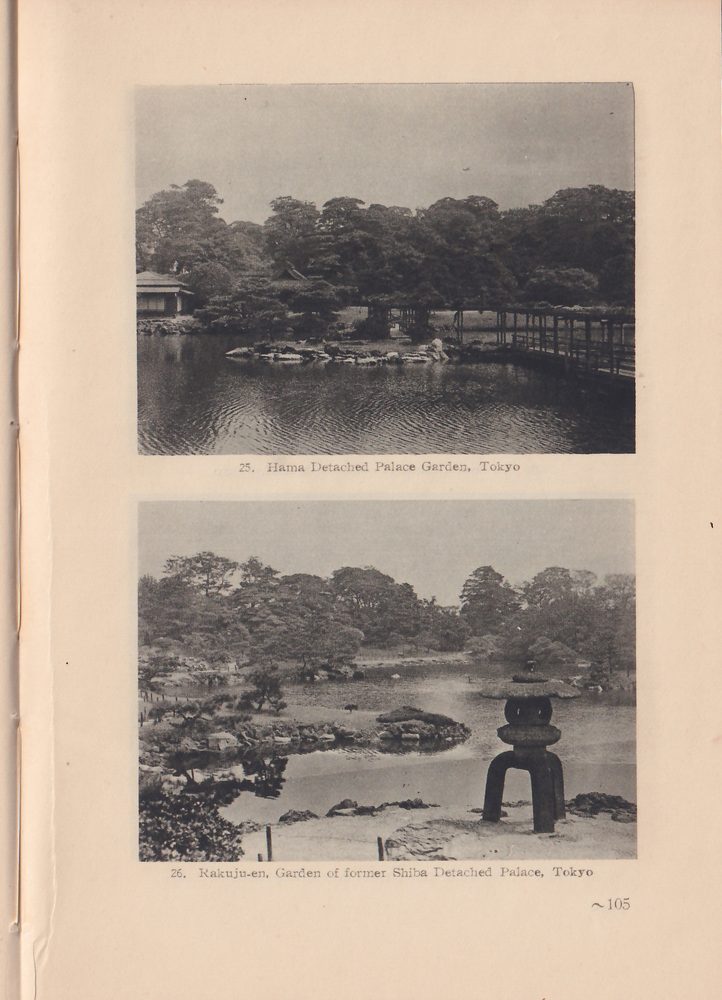
25. Hama Detached Palace Garden, Tsukiji, Tokyo
A spacious stroll garden with a tidal pond. The original was modified at the time of the eleventh Shōgun, Tokugawa Ienari.
26. Rakuju-en, Hamazakichō, Shiba, Tokyo
This was formerly the property of the Imperial Household, but was given to the City of Tokyo in 1924. The garden, similar in design to No. 25, was built by Ōkubo, the Lord of Odawara, in the last quarter of the 17th century.
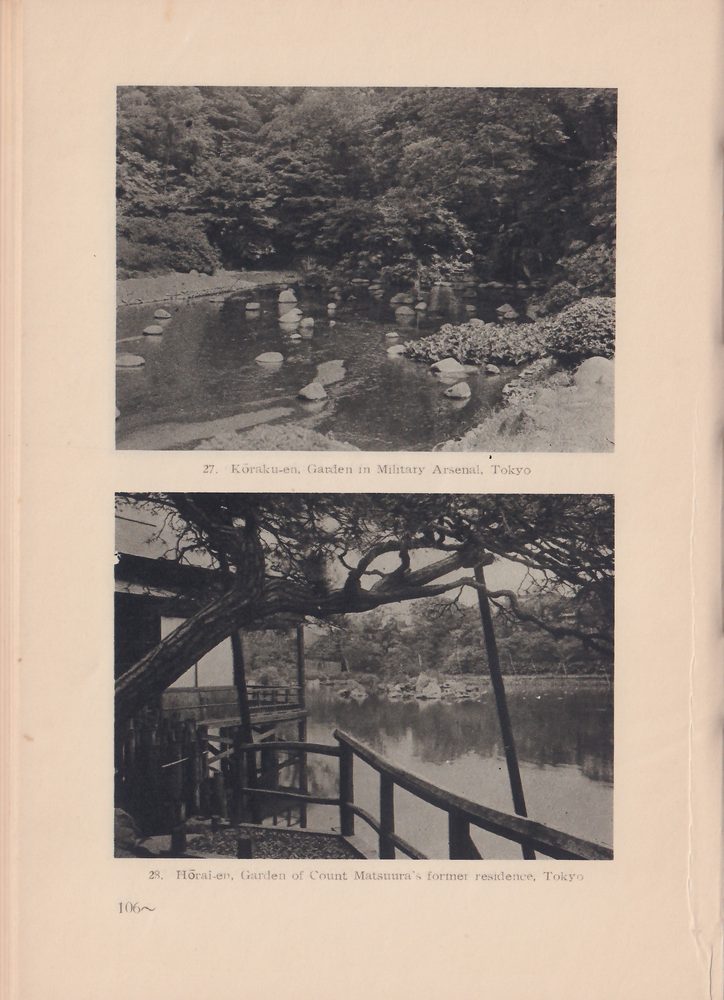
27. Kōraku-en, Military Arsenal, Koishikawa, Tokyo
The estate formerly belonged to the Lord of Mito. It is a “stroll garden” in which the natural features of the land are used to advantage. The water for the pond is drawn from the River Edo, which was formerly the source of Edo’s water-supply. The garden belongs to the early years of the Edo Period, and the deep interest in things Chinese taken by Tokugawa Mitsukuni, one of the most illustrious of the Tokugawa Family of Mito, had its influence in the design of the garden, in which, as is well known, Shu Shun Sui, the learned refugee from China under Mitsukuni’s patronage, also participated.
28. Hōrai-en, Count Matsuura’s former residence, Mukō-yanagiwara, Asakusa, Tokyo
This is a “stroll garden” with a tidal pond as the central feature. In the shape of the pond, and in several other details of the garden, the refined taste of the builder, Matsuura Shigenobu, is clearly in evidence.
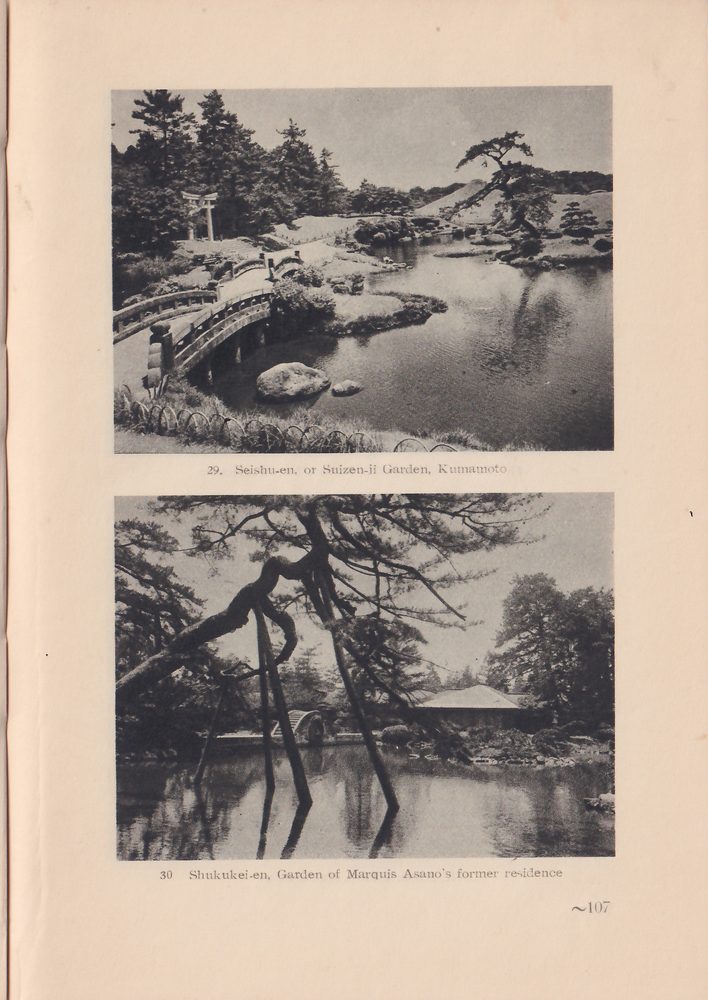
29. Seishu-en, or Suizen-ji Garden, Kumamoto, Kyūshū
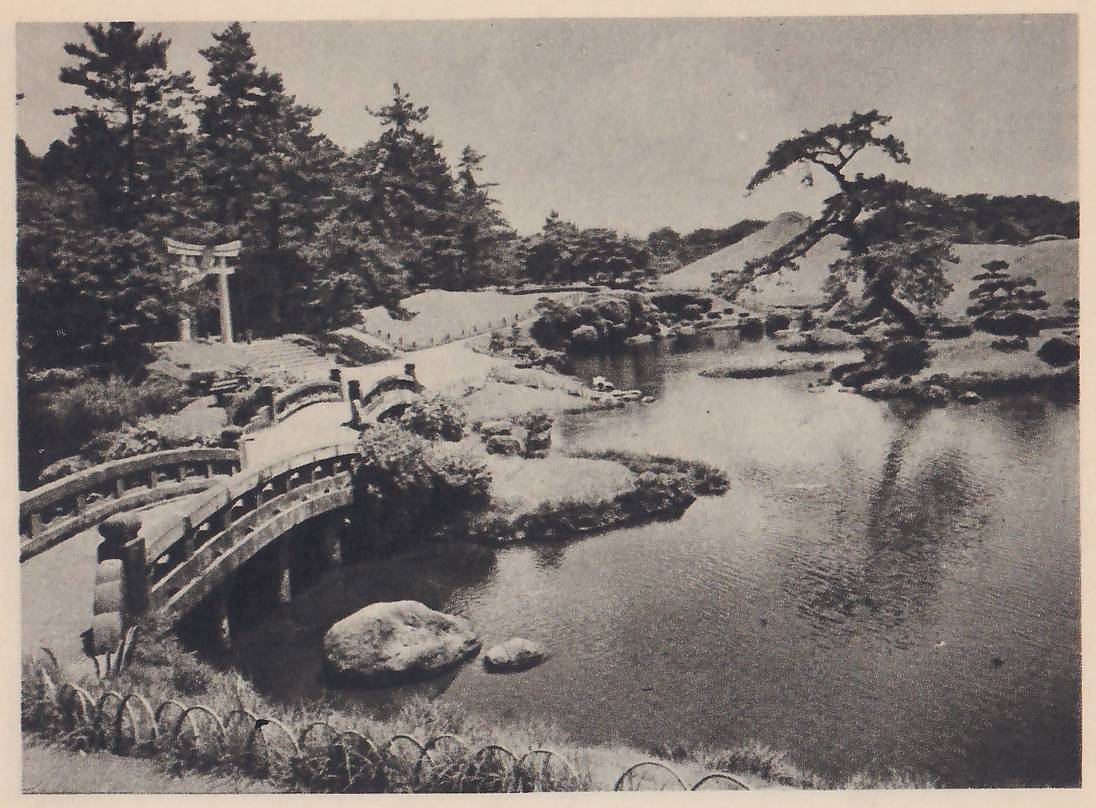
The site of the garden was formerly occupied by one of the mansions of the Hosokawa, the daimyō family of Kumamoto. The garden is of the “stroll-garden” type with a pond as the main feature, on the
west of which is a miniature Fuji. Connection with the island in the pond is effected, not by a bridge as is usual, but by stepping-stones laid in the clear water.
30. Shukukei-en Garden, Hiroshima
This is the country seat of Marquis Asano of the family which held Hiroshima as its fief. The mansion is also known by the name of “Sentei.” The garden is of the “stroll-garden” pattern, the chief feature being a pond containing islands of various sizes connected by bridges in Chinese style.
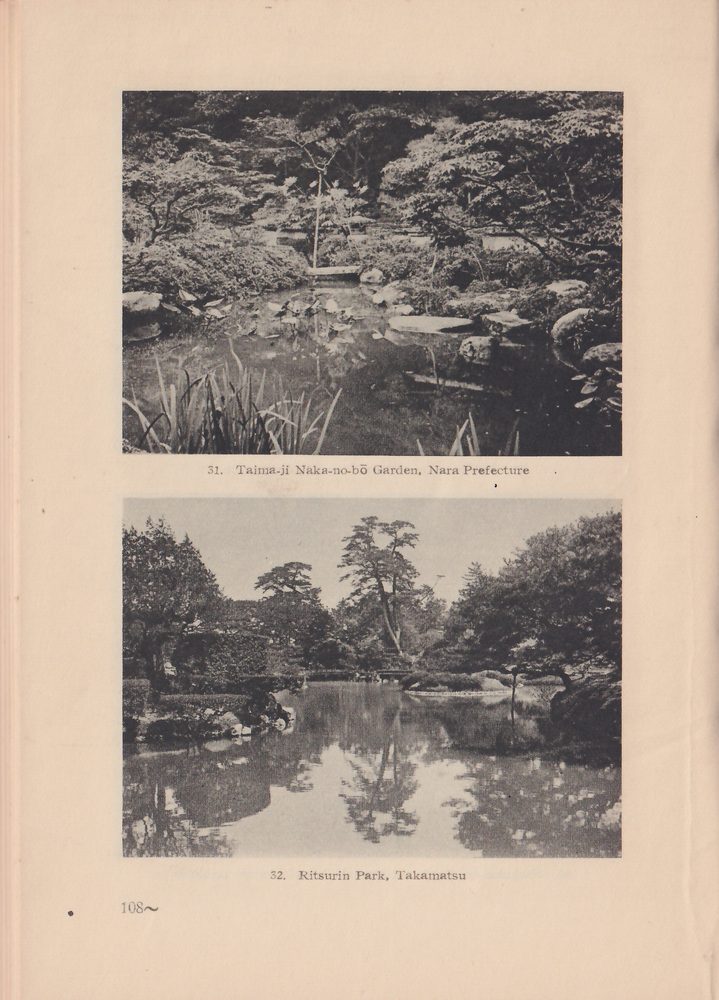
31. Taima-ji Naka-no-bō Garden, Taima-mura, Nara Prefecture
The garden, belonging to the early period of Edo, is attributed to Katagiri Sekishū, the tea-master. The famous three-storied pagoda is on the mountain that backs the pond. There is also the tea-house attributed to the same designer.
32. Ritsurin Park, Takamatsu, Shikoku
This pond-centred stroll garden, built by Matsudaira Yorishige, one of the lords of Takamatsu, in the last quarter of the 17th century, is of rare beauty, quite exhilarating in effect. The garden is greatly set off by a section of the woodland of pine trees, which forms its background.
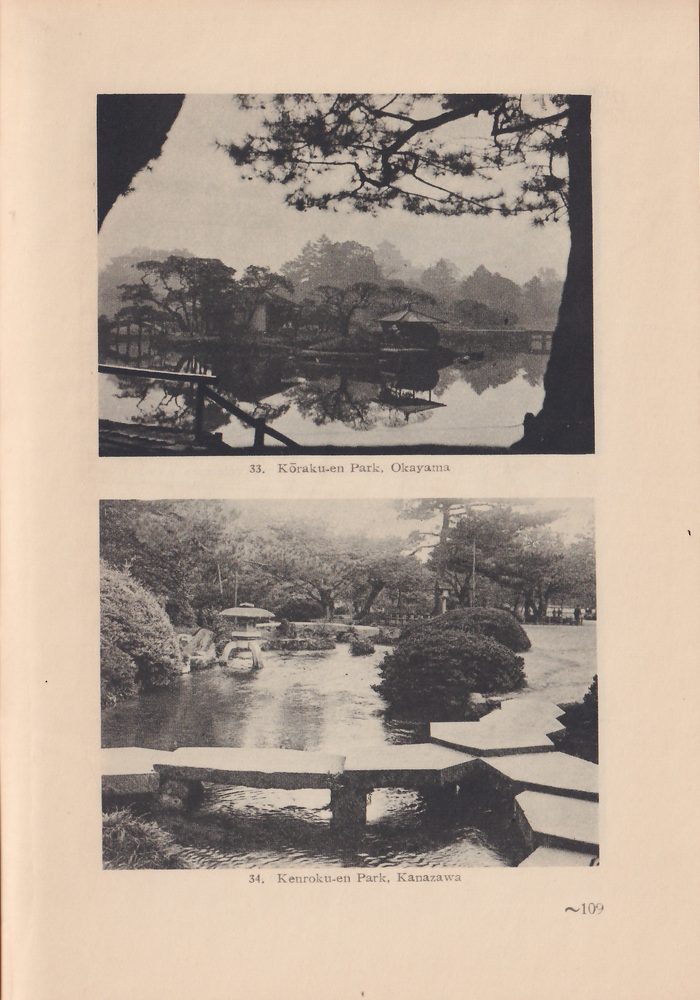
33. Kōraku-en Park, Okayama
This extensive “stroll garden,” with a central pond, was built by one of the Okayama daimyōs in the second half of the 18th century. Okayama Castle forms a fine background. There are some noteworthy features in the details.
34. Kenroku-en Park, Kanazawa
It is probable that the garden was reconstructed in the late Edo Period. This garden, when combined with the building which is now lost, must have made up a harmonious whole, though in its present state of isolation it gives the impression of lacking in unity. At present the garden has two ponds on different levels, the two being connected by stream and cascade. Scenic effect seems to have been the main point of consideration.
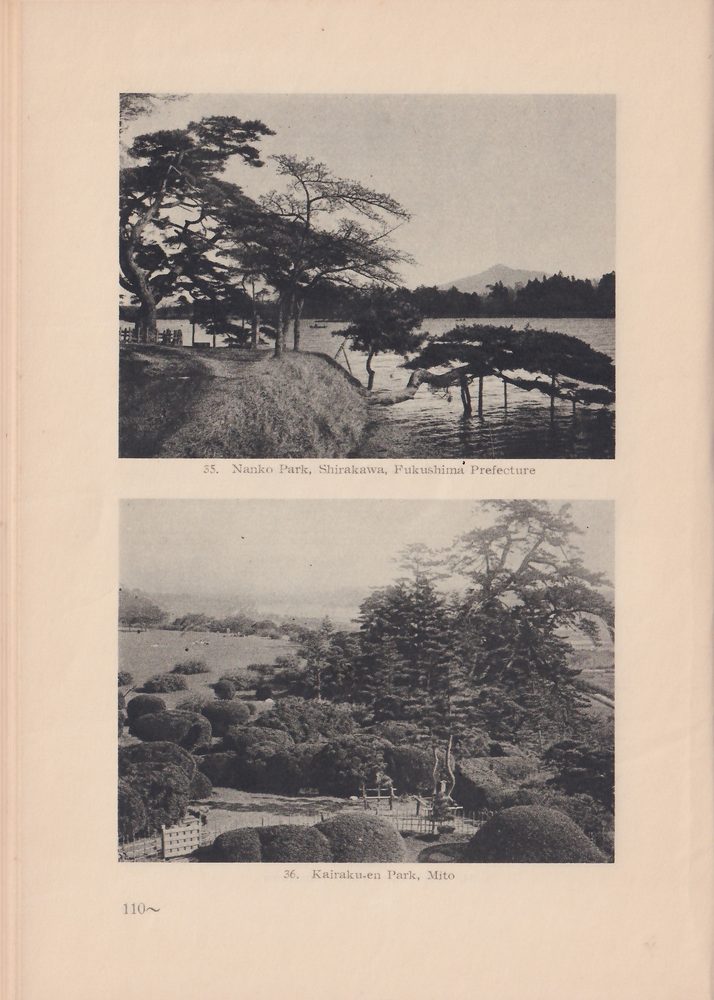
35. Nanko Park, Shirakawa-machi, Fukushima Prefecture
This is one of the oldest parks in Japan. It was built by Matsudaira Sadanobu, the Lord of Shirakawa, in the first quarter of the 19th century, for the health and pleasure of the local inhabitants. Originally, the place was a reservoir for irrigation, but laid out later as a recreation ground. The park is a monument of the advanced ideas by which the famous statesman was animated.
36. Kairaku-en Park, Mito
This is another pioneer park constructed by Tokugawa Nariaki, Lord of Mito, in the second quarter of the 19th century. The garden is so designed as to show its fine prospect to the best advantage. It is abundantly planted with plum trees which, though originally intended for the fruit to be used as provisions in wartime, now attract, when in blossom, crowds of holiday-makers from the towns.
The foregoing gives a brief sketch of Japanese gardens. Though the list is not an exhaustive one, the writer believes that it includes the more famous of the historic gardens of this country now in existence.
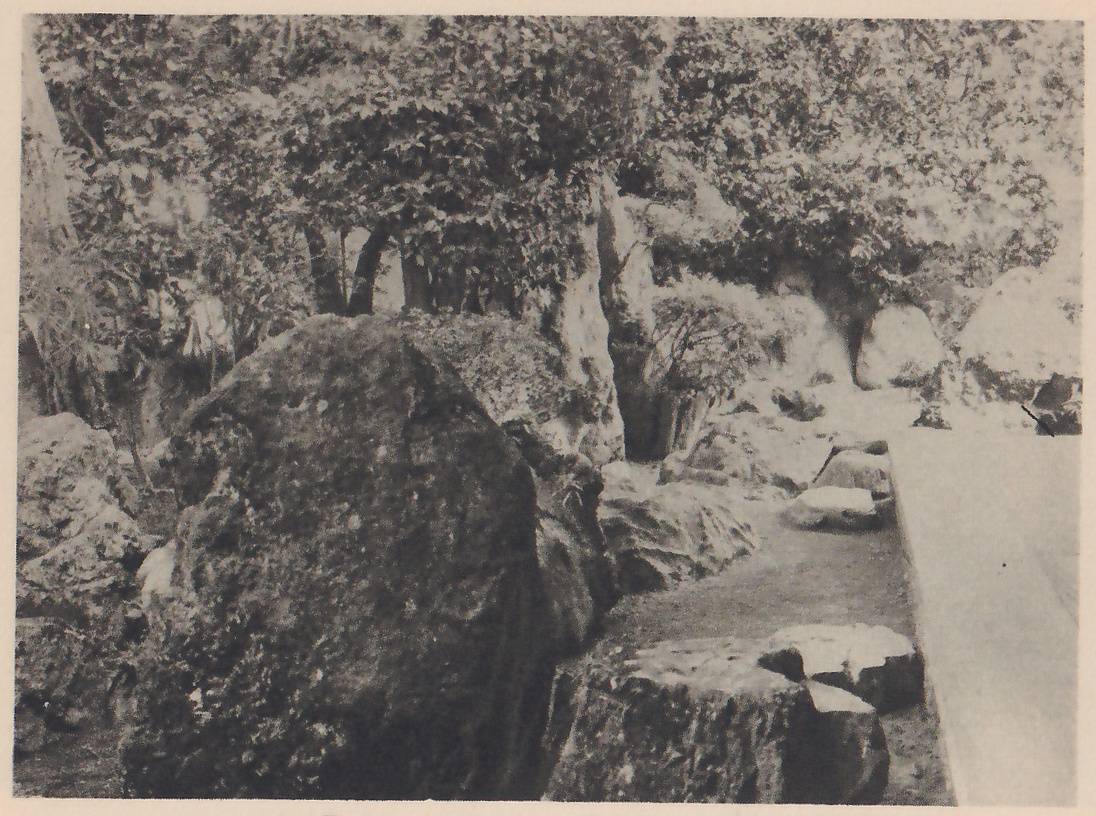
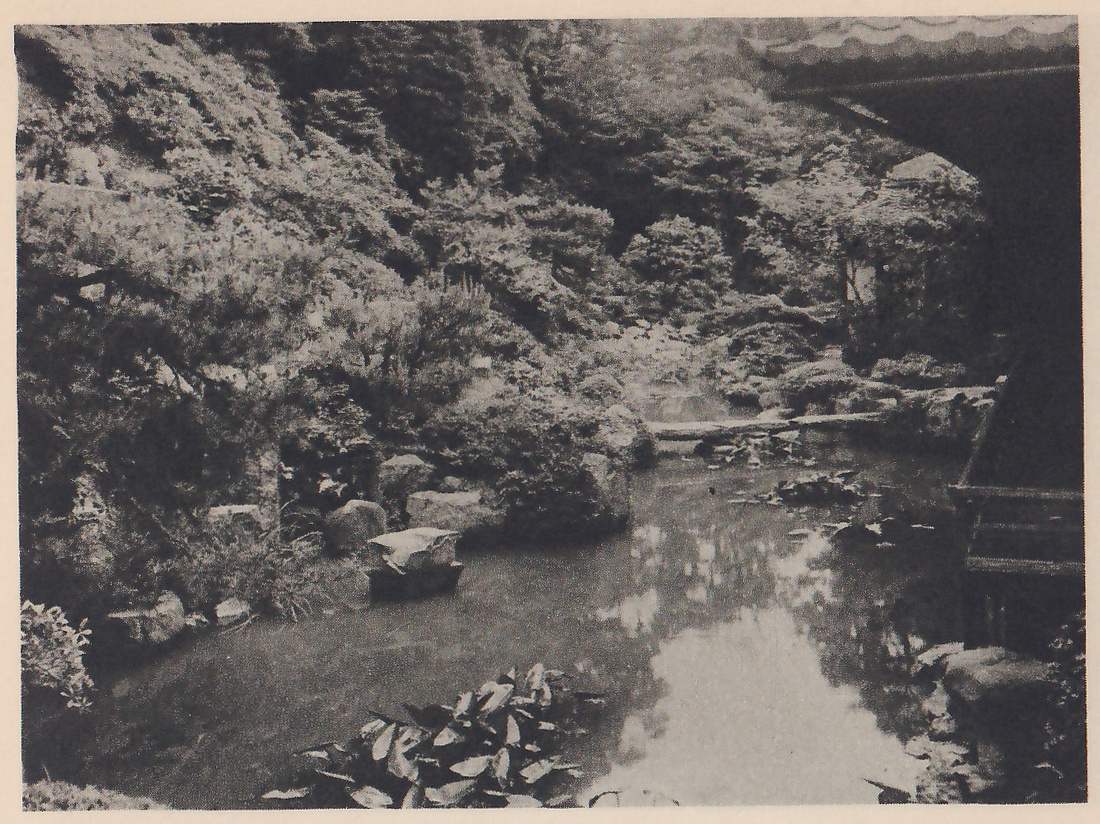
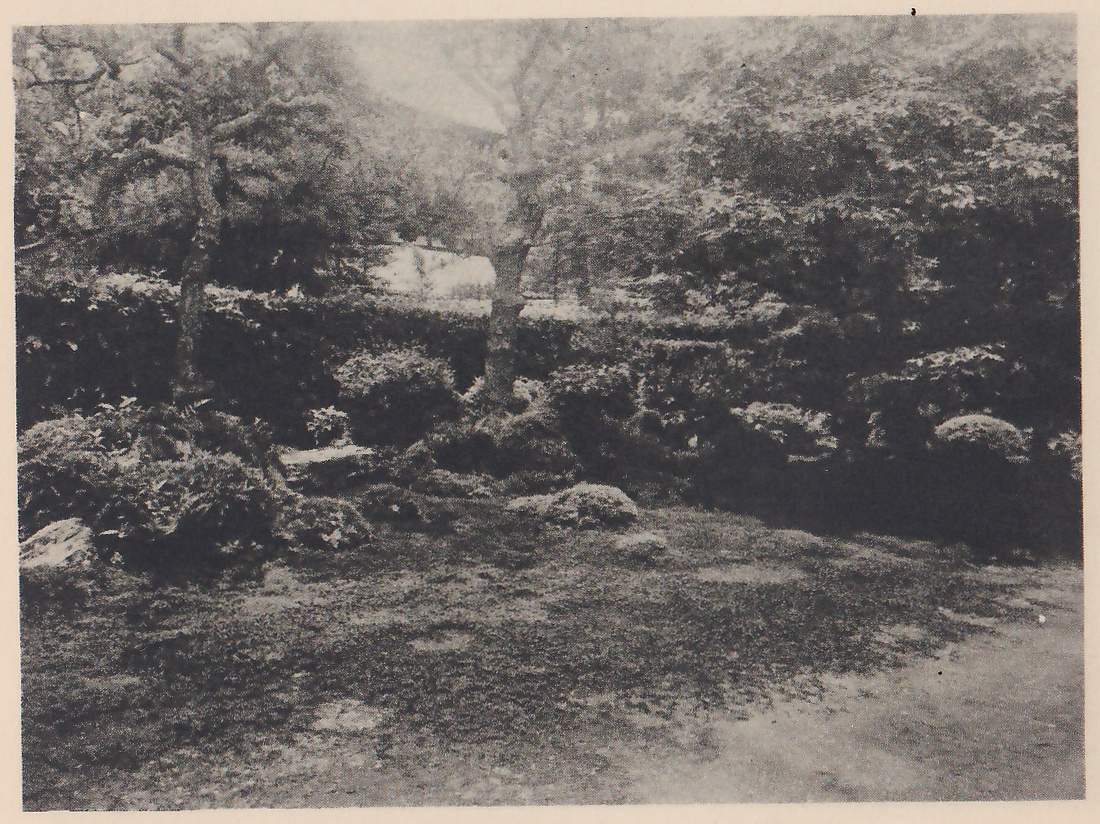
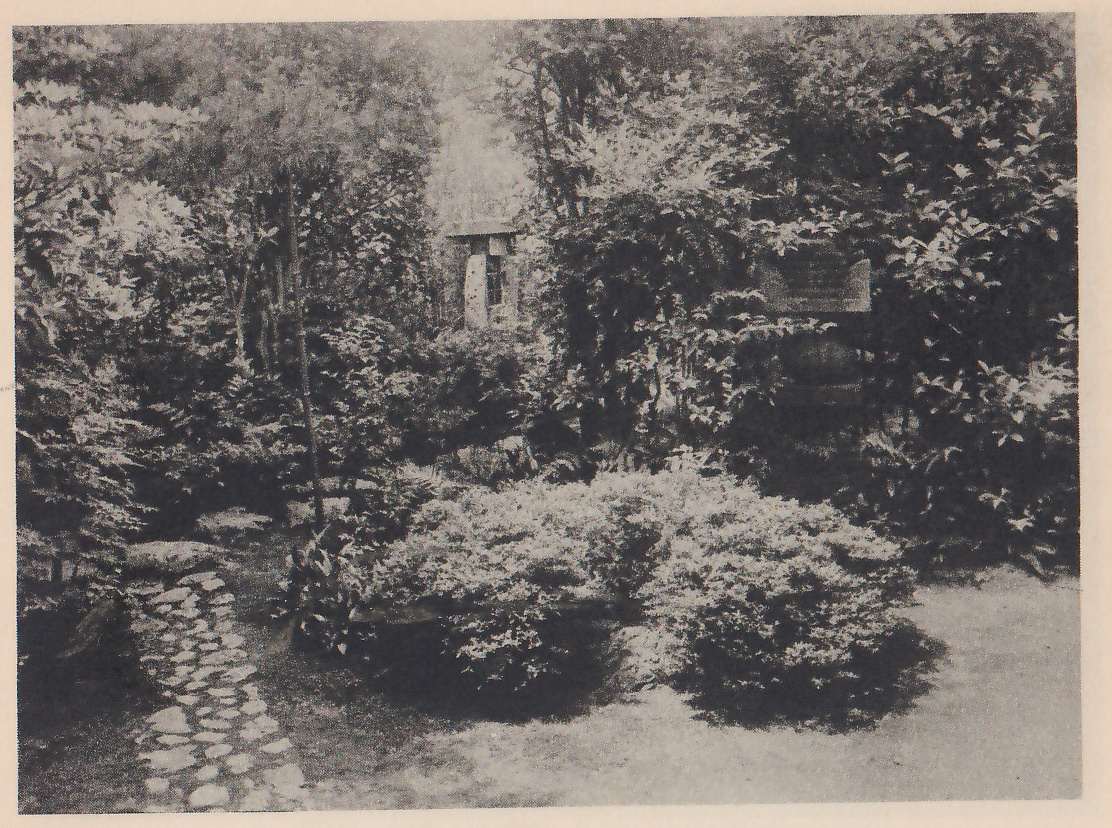
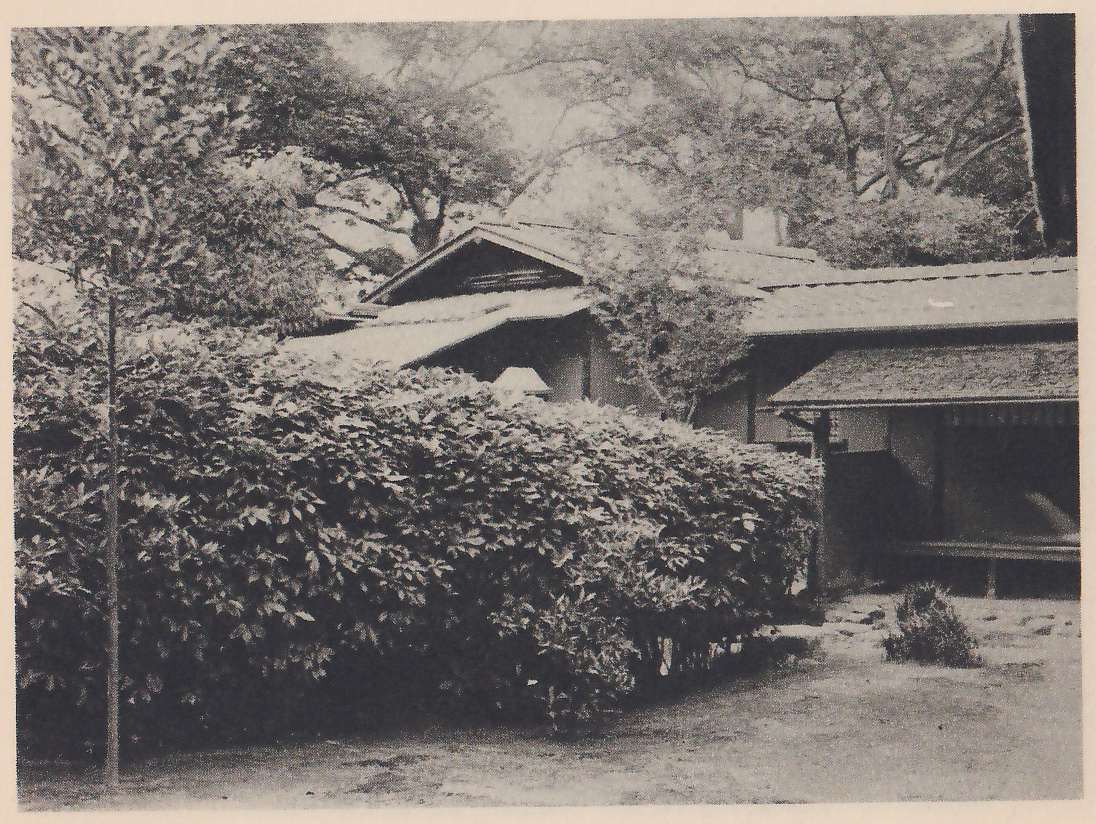
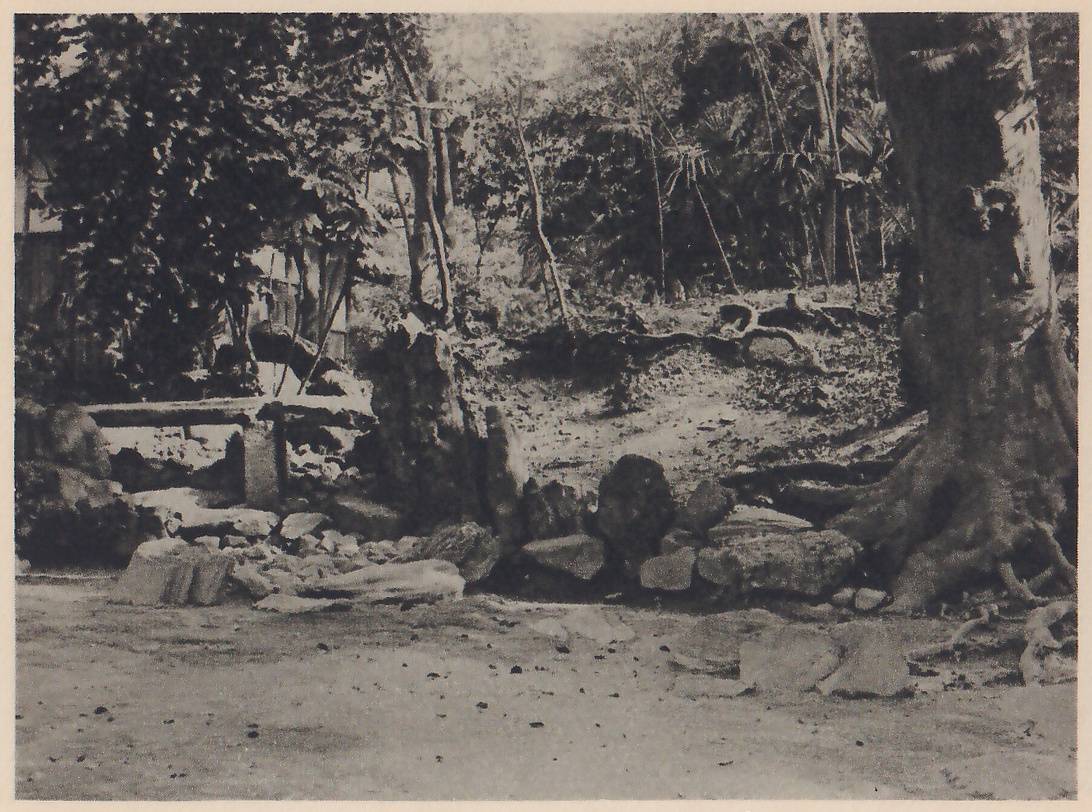
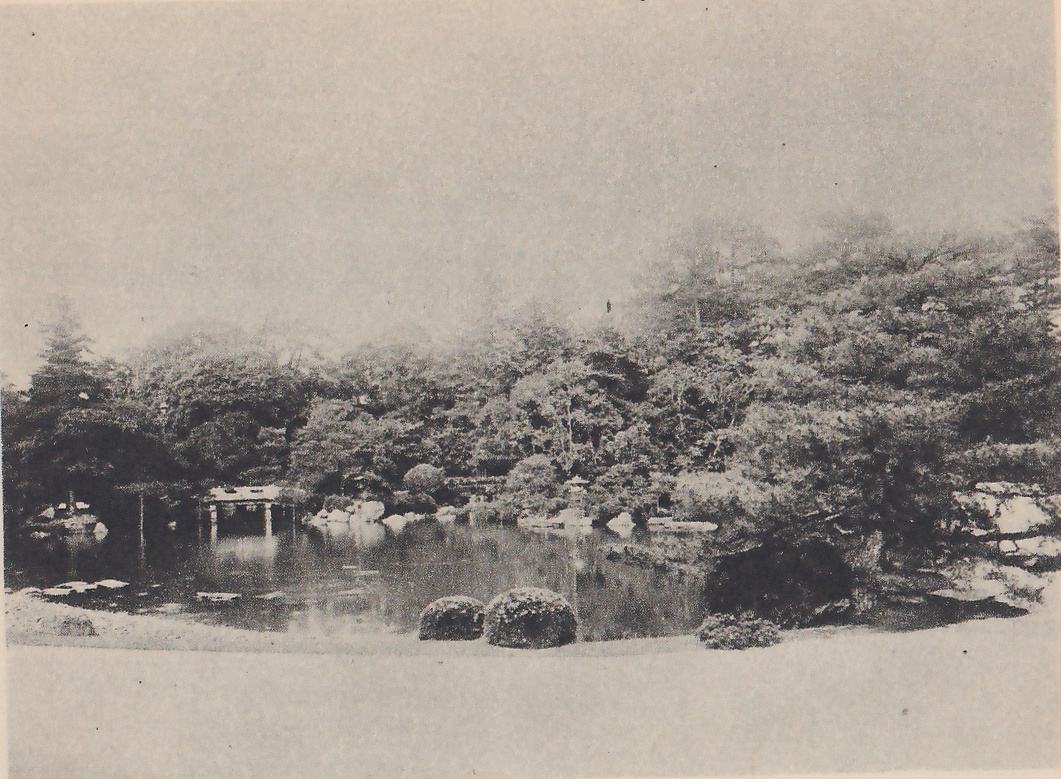
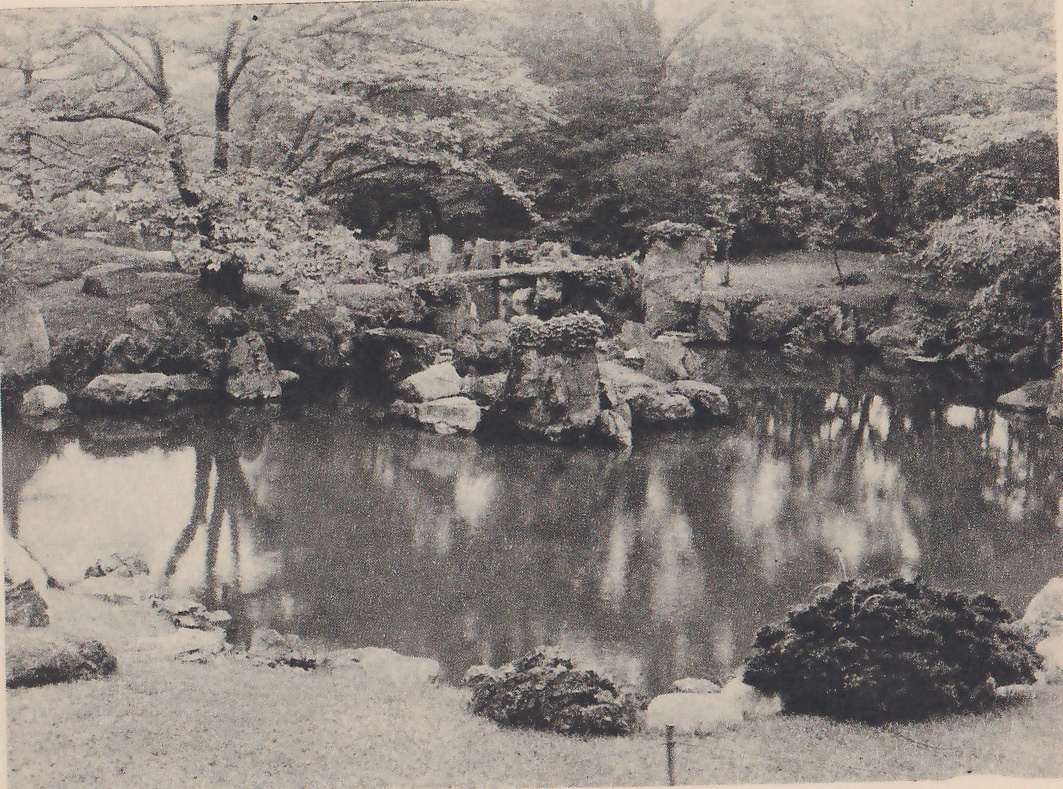
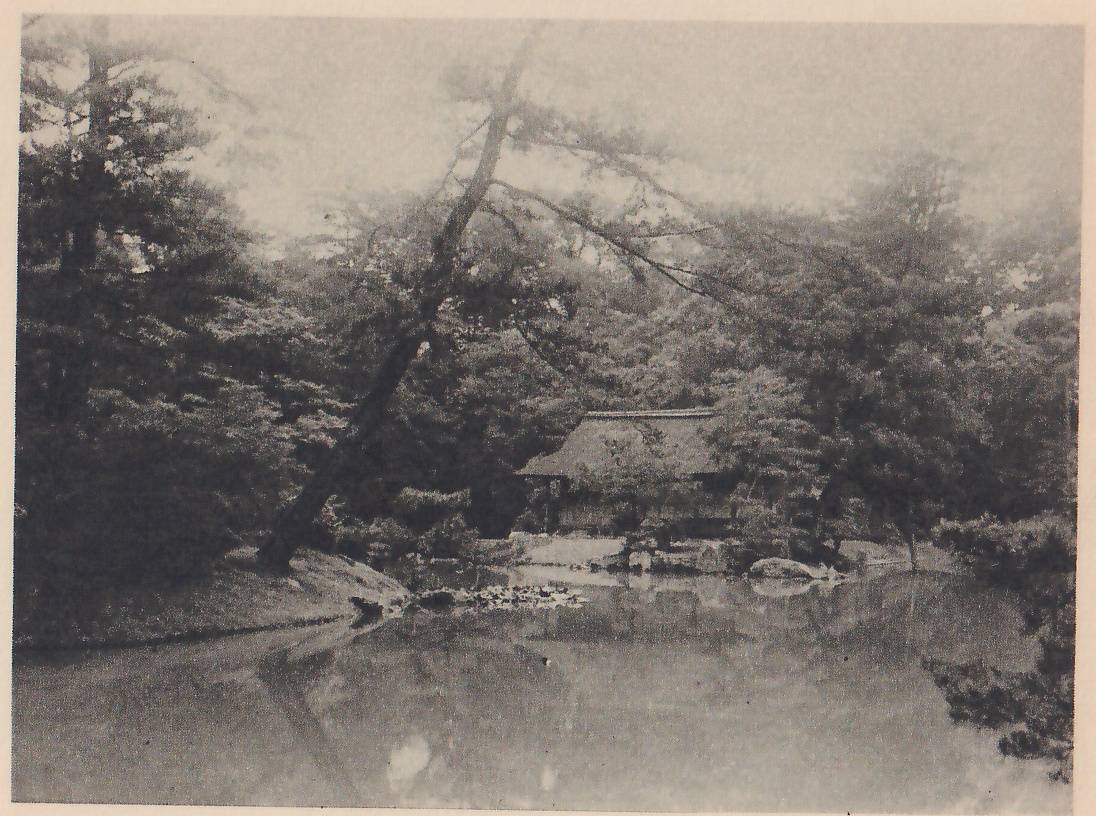
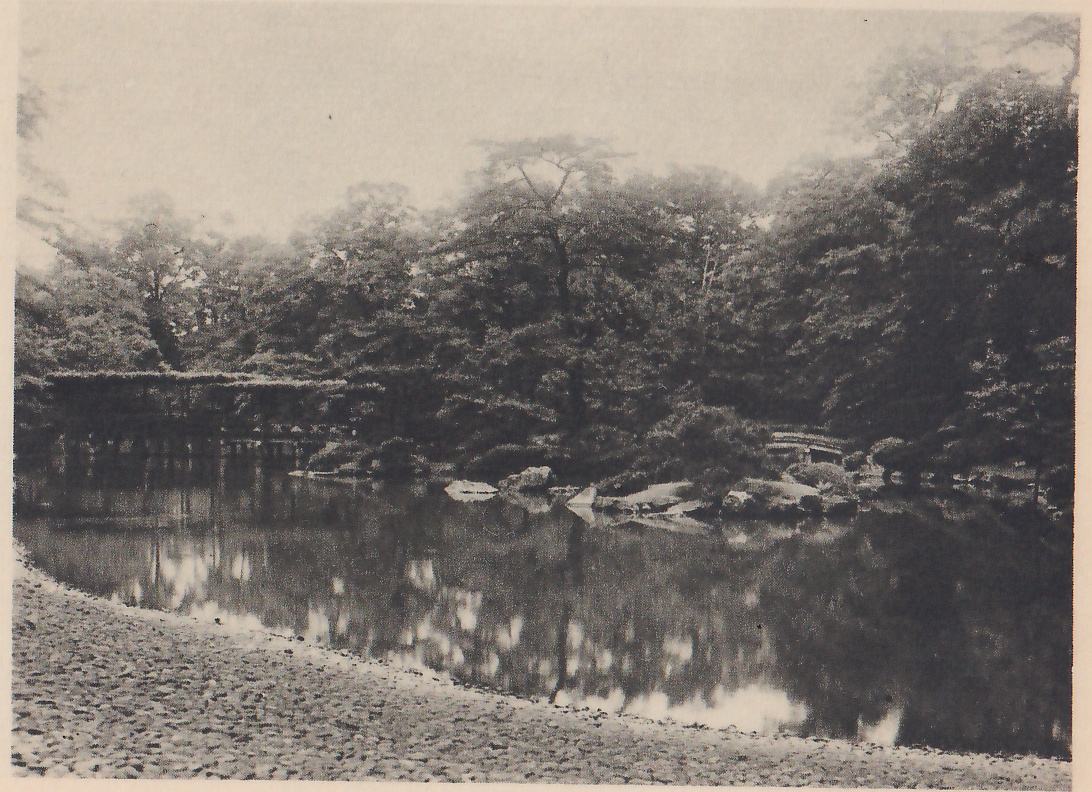
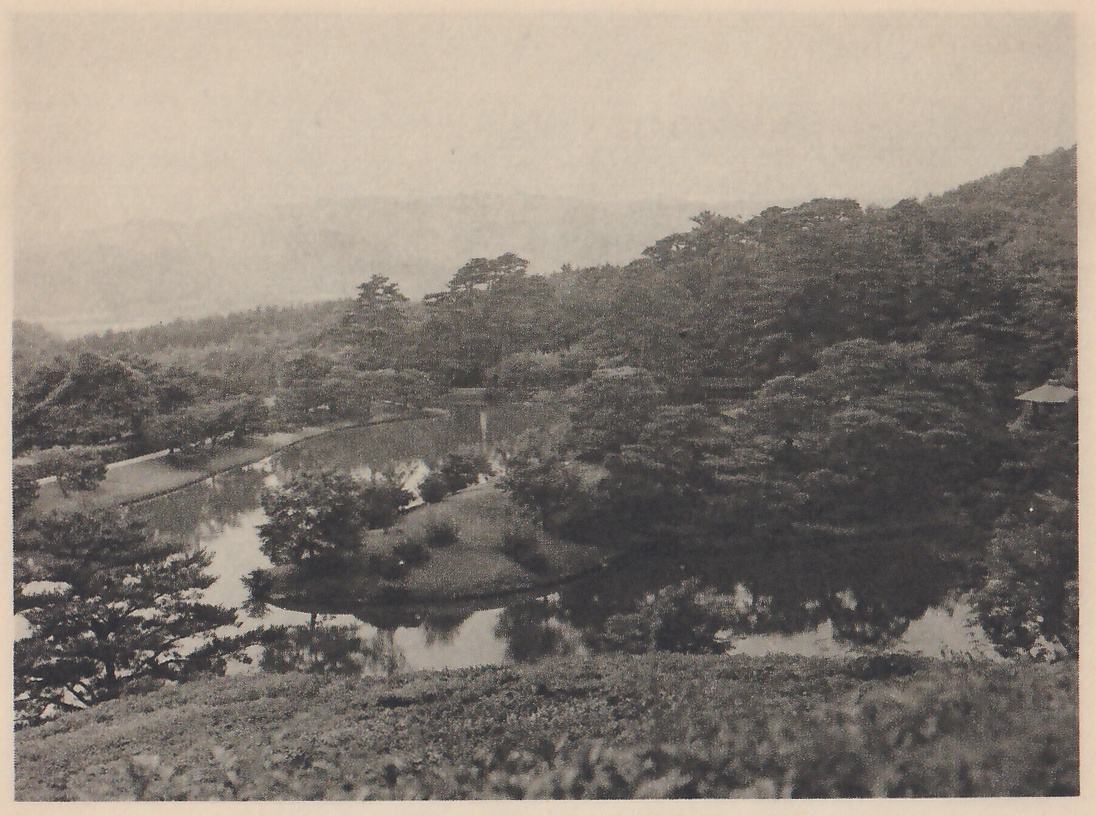
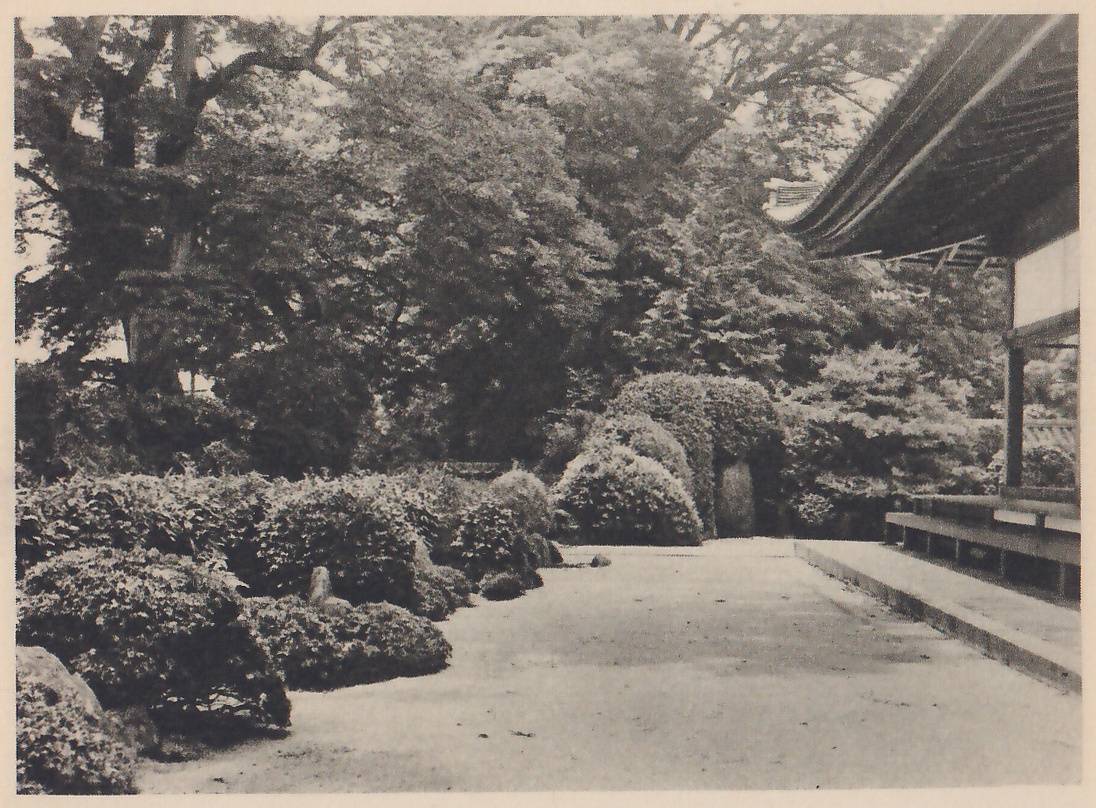
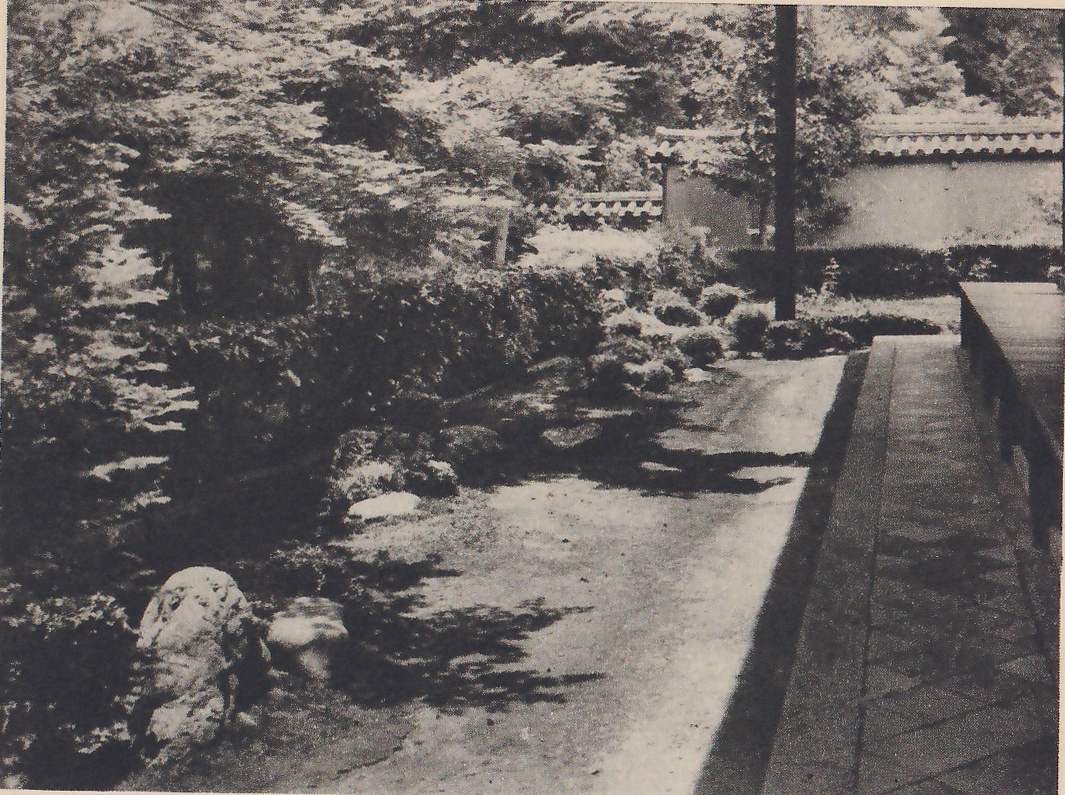
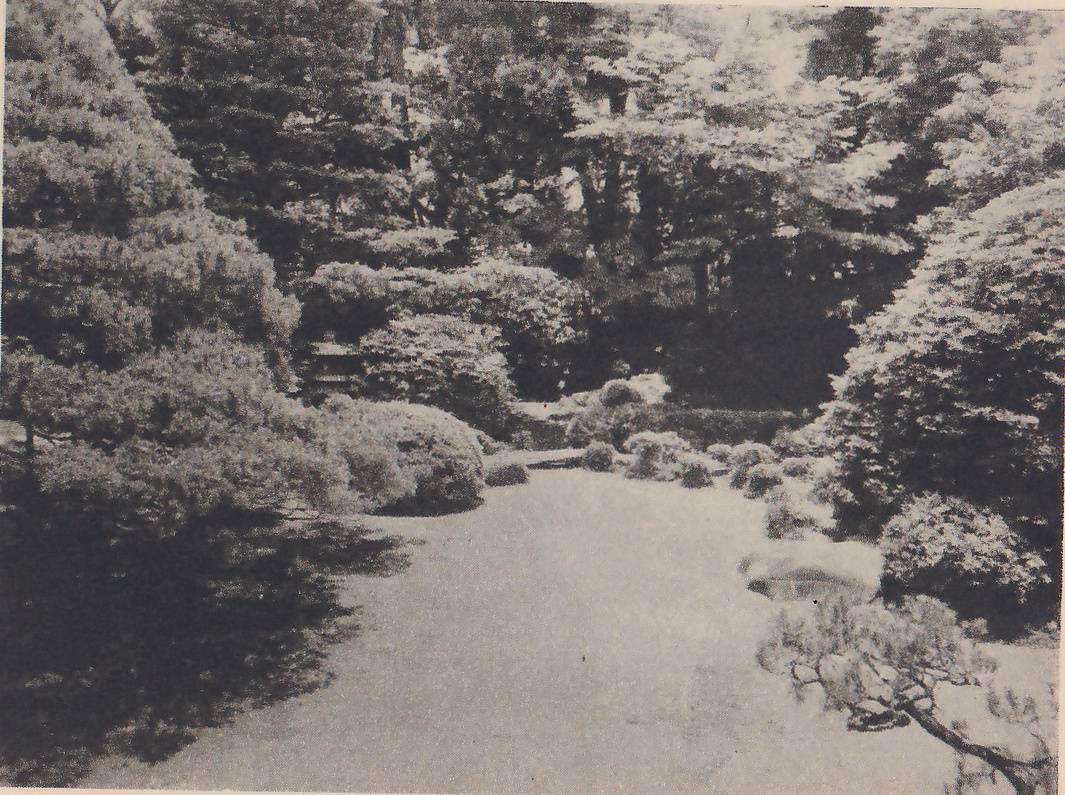
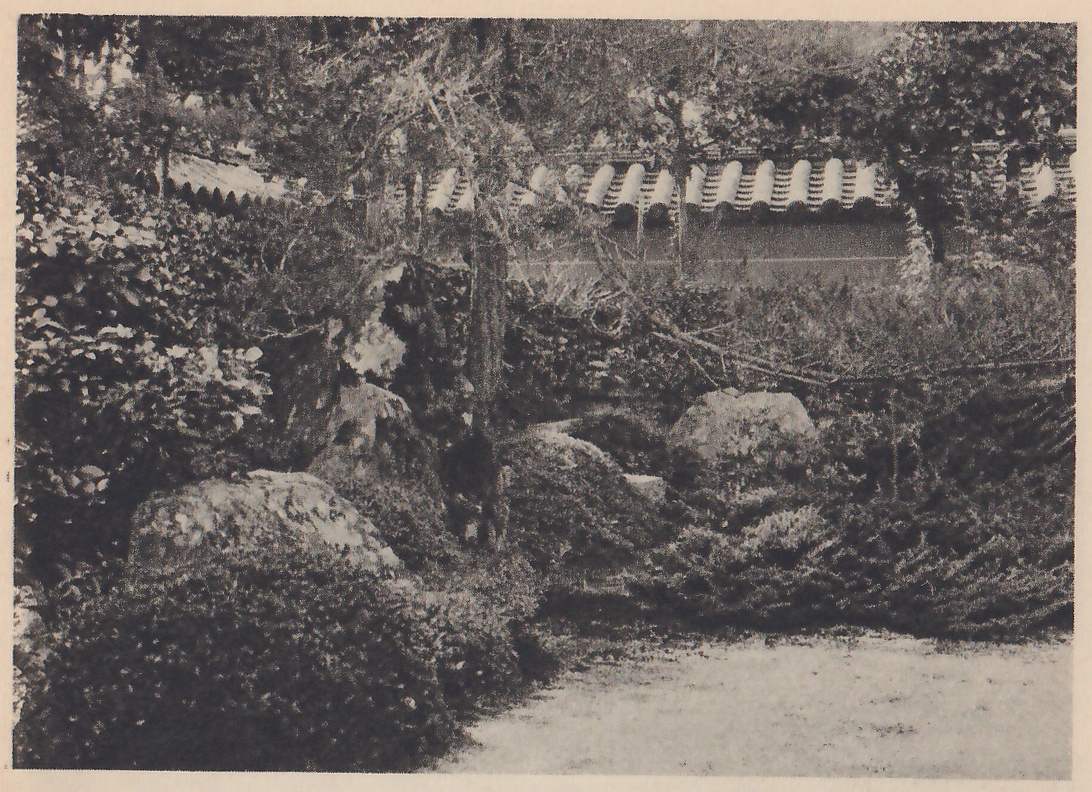
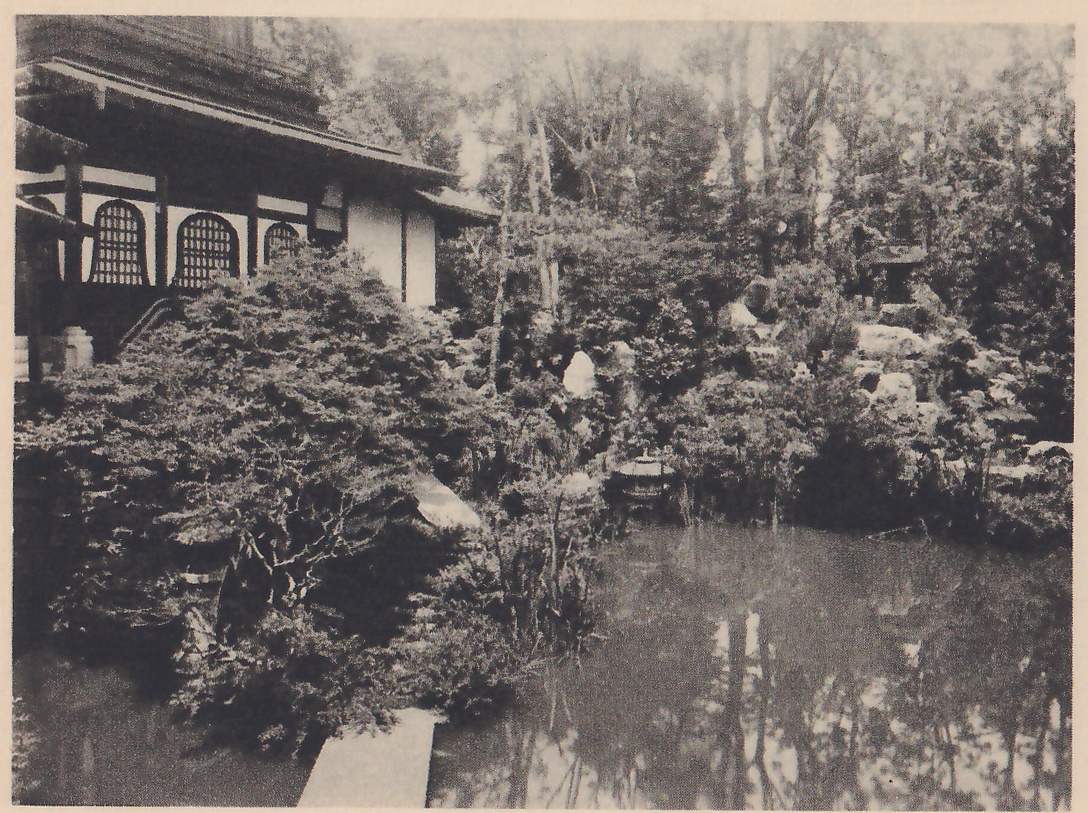
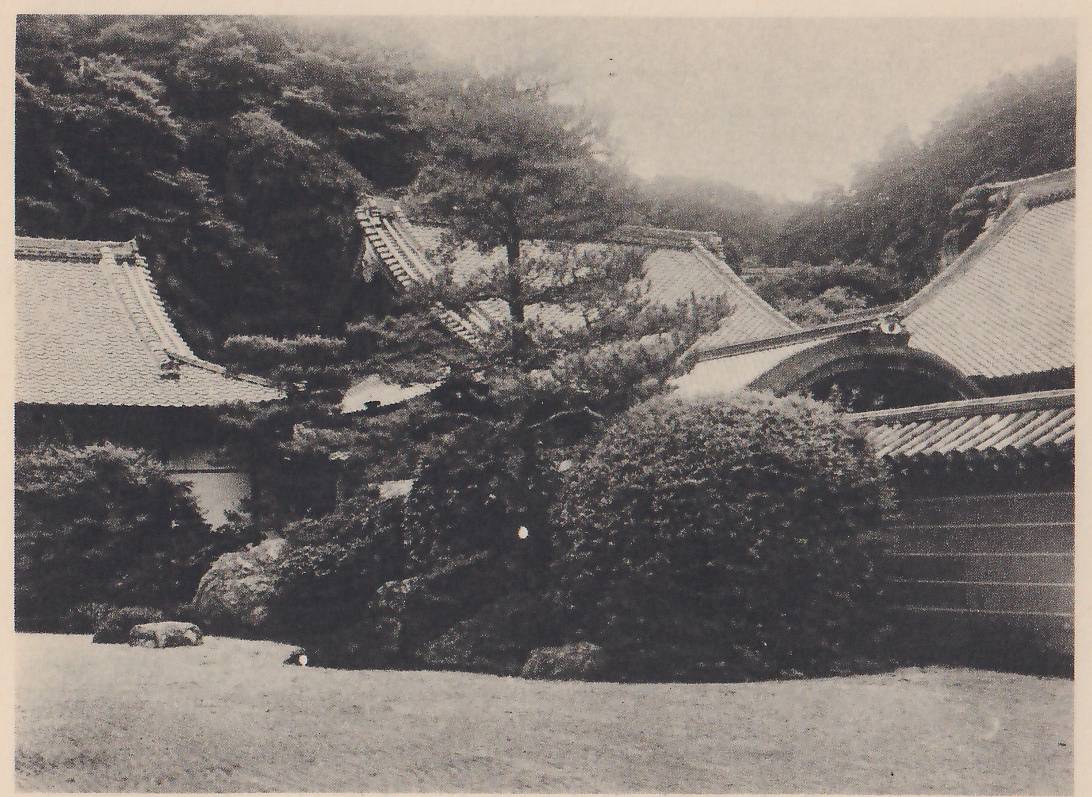
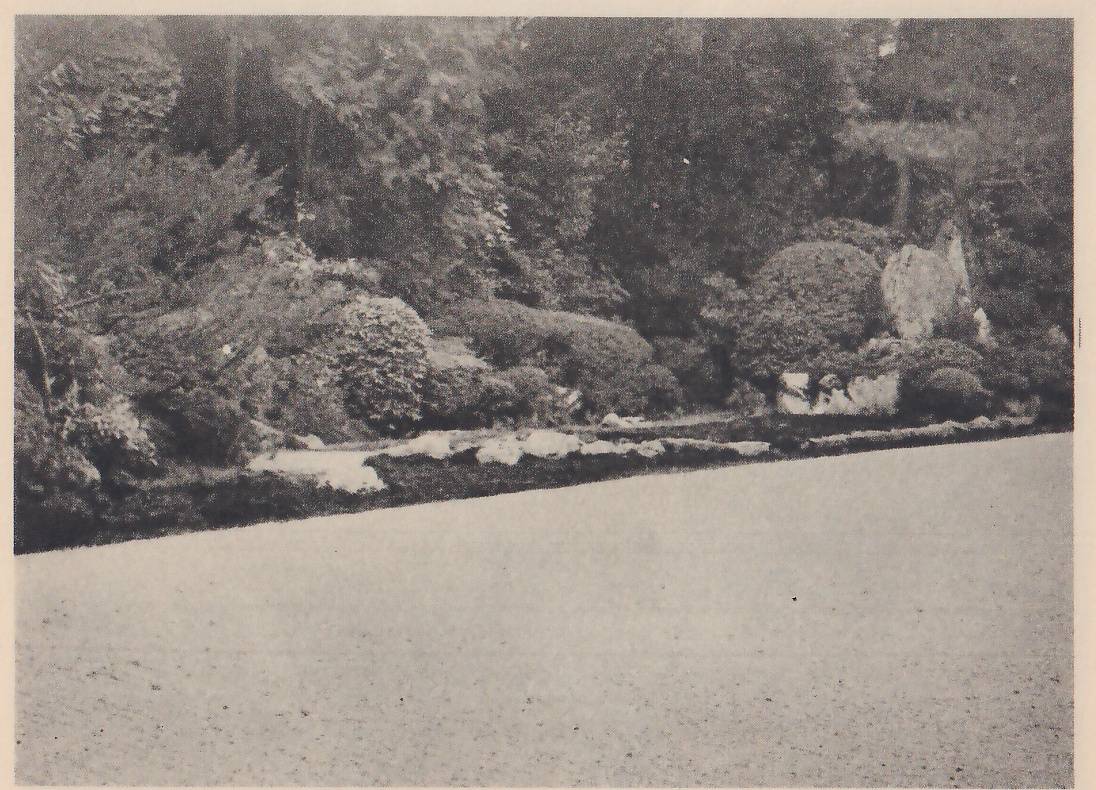
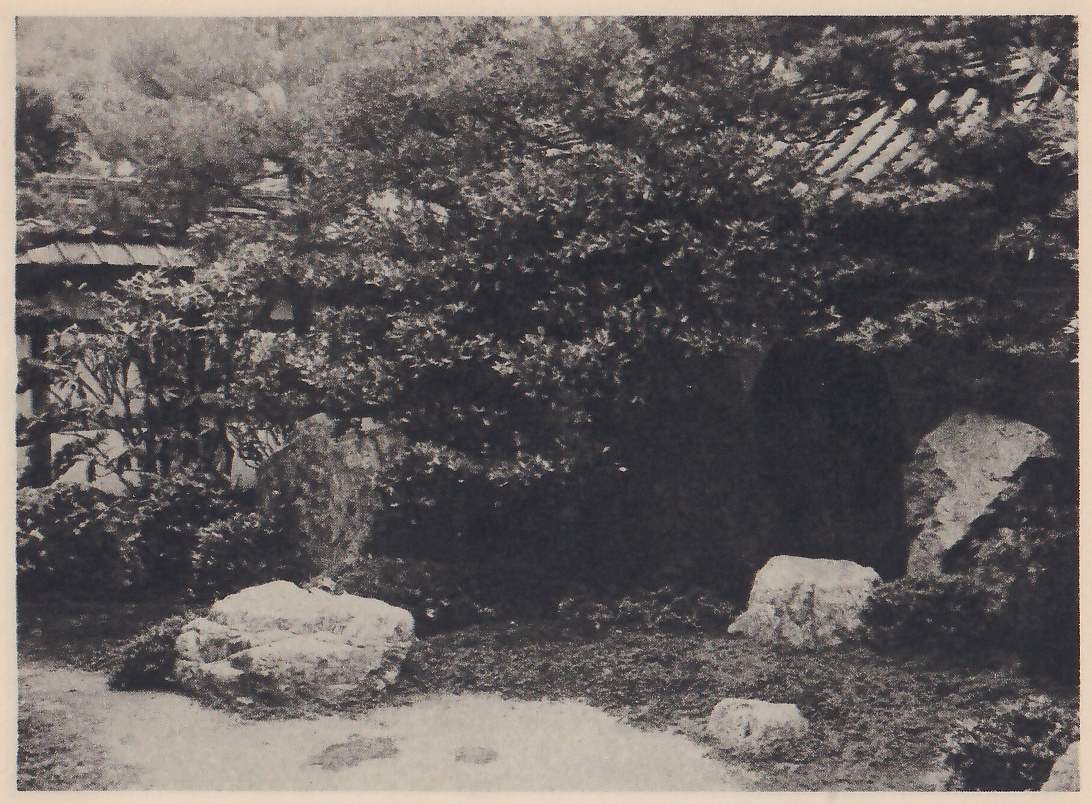
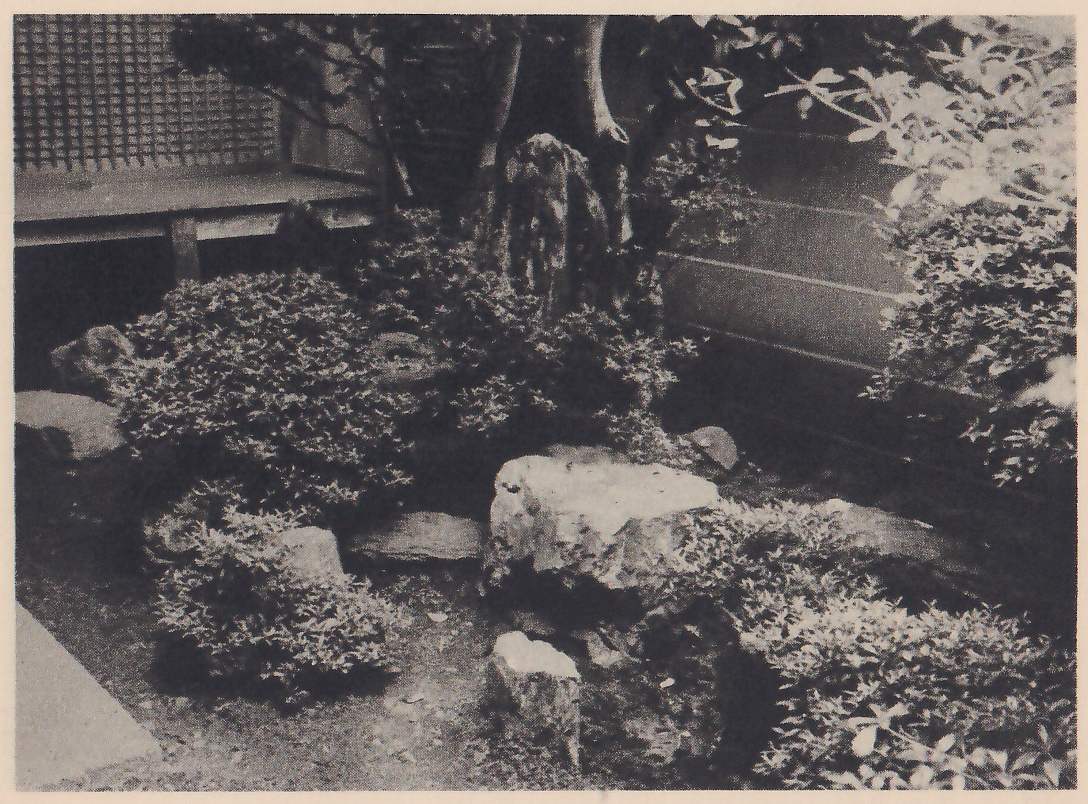
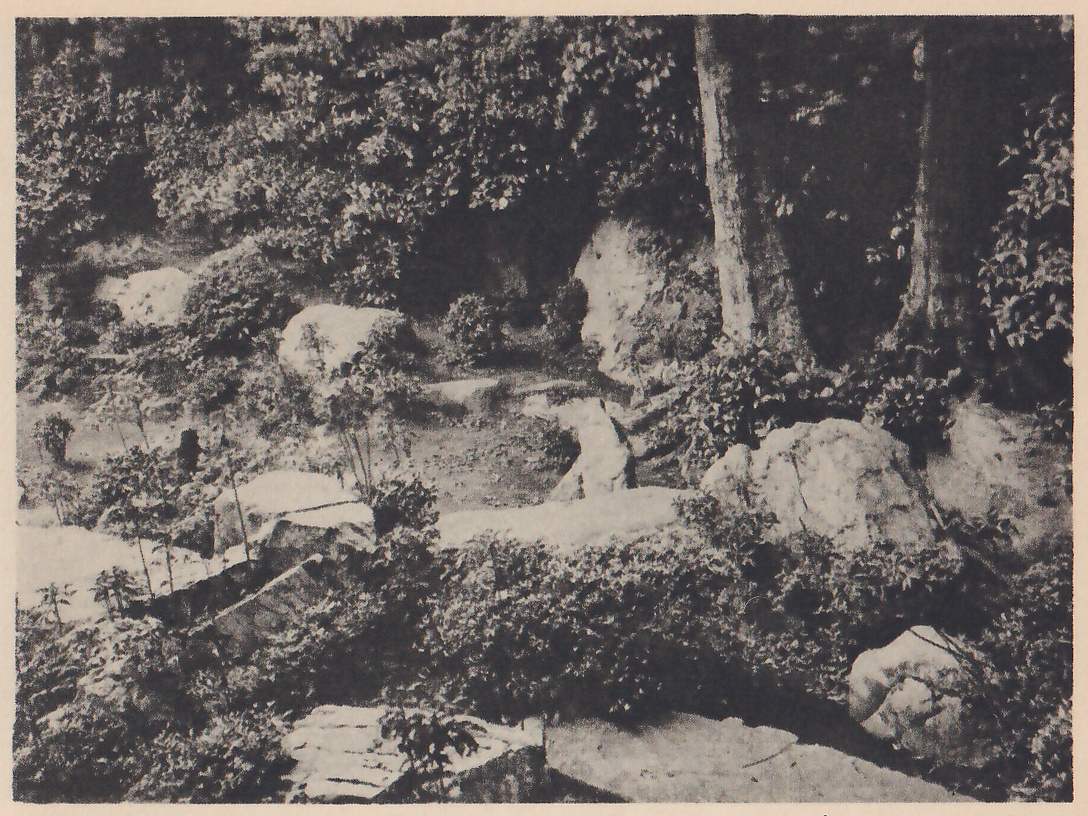
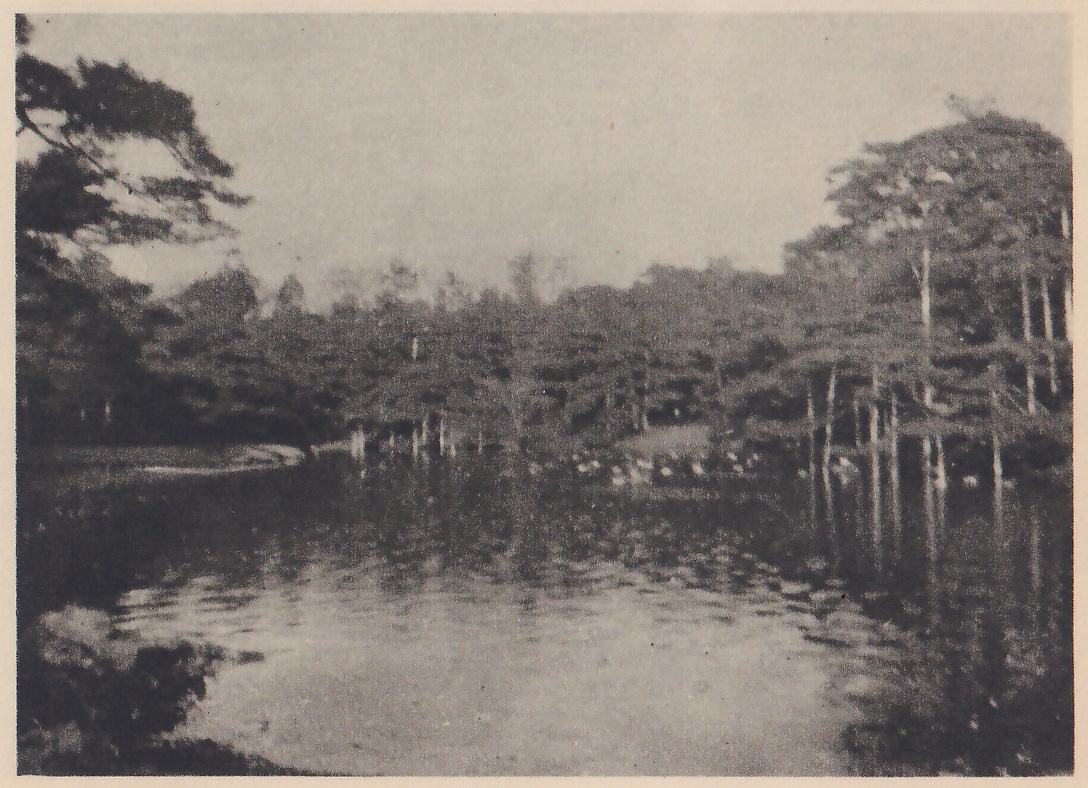
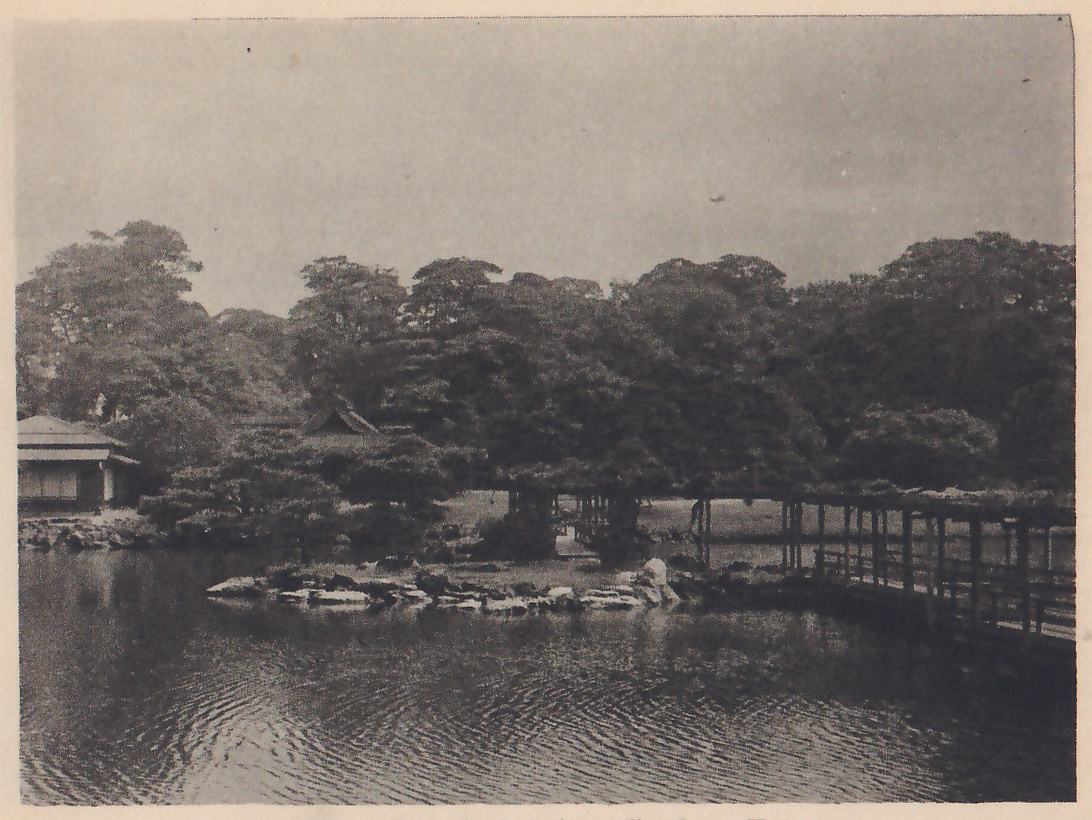
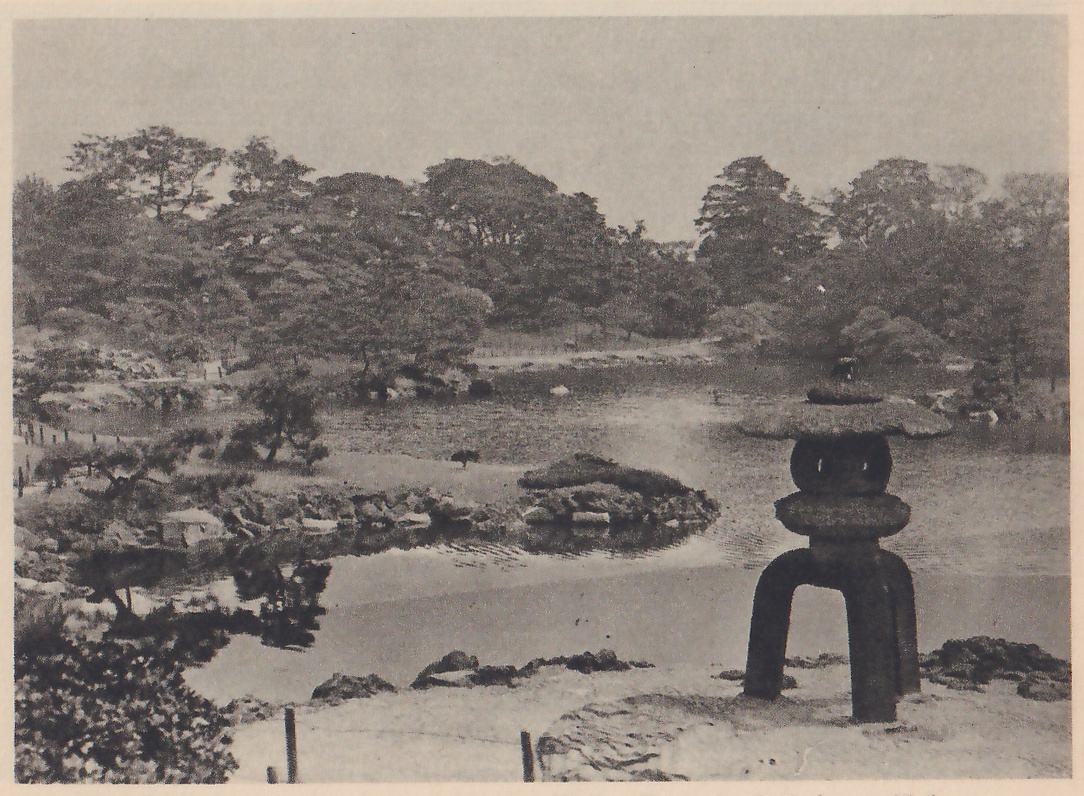
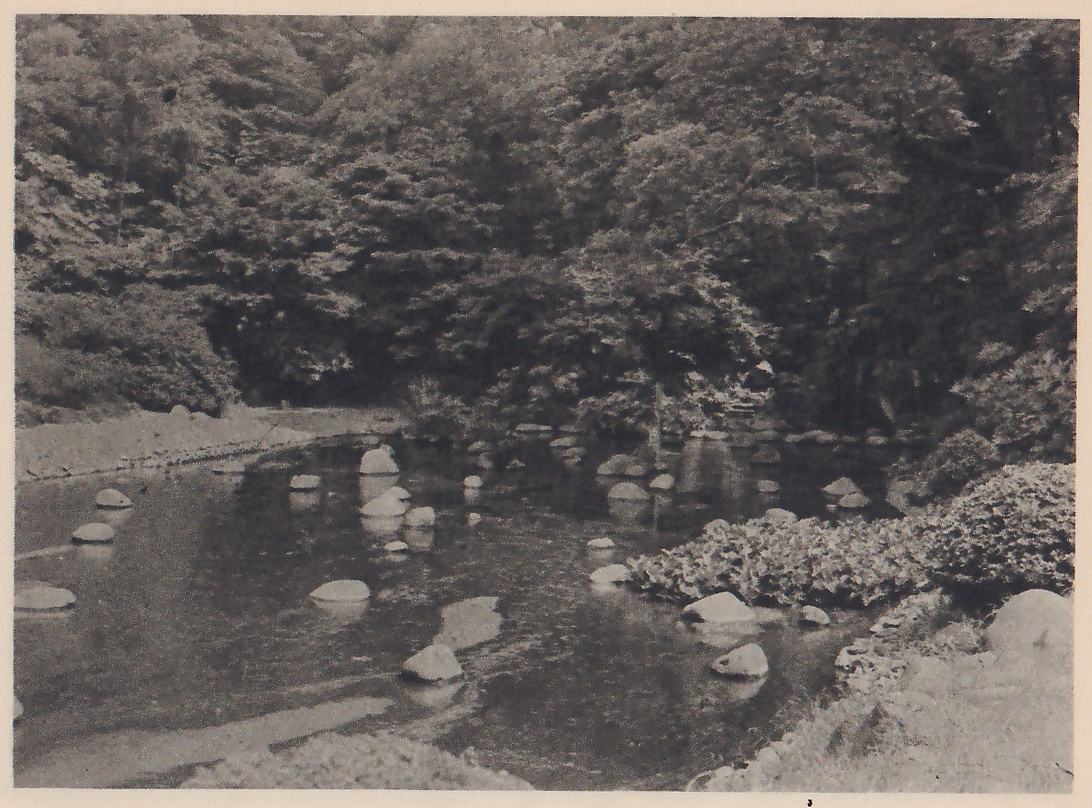
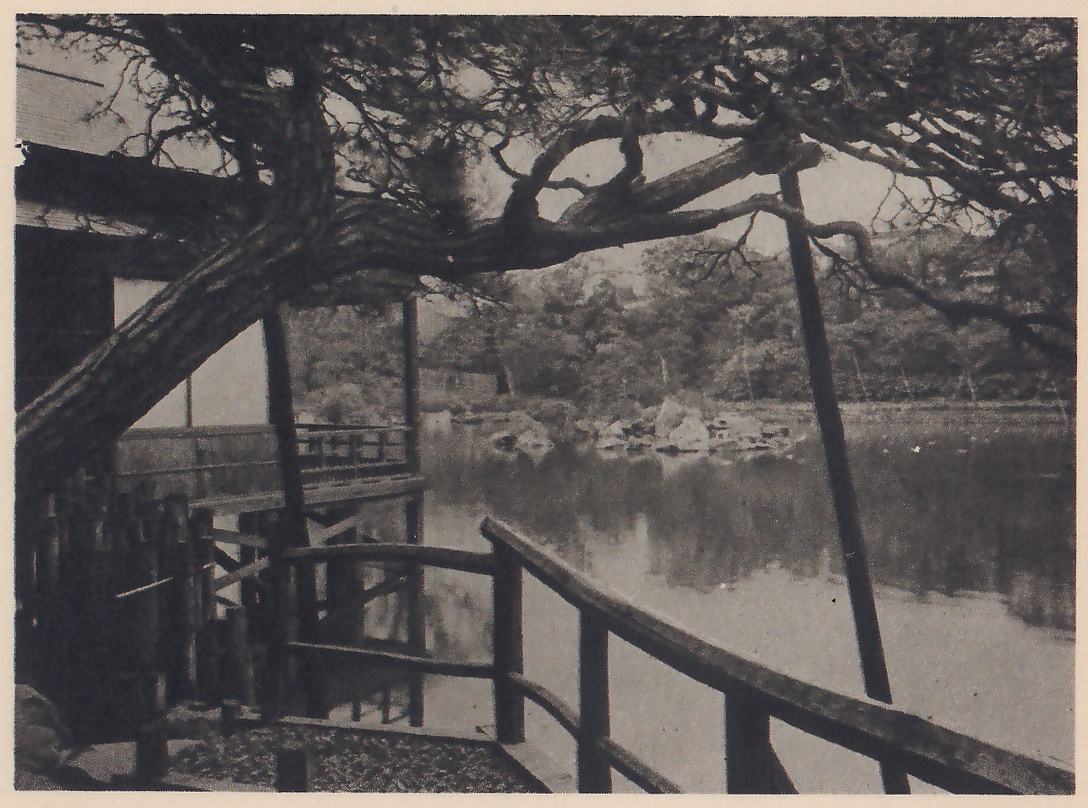
The numbers of the illustrations in the following pages correspond to the numbers of the gardens discussed in the pages from 65 to 82.