
VI GIANT CHERRY TREES
Higan-zakura, Shidare-zakura and Yama-zakura—these three kinds of Japanese sakura trees attain an unusually remarkable size, and, if well cared for and duly protected, will flourish and grow into giant trees. There exist many giant trees of the species, several centuries old, and still in a flourishing state, which have withstood the attacks of severe storms and all sorts of weather because of the good care and attentive protection of their keepers, who tend them mostly in the grounds of ancient shrines or temples. The giant trees we are now about to describe are those specially designated as natural monuments by the authorities.
(1) “Yamataka Jindai-zakura”
A gigantic sakura tree belonging to the species of white equinox cherries (shiro higan-zakura), and known as “Yamataka jindai-zakura”, grows in the precincts of the Jissō-ji Temple at Mukawa-mura, Kita-Koma County, Yamanashi Prefecture. This is about 2.5 miles from Hinoharu station on the ChūōPrinted: Chuō Line of the Government Railways. Motor-car service is available for the trip from the station halfway to the spot. Measuring 10.6 metres in girth at breast height the tree is the largest of its kind, the monarch of its species.
In the early stage of blooming the tree puts on a veil of pale crimson, which later turns snow-white.
A severe storm that occurred a few years ago broke and took away four overspreading boughs from
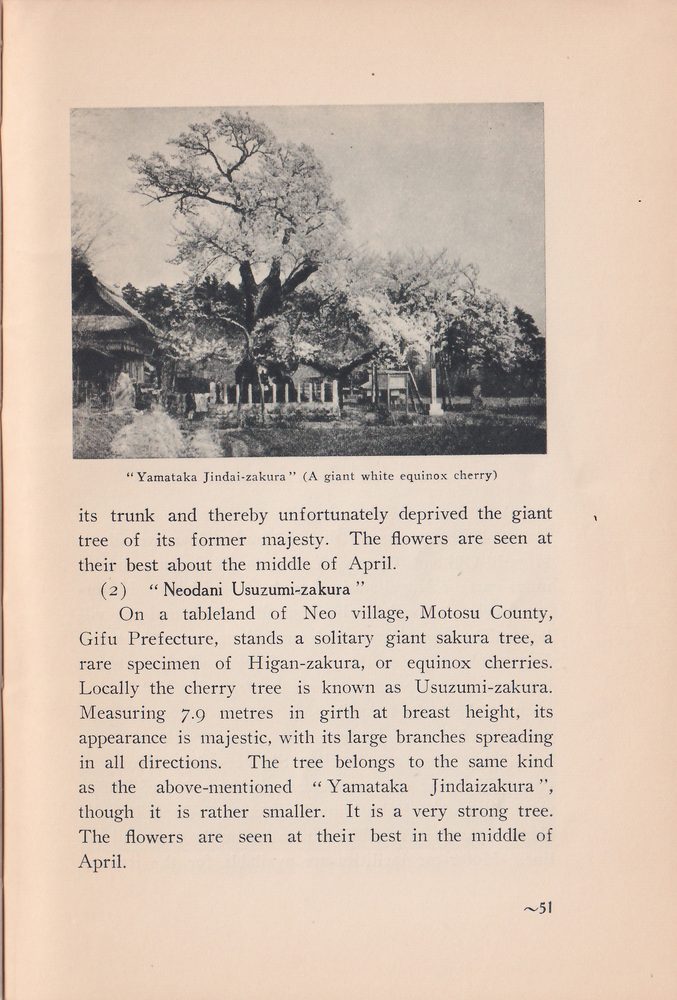
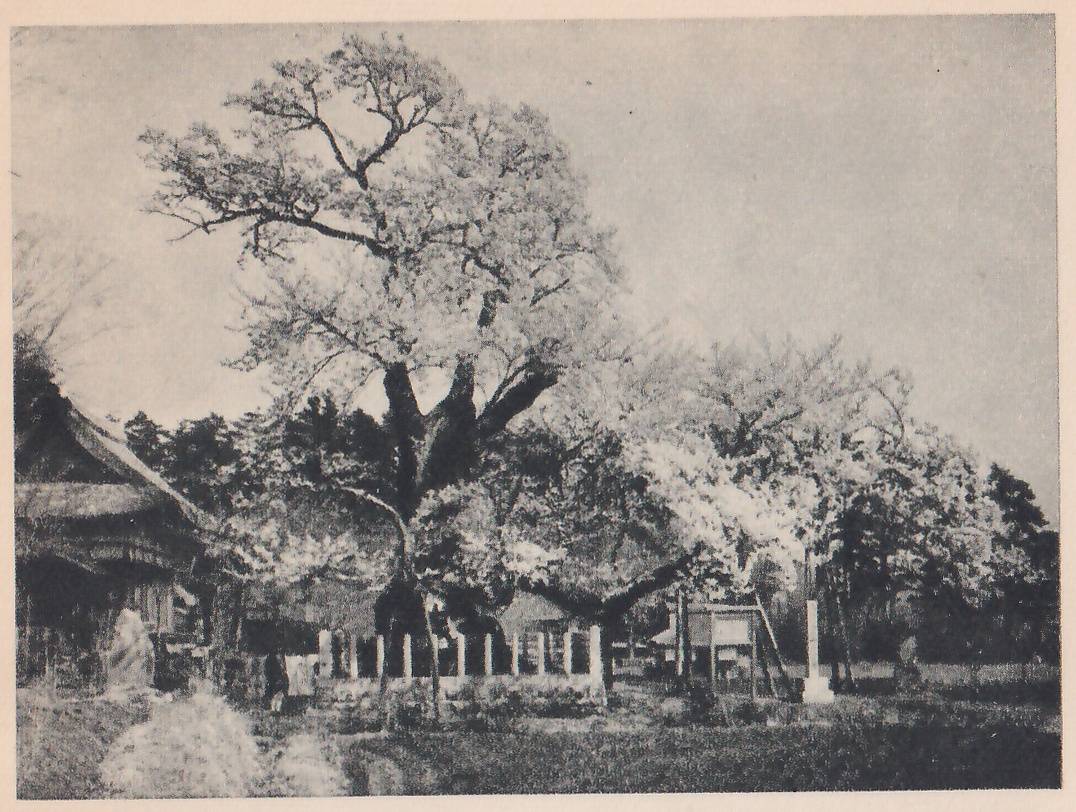
its trunk and thereby unfortunately deprived the giant tree of its former majesty. The flowers are seen at their best about the middle of April.
(2) “Neodani Usuzumi-zakura”
On a tableland of Neo village, Motosu County, Gifu Prefecture, stands a solitary giant sakura tree, a rare specimen of Higan-zakura, or equinox cherries. Locally the cherry tree is known as Usuzumi-zakura. Measuring 7.9 metres in girth at breast height, its appearance is majestic, with its large branches spreading in all directions. The tree belongs to the same kind as the above-mentioned “Yamataka Jindaizakura”, though it is rather smaller. It is a very strong tree. The flowers are seen at their best in the middle of April.
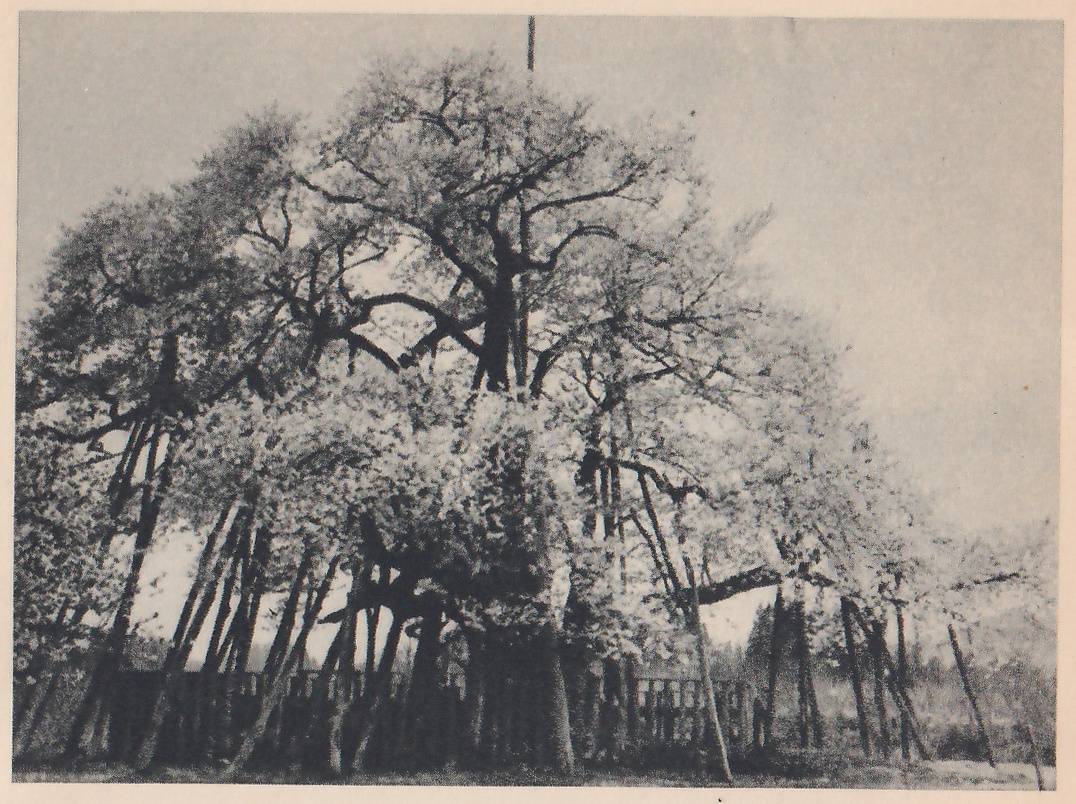
(3) “Isazawa Kubo-zakura”
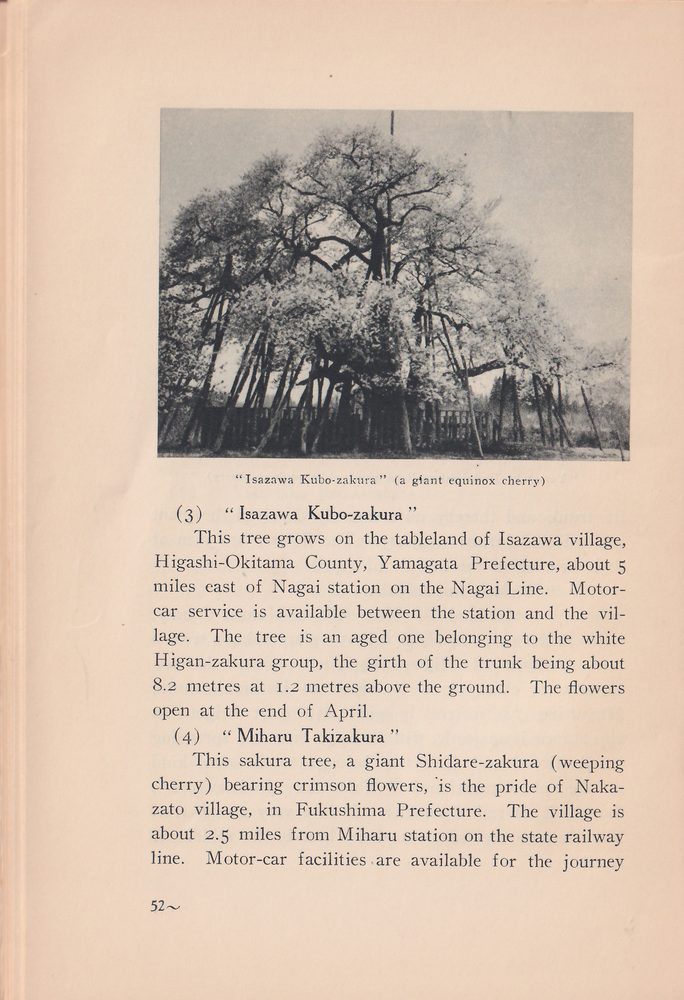
This tree grows on the tableland of Isazawa village, Higashi-Okitama County, Yamagata Prefecture, about 5 miles east of Nagai station on the Nagai Line. Motor-car service is available between the station and the village. The tree is an aged one belonging to the white Higan-zakura group, the girth of the trunk being about 8.2 metres at 1.2 metres above the ground. The flowers open at the end of April.
(4) “Miharu Takizakura”
This sakura tree, a giant Shidare-zakura (weeping cherry) bearing crimson flowers, is the pride of Nakazato village, in Fukushima Prefecture. The village is about 2.5 miles from Miharu station on the state railway line. Motor-car facilities are available for the journey
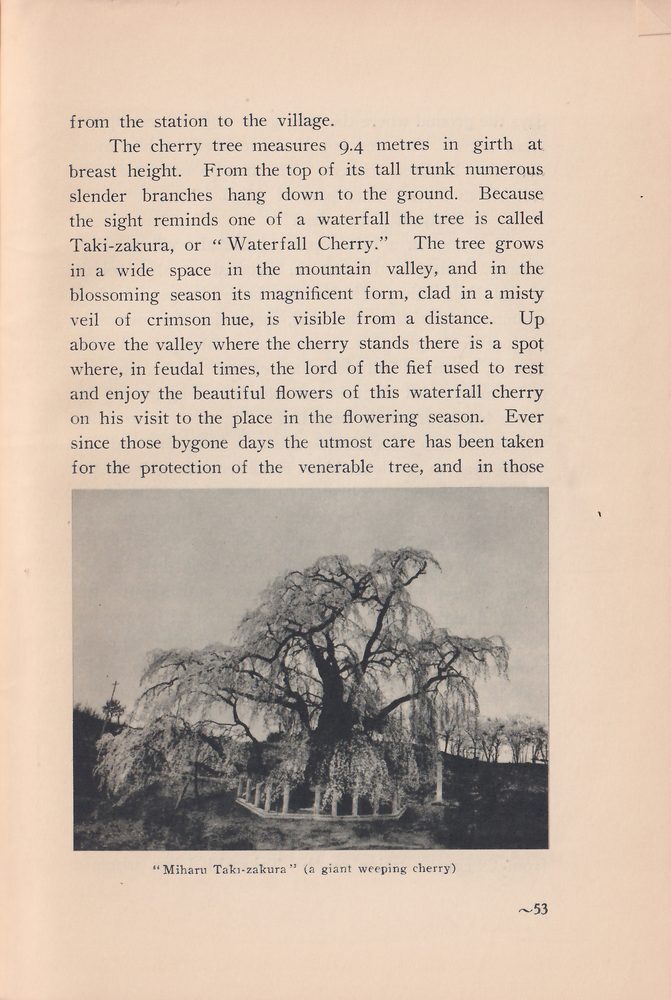
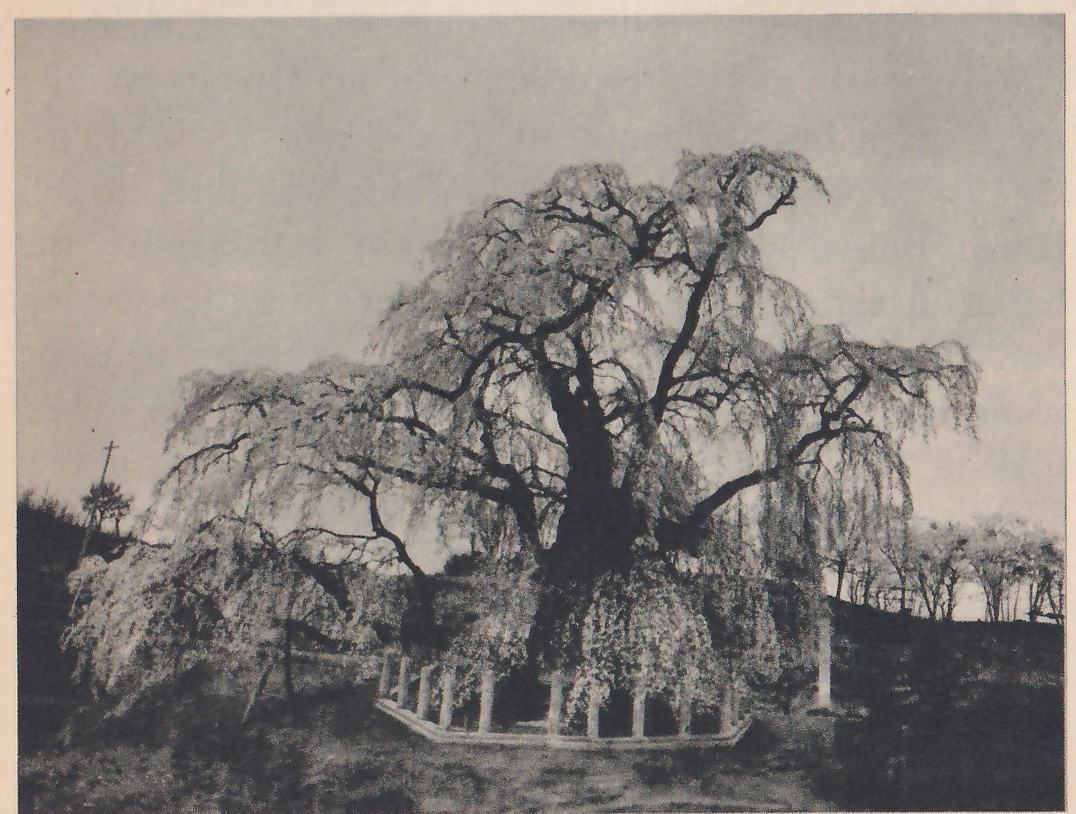
from the station to the village.
The cherry tree measures 9.4 metres in girth at breast height. From the top of its tall trunk numerous slender branches hang down to the ground. Because the sight reminds one of a waterfall the tree is called Taki-zakura, or “Waterfall Cherry.” The tree grows in a wide space in the mountain valley, and in the blossoming season its magnificent form, clad in a misty veil of crimson hue, is visible from a distance. Up above the valley where the cherry stands there is a spot where, in feudal times, the lord of the fief used to rest and enjoy the beautiful flowers of this waterfall cherry on his visit to the place in the flowering season. Ever since those bygone days the utmost care has been taken for the protection of the venerable tree, and in those
days the ground where the tree grew enjoyed exemption from taxes. The tree is believed to have survived more than five hundred winters. The flowers are usually in full bloom in the latter part of April.
(5) “Kariyado Geba-zakura”
Growing on a raised part of Shiraito village, Fuji County, Shizuoka Prefecture, situated at the foot of Mount Fuji, this particular tree is the largest of white mountain cherries in the land, measuring 8.5 metres in girth at the height of 1.1 metres above the ground. Its flowers, when in full bloom, are of pure white, and are in harmony with the crimson-coloured young leaves, the whole being strikingly beautiful. The tree is also called “Yoritomo no Komatome-zakura” from the tradition that it was in a flourishing condition as early as the days of Minamoto Yoritomo (founder of the Kamakura Government); and on the occasion of the famous hunting party given by Yoritomo around the foot of Mt. Fuji the grand sight of the cherry, which was then in full bloom, caused him to stop his horse and admire the beautiful sight. The name Komatome means “to stop one’s horse,” and the above story explains why the name was given to the tree. The tree had one of its gigantic branches broken off by a severe storm a few years ago. The flowers are usually in full bloom about the 10th of April.
(6) “Ishido Kaba-zakura”.
This peculiar cherry tree, Prunus media, stands in the grounds of the Tōkōin Temple at Ishido village, Kita-Adachi County, Saitama Prefecture, about 2.5 miles from Okegawa station on the Takasaki Line, where a
motor-car is available to the temple.
Consisting of four large trunks branching at the base of the stump and stretching their branches in all directions, the tree is a rare specimen of its kind. The circumference of its trunk at the foot measures about 11 metres. Its flowers are snow-white, and its flower-stalks are somewhat hairy. Around the root of the tree there are about ten stone tablets on the ground. Some of these have been embraced by the trunks and have become part of the tree as it has grown up through many centuries. The oldest of the tablets bears an inscription reading “second year of the Jōei era,” which corresponds to 1233 of the Christian era. From the inscription it is surmised that the tablet was placed here at this early period (the Kamakura period). A minute description of these stone tablets appears in the “Gendō Hōgen” written by Takizawa Bakin (1767—1849), which also contains their picture, sketched by Watanabe Kwazan, a noted painter of the Tokugawa period. This cherry tree is in full bloom about the middle of April.
Besides the above-mentioned giant trees, there is at Ōdo, Nagaoka village, Ibaraki Prefecture, a noted cherry tree known as “Ōdo-no-sakura.”
The place is near the city of Mito, and can be reached in a short time from that city by motor-car. The tree is a gigantic specimen of the white mountain cherry, measuring about 9.5 metres in girth at breast height. The blooming season is about April 20th.
In Maruyama Park, Kyoto, there is a famous cherry tree. It is an aged weeping cherry, which bears white
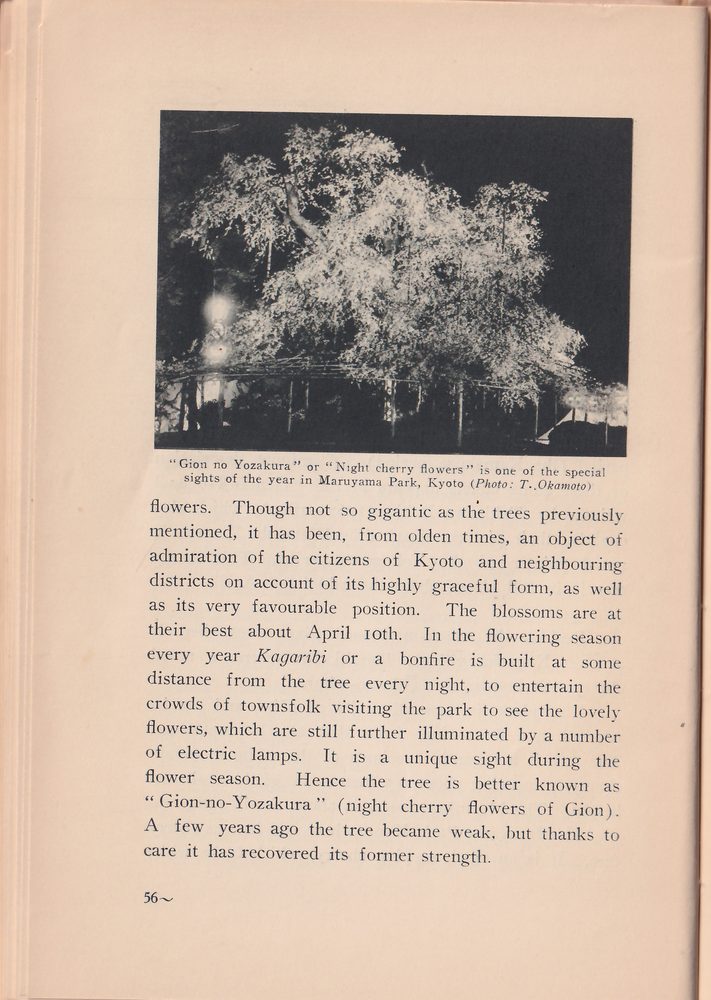
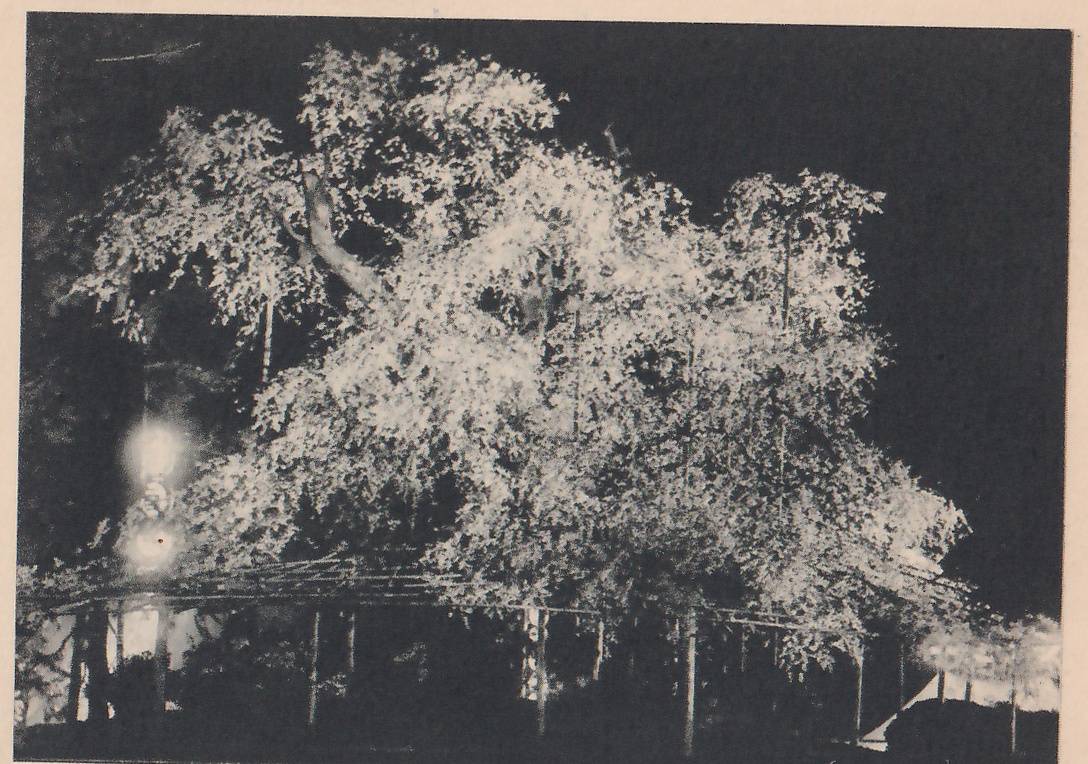
flowers. Though not so gigantic as the trees previously mentioned, it has been, from olden times, an object of admiration of the citizens of Kyoto and neighbouring districts on account of its highly graceful form, as well as its very favourable position. The blossoms are at their best about April 10th. In the flowering season every year Kagaribi or a bonfire is built at some distance from the tree every night, to entertain the crowds of townsfolk visiting the park to see the lovely flowers, which are still further illuminated by a number of electric lamps. It is a unique sight during the flower season. Hence the tree is better known as “Gion-no-Yozakura” (night cherry flowers of Gion). A few years ago the tree became weak, but thanks to care it has recovered its former strength.