

NEW METHODS FOR NEW TIMES
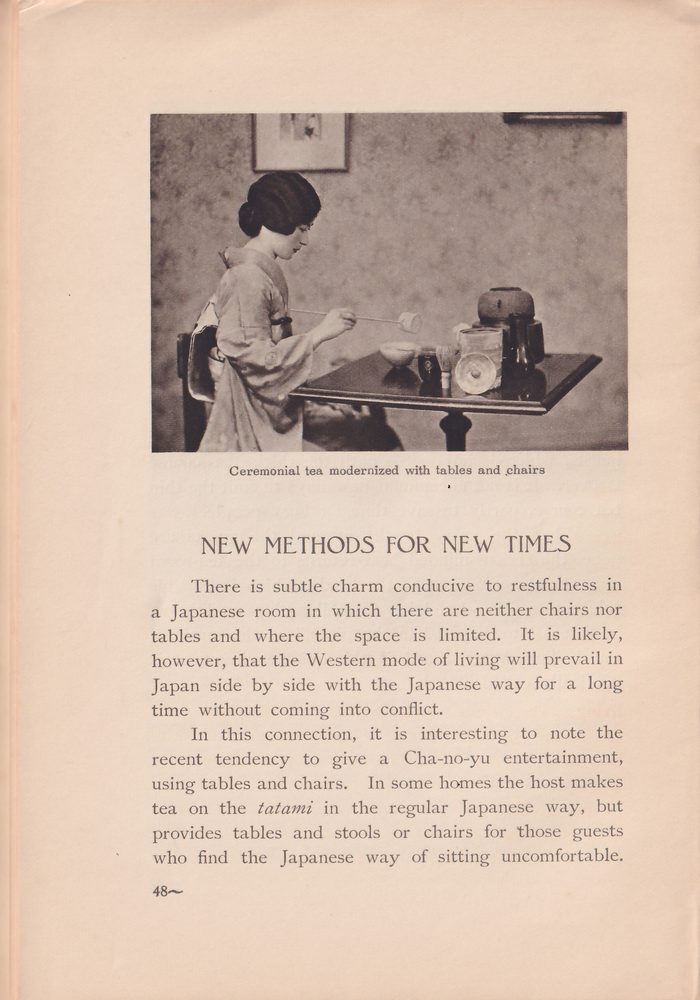
There is subtle charm conducive to restfulness in a Japanese room in which there are neither chairs nor tables and where the space is limited. It is likely, however, that the Western mode of living will prevail in Japan side by side with the Japanese way for a long time without coming into conflict.
In this connection, it is interesting to note the recent tendency to give a Cha-no-yu entertainment, using tables and chairs. In some homes the host makes tea on the tatami in the regular Japanese way, but provides tables and stools or chairs for those guests who find the Japanese way of sitting uncomfortable.
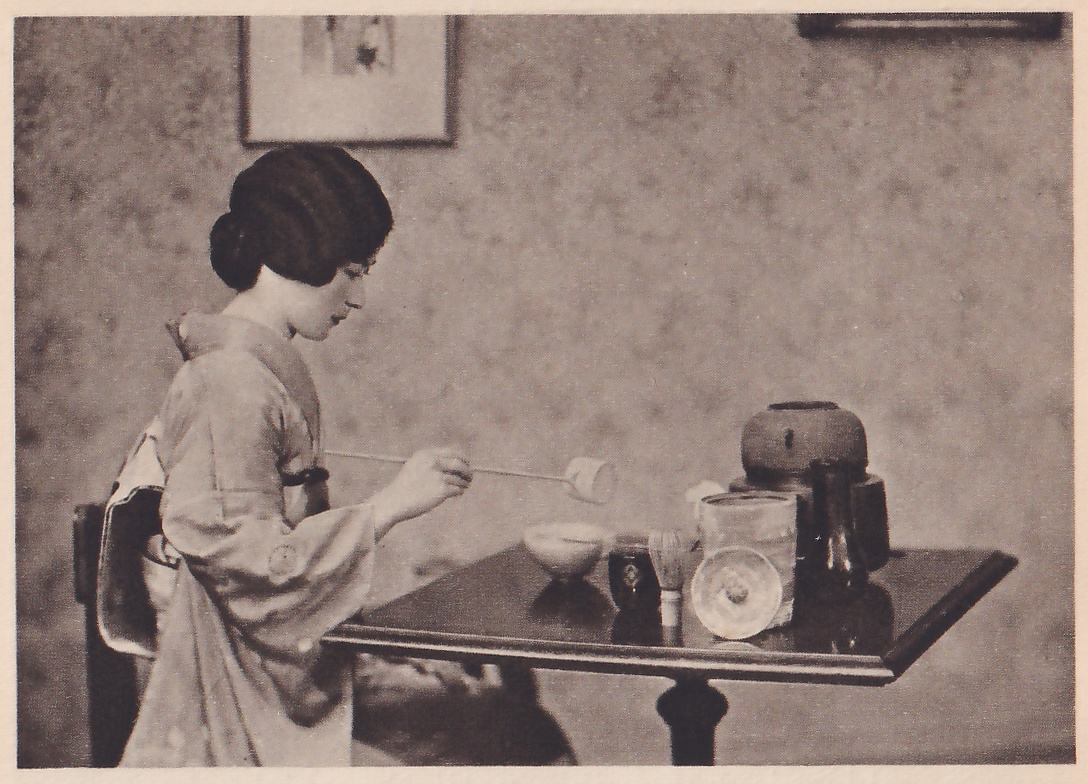
This is, however, a poor makeshift, and not without some incongruity. There is another way in which the host or hostess sits at the serving table, on which the necessary utensils are arranged conveniently. This style was devised about sixty years ago by a tea-master of the Ura Senke School in Kyoto, but has scarcely been improved since it was originally devised as a makeshift only. It is natural that some tea-masters and devotees of the orthodox type should attach little importance to the practice of using tables and chairs, for they do not quite harmonize with a Japanese room. Among other things, the presence of tables and stools spoils the artistic effect of the alcove decoration, which is the most important part of a Japanese room.
In Tokyo there is a tea-master who is a man of original ideas. For some time he has been giving lessons in Cha-no-yu to several Western ladies, and has already introduced some innovations. The author was present at such a party recently conducted by this tea-master in the drawing-room of a regular Western-style house. He had to deviate to a great extent from the practice as handed down by the originator, yet he proved highly successful in adapting the tea ceremony of Japan to the Western way of living. The whole procedure was in harmony with the room. In making the necessary preparation, the first thing he did was to remove many articles usually displayed in the room. The mantelpiece, on which he put nothing but a bamboo vase, with a few flowers arranged simply, looked most attractive and effective. It was found that this use of the mantelpiece is far
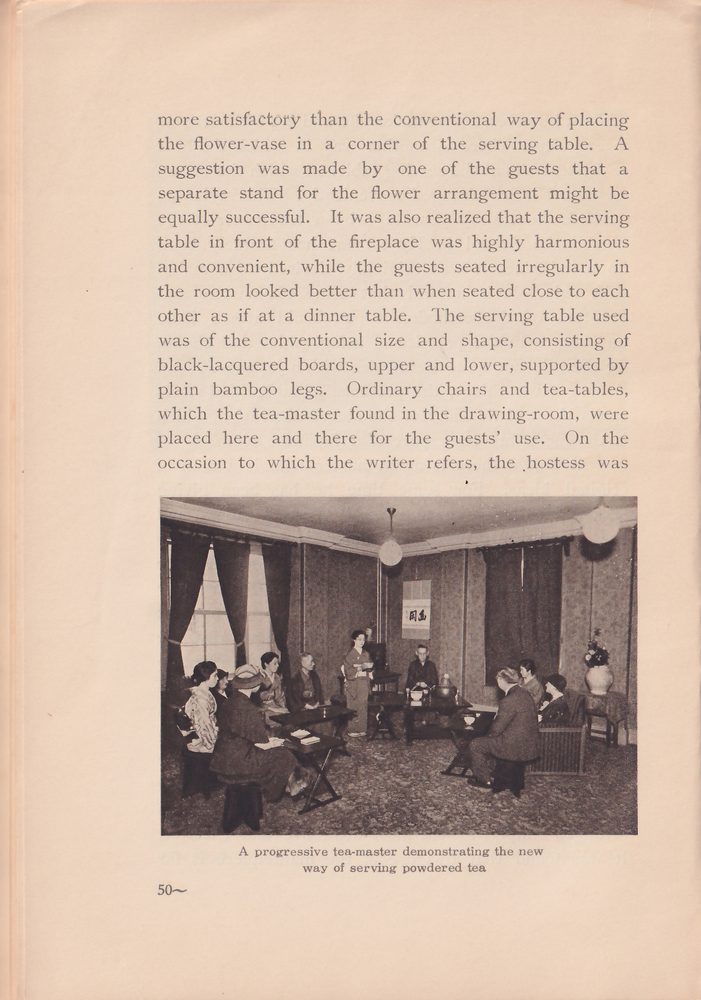
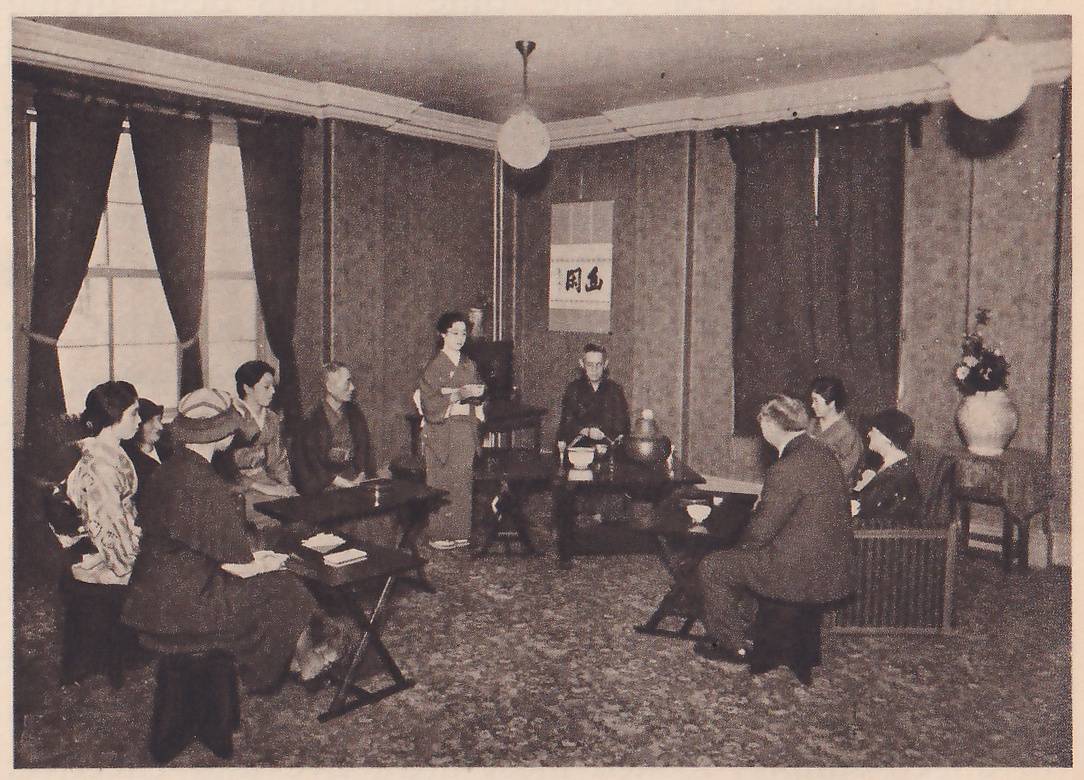
more satisfactory than the conventional way of placing the flower-vase in a corner of the serving table. A suggestion was made by one of the guests that a separate stand for the flower arrangement might be equally successful. It was also realized that the serving table in front of the fireplace was highly harmonious and convenient, while the guests seated irregularly in the room looked better than when seated close to each other as if at a dinner table. The serving table used was of the conventional size and shape, consisting of black-lacquered boards, upper and lower, supported by plain bamboo legs. Ordinary chairs and tea-tables, which the tea-master found in the drawing-room, were placed here and there for the guests’ use. On the occasion to which the writer refers, the hostess was
an American lady, and some of the guests were Japanese. The hostess and her guests presented a most pleasing and picturesque sight, their Western dresses being perfectly in keeping with the room.
All those present were in favour of the new style. It was indeed a revelation to see that the practice of serving ceremonial tea in a Western-style room was so full of possibilities. In the present instance usucha, or thin tea, was served informally, in accordance with the general practice, and it will be extremely interesting to make a deeper study with a view to adapting it to the more formal way of serving koicha, or thick tea.
It may be that there is little room for improvement in the preparation of kaiseki, the typical meal of Cha-no-yu, and for which the choicest materials are used. Some departure from the original procedure will, however, be necessary in serving the meal. The new style is not yet free from incongruous and crude features. Tea-masters and devotees, many of whom are proverbially resourceful and gifted with original ideas, will be able to make the new way more harmonious with the changing mode of living in Japan. Those of Western birth and upbringing are in an advantageous position to make contributions to the ancient Japanese cult of ceremonial tea.
There are a few small houses specially built for Cha-no-yu, in which the floors are so arranged as to make it unnecessary for the guests to take off their shoes. Tables and chairs are found convenient when wearing Western-style clothes, and make it unnecessary
to kneel in the proper Japanese manner. Alcoves are raised very much higher than the standard tokonoma, so that hanging scrolls can be displayed more conveniently for those sitting in chairs. Visitors to the Century of Progress Exposition in Chicago will remember a similar house. There, the powdered tea served was more comfortably enjoyed by American guests who did not care to conform strictly to the typical Japanese mode of living.
It is hoped that in addition to the old-fashioned manner of giving a Cha-no-yu party, which is in a highly developed state due to the refining process continued for centuries, the new method, briefly sketched above, may be more widely adopted by those who live in Western-style houses. Is it not to the advantage of tea-masters and devotees of tea to co-operate harmoniously in order to make the new way more attractive and practical?