

SIMPLICITY, THE KEY-NOTE
In addition to a brief historical survey of Cha-no-yu as it has come down to the present generation from the early masters, we have seen how lessons are given, and how the entertainments are conducted. It would, however, be extremely difficult, if not impossible, to appreciate the fundamental ideals and traditions of Cha-no-yu without knowing something of the philosophy of life and art according to Zen Buddhism.
Meditation and introspection are stressed in the Zen philosophy, and the habit of individual and independent thinking is cultivated. It is natural that the inadequacy of words as vehicles of expression should be recognized. In the mental discipline of Zen, concentration is considered more important than anything else, and devotees are taught to cultivate direct communion with the inner nature of things in order to arrive at truth. The value of suggestion and intuition are therefore emphasized by those who follow Zen traditions.
Cha-no-yu is now a secular pastime, as we have seen. Neither religion nor philosophy has much to do with the cult as it is today. However, the canon of preferring plainness and austere simplicity to elaborate decoration cannot be accounted for except as being of Zen origin.
Paintings in black and white by Zen monks and
artists, creating an atmosphere of transcendental calm, are highly prized for their simple, but subtle and suggestive beauty. For the same reason, hanging scrolls bearing inscriptions by the ancient Zen monks are still used for Cha-no-yu parties. The sentiments expressed may be moral or religious, but they are characterized by untrammelled aloofness from dogmas and creeds, and exercise a liberating influence upon the mind. The free and natural strokes of the ideographs, which are different from the more regular styles of the ordinary calligraphers, suggest the writer’s freedom from worldly emotion and passion.
Only a small section of the Japanese people understand the institution of Cha-no-yu, but the com-
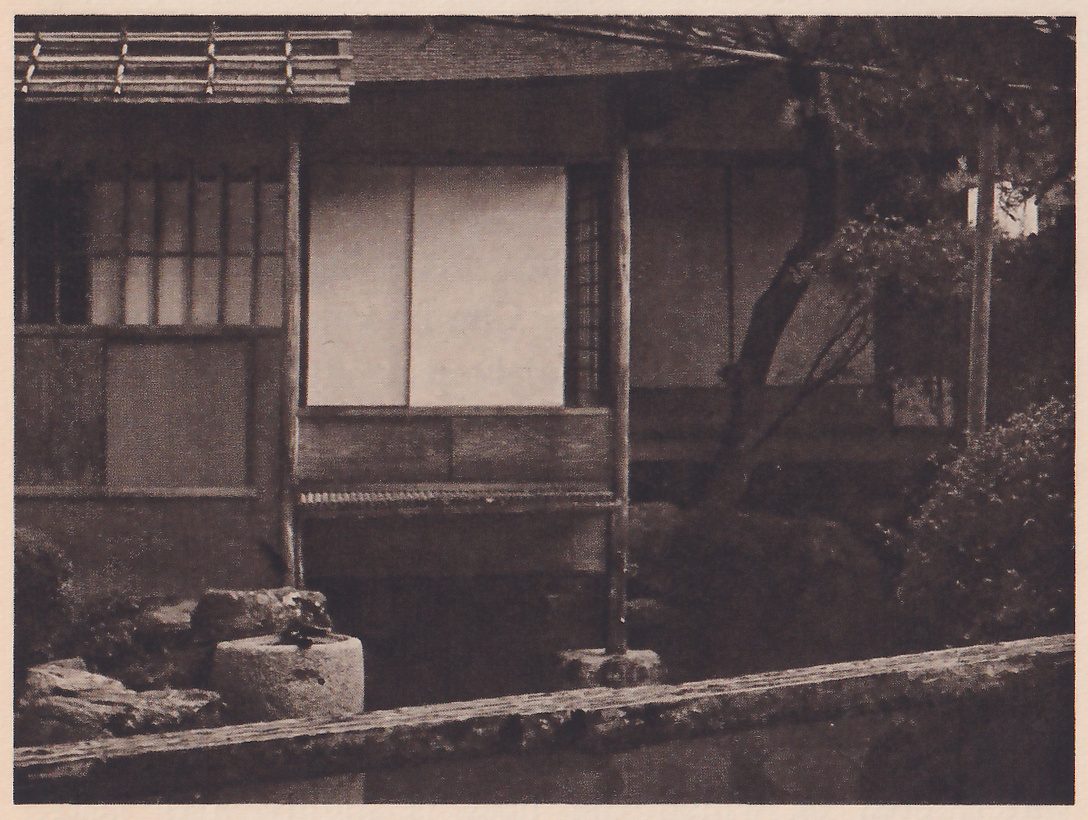
mon intuition of seeing true beauty in severe simplicity and refined poverty may be considered a racial trait. This characteristic phase of Japanese life may also be traced to the ideals inculcated by the early masters through the medium of the tea ceremony.
With the introduction of Western modes of civilization Japan has undergone changes in many directions; the beauty of chaste simplicity is often sacrificed to ugly vulgarism, which characterizes all cheap copies and imperfect adaptations. Nevertheless the inborn love of simplicity is so deep-rooted that it is discernible, not only in the art and architecture of Japan, but also in the daily life of the Japanese people. The influence of the tea cult is to be seen in the Japanese
home even though nothing be known of ceremonial tea.
Having observed the tea-master’s way of training his pupils, and having taken part in more than one entertainment, the readers will have noted that Cha-no-yu is related to nearly all branches of arts and crafts, as well as to various phases of Japanese home life. It is its many-sidedness that makes Cha-no-yu one of the most interesting aesthetic pursuits.
The love of chaste and refined simplicity, which is the key-note of the Japanese cult of ceremonial tea, has exercised a wholesome influence upon architecture, pottery, landscape gardening, etc. For those who are satiated with looking at elaborate, tawdry and pretentious works of art, it is a relief to discover subtle beauty and refinement under an inornate and almost barren aspect. When accomplished tea-masters and devotees give entertainments, they know how to attain artistic effect without depending upon what is colourful and gaudy.
Pottery is perhaps the most important of the industrial arts allied with Cha-no-yu. The ceramic art of Japan is greatly indebted to tea-masters and devotees for its refined taste, which has inspired artisans. Some knowledge of ceramics is therefore essential for the full enjoyment of a Cha-no-yu entertainment, at which by far the larger part of the utensils are of pottery. Any guest not interested in pottery will disappoint his host. Such a guest invariably fails to appreciate the tea-bowl, caddy, receptacle for fresh water, etc., of which the host is highly and justly proud.
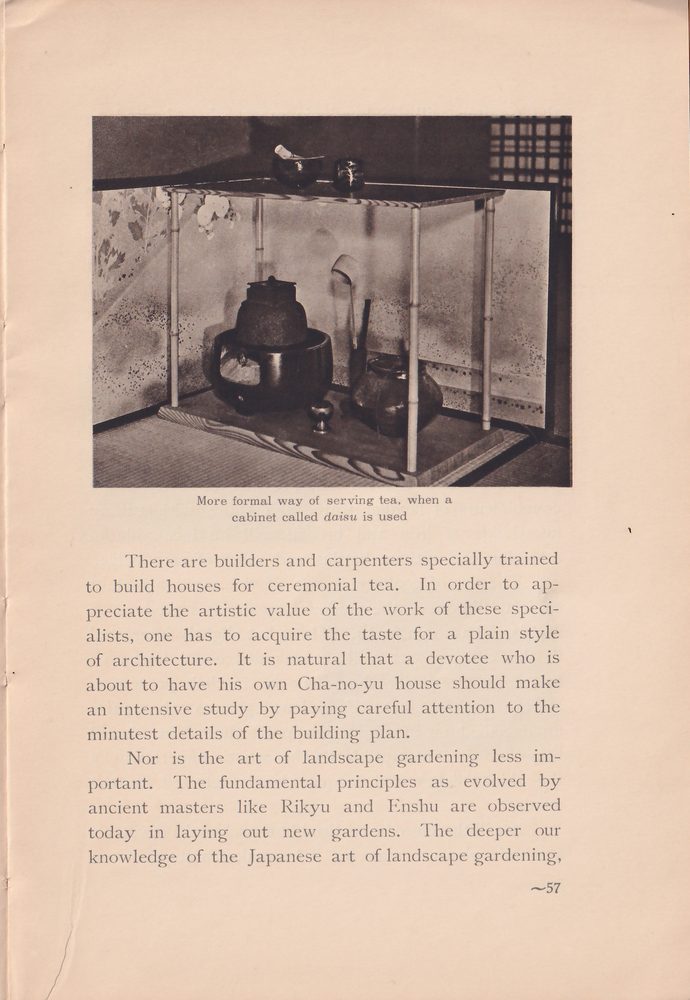
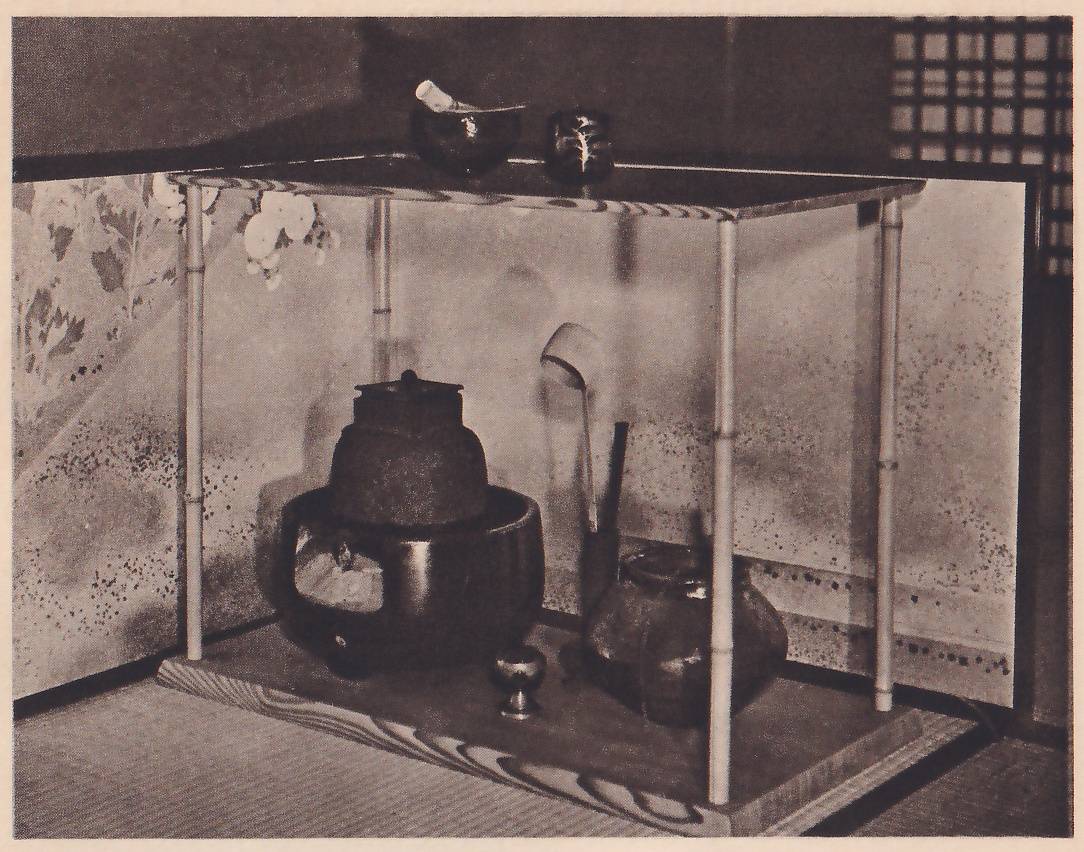
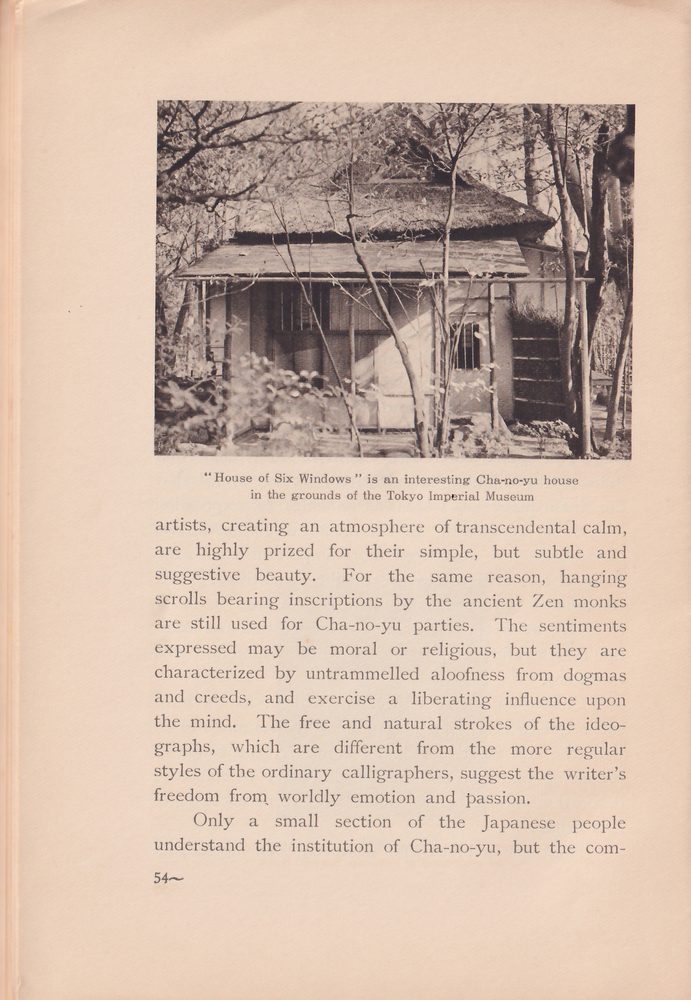
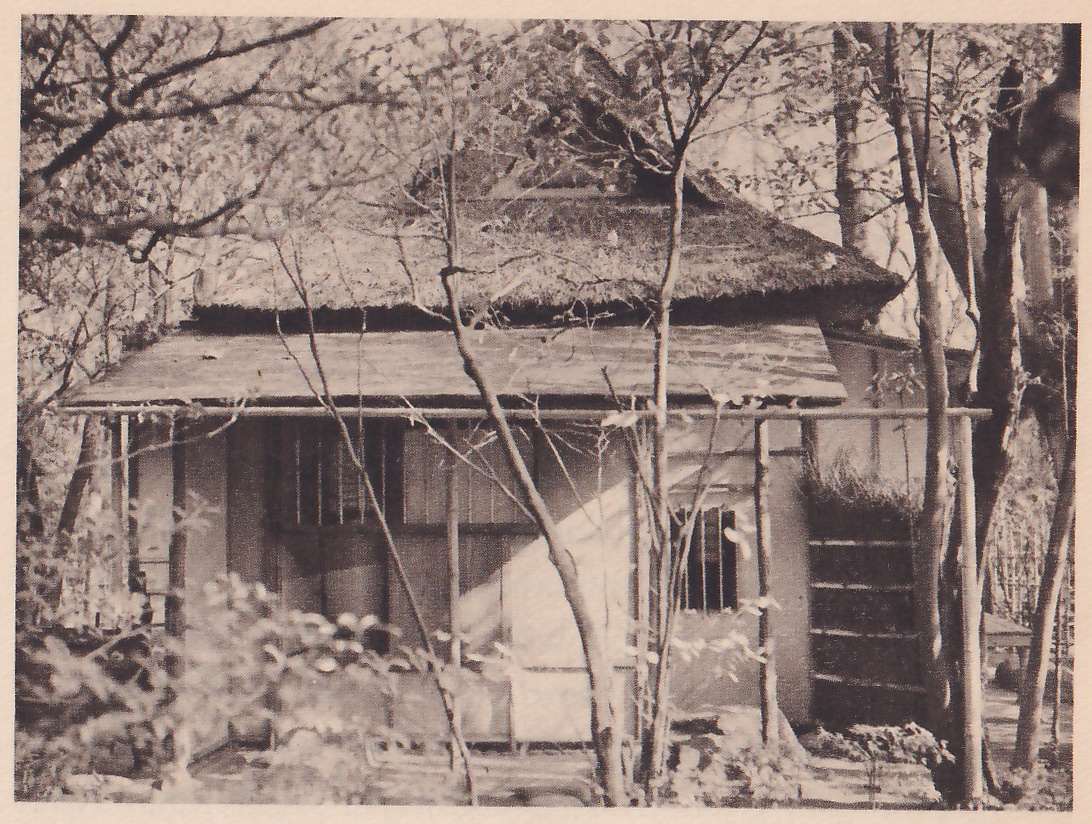
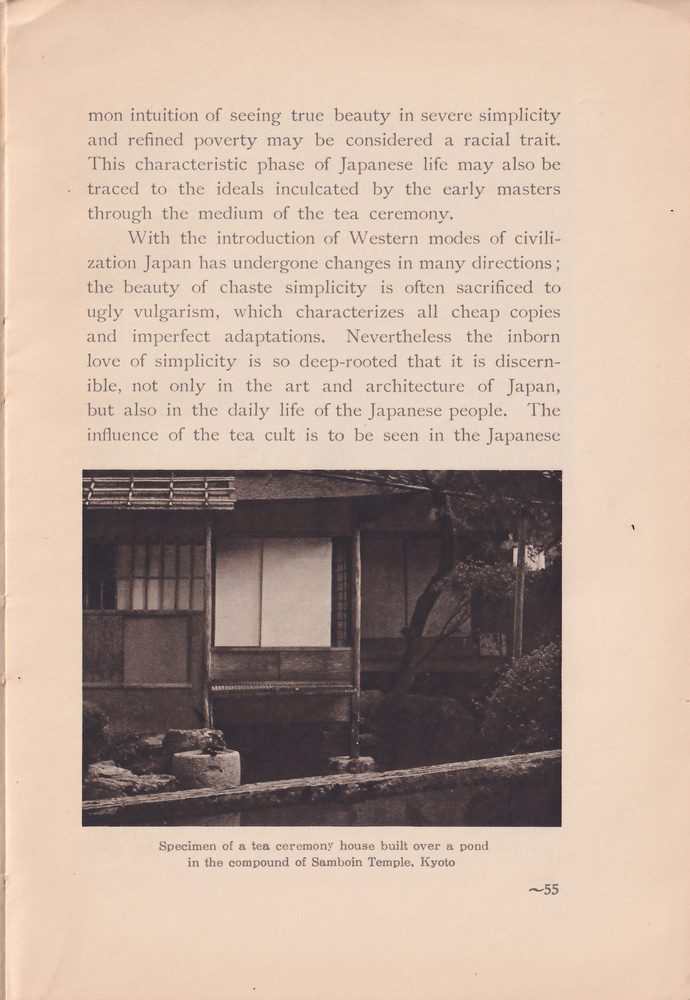
There are builders and carpenters specially trained to build houses for ceremonial tea. In order to appreciate the artistic value of the work of these specialists, one has to acquire the taste for a plain style of architecture. It is natural that a devotee who is about to have his own Cha-no-yu house should make an intensive study by paying careful attention to the minutest details of the building plan.
Nor is the art of landscape gardening less important. The fundamental principles as evolved by ancient masters like Rikyu and Enshu are observed today in laying out new gardens. The deeper our knowledge of the Japanese art of landscape gardening,
the greater will be our enjoyment when invited to inspect any garden, even though not connected with Cha-no-yu.
None but a person with an artistic sense strongly developed is capable of arranging flowers in a simple but highly effective way, which is so characteristic of the alcove decoration at a Cha-no-yu party. Should a guest fail to appreciate the vase and flowers arranged in them, his host might never invite him again.
No host would blame those unfamiliar with the Japanese language and literature for their indifference to hanging scrolls bearing inscriptions. A knowledge of textiles will, however, be helpful in appreciating the quality of the ancient brocade used in mounting them.
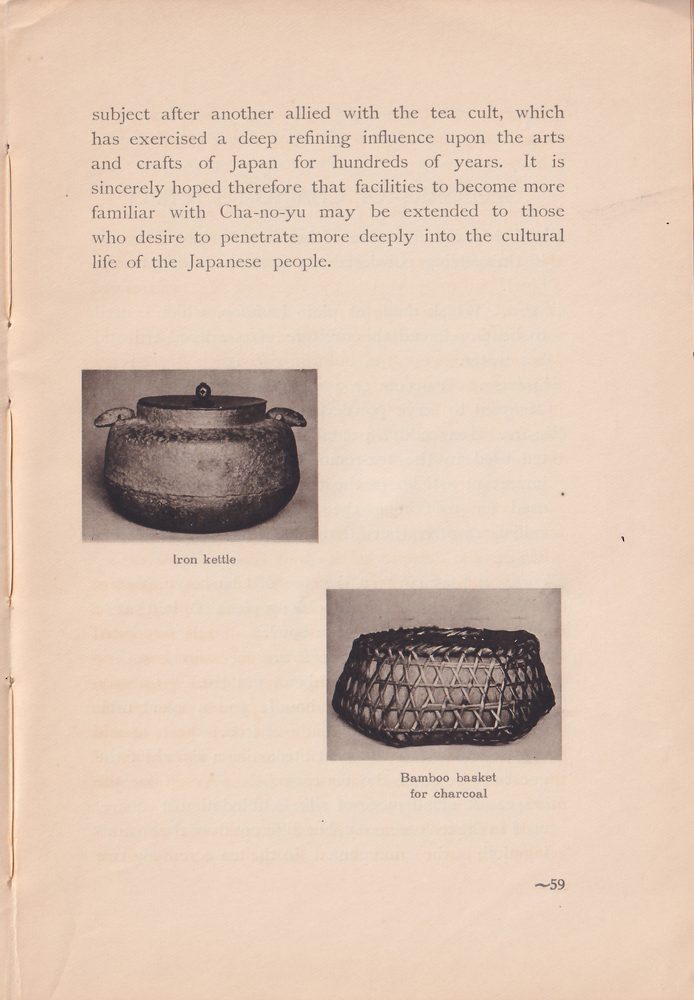
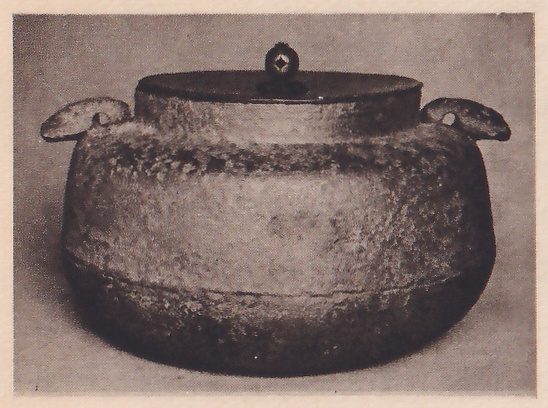
Devotees of the tea cult are also expected to be connoisseurs of lacquer ware, and those with scanty knowledge of iron and bronze will be incapable of admiring the antique kettles and vases of rare value.
The art of cookery is one of the most important subjects, because the kaiseki meal is served at a regular Cha-no-yu party. Those but slightly interested in the culinary art will make unsuccessful hosts, no matter how superior they may be in their possession of rare works of art. Fastidious epicures who praise an excellent menu might disappoint their host, should they remain insusceptible to the artistic superiority of the china dishes and lacquer bowls selected for the meal.
It will therefore be realized how profound a devotee’s aesthetic pleasure may be, if he makes a study of one
subject after another allied with the tea cult, which has exercised a deep refining influence upon the arts and crafts of Japan for hundreds of years. It is sincerely hoped therefore that facilities to become more familiar with Cha-no-yu may be extended to those who desire to penetrate more deeply into the cultural life of the Japanese people.