

WHEN KOICHA IS SERVED
Cha-no-yu would, indeed, be a polite, but dull pastime, were it merely a systematized performance or conventional etiquette to serve powdered tea. To those who observe but young women taking lessons, or are present when powdered tea is served as a sort of sideshow at a Western-style reception or similar party, it is natural that Cha-no-yu, with its complicated ritual, should seem to belong to the strange customs of the country.
It is hoped that readers have now a fairly good idea of the way in which powdered tea is served in an informal way. Those who have been present at an entertainment as described in the foregoing chapter have a more concrete idea of this phase of Japanese home life. In order to get a deeper insight into the home life of the Japanese people, as reflected in the tea cult, it is necessary to have an opportunity to participate in a regular Cha-no-yu party, at which koicha, or thick tea, is served, in addition to the typical meal known as kaiseki. A Cha-no-yu party is an exclusive one. It is not easy to receive an invitation, and a stranger would be quite ill at ease, even though fortunate enough to receive an invitation, were he not properly piloted. As will be seen later, only one or two of those totally unfamiliar with the general practice could join a small party of five or six.
Five is the usual number of guests, and the host has a definite object in arranging an entertainment. The first thing the host does is to select the principal guest. Choosing the other guests congenial to the principal is the next most important matter.
Those who are only familiar with the busy activities in Tokyo’s modern office buildings (scarcely different from those in New York or London), would hardly be able to recognize financial magnates or captains of industry in the midst of the tea atmosphere. Rival politicians are different men when they come together at a Cha-no-yu party. Nothing suggests business or politics. The host and guests are dressed as becomes the ceremony, i. e. in a comfortable silk kimono,
of sober hue. When the men change from the close-fitting Western suits, which they wear at the office, they experience a physical and mental relaxation, that effects a transfiguration in their appearance.
Our host then is a wealthy industrialist, whose residence is one of the finest in Tokyo. On arrival the
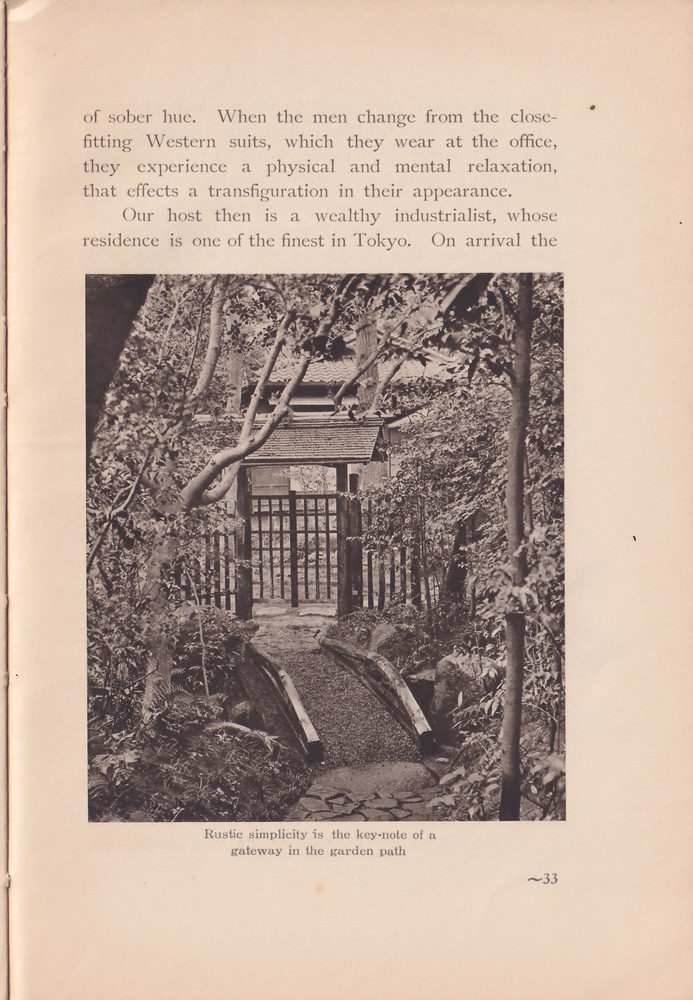
main front door is not opened to the guests. They are directed to proceed unattended to a small waiting-place in a quiet corner of the garden. It is at this point that the guests begin to lose contact with the outside word.
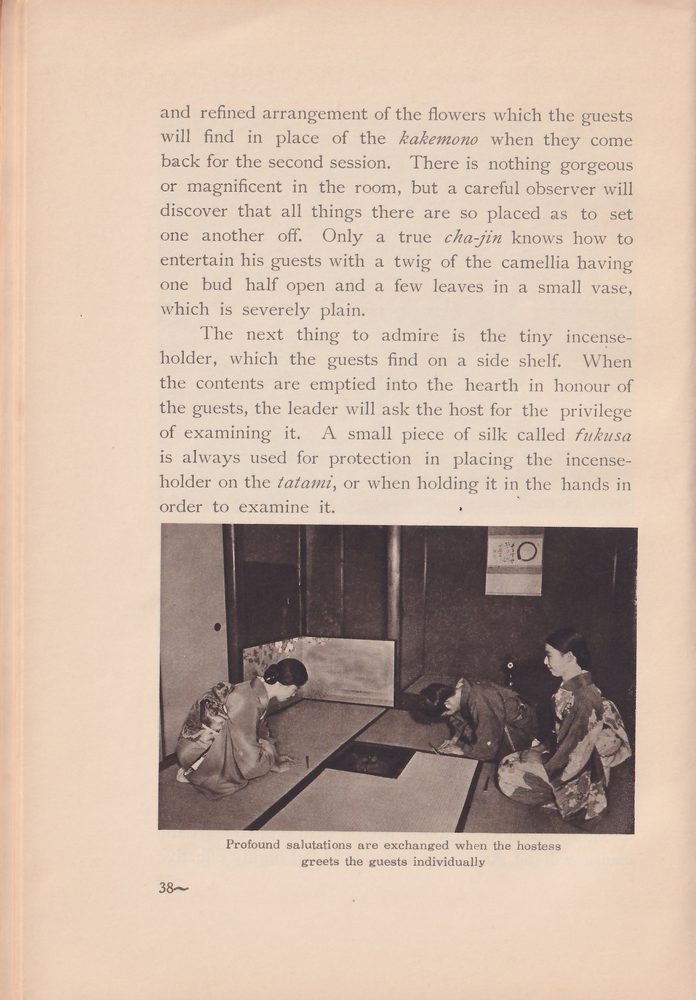
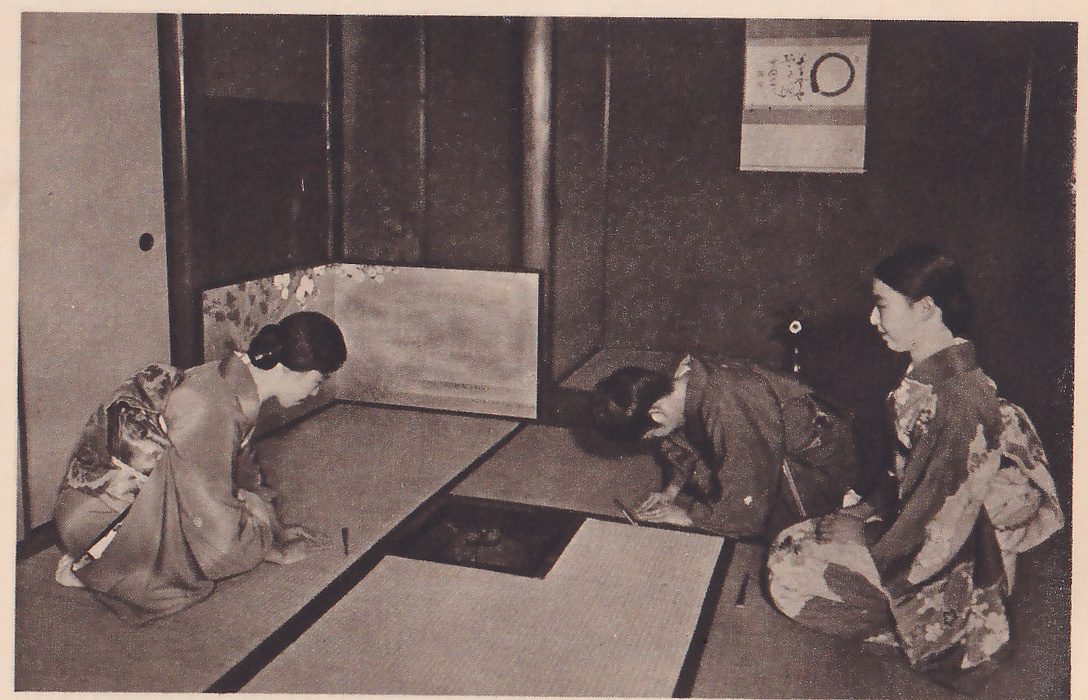
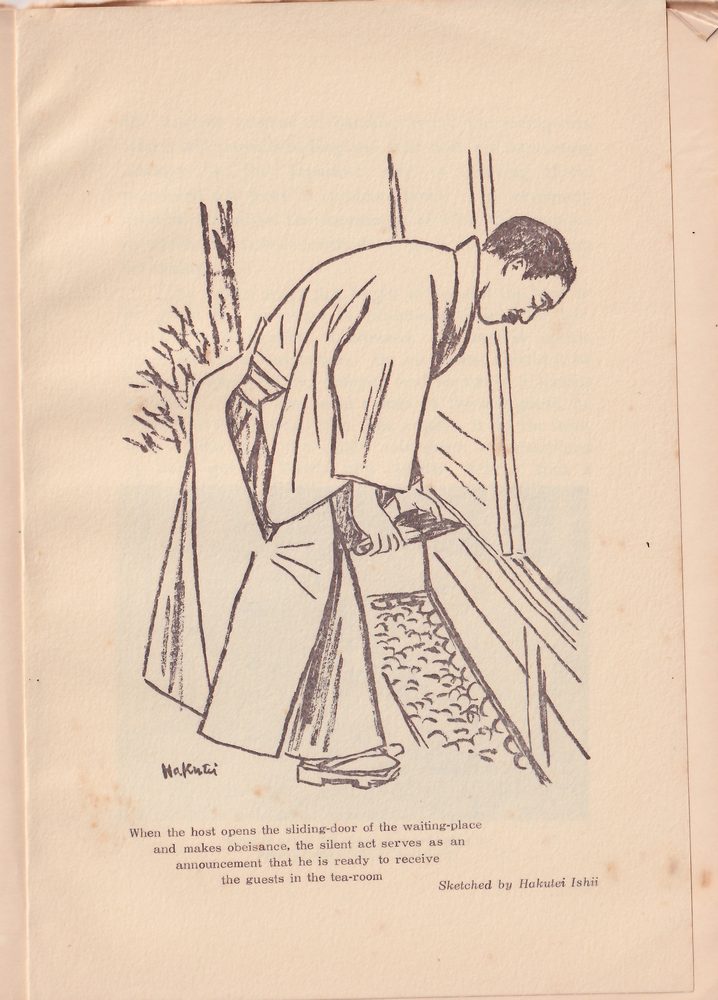
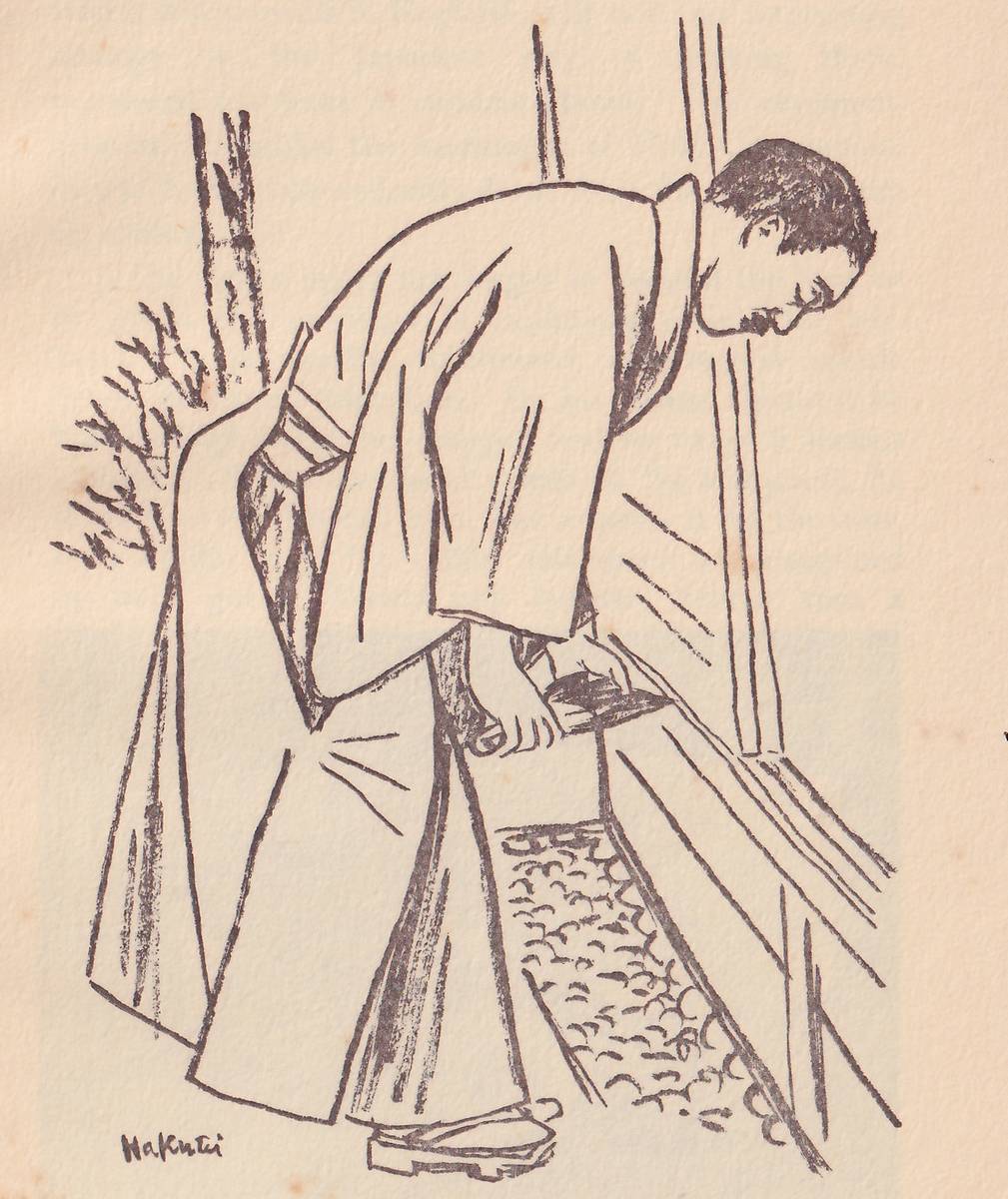
As the guests arrive, one by one, and assemble in the yoritsuki, or waiting-room, they greet one another, expressing the joy of sharing the hospitality of their host. This yoritsuki is, perhaps, a small room with three mats, but the guests are expected to inspect and admire the various articles tastefully arranged. Indifference is a deadly sin, and the host will be greatly disappointed if his guests fail to take interest in anything shown, or are incapable of appreciating his thoughtfulness in arranging the smallest details of the entertainment. In due time the host comes, and quietly opens the paper sliding-door. He makes a
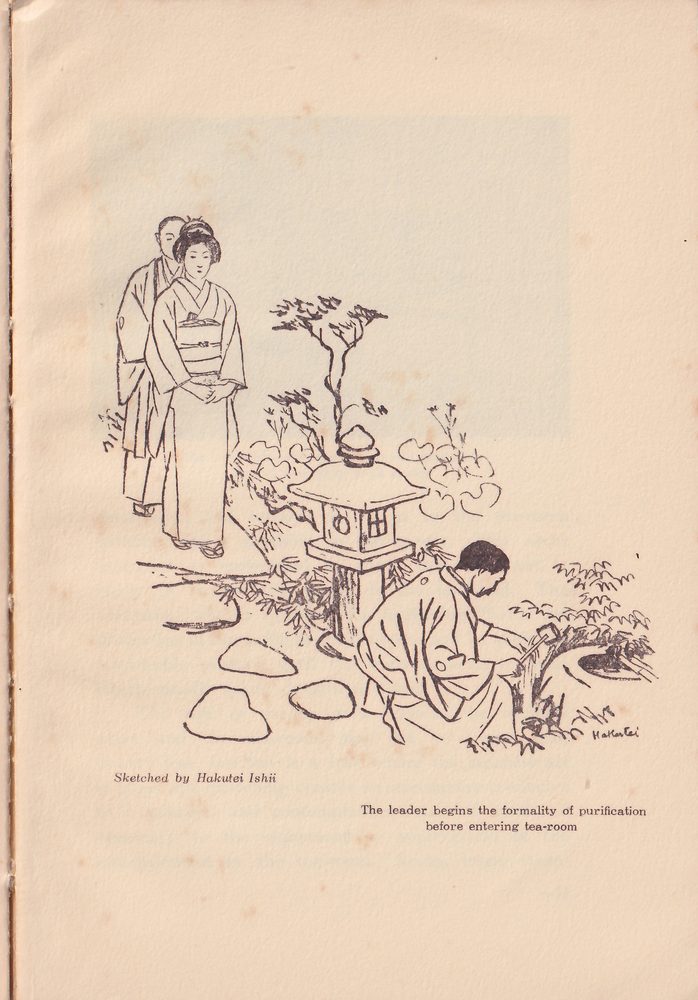
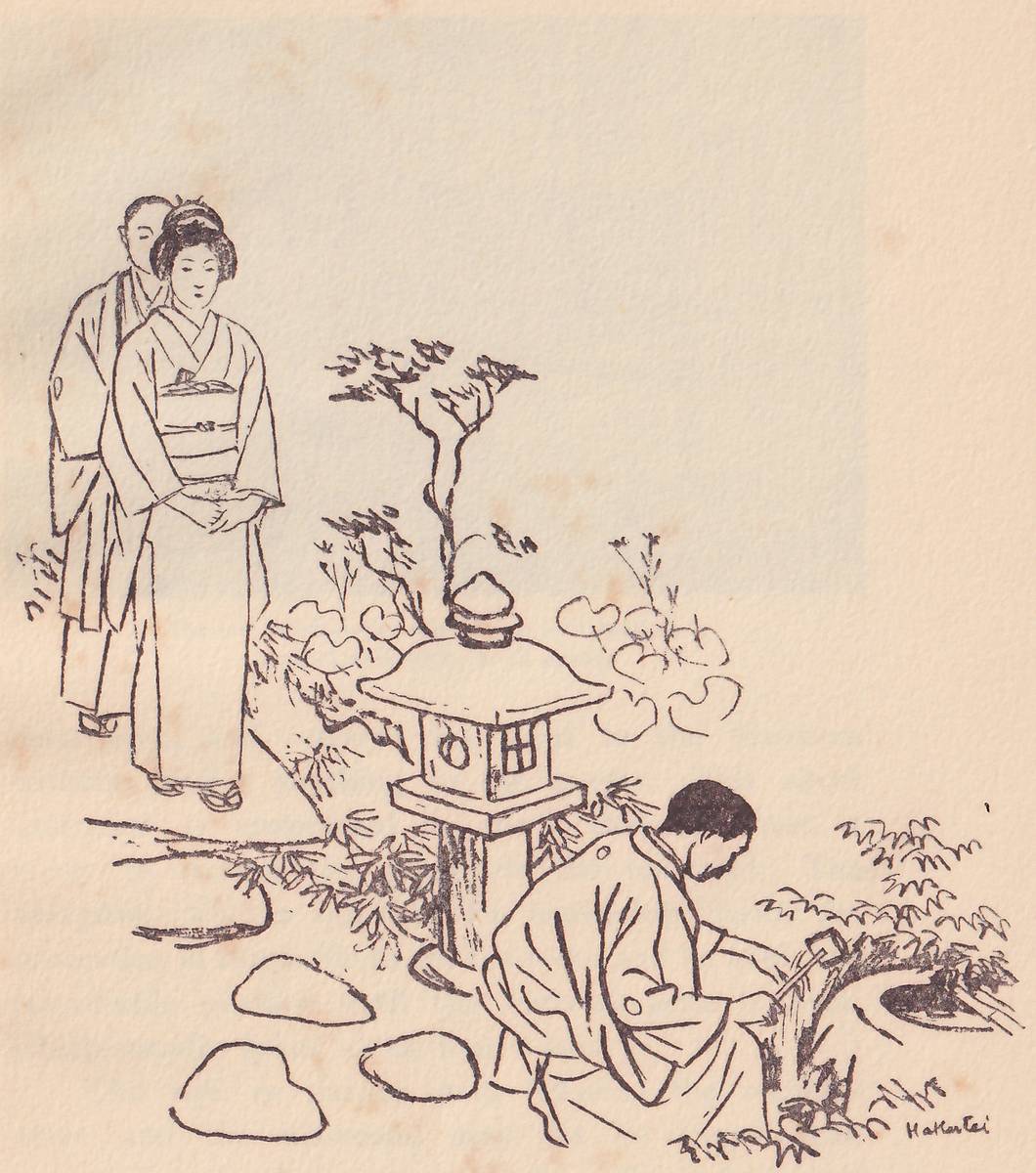
The leader begins the formality of purification before entering tea-room
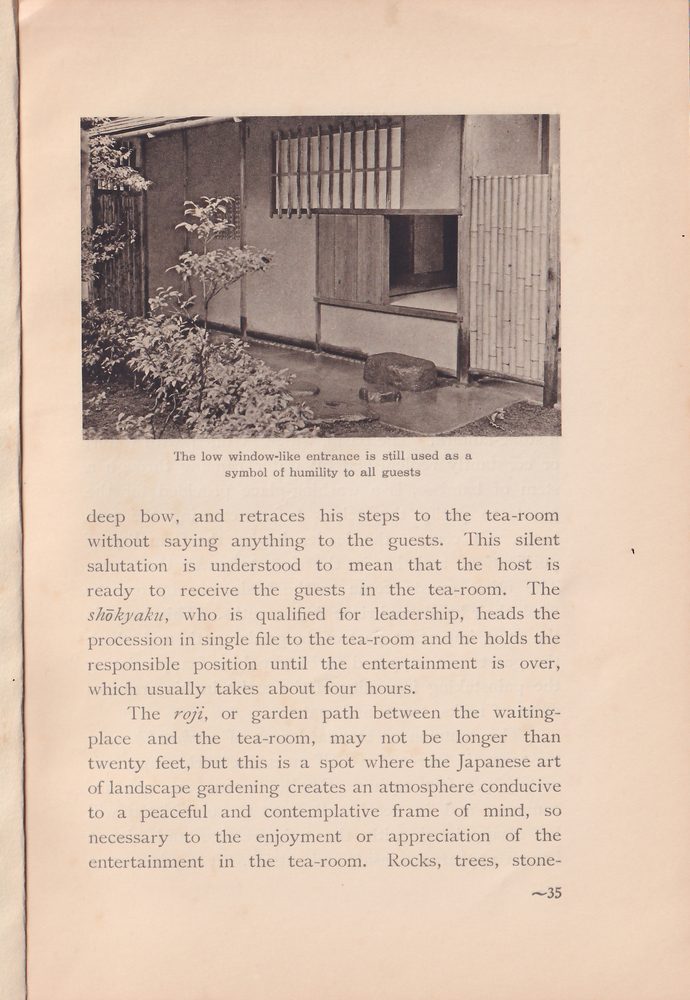
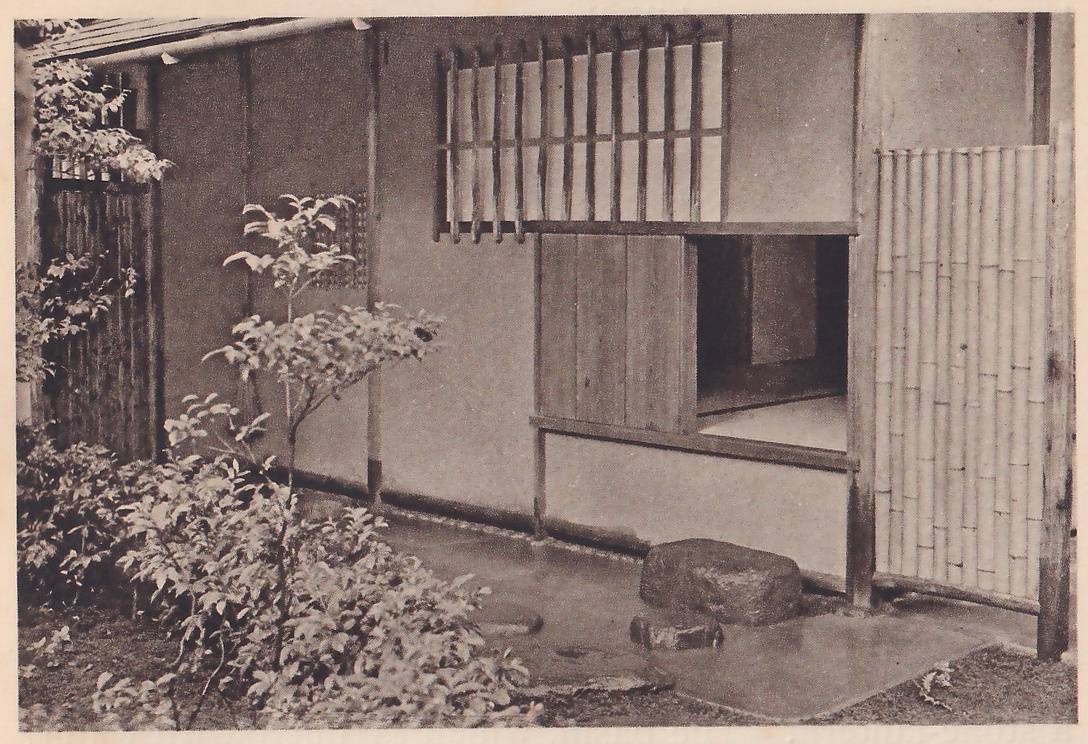
deep bow, and retraces his steps to the tea-room without saying anything to the guests. This silent salutation is understood to mean that the host is ready to receive the guests in the tea-room. The shōkyaku, who is qualified for leadership, heads the procession in single file to the tea-room and he holds the responsible position until the entertainment is over, which usually takes about four hours.
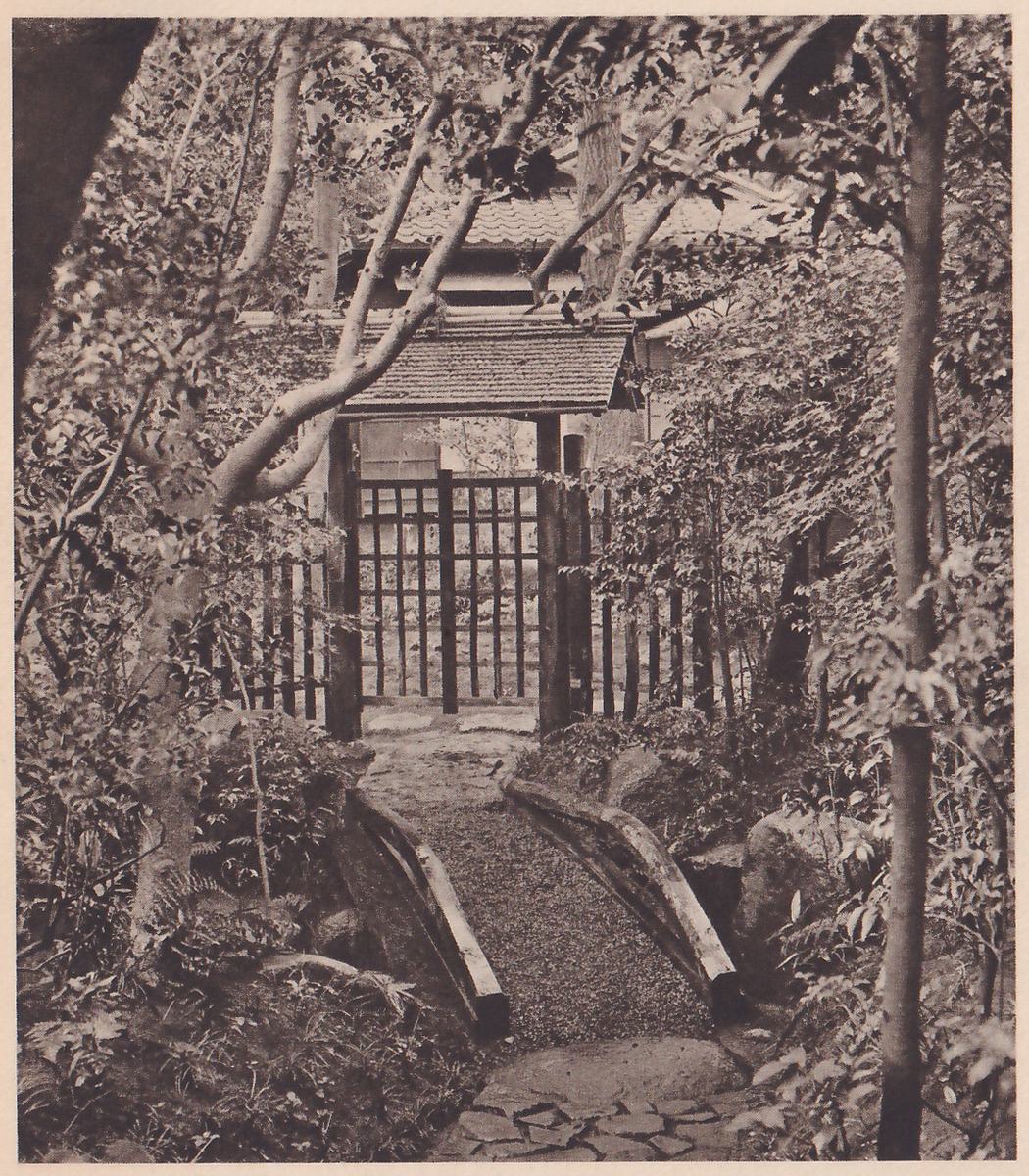
The roji, or garden path between the waiting-place and the tea-room, may not be longer than twenty feet, but this is a spot where the Japanese art of landscape gardening creates an atmosphere conducive to a peaceful and contemplative frame of mind, so necessary to the enjoyment or appreciation of the entertainment in the tea-room. Rocks, trees, stone-
lanterns, etc., are skilfully arranged so as to form a charming combination of Nature and Art. The whole is highly artistic, and not artificial, provided of course the garden is the work of a first-class landscape artist and is under his constant care.
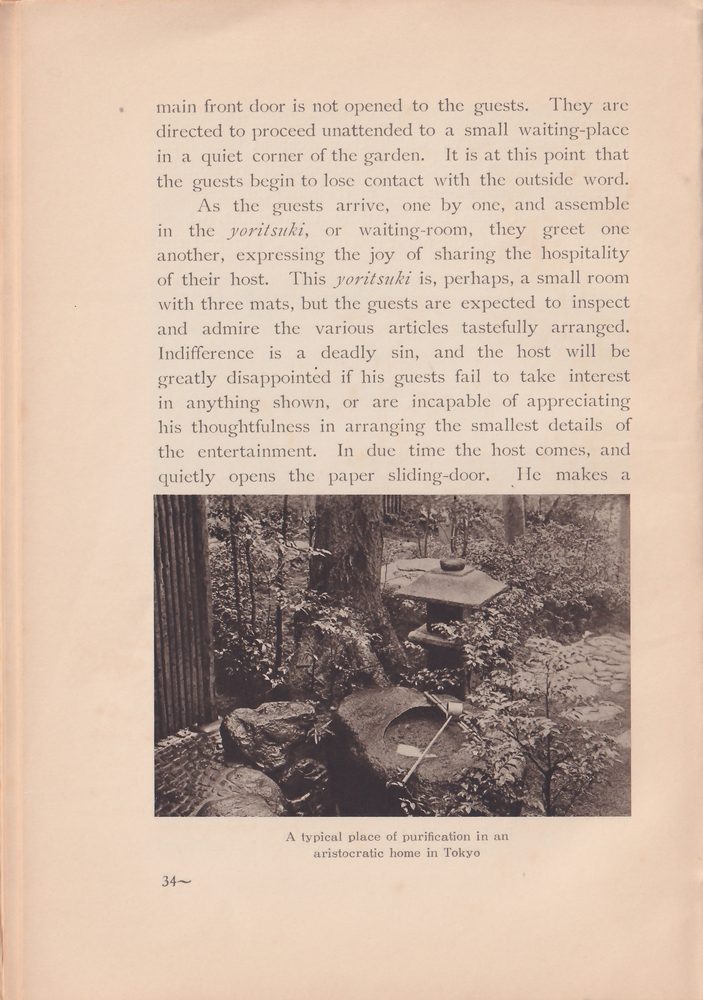
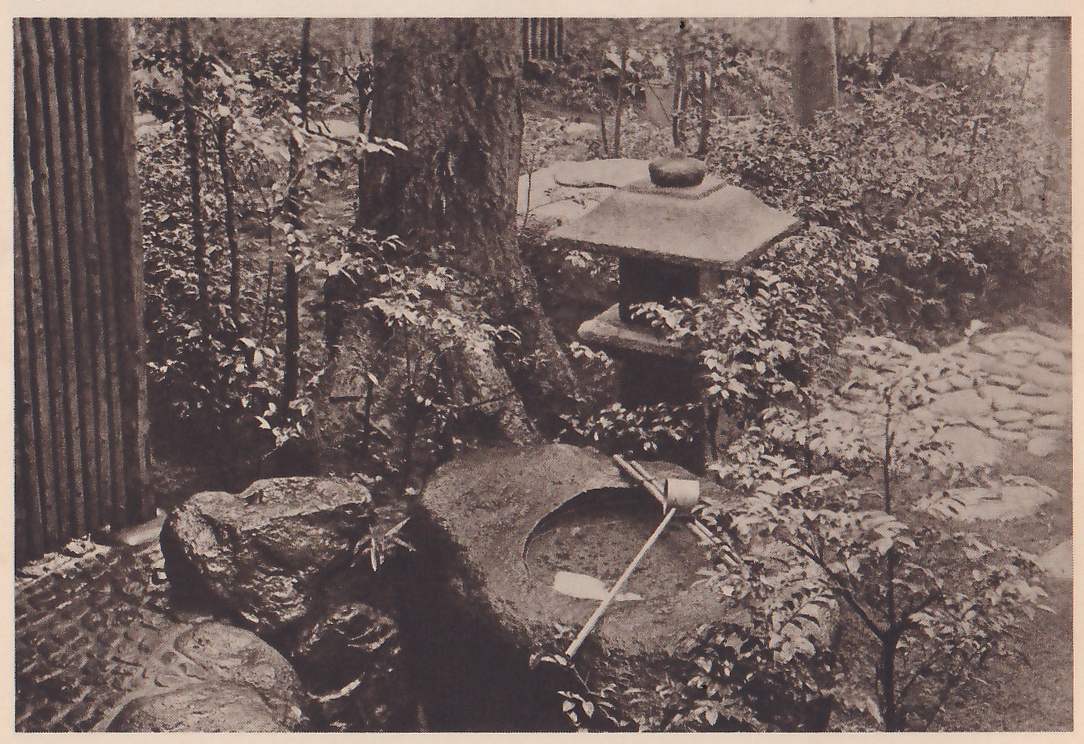
Communion with nature is expected of those about to enter the tea-room, and the procession is silent; for the guests’ serenity of mind is not to be disturbed. No funeral procession could be more quiet. Were the guests to be asked if this was really an “entertainment”, they would emphatically answer that it was so. As they approach the tea-room, they come to a point where there is a stone basin close by a stone-lantern. The basin, which is filled with water, or constantly replenished by water running through a stem of bamboo, is a washing-place provided for the guests to purify themselves before entering the tea-room. Of course, the leader begins the formality of purification, and he is the first to enter the room. The other guests come to the basin, one by one, to wash their hands and rinse their mouths. This basin is the most important part of the garden path, and where the guests are supposed to be capable of appreciating the painstaking ingenuity of the artist in his arrangement of rocks, trees, and water.
The common or standard area of a cha-shitsu, or tea-room, is four and a half mats, measuring approximately 9.5 feet square. Smaller rooms are not uncommon, and in nearly all cases the uninitiated will be disappointed with the unimpressive and almost barren appearance inside and outside. It requires some
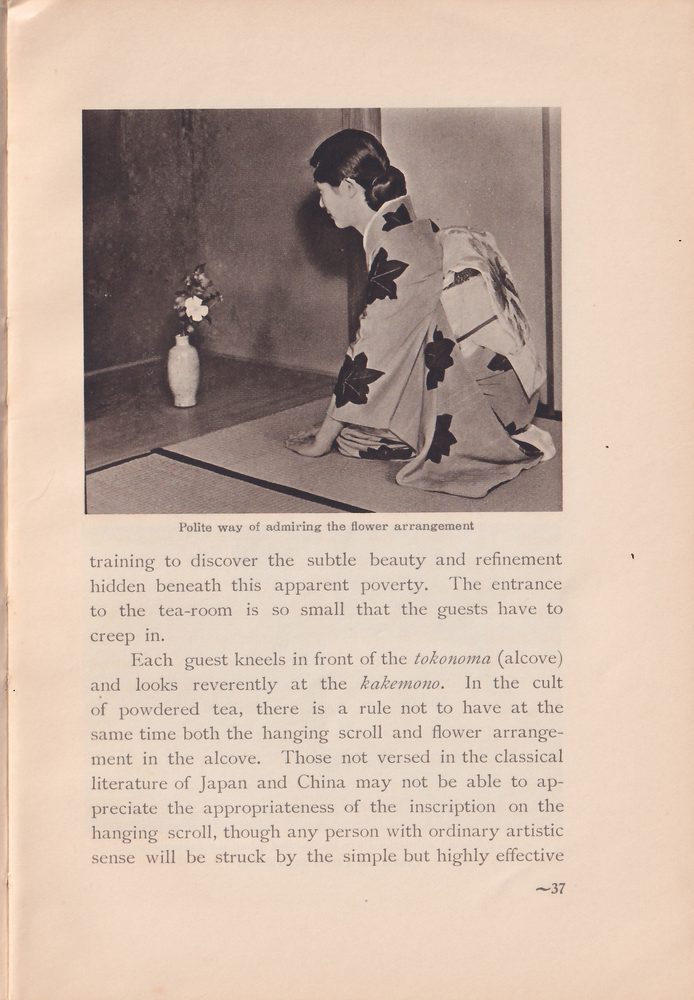
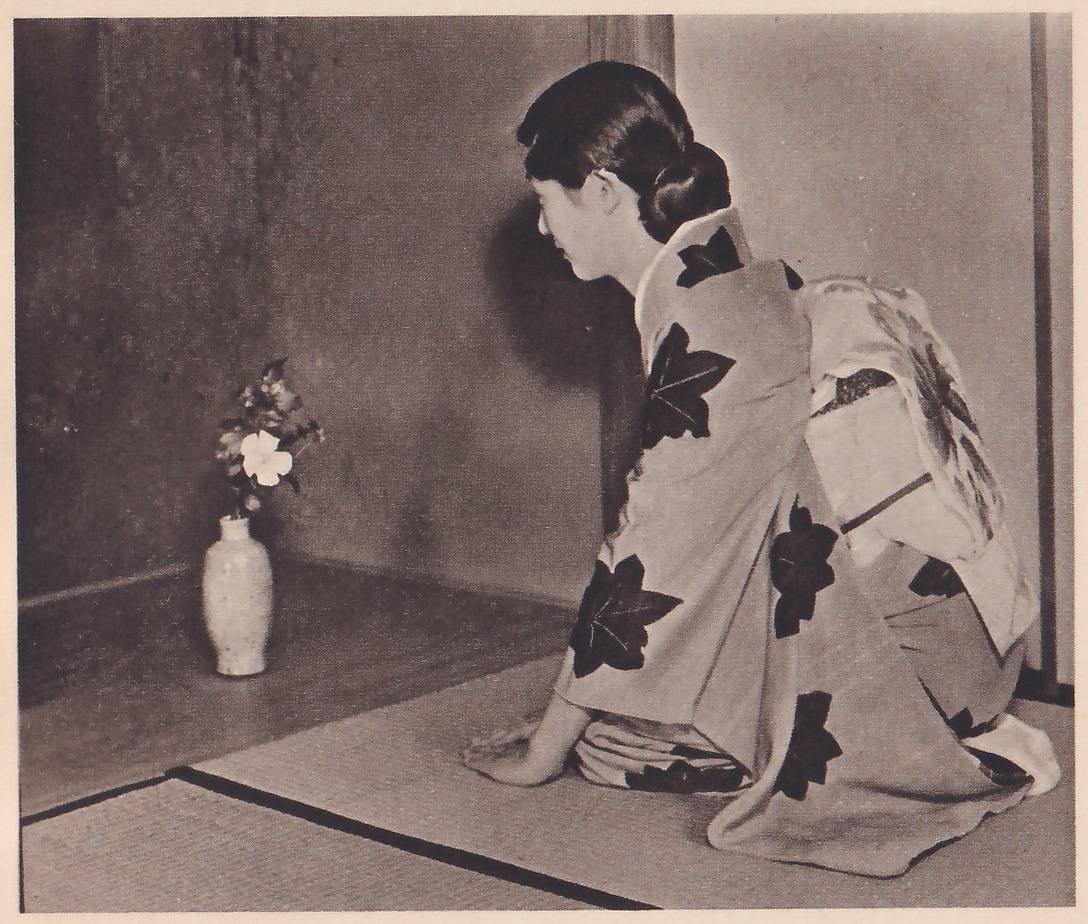
training to discover the subtle beauty and refinement hidden beneath this apparent poverty. The entrance to the tea-room is so small that the guests have to creep in.
Each guest kneels in front of the tokonoma (alcove) and looks reverently at the kakemono. In the cult of powdered tea, there is a rule not to have at the same time both the hanging scroll and flower arrangement in the alcove. Those not versed in the classical literature of Japan and China may not be able to appreciate the appropriateness of the inscription on the hanging scroll, though any person with ordinary artistic sense will be struck by the simple but highly effective
and refined arrangement of the flowers which the guests will find in place of the kakemono when they come back for the second session. There is nothing gorgeous or magnificent in the room, but a careful observer will discover that all things there are so placed as to set one another off. Only a true cha-jin knows how to entertain his guests with a twig of the camellia having one bud half open and a few leaves in a small vase, which is severely plain.
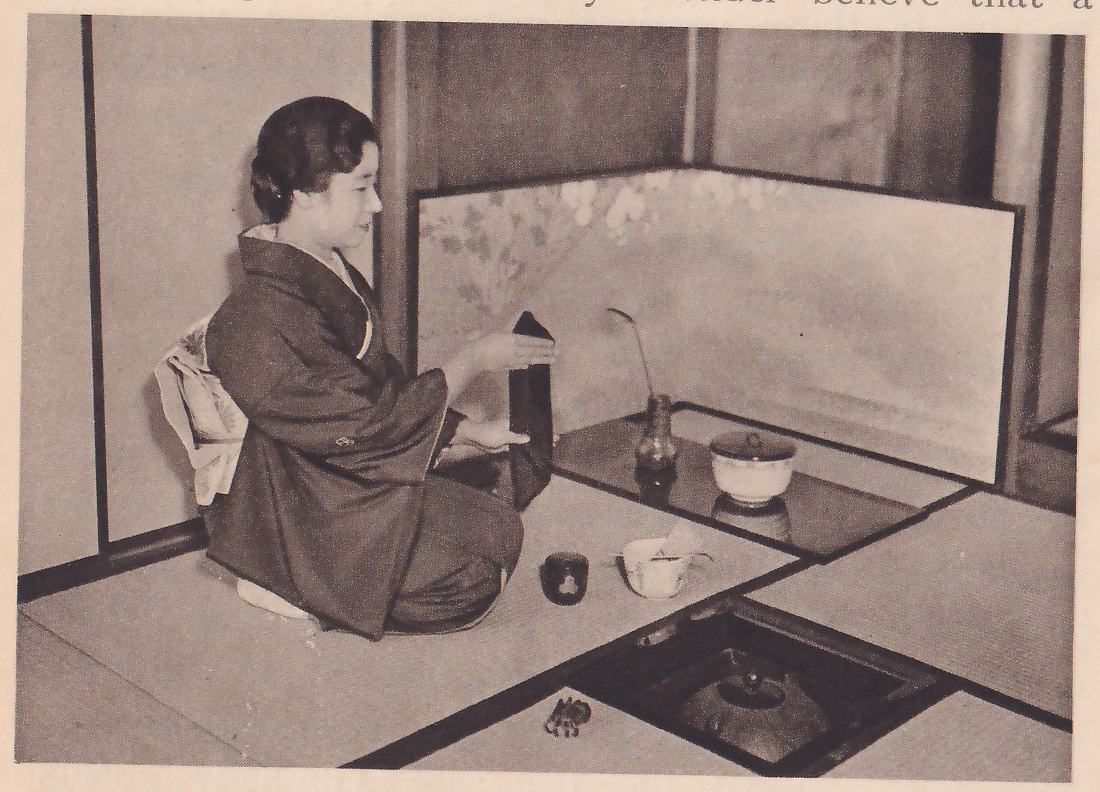
The next thing to admire is the tiny incense-holder, which the guests find on a side shelf. When the contents are emptied into the hearth in honour of the guests, the leader will ask the host for the privilege of examining it. A small piece of silk called fukusa is always used for protection in placing the incense-holder on the tatami, or when holding it in the hands in order to examine it.
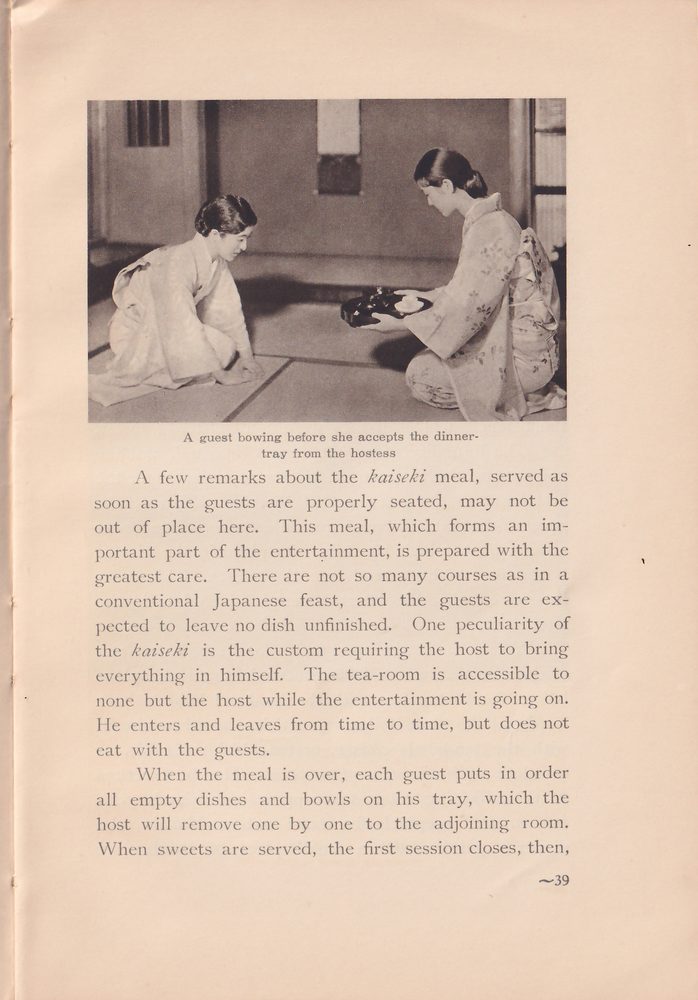
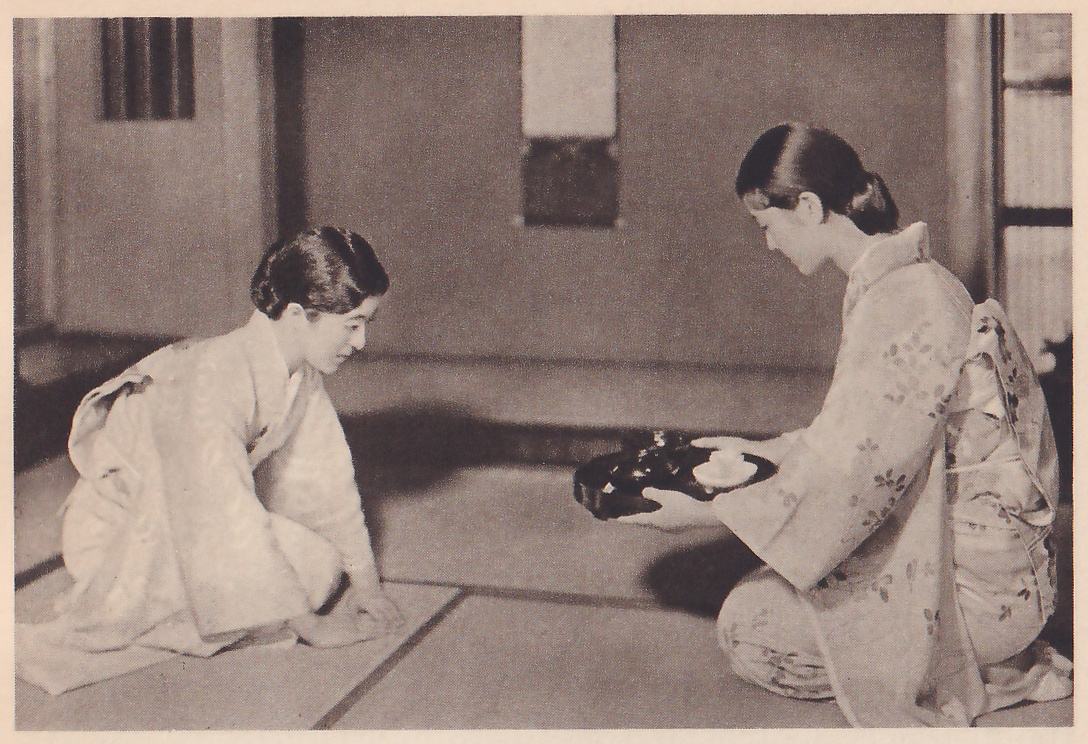
A few remarks about the kaiseki meal, served as soon as the guests are properly seated, may not be out of place here. This meal, which forms an important part of the entertainment, is prepared with the greatest care. There are not so many courses as in a conventional Japanese feast, and the guests are expected to leave no dish unfinished. One peculiarity of the kaiseki is the custom requiring the host to bring everything in himself. The tea-room is accessible to none but the host while the entertainment is going on. He enters and leaves from time to time, but does not eat with the guests.
When the meal is over, each guest puts in order all empty dishes and bowls on his tray, which the host will remove one by one to the adjoining room. When sweets are served, the first session closes, then,
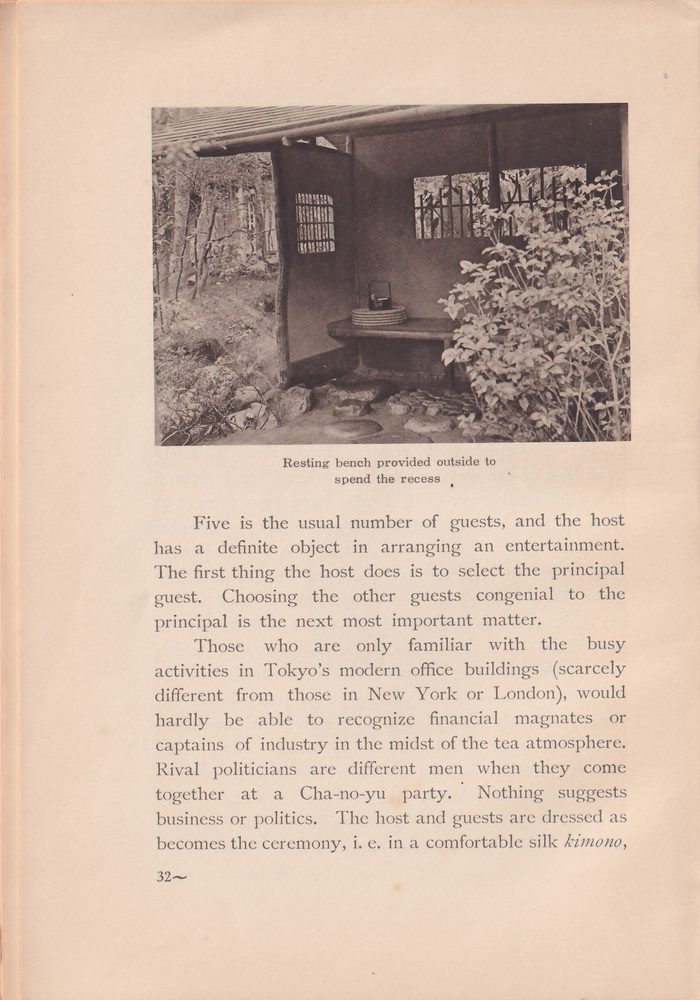
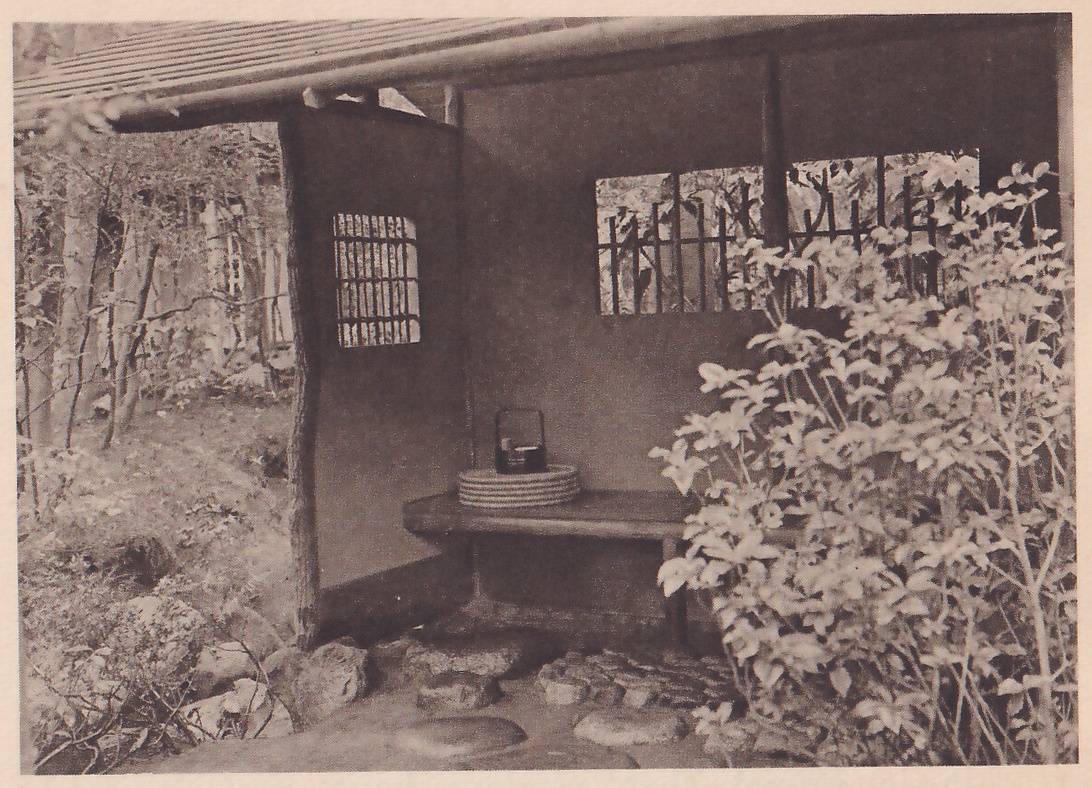
at the host’s suggestion, the guests retire to the waiting-room, as before, or to another place where a bench is provided. Usually a gong, which is often an antique work of art, is hung near the tea-room in order to give a signal for the guests to return. Five or seven strokes are usually given. As soon as the first stroke is heard, the guests are expected to stop chatting or smoking and listen attentively in a reverent attitude. It is the signal that the host is ready to serve the koicha, or thick tea. Care is taken not to make the strokes too strong or too weak. When struck by a practised hand, an ancient gong of rare quality produces rich and pleasing tones which make the listeners feel as if they were in a cloister or forest.
The formality of purification is repeated, and the guests enter the tea-room in the same order as for the first session. On entering, led by the shōkyaku, the guests find that the hanging scroll is gone. The flower arrangement, which has taken its place in the alcove, is the first sight to welcome the guests. This order is reversed when the entertainment is given late in the afternoon.
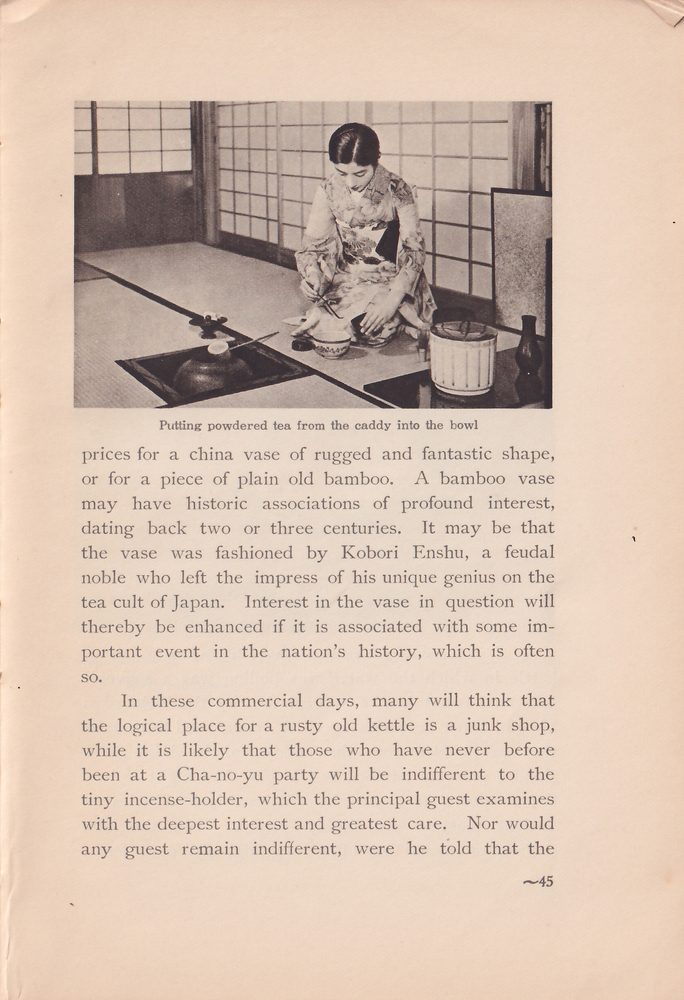
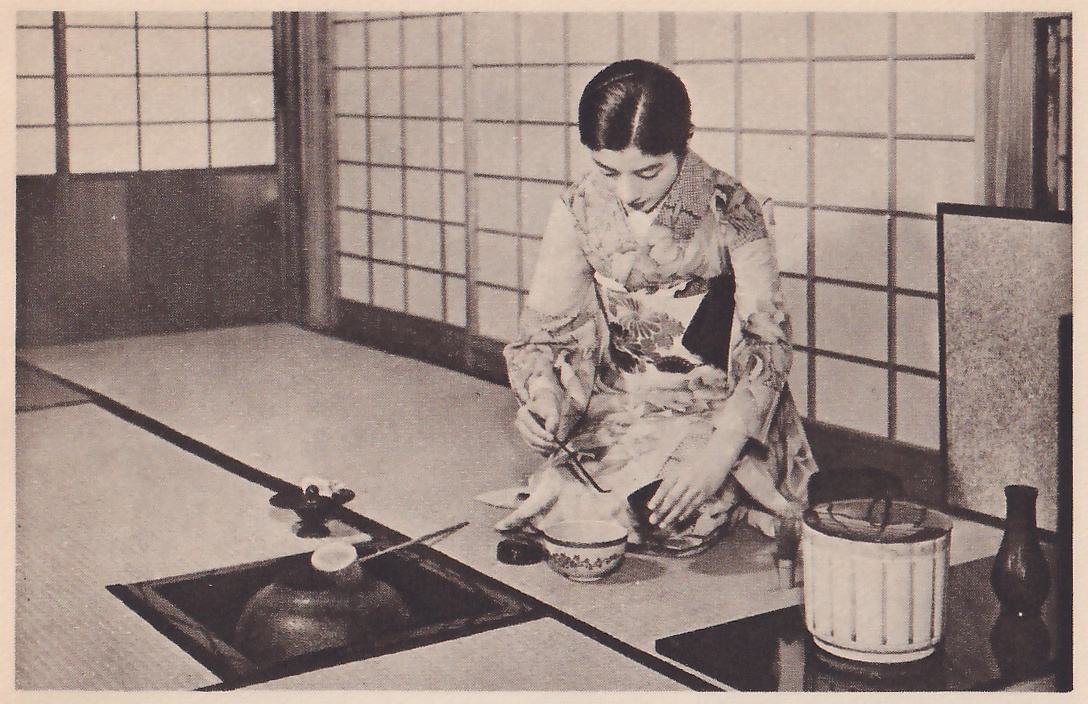
Mizusashi, or the receptacles for fresh water, and cha-ire, or the tea-caddy, are seen in the right place before the host enters with the tea-bowl held in both hands. The three following articles are brought in with the tea-bowl—chasen, or tea-whisk; cha-kin, or tea-cloth; cha-shaku, or tea-spoon. The host retires to the adjoining room, to reappear immediately with koboshi, the receptacle for waste water; hishaku, the dipper; and futaoki, a small piece of bamboo or
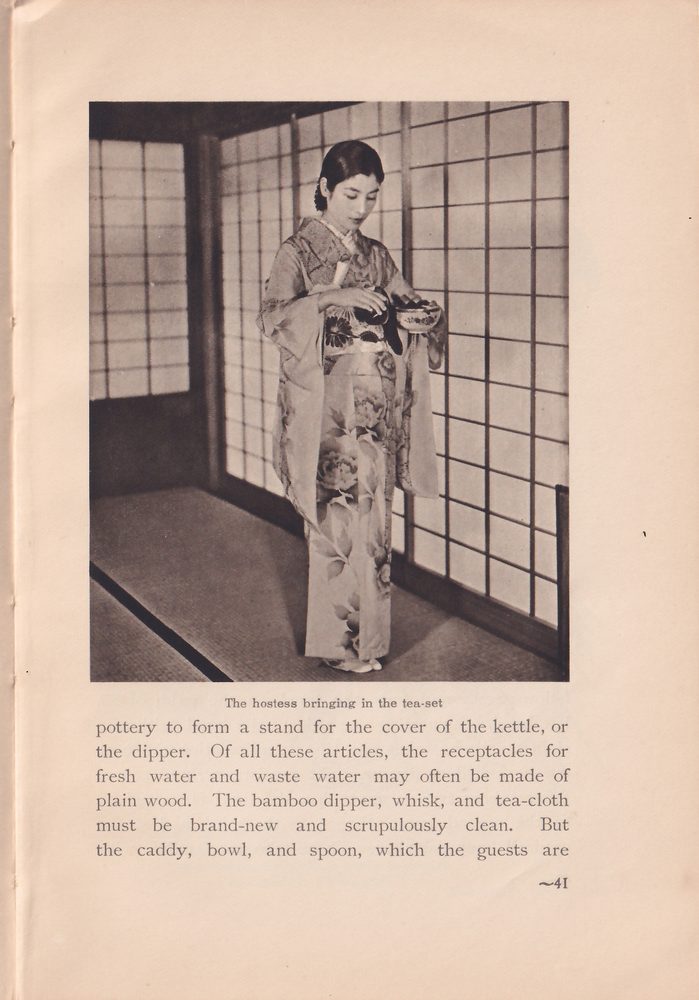
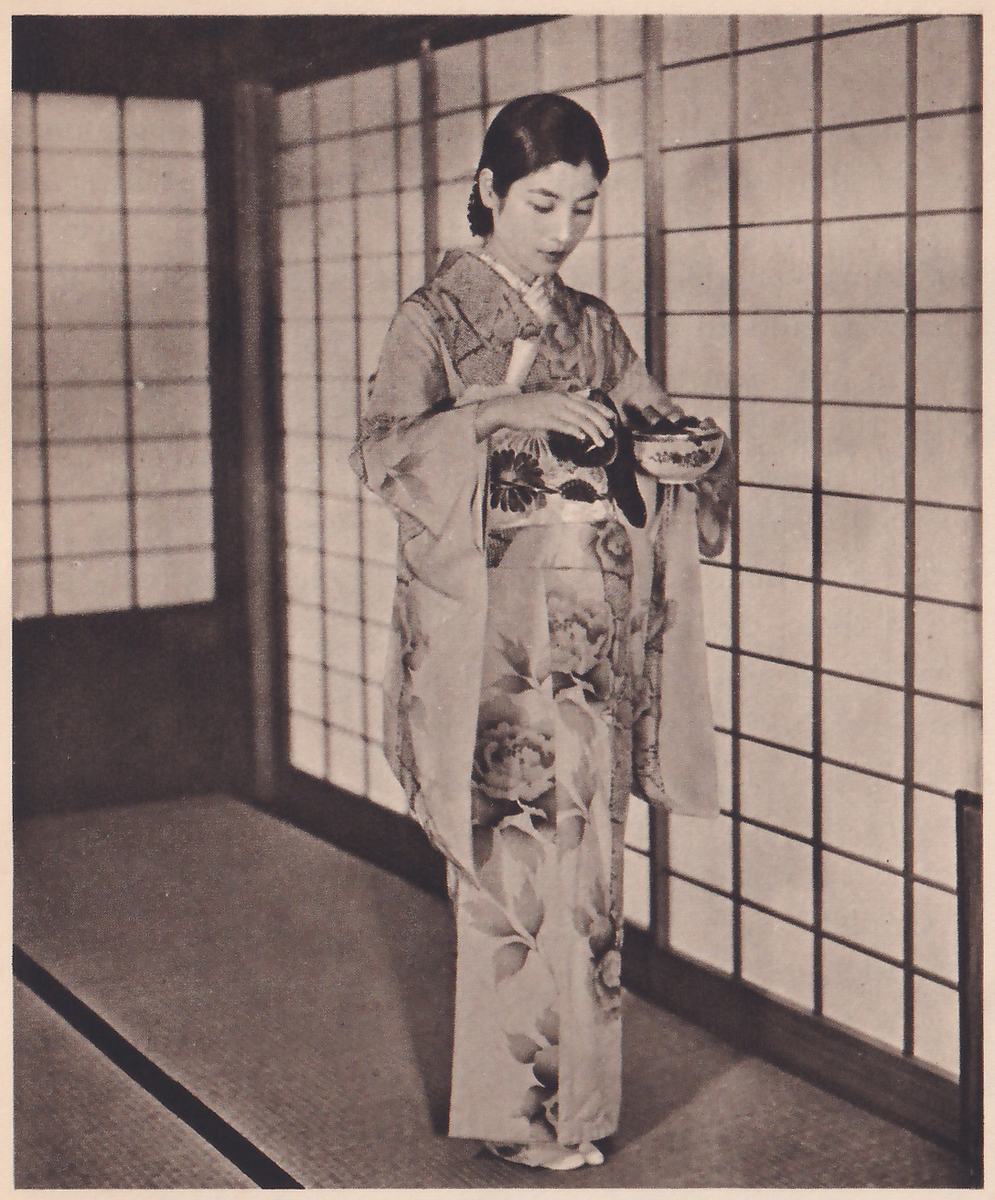
pottery to form a stand for the cover of the kettle, or the dipper. Of all these articles, the receptacles for fresh water and waste water may often be made of plain wood. The bamboo dipper, whisk, and tea-cloth must be brand-new and scrupulously clean. But the caddy, bowl, and spoon, which the guests are
privileged to examine closely after tea is served, are, as a rule, valuable objects of art. These three articles, as well as the incense-holder mentioned previously, are carefully selected by the host after a deep study of his treasures. There are certain preliminary actions before tea is served which, to the observer, add to the interest of the ceremony.
In an atmosphere conducive to restfulness and calm the guests listen to the “soughing of the wind in the pines”, as the music of the boiling water is poetically called. The host is, of course, proud of his kettle and hearth. No guest incapable of appreciating the artistic design of the antique kettle, or of discovering a subtle charm in the wooden framework of the hearth, is considered worthy of invitation. The hearth is a deep, square fire-box, and in order that it may fit into the floor, a corner of the tatami, or straw mat, is cut out. The stationary hearth is covered with a complete piece of tatami when a movable fire-brazier is used from early summer to late autumn.
When the tea, resembling thick spinach soup in consistency, as well as in colour, is made, as briefly described elsewhere, the host places it in front of the principal guest. The guest makes a bow to his fellow-guests and puts the bowl on the palm of his left hand. Supporting one side of the bowl with the right hand, he takes one sip, complimenting the host on the excellent flavour, right consistency, and so on. After taking two or more sips, the bowl is passed on to the second guest, thence to the third, and so on, until all have partaken. Those who are familiar with
Sketched by Hakutei Ishii
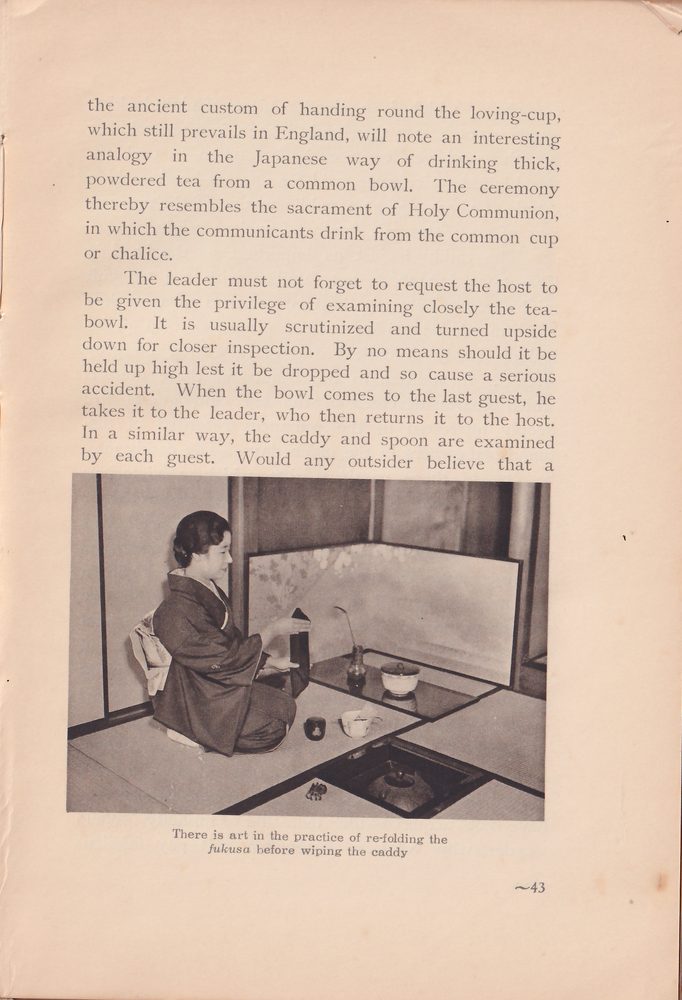
the ancient custom of handing round the loving-cup, which still prevails in England, will note an interesting analogy in the Japanese way of drinking thick, powdered tea from a common bowl. The ceremony thereby resembles the sacrament of Holy Communion, in which the communicants drink from the common cup or chalice.
The leader must not forget to request the host to be given the privilege of examining closely the tea-bowl. It is usually scrutinized and turned upside down for closer inspection. By no means should it be held up high lest it be dropped and so cause a serious accident. When the bowl comes to the last guest, he takes it to the leader, who then returns it to the host. In a similar way, the caddy and spoon are examined by each guest. Would any outsider believe that a
cha-shaku, which is a slender piece of plain-looking bamboo not longer than eight inches, is often sold for ten thousand yen or more? ¥ 189,900 is, perhaps, the highest price ever paid for one tea-bowl—sold a couple of years ago at a public auction of the possessions of an aristocratic family of ancient origin.
The caddy is just as important as the bowl in Cha-no-yu, but those not familiar with the tea cult might wonder why the host is so proud of a cracked bowl mended in three or four places, or of a plain-looking caddy of dark brown glaze with a few grey streaks. In addition to the beauty of these utensils which charm devotees of the tea cult, guests are deeply interested in the romances recorded of distinguished owners in the olden days. The caddy may be one of those precious gifts which a victorious general received from his chief, such as Hideyoshi or Nobunaga, in place of a feudal domain, and was miraculously saved later when his castle was destroyed by an enemy. Or the bowl may be associated with a romance of intense but friendly rivalry between two modern millionaires, who vied with each other in acquiring it from the previous owner. The guests will share the host’s pride, if the bowl used is a family treasure once owned by an ancestor a century ago and recently recovered by some happy circumstance.
If the flower-vase is an antique celadon of Chinese origin, it will attract the attention of any ordinary student of ceramics. But it is natural that those who have not acquired the taste for simplicity should wonder why votaries of the tea cult pay fabulous
prices for a china vase of rugged and fantastic shape, or for a piece of plain old bamboo. A bamboo vase may have historic associations of profound interest, dating back two or three centuries. It may be that the vase was fashioned by Kobori Enshu, a feudal noble who left the impress of his unique genius on the tea cult of Japan. Interest in the vase in question will thereby be enhanced if it is associated with some important event in the nation’s history, which is often so.
In these commercial days, many will think that the logical place for a rusty old kettle is a junk shop, while it is likely that those who have never before been at a Cha-no-yu party will be indifferent to the tiny incense-holder, which the principal guest examines with the deepest interest and greatest care. Nor would any guest remain indifferent, were he told that the
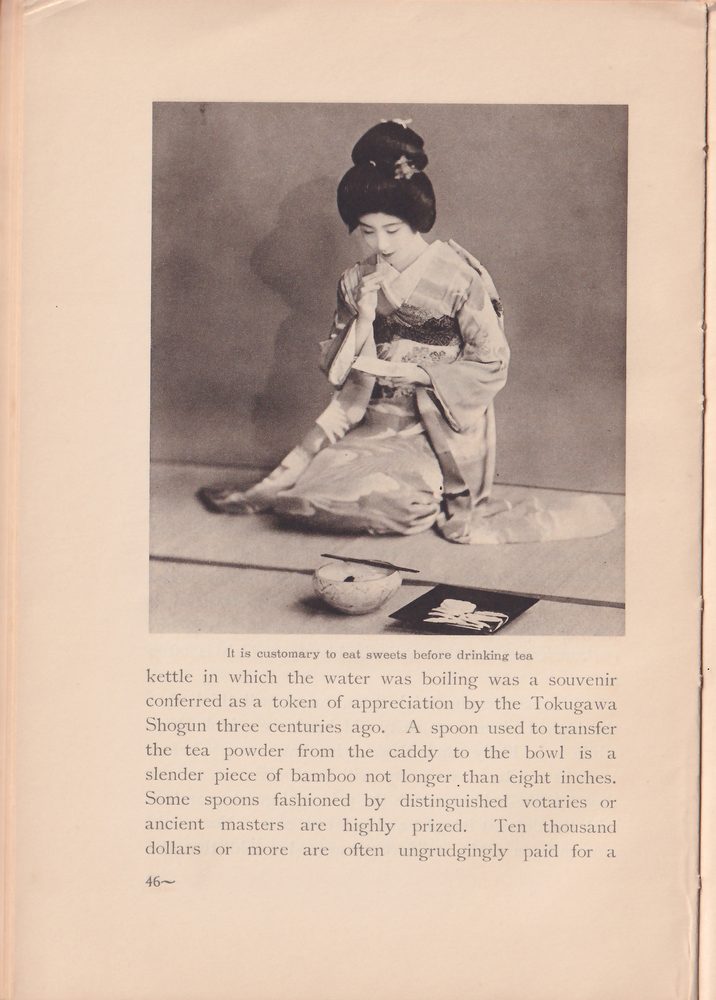
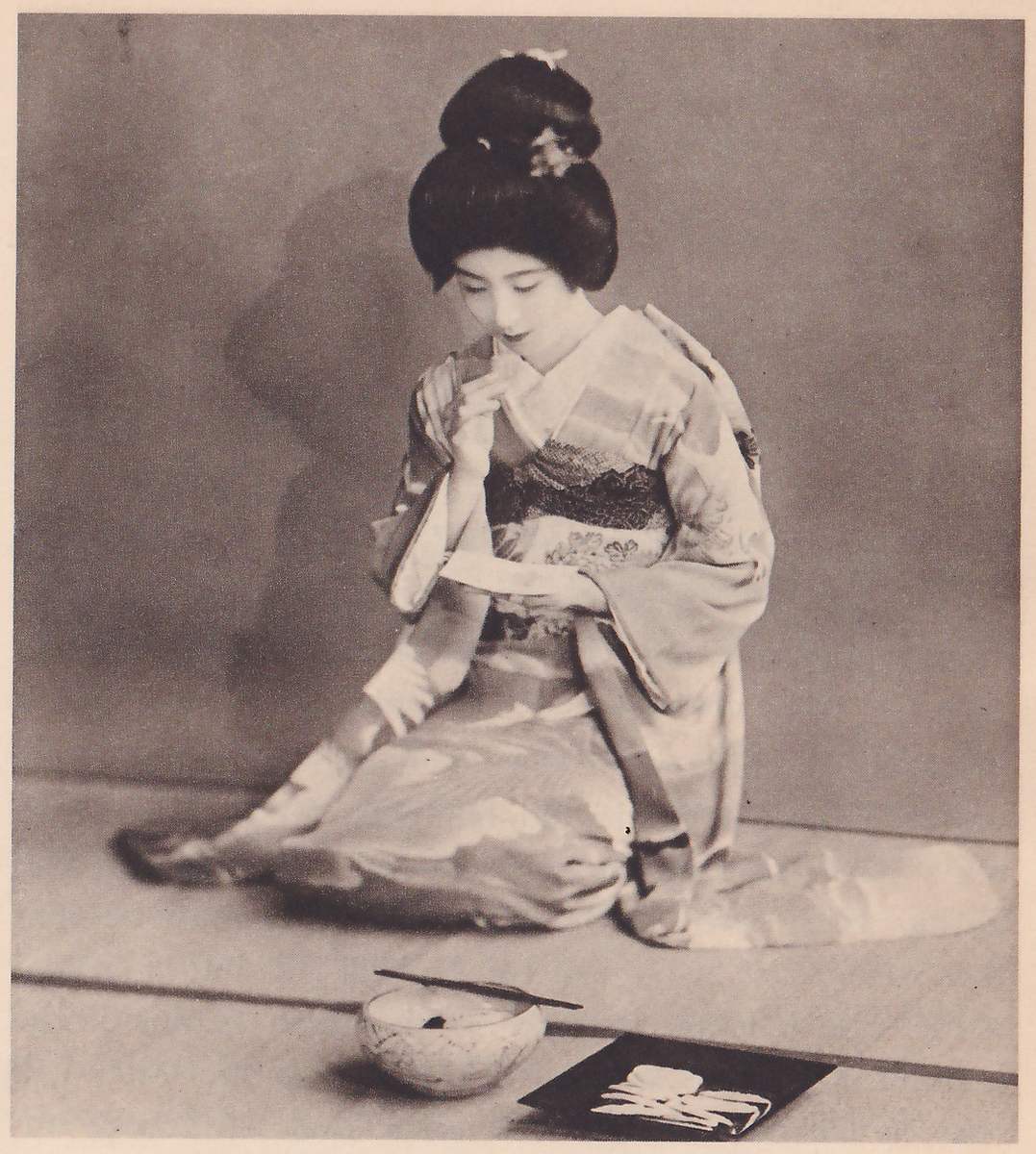
kettle in which the water was boiling was a souvenir conferred as a token of appreciation by the Tokugawa Shogun three centuries ago. A spoon used to transfer the tea powder from the caddy to the bowl is a slender piece of bamboo not longer than eight inches. Some spoons fashioned by distinguished votaries or ancient masters are highly prized. Ten thousand dollars or more are often ungrudgingly paid for a
historic spoon, into which work an ancient master has put his very soul.
All these treasures furnish inexhaustible topics of conversation and absorb the participants in questions of art and history. It is in this rare atmosphere of congeniality that the thick tea is served.
When the bowl, caddy and spoon are returned to the host in the prescribed fashion, the Cha-no-yu entertainment is over, properly speaking. Usucha, or thin tea, which is usually served more informally in the same small room, or a larger room, does not constitute an important part. It gives an excellent opportunity to chat more freely, and also enables other members of the host’s family to mingle with the guests, which is impossible until the thick tea course is over. It is not uncommon nowadays to omit the thin tea course, partly to save time for busy people.
When the party breaks up and the guests are gone, the serious-minded host returns to the tea-room and sits alone in front of the kettle, which is now his sole companion. Indulging in philosophic meditation, he listens “to the wind in the pines,” as the music of the boiling water heard in this quiet environment is poetically called.