

PARTAKING OF THE FIRST BOWL
Those without previous experience need not be frightened or discouraged by the brief description of training in the etiquette given in the foregoing chapter. Japanese friends are ready to tell the guest unacquainted with the ceremony what to do, and what not to do. They will not criticise the blunders which strangers may commit. Those who are really interested in participating in Cha-no-yu will be welcome at any home where there are facilities to serve powdered tea. Familiarity with some elementary rules will be sufficient.
There are various ways of giving a Cha-no-yu entertainment according to different occasions and seasons. Powdered tea is often served quite informally without an invitation, and the host may or may not provide a meal. A large room may be used for entertaining many guests at a time, while five or six guests may be carefully selected to be entertained in a small room. A garden party is sometimes arranged when hundreds of people are entertained with powdered tea served in different pavilions.
Let us pay a visit to the home of a successful business man. The appointment has been casually made on the previous day, and the host is not supposed to have made any elaborate preparation. None will fail, however, to realize as we pass the gateway that
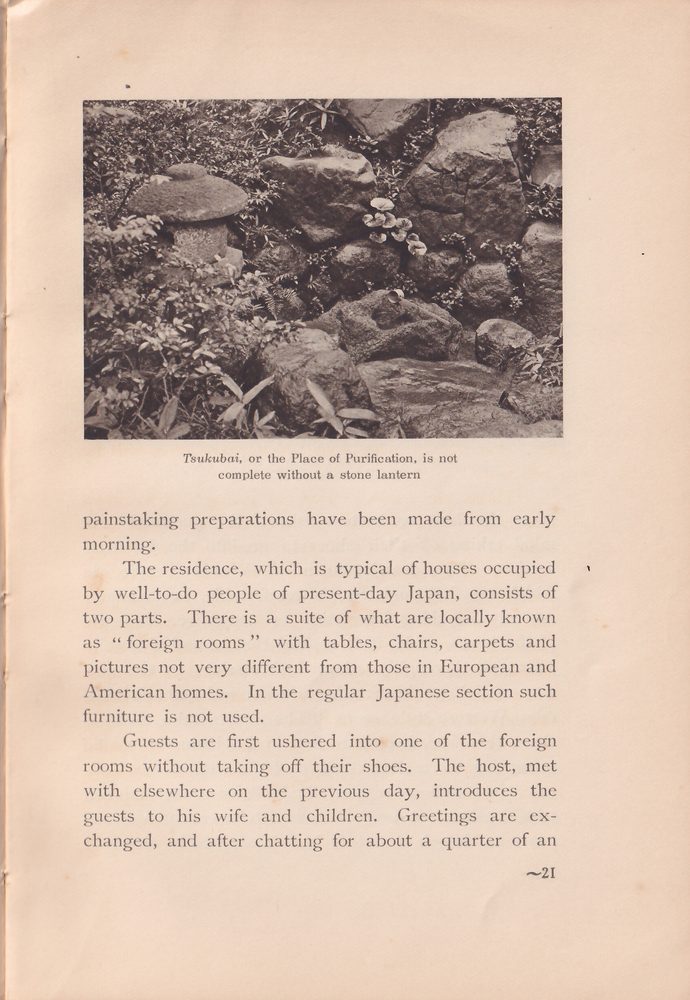
painstaking preparations have been made from early morning.
The residence, which is typical of houses occupied by well-to-do people of present-day Japan, consists of two parts. There is a suite of what are locally known as “foreign rooms” with tables, chairs, carpets and pictures not very different from those in European and American homes. In the regular Japanese section such furniture is not used.
Guests are first ushered into one of the foreign rooms without taking off their shoes. The host, met with elsewhere on the previous day, introduces the guests to his wife and children. Greetings are exchanged, and after chatting for about a quarter of an
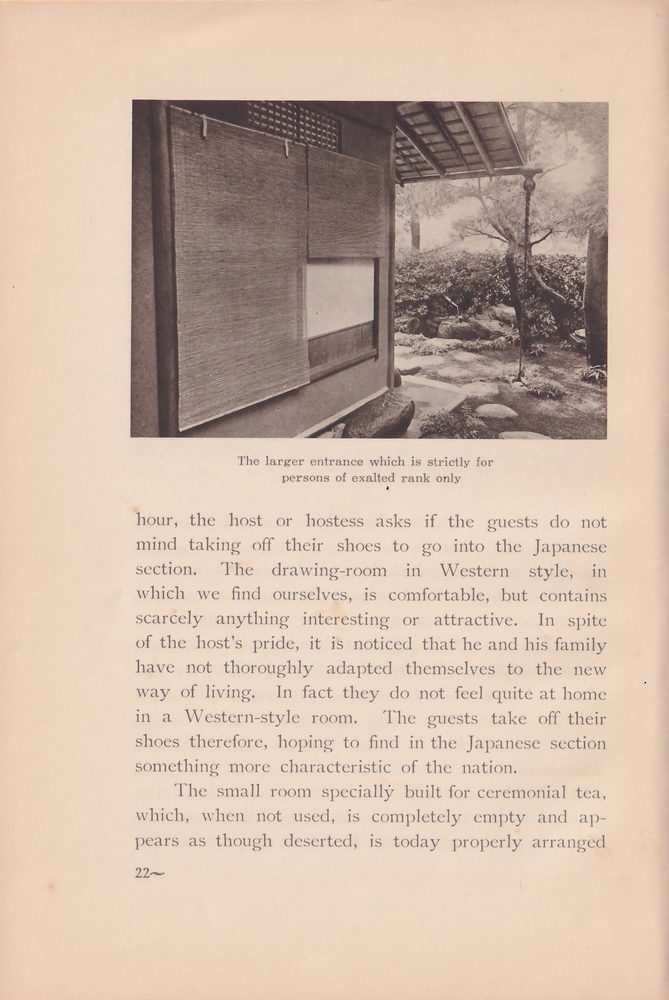
hour, the host or hostess asks if the guests do not mind taking off their shoes to go into the Japanese section. The drawing-room in Western style, in which we find ourselves, is comfortable, but contains scarcely anything interesting or attractive. In spite of the host’s pride, it is noticed that he and his family have not thoroughly adapted themselves to the new way of living. In fact they do not feel quite at home in a Western-style room. The guests take off their shoes therefore, hoping to find in the Japanese section something more characteristic of the nation.
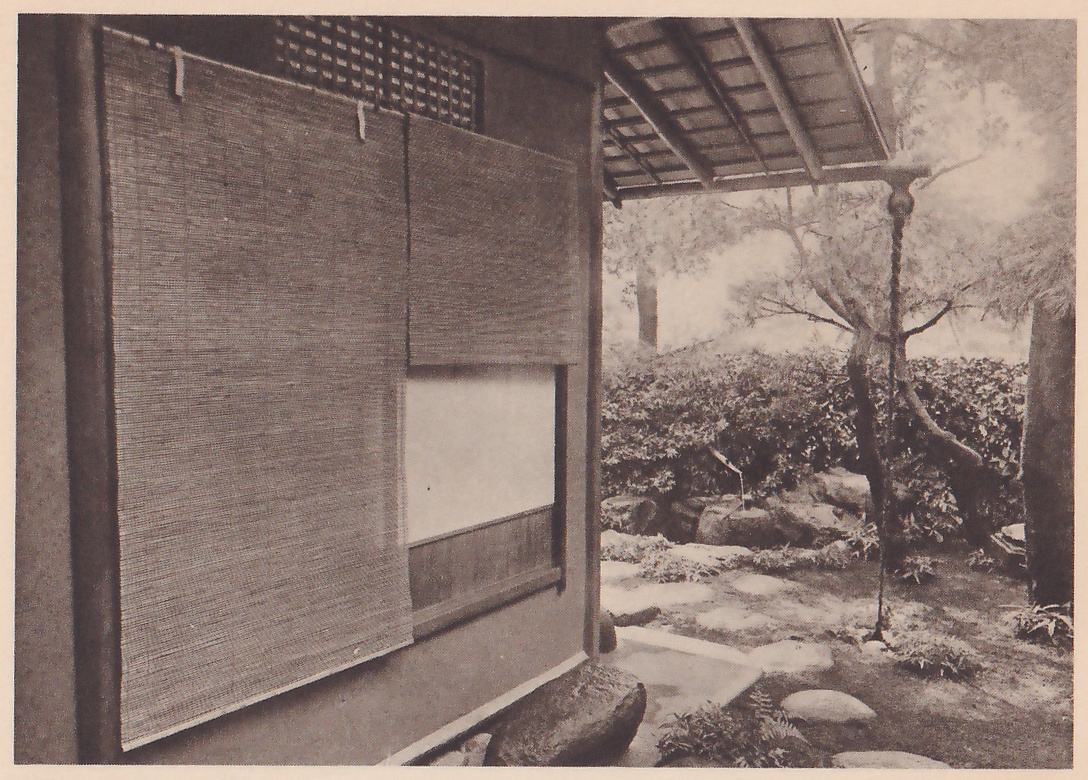
The small room specially built for ceremonial tea, which, when not used, is completely empty and appears as though deserted, is today properly arranged
for inspection. The entertainment is not to take place in this room. There is a party of ten, and the guests assemble in a large room of twelve mats.
The Japanese love of simplicity and plainness, in which there is subtle beauty, is discernible in this reception room. It is different in every way from the Western-style room into which the guests were first ushered. It is not overcrowded with furniture and art objects. There is one silk cushion for each guest to sit on, in addition to some braziers and ash-trays. The woodwork of the room consists of the finest parts of cedar, maple, oak and other rare woods. The grain is shown to the best advantage, although some members of the party may fail to be struck with the
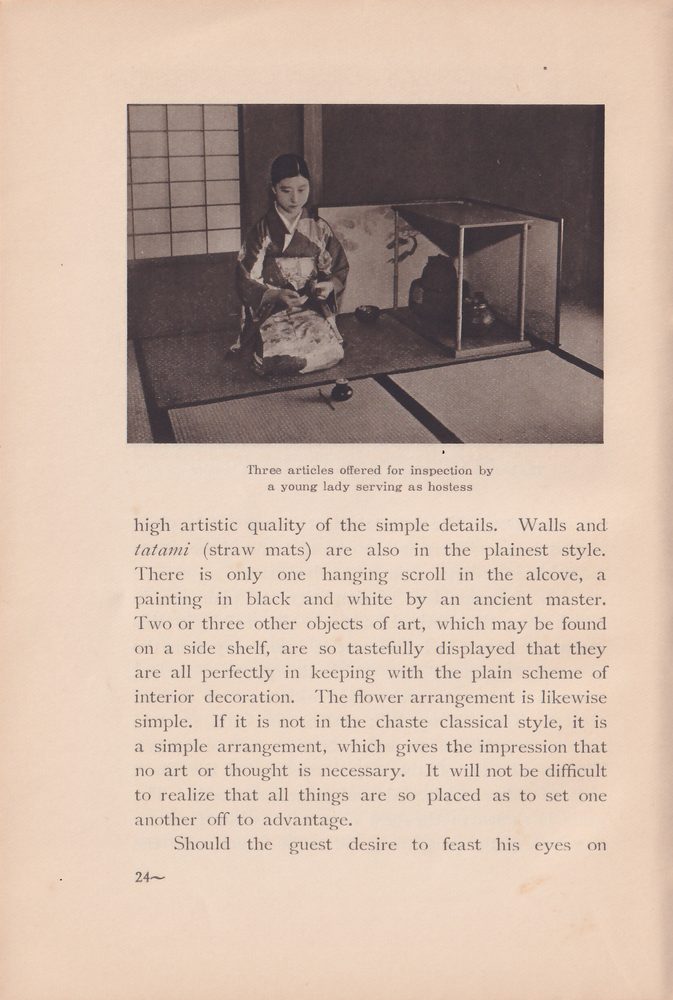
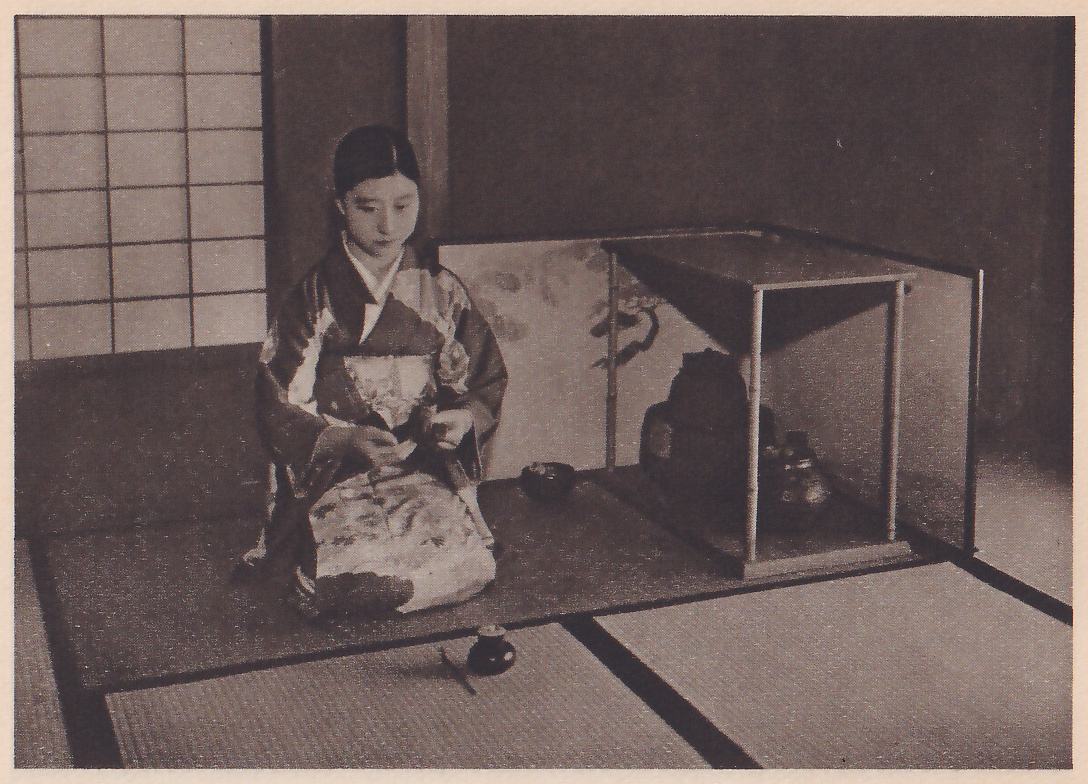
high artistic quality of the simple details. Walls and tatami (straw mats) are also in the plainest style. There is only one hanging scroll in the alcove, a painting in black and white by an ancient master. Two or three other objects of art, which may be found on a side shelf, are so tastefully displayed that they are all perfectly in keeping with the plain scheme of interior decoration. The flower arrangement is likewise simple. If it is not in the chaste classical style, it is a simple arrangement, which gives the impression that no art or thought is necessary. It will not be difficult to realize that all things are so placed as to set one another off to advantage.
Should the guest desire to feast his eyes on
gorgeous splendour or magnificent grandeur, a typical Japanese room is the wrong place to look for it. It is a place where the atmosphere is conducive to serenity of mind; where art may be appreciated without distraction.
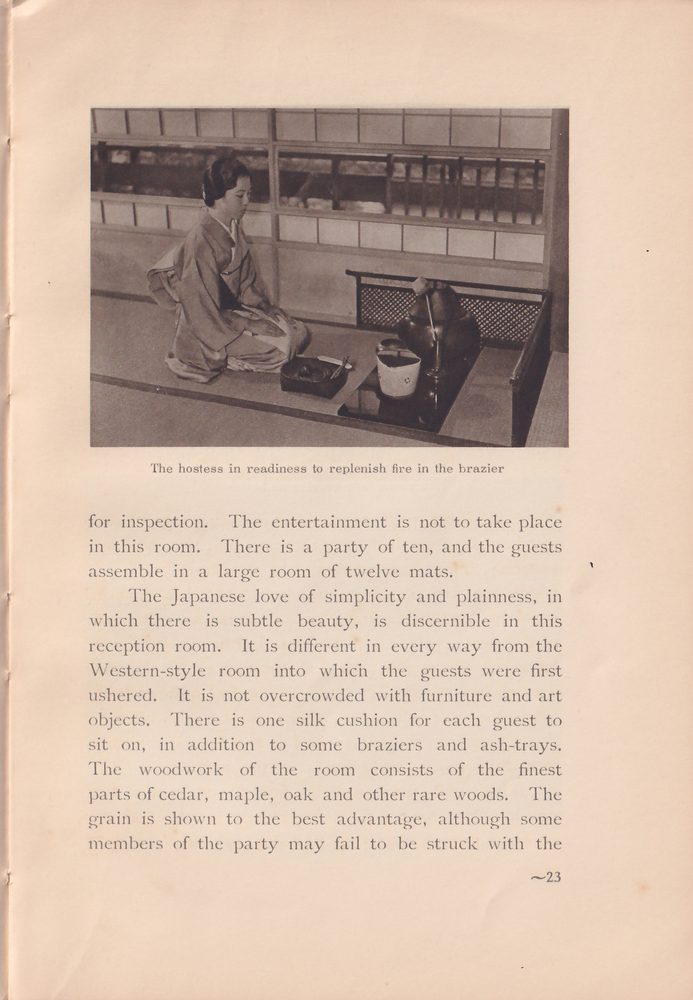
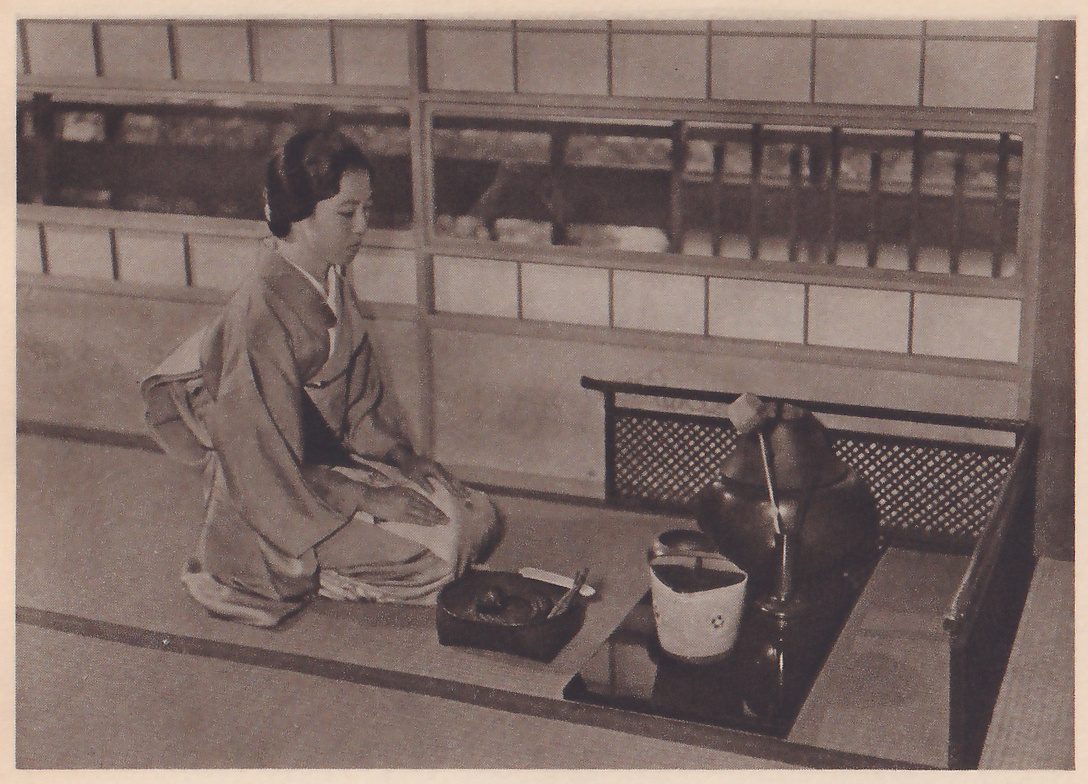
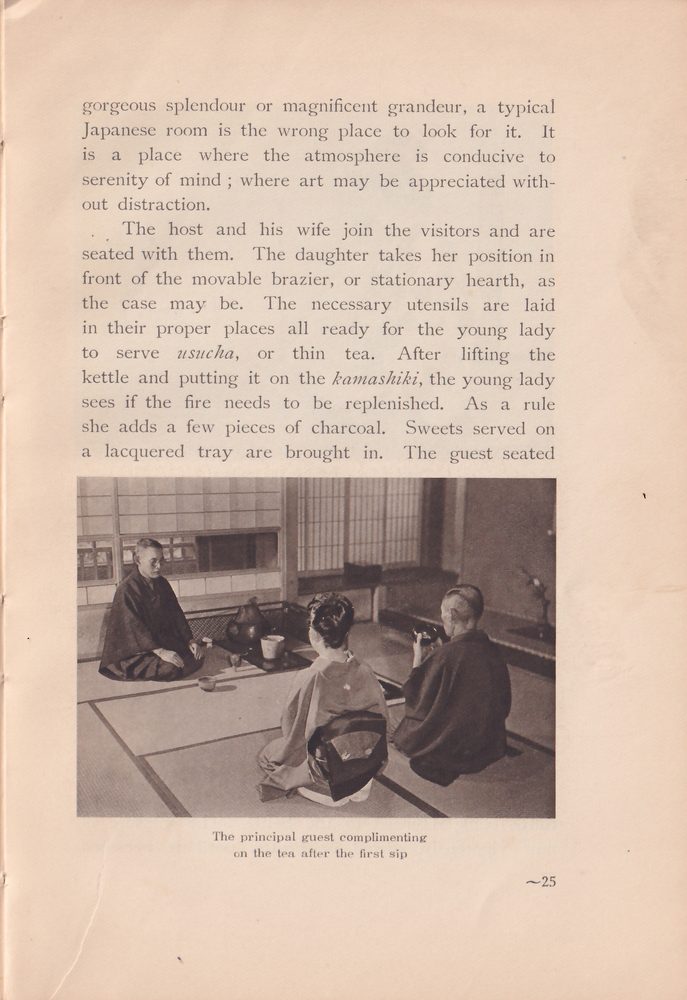
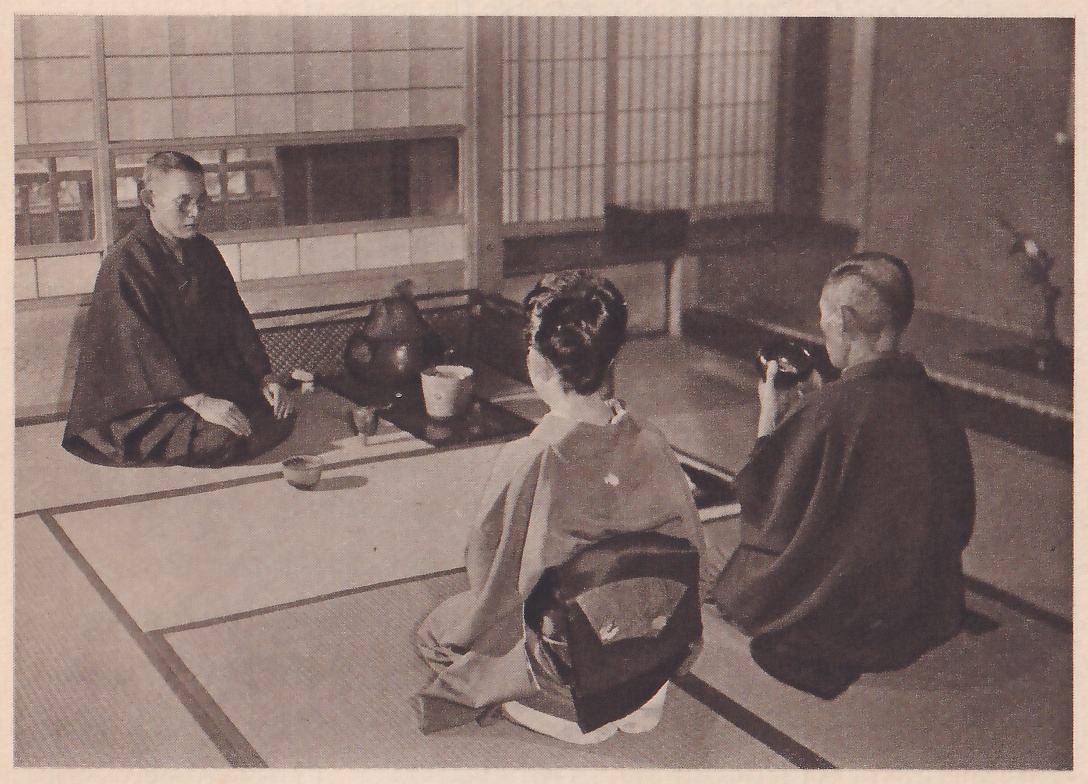
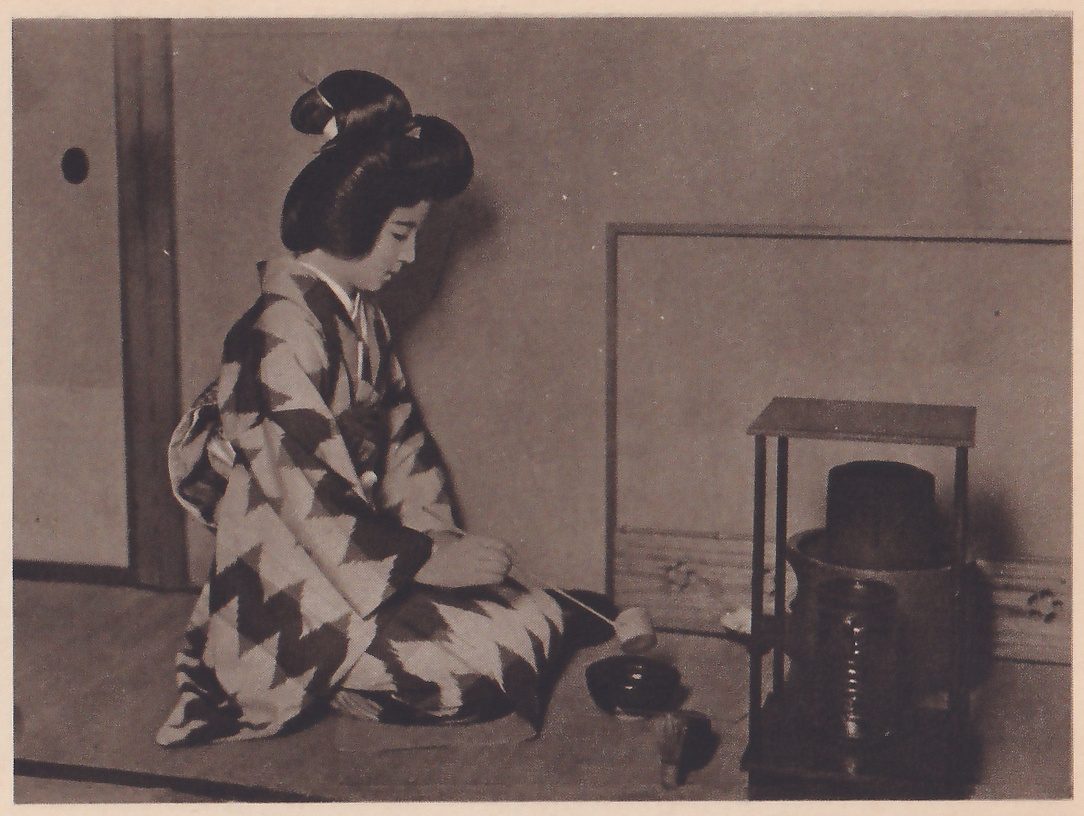
The host and his wife join the visitors and are seated with them. The daughter takes her position in front of the movable brazier, or stationary hearth, as the case may be. The necessary utensils are laid in their proper places all ready for the young lady to serve usucha, or thin tea. After lifting the kettle and putting it on the kamashiki, the young lady sees if the fire needs to be replenished. As a rule she adds a few pieces of charcoal. Sweets served on a lacquered tray are brought in. The guest seated
nearest the alcove is the first person to take his portion and put it on a piece of paper. Japanese guests are expected to have their own paper ready for use, but to strangers paper will be furnished by the host or hostess, who will also show them how to use it. The tray is passed from one guest to another until all the guests have taken their own portions of sweets.
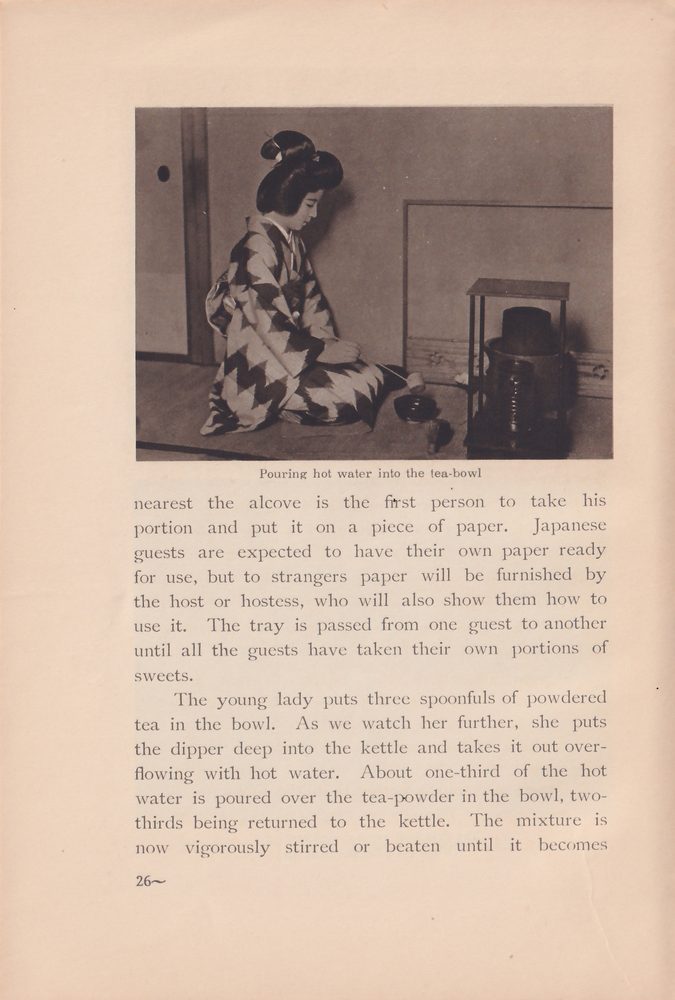
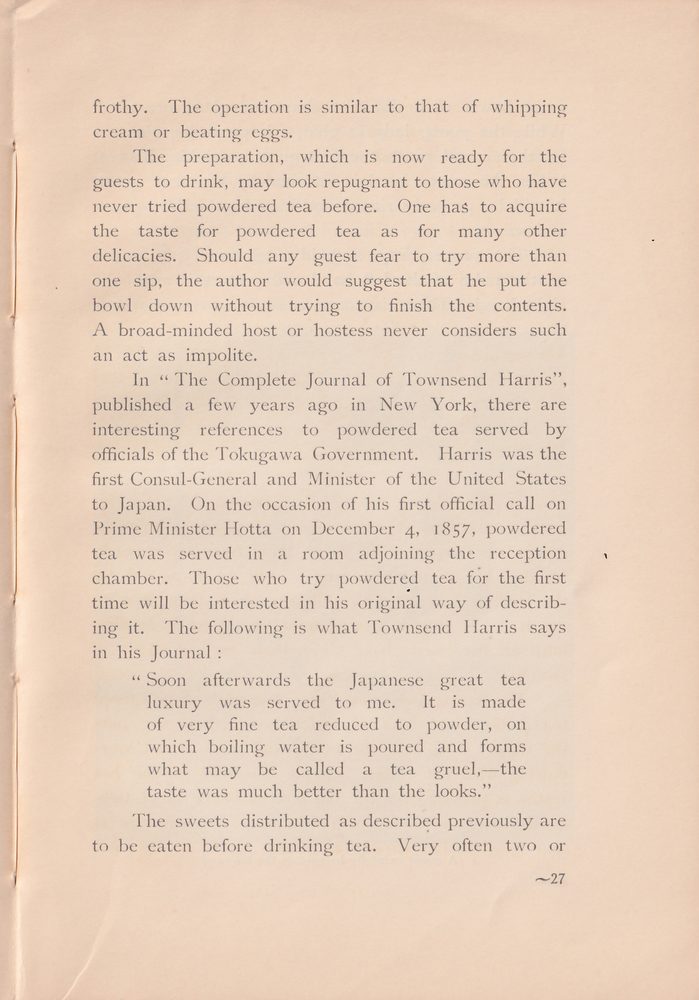
The young lady puts three spoonfuls of powdered tea in the bowl. As we watch her further, she puts the dipper deep into the kettle and takes it out overflowing with hot water. About one-third of the hot water is poured over the tea-powder in the bowl, two-thirds being returned to the kettle. The mixture is now vigorously stirred or beaten until it becomes
frothy. The operation is similar to that of whipping cream or beating eggs.
The preparation, which is now ready for the guests to drink, may look repugnant to those who have never tried powdered tea before. One has to acquire the taste for powdered tea as for many other delicacies. Should any guest fear to try more than one sip, the author would suggest that he put the bowl down without trying to finish the contents. A broad-minded host or hostess never considers such an act as impolite.
In “The Complete Journal of Townsend Harris”, published a few years ago in New York, there are interesting references to powdered tea served by officials of the Tokugawa Government. Harris was the first Consul-General and Minister of the United States to Japan. On the occasion of his first official call on Prime Minister Hotta on December 4, 1857, powdered tea was served in a room adjoining the reception chamber. Those who try powdered tea for the first time will be interested in his original way of describing it. The following is what Townsend Harris says in his Journal:
“Soon afterwards the Japanese great tea luxury was served to me. It is made of very fine tea reduced to powder, on which boiling water is poured and forms what may be called a tea gruel,—the taste was much better than the looks.”
The sweets distributed as described previously are to be eaten before drinking tea. Very often two or
more bowls of a different shape or glaze are used. While the young lady in charge is preparing the tea for the second guest, the first. guest is drinking his tea. When the empty bowl is returned by the first guest, it will be properly rinsed and used for the third guest, and so on.
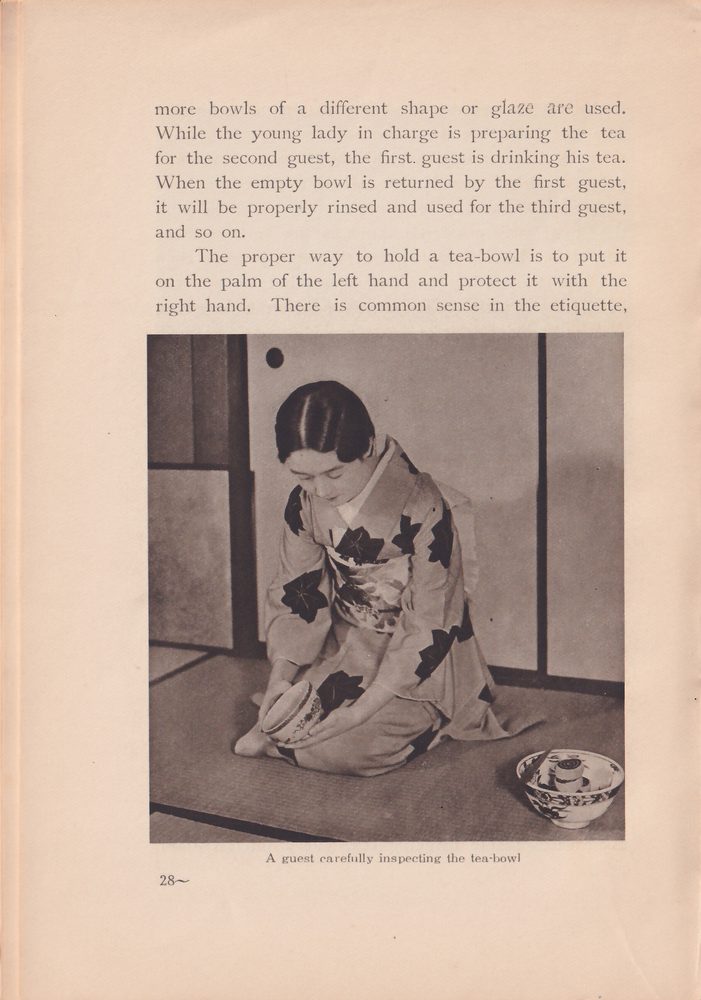
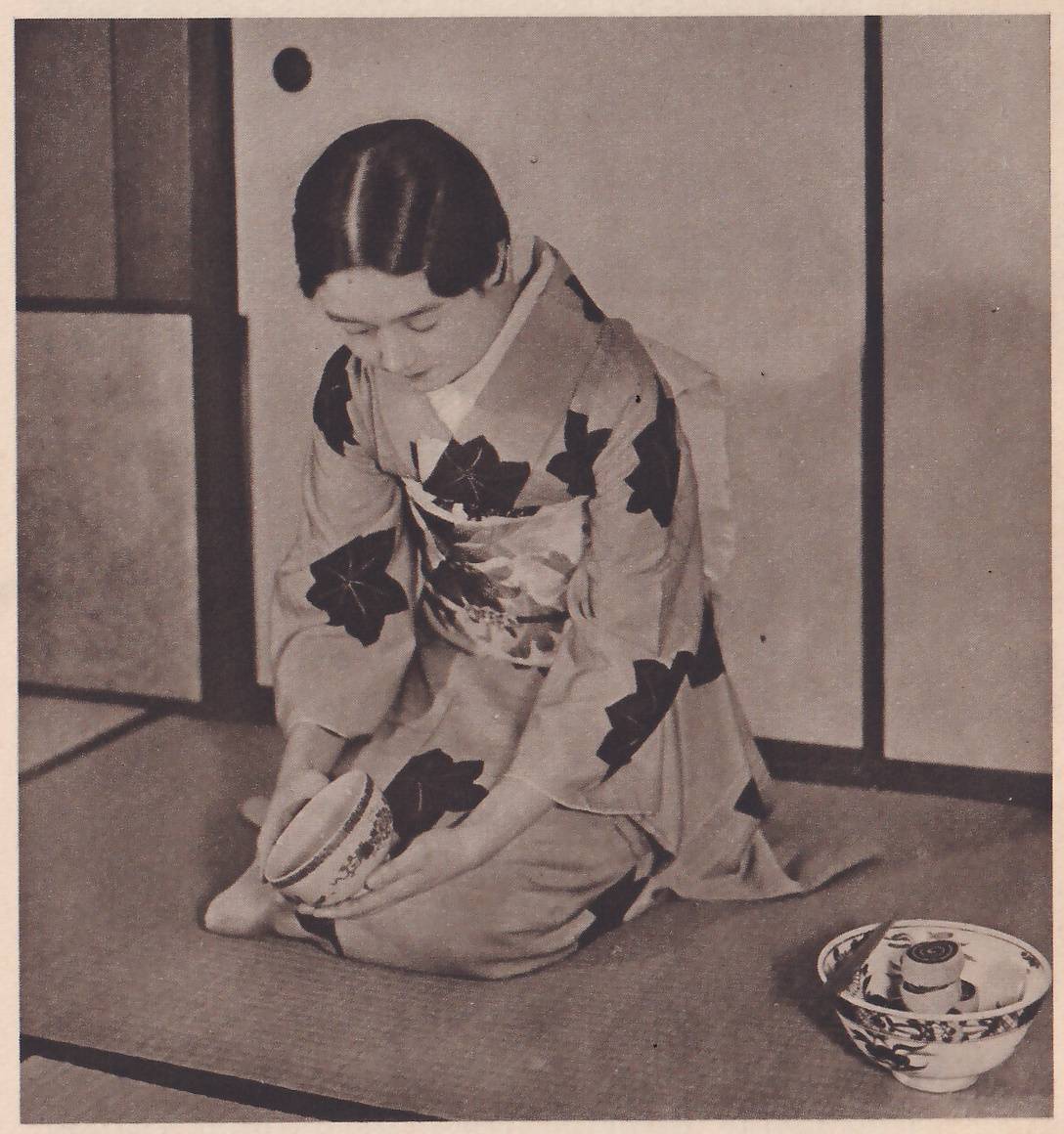
The proper way to hold a tea-bowl is to put it on the palm of the left hand and protect it with the right hand. There is common sense in the etiquette,
as this is the safest way of handling it. If you hold a tea-bowl with two or three fingers only, as is often done by those unfamiliar with the etiquette, you might drop it, which would be serious, were the object a special treasure, as it often is.
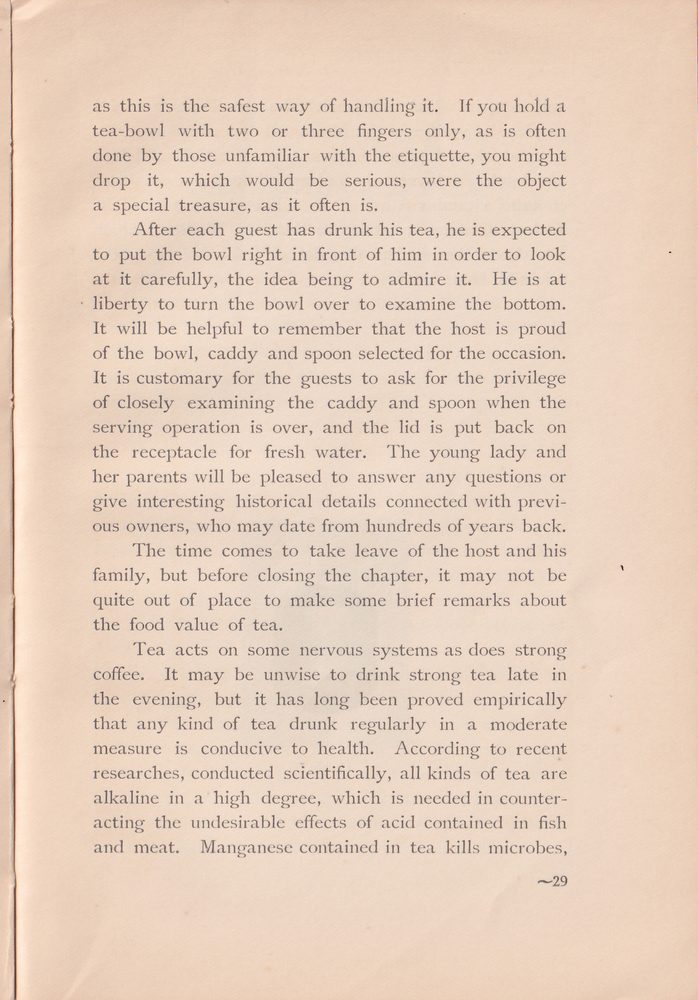
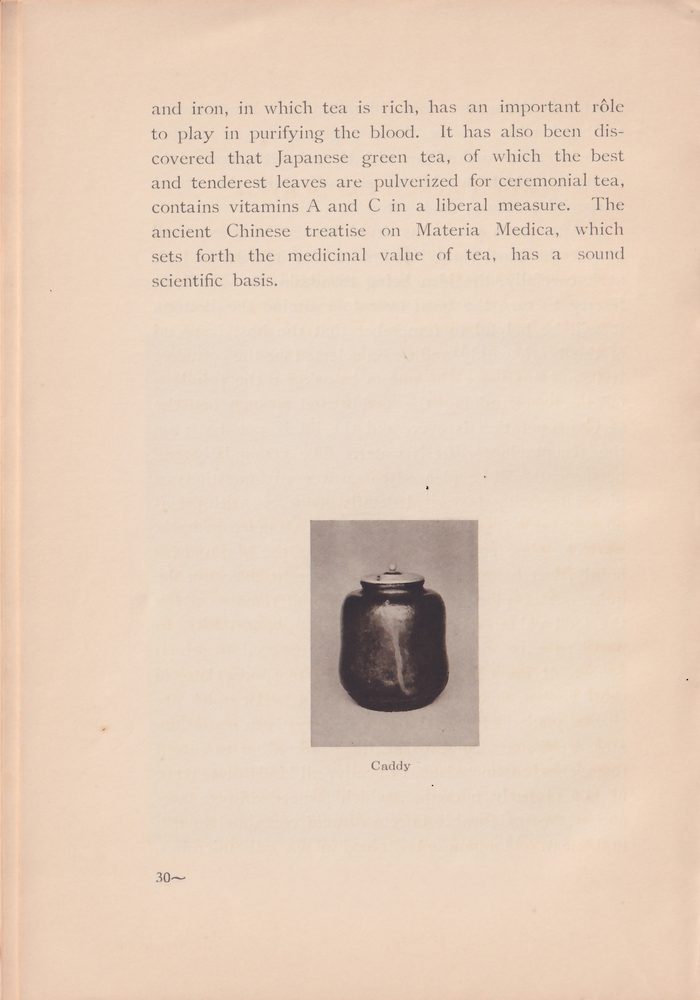
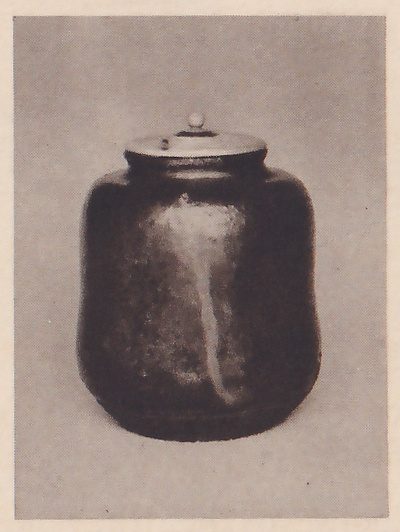
After each guest has drunk his tea, he is expected to put the bowl right in front of him in order to look at it carefully, the idea being to admire it. He is at liberty to turn the bowl over to examine the bottom. It will be helpful to remember that the host is proud of the bowl, caddy and spoon selected for the occasion. It is customary for the guests to ask for the privilege of closely examining the caddy and spoon when the serving operation is over, and the lid is put back on the receptacle for fresh water. The young lady and her parents will be pleased to answer any questions or give interesting historical details connected with previous owners, who may date from hundreds of years back.
The time comes to take leave of the host and his family, but before closing the chapter, it may not be quite out of place to make some brief remarks about the food value of tea.
Tea acts on some nervous systems as does strong coffee. It may be unwise to drink strong tea late in the evening, but it has long been proved empirically that any kind of tea drunk regularly in a moderate measure is conducive to health. According to recent researches, conducted scientifically, all kinds of tea are alkaline in a high degree, which is needed in counteracting the undesirable effects of acid contained in fish and meat. Manganese contained in tea kills microbes,
and iron, in which tea is rich, has an important rôle to play in purifying the blood. It has also been discovered that Japanese green tea, of which the best and tenderest leaves are pulverized for ceremonial tea, contains vitamins A and C in a liberal measure. The ancient Chinese treatise on Materia Medica, which sets forth the medicinal value of tea, has a sound scientific basis.