

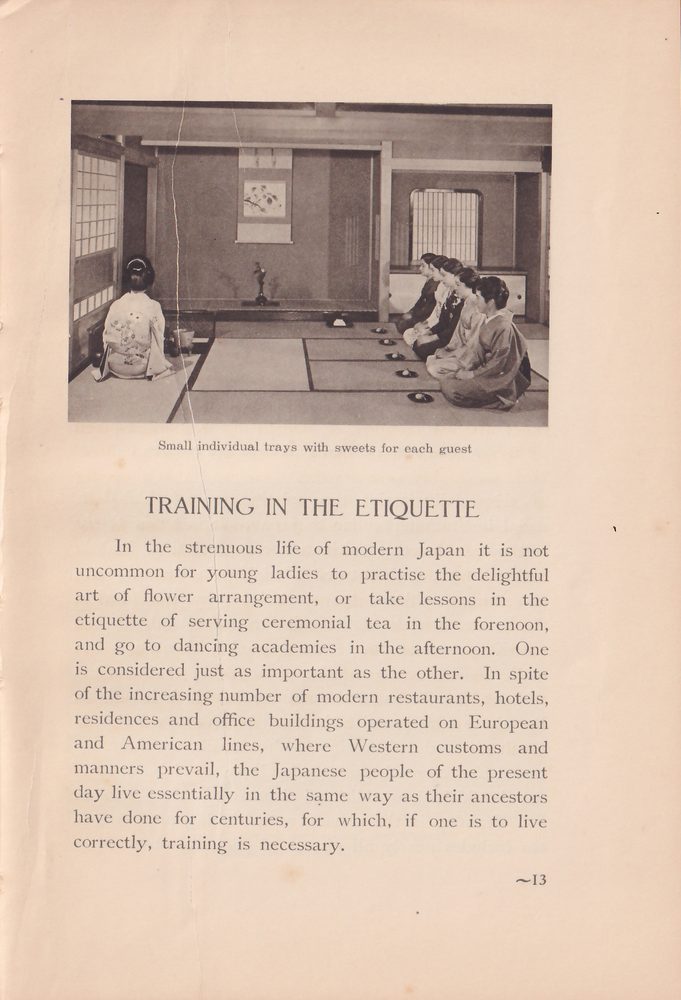
TRAINING IN THE ETIQUETTE
In the strenuous life of modern Japan it is not uncommon for young ladies to practise the delightful art of flower arrangement, or take lessons in the etiquette of serving ceremonial tea in the forenoon, and go to dancing academies in the afternoon. One is considered just as important as the other. In spite of the increasing number of modern restaurants, hotels, residences and office buildings operated on European and American lines, where Western customs and manners prevail, the Japanese people of the present day live essentially in the same way as their ancestors have done for centuries, for which, if one is to live correctly, training is necessary.
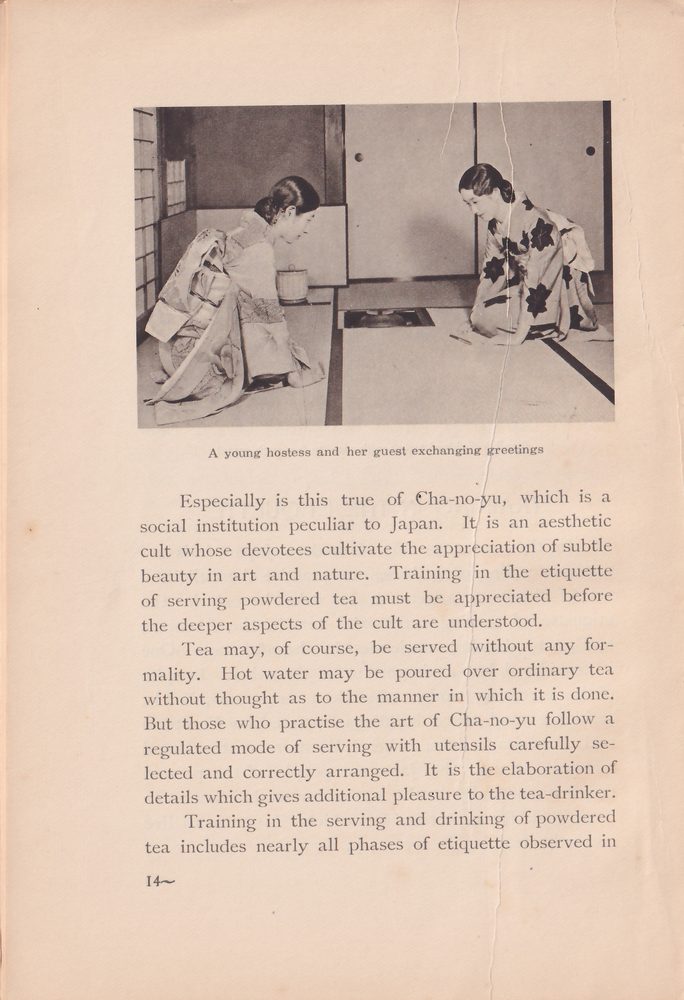
Especially is this true of Cha-no-yu, which is a social institution peculiar to Japan. It is an aesthetic cult whose devotees cultivate the appreciation of subtle beauty in art and nature. Training in the etiquette of serving powdered tea must be appreciated before the deeper aspects of the cult are understood.
Tea may, of course, be served without any formality. Hot water may be poured over ordinary tea without thought as to the manner in which it is done. But those who practise the art of Cha-no-yu follow a regulated mode of serving with utensils carefully selected and correctly arranged. It is the elaboration of details which gives additional pleasure to the tea-drinker.
Training in the serving and drinking of powdered tea includes nearly all phases of etiquette observed in
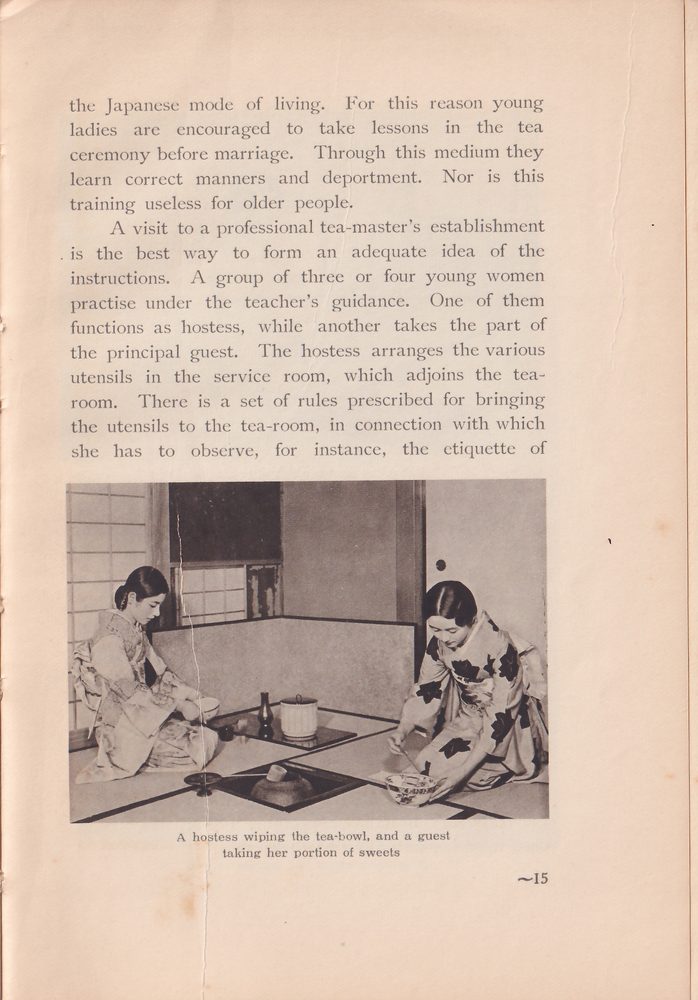
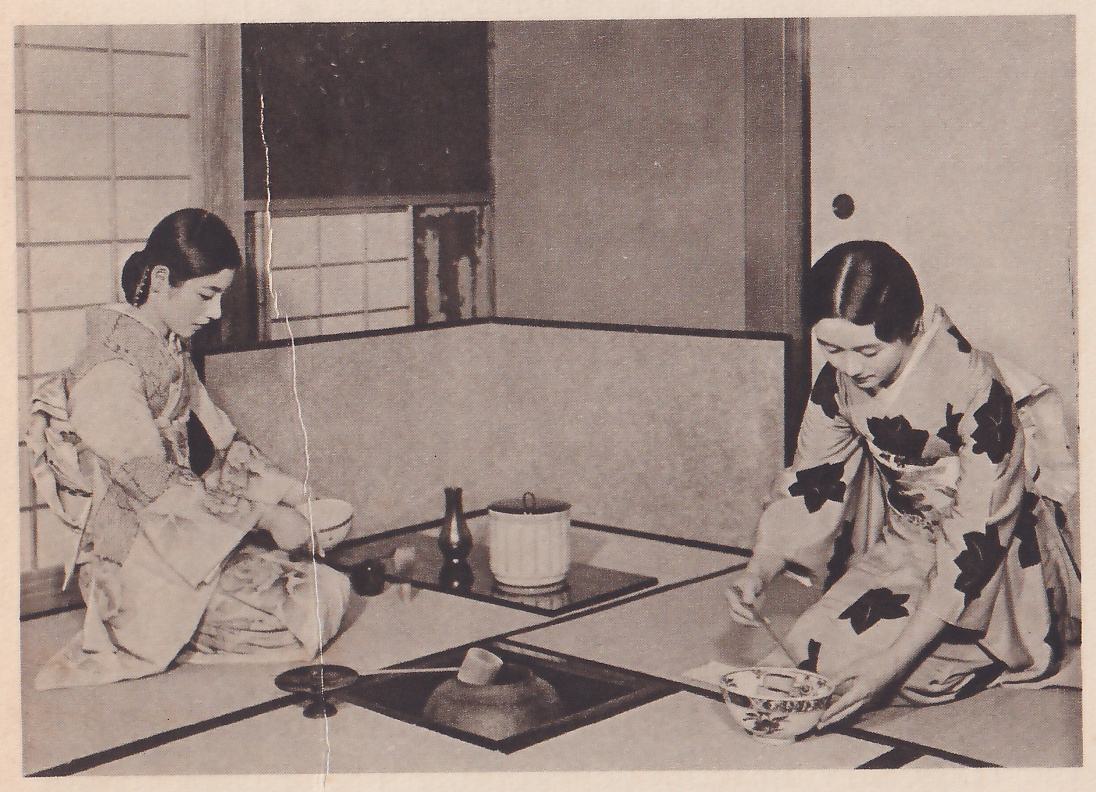
the Japanese mode of living. For this reason young ladies are encouraged to take lessons in the tea ceremony before marriage. Through this medium they learn correct manners and deportment. Nor is this training useless for older people.
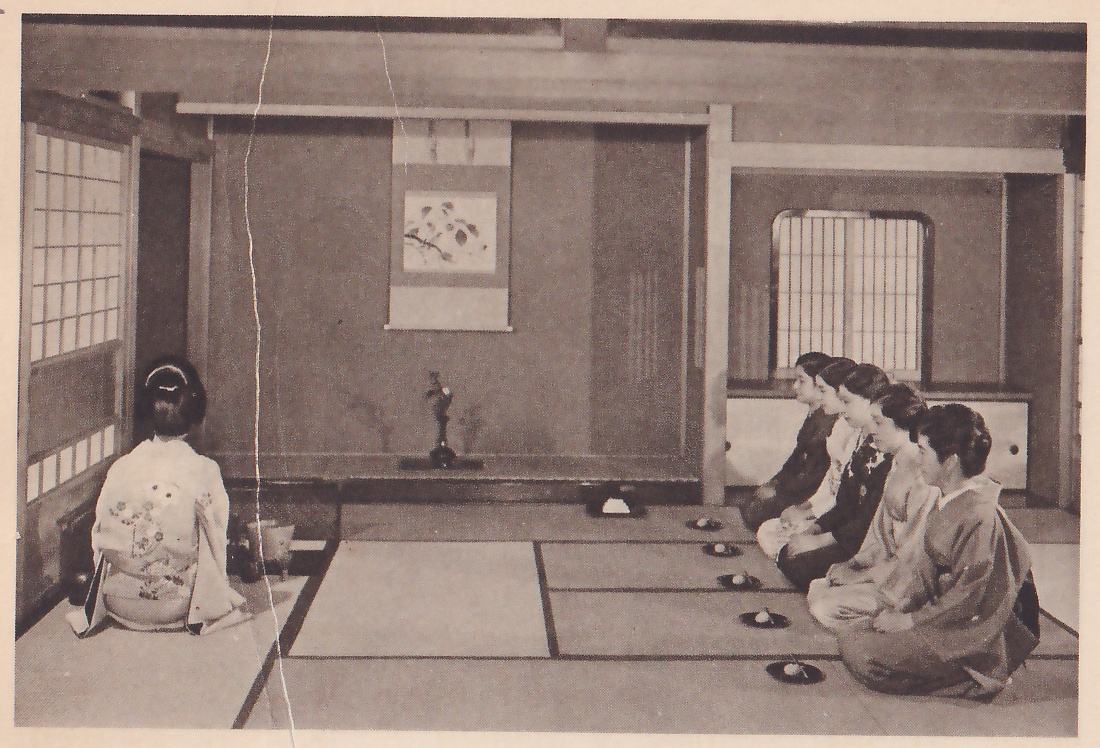
A visit to a professional tea-master’s establishment is the best way to form an adequate idea of the instructions. A group of three or four young women practise under the teacher’s guidance. One of them functions as hostess, while another takes the part of the principal guest. The hostess arranges the various utensils in the service room, which adjoins the tea-room. There is a set of rules prescribed for bringing the utensils to the tea-room, in connection with which she has to observe, for instance, the etiquette of
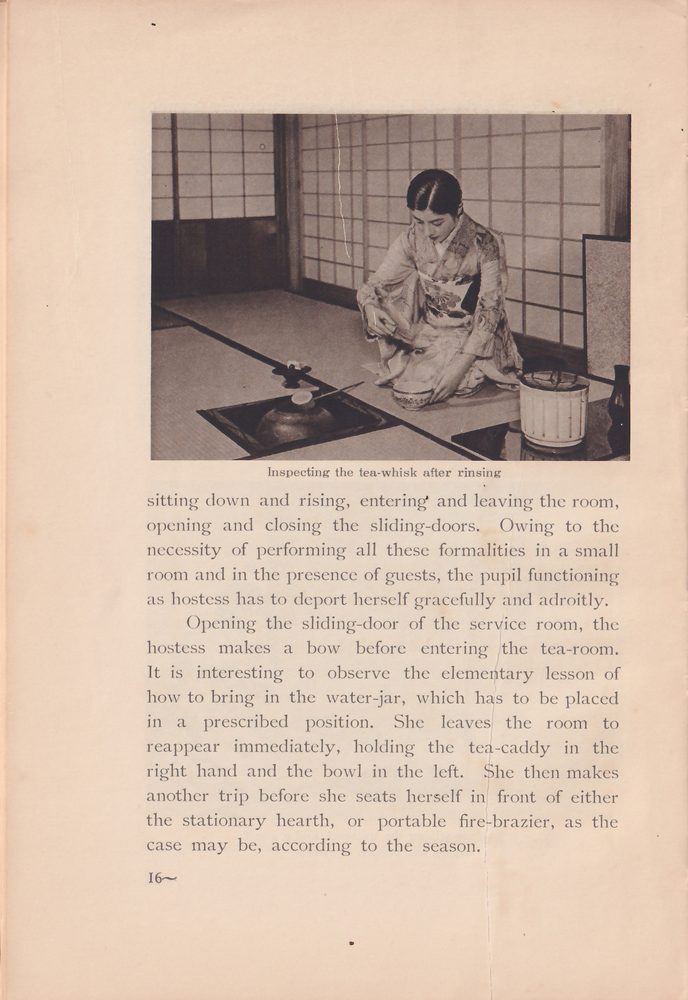
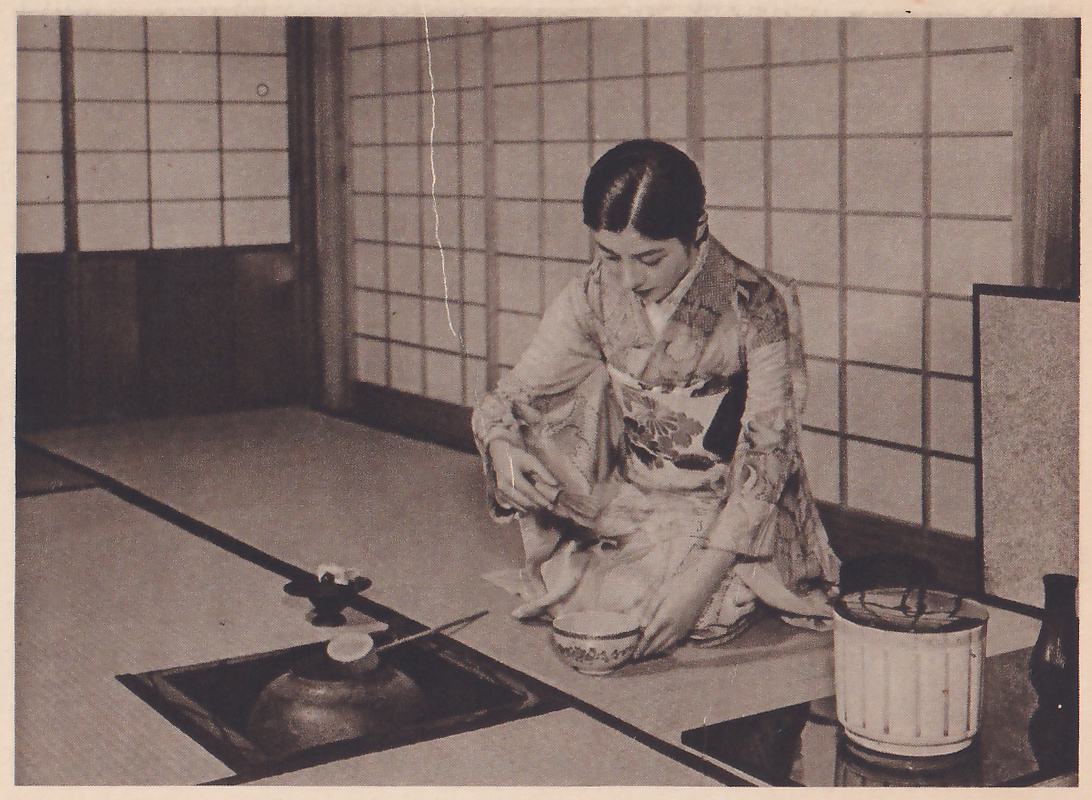
sitting down and rising, entering and leaving the room, opening and closing the sliding-doors. Owing to the necessity of performing all these formalities in a small room and in the presence of guests, the pupil functioning as hostess has to deport herself gracefully and adroitly.
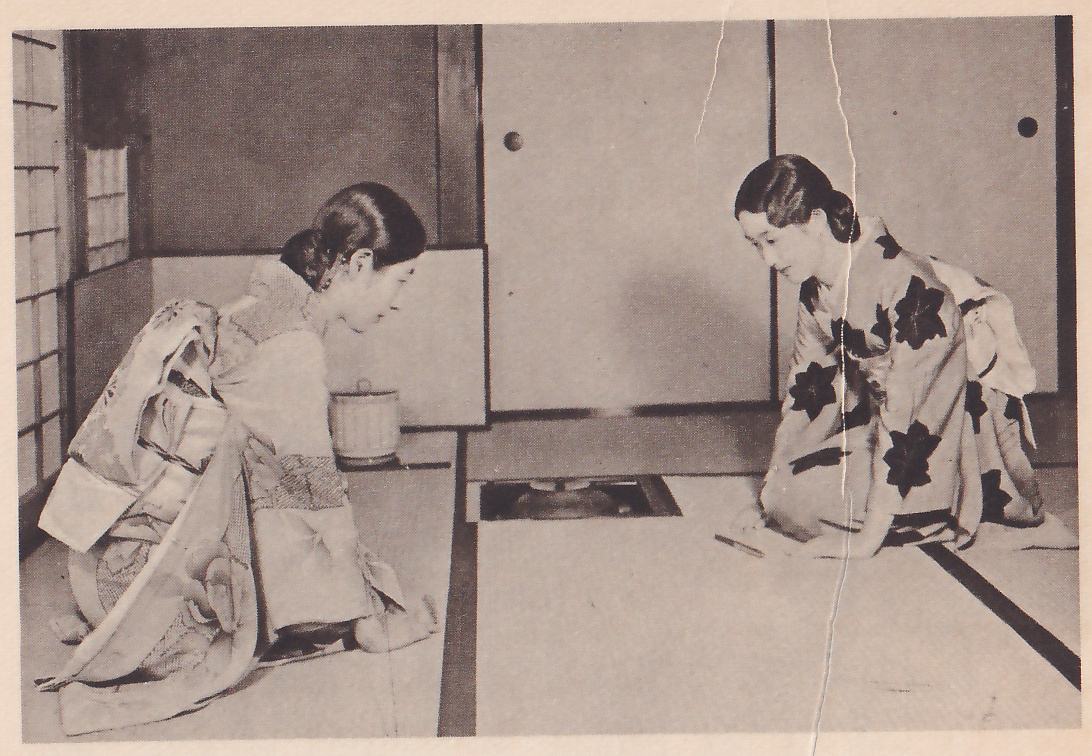
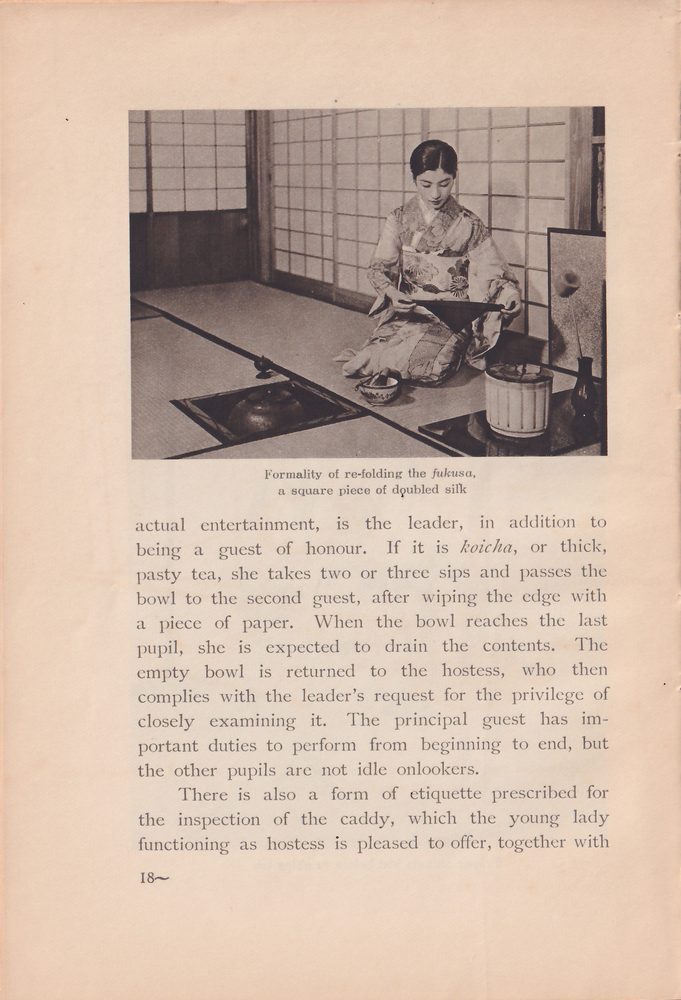
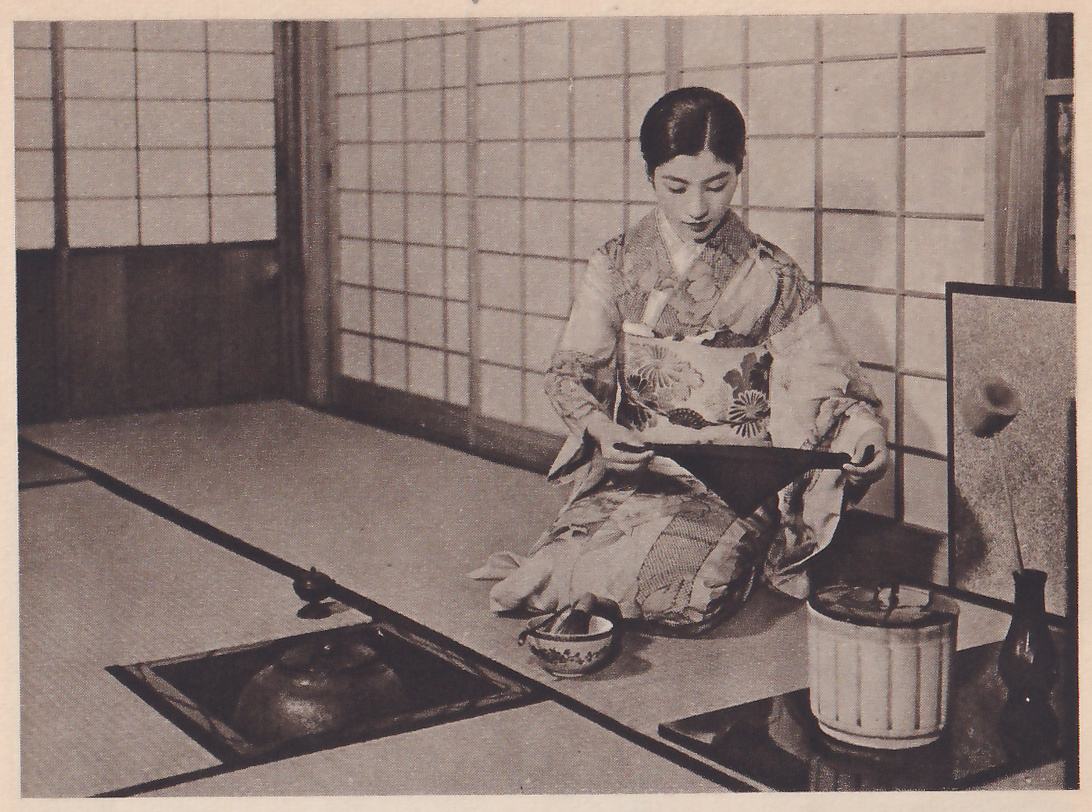
Opening the sliding-door of the service room, the hostess makes a bow before entering the tea-room. It is interesting to observe the elementary lesson of how to bring in the water-jar, which has to be placed in a prescribed position. She leaves the room to reappear immediately, holding the tea-caddy in the right hand and the bowl in the left. She then makes another trip before she seats herself in front of either the stationary hearth, or portable fire-brazier, as the case may be, according to the season.
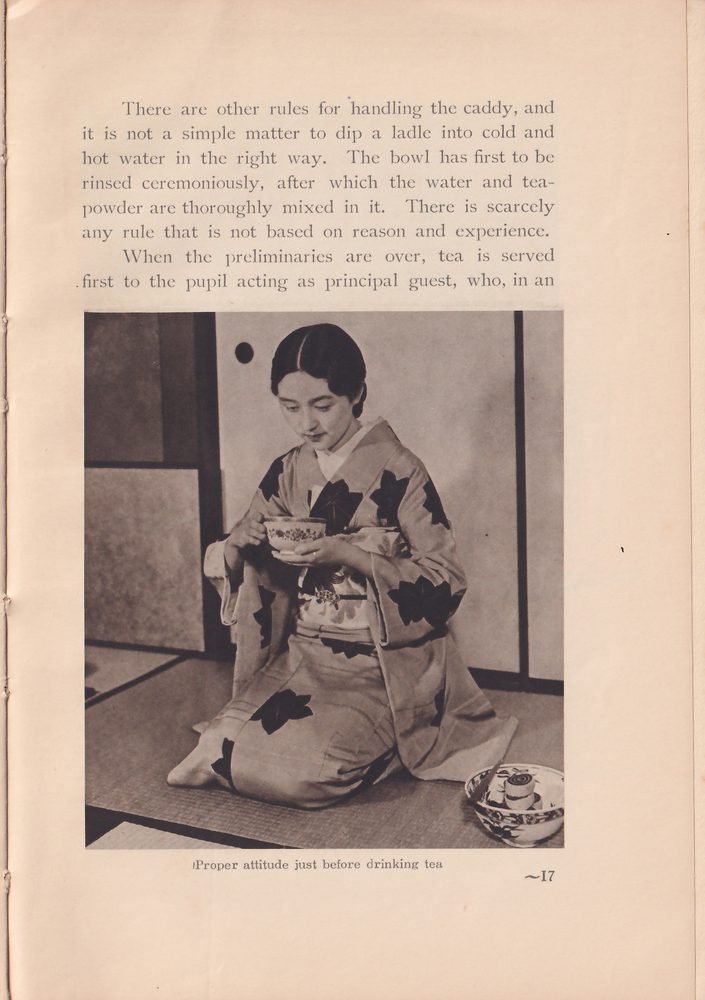
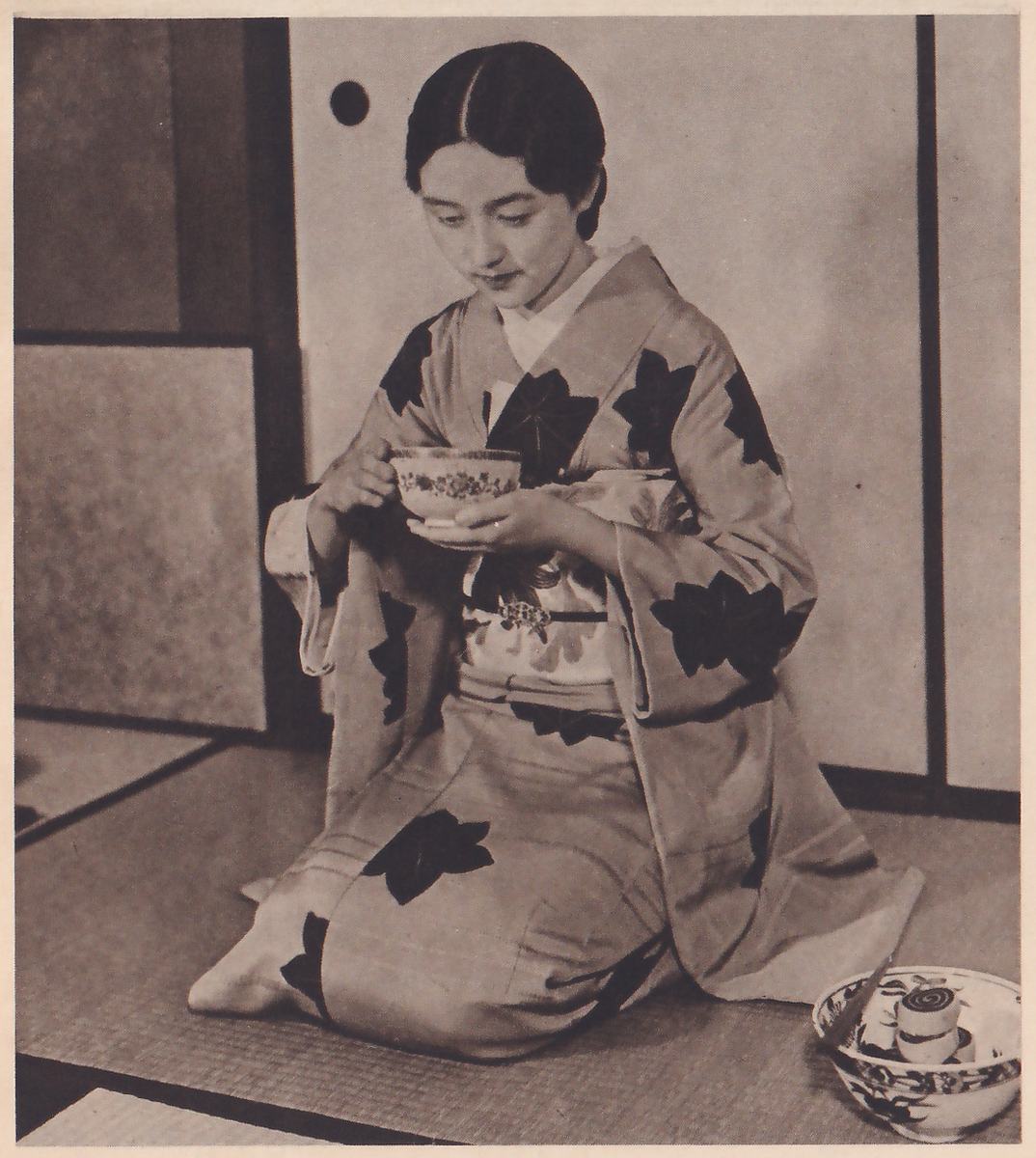
There are other rules for handling the caddy, and it is not a simple matter to dip a ladle into cold and hot water in the right way. The bowl has first to be rinsed ceremoniously, after which the water and tea-powder are thoroughly mixed in it. There is scarcely any rule that is not based on reason and experience.
When the preliminaries are over, tea is served first to the pupil acting as principal guest, who, in an
actual entertainment, is the leader, in addition to being a guest of honour. If it is koicha, or thick, pasty tea, she takes two or three sips and passes the bowl to the second guest, after wiping the edge with a piece of paper. When the bowl reaches the last pupil, she is expected to drain the contents. The empty bowl is returned to the hostess, who then complies with the leader’s request for the privilege of closely examining it. The principal guest has important duties to perform from beginning to end, but the other pupils are not idle onlookers.
There is also a form of etiquette prescribed for the inspection of the caddy, which the young lady functioning as hostess is pleased to offer, together with
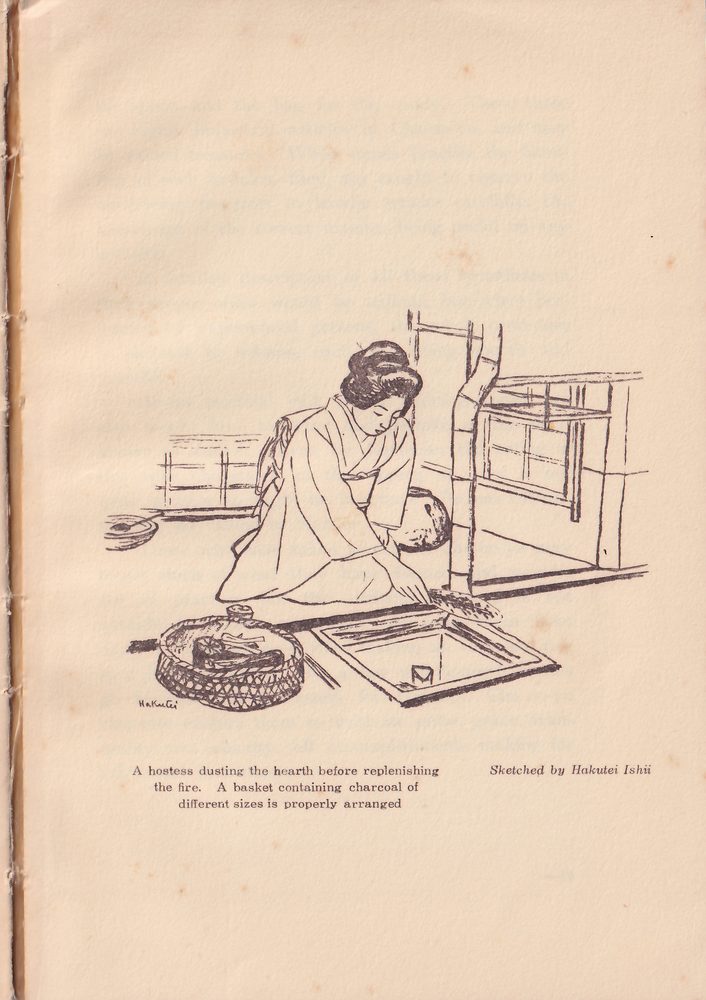
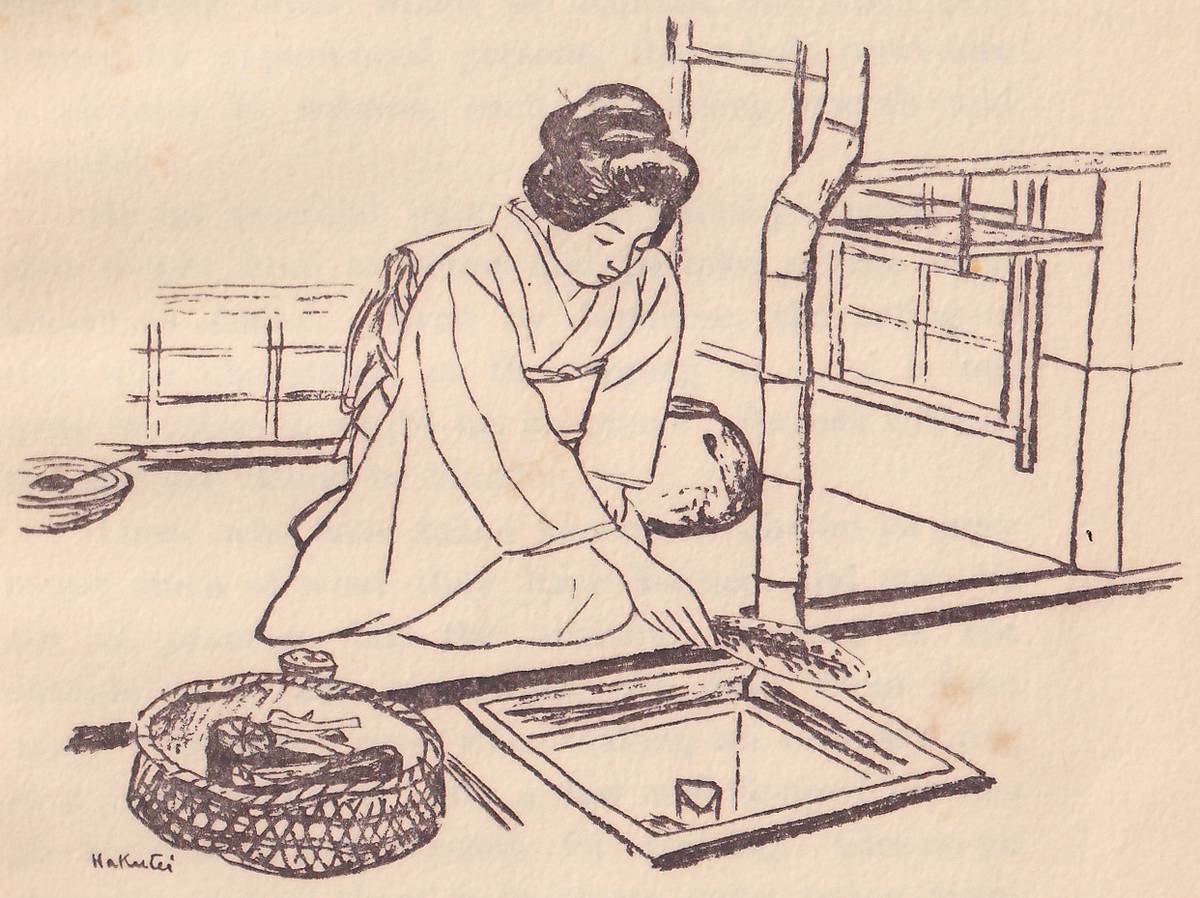
Sketched by Hakutei Ishii
the spoon and the bag for the caddy. These three are highly important articles in Cha-no-yu, and may be valued treasures. When pupils practise the handling of such articles, they are taught to observe the underlying practices to handle articles carefully, the knowledge of the correct manner being useful on any occasion.
A detailed description of all these formalities in their proper order would be tedious, but when performed by experienced persons, the whole procedure is pleasant to witness, each step being smooth and graceful.
As an essential part of the training, pupils are also taught how to serve and partake of the meal known as kaiseki. Even by Japanese, the eating of rice with chopsticks, or the sipping of soup, is not quite so easy as might be imagined. Persons without training are bound to blunder.
Those who have taken lessons in Cha-no-yu may forget much of what they have learned, and may be out of practice, but the training received is not entirely lost. The experience will save them from many a faux pas, even when making an ordinary call in a Japanese home. Not a few middle-aged persons go to professional masters for training. Cha-no-yu etiquette enables them to cultivate poise, grace, tranquility and urbanity, all accomplishments making for refinement in manners.