

HOW TEA-DRINKING BEGAN
The custom of drinking tea is now universal. Although Oriental in origin, there is today no Western country where tea is unknown. In Japan the people drink tea during and after each meal, and it is customary to offer a cup of tea to callers at any time of the day.
A fine powder of choice green tea is used in Cha-no-yu. To serve powdered tea, it is put in a bowl much larger than an ordinary tea cup, and hot water is poured over it. The mixture is beaten by means of a bamboo whisk, which resembles a shaving-brush more than anything else. This practice, which
is older in origin, is not in such common use as the later way of steeping cured leaves in hot water.
Cha-no-yu is peculiar to Japan. It was originally a monastic custom introduced by Japanese Buddhists who had gone to China for study. It is forgotten in the land of its origin, and survives in Japan as an aesthetic pastime, a cult in which the beverage is idealized. Devotees of Cha-no-yu appreciate Art and worship Nature through the medium of the indescribably delicate and refreshing aroma of powdered tea.
So far as written evidence is concerned, the earliest record of tea-drinking in Japan takes us back to 729 A. D., in which year the Emperor Shōmu is said to have invited one hundred Buddhist monks to
take tea in his palace. It is very likely that in those days tea was one of the most precious articles imported from China.
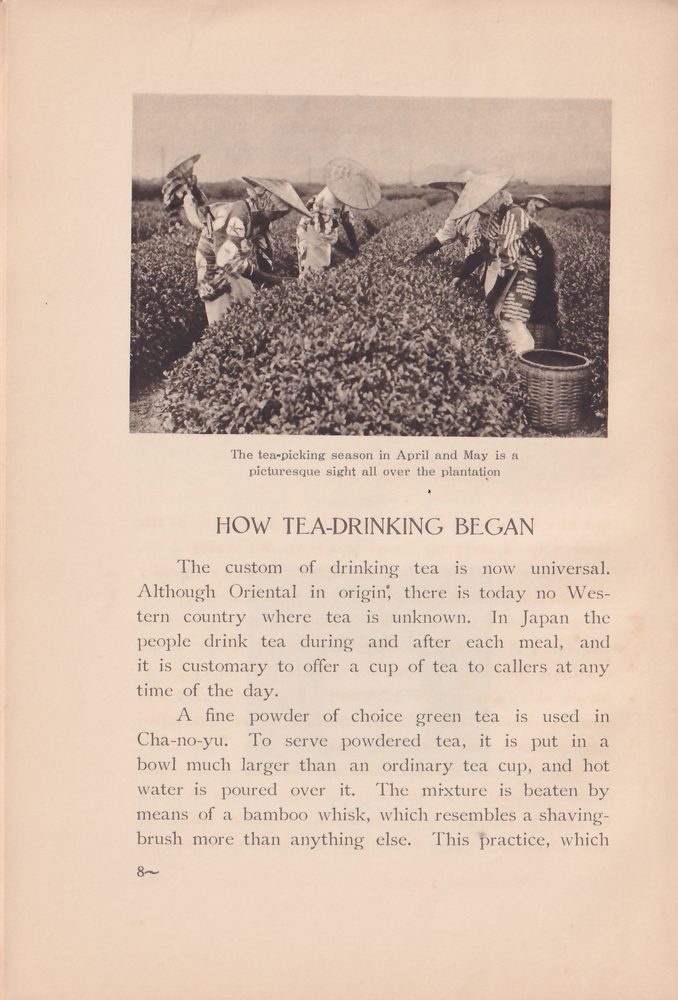
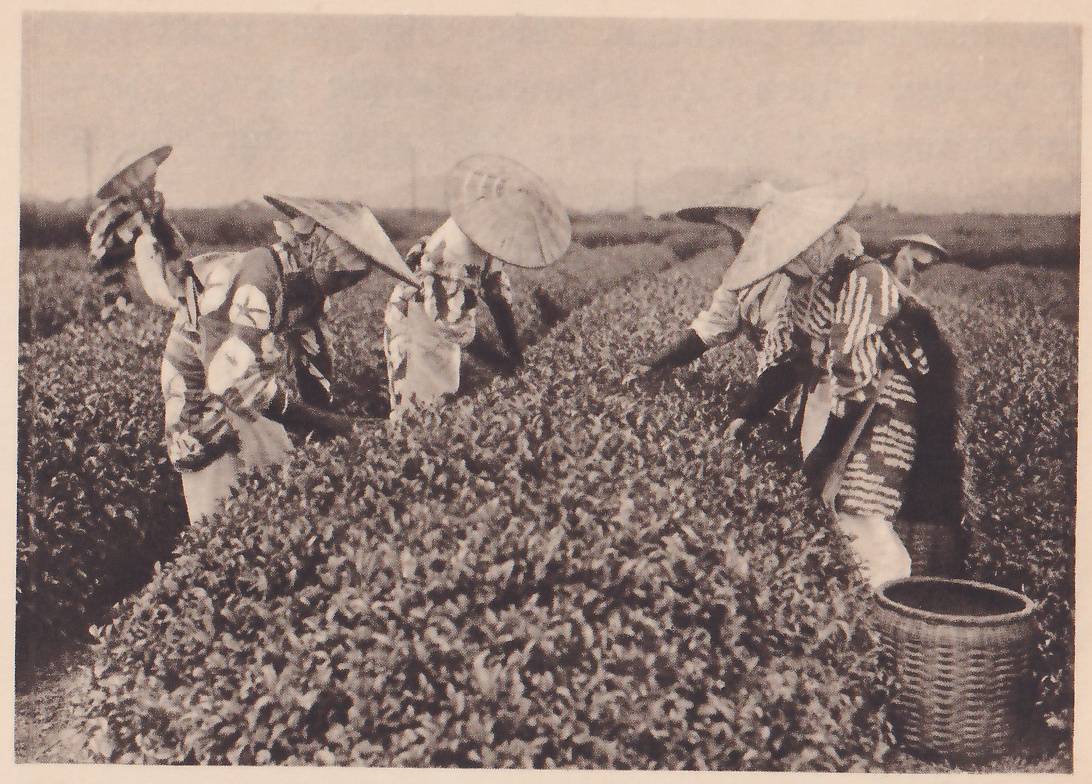
It took nearly four centuries for the cultivation of the tea-plant to become popular. Uji, a district not far from the ancient city of Kyoto, where the best grade of powdered tea is produced, is indebted to a Japanese monk who brought tea seeds from China in the twelfth century. The tea plantations in Shizuoka Prefecture are not so old as those in Uji, but the export of green tea produced there constitutes an important item of Japan’s foreign trade.
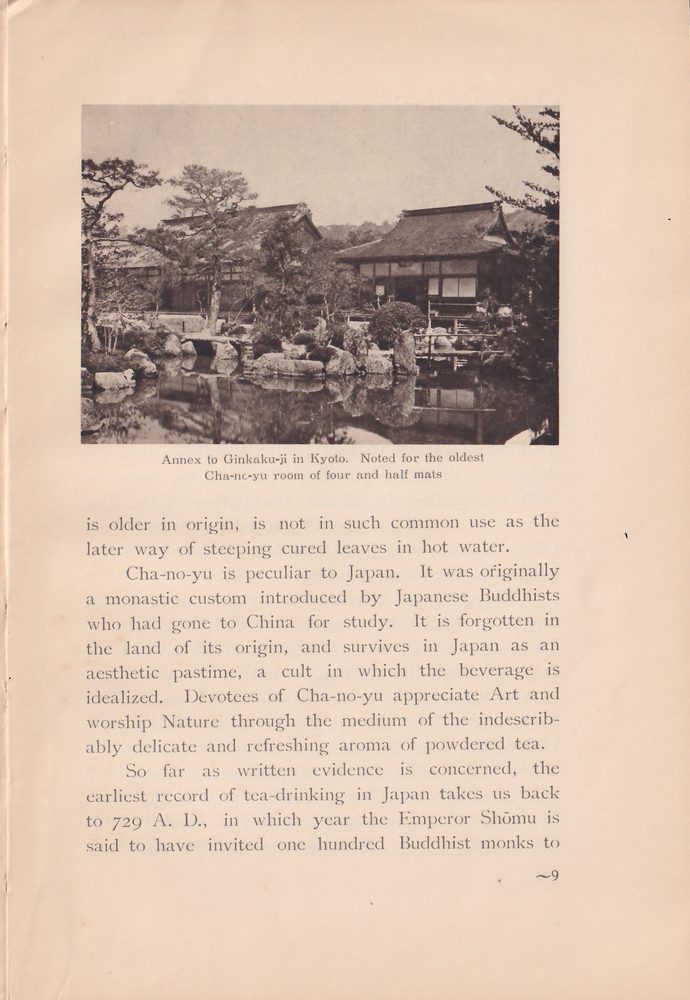
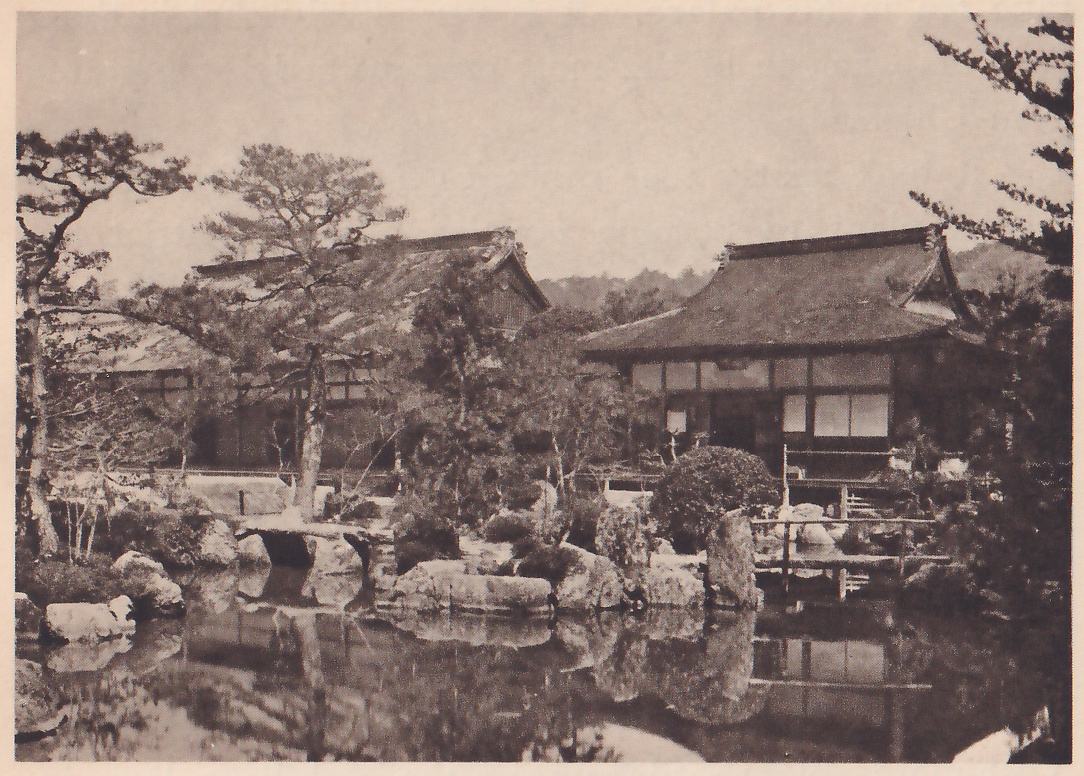
In the north-eastern corner of Kyoto, secluded from the bustling city life, there is the famous villa where Yoshimasa, eighth Shōgun of the Ashikaga line, indulged in aesthetic pursuits. The historic tea-room built as specified by Shukō, the Father of the Tea Ceremony, is still preserved in sound condition in the villa, which is called Ginkaku-ji, better known to foreign tourists as the Silver Pavilion.
The principles of refined and chaste simplicity as taught by Shukō were more concretely set forth by Jowo (1503–1555), who pleaded for a loftier and more original taste. Jowo’s mantle fell on Sen-no-Sōyeki (1521–1591), who is better known by the court name, “Rikyu”, granted through the influence of his patron, Hideyoshi. The formula and etiquette instituted by Rikyu still remain the basic practices as taught by various schools that have sprung up since his death in 1591. Many utensils bearing the stamp of his genius have come down to the present day, and
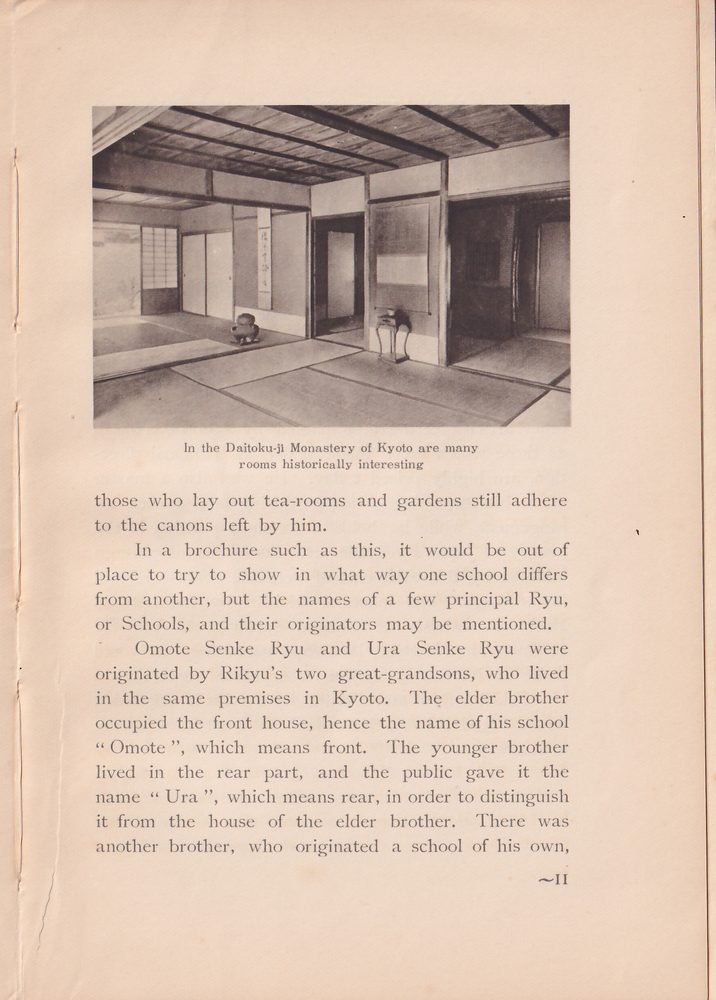
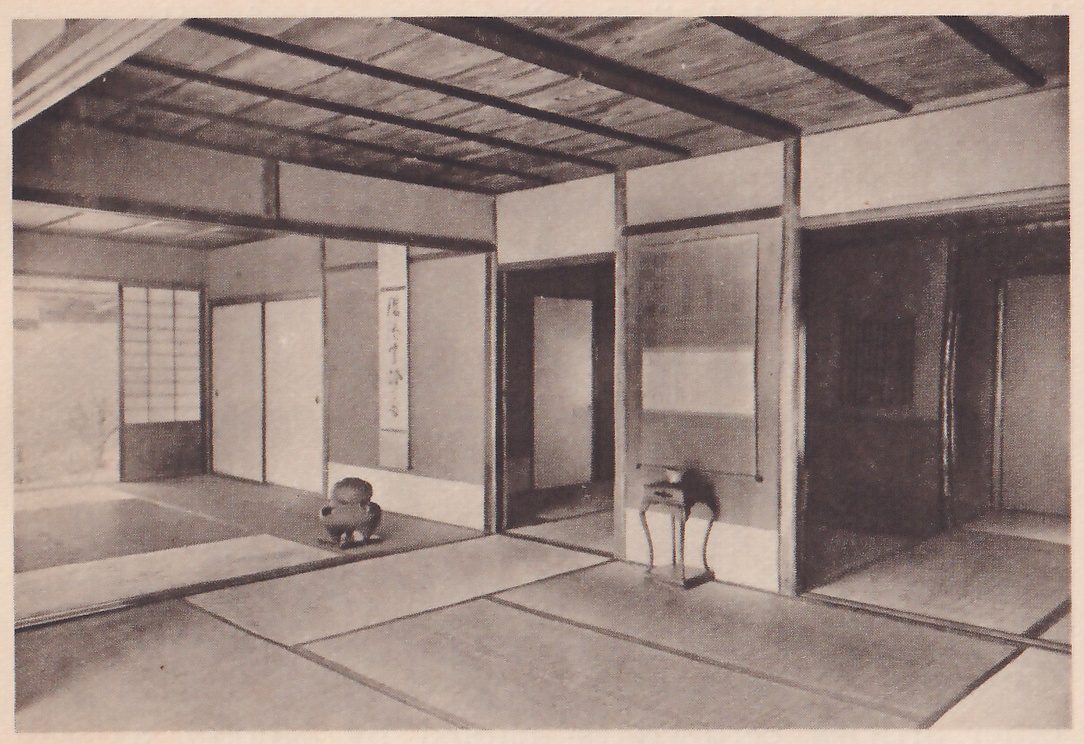
those who lay out tea-rooms and gardens still adhere to the canons left by him.
In a brochure such as this, it would be out of place to try to show in what way one school differs from another, but the names of a few principal Ryu, or Schools, and their originators may be mentioned.
Omote Senke Ryu and Ura Senke Ryu were originated by Rikyu’s two great-grandsons, who lived in the same premises in Kyoto. The elder brother occupied the front house, hence the name of his school “Omote”, which means front. The younger brother lived in the rear part, and the public gave it the name “Ura”, which means rear, in order to distinguish it from the house of the elder brother. There was another brother, who originated a school of his own,
known as “Mushakōji Ryu”, so named after the street where he lived. There are many other schools which various tea-masters represent in giving lessons, but one is little different from another in their essentials. Harmony prevails, therefore, when persons of different schools meet at a Cha-no-yu party.
Of the several feudal lords who were first-class tea-masters and originated their own systems of ceremonial tea, brief reference may be made to Kobori Masakazu, Lord of Enshu, whose school is known as “Enshu Ryu”. He was the most influential tea-master and connoisseur of the earlier Tokugawa régime in the seventeenth century. Tea-bowls, caddies and other articles certified or named by Kobori, as well as those which were made under his personal direction, are highly prized today. He was also a master of architecture, landscape gardening and flower arrangement, while he holds a foremost position in the history of Japan’s ceramic art. Some famous gardens laid out by this aristocrat of versatile genius are still in existence. The influence wielded by the Lord of Enshu as adviser to Shōgun Iyemitsu in the tea ceremony, architecture, landscape gardening, etc. would make an interesting subject for separate treatment.
Sekishū Ryu and Unshū Ryu, schools originated by two feudal lords, have had adherents among the aristocracy.