

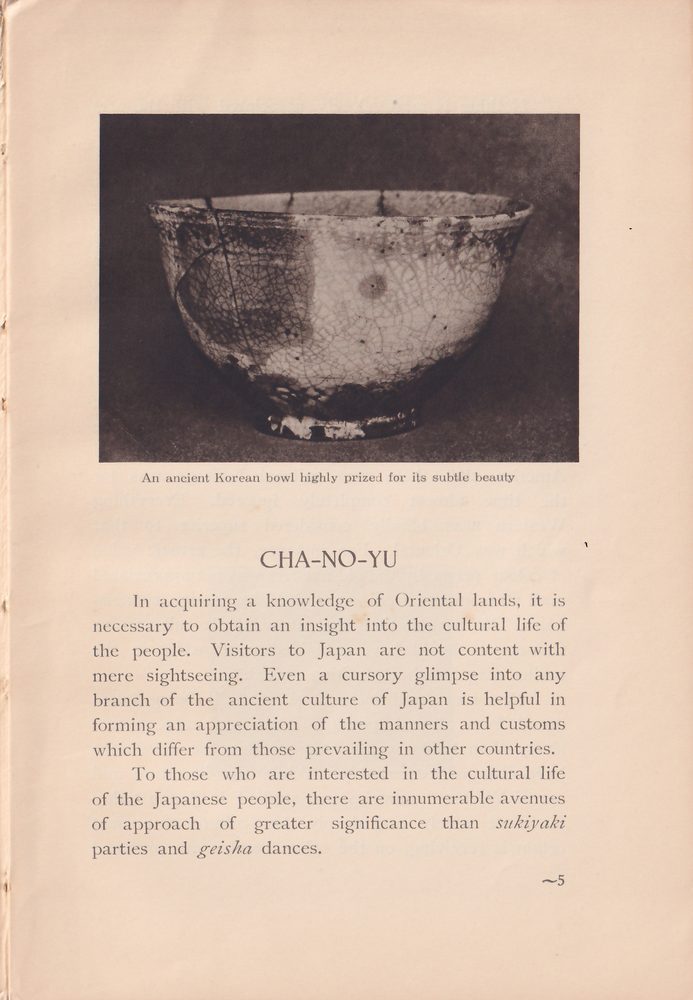
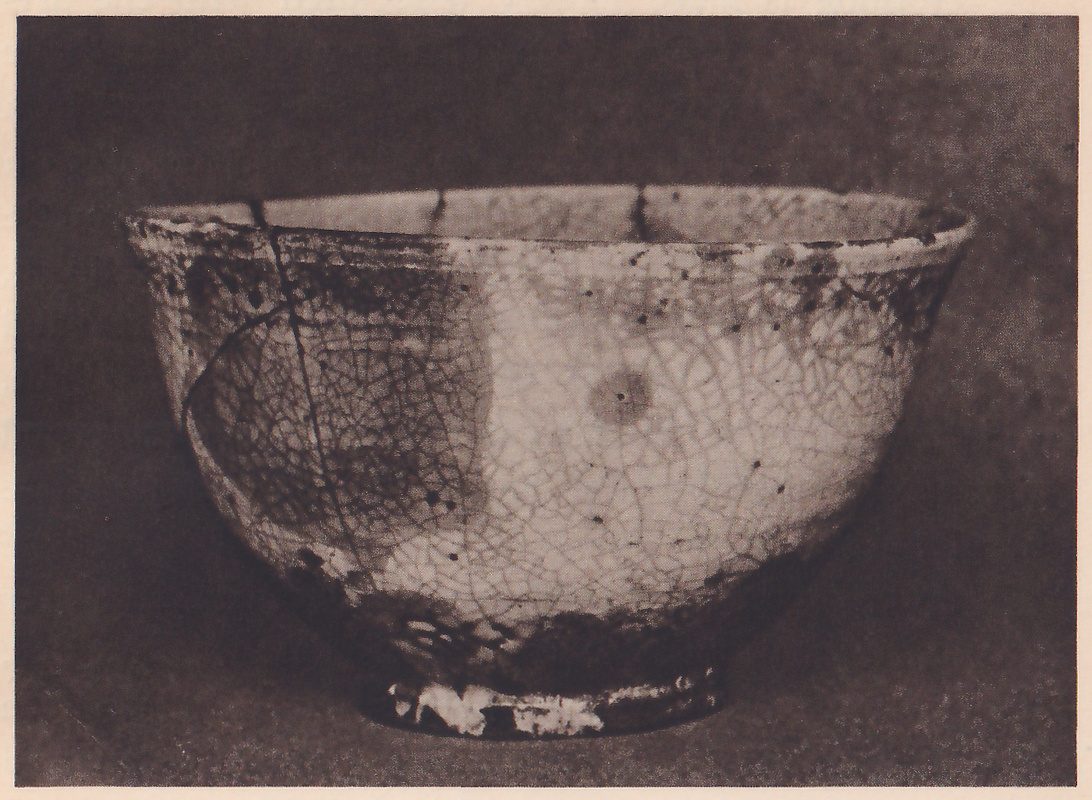
CHA-NO-YU
In acquiring a knowledge of Oriental lands, it is necessary to obtain an insight into the cultural life of the people. Visitors to Japan are not content with mere sightseeing. Even a cursory glimpse into any branch of the ancient culture of Japan is helpful in forming an appreciation of the manners and customs which differ from those prevailing in other countries.
To those who are interested in the cultural life of the Japanese people, there are innumerable avenues of approach of greater significance than sukiyaki parties and geisha dances.
Nothing is more closely associated with the arts and crafts of Japan than Cha-no-yu, an aesthetic pastime in which powdered green tea is served in a refined atmosphere. It is a subject which requires a life-long study to appreciate fully the underlying subtle aestheticism, with its manifold bearings upon religion, literature and philosophy, as well as the arts and crafts. A knowledge of Cha-no-yu, however slight, will therefore be highly useful to understand and adequately appraise the home life of the Japanese people.
After Japan abandoned her policy of isolation, over sixty years ago, and the Imperial régime was restored, the Government and people were so eager to introduce Western manners and institutions from Europe and America that their own cultural heritage was for the time almost completely ignored. Everything Western was blindly considered superior to that which was Oriental. For instance, the artistic value of colour prints by the old masters was not appreciated until their merits were recognized by foreign connoisseurs. No wonder then that an aesthetic cult such as Cha-no-yu should have remained unattractive in the earlier stage of the transition period.
New ideas and institutions are still being introduced from abroad, perhaps faster and more extensively than half a century ago. But the conditions have changed remarkably. While the literature and art of Western countries are studied in Japan today far more widely and deeply, her culture of ancient origin is receiving, on the other hand, more profound
and intelligent attention. The reign of peace and prosperity, which the Japanese people have enjoyed during the past forty years, has also contributed to the revival of Cha-no-yu.
It is the author’s purpose to give in this brochure some fundamental principles of Cha-no-yu, and briefly to expound the etiquette generally observed by those who participate in the entertainment. A general but correct idea of the Japanese custom of serving powdered tea will be helpful in obtaining a deeper insight into the nation’s cultural life. The author would therefore suggest that visitors to Japan avail themselves of an opportunity to observe, or participate in, the refined entertainment of Cha-no-yu.