
Lesson 23
洗心 senshin · Clear Mind
1. The character
senshin 洗心 means Clear Mind and combines sen 洗 meaning "to clean" and shin 心 meaning "mind" or "heart."
心 is also read as kokoro meaning "heart."
senshin (Clear Mind) 洗心 — sensei video
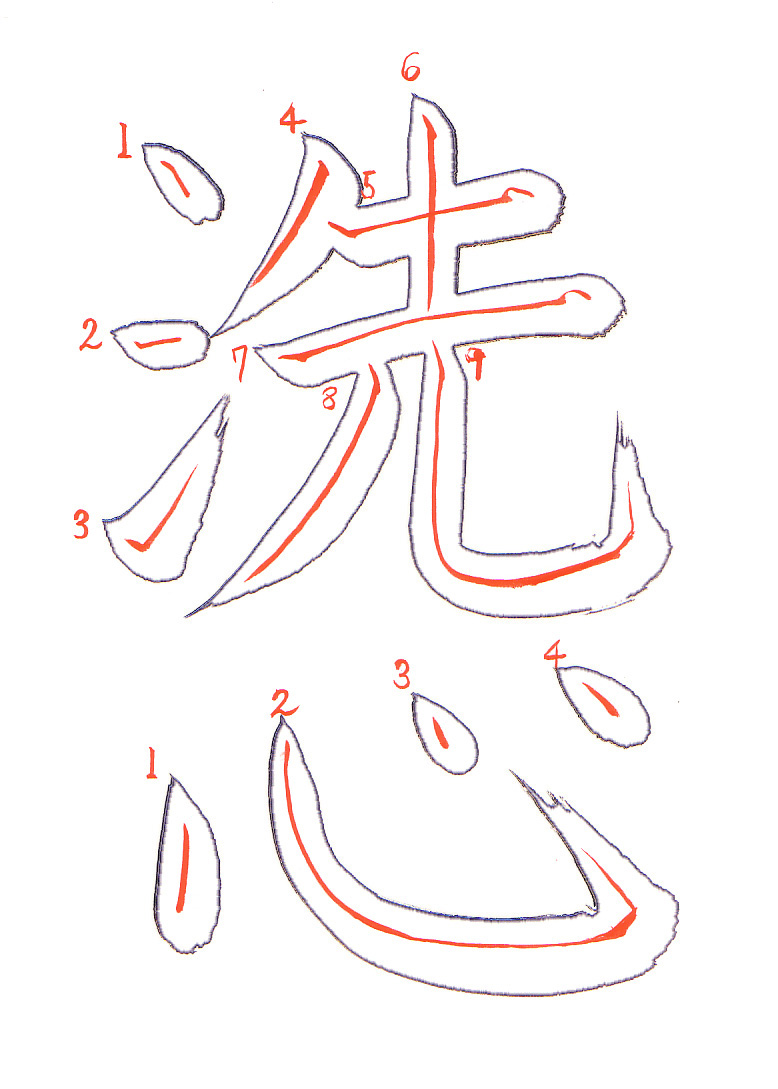
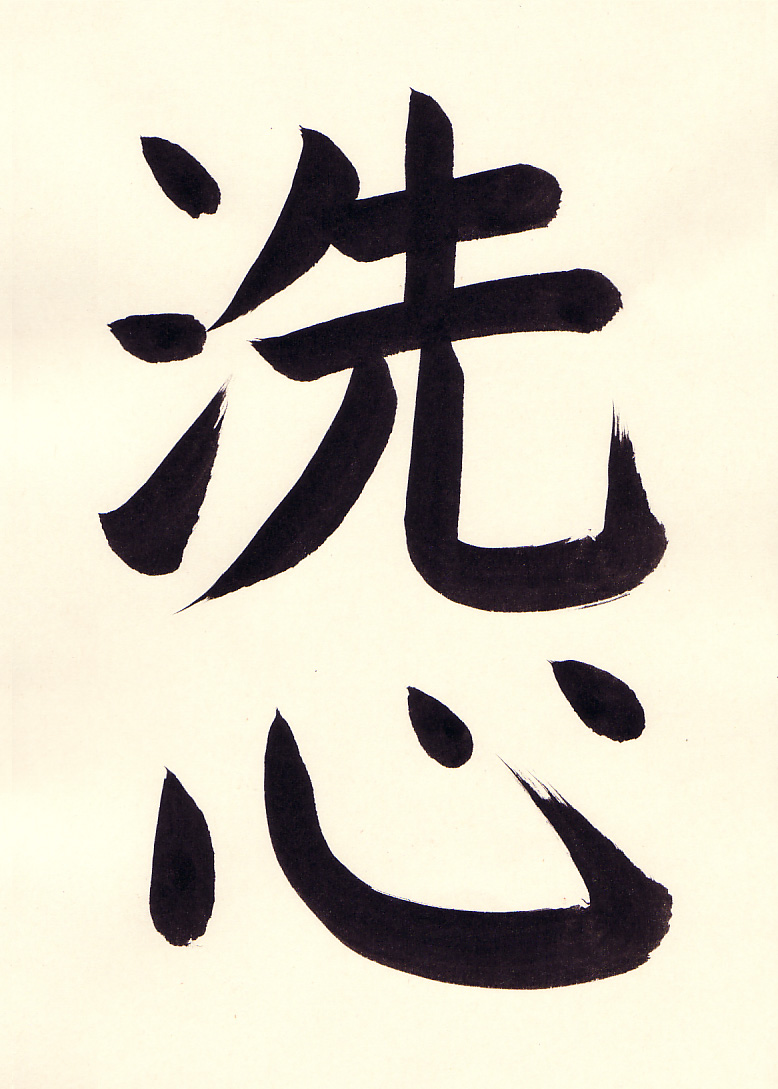
- 0:04 Start to the left of center. Apply the brush at a 45 degree angle.
- 0:05 Push down on the brush and pull the brush very slightly down and to the left at a 45 degree angle.
- 0:06 Finish the line by bringing the brush up and off the paper.
- 0:07 The second ten is more horizontal. Apply the brush at a 45 degree angle.
- 0:08 Press down on the brush and pull slightly to the right.
- 0:08 Release the pressure a bit and reapply the pressure. This will give a nice ending to the line.
- 0:09 Then bring the brush up and to the left off the paper.
- 0:11 For the migihane, apply the brush to the paper at a 45 degree angle.
- 0:11 Press down slightly and draw the line slightly to the right and down.
- 0:12 Rotate the brush counterclockwise so the thick part of the brush is upward and to the right.
- 0:12 In a quick motion bring the brush up and off the paper.
- 0:12 This large stroke will give a nice taper to the stroke.
- 0:20 For the hidarihane, apply the brush to the paper at a 45 degree angle.
- 0:20 Press down gently on the brush and come back up.
- 0:21 Then rotate the brush so the thick end of the curve is in the direction of the stroke.
- 0:21 Using consistent pressure and using the entire arm to draw the line.
- 0:21 As you approach the bottom of the stroke bring the brush off the paper giving a nice taper to the line.
- 0:23 For the yokoga, apply the brush to the paper at a 45 degree angle. Press down gently on the brush and release the pressure.
- 0:23 Rotate the brush counterclockwise so the thick part of the brush is facing to the right and slightly upward. The brush is tilted so that the tip of the brush is to the right of the end of the brush.
- 0:24 Push the brush to the right using the whole arm and even pressure.
- 0:25 At the end of the line, raise the brush a bit and then again gently press down on the brush at a slight angle. The brush is brought down and around and off to the left.
- 0:28 For the tatega, apply the brush to the paper at a 45 degree angle.
- 0:28 Press down gently on the brush and come back up a little.
- 0:29 The brush is then rotated clockwise so the thick part of the curve of the brush is facing downward. The brush is also tilted so the tip of the brush is well below (towards the bottom of the page) the end of the brush. Then push the brush straight down using your arm to draw the line.
- 0:30 At the end of the line press down very slightly.
- 0:31 The brush is then brought up and off the page to give a nice ending.
- 0:32 For the yokoga, apply the brush to the paper at a 45 degree angle.
- 0:32 Press down gently on the brush and release the pressure.
- 0:33 Rotate the brush counterclockwise so the thick part of the brush is facing to the right and slightly upward. The brush is tilted so that the tip of the brush is to the right of the end of the brush.
- 0:34 At the end of the line, raise the brush a bit and then again gently press down on the brush at a slight angle.
- 0:34 Then bring the brush down.
- 0:35 The bottom part is filled out.
- 0:35 Finally the brush is brought off to the left. This entire motion is like drawing a small arc around the end of the line.
- 0:37 To begin the hidaribarai, apply the brush to the paper at a 45 degree angle.
- 0:38 Press down gently on the brush and come back up. Then rotate the brush so the thick end of the curve is in the direction of the stroke.
- 0:39 Using consistent pressure and using the entire arm to draw the line, bring the brush to the left and down in a nice smooth arc.
- 0:39 As you approach the bottom of the stroke gradually bring the brush off the paper giving a nice taper to the line.
- 0:39 This is a large deliberate motion.
- 0:43 For the curved line apply the brush just to the right of center at a 45 degree angle.
- 0:43 Press down gently on the brush and come back up. Then rotate the brush so the thick end of the curve is in the direction of the stroke. The direction in this case is downward but angled slightly to the left.
- 0:44 The brush is also tilted so the tip of the brush is well below (towards the bottom of the page) the end of the brush. Then push the brush down using your arm to draw the line.
- 0:45 Near the very bottom of the vertical component draw a curve into the horizontal component.
- 0:46 The arm is used to draw the line.
- 0:47 At the end of the line the brush is repositioned so the thick part of the brush is facing up and to the right.
- 0:47 A slight 45 degree angle is drawn and then the brush is rotated counterclockwise once again to prepare for the hane stroke.
- 0:48 The hane stroke is a quick and large motion stroke.
- 0:55 For the tatega, apply the brush at a 45 degree angle.
- 0:56 Press down gently on the brush and come back up a little. The brush is then rotated clockwise so the thick part of the curve of the brush is facing downward. The brush is also tilted so the tip of the brush is well below (towards the bottom of the page) the end of the brush.
- 0:57 At the end of the stroke release and then reapply the pressure on the brush to give a nice ending. The brush is brought up and off the paper.
- 1:00 Starting to the right above the previous line, apply the brush at a 45 degree angle. Press down gently on the brush and come back up a little. The brush is then rotated clockwise so the thick part of the curve of the brush is facing downward.
- 1:01 Then push the brush straight down and then curve to the right using your arm to draw the line.
- 1:02 Again this is a large curved line drawn with the entire arm to give a nice consistent width to the line.
- 1:03 At the end of the line, pause briefly to rotate the brush counterclockwise so the thick part of the brush is facing up and to the right.
- 1:03 Draw a very slight 45 degree angle.
- 1:04 Rotate the brush again and begin the hane stroke in a large and quick motion.
- 1:05 This hane stroke is directed to the left.
- 1:09 Draw the ten stroke. The brush is shown here being brought up and off the page.
- 1:10 For the final ten stroke, apply the brush at a 45 degree angle.
- 1:11 Press down on the brush while bringing it very slightly down and to the right.
- 1:12 Finish the stroke by bringing it up and off the paper.
2. How students did
A student’s 洗心
The student’s video, without corrections
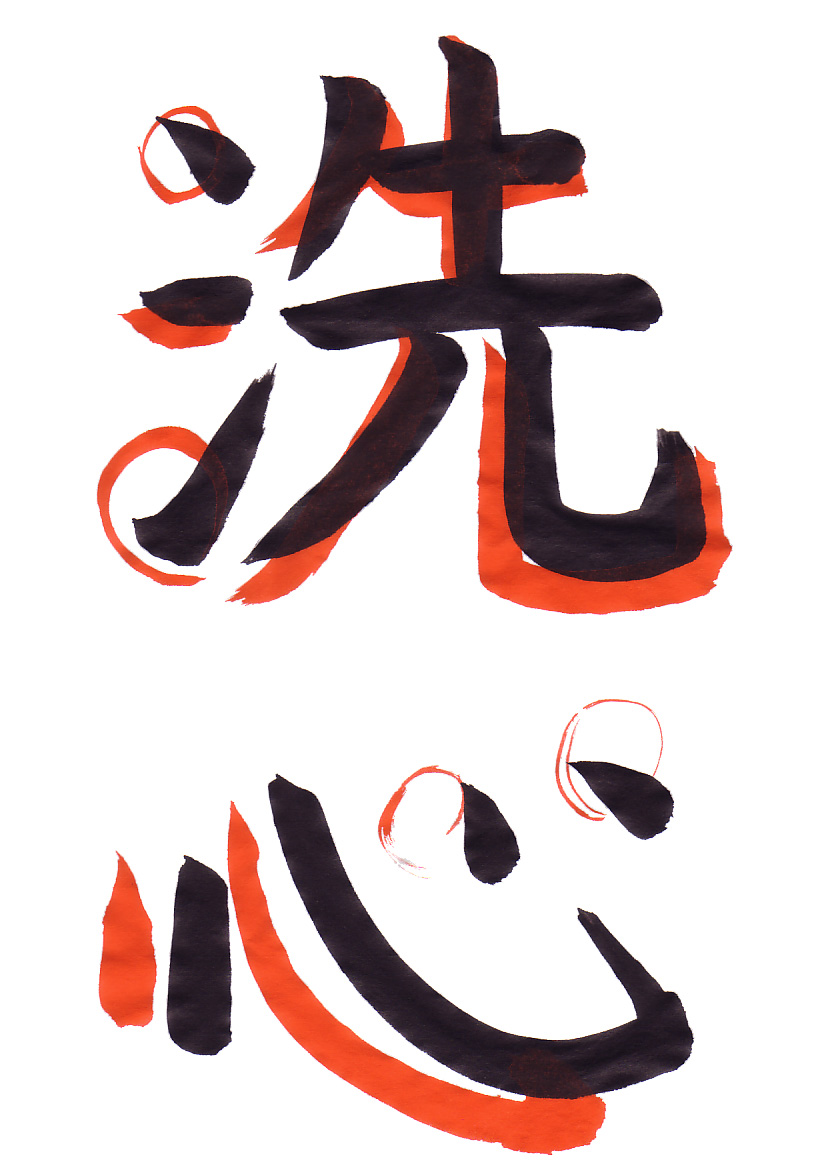
- 0:13 The first ten is fine. The second can be down further to be in line with the middle of the yokoga on the right.
- 0:18 The hidarihane should be angled more.
- 0:22 The start and end of the yokoga can be done better. At the end of the stroke bring the brush up and press down.
- 0:23 Then bring the brush clockwise around the edge of the line.
- 0:23 This shows the brush at the bottom of the slight clockwise circle being drawn.
- 0:23 The stroke is finished up and off to the left.
- 0:31 The tatega is brought up off the page.
- 0:46 The position and direction of the hidaribarai and curved line can be better.
- 0:49 The tatega does not have a nice start. Apply the brush at a 45 degree angle.
- 0:50 Press down on the brush and release.
- 0:50 Pull straight downward.
- 0:51 At the end of the line pause briefly.
- 0:52 Then bring the brush up and off the page.
- 0:56 The curved line does not have a nice start.
- 0:57 Note the beginning of the stroke is in fact straight down.
- 0:58 The entire arm is used to draw the curve.
- 0:58 At the end of the line pause to reorient the brush.
- 0:59 Rotate the brush counterclockwise and draw a slight 45 degree angle line up and to the right.
- 1:01 Reposition the brush again to begin the hane stroke.
- 1:03 The hane stroke is up and to the left. Note the large, quick motion.
- 1:08 This ten is fine.
- 1:09 The final ten is also fine.
Another student’s 洗心
The student’s video, without corrections
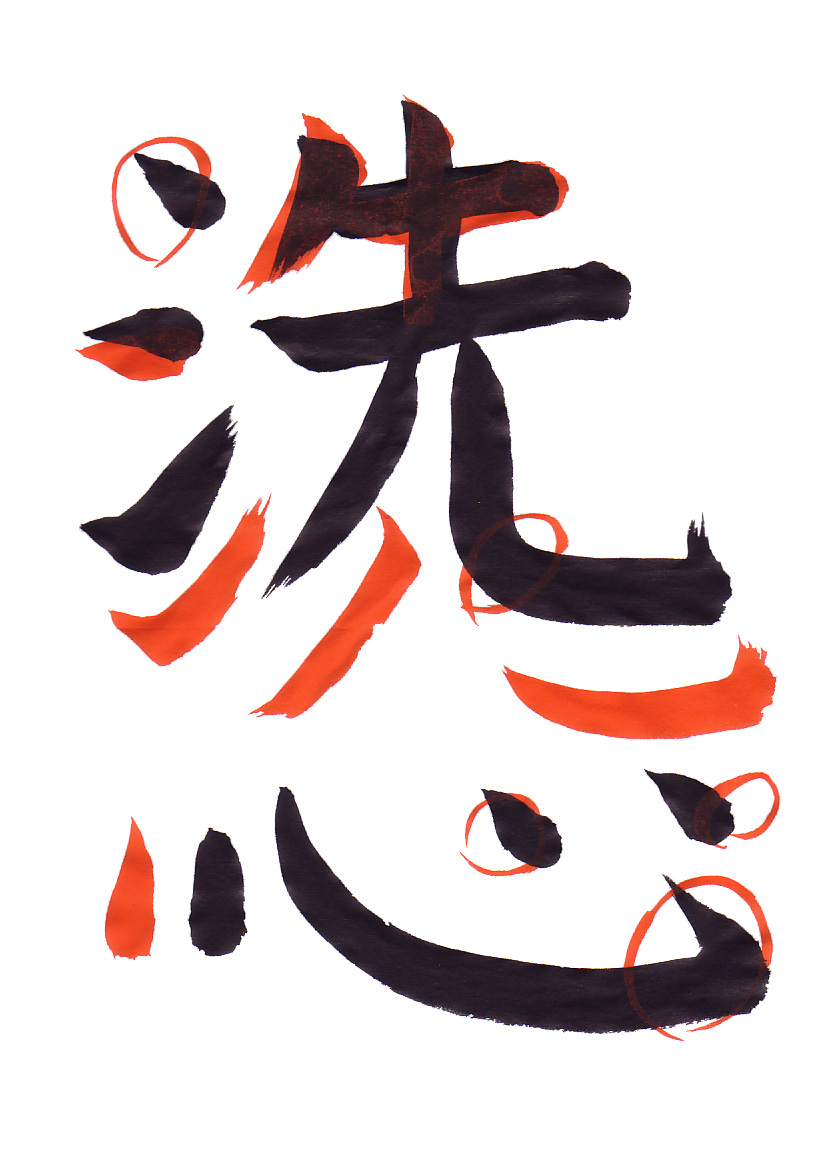
- 0:07 The first ten is fine. The second ten should be in line with the middle level of the yokoga on the right.
- 0:11 The position of the migihane should be much lower.
- 0:14 For the hidarihane, apply the brush at a 45 degree angle.
- 0:14 Press down slightly and release the pressure.
- 0:15 The brush has been rotated clockwise so that the thick part of the brush is facing down and to the left.
- 0:15 In a quick motion bring the brush down and to the left while also bringing the brush up and off the paper.
- 0:15 Note the curve of the brush which requires tilting the brush in order to get a nice tapered edge.
- 0:21 This frame shows the result of the changes.
- 0:29 The hidaribarai stroke does not have a nice form. The brush is initially applied at a 45 degree angle.
- 0:30 Press down on the brush slightly and then release the pressure.
- 0:30 The brush is then rotated clockwise so the thick part of the brush is facing down and to the left.
- 0:31 Using consistent pressure and using the entire arm to draw the line, bring the brush to the left and down in a nice smooth arc.
- 0:32 As you approach the bottom of the stroke gradually bring the brush off the paper giving a nice taper to the line.
- 0:37 The curve is fine.
- 0:41 The end of the stroke is missing the slight 45 degree angle line. This frame shows the hand at the end of the horizontal component of the line.
- 0:41 The brush is then repositioned so that a slight 45 degree angle line can be drawn.
- 0:43 After the 45 degree angle line is drawn the brush is repositioned once again to draw the hane stroke.
- 0:44 The hane stroke is upward and is a quick, large stroke.
- 0:50 For the tatega, apply the brush at a 45 degree angle.
- 0:51 Press down on the brush and bring it down slightly towards the bottom of the page.
- 0:52 At the bottom of the stroke release the pressure on the brush and reapply it.
- 0:52 Then bring the brush up and off the paper.
- 0:56 The curved line ends fine.
- 1:01 The two ten strokes are also fine.
Vocabulary
| Romaji | Kana | Kanji | English | Audio |
|---|---|---|---|---|
| hane | はね | 撥ね | Flick Stroke | audio |
| hidaribarai | ひだりばらい | 左払い | Left Pullout Stroke | audio |
| hidarihane | ひだりはね | 左撥ね | Left Flick Stroke | audio |
| migihane | みぎはね | 右撥ね | Right Flick Stroke | audio |
| senshin | せんしん | 洗心 | Clear Mind | audio |
| tatega | たてが | 縦画 | Vertical Stroke | audio |
| ten | てん | 点 | Dot Stroke | audio |
| yokoga | よこが | 横画 | Horizontal Line | audio |