
Lesson 22
克己 kokki · Self-restraint
1. The character
kokki 克己 means self-restraint and is composed of the kanji koku 克 meaning to overcome and ki 己 meaning oneself. Notice that the word is read kokki and not kokuki!
己, when written alone, is read onore meaning "I", "me", "myself".
kokki (Self-restraint) 克己 — sensei video
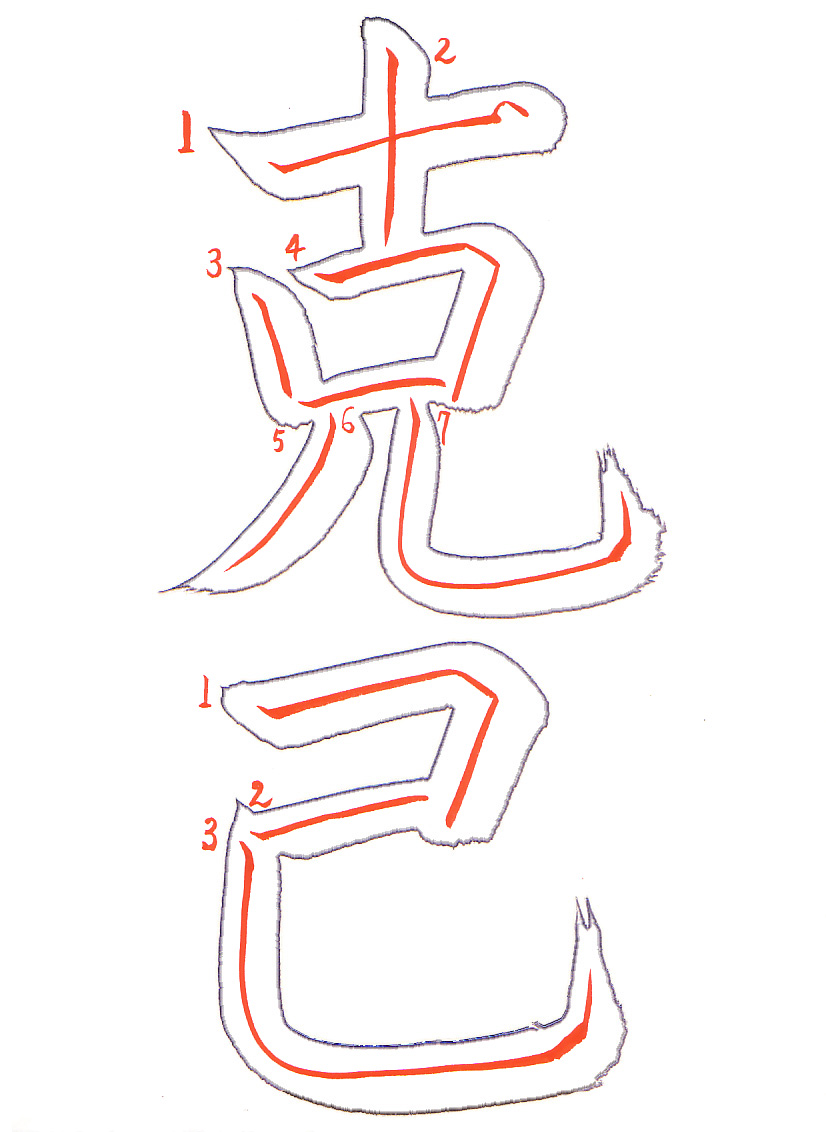
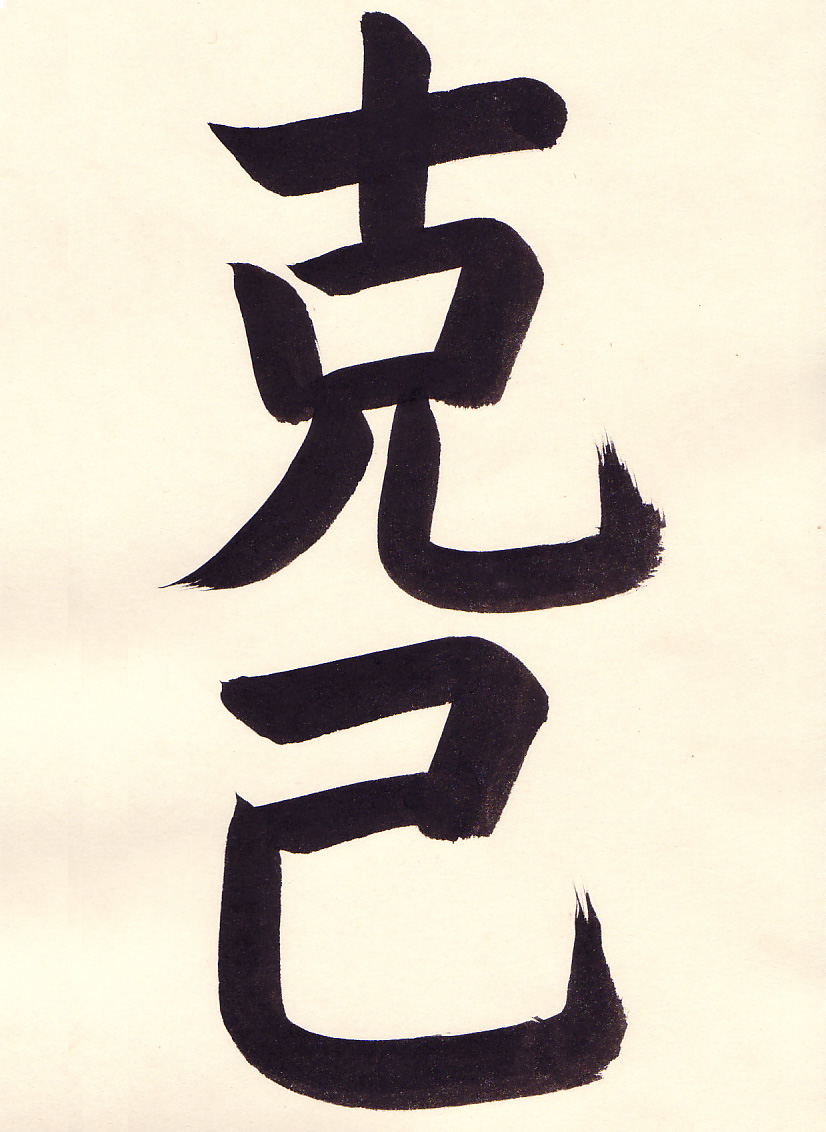
- 0:05 Start the yokoga just left of center. Apply the brush to the paper at a 45 degree angle.
- 0:05 Press down gently on the brush and release the pressure.
- 0:06 Rotate the brush counterclockwise so the thick part of the brush is facing to the right and slightly upward. The brush is tilted so that the tip of the brush is to the right of the end of the brush.
- 0:08 Push the brush to the right using the whole arm and even pressure.
- 0:08 At the end of the line, raise the brush a bit and then again gently press down on the brush.
- 0:08 Bring the brush down and around the edge.
- 0:13 Start the tatega in the center. Apply the brush to the paper at a 45 degree angle.
- 0:15 Press down gently on the brush and come back up a little. The brush is then rotated clockwise so the thick part of the curve of the brush is facing downward. The brush is also tilted so the tip of the brush is well below (towards the bottom of the page) the end of the brush.
- 0:17 To end the stroke, the brush is lifted a bit and reapplied very briefly.
- 0:17 Finally the brush is lifted in an upward stroke (towards the top of the paper) and off of the paper. This is performed in a large motion.
- 0:20 Under the left of the first yokoga begin the second tatega. Apply the brush to the paper at a 45 degree angle.
- 0:20 Press down gently on the brush and come back up a little. The brush is then rotated clockwise so the thick part of the curve of the brush is facing downward. The brush is also tilted so the tip of the brush is well below (towards the bottom of the page) the end of the brush.
- 0:21 To end the stroke, the brush is lifted a bit and reapplied very briefly.
- 0:22 Finally the brush is lifted in an upward stroke (towards the top of the paper) and off of the paper.
- 0:23 Begin this tensetsu by applying the brush at a 45 degree angle.
- 0:23 Press down gently on the brush and release the pressure. Rotate the brush counterclockwise so the thick part of the brush is facing to the right and slightly upward. The brush is tilted so that the tip of the brush is to the right of the end of the brush.
- 0:24 Push the brush to the right using the whole arm and even pressure. At the end of the horizontal stroke, pause and rotate the brush clockwise a bit.
- 0:25 Draw a short 45 degree angle line down and to the right. Note how the hand position is changed to bring the thick end of the brush in line with the direction of the line to be drawn.
- 0:26 Use the entire arm to draw the vertical component that is angled slightly to the left.
- 0:27 To end the stroke, the brush is lifted a bit and reapplied very briefly.
- 0:27 Finally the brush is lifted in an upward stroke (towards the top of the paper) and off of the paper.
- 0:30 Add the yokoga.
- 0:31 Begin the hidaribarai by applying the brush to the paper at a 45 degree angle.
- 0:32 Press down gently on the brush and come back up. Then rotate the brush so the thick end of the curve is in the direction of the stroke.
- 0:33 Use consistent pressure and use the entire arm to draw the line. Bring the brush to the left and down in a nice smooth arc.
- 0:33 As you approach the bottom of the stroke gradually bring the brush off the paper giving a nice taper to the line.
- 0:34 This is a gentle, deliberate stroke with a large motion.
- 0:36 Apply the brush to the paper at a 45 degree angle.
- 0:37 Press down gently on the brush and come back up a little. The brush is then rotated clockwise so the thick part of the curve of the brush is facing downward. The brush is also tilted so the tip of the brush is well below (towards the bottom of the page) the end of the brush.
- 0:37 Towards the bottom begin a sharp curve to the right.
- 0:38 Again the arm is being used to draw the line.
- 0:39 At the end of the line pause and reposition the brush so the thick part is facing up and to the right.
- 0:40 Draw a very slight 45 degree angle line and then rotate the brush again so the thick part of the brush is facing upward.
- 0:41 In a large hane stroke finish off the character.
- 0:46 For the horizontal component of the tensetsu, apply the brush to the paper at a 45 degree angle.
- 0:47 Press down gently on the brush and release the pressure. Rotate the brush counterclockwise so the thick part of the brush is facing to the right and slightly upward. The brush is tilted so that the tip of the brush is to the right of the end of the brush.
- 0:48 Draw the line with your arm.
- 0:48 At the end of the horizontal component, pause and rotate the brush a bit clockwise to face down and to the right.
- 0:49 Draw a short 45 degree angle line down and to the right.
- 0:50 Rotate the brush further clockwise and draw the vertical component which slants slightly inward to the left.
- 0:51 At the end of the line there is no pause. The brush is brought up (towards the top of the paper) and off the paper.
- 0:53 For the yokoga, apply the brush to the paper at a 45 degree angle.
- 0:54 Press down gently on the brush and release the pressure.
- 0:55 Rotate the brush counterclockwise so the thick part of the brush is facing to the right and slightly upward. The brush is tilted so that the tip of the brush is to the right of the end of the brush. Push the brush to the right using the whole arm and even pressure.
- 0:56 The yokoga is ended by bringing the brush up and off the paper to the left.
- 0:58 For the tensetsu, apply the brush at a 45 degree angle.
- 0:58 Press down gently on the brush and release the pressure.
- 1:00 Rotate the brush clockwise so the thick part of the brush is facing downward. The brush is tilted so that the tip of the brush is well below (towards the bottom of the page) the end of the brush. Push the brush down towards the bottom of the page using the whole arm and even pressure.
- 1:01 Use the arm to draw a curve.
- 1:02 At the end of the line the brush is rotated counterclockwise so the thick part is facing upward and to the right.
- 1:03 Draw a short 45 degree angle line.
- 1:05 Then draw the hane stroke in a quick movement.
2. How students did
A student’s 克己
The student’s video, without corrections
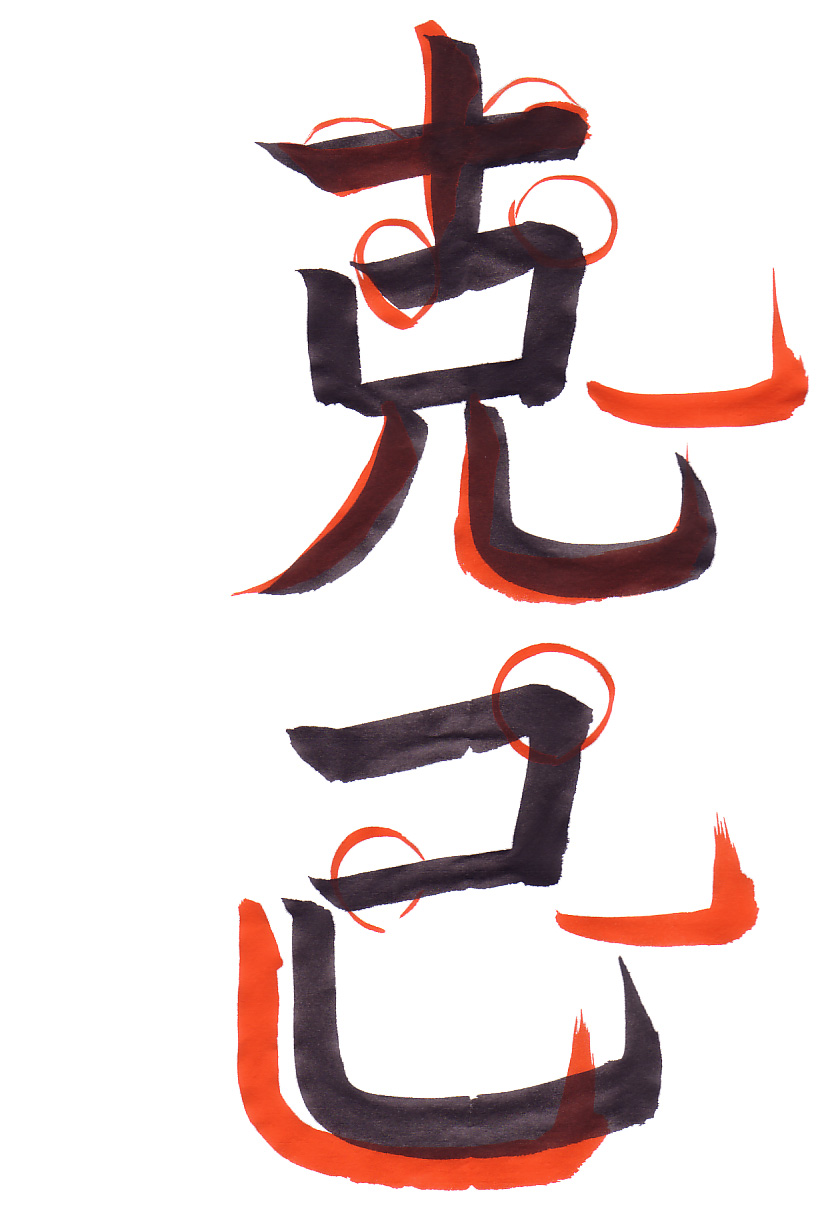
- 0:13 The yokoga should have equal lengths on each side.
- 0:25 The tensetsu has a nice start and the corner is fine.
- 0:26 For the hidaribarai, use less of a curve. Also the start can be improved to have a sharp edge.
- 0:27 Note how the thick part of the brush is being used to draw the line.
- 0:28 As one gets to the bottom of the stroke the brush is tilted to use the tip to finish the line as the brush is brought off the paper.
- 0:30 The hidaribarai is a large and deliberate stroke.
- 0:36 The vertical component of the curved line should angle slightly to the left.
- 0:46 Before the hane stroke draw a short 45 degree angle line.
- 0:48 After the line reposition the brush again so the thick part of the brush is facing further upward.
- 0:49 The hane is a large, quick stroke.
- 0:57 The corner of the tensetsu is fine and the start of the yokoga is fine.
- 1:00 The curved line is too curved on the bottom. The vertical component is quite vertical and the horizontal component is quite horizontal. Apply the brush at a 45 degree angle.
- 1:01 Press down briefly on the brush and release the pressure.
- 1:03 The brush is then rotated clockwise so the thick part of the curve of the brush is facing downward. The brush is also tilted so the tip of the brush is well below (towards the bottom of the page) the end of the brush. Then push the brush straight down using your arm to draw the line.
- 1:05 Begin curving the line only when near the bottom.
- 1:07 Continue as a horizontal line along the bottom. At the end of the line draw a short 45 degree angle line that goes up and to the right.
- 1:09 Reposition the brush again and finish with the quick hane stroke.
- 1:13 Again the horizontal component is horizontal. Then the brush is rotated counterclockwise.
- 1:16 Draw a very short 45 degree angle line.
- 1:17 Then reposition the brush once again for the hane stroke.
- 1:19 The hane stroke is a large motion stroke.
- 1:24 This shows the final corrections.
Another student’s 克己
The student’s video, without corrections
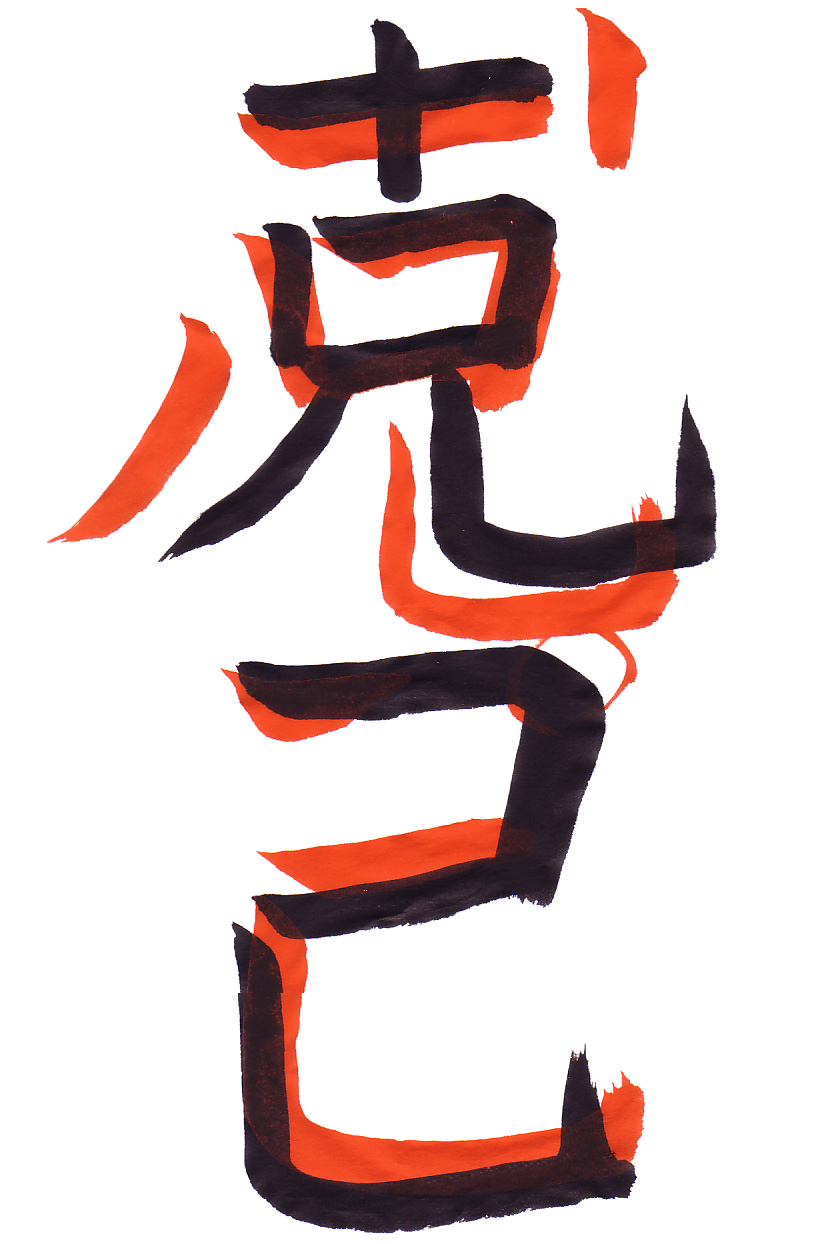
- 0:07 The first yokoga is positioned too high. The start and ending can also be improved.
- 0:10 The tatega is not well formed. Start by applying the brush at a 45 degree angle.
- 0:12 Pressing down on the brush will give a nice sharp start.
- 0:13 At the end of the stroke the brush is brought slightly up and reapplied.
- 0:13 Then the brush is brought up and off the page. This gives a nice ending to the line.
- 0:17 The second tatega should be angled slightly inward.
- 0:17 In this frame we can see how pressing down on the brush gives a nice form to the start of the line.
- 0:19 The brush is tilted and pulled to draw the line.
- 0:30 The entire shape of the box needs to be redone. The student needs to review the sensei video.
- 0:33 The hidaribarai stroke is not well done. It should be at much less of an angle. To start apply the brush at a 45 degree angle.
- 0:34 Press down gently on the brush and come back up.
- 0:36 Then rotate the brush so the thick end of the curve is in the direction of the stroke. Using consistent pressure and using the entire arm to draw the line, bring the brush to the left and down in a nice smooth arc.
- 0:37 As you approach the bottom of the stroke gradually bring the brush off the paper giving a nice taper to the line.
- 0:42 The form of the curved line is not good. To start the line apply the brush at a 45 degree angle.
- 0:42 The line is angled slightly inward (to the left).
- 0:43 The curve is started only as one approaches the bottom of the line.
- 0:44 This frame shows the hand position at the end of the horizontal component.
- 0:45 At the end of the horizontal component a slight 45 degree angle line is drawn.
- 0:46 The brush is repositioned once again to start the hane stroke.
- 0:47 Finally the hane stroke is a large and quick motion.
- 0:51 Apply the brush at a 45 degree angle.
- 0:52 Press down gently and then release.
- 0:52 The hand is rotated counterclockwise and the brush tilted so the thick part of the brush is facing right.
- 0:53 Using the entire arm to draw the line.
- 0:55 The corner is fine.
- 1:00 The yokoga should be straight and angled slightly upward. In this case the line should also be placed as shown in red.
- 1:03 For the curved line apply the brush at a 45 degree angle.
- 1:03 Use the thick part of the brush and the arm to draw the line.
- 1:04 The line is straight and the curve only starts when one approaches the bottom of the line.
- 1:06 At the end of the line the brush is repositioned to draw a slight 45 degree angle line.
- 1:07 Draw the short 45 degree angle line.
- 1:09 The brush is then repositioned before starting the hane stroke.
- 1:10 The hane is a large and quick upward motion.
- 1:12 Student 2 needs to work on the basic strokes and lines. Each line should be practiced individually over and over again.
Vocabulary
| Romaji | Kana | Kanji | English | Audio |
|---|---|---|---|---|
| hane | はね | 撥ね | Flick Stroke | audio |
| hidaribarai | ひだりばらい | 左払い | Left Pullout Stroke | audio |
| kokki | こっき | 克己 | Self-restraint | audio |
| migihane | みぎはね | 右撥ね | Right Flick Stroke | audio |
| tatega | たてが | 縦画 | Vertical Stroke | audio |
| tensetsu | てんせつ | 転折 | Continued Lines | audio |
| yokoga | よこが | 横画 | Horizontal Line | audio |