





Font Design · VD5J
Font Designs are Master Takase's unique designs. Often she will use her own style or a combination of fonts and, without a classification limit, create exactly the look she wants.
桃李満門
tōri manmon
A Gate Full of Excellent Pupils
A teacher with many excellent pupils; in the words, peach and plum fill the gate.
Master Takase creates this beautiful scroll when your order is placed. Personally preparing the ink and brushing your art that proudly bears her signature and seal. This is an original work of art.
Description
桃李満門 (tōri manmon): a teacher has many excellent pupils; the words say peach and plum fill the gate.
The Japanese dictionaries enter the phrase as 桃李門に満つ, tōri mon ni mitsu. There are many outstanding pupils under one's gate. Peach and plum are the people one raises and puts forward. The gate is the house of a teacher. In the Japanese writings read for its history, Takahashi Sōan's household of 1928 aside, the phrase is a tribute said of a teacher by others. Whether it is for a dōjō's teacher or for any teacher you honor is yours.
The Confucian scholar Uno Meika wrote of Kinoshita Jun'an's school that its gate was full of peach and plum. A book of scholars' lives of 1816 took his line into its life of Jun'an. It then listed Jun'an's pupils, beginning with Arai Hakuseki. The monk Gesshō wrote a poem to the master of a village school that opens on peach and plum filling his gate.
An essay on the Zen master Shaku Sōen, dated the day after his death in 1919, says peach and plum filled his gate. They came drawn of themselves, it says, and he did not spend his strength to widen his gate. In 1929 Tokutomi Sohō was asked for a title for an album of letters by the friends and pupils of Yokoi Shōnan. He brushed the four characters 桃李満門 three ways, large, middle and small.
Chinese: peach and plum as the people one raises go back to the Han collections' story of planting and to the 資治通鑑's line to Di Renjie (700); the four characters stand in a Chinese text of 1169, and in Japan, in the National Diet Library's full text, in a Zen letter of 1398.
We want you to be as happy with the meaning as you are with Master Takase's art. To learn more, visit Philology of 桃李満門.
Delivery
Your scroll is brushed when you order it and completed within 1 to 3 business days. It ships by USPS Priority Mail from Master Takase's studio in Washington State, boxed and ready to hang, with a printed page giving the art's English, romaji and Japanese.
Sending it as a gift? Add your message at checkout and we will include it.
Shipping is calculated at checkout from your address; within the United States it is $13 to $23. We ship worldwide, and any import charges for your country are shown at checkout before you pay.
Every order is covered by our 30-day money-back guarantee. If your scroll arrives damaged, or we made an error, we replace it or refund you in full, including shipping. Refund policy
About Our Scrolls
Master Japanese Calligrapher Eri Takase brushes your scroll by hand when you order it. Each scroll bears her red seal, 英利, and her signature.
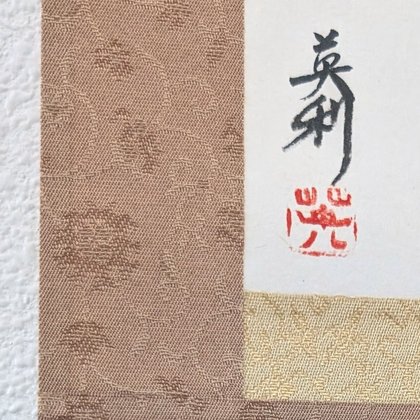
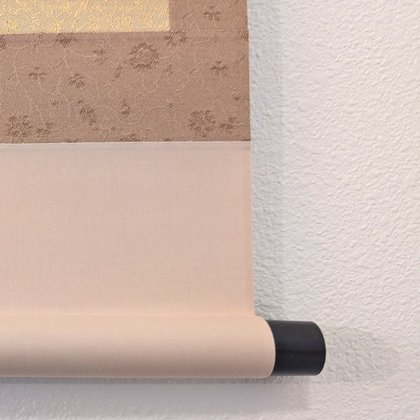
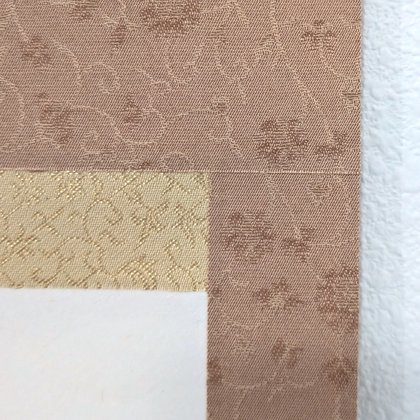
The scrolls are 12 1/4" W × 43" H (31 × 109 cm) with real silk borders and Japanese paper that are layered so the scroll hangs straight and will not warp over time. The scrolls themselves are made by Sankō (株式会社三幸) in Gifu prefecture, which has been making high quality scrolls since 1947, and we have worked with Sankō for over two decades.
Eri Takase was born and raised in Osaka, Japan, and holds the rank of Shihan, the highest rank in Japanese calligraphy, from the Bokuteki-kai and the Bunka-shodo. About Master Takase


