


Block · kaisho 楷書 · OB3A
Block or kaisho (楷書) styles are the most common and recognizable styles. Block styles are easily read and are noted for their angular form and their vertical and horizontal lines.
合氣道
aikidō
Aikido
Aikido, the way of harmony with spirit.
Master Takase creates this beautiful scroll when your order is placed, personally preparing the ink and brushing your art, which proudly bears her signature and seal. This is an original work of art.
Description
Aikido in Japanese is 合氣道 which is read aikidō
合氣道 (aikidō): the way of harmony with spirit, the name Ueshiba Morihei gave his art.
The name is two words. 合気 (aiki) is the joining of ki, and 道 (dō) is the way. It is the suffix by which a Japanese art declares itself a path rather than a set of techniques, as 柔道 and 剣道 do. The dictionaries define aikido by its descent from the Daitō-ryū and by its pins and throws. The art's own books define it as harmony with ki, the founder's sense of aiki. The two do not conflict: one says what the art is, the other what he meant by calling it that.
Aiki carries three senses, in order of age. The oldest is the deadlock of two matched fighters, which the Edo sword schools taught a swordsman to break. The next is the Meiji technique of seizing an opponent's ki before the swords cross. The youngest is Ueshiba's joining of one's own ki with the ki of the universe. A reader who takes the word for harmony alone has the youngest of them.
Nine of the ten designs write 合氣道 with the older form of the character ki. The Aikikai's own newspaper has carried that form in its title since 1959. The tenth design writes the modern form, 気; they are one word.
合氣道 is composed of the kanji 合 (read ai) meaning "join; meet", 氣 (read ki) meaning "air, breath, spirit", and 道 (read dō) meaning "the way".
Ueshiba Morihei's art was officially recognized under the name 合気道 in February 1942, on his son's account, when it entered the Dai-Nippon Butokukai after twenty years under other names, among them aiki-jūjutsu, aiki-jutsu and aiki-budō; the son also says some people were calling the art aikido by 1930, and the word aiki itself is older than the art and was not his.
We want you to be as happy with the meaning as you are with Master Takase's art. To learn more, visit Philology of 合氣道.
Delivery
Your scroll is brushed when you order it and completed within 1 to 3 business days. It ships by USPS Priority Mail from Master Takase's studio in Washington State, boxed and ready to hang, with a printed page giving the art's English, romaji and Japanese.
Sending it as a gift? Add your message at checkout and we will include it.
Shipping is calculated at checkout from your address; within the United States it is $13 to $23. We ship worldwide, and any import charges for your country are shown at checkout before you pay.
Every order is covered by our 30-day money-back guarantee. If your scroll arrives damaged, or we made an error, we replace it or refund you in full, including shipping. Refund policy
About Our Scrolls
Master Japanese Calligrapher Eri Takase brushes your scroll by hand when you order it. Each scroll bears her red seal, 英利, and her signature.
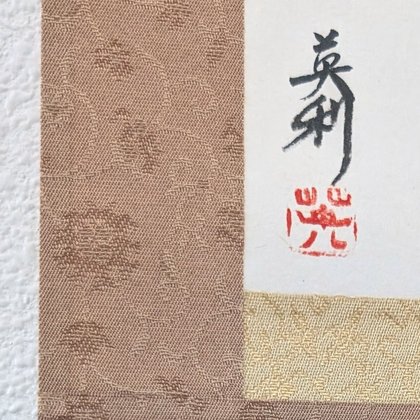
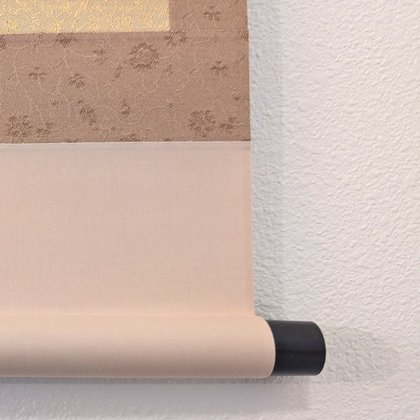
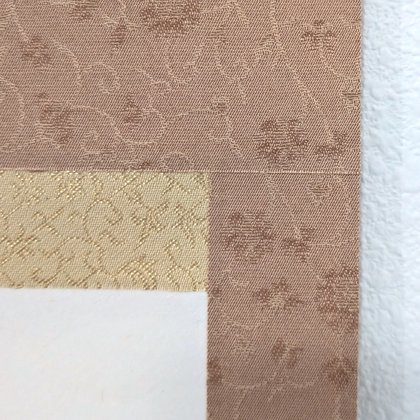
The scrolls are 12 1/4" W × 43" H (31 × 109 cm), with woven damask borders and layered Japanese paper, designed to last generations. The scrolls themselves are made by a scroll maker in Gifu, Japan, and we have worked with them for over two decades.
Eri Takase was born and raised in Osaka, Japan, and holds the rank of Shihan, the highest rank in Japanese calligraphy, from the Bokuteki-kai and the Bunka-shodo. About Master Takase


