



Font Design · VD5J
Font Designs are Master Takase's unique designs. Often she will use her own style or a combination of fonts and, without a classification limit, create exactly the look she wants.
菜の花や
月は東に
日は西に
na no hana ya
tsuki wa higashi ni
hi wa nishi ni
buson 蕪村
Rapeseed flowers:
the moon in the east,
the sun in the west
Rapeseed flowers: the moon in the east, the sun in the west.
Master Takase creates this beautiful scroll when your order is placed. Personally preparing the ink and brushing your art that proudly bears her signature and seal. This is an original work of art.
Description
菜の花や月は東に日は西に (na no hana ya tsuki wa higashi ni hi wa nishi ni): rapeseed flowers: the moon in the east, the sun in the west.
Yosa Buson was a poet and a painter. 菜の花 is the flower of the rape plant, grown for its oil, and a word of spring. The verse gives the moon and the sun their places with no verb. So it does not say whether the moon is rising or the sun is setting.
By the date in the diary, the moon on the day of the session was about twenty-two days old and rose near midnight. So no moon stood in the east at sunset, as Yamashita Kazumi noted in 1982.
Kitō wrote the third verse at the session. Twelve years later he set the scene at about four in the afternoon on a long spring day. In his reading, a moon of about the tenth day was already up, and rapeseed was in flower all around.
In 1904 Satō Kōroku granted that the moon in the east while the sun is still in the west is nothing remarkable. He read the verse as the abstract beauty of a spring scene rather than a sketch of a sight. Later readers have given the moon four different ages, and the verse names none.
Shizuo Kasai put the verse into Spanish in a Santiago newspaper in 1928, and Miyamori Asatarō into English in 1932. R. H. Blyth in 1949 and Harold Henderson in 1958 put the sun before the moon in their English verses, against the Japanese order.
Yosa Buson (1716–1784). Composed as the opening verse (hokku) of a linked-verse session with 樗良 and 几董 on the 23rd day of the third month of 安永3, 3 May 1774, as 几董's diary records it; printed in 1776 in 『続明烏』, edited by 几董, and collected in 1784 in 『蕪村句集』 under the heading 春景, spring scene.
We want you to be as happy with the meaning as you are with Master Takase's art. To learn more, visit Philology of 菜の花や月は東に日は西に.
Delivery
Your scroll is brushed when you order it and completed within 1 to 3 business days. It ships by USPS Priority Mail from Master Takase's studio in Washington State, boxed and ready to hang, with a printed page giving the art's English, romaji and Japanese.
Sending it as a gift? Add your message at checkout and we will include it.
Shipping is calculated at checkout from your address; within the United States it is $13 to $23. We ship worldwide, and any import charges for your country are shown at checkout before you pay.
Every order is covered by our 30-day money-back guarantee. If your scroll arrives damaged, or we made an error, we replace it or refund you in full, including shipping. Refund policy
About Our Scrolls
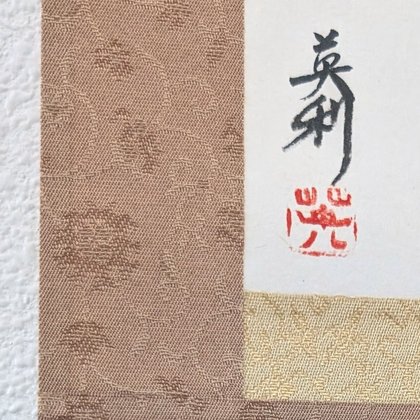
Master Japanese Calligrapher Eri Takase brushes your scroll by hand when you order it. Each scroll bears her red seal, 英利, and her signature.
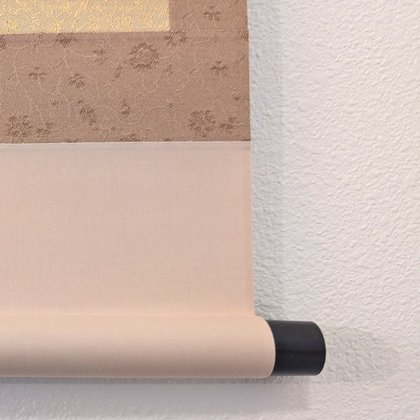
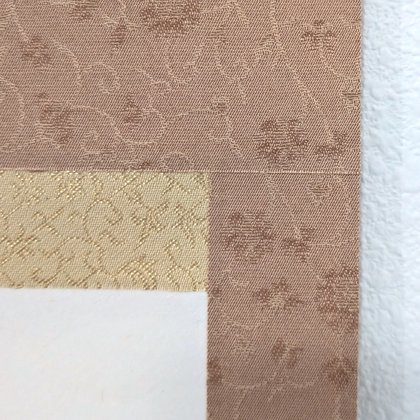
The scrolls are 12 1/4" W × 43" H (31 × 109 cm) with woven damask borders and Japanese paper that are layered so the scroll hangs straight and will not warp over time. The scrolls themselves are made by a scroll maker in Gifu, Japan, and we have worked with them for over two decades.
Eri Takase was born and raised in Osaka, Japan, and holds the rank of Shihan, the highest rank in Japanese calligraphy, from the Bokuteki-kai and the Bunka-shodo. About Master Takase
Related products

Bashō - A rough sea: lying toward Sado, the Milky Way荒海や佐渡によこたふ天河araumi ya sado ni yokotau amanogawa

Bashō - As the temple bell fades, The ringing lingers in the blossom scent, Evening鐘消えて花の香は撞く夕べ哉kane kiete hana no ka wa tsuku yūbe kana

Bashō - Gathering the early-summer rains, swift: the Mogami River五月雨をあつめて早し最上川samidare o atsumete hayashi mogamigawa
