

和敬清寂 · wakei seijaku · Harmony, respect, purity, tranquility
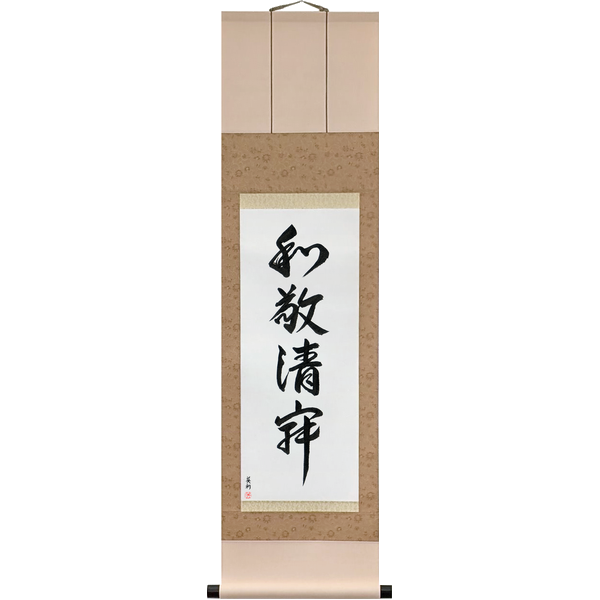
Sold as Four Virtues of Tea · Read wakei seijaku · Oldest witness the 茶祖伝, a life of the founders of tea with a preface of 1699, printed in 1730, which gives the four to 千利休 as his rewording of four exclamations of 村田珠光 · Sense the four virtues of the tea gathering, harmony and respect between host and guest, purity and stillness in the room; attributed to 利休 since 1699, and carried in that form by every tea house since.
The words
Four characters, four virtues: 和 harmony, 敬 respect, 清 purity, 寂 tranquility, the last the stillness of a quiet place and the word that also names wabi's beauty of the plain and the worn. The catalogue's four English words are right, and they are Urasenke's. The dictionaries read them in two pairs: 和敬, the frame of mind between host and guest, and 清寂, the frame of mind toward the garden, the room and the utensils. 和敬 alone is a Buddhist word, first cited from 道元's monastic rule in the thirteenth century, the beginner and the late learner, in harmony and respect, follow along. The oldest text that sets the four together does not write them as one word but as four abilities, 能和能敬能清能寂, to be able to be harmonious, respectful, pure, still; the four-character word is the Japanese abridgement, in print by the 1820s. There is a variant, 和敬静寂, with stillness twice, that appears in Meiji and was rejected in 1905 by a tea master on the ground that a virtue cannot be listed twice; Eri brushes the older and correct 清. And there is the form the legend gives to 珠光, 謹敬清寂, with reverence in place of harmony, which is the change the whole story turns on.
A history, from the earliest witness
1699, printed 1730, 巨妙子, the 茶祖伝, read at the 1730 print and at a manuscript copy in the National Diet Library. The formula's first appearance in any text is the last sentence of a short biography of 利休 in a life of the founders of tea, whose preface is signed in 1699 by 巨妙子, the Daitokuji abbot 大心義統, and which reached print in 1730 as an old book added at the end of a Kyoto cookbook. 今茶之道四焉、能和能敬能清能寂、是利休因茶祖珠光答東山源公文所云: the way of tea today has four: to be harmonious, to be respectful, to be pure, to be still; this is what 利休 set down on the ground of the founder 珠光's answer to Lord 足利義政. The answer it means is told earlier in the same book. The shogun asks 珠光 what tea is, and 珠光 says the one taste of purity, the joy of the dharma, the delight of meditation; the shogun objects that a warrior may not bring his sword into the tea room and is left without his guard; 珠光 laughs and says the lord argues the branch and not the root, 其入此室者外離我人之相、内条和之徳、至交接相見之間、謹兮敬兮清兮寂兮、卒及天下泰平、何足言也, one who enters this room leaves outside the distinction of self and other and keeps within the virtue of gentleness, and when host and guest meet, reverence! respect! purity! stillness!, and from that the peace of the realm follows; what more is there to say? So the book's own account is that 珠光 said four things beginning with reverence, and 利休 made them four beginning with harmony. Both sentences are the abbot's, written a hundred and eight years after 利休's death; no text of 利休's, of 珠光's, or of anyone before 1699 carries either. [2][4]
1801, 八文舎自笑, 役者大功記, a book about kabuki actors, read at the scan. The formula has left the tea room: a comic sketch of a tea bore quotes the four maxims of tea, 能和能敬能清能寂, sets beside them 西行's poem on the loneliness of a grass hut, and says 利休 held them as the essence of the way of tea. [5]
The 1820s, 深田正韶, 喫茶余録, a tea miscellany from Owari, read at the scan. The 珠光 dialogue retold in Japanese, and now with the four-character word in 珠光's own mouth: 夫この室に入る者は外には人我の相を離れ内には柔和の徳を … 応接相見の際に至りては和敬清寂を本として末は天下泰平にいたらむ事いふもさらなり, one who enters this room leaves outside the distinction of self and other and keeps within the virtue of gentleness, and when host and guest meet, with 和敬清寂 as the root, the peace of the realm follows as the branch, as goes without saying. The legend is already being told with the later wording. [6]
1851, 緑亭川柳, 祥瑞白菊物語, the preface to a popular novel. In its intent there is no gap between high and low; it does not abandon the four characters 和敬清寂: the phrase as a commonplace a novelist can use for his own art. [7]
1893 and 1905, the two spellings. The Meiji tea writers spell it two ways. 高畠米護 (1893) derives the stillness form, 和敬静寂, from two of the famous three autumn evenings poems, 定家's and 寂蓮's, the character 静 is said to be explained by these poems. 田中仙樵 (1905), the founder of the 大日本茶道学会, will have none of it: 利休居士、始めて茶道は和敬清寂にありと謂ひしより、苟も茶道に入る者、皆口に此語を稱へて金言と爲す … 世に和敬清寂の文字を、和敬靜寂と書す者あれ共誤なり … 靜と寂とは殆と其意を同ふし, since 利休 first said the way of tea lies in 和敬清寂, everyone who enters the way recites it as a golden saying, and few know what it holds; there are those who write it 和敬静寂, and they are wrong, because 静 and 寂 mean nearly the same and the four are four separate meanings. The library's index bears him out on usage and not on chronology: the stillness form is in thirty-two books before 1945 against thirteen for the purity form, and none of the thirty-two is earlier than 1893. [8]
1922 to 1937, the tea houses and the legend finished. The 武者小路千家's rulebook, the 官休清規 (1922), sets the four in its preface among the disciplines of the heart. 横光利一's novel 紋章 (1934) has a character reason from 利休's saying that the essence of the tea method is 和敬清寂, and that sentence is the 日本国語大辞典's first citation for the phrase, which no dictionary entered before the 広辞林 of the same year. A 千家 manual of 1937 gives the legend in its finished form: 珠光 hung the four characters 和敬清寂 at the entrance of his four-and-a-half-mat room. [10][11][12]
Today. 大辞泉: a term used to express the spirit of the way of tea; 和敬 the frame of mind between host and guest, 清寂 the frame of mind toward garden, room and utensils. The two historians of tea who write the encyclopedia entries agree on what the record shows. 筒井紘一: the phrase is handed down as the four rules of 利休's "four rules and seven principles," but in fact is not an expression 利休 made; it belongs to the return to 利休 that was called for around his hundredth memorial in the 元禄 years, and its first appearance is the 茶祖伝. 熊倉功夫: the attribution to 珠光 rests on mid-Edo tea books and is probably no more than legend; rather, the Buddhist words 和敬 and 静(清)寂 were transferred, and the phrase came into wide use from the early Edo period. An older story, that the four come from a Chinese Rules of the Tea Hall by one 劉元甫 brought home by a Zen master in the thirteenth century, is still in two dictionaries; neither historian repeats it and no such text was found. [kotobank, whole entries.]
The sense across time
One sense throughout, and one story about who said it first. The four virtues have meant the same thing since 1699: how host and guest are to be with each other, and how the room is to be. What changed is the frame. In the 茶祖伝 they are the root from which the peace of the realm grows, an answer to a shogun's worry about swords; in the Meiji tea schools they are the golden saying every beginner recites; in the modern dictionaries they are the spirit of the way of tea in four words. The attribution to 利休 has been constant since the first text, and the historians' finding that it is a 元禄 tradition has not changed what the tea houses say.
What is not a source
No text of 利休's or 珠光's carries the four; the 南方録 and 珠光's letter were not opened here and the historians say they do not. The Chinese Rules of the Tea Hall named by two dictionaries was not found. The three autumn evenings poems are a Meiji gloss on the wrong spelling. Okakura's Book of Tea (1906) has purity and harmony and not the formula. And 一期一会, which the modern writers set beside it, has its own history, told in this Library.
The text in English
No Meiji dictionary opened enters it. 1933, A. L. Sadler, Cha-no-yu: The Japanese Tea Ceremony, Kobe and London; read in the Tuttle reprint of 1962. Wa Kei Sei Jaku 和敬清寂 was adapted by Rikyu from the Kin Kei Sei Jaku of Shuko. Kin 謹 means Respect, Jap., Tsutsushimu …: the 茶祖伝's story in English, the earliest found. [snippet.] 1960, The Oriental Economist. A painter's title glossed Peace, respect, purity and silence. [snippet.] 1964 and 1973, The East. As described by Rikyu as Wakei-Seijaku, meaning "peacefulness and mutual respect …"; to calm one's mind, respect each other …. [snippets.] 1967, Sen Sōshitsu, The Art of Taking Tea, Tanko Shin-Sha, and 1979, Tea Life, Tea Mind, Weatherhill, ISBN 9784473031204. The principles of chanoyu, which are Harmony, Respect, Purity, and Tranquility. The grand master of Urasenke's four English words, which are the house's and nearly every later book's. [snippets.] 1968, Joseph Goedertier, A Dictionary of Japanese History, Walker/Weatherhill. Summarized in "tranquil respect and serenity" (wakei-seijaku). [snippet.] 1991, Jennifer Anderson, An Introduction to Japanese Tea Ritual, SUNY, ISBN 0791407497. Shukō's normative mnemonic "Kin Kei Sei Jaku" (reverence, respect, purity, and tranquillity). [snippet.] 1998, Sen Sōshitsu XV, The Japanese Way of Tea, University of Hawai'i Press, ISBN 0824818970. Murata Jukō's "Kin Kei Sei Jaku" (Humility, Respect, Purity, and Tranquillity). [snippet.] 2007, Laura C. Martin, Tea: The Drink That Changed the World, Tuttle, ISBN 9780804837248. Principles set forth by Rikyu: harmony, respect, purity, and tranquility. [snippet.]
Today. The English is settled and is Urasenke's: harmony, respect, purity, tranquility, in that order, and the house's title uses it; Sen Sōshitsu XV's credit stands for the four words. The only choice a translator has is the fourth, tranquility or stillness, and the second in the 珠光 form, reverence or humility for 謹. A rendering must keep four separate virtues and must not let the third and fourth collapse into one, which is the 1905 argument in English.
A reading
The scroll is right and the page's attribution is the tradition's, and the tradition is what should be said. The four characters are first in print in 1730, in a Zen abbot's preface of 1699 that gives them to 利休 as his rewording of four exclamations of 珠光 in a conversation with a shogun about swords; no text of 利休's or 珠光's carries either set, and the two historians who have looked hardest call the 珠光 story legend and the 利休 formula a 元禄 invention. That is not a loss for the scroll. It is the history of how a tea tradition came to name its virtues, and it can be told to a buyer in two sentences: the four were fixed in this form around 1700 and given to 利休 in the telling; the tea houses have kept them ever since, and Urasenke's grand master gave them the English words on this page. Two smaller things are worth a line: the stillness spelling is a Meiji variant a Meiji master rejected, so Eri's 清 is the right character; and the four begin with harmony because the 茶祖伝 put it there in place of 珠光's reverence, which is the change the whole story is about. No change to the design, the reading or the title. The page's as described by the 16th century Tea Master Sen Rikyuu should become attributed to Sen Rikyū since 1699, or words 照 prefers.
How this was read
By OCR at the National Diet Library's next-generation digital library, the scan number part of each address: the 1730 print of the 茶祖伝 appended to the 料理網目調味抄 (pid 2557798, scans 9–13 and 19); the manuscript 茶祖珠光傳 (pid 2538364, scans 3–5 and 9); the 役者大功記 (pid 2567098, scan 14); the 喫茶余録 (pid 2567773, scan 15); the 祥瑞白菊物語 (pid 9893735, scan 5); the 紀堂茶話 (pid 889003, scan 14); the 茶禅一味 (pid 823364, scan 106); the 千家草庵茶の湯の秘法 (pid 1113772, scan 13); the 井伊大老 (pid 1875095, scan 161). A leaf named as pid P, scan N has its text at lab.ndl.go.jp/dl/api/page/P_N and its image at dl.ndl.go.jp/api/iiif/P/R<N as seven digits>/full/full/0/default.jpg; the pre-1868 books answer a signed address only with -L. From the index alone, scan not derived: the 官休清規 (1922), the 広辞林 (1934), 横光's 紋章 in the 1936 collected edition, the 茶禅 of 1935. As text: kotobank's five entries on the phrase and two on 和敬, whole; the library's full-text index on fourteen spellings, every hit titled; the Internet Archive's index on the romaji and four English renderings, snippets only, the books dated from their scan records. By eye: the scroll template. Not opened: the 南方録; 珠光's 心の文; the 禅茶録; the Rules of the Tea Hall two dictionaries name; Sadler's 1933 first edition; 井伊直弼's poem on the four; the English tea books at the page.
References
- The design (ours) (—) — template O6004SSVB3A, by eye; cultural_works 710; whole_designs.csv:207
- 巨妙子 (大心義統)『茶祖伝』, the 利休 entry, in the 1730 print (preface 1699; printed 享保15 (1730) as 追加古書 to a cookbook) — NDL pid 2557798 scan 19, OCR; image R0000019 ↩
- the same, in the manuscript 『茶祖珠光傳』 (undated copy) — pid 2538364 scan 9, OCR
- the 珠光 dialogue, in the manuscript (as above) — pid 2538364 scans 3–4, OCR; the 1730 print carries the same dialogue at scans 10–13 with kunten ↩
- 八文舎自笑『役者大功記』 (寛政13 (1801)) — pid 2567098 scan 14, OCR ↩
- 深田正韶『喫茶余録』 (文政 (1818–30)) — pid 2567773 scan 15, OCR ↩
- 緑亭川柳『祥瑞白菊物語』二, the preface (嘉永4 (1851)) — pid 9893735 scan 5, OCR ↩
- 高畠米護『紀堂茶話』 (1893) — pid 889003 scan 14, OCR ↩
- 田中仙樵『茶禅一味』 (1905) — pid 823364 scan 106, OCR
- 『官休清規』5上 (武者小路千家) (1922) — pid 1241229, highlight ↩
- 横光利一『紋章』 (1934 (read in the 1936 全集)) — pid 1218966, highlight; the 日国's 初出 ↩
- 一箒庵宗心『千家草庵茶の湯の秘法』 (1937) — pid 1113772 scan 13, OCR ↩
- 中村勝麻呂『井伊大老』 (undated (Shōwa)) — pid 1875095 scan 161, OCR
- kotobank, 和敬清寂 (current) — https://kotobank.jp/word/和敬清寂-154004, whole entries
- kotobank, 和敬 (current) — https://kotobank.jp/word/和敬
- The NDL Lab full-text index, pre-1945 (1730–1944) — `labsearch_*.json`
- A. L. Sadler, *Cha-no-yu: The Japanese Tea Ceremony*, Kobe and London 1933 (read in the Tuttle reprint of 1962) (1933) — archive.org `chanoyujapaneset0000sadl`, snippet; the earliest English found
- *The Oriental Economist* (1960) — `tokyo-business-today_1960-10_28_600_0`, snippet
- *The East* (1964 · 1973) — `sim_east_1964_1_2` · `sim_east_1973-10_9_9`, snippets
- Sen Sōshitsu, *The Art of Taking Tea*, Tanko Shin-Sha · *Tea Life, Tea Mind*, Weatherhill (1967 · 1979 (ISBN 9784473031204)) — `artoftakingtea0000sens` · `tealifeteamind00sens`, snippets; the house's four words
- Joseph Goedertier, *A Dictionary of Japanese History*, Walker/Weatherhill (1968) — `dictionaryofjapa0000goed`, snippet
- Jennifer Anderson, *An Introduction to Japanese Tea Ritual*, SUNY (1991 (ISBN 0791407497)) — `introductiontoja0000ande`, snippet
- Sen Sōshitsu XV, *The Japanese Way of Tea*, University of Hawai'i (1998 (ISBN 0824818970)) — `japanesewayoftea0000sens`, snippet
- *Japan Echo* · Laura Martin, *Tea: The Drink That Changed the World*, Tuttle (2006 · 2007 (ISBN 9780804837248)) — `japan-echo_2006-04_32_2` · `teadrinkthatchan0000mart`, snippets
- Okakura, *The Book of Tea* (1906) — `bookoftea00okak`, snippet
- The house (2026) — the live page