

了了知 · ryōryōchi · Knowing clearly, clearly
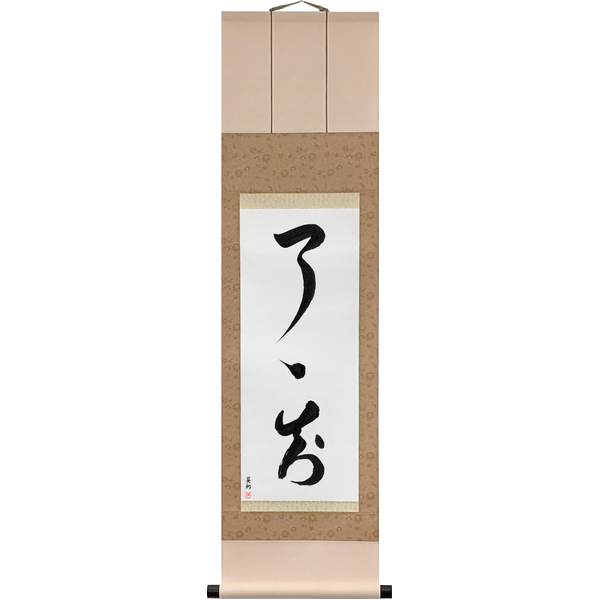
Sold as Complete Understanding · Read ryōryōchi · Oldest witness Buddhist Chinese of the fifth century and a Tang poem of 寒山's; as a Zen line, 無学祖元's verse for 北条時宗 at his tonsure in 1284, whose first six characters are 了了知了了見 · Sense to know with clarity and nothing left over; not a coinage of the eighteenth century, whatever the page says.
The words
Three characters. 了了 is a doubled adverb, clearly, distinctly, resolved, in Chinese from the third century and in Japanese from the 栄花物語, where a woman sees the Buddha and hears the law, clearly and distinctly; 知 is to know. The Zen records write the doubling as 了了 or 了々 without distinction, and Eri writes the two characters in full, as the 1922 collected edition does. The three characters are not a term of art. They are the plain Buddhist Chinese for knowing without residue, and they head a family: 了了常知, knowing clearly and always, which is what the Second Patriarch said to 達磨; 了了見, seeing clearly, which is the 証道歌's; 了了分明, clear and distinct, the commonest of all in the canon; and 了了知了了見, knowing clearly, seeing clearly, the six-character line the founder of 円覚寺 used twice, from which the design takes its first half. The page's alternative, Finally, Finally, Understanding, reads 了 as to finish, which it also means, but no witness reads the doubled word that way. Complete Understanding is a fair gloss.
A history, from the earliest witness
The fifth century, the 大智度論 as the Japanese commentators quote it, and the twelfth, the 翻譯名義集, read in a 寛永 print. The Buddha-eye, says the great commentary on the Perfection of Wisdom, is knowing every dharma clearly, as present before one, 佛眼名一切法現前了了知; and the Song dictionary of Buddhist terms explains the name Buddha by the same three characters: 菩提樹下了了知故名佛, because beneath the bodhi tree he knew clearly, he is called the Awakened. [4]
The Tang, 寒山, a poem, read at the 全唐詩 and in a print of 1618. The hermit poet of 天台 remembers walking back to 国清寺 after twenty years and being called a fool by everyone in it: 我尚自不識,是伊爭得知。低頭不用問,問得復何為。有人來罵我,分明了了知。雖然不應對,卻是得便宜, I do not even know myself; how should they know me? I bow my head and do not ask; what would asking gain? When someone comes to curse me, I know it clearly, distinctly; though I make no answer, I come out ahead. The three characters as ordinary speech, in the mouth of the poet every Zen monk read. [2]
1004, the 景徳伝灯録, and the early eighth century, the 証道歌, read at CBETA. The two halves of the Zen line. 達磨 asks 慧可 how he can tell that his stilled mind is not annihilation. 可曰。了了常知故。言之不可及。師曰。此是諸佛所傳心體。更勿疑也, "Because it knows, clearly and always; words cannot reach it." "This is the mind-essence all the Buddhas have transmitted. Doubt it no more." And 永嘉's song of enlightenment: 了了見無一物。亦無人亦無佛。大千沙界海中漚, seeing clearly there is not one thing, no person and no Buddha; the worlds of the great chiliocosm are foam on the sea. A thirteenth-century record adds the verb in a monk's mouth: 香嚴, watching his teacher wash his face after a dream, says 了了知得, I knew it clearly. [T51n2076_p0220a01–02; T48n2014_p0396c23–24; T47n2000_p1052a05; text.]
The 1280s, 無学祖元, the 佛光国師語録, book four, read in the 1922 collected edition and the 1930 annotated translation. The Chinese master whom 時宗 brought to Kamakura in 1279 joined the two halves and used the six characters twice. Once at a 上堂, where they open a spring poem: 了了知了了見、綠樹囀嬌鶯、畫梁鳴乳燕、五陵公子踏青行、卻把青羅扇遮面, knowing clearly, seeing clearly; in the green trees the warblers sing, in the painted beams the young swallows cry; the young lords of the five tombs walk out on the spring grass, and hide their faces behind fans of blue silk. And once, on the fourth day of the fourth month of 弘安 7 (1284), when the regent 北条時宗, in his last illness, took the tonsure from him with fifty-four of his household following the same day: 了了知了了見。生滅根源一刀截斷。斬新風月付兒孫。枝枝葉葉無邊春, knowing clearly, seeing clearly; the root of birth and death cut through with one stroke of the blade; wind and moon made new, left to your sons and grandsons; on every branch, on every leaf, a spring without end. 時宗 died that day. The founder of 円覚寺 gave the verse to the man who had built it for him, and its first line is the design. A 1930 annotator reads the line as the point at which knowing is seen as delusion and seeing is seen. [8][9][8]
1754–1817, 隠山惟琰, and the page. The catalogue says the phrase was coined by Zen Master Inzan Ien and that the designs are inspired by Inzan's original calligraphy. Inzan was a Rinzai master of 白隠's line, born in 越前, trained under 月船, abbot of 梅泉寺 in 美濃, founder of one of the two lines of modern Rinzai training; the National Diet Library's index has twenty-two notices of his life, none with the three characters; the Internet Archive has nothing; the dealers who sell his calligraphy list circles and other phrases. If a scroll of his with the three characters exists, he brushed a line five centuries old; he did not coin it. [the index; web searches.]
Today. No Japanese dictionary enters 了了知; kotobank has 了了 only, the state of things being clear, and the bilingual dictionaries nothing. The phrase lives in the Zen records and, as this scroll, on a wall. [kotobank; JMdict.]
The sense across time
One sense, in three registers. In the sutras, the Buddha's knowing, complete and present; in 寒山, a man's plain knowing that he is being cursed; in Zen, from 慧可's answer to 祖元's verse, the knowing that is not annihilation and not delusion, clear because there is nothing in it to be unclear about. The design's three characters carry all three, and the tonsure verse carries the last.
What is not a source
隠山惟琰 is not the source; nothing opened connects him to the phrase, and the phrase is centuries older than he. The Second Patriarch's 了了常知 and the 証道歌's 了了見 are the kin the Zen line joins, not the origin of the three characters, which are older than both. Finally, Finally, Understanding is a misreading, not a tradition.
The text in English
None found. The Internet Archive's full-text index has no book with the romaji, and the English histories that tell of 時宗's tonsure (Collcutt's Five Mountains, 1981; Zen Masters of Medieval Japan) do not render the verse in what was seen of them.
Today. The house's Complete Understanding is its own rendering, made for Takase Studios, and the only English of the phrase found. A rendering must keep the doubling as clarity, not as finishing, and knowing as a verb, not a noun; knowing clearly, clearly is the literal, and complete understanding a fair gloss.
A reading
The scroll is right and the page's story is wrong in the one way that matters: nobody coined these three characters in the eighteenth century. They are the Buddhist Chinese for knowing without residue, a Tang poet's words for knowing when he is being cursed, and the first half of a line that the founder of 円覚寺 used twice, once in a poem about spring and once in the verse he gave the regent 北条時宗 as he took the tonsure on the day he died. That verse is what a buyer should be told, in two sentences: knowing clearly, seeing clearly; the root of birth and death cut with one stroke, Kamakura, 1284. Whether 隠山 ever brushed the three characters I could not find out; if he did, the page may say as brushed by, never as coined by. No change to the design or the reading; the title stands as a gloss, and the Finally, Finally alternative should go.
How this was read
As text at CBETA's stable API, the Taishō column part of each address: the 景徳伝灯録 (T2076, fascicle 3), the 証道歌 (T2014), the 虚堂録 (T2000, fascicle 9); the 佛光国師語録 (T2549) returned no text for any fascicle on the day and was read instead in two Japanese typesets. As text at the Chinese Wikisource: 全唐詩 卷806 for 寒山. By OCR at the National Diet Library's next-generation digital library, the scan number part of each address: the 大日本仏教全書 95 (pid 952799, scan 128); the 国訳禅学大成 20 (pid 1120192, scan 103); the 禅宗編年史 (pid 1230682, scan 173); the 増註証道歌直截 (pid 823279, scan 40); the 翻譯名義集 (pid 2544443, scan 10); the 三教妙述 (pid 2580806, scan 8); the 1664 佛光録 (pids 2559746, 2559747) for the neighboring 時宗 pieces, the verse itself not located there. A leaf named as pid P, scan N has its text at lab.ndl.go.jp/dl/api/page/P_N and its image at dl.ndl.go.jp/api/iiif/P/R<N as seven digits>/full/full/0/default.jpg. From the index alone, scan not derived: the 一乗要決 and 恵心僧都全集 quotations of the 大智度論, the 1926 国訳禅宗叢書, the 1945 children's book, the 1915 禅宗辞典 on Inzan. As text: kotobank's 了了, whole; JMdict through the gokanji database (nothing); the library's index on ten spellings; the Internet Archive's index on the romaji (nothing) and on the tonsure (three histories, snippets). By eye: the scroll template. Not opened: the 佛光録 at CBETA or at the 1664 leaf for the verse; the 大智度論 at its column; any record or scroll of 隠山's with the phrase; the annotator's note whole; the English histories at the page.
References
- The design (ours) (—) — template Z2023SSVB2A, by eye; cultural_works 1082; whole_designs.csv:98
- 寒山, a poem (Tang (7th–9th c.)) — zh.wikisource 全唐詩/卷806, TEXT; 李贄『三教妙述』1618 (pid 2580806 scan 8, OCR: 有人來駕我分明了了知雖然不應對却是得便宜) ↩
- 大智度論, the Buddha-eye, as quoted ((Kumārajīva's translation, 405) quoted by 恵心 (10th c.) and in 性霊集講義 (1942)) — 大日本仏教全書 32 (pid 952712) and 恵心僧都全集 5 (pid 1240747), highlights; the column in T1509 not opened
- 法雲『翻譯名義集』, on 佛 (Song (1143); read in a 寛永 print) — pid 2544443 scan 10, OCR ↩
- 景徳伝灯録 卷三, 慧可 and 達磨 (1004) — CBETA T51n2076_p0220a01–02, TEXT
- 永嘉玄覚『証道歌』 (early 8th c.) — CBETA T48n2014_p0396c22–24, TEXT; the 1881 Japanese commentary 増註証道歌直截 (pid 823279 scan 40, OCR) glosses 了了見
- 虚堂和尚語録 卷九, the 潙山 dream (13th c. (虚堂智愚, 1185–1269)) — CBETA T47n2000_p1052a05, TEXT
- 無学祖元『佛光国師語録』卷四, the tonsure of 北条時宗 (弘安7 (1284), 4th month, 4th day; read in the 1922 typeset) — 大日本仏教全書 95, pid 952799 scan 128, OCR; the date in 禅宗編年史 1937 (pid 1230682 scan 173: 四月四日北條時宗落飾す、法名道果 … 一門近習のもの五十四人出家す); the verse in kundoku in 楠山正雄 1945 (pid 1168322, highlight: 了了に知り了了に見て、生滅の根源を一刀に裁斷す …) ↩
- the same, the 上堂 (1279–86 (his years at 建長寺 and 円覚寺)) — 国訳禅学大成 20, pid 1120192 scan 103, OCR (the 上堂 immediately before the 佛涅槃上堂); also 国訳禅宗叢書 1926 (pid 959992), highlight ↩
- 『佛光録』, the 1664 print (寛文4 (1664)) — pids 2559746 scans 55 · 67, 2559747 scans 125 · 133, OCR; the tonsure verse not located
- kotobank, 了了 (current) — https://kotobank.jp/word/了了-659632, whole
- kotobank · JMdict, 了了知 (current) — probes; gokanji.db
- The NDL Lab full-text index, pre-1945 (1600s–1945) — `labsearch_*.json`
- 隠山惟琰 (1754–1817), the page's author (—) — highlights; web searches
- The house (2026) — the live page