

南無妙法蓮華経 · namu myōhō renge kyō · Devotion to the Lotus Sutra
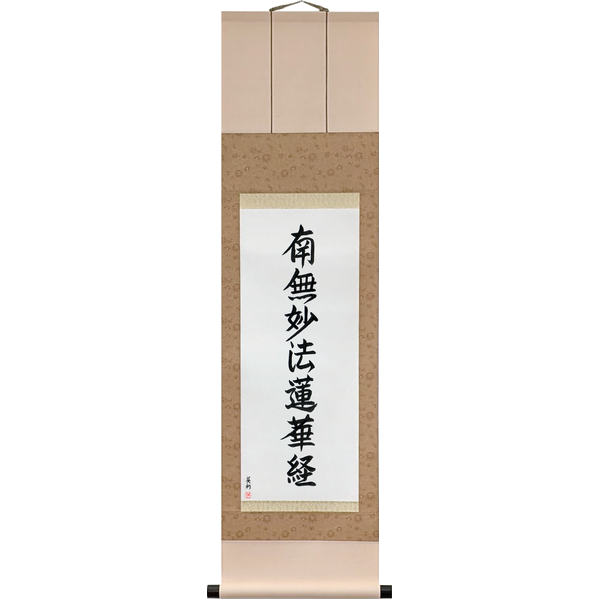
Sold as Nam Myoho Renge Kyo · Read namu myōhō renge kyō, seven characters, eleven syllables; Soka Gakkai writes Nam-myoho-renge-kyo, the second vowel swallowed in chant, and Nichiren Shu writes Namu Myoho Renge Kyo · Oldest witness a court poet's prayer for his dead father, 881, which closes with these seven characters · Sense one, and the dictionaries' word for it is 帰依: taking refuge in, devotion to, the Sutra of the Lotus of the Wonderful Law.
The words
南無 is namu, the Chinese spelling of Sanskrit namas, homage. The Japanese dictionaries translate it 敬礼 and 帰命, reverence and taking refuge; Hepburn's dictionary of 1886 rendered it I adore thee; Nichiren Shu says adoration and Soka Gakkai to devote or dedicate oneself. 妙法蓮華経 is Myōhō Renge Kyō, the title Kumārajīva gave the Lotus Sutra when he translated it into Chinese in 406: the Sutra of the Lotus of the Wonderful Law. The English has called that law True (Kern, 1884), Good (Hearn, 1898), Perfect Truth (Anesaki, 1916) and Mystic (Soka Gakkai today). Together the seven characters are the 題目, daimoku, the title; the 言海 dictionary of 1889 defines the word as in the Nichiren school, the title of the Lotus Sutra, that is, the phrase 南無妙法蓮華経, called the seven-character title. In ordinary Japanese お題目 also means empty words, and a writer who uses odaimoku in English should know that.
A history, from the earliest witness
The seven characters are older than the school that made them famous. In the tenth month of 881 菅原道真, then a scholar of the Ministry of Ceremonial and not yet the god of learning, held a Lotus Sutra rite at 吉祥院 for his father, who had died the year before. The prayer he wrote for it survives in his collected works, the 菅家文草, and it ends, after the grief, with two lines of homage: 南無觀世音菩薩 南無妙法蓮華經 如所説, homage to Kannon, homage to the Sutra of the Lotus of the Wonderful Law, as the sutra says. A 1700 printing of the text was read for this history. That is the formula, used as a formula, three hundred and seventy-two years before Nichiren. Whether Heian monks already chanted it as a practice, as the Japanese Wikipedia says, no source read here shows.
Nichiren (1222–1282) is the reason anyone chants it now, and his own words on how it began are plainer than the legend's. In a letter of 1279 he wrote: on the twenty-eighth day of the fourth month of 1253, in the province of Awa, on the south side of the Buddha hall of Shobutsu-bō at Kiyosumi temple, at the hour of the horse, I began to declare this teaching; it is now twenty-seven years. An earlier letter to the monks of Kiyosumi gives the same day and place and names the audience, a priest called Jōen-bō and a few of the brethren. Neither letter quotes the seven characters at the founding; both say this teaching, and both say noon. The seven characters as the ordinary practice come seven years later, in the 唱法華題目抄 of 1260, written at Nagoe in Kamakura: let the ordinary practice be to chant the title as Namu Myōhō Renge Kyō, with a verse or a line read by those who can, and homage to Śākyamuni, Tahō and the assembly as the supporting practice. By 1275 he calls it the heart of the Lotus Sutra, and predicts it will spread through the world as the nenbutsu now sounds in every mouth in Japan. That sentence is the dictionary's earliest citation for the phrase.
After him the seven characters go everywhere the school goes. A fifteenth-century collection of tales has monks chanting it; a poem-debate on wine and rice has a Lotus believer end his speech with it; the chronicle of Oda Nobunaga says his nine battle banners carried it in the drawn-out whisker hand beside the coin-crested standard; Lafcadio Hearn, in 1894, saw it on temple charms and knew it as the text of Katō Kiyomasa's flag. The founding, meanwhile, became a story. A sightseers' guide to Kyoto printed in the seventeenth century says Nichiren first chanted the seven characters of Namu Myōhō Renge Kyō at thirty-two, on the twenty-eighth of the third month; a later miscellany says the twenty-first of the third month, aged twenty-two, facing the morning sun; Anesaki's English life of 1916 has him cry the seven characters at dawn, making the all-illumining sun his witness. The date, the age, the hour and the words move from telling to telling. Nichiren's own are the fourth month, noon, and this teaching.
The sense across time
One sense, held steadily for seven hundred years, and the commentators differ only in how much they load onto it. Nichiren in 1260 makes the chant the whole practice for the ordinary person, and elsewhere calls chanting it polishing the mirror of the mind. The Britannica entry puts the school's claim in a sentence: even the unlearned are saved by chanting these words alone. Anesaki insisted the formula was not a mere title but an adequate embodiment of the whole truth revealed in that unique book. The Japanese encyclopedia adds that only the Nichiren schools chant it, and that on Nichiren's own mandalas the seven characters are written with their strokes drawn out, the whisker daimoku, to show the title's light reaching all of creation.
What is not a source
The dawn. Every dawn proclamation traces to tellings later than Nichiren; his own letters say noon. The seven characters at the founding: likewise the tradition's, and a reasonable inference, but not in his two accounts. And Glory to the Sutra; Hail Lotus Sutra: the page's sentence is the gloss of one online dictionary, and no printed dictionary, Japanese or English, says glory; the nearest ancestor is Hearn's Hail to the Sutra of the Lotos of the Good Law of 1898. The lineage's own words are adoration and devotion.
The text in English
The chant reached English dictionaries early: Hepburn's second edition of 1872 already gives it as the sect's formula of prayer, the third of 1886 defines daimoku as the title of the prayer of the Nichi-ren sect, and Brinkley's of 1896 adds the verb daimoku wo tonau and the daimokukō, a fraternity of Nichiren's followers. Hearn wrote it three times in the 1890s, on a flag, on gravestones and on a girl's lips. Chamberlain's Things Japanese of 1905 quotes the physician Baelz watching devotees at Minobu repeat it for hours. Arthur Lloyd in 1911 called it the name carved on stone or painted on wood, which is found all over Japan. Since Anesaki's Nichiren, the Buddhist Prophet of 1916 the standard English has been Namu Myōhō Renge Kyō with adoration; since the postwar growth of Soka Gakkai a second standard, Nam-myoho-renge-kyo with devotion, is at least as common, and it is the form Tina Turner chanted from 1973 and the form most English readers have met. The two spellings are one chant; the difference is whether the u of namu is written or swallowed.
A reading
Signed 典, 2026-09-08. The seven characters on Eri's scroll are the most sacred text in this catalogue, and their page should say three things it does not. They are older than Nichiren: a grieving son wrote them in 881. Nichiren's own account of their founding is plainer than the legend, and better for it: a teaching declared at noon on a spring day in 1253, and the chant as the ordinary practice seven years later. And the English has never settled on one word, because 帰依 is both adoration and devotion; I would print Devotion to the Lotus Sutra, name both school spellings in one sentence, and say that a calligrapher's daimoku is a devotional hanging and not a Gohonzon, the inscribed mandala of the schools. Eri brushes the modern 経 where every witness before the war wrote 經; that is her ordinary practice and needs no defense. On a wall, for a practitioner, without question; on skin, a declaration of faith in a living religion, which the person choosing should know they are choosing.
How this was read
By eye: the template; Nichiren's letter of 1279 and the 唱法華題目抄 of 1260 in the 1904 collected writings; 道真's prayer in the 1700 printing of the 菅家文草; the 言海 of 1889 at 題目. By OCR: the letter to the Kiyosumi monks, the 信長記, the 洛陽名所集 (its seven characters confirmed by eye), a text in the 1904 edition ending 一生成仏の信心; the local harvest archive of 9,870 prewar books on both forms; the NDL Lab's search file of 3,704 hits by facet and decade. By text: the four dictionary blocks at kotobank and the six of the founding record; three letters at the 創価学会 text site; the two schools' English pages; Hepburn 1867, 1872 and 1886, Brinkley 1896, Hearn 1894, 1898 and 1899, Chamberlain 1905, Kern 1884, Lloyd 1911 and Anesaki 1916 on the shelf or at the Internet Archive; the English Wikipedia's raw text; a 2023 Tricycle article. Not opened: the 法華験記 and the 梁塵秘抄; the critical editions for the letters' dates; the page images of the 信長記 and the 洛陽名所集 beyond the seven characters; Hearn's Kokoro; Kenkyūsha 1991 and the Soka Gakkai dictionary that Wikipedia cites; the NDL Lab's index by year.
Supersession 2026-09-13 (s90)
The romaji case. The first draft wrote the chant's romaji with capitals in the romaji: field, the title line and the Read form above: Namu Myōhō Renge Kyō. All three now read namu myōhō renge kyō. Romaji never carries a capital (Tim, DECISION_LOG 2026-09-12; the rule's single home is docs/papers/romanization_handbook.md § 2). The forms quoted as other people's spellings are unchanged: the catalogue's Nam Myoho Renge Kyo under Sold as, Soka Gakkai's Nam-myoho-renge-kyo and Nichiren Shu's Namu Myoho Renge Kyo are what those bodies print, not romaji of mine. The store row is 礎's and was routed to her s88.
References
Each witness is cited in the account above, at the frame or entry where it was read. A linked list follows when the record for this text is completed.