

不知最親切 · fuchi mottomo shinsetsu · Not knowing is the closest of all
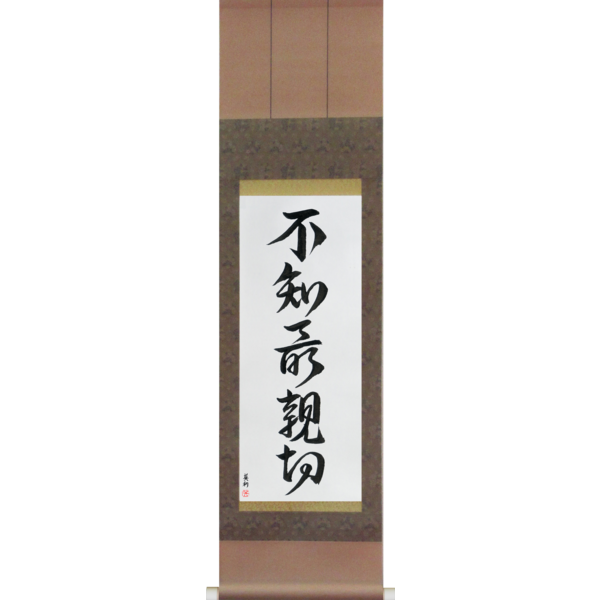
Sold as Not Knowing is Most Intimate · Read fuchi mottomo shinsetsu, the reading every Japanese Zen text gives the line; the page still prints fuchi sai shinsetsu, a spelled-out reading no witness gives · Oldest witness the 景德傳燈錄 of 1004, in the life of the master 法眼文益 · Sense a teacher's answer to a student who has just said he does not know where his pilgrimage is going: that not-knowing is the closest you can come. The master who built the koan around it warns that this is not ignorance.
The words
不知, fuchi, is not knowing. 精選版日本国語大辞典 gives three senses: 知らないこと, not to know; 知恵がないこと, to lack wisdom; and the Buddhist 無明, the ignorance that veils the truth. The whole koan turns on the first against the third, and the master who wrote it up says so. 最, mottomo, is most. 親切, shinsetsu, is the word that misleads. In Japanese today it means kind, considerate, and that sense is Muromachi Japanese, first attested in the 1470s; in a Song Chan text the word means close, intimate, right on the point, which 普及版字通 gives as ゆきとどき、よくあてはまる and the 精選版日国 as its first sense, 深くはなはだしいこと … 心の底からであること, deep and thorough, from the bottom of the heart, with an eighth-century attestation. The Japanese phrase book of 1889 glosses it with the kunten 親シ, shitashi, close. The page's note, this is the Chinese meaning, is right. [kotobank.jp/word/不知 and /親切, text]
Intimate, the English the page uses and Blyth chose in 1964, covers the Chinese sense of closeness without distance. It does not carry the other Chan shade, apt, exactly to the point, which the master's own interlinear comment plays on. Most intimate is a faithful rendering, not a complete one; no single English word covers both.
The reading. The catalogue's fuchi mottomo shinsetsu is the reading the Japanese Zen texts give the five-character line, with 最 read as the adverb mottomo: a 1915 commentary prints it so with furigana, ふち・もっとも・しんせつ. The page's fuchi sai shinsetsu spells out the on-reading of 最 as if the line were a compound, and no witness reads it that way. The four-character form in the phrase book, 不知最親, is read shirazu mottomo shitashi. The store now carries the ruled reading; the page's title and body still print the old one. [4]
A history, from the earliest witness
1004. 道原, 景德傳燈錄, book 24, the life of 清涼文益, called 法眼. The young monk 文益, on pilgrimage, shelters from rain at a temple in Fuzhou where the master 桂琛, called 地藏, is teaching. 琛問曰。上座何往。師曰。邐迤行脚去。曰行脚事作麼生。師曰不知。曰不知最親切。師豁然開悟, 琛 asked: where are you going, senior? He said: on pilgrimage, wandering as I go. What is this pilgrimage business? He said: I don't know. Not knowing is the closest of all. At that the master awoke. The exchange belongs to the biography of 法眼 (885–958), founder of one of the five houses of Chan, written some fifty years after his death; this is its oldest text. [cbdata.dila.edu.tw stable juans, work T2076 juan 24, T51n2076_p0398b10–12, text]
Twelfth century, written up 1224. 天童正覺's verse and 萬松行秀's 從容録, case 20, 地藏親切. 宏智正覺 (1091–1157) chose the exchange as one of his hundred cases and wrote a verse on it; 萬松行秀 wrote the 從容録 around the verses in 1224, with a preface, interlinear comments and two evaluations for each. The case: 舉。地藏問法眼。上座何往。眼云。迤邐行脚。藏云。行脚事作麼生。眼云。不知。藏云。不知最親切。眼豁然大悟, and between the lines 萬松's asides, at 不知最親切 the words 就身打劫, robbing him on his own body, which is to say the reply uses only what the student brought. His evaluation is the warning that the whole later tradition stands on: 南泉道。道不屬知。不屬不知。知是妄覺。不知是無記。今人見道不知最親切。更是法眼悟頭。便一向不知不會。只這是也。殊不知。古人一句子。如天普蓋。似地普擎, 南泉 said: the Way does not belong to knowing or to not-knowing; knowing is false awareness, not-knowing is blank indifference. People today see "not knowing is the closest of all" and that it was where 法眼 awoke, and go straight to not-knowing and not-understanding, saying: this is it. They do not realize that the old man's one sentence covers like the sky and bears up like the earth. And on the awakening itself: 法眼大悟元來這不知却親切, 法眼 awoke: so this not-knowing was the closest thing after all. The verse: 而今參飽似當時/脫盡簾纖到不知/任短任長休剪綴/隨高隨下自平治 …, now that I have studied to the full it is as it was then; shedding every last thread I arrive at not-knowing; let short be short and long be long, stop cutting and stitching; high or low, it levels itself. The not-knowing of the verse's second line is the one reached by shedding everything, not the one before setting out. The page says the koan was written in the 12th century by Hongzhi Zhengjue; 宏智 wrote the verses, the book with its warnings is 萬松's and thirteenth-century, and the exchange is older than both. [work T2004 juan 2, T48n2004_p0240a04–c08, text]
Thirteenth century. 紹曇, 五家正宗贊, the hymnal of the five houses, on 法眼. A different shape of the same story, and a shorter line. 入堂,見藏坐地爐,問師:此行何之?曰:行脚去。曰:行脚事作麼生?曰:不知。曰:不知最親 三人附火, he went into the hall and saw 地藏 sitting at the sunken hearth, who asked: where does this journey go? Pilgrimage. What is this pilgrimage business? I don't know. Not knowing is the closest. The three of them warmed themselves at the fire. Here the line is four characters, no awakening follows it, and the great awakening comes a month later at another sentence, 若論佛法,一切見成, if you speak of the Buddha's teaching, everything is already complete. This is the shape Blyth would tell in 1964. [work X1554 juan 4, X78n1554_p0619b04–19, text]
1889 and 1894. The 禪林句集, the phrase book of Japanese Zen, in two editions. Among the four-character phrases: 不知最親, with the kunten 不知ラ最モ親シ, shirazu mottomo shitashi, not knowing, closest of all, and a head note sending the reader to 正宗賛法眼章, the hymnal's chapter on 法眼. The Japanese phrase book took the four-character form, not the five; the design brushes the five, which is the koan's and the oldest. [5]
1906. 高田道見, 従容録講話, lectures on the koan collection. その不知こそ行脚に於て最も親切な所ではないか, is not that very not-knowing the closest thing there is in a pilgrimage?, and 就身打劫 glossed as 剝取て仕舞ふ, to strip him bare. The page links this book at its old address. [dl.ndl.go.jp/pid/823143 koma 176, OCR, where the layer reads 放も製切 for 最も親切]
1915. 神保如天, 従容録通解, a full commentary with the Japanese reading. The case printed with 萬松's asides in small type, then the reading: 藏云く、不知最も親切。眼、豁然として大悟す, with the furigana ふち・もっとも・しんせつ; then the gloss, 其の不知は最も親切である、行脚の事徹底不知ならば其れが最も參禪に親しい處、參學の事了畢矣, that not-knowing is the closest thing; if the pilgrimage is thoroughly not-known, that is the place closest to Zen study, and the work of study is finished; and on the verse, 如今は岐路鬼徑を盡く脫落して、眞實不知最も親切と云ふ境界に到達した, now, having shed every byway and ghost-path, he has arrived at the state where truly not-knowing is the closest of all. This is the witness for the reading fuchi mottomo shinsetsu. The page links this book too. [dl.ndl.go.jp/pid/943578 komas 94–96, pages 160–161, by eye at width 3600; lab.ndl.go.jp/dl/api/page/943578_95, text]
Today. The dictionaries quoted under The words; no dictionary heads the phrase itself. The National Diet Library's full-text search returns the five-character line in twenty-eight public-domain books and the Japanese reading 不知最も親切 in twenty-six, none opened beyond the two above. [lab.ndl.go.jp/dl/api/book/search, pulled 2026-09-03]
The sense across time
One exchange, two shapes, one warning. In the oldest text and in the koan collection, 法眼 awakens at the line; in the hymnal he warms his hands and awakens a month later at something else, and the line is four characters long. Every Japanese reader from 1224 on has had 萬松's caution in front of them: the not-knowing that is closest is not the not-knowing of a blank mind, and a reader who takes the line as just don't know has missed the awakening it records. The 1906 lecturer hears it as the pilgrim's own condition; the 1915 commentator hears the end of study; Blyth in 1964 hears a joke against philosophy. The phrase book cut it to four characters and read it as plain Japanese, not knowing, closest of all, which is the reading the design's romaji now carries.
What is not a source
The Song collections that also carry the exchange, the 五燈會元, 聯燈會要 and 宗門統要, were not opened; the oldest text is enough to date the story and the koan collection to fix its shape. The page's paraphrase, Then Jizo asked why, is in no witness: 行脚事作麼生 asks what is this pilgrimage business, and the I don't know answers that. The web page the design links for English translations was not opened. Neither American proverb collection on the shelf carries the line, which is right, since it is not a proverb.
The text in English
1964. R. H. Blyth, Zen and Zen Classics, volume 2, Hokuseido, pages 66–67, the chapter on 法眼. "Just on an angya, slanting about." "What is angya?" said Keichin. "I don't know," said Hogen. "Don't-know is the most intimate," said Keichin. Blyth tells the hymnal's shape, the fire, a stone in the garden, a month's stay, and ends At this, Hogen was profoundly enlightened; then, Buddhism, that is, Zen, is not philosophy, but it is not no-philosophy. His intimate is the word the page uses. [text layer; the layer carries no page markers, so the pages stand on the shelf's own pagination; a printed book, checkable by a reader who holds it]
1990. Thomas Cleary, Book of Serenity, and 2005, Gerry Shishin Wick, The Book of Equanimity, the two English translations of the koan collection. The page links Cleary's book and its title Not Knowing is Most Intimate is the wording that circulates from that generation of American Zen. Neither was opened; which of them the page's wording follows is not established here. [the page links amazon.com/dp/1590302494; not opened]
Today. The house title, Not Knowing is Most Intimate, renders the line faithfully in the Chinese sense of 親切. What a rendering must keep: intimate or close, never kind; not-knowing as the condition 法眼 was in, not a recommendation of ignorance; and the reading fuchi mottomo shinsetsu, which is now the store's and not yet the page's.
A reading
The text is sound as brushed: 不知最親切 is the canon's oldest wording and the koan collection's, and Not Knowing is Most Intimate renders it in the Chinese sense of the word. Three things on the page are not sound, and one of them has already moved. The dating and authorship conflate the twelfth-century verses with the thirteenth-century book and both with a tenth-century exchange. The romaji fuchi sai shinsetsu is a spelled-out reading no witness gives; the store now carries fuchi mottomo shinsetsu, and the page's title, body and address still carry the old form. And 萬松's warning belongs on the page, because it is the one thing a buyer of this line most needs and least expects: the master who wrote the book says outright that not knowing here is not blank indifference, and that a reader who takes the line as just don't know has missed 法眼's awakening.
My own reading is that the line is the gentlest koan in the collection and the easiest to get wrong, for the same reason. It was said to a young man who had just admitted he did not know what he was doing, and it told him that this was the nearest he had come. The design is right to brush it; the page should tell the buyer what the master said next. Signed, 典, 2026-09-05.
How this was read
By eye: the 1889 phrase book at the entry with its kunten, and the 1915 commentary at the case, the reading and the gloss, each at the National Diet Library's page image at width 3600 on the day of writing; the 1894 phrase book at the entry when the account was written. By text at the address: the 景德傳燈錄, the 從容録 case whole and the 五家正宗贊 chapter at the CBETA column; the kotobank entries for the two words; the library's page API for the three leaves; the OCR layer for the 1906 lectures; the live row and both live pages; the text layer of Blyth's book, which carries the words and no page markers; the three saved search returns. Every address in the earlier account was re-opened by a reader before writing and agreed with it. Not opened: the 五燈會元, 聯燈會要 and 宗門統要; the modern annotated phrase book and the Zen dictionary; Cleary and Wick at their pages; the 1906 lectures by eye; the twenty-eight books the search returns beyond the two read. The printed books check only for a reader who holds them. The account beneath this history carries every address, the raw OCR beside each reading, and the page-image addresses for the leaves read by eye.
References
- 景德傳燈錄 巻二十四, 清涼文益 chapter (道原) (1004) — T51n2076_p0398b10–12
- 從容録 巻二 第二十則 地藏親切 (天童正覺's 頌古, 12th c.; 萬松行秀's 評唱) (1224) — T48n2004_p0240a08–11
- 五家正宗贊 巻四, 清涼法眼禪師 (紹曇) (Song, 13th c.) — X78n1554_p0619b09–18
- 禪林句集 四言, 1889 頭書 edition (1889) — pid 899715 koma 29, by eye ↩
- 禪林句集 四言, 1894 首書 edition (1894) — pid 875204 koma 19, by eye ↩
- 從容録通解 (神保如天) (1915) — pid 943578 koma 95, by eye
- The design () — cultural_works 1080