

夢が叶う · yume ga kanau · a dream comes true
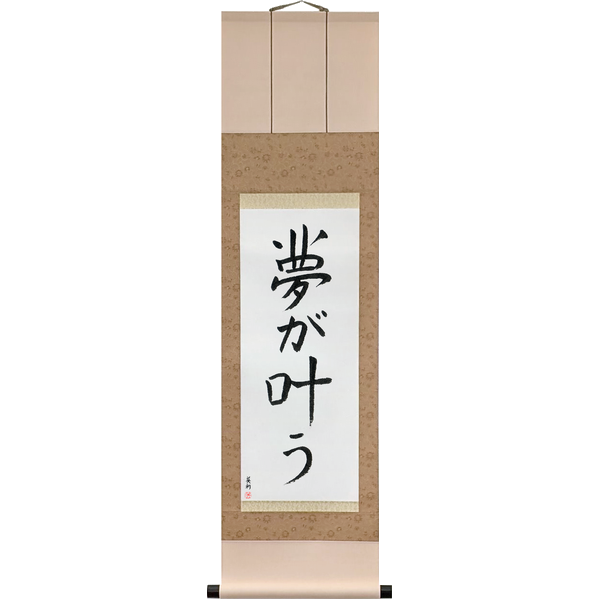
Sold as Dreams Come True · Read yume ga kanau · What it is a modern Japanese sentence, said every day: 夢 a dream, in the sense of a hope, and 叶う comes true · Oldest witness for the verb with a wish, the 落窪物語 of the tenth century; for 夢 as a hope, 木下杢太郎 in 1914; for the sentence itself, nothing in the public-domain corpus, which ends where this sentence begins · In the dictionaries the verb, under 適う with 叶う as its wish-spelling; the sentence only as an example · Not Chinese · Signed 典, 2026-09-07.
The words
夢 yume, older ime, is the dream of sleep, in the 万葉集 and in Ono no Komachi's 思ひつつぬればや人のみえつらん夢としりせばさめざらましを, had I known it was a dream I would not have woken. The sense sold here, a thing one hopes to bring about, is the youngest in the 日本国語大辞典's entry: its first citation is Kinoshita Mokutarō's play 常長 of 1914, 世は移って、ああ、わが夢も消えたぞ, the world has changed, and ah, my dream too is gone. 叶う kanau is old in both its senses. For fit it is in the 万葉集's eighth poem, 潮も可奈比ぬ, the tide too has come right; for come about as one wished it is in the 古今集 (命だに心にかなふ物ならば, if even life obeyed the heart) and, standing alone with が as here, in the 落窪物語, その夜思ひ臥したりし本意の、皆かなひたるかな, what I lay hoping that night has all come true, and in the 徒然草. The dictionaries head the verb 適う and give 叶う to this sense: 大辞泉 defines it 思いどおりに実現する。願っていたことがそのとおりになる, to come about as one wished, with 念願が叶う and 叶わぬ恋 as its examples. The character 叶 itself is the old form of 協, to accord; it is not on the 常用 list but on the 人名用 one, and it is what people write.
A history, from the earliest witness
The sentence has almost none, and the absence is the history. The Diet Library's corpus of public-domain books, which runs to the middle of the twentieth century, has 夢が叶う in no book, nor 夢が叶ふ, 夢がかなう, 夢がかなふ, 夢は叶う or 夢の叶う; and this is not the corpus failing, because the same query finds 願ひが叶ふ in 142 books, 願が叶ふ in 193 and 望みが叶ふ in 135, from an 1825 novel onward (時雨の袖: そなたが年頃の願ひが叶ふて, your long-held wish has come true). What Japanese said, when a hope came true, was that a 願い or a 望み had. What the corpus has for 夢 with 叶う is older and other: the 狭衣物語 of the 1070s, その御夢かなふには, where the dream that comes true is an omen dream of sleep. The new sense arrives in translation. Tolstoy's Princess Marya, in 島村抱月's War and Peace of 1916, hopes 禁ぜられたこの世の夢の叶ふことを, that her forbidden worldly dream might come true; 馬場孤蝶 the year before had written the same clause 夢の協ふ. Between the wars the language preferred the noun: 夢の実現 is in 181 books from 1904, 夢を実現 in 409. 夢が叶う as a spoken sentence belongs to the postwar decades, and the corpus that would show it arriving is still in copyright.
What is not a source
Not a proverb, not a classical phrase, not Chinese. The 狭衣物語 line is the old sense of both words and not the ancestor of the design; 願いが叶う is the old sentence and not this one.
The text in English
Dreams come true rises in English from the 1880s, surges in the 1910s and 1920s and peaks in the 2010s; capitalized, as a title, it peaks around 1930, and make your dreams come true is in print from 1895. In Japan the English phrase is a household name in its own right: DREAMS COME TRUE, the band of 吉田美和 and 中村正人, whom everyone calls ドリカム, and the Japanese sentence and the English title have carried each other since. The example corpora now render dreams come true as 夢が叶う, 夢はかないます and 夢が実現する; the house's title Dreams Come True is the ordinary equivalent and needs no footnote.
A reading
Of the six texts that close this shelf, this is the one a Japanese speaker says most and the one whose history is shortest on paper. Its verb is Heian, its noun's sense is Taishō, and the sentence is Shōwa. It needs no source and should not be given a false one; it is simply what the language now says, and it says it well: 叶う is the verb of a wish granted, and 夢 has meant what I hope for for a century. The calligrapher's 叶 is the right character for the sense, and the older store spelling 適う was a slip, not a variant, since 適う is the verb of fitting a standard. A buyer who wants the older Japanese has 願いが叶う, a wish come true; a buyer who wants this sentence has it exactly. Romaji yume ga kanau.
Notes
が marks the subject: 夢 is what comes true. (Superseded s77, 2026-09-08: when this history was written the page called が the marker of the object, and the legacy store copy for I6021SS still read 夢が適う; 礎's wave 32 had replaced the grammar sentence the same day, and 照 measured s347 that the live page reads subject and I6021SS reads 叶う in both descriptions. Nothing on the page now differs from this history.)
How this was read
By eye: the template I6021SSVB4A. By text at the address: the Diet Library's full-text index on the sentence and five variants (0 each) and on three positive controls; the 狭衣 and Tolstoy hits as snippets; kotobank whole for 夢, 適う and 叶; Weblio's Japanese example corpus and its English example corpus; ja.wikisource on three spellings (0); the Google Books ngram on four English forms; Wikipedia's summary on the band; the Wayback index for the house's own record (the design image on takase.com by 8 January 2011); the store files, both live routes. Not read: the 日国 leaves; 狭衣物語 at the leaf; the 1825 novel at the leaf; the OED; any postwar corpus; the house's own record of when the scroll was brushed. Every address is in the account.
References
- 古事記 下 (日国 力 ①) (712) — kotobank.jp/word/力 (精選版)
- 万葉集 17·3972 (日国 力 ②) (8C) — kotobank.jp/word/力 (精選版)
- 江談抄 五 (日国 名誉 ①) (c. 1111) — kotobank.jp/word/名誉 (精選版)
- 平治物語 中 (日国 名誉 ②) (c. 1220) — kotobank.jp/word/名誉 (精選版)
- 久米邦武 米欧回覧実記 一 (日国 名誉 ④, the *honor* sense) (1877) — kotobank.jp/word/名誉 (精選版)
- ジョン・ウェスレー 新約筌蹄 上 (tr.) (1898) — lab.ndl.go.jp/dl/api/page/825548_300 (OCR)
- 長谷川天渓 アリストートル (1902) — lab.ndl.go.jp/dl/api/page/809437_40 (OCR)
- ポール・モンロー 世界教育史要 (tr. 石田新太郎) (1910) — lab.ndl.go.jp/dl/api/page/809527_212 (OCR)
- ルドルフ・オイケン 大思想家の人生観 (tr. 安倍能成) (1912) — Lab index 949301 (snippet)
- ホオマア イリアード (tr. 馬場孤蝶) (1915) — Lab index 950222 (snippet)
- 箴言 31:25, 文語訳 (1887/1917 text) — ja.wikisource.org/wiki/箴言(文語訳)
- Proverbs 31:25, KJV (1611) — en.wikisource.org/wiki/Bible_(King_James)/Proverbs
- Gladiator, Maximus's line; Japanese subtitle 力と名誉を (2000 (subtitle reported 2012)) — detail.chiebukuro.yahoo.co.jp/qa/question_detail/q1484658174 (REPORTED; the disc not opened)
- 万葉集 4·490 (日国 いめ) (8C) — kotobank.jp/word/夢 (精選版)
- 古今和歌集 恋二·552 小野小町 (日国 夢 ①) (905–914) — kotobank.jp/word/夢 (精選版)
- 木下杢太郎 常長 四景 (日国 夢 ⑤, the aspiration sense) (1914) — kotobank.jp/word/夢 (精選版)
- 万葉集 1·8 (日国 かなう ①) (8C) — kotobank.jp/word/適う (精選版)
- 古今和歌集 離別·387 白女 (日国 かなう ②イ) (905–914) — kotobank.jp/word/適う (精選版)
- 落窪物語 四 (日国 かなう ②ロ, …がかなう) (late 10C) — kotobank.jp/word/適う (精選版)
- 徒然草 189 (日国 かなう ②ロ) (c. 1331) — kotobank.jp/word/適う (精選版)
- 狭衣物語 四之上 (c. 1070s (1600 print, 1913 and 1926 eds.)) — Lab index 2544518 · 1913586 · 1018121 (snippets, OCR)
- 東籬園瀬川路考 時雨の袖 (1825) — Lab index 8943099 (snippet, OCR)
- トルストイ 戦争と平和 (tr. 島村抱月) (1916) — Lab index 954325 (snippet, OCR); 馬場孤蝶's 1915 rendering writes 夢の協ふ (950223)
- 字通 叶 (—) — kotobank.jp/word/叶 (普及版 字通)
- ja.wikipedia DREAMS COME TRUE (band formed 1988 (recall for the year; the summary does not date it)) — ja.wikipedia.org/wiki/DREAMS_COME_TRUE (REST summary)
- 浄瑠璃 軍法富士見西行 (日国 眼張る ①) (1745) — kotobank.jp/word/眼張る (精選版)
- 歌舞伎 高麗大和皇白浪 (日国 眼張る ①, first 頑張 spelling) (1809) — kotobank.jp/word/眼張る (精選版)
- 落語 素人人力 三代目円遊 (日国 ④) (1893) — kotobank.jp/word/眼張る (精選版)
- 夏目漱石 吾輩ハ猫デアル 中 (1907) — Lab index 888726 (snippet, OCR)
- 竹田黙雷 黙雷禅話 (1907) — Lab index 823526 (snippet, OCR)
- 童謡 お山の杉の子 (日国 ⑤, the persevere sense) (1944) — kotobank.jp/word/眼張る (精選版)
- 太宰治 ヴィヨンの妻 (日国 ⑥) (1947) — kotobank.jp/word/眼張る (精選版)
- 改訂増補哲学字彙 (日国 実現) (1884) — kotobank.jp/word/実現 (精選版)
- 夏目漱石 虞美人草 一二 (日国 実現 初出) (1907) — kotobank.jp/word/実現 (精選版)
- ヰリアム・モリス 理想郷 (tr. 堺利彦) (1904) — Lab index 798702 (snippet, OCR)
- トルストイ書簡集 (石田三治) (1918) — Lab index 933065 (snippet, OCR)
- 山浦貫一 森恪 上 (1943) — Lab index 1908689 (snippet, OCR)
- 桑木彧雄 科学史考 (1944) — Lab index 1063016 (snippet, OCR)
- 日本書紀 神武即位前, 北野本室町時代訓 (日国 心のまま) (720) — kotobank.jp/word/心のまま (精選版)
- 竹取物語 (日国 心のまま; 群書類從 text at Wikisource) (late 9C–early 10C) — kotobank.jp/word/心のまま; ja.wikisource.org/wiki/竹とりの翁物語_(群書類從)
- 源氏物語 篝火 · 常夏 (c. 1008) — ja.wikisource.org/wiki/源氏物語/篝火 · /常夏
- 続世継 (今鏡) (c. 1170) — Lab index 2546534 (classical, snippet)
- 太平記 巻第十二 · 二十六 (14C) — ja.wikisource.org/wiki/太平記/巻第十二 · /巻第二十六
- 山田宗徧 茶道便蒙抄 (1686) — Lab index 2575277 (classical, snippet)
- 本居宣長 古事記傳 巻2 (1785) — Lab index 2545185 (classical, snippet)
- 台記 康治二年 (日国 運 ①) (1143) — kotobank.jp/word/運 (精選版)
- 大鏡 五 (日国 運 ②, 幸運) (early 12C) — kotobank.jp/word/運 (精選版)
- 歌舞伎 𢅻雑石尊贐 中幕 (日国 運が向く) (1823) — kotobank.jp/word/運が向く (精選版)
- 花笠文京 自由新話 (1883) — Lab index 886680 (snippet, OCR)
- 春錦亭柳桜 女煙草 (口演) (1891) — Lab index 891178 (snippet, OCR)
- 井上十吉 新訳和英辞典 (1911) — Lab index 870153 (snippet, OCR)
- 武信由太郎 武信和英大辞典 (1918) — Lab index 925665 (snippet, OCR)
- 斎藤和英大辞典 (via Weblio) (1928) — ejje.weblio.jp/sentence/content/"fortune smiles"
- 岡本綺堂 半七捕物帳 津の国屋 (1917–) — ja.wikisource.org/wiki/半七捕物帳_第一巻/津の国屋