

善かれ悪しかれ · yokare ashikare · Be it good or bad, either way
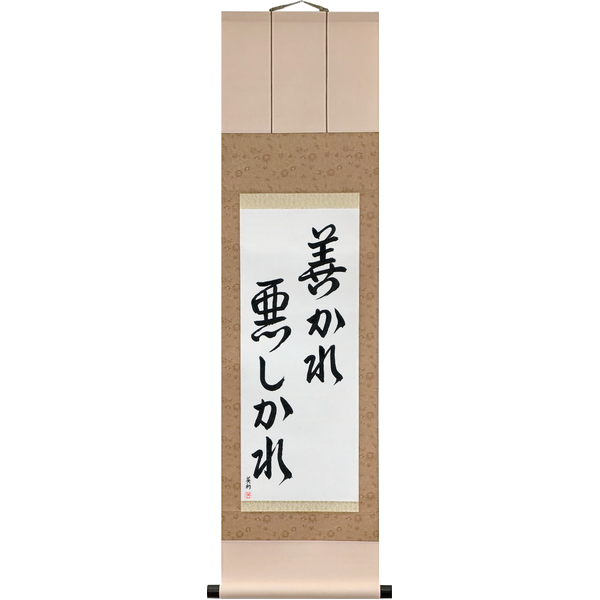
Sold as For Better or For Worse · Read yokare ashikare · Oldest witness a letter of Hōnen, carried in collections of his words from the 1250s on, and a Muromachi tale in the 御伽草子; both read in Meiji typesets · Sense whatever the outcome, whichever way it falls; an adverb of resignation, not a promise.
The words
Two old imperatives joined into one adverb. よかれ is the classical adjective 良し in the form that means let it be good; あしかれ is 悪し, let it be bad; together they say be it good or be it bad. A grammar of 1900 takes the word apart to show the seam: the -く of the adjective and あり have fused, so that 善かれ悪しかれ can be pulled back into 善くあれ, 悪しくあれ without losing its meaning. Every witness before 1900 writes the word in kana; the dictionary and the scroll write it with the characters 善 and 悪, and デジタル大辞泉 marks 悪 as carrying a reading outside the standard list, since あし is not among that character's approved readings. The modern printed form 悪 and the old form 惡 in the 1900 grammar are one character. One word, no variants, and its meaning has not moved in seven hundred years.
A history, from the earliest witness
Undated, medieval by report. Hōnen's reply to Ōgo Tarō Sanehide, in the 1906 『法然上人全集』, letter 48. Hōnen writes to a lay follower about exclusive nembutsu, and near the end warns him against looking down on those who practice otherwise: よく〳〵御つゝしみ候て。雜行の人なればとて。あなづる御心候まじく候也。よかれあしかれ。人のうへのよしあしをば。おもひいれぬがよき事にて候也。, be very careful; even if someone is a person of mixed practices, you must not have a heart that scorns him. Good or bad, either way, it is best not to take to heart the good and bad of what other people do. The word means whichever way it is, and the sentence is about leaving other people's conduct alone. The letter is signed 源空, Hōnen's monastic name, and dated only 三月十四日, the fourteenth of the third month. Under it the 1906 editor notes where the letter is carried: 和語燈錄。九卷傳等に出づ。又西方指南鈔に載する所。之と異同少からず。, it appears in the Wago tōroku and the nine-fascicle biography, and also in the Saihō shinanshō, with no small variance from this text. The last of those is Shinran's autograph collection of Hōnen's words, with a colophon of 1257, a national treasure at the Senjuji temple; none of the three was opened, so the date the history can honestly claim is carried in collections of the 1250s and after, and whether the 1257 manuscript has this sentence in this form was not checked. [NDL pid 991644, koma 253 (p. 486); read by eye at width 3600 and on a crop; the OCR layer reads をは for the leaf's をば; the letter's heading 四十八大胡太郞實秀へつかはす御返事 at koma 247 and the table of contents at koma 8, both OCR; text at lab.ndl.go.jp/dl/api/page/991644_253. For the 西方指南抄: kotobank.jp/word/西方指南抄-68228, 精選版日本国語大辞典, 康元二年(一二五七)の奥書がある]
Muromachi period, by every dictionary. 『唐糸草子』, a tale of the 御伽草子, in the 1891 typeset edited by 今泉定介 and 畠山健. The tale of Karaito, a lady of Kiso Yoshinaka's side sent to Kamakura to kill Yoritomo, caught and imprisoned, and of her daughter Manju, who comes to Kamakura to find her. Manju has listened for twenty days for anyone to speak her mother's name, and says to her nurse: 生きてうきよにあるならば。人をば。よかれあしかれさたするならひなり。名をだに申す人もなし。, if she were alive and in this world, people would be talking of her, for good or for ill; that is the way of it. Yet no one so much as says her name. Here the word means well or ill, said of how people are spoken of, and the sentence turns on it: to be talked about either way is the proof of being alive. The dictionaries date the tale to the Muromachi period and name it as one of the twenty-three tales of the 渋川版 御伽文庫, the Edo printed set; the 1891 editors say in their preface that their book is the 御伽文庫 with kanji filled in and the original otherwise left as it was, and name no base copy. The Edo print itself was not opened. [NDL pid 992891, koma 78 (p. 16); read by eye at width 3600 and on a crop; the typeset prints な in an old kana form that the OCR layer reads as ふ, so the OCR reads さたするふらひふり, 人をは, 申ず, 人もふし; the tale opens at koma 70 and the table of contents at koma 5 lists it sixth, both OCR; text at lab.ndl.go.jp/dl/api/page/992891_78. Dates: kotobank.jp/word/唐糸草子-47020 (ブリタニカ 室町時代に成る; 世界大百科 渋川版の一つ) and kotobank.jp/word/御伽草子-40713]
Undated, Edo. 『俗語之種』, a miscellany by 粟生菴清陰, part 4. Among remarks on writing: 物書事はよかれあしかれの出入や, writing things down is a matter of coming out well or badly. The catalogue gives no date. [NDL pid 2578789, koma 3; OCR; text at lab.ndl.go.jp/dl/api/page/2578789_3]
1836. 墨川亭雪麿's illustrated novel 『也字結恋之弶天』. A character in the dense kana of the genre: こんやもふしゆびよかれあしかれもういちをわしかいつてやかたのやうすとつくり見てからに, tonight too, whatever comes of it, I'll go once more and have a good look at how things stand at the mansion. The word means whatever the outcome. [2]
1852. 笠亭仙果's illustrated novel 『春服対佳賀紋』, part 3. A speaker entrusts herself to Amida: いつかういつしんおによらいさまにおたのみまうしよかれあしかれおまかせまうじて, with all my heart I ask it of the Buddha and leave it to him, come what may. The nearest the Japanese comes to the spirit of a vow, and the other party is a Buddha, and the act is surrender rather than promise. [3]
1891. A dodoitsu in 『新選歌曲集』. A popular song uses it as a shrug: よかれあしかれ入らざるお世話, good or bad, it's none of your business. [NDL pid 876518, koma 184; OCR; text at lab.ndl.go.jp/dl/api/page/876518_184]
1900. 金沢庄三郎, 『日本文法講義』. The grammar quoted in The words above: くとありとが結びついて、善かれ惡しかれ」などゝなるのは、假初の結びつきであるから、これを引き離して善くあれ」惡しくあれ」としても意味を傷けない, when -ku and ari have fused, as in yokare ashikare, the fusion is a light one, so pulling them apart into yoku are, ashiku are does no harm to the sense. The first witness opened that writes the word in kanji, and it writes 惡. [NDL pid 993662, koma 74; OCR; text at lab.ndl.go.jp/dl/api/page/993662_74]
Today. デジタル大辞泉: よいにしろ、悪いにしろ。善悪にかかわらず。どっちにしても, whether good or bad; regardless of good and bad; either way, with the example 善かれ悪しかれ結果を待つしかない, good or bad, all one can do is wait for the result, and a list of synonyms that are the adverbs of resignation and summation: どの道, 結局, 所詮, 何れにしても, 要するに. It is the only dictionary on the page; 精選版日本国語大辞典 has no headword for the word there. The word is in some 680 digitized books to 1946 in the kanji spelling and 420 in kana. [4]
The sense across time
One sense from Hōnen to the dictionary: whichever way it falls. What changes is what falls. In the medieval witnesses it is other people's conduct and other people's talk, things the speaker is told to leave alone; in the Edo novels it is an outcome the speaker resigns to or hands to a Buddha; in the song it is a brush-off; in the dictionary it is a result one waits for. In every case the word declines to care which way. It never promises anything.
What is not a source
The English wedding vow is not a source and not a parallel. For better for worse in the Book of Common Prayer is a promise to stay through both; 善かれ悪しかれ is a statement that the outcome is not the point. The two share their words and not their act. No Japanese rendering of the Anglican vow was opened, so whether the word was ever used to translate it is not known; if it was, that would be a use of the word, not its meaning.
The word in English
Hepburn's dictionary was not opened for this word, and no Meiji bilingual equation was found. The English rests on one modern source.
Today. EDRDG at jisho gives for better or worse; right or wrong; for good or ill, all three adverbs, and the first is the house's title. As an English adverb for better or worse means what the Japanese means: the plan went ahead, for better or worse. The vow's for better for worse is the same words in a different act. The house product page, not jisho, says the phrase is the same phrase spoken in the traditional wedding vow; the words are the same, the act is not, and a rendering must keep the adverb and let the buyer bring the vow. [jisho.org/search/善かれ悪しかれ; text]
A reading
A word, not a saying, and older than the account first knew: Hōnen uses it to tell a warrior to leave other people's failings alone, and a Muromachi tale uses it for the talk of the world that proves a woman is still alive. Seven centuries later it still means either way. The scroll sells it as the vow, and I would not call that a mistranslation, since the English adverb says exactly what the Japanese says; I would call it a pairing the page presents as an identity, and the honest history gives the buyer the 1852 sentence, the closest the Japanese comes to a vow, and lets them decide whether come what may, I leave it to you is what they want on a wall at a wedding. It is a fine thing to say of a marriage. It is not a promise. Romaji yokare ashikare, two words, no macron; the catalogue runs them together. Signed, 典, 2026-09-06.
How this was read
By eye, at the National Diet Library page images at width 3600 and on a crop: the Hōnen letter in the 1906 typeset, and the 唐糸草子 leaf in the 1891 typeset. By OCR at the local harvest and the page API: the letter's heading and table of contents, the tale's opening and table of contents and the editors' preface, the 1836 and 1852 novels, the undated miscellany, the 1891 song, the 1900 grammar. By text at the address: the kotobank pages for the word, for the tale, for the 御伽草子 and for the 西方指南抄; EDRDG at jisho. Not opened: the 西方指南抄, the 和語燈録 and the nine-fascicle biography at the letter; the 渋川版 print of the tale (NIJL 国書データベース work 121131, 御伽草子, 享保頃刊); 精選版日本国語大辞典 in print; Hepburn 1872; any Japanese translation of the Anglican marriage service; the 1836 leaf as an image. A leaf cited as pid P, koma N resolves as text at lab.ndl.go.jp/dl/api/page/P_N and as an image at dl.ndl.go.jp/api/iiif/P/R<N, seven digits>/full/3600,/0/default.jpg. The full apparatus, with every address, is in the account.
References
- The scroll (ours) (—) — L5039SSVB4A; cultural_works 421
- 墨川亭雪麿『也字結恋之弶天』 (天保7 (1836)) — NDL pid 10301655 koma 16 ↩
- 笠亭仙果『春服対佳賀紋』 (嘉永5 (1852)) — NDL pid 10303763, snippet ↩
- デジタル大辞泉 (current) — kotobank 653615 ↩
- EDRDG (current) — jisho.org