

美しき過ち · utsukushiki ayamachi · Beautiful mistakes
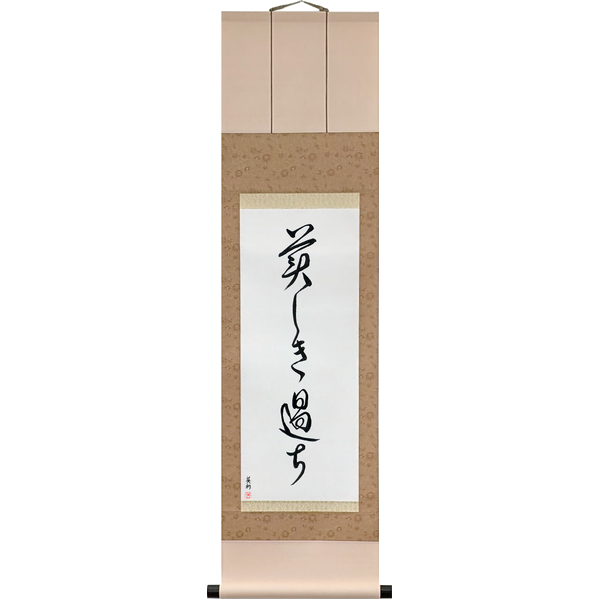
Sold as Beautiful Mistakes · Read utsukushiki ayamachi; the page's utukushiki is a typo · Register literary: a classical adjective form kept today for titles and poems, on a common noun · Sense a mistake, a wrong or an affair that one holds as beautiful, which is the spread the English has too.
The phrase
美しき, utsukushiki, is the classical attributive of 美しい, beautiful, the form a noun follows; modern Japanese keeps it for titles and poetry, and three film and drama titles of 1991 to 2005 use it. Classical 美し meant lovely, dear, endearing before it meant beautiful, and the 枕草子's list of うつくしきもの, lovely things, begins with a child's face drawn on a melon. 過ち, ayamachi, is the noun the phrase turns on. デジタル大辞泉 gives it four senses: 1 まちがい。失敗, a mistake, a failure, with the example 過ちを恐れず試みる, try without fearing mistakes; 2 犯してしまった罪。過失, a wrong one has committed; 3 男女間の不倫。不義, an affair; 4 an injury, classical. デジタル大辞泉 also gives the Confucian line its own entry, 過ちては改むるに憚ること勿れ, 《「論語」学而から》過ちを犯したら、ためらわないで改めよ, when you err, do not hesitate to mend it. So the one noun runs from the error one learns from, through the wrong one owns, to the affair, with the moral tinge that English mistake also carries when it is serious. [kotobank.jp/word/過ち-427651, kotobank.jp/word/過ちては改むるに憚ること勿れ-3227223, kotobank.jp/word/美しい (the 日国 entry, the 枕草子 line under sense ②), weblio.jp/content/美しき; text; all re-fetched 2026-09-05]
The English beside it. Mistake runs the same road. An error one learns from, the happy accident that turned out well; a wrong decision; a relationship one should not have had and cherishes, which is what the 2021 Maroon 5 song Beautiful Mistakes sings about; and, in slang since 1957, an unplanned child. Beautiful in front of it chooses none of them. The Japanese covers the first three in one noun of one register, and reaches the fourth only through the third. The alternatives each narrow it: 失敗 to failure, 罪 to sin, 過失 to negligence, 誤り toward the correctable error; and 間違い, the one noun broader than 過ち, is plain speech under a classical adjective. [greensdictofslang.com/entry/niy33jq; songfacts.com/facts/maroon-5/beautiful-mistakes; kotobank.jp/word/誤り, /過失, /間違い; text]
Where it comes from
This is not a Japanese saying. No Japanese song, novel, film or drama carries the title, and a search of titles, lyrics, poetry, blogs and the full text of the 青空文庫 finds the exact phrase only in fan subtitles of the Maroon 5 song. It is the house's own rendering, made in February 2010 by Master Takase for a customer who asked for the English phrase as a design, citing the P!nk song Crystal Ball (2008): I'm learning to be brave in my beautiful mistakes. The requests began in 2009, before the song that now owns the phrase, and most of the people who wrote in over the following years meant the happy accident, the mistakes that made them. The rendering was chosen over 美しい間違い, 美しい誤り and 美しい過失, and it was chosen well, for the reason above: the English is ambiguous, the Japanese is ambiguous, and the ambiguities overlap, which is what a good translation does. [the house archive, read in aggregate; azlyrics.com/lyrics/pink/crystalball.html; en.wikipedia.org/wiki/Beautiful_Mistakes; text]
Where it is used
In Japanese, 過ち alone is the serious word: the usage guides call it the somewhat formal cousin of 間違い, used for the fault that is judged by social or moral norms, and 一夜の過ち, one night's mistake, is a stock phrase for an affair. 美しき in front of it gives the phrase the poetic distance of a title, and lets the reader bring their own case to it. A Japanese reader meeting the phrase cold can hear a beautiful sin, and can also hear the poem; which they hear first no dictionary settles, and a blind panel of three language models split on it. The Japanese idioms for the happy accident by itself are other phrases, 怪我の功名, a lucky break from a blunder, and 失敗は成功のもと, failure is the seed of success, and neither is in the catalogue. [eigobu.jp/magazine/ayamachi; thetv.jp program listing for 一夜の過ち; kotobank.jp/word/怪我の功名; text]
The phrase in English
JMdict glosses 過ち as fault; error; indiscretion; faux pas and 美しい as beautiful; pretty; lovely; sweet; pure. There is no bilingual dictionary lineage for the phrase, because it was made from English. What a rendering back into English must keep is the ambiguity: beautiful mistakes, plural and unspecified, is exactly right, and anything that picks a sense, happy accidents, lovely sins, is a different design. [new.gokanji.com/word/過ち, /美しい; text]
A reading
The characters are sound, the register is right, and the phrase does the one thing a translation of this English has to do: it holds the mistake, the wrong and the affair the reader brings to it. The page should say so, in a sentence, and should say that the phrase was made for the English rather than found in Japanese; it should not choose a sense for the customer, and it should fix the romaji. The one thing that does not fit is the shelf: a phrase whose point is that it holds several senses sits under motivational, which asserts one. One question stands open for Master Takase, and it is the smallest the text allows: to confirm that holding the three senses is the point of her rendering, not a defect in it. Signed, 典, 2026-09-05.
How this was read
By text at the address: the デジタル大辞泉 and 精選版日本国語大辞典 entries for 過ち, 誤り, 過失, 間違い and 美しい, whole; Weblio's conjugation dictionary for 美しき; JMdict through gokanji; Green's Dictionary of Slang; the song's lyric and its history at their pages; the Japanese program listing and usage guide; the house archive in aggregate, without names. Not opened: the 日国 in print; any Japanese use of the exact phrase, because none was found; the P!nk lyric in a printed source. Every address in this history is a text address. The full apparatus, with every address, is in the account.
References
Each witness is cited in the account above, at the frame or entry where it was read. A linked list follows when the record for this text is completed.