

誕生日おめでとうございます · 有難う御座います · tanjōbi omedetō gozaimasu · arigatō gozaimasu · Happy birthday · Thank you
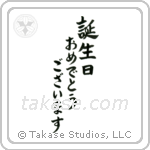
Sold as Happy Birthday · Thank You · Read tanjōbi omedetō gozaimasu · arigatō gozaimasu · Register the polite spoken formulas, 丁寧語, the forms one says to anyone one does not know well; both are what every Japanese speaker says · Oldest witness 有難う御座います in the first shorthand transcript of a storyteller, Sanyūtei Enchō's 怪談牡丹燈籠, 1884; the birthday greeting as a whole string in no book to 1946, though every word of it is centuries old · Sense congratulations on the day; thanks.
The sense: two things everyone says
These are not phrases the house made. They are the two sentences a visitor to Japan learns first, in their full polite form. 有難う御座います, thank you, is literally it is a rare thing: 有り難い meant hard to exist, rare in the 万葉集, and gratitude grew out of rarity, as the dictionaries and the encyclopedia both say. 誕生日おめでとうございます, happy birthday, joins the word for the day one was born to おめでとう, the congratulation said at New Year and at any happy event, and closes both with ございます, the polite verb that turns a word into an address to someone. The one thing a buyer needs told is about the first design's spelling: it writes the thanks in kanji, 有難う御座います, where a Japanese hand today writes it in kana, ありがとうございます. The kanji form is not wrong; it is what a printer set in 1884 and what 1,739 prewar books carry; it is old-fashioned, and a person who knows Japanese will see that at once.
The words
有難い arigatai: デジタル大辞泉 《あることがむずかしい、の意から》人の好意などに対して、めったにないことと感謝するさま, from the sense 'hard to be': to be grateful for a kindness as a thing that seldom happens; 精選版日本国語大辞典's first sense is the literal one, 存在がまれである、むずかしい, rare, hard to come by, cited from the 万葉集 in the spelling 安里我多之. 有難う arigatō is the adjective's adverbial form with the sound change -aku to -ō; the 大辞泉 adds, 丁寧に言うときは「ございます」を付ける。関西地方では「おおきに」, to say it politely, add gozaimasu; in the Kansai, ōkini. ございます is the polite form of ござる, to be, first cited in 1593 from the Jesuits' Amakusa Aesop, with the note that in the later Edo period ございます replaced ござる as the polite verb. The bilingual dictionary lists the greeting as an expression, thank you, polite, usually written using kana alone, and gives 有難う御座います as one of four kanji variants. [kotobank.jp/word/有難い · /word/有難う · /word/御座る · jisho.org/search/有難う御座います, text; read by the investigator; the jisho address is the search form, since the word form returns 404 for this expression]
誕生日 tanjōbi: 人の生まれた日。毎年迎える誕生の記念日, the day a person was born; the yearly anniversary of it; the dictionary cites an older reading, たんじょうにち, from a 1443 temple document, and the modern one from a nineteenth-century 人情本, 明後日は姫君さまの、御誕生日のお祝ひ, the day after tomorrow is the young lady's birthday celebration. おめでとう omedetō is the adverbial form of おめでたい, itself from めでたい, admirable, auspicious, which the dictionary derives from めでる, to admire, and dates to the 竹取物語; the greeting is cited from a Muromachi kyōgen, おめでたう存じます. So the birthday formula is three old words in a modern order, and the Library holds no page with the whole string before 1946, which says only that the printed formula is postwar, not that anyone lacked the words. [kotobank.jp/word/誕生日 · /word/おめでとう · /word/めでたい, text; read by the investigator]
The English matches loosely, as greetings do. Thank you and 有難う御座います do the same work, and the Japanese is longer and more formal; happy birthday is a wish and おめでとう is a congratulation, so the Japanese says it is auspicious where the English says may it be happy. Both are what one says, and nobody hears the etymology. [jisho.org/search/おめでとうございます, text]
A history, from the earliest witness
1884. A storyteller's thanks, in shorthand. The oldest page in the library with 有難う御座います is the first book ever made by shorthand from a performer's speech: Sanyūtei Enchō's ghost story 怪談牡丹燈籠, taken down by Wakabayashi Kanzō and printed in 1884. In the scene where a samurai offers to stand second in a fight, the man he helps says it: 有難う御座います, and the storyteller goes on, 已が助太刀をして遣るのを夫程までに嬉しい歟, is it such a joy to you that I should second you?; the OCR's 已 is the printed 己. The phrase is spoken Japanese of the 1880s written down as spoken, which is what a greeting on a scroll is. [三遊亭円朝演述・若林玵蔵筆記『怪談牡丹燈籠』第1編 東京稗史出版社 1884, NDL pid 891188, koma 18, OCR, ruby-interleaved]
1885. Enchō again, in the next year's stenographed tale, in a sickroom: 見舞に來て下すつて。誠めseに有難う御座います, you came to visit me; truly, thank you, as the OCR reads it, with two garbage characters inside 誠に. Between 1884 and 1946 the library holds 1,739 books with the phrase in these kanji, most of them fiction and stenographed speech; the kana spelling was not counted and would be larger. [三遊亭円朝『業平文治漂流奇談』速記法研究会 1885, NDL pid 891415, koma 24, OCR]
誕生日おめでとうございます: no page to 1946. The full-text search of the Library's public-domain books returns nothing for the whole string. The words are old, the fixed formula in print is not. [labsearch_house_19.txt, the Lab full-text API, 0 hits]
What is not a source
Greetings have no author. The Enchō pages are the oldest printed speech, not an origin. The English song Happy Birthday to You is not the source of the Japanese formula, which is the ordinary congratulation with the occasion named in front of it.
The phrases in English
Happy Birthday to You is the American song whose melody, Good Morning to All, is attributed to Patty and Mildred Hill in 1893, disputed, and which has been in the public domain since the 2015 ruling against the Warner Chappell copyright; the Japanese greeting is not a translation of it and would be said on a birthday with or without the song. Thank you is thank you. What a rendering must keep is the politeness: 有難う御座います is not the bare 有難う, and thanks would be wrong for it; and for the birthday design, the whole formula is the polite one, and a page that shortens it to tanjōbi omedetō has shortened the design. [en.wikipedia.org/wiki/Happy_Birthday_to_You · ja.wikipedia.org/wiki/ありがとう, text]
A reading
Two greetings, and one decision for the page: tell the buyer of 988 that the kanji spelling is the old way. It is what Enchō's stenographer set in 1884, and it is what a Japanese reader will recognize as a printed, slightly ceremonious form; it is not what they would write in a card. That is a feature of the design, and a buyer should choose it knowing so. The birthday design needs no such note; its Japanese is exactly what one says, and the one thing worth knowing is that it is a congratulation, it is auspicious, rather than a wish. Signed, the philologist, 2026-09-06.
Notes
- Kanji or kana. EDRDG marks the greeting usually written using kana alone and lists 有難う御座います as one of four kanji variants; the two kotobank dictionaries do not carry the whole phrase as a headword and state no preference. The 1,739 prewar books are the kanji form's warrant; the kana form is the modern norm. Both are one phrase. A page note for 988, as the account said.
- The 1884 book is the first sokkibon, the first published shorthand transcript of a performance; the phrase in it is quoted as the OCR reads, with the ruby interleaved.
- Romaji. The page carries tanjōbi omedetō gozaimasu and arigatō gozaimasu with macrons; the catalogue's tanjoubi omedetou and arigatou are the wapuro forms of the same words.
How this was read
A bracket that names a National Diet Library leaf as pid and koma resolves at lab.ndl.go.jp/dl/api/page/<pid>_<koma> for the OCR text and at dl.ndl.go.jp/api/iiif/<pid>/R<koma, seven digits>/full/2400,/0/default.jpg for the image. By OCR, own-hand at the koma: the two Enchō books. By the Lab's full-text search, own-hand, the whole result set of each phrase sorted by year (0 · 1,739, the latter walked to 1,727). By text: the kotobank entries for 有難い, 有難う, 御座る, 誕生日, おめでとう and めでたい, read whole by investigate-ten on 2026-09-05 and quoted from its reading files, not re-opened by the seat; the EDRDG entries at jisho; the English Wikipedia article on Happy Birthday to You and the Japanese one on ありがとう, pulled through the parse API. Not opened: any leaf by eye; the kana-spelled count; the 1,737 other pages; the Amakusa Aesop for ござる.
References
- 129 誇りと喜び (164 books; 1937) — F0056
- 164 子供の為に (1,684 books; 1912) — F6000
- 222 家族は永遠 (2 books; 1924) — F6058
- 291 自分を信じる (39 books; 1946) — I6002
- 295 精一杯生きる (0) — I6006
- 299 強く生きる (207 books; 1937) — I6010
- 319 希望は最大の宝 (0) — I6030
- 327 自由に生まれて (0) — I6038
- 331 新たな始まり (1 book; 1948) — I6042
- 415 永遠に心の中に (1 book; 1927) — L5033
- 418 永遠に私の心に (3 books; 1935, 1941) — L5036
- 566 危険を冒す (2,388 books; 1897 among the first five) — M6013
- 961 生きる笑う愛する (0) — S0000
- 968 誕生日おめでとうございます (0) — S0007
- 988 有難う御座います (1,739 books; 1914 among the first five) — S0030
- 1010 ゴルファー (50 books; 日国 初出 1930) — S5009
- 392 禁じられた愛 (1 book; 1924) — L5010
- 834 永遠の若さ (202 books) — P4103
- 627 母なる自然 (85 books) — N4014