

森羅万象 · shinra banshō · All of Creation
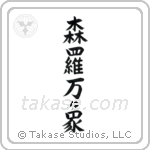
Sold as All of Creation · Read shinra banshō, four characters; older readings shinra manzō and shinra banzō are the same word · Register a Zen term that became an ordinary literary word; the dictionaries tag it a four-character compound and give no special register · Sense one: everything that exists in the universe, all things and all phenomena.
The words
森 is a mass of trees, and 羅 is a net or a row, ranged; 森羅 is ranged without number, as trees stand in a forest. 万象 is the ten thousand forms, every shape a thing can take. A four-character dictionary explains it in exactly those terms, and that explanation corrects the page, which glosses the second character as gauze; thin silk; Rome and the fourth as elephant; pattern after; imitate. Those are real senses of 羅 and 象, but not the senses in this word; here 羅 is ranged and 象 is forms. The whole, in the national dictionary: all the things that exist without number in the universe. Its neighbors, by the 大辞泉's list, are 自然, 天然, 造化 and 大自然, nature and creation.
Where it comes from
The word is Chinese and Chan. The Song of Enlightenment attributed to 永嘉玄覺, who died in 713, has it in the reverse order, in a line about the mirror of the mind: clear, unobstructed, its light fills the worlds like sand; the ten thousand forms, ranged, appear reflected in it; one round radiance, neither inside nor out. The 碧巌録, the great koan collection of 1125, uses it four times and once quotes an older line, the forest of forms and the ten thousand things are all the seal of one dharma. A verse by the master 宏智正覺 that begins the ranged ten thousand forms, so tall and sheer was still being copied into a Japanese Zen phrase-book printed in 1620, which was read for this history.
In Japanese the dictionaries' first is Dōgen, in the 法性 chapter of the 正法眼蔵, written between 1231 and 1253, reading it shinra manzō in the Buddhist pronunciation: this shinra manzō and the dharma-nature are far beyond any argument about same and different. A century later the Chinese master 清拙正澄, preaching in Kamakura, told his monks that sun, moon and stars are lamps, mountains and rivers are lamps, shinra banzō are lamps. Then the word left the monastery. The Jesuits' Japanese-Portuguese dictionary of 1603 records the sentence Our Lord Deus made the shinra manzō, a Christian creation in a Buddhist word. A 1778 comic novel uses it of a worldly man; a 1783 treatise on haikai says the poet's mind turns with the ten thousand forms and yet is not two; the first modern Japanese dictionary, the 言海 of 1889, uses it in its own preface to describe its scope, the words for all things in heaven and earth. In the same decade Hepburn's dictionary of 1886 glossed it All things and gave one example, the Jesuits' sentence again: kami wa shinra banzō wo tsukuritamau, God created all things. The reading itself has a history: manzō in Dōgen and the Jesuits, banzō in Hepburn, banshō in the 1778 novel, in the 言海 and in every mouth today.
The text in English
One line, four centuries long: the Jesuits' Deus made (1603), Hepburn's God created all things (1886), the online dictionary's the whole creation, and this catalogue's All of Creation. A Buddhist word for the sum of things has been carried in English by the word creation since the first Europeans learned it, and the fit holds because creation in English long ago came to mean the world itself as much as the making of it. In modern Japanese the word is plain and secular. A novelist in 1951 used it of the Book of Changes explaining all things; another in 1970 of light making the whole of heaven and earth; and four prime ministers have reached for it in the Diet, from Nakasone in 1985 to Abe on 6 February 2019, who said I am the prime minister, so I am in charge of shinra banshō, everything there is, and made the word a trending topic for a day. It also meets another scroll in this catalogue: the Japanese encyclopedia explains that the whisker strokes of the Nichiren daimoku show the title's light reaching 森羅万象.
A reading
Signed 典, 2026-09-08. All of Creation is a better English for this word than it looks, because it is not a gloss at all but the oldest English use of the word: the sentence the Jesuits wrote down in 1603 and Hepburn printed in 1886. The design needs no change and the reading stands. The page should fix its kanji-by-kanji line, which teaches a buyer that 羅 means Rome and 象 an elephant, and might say in one sentence where the word comes from, since a Zen line about the mirror of the mind is a better story than a list of radicals.
How this was read
By eye: the template; the 1620 phrase-book and the 1737 commentary on the Song of Enlightenment at the page; the 言海 of 1889 at the entry. By text: the Song of Enlightenment and the 碧巌録 at CBETA to the column; Dōgen's chapter at a modern transcription; the dictionary blocks at kotobank and the online dictionary; Hepburn 1872 and 1886 and Brinkley 1896 on the shelf; a 2019 news column for the Diet quotations. By OCR: the local harvest archive of 9,870 prewar books on both spellings, 1,813 books for the old form; 清拙's recorded sayings. Not opened: the line's own source that the 碧巌録 quotes; a critical edition of Dōgen; the Jesuit dictionary at a page; Brinkley's entry, unreadable in the OCR; the NDL Lab's own index, which waits on Tim's run; a JapanKnowledge column on the word that a search reported at an address which opened a different column.
References
Each witness is cited in the account above, at the frame or entry where it was read. A linked list follows when the record for this text is completed.