

千羽鶴 · senbazuru · a thousand cranes
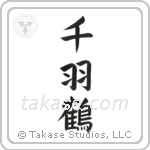
Sold as 1000 Cranes · Read senbazuru · What it is a string of many folded paper cranes, traditionally a thousand, made as a prayer; before that, a textile pattern of a thousand cranes; the crane lives a thousand years, so the thousand is long life · Oldest witness for the pattern, 近松's play 傾城島原蛙合戦 of 1719; for the folded string, a senryū of 1828 and the dictionary ことばの泉 of 1898 · In the dictionaries both senses; the folded string first · In English a thousand paper cranes, through Sadako Sasaki's story, told by Robert Jungk in 1961 and by Eleanor Coerr in 1977 · Signed 典, 2026-09-07.
The words
千 sen is a thousand. 羽 is the counter for birds, read wa on its own and ba after 千, as in 三羽 sanba. 鶴 tsuru is the crane, voiced to -zuru at the end of the compound. So the word is sen-ba-zuru, a thousand birds that are cranes, and the dz in the catalogue's senbadzuru is a typing spelling of the same syllable. The crane's thousand years come from a Chinese book of the second century BC, the 淮南子, which the proverb 鶴は千年亀は万年, the crane a thousand years, the tortoise ten thousand, has carried in Japanese since the 御伽草子 tale of Urashima Tarō. A thousand cranes is therefore not a count but a wish, and every dictionary says so: 千羽は多数の意で、かならずしも正確な数をいうのではない, the thousand means many and need not be exact.
A history, from the earliest witness
1719, 近松門左衛門, 傾城島原蛙合戦, a puppet play. A bride is dressed: 先づ上着のお小袖は。千代を染込む松葉色松に群れゐる千羽鶴。十二の雛を飼ひ育て, first the outer kosode, a thousand years dyed into pine-needle green, a thousand cranes flocking in the pines, rearing twelve chicks. The thousand cranes are a pattern on silk, and the twelve chicks are the wish for children that a wedding robe carries. This is the word's first appearance and it is a pattern, not a paper bird. [1]
1751, a haikai anthology, 頭陀袋. 名も万年の千羽鶴, a thousand cranes whose name is ten thousand years, the crane's thousand and the tortoise's ten thousand folded into one congratulation. Still the auspicious image, not the folded paper. [2]
1797, 秘傳千羽鶴折形, the oldest surviving book of recreational origami. Forty-nine ways to cut and fold a flock of cranes from a single sheet, each design named and given a comic verse. One is called 比翼, wing to wing, with the verse 天にあらばひよくのちぎりたのしまん かすミの蒲團 雲どりの夜着, in heaven we would enjoy the pledge of wing-to-wing birds, a quilt of mist, bedclothes of cloud. In this book 千羽鶴 means the connected cranes, a third sense, and its preface says folded cranes were already common knowledge. The designer was a temple priest in Kuwana, and the book was forgotten until an origami master republished it in 1957. [The poems on ja.wikisource; the preface reported by the 世界大百科事典; the authorship and rediscovery reported by ja.wikipedia.]
1828, a senryū in the 柳多留. 千羽鶴いたちごっこのように折り, folding a thousand cranes like a game of itachi-gokko, the children's hand-over-hand game that never ends. The first record of people folding a thousand paper cranes, and it is a joke about how long it takes. [The 精選版 日本国語大辞典's first citation for the folded sense; the leaf not opened.]
1762, 近松半二, 奥州安達原, a puppet play, and a legend. A peasant reads a placard: 此の國の殿樣八幡太郞樣が、武運長久の爲ぢやというて、鎌倉とやらで鶴を千羽、金の札付けてお放しなされたげな, they say the lord of this province, Lord Hachiman Tarō, released a thousand cranes at Kamakura with gold tags on them, for long luck in war. Later writers tied the thousand released cranes to Yoritomo's life-release rite at the Tsurugaoka shrine, and one of them in 1880 added that it is not in the official history. It is a legend of live cranes, and nothing read connects it to the paper ones. [5][6]
1898, 落合直文, ことばの泉, a dictionary. せんば-づる 千羽鶴。紙を折りて、數多つらなりたる鶴の形をつくりたるもの, paper folded into the shapes of many cranes strung together. The first dictionary to give the word a headword gives the folded string and only that. [7]
1913 to 1933, the small dictionaries and a folklorist. Between them they say what the strings were for. Hung from the ceiling in summer to keep the flies off: 夏日家の天井に懸け置きて蠅の糞を除ける (和漢雅俗いろは辞典, 1913). Offered at shrines: 神社などに奉納す (秘密辞典, 1920). Offered at the Kishimojin and Awashima shrines in Tokyo for a girl's progress in her accomplishments: 女兒の技藝の上達を祈る … 鬼子母神・淡島などに捧ぐ (言泉, 1922). And in 三田村鳶魚's list of Edo customs: 千羽鶴 是は紙で折つて神社佛閣へ納めるのです, these are folded from paper and offered at shrines and temples (江戸っ子, 1933). [8][12][13][14]
1916, 小川未明, 千羽鶴, a children's story. An old woman notices the village shrine has gone lonely and neglected, folds cranes in red, blue and yellow paper, strings them, and hangs them on the lattice of the shrine's door: 千羽鶴を造って、お宮へ捧げたら … それを糸でつないで、お宮の拝殿の扉の格子につるしました. That night a white crane comes to her window as the god's messenger. The votive string as a plain village act, told for children. [Aozora Bunko card 52642, text; first printed in 教育の世紀, July 1916.]
1917, 泉鏡花, 弥生帖. A girl at the Kishimojin shrine: 「鬼子母神樣、雪がお願ひに參りました、何うぞ、母さんの病氣の治りますやうに」金紙銀紙千代紙の折鶴、千羽鶴, "Kishimojin, Yuki has come to ask you: please, let my mother's illness be cured." Folded cranes of gold paper, silver paper, chiyogami: a thousand cranes. The prayer for a sick parent, with a string of cranes, thirty-eight years before Hiroshima. [10]
1934, 小笠原長生, 晩年の東郷元帥, a memoir of Admiral Tōgō. The old admiral, himself dying, folds small cranes for his wife's sickroom and has them hung on a pine branch: 小さい鶴を澤山折りましたら、その松に飛ばせよ、とおつしやるのです。「これは、目出度い、目出度い、松に千羽鶴が飛んだ」, when I had folded many small cranes he said, let them fly in that pine. "How auspicious, how auspicious, a thousand cranes have flown into the pine." When the nurse forgot the fold he showed her himself. [15]
1941, 高村光太郎, 智恵子抄. The poet brings chiyogami to his wife in the hospital: 智惠子は大へんよろこんで其で千羽鶴を折つた。訪問するたびに部屋の天井から下つてゐる鶴の折紙がふえて美しかつた, Chieko was delighted and folded a thousand cranes with it. Each time I visited, the folded cranes hanging from the ceiling of her room had grown, and it was beautiful. In 1943 he asks the dead, 千羽鶴は折れたか, did you finish the thousand cranes? The same year a teachers' manual recommends the thousand cranes as a class project, one crane from each child, which is how the postwar school custom already looks. [17][18]
1955, 佐々木禎子, Hiroshima. Born 7 January 1943, she was two when the bomb fell about a mile from her house; she grew up well and ran on her class relay team; in the winter of 1954 the swellings began, in February 1955 the diagnosis was leukemia, and on 21 February she entered the Red Cross hospital. In August, when a string of cranes sent by high-school students in Nagoya reached the ward, she began to fold. The Japanese biographical dictionary gives the story in one line: 「鶴を千羽折ると願いがかなう」と言う級友の言葉により鶴を折り続けたがよくならず, on a classmate's word that if you fold a thousand cranes your wish comes true, she went on folding cranes, but did not get better. She folded with medicine wrappers and cellophane when the paper ran out; her family says she passed a thousand by the end of August and kept going; the museum's count is over 1,300. She died on 25 October 1955, at twelve. Her classmates' campaign built the 原爆の子の像, the Children's Peace Monument, unveiled in the Peace Park on 5 May 1958; the bell inside it carries the two words 千羽鶴 in the hand of the physicist 湯川秀樹. [20世紀日本人名事典 and 日本人名大辞典 on kotobank; ja.wikipedia 佐々木禎子 and 原爆の子の像, reported for the August date, the counts and the bell; the museum's own page not reached.]
The sense across time
The dictionaries hold two senses and the history adds a third. First, from 1719, the pattern: a thousand cranes on cloth, a screen, a sword hilt, the auspicious flock with the crane's thousand years in it; this is the sense Kawabata took for the title of his 1949 novel, a furoshiki with the crane pattern carried by a young woman at a tea lesson. Second, from the 1790s, the connected cranes of the Kuwana book, a sense that lived until at least 1940. Third, from 1828 and in every dictionary from 1898, the string of folded cranes made as a prayer: for a girl's accomplishments at the shrine, against flies in summer, for a sick mother, for a sick wife, by a class for a classmate, and since 1955 for one child and, through her, for peace. The 世界大百科事典 places it in a family of Japanese customs where many small acts by many hands stand against one person's danger, the thousand prayers of 千人針 and the hundred visits of 百度参り, and reads the thousand as many.
What is not a source
The legend of a thousand live cranes released with gold tags at Kamakura, in an eighteenth-century play and later miscellanies, is a story about the shrine's life-release rite, not about folded paper. The 1797 book is often named as the origin of the thousand-crane custom; it is the oldest book about folding cranes, and its title uses the word for cranes joined from one sheet, a different thing from a string. The often-repeated line that folding a thousand cranes grants one wish is in the Japanese sources as a classmate's saying in 1955 and in the dictionaries as a votive practice; no older text read states it as a rule.
The text in English
1958, Edward Seidensticker, Thousand Cranes, the English title of Kawabata's novel. The first form in which the word reached English readers in numbers, though the novel's cranes are a textile pattern. The capitalized phrase in the Google Books corpus rises from the 1950s and peaks in 1987, twenty years after the Nobel prize. [Year from en.wikipedia; the translation not opened.]
1961, Robert Jungk, Children of the Ashes, Harcourt, Brace & World, New York. The English of an Austrian journalist's 1959 account of Hiroshima's rebuilding: There is a Japanese belief that a sick person who, even on his deathbed, can fold a thousand paper cranes will be out of danger. As Sadako's leukaemia grew worse she bravely set about this task, and soon above her hospital bed there arose a web of strings on which the little cranes fluttered. But when the sick girl had just made her six hundredth little paper creation, her strength began to ebb away, and with No. 644 she was forced to give up. This is the earliest English telling found, and the earliest appearance of the number 644. Where Jungk had the number I did not find. [archive.org, ChildrenOfTheAshes-English, text.]
1962, Karl Bruckner, The Day of the Bomb, Van Nostrand. The English of the Austrian children's novel Sadako will leben (1961), the version many European schoolchildren read. [Record only.]
1977, Eleanor Coerr, Sadako and the Thousand Paper Cranes, Putnam, New York. The children's novel that made the story a school text in English: Sadako folds 644, her friends complete the thousand, and the cranes are buried with her. Her family, through her elder brother, says she passed a thousand and went on, and the Japanese article on her says the smaller number was spread to sharpen the tragedy. The 644 is Jungk's, sixteen years older than Coerr, and it is disputed. [archive.org record; the plot as en.wikipedia gives it; the book not opened.]
The ngram. Paper cranes is flat in English until the 1950s and rises through the 1960s and 1980s to its peak in 2019; thousand paper cranes is first real in the 1960s; origami crane is a word of the 1980s; senbazuru first appears in 1964 and is visible only after 2000; Sadako rises from the 1950s and peaks in 2016.
Today. JMdict: (string of) many (traditionally 1000) paper cranes. The house title 1000 Cranes is the house's own, the literal count in figures. A rendering must keep the number and the bird; the paper may be left to the reader, and the English phrase that carries the tradition is a thousand paper cranes.
A reading
The word is older than its story and larger than it. For its first century in print it was a pattern, cranes on a bride's sleeve with the crane's thousand years dyed into the green. The folded string arrives in the 1820s as a joke about patience, and by the 1910s it was three homely things at once: a girls' offering at two Tokyo shrines, a summer charm against flies, and a bundle a daughter carried to Kishimojin for a sick mother. An admiral folded them for his wife in 1934 and a poet's wife folded them in a hospital in the late 1930s, so the sickroom crane was in place before the war. What 1955 changed was not the custom but its weight: one child's thousand against a death the whole world had a hand in, and the word 千羽鶴 cast on a bell under her statue in a physicist's calligraphy. That is why the same three characters can hang in a sickroom, at a wedding, and at a peace park without contradiction. The number 644 belongs to a European book of 1961 and an American one of 1977, not to her family, and a page should not repeat it. The design is right as it stands; what the page needs is its readings corrected and one sentence saying what the word carries: a long life, a recovery, and since 1958 peace.
Notes
The page's composition line gives 羽 as read u and 鶴 as read kaku; those are the characters' Chinese readings, and in this word they are ba and zuru. The catalogue's romaji senbadzuru is the typing spelling; Modified Hepburn is senbazuru. The 1898 dictionary's OCR layer reads 四 where the leaf has 鶴. The Japanese Wikipedia article dates the modern string to at least 1916 from 小川未明; the 1898 headword and the 1828 senryū are earlier. The Diet Library's index thins after 1950 for copyright, so the postwar rise of the word cannot be counted there. The German year of Jungk's book, 1959, is recall.
How this was read
By eye: the template O6016SSVB4A. By text at the address: the Diet Library's full-text index on ten forms with the word pulled whole and counted by decade (the text of a leaf is at lab.ndl.go.jp/dl/api/page/
References
- 近松門左衛門, 傾城島原蛙合戦 五 (近松全集 1923 typeset) (1719) — pid 1884384 koma 304, OCR; 日国 ② 初出 ↩
- 東々庵蛙井 編, 頭陀袋 (1751) — pid 2539782 koma 42, OCR ↩
- 東西庵南北, 丁子車引手妻音 (1812) — pid 9893183 koma 7, OCR
- 柳多留 一〇二 (1828) — 日国 ① 初出, reported; leaf not surfaced
- 近松半二, 奥州安達原 (有朋堂文庫 1914) (1762) — pid 1913636 koma 117, OCR ↩
- 白井光太郎 編, 諸家随筆ぬきがき 5 (1880) — pid 2576028 koma 18, OCR ↩
- 落合直文, ことばの泉 (1898) — pid 862875 koma 406, OCR (鶴 read as 四) ↩
- 高橋五郎, 和漢雅俗いろは辞典 (1913) — pid 932526 koma 583, OCR ↩
- 小川未明, 千羽鶴 (教育の世紀 4-7) (1916) — Aozora card 52642, text
- 泉鏡花, 弥生帖 (1917) — pid 914760 koma 68, OCR ↩
- 上田万年・松井簡治, 大日本国語辞典 (1917) — pid 954647, by highlight
- 自笑軒主人, 秘密辞典 (1920) — pid 962110 koma 100, OCR ↩
- 落合直文, 言泉 (1922) — pid 969161 koma 301, OCR ↩
- 三田村鳶魚, 江戸っ子 (1933) — pid 1181053 koma 229, OCR ↩
- 小笠原長生, 晩年の東郷元帥 (1934) — pid 1235733 koma 110–111, OCR ↩
- 松浦彦操, みふみかたどり (1940) — pid 1258171 koma 18, OCR
- 高村光太郎, 智恵子抄 (1941) — pid 1129197 koma 79, OCR ↩
- 西館弥輔, 芸能科工作研究折紙による練成 (1941) — pid 1267692 koma 19, OCR ↩
- 秘傳千羽鶴折形 (poems) (1797) — ja.wikisource, text
- 20世紀日本人名事典, 佐々木禎子 (2004) — kotobank, text
- Jungk, Children of the Ashes (1961) — archive.org ChildrenOfTheAshes-English, text
- Coerr, Sadako and the Thousand Paper Cranes, Putnam (1977) — archive.org record sadakothousandp00coer; en.wikipedia
- Kawabata, tr. Seidensticker, Thousand Cranes (1958) — en.wikipedia; archive.org record
- 大辞泉 · 精選版日国 · ニッポニカ · 世界大百科 (千人針 · 折紙) (current) — kotobank, text