

正射正中 · seisha seichū · Correct shooting, correct hit
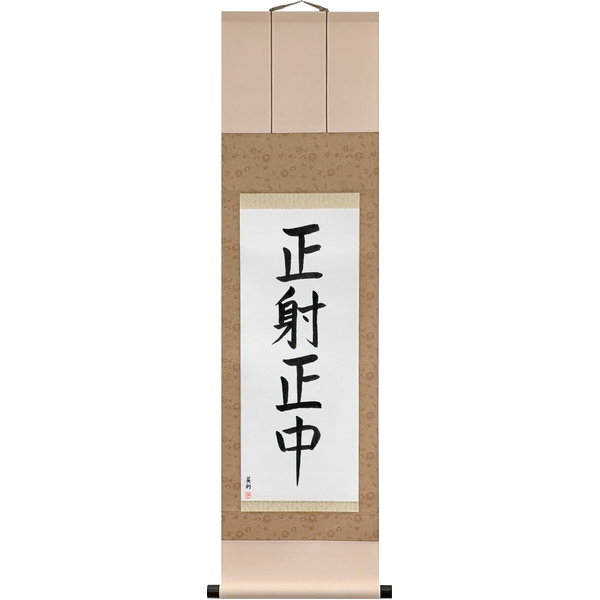
Sold as Correct Shooting, Correct Hit · Read seisha seichū; the standard form of the maxim is 正射必中 seisha hitchū · Oldest witness for the idea, the Record of Rites and Mencius; for the four characters, none before 1946, a catalogue entry of 1968 and a title of 1992 · Sense the maxim of Japanese archery: shoot correctly and the hit follows; attend to the form, not the target.
The words
正射 is correct shooting, and it is the discipline's own word. The general dictionaries know 正射 only as frontal fire, first cited from a war memoir of 1913, and as the mathematician's orthogonal projection; neither has the archer's sense, and the standard Japanese-English dictionary has no entry at all. In kyūdō writing the word means shooting that follows the form, and the older books say it in plain Japanese instead, 正しい射, 正しき射形, 射の正法. The Chinese word is older than any of this: in the Spring and Autumn Annals of Wu and Yue, the king of Yue asks his archery master 願聞正射之道, tell me the way of correct shooting, and the master answers with the whole posture of the crossbowman, body like a board, head like a struck egg, the right hand releases and the left hand does not know it. 中 is to hit, the target's word since the Record of Rites. The house's second word, 正中, is correct hit, with the dictionary sense of 正中 that Fukuzawa used, right and ideal, and the ordinary sense, dead center, both available to a reader. The standard form's second word, 必中, is a sure hit, 必ず命中すること, the word of 一発必中; the big dictionary first cites it from a 1963 novel, which is a thousand years late, because 必中 is already the Rites' own phrase for the archer whose every movement hits the mark of ritual. So the two forms say nearly the same thing: correct shooting hits correctly, or correct shooting hits without fail.
A history, from the earliest witness
The Chinese ground. 禮記 射義, the Meaning of Archery chapter of the Record of Rites: 故射者,進退周還必中禮,內志正,外體直,然後持弓矢審固;持弓矢審固,然後可以言中;此可以觀德行矣 — the archer's advancing, retiring and turning must all hit the mark of ritual; the will within correct, the body without straight, then he holds bow and arrow steady and sure; only then can one speak of hitting; and by this one may see his virtue. And: 射者,仁之道也。射求正諸己,己正而後發,發而不中,則不怨勝己者,反求諸己而已矣 — archery is the way of humaneness: the archer seeks correctness in himself; correct in himself, then he releases; if he releases and misses, he does not resent the one who beat him, but turns and seeks the cause in himself. Mencius has the same sentence, 仁者如射:射者正己而後發, the humane man is like the archer: he makes himself correct, and then releases. The Doctrine of the Mean has the short form every Japanese archer learned: 射有似乎君子。失諸正鵠,反求諸其身 — archery is like the gentleman: when he misses the mark, he seeks the cause in himself. Confucius in the Analects adds 射不主皮, in archery the point is not piercing the hide. [zh.wikisource 禮記/射義, 孟子/公孫丑上, 禮記/中庸, 論語/八佾第三, 吳越春秋/勾踐陰謀外傳; text]
Japan before the four characters, 1918 to 1942. The pre-war archery books carry the whole idea in prose and never the four characters. A Heki-school manual of 1918: 矢は心の通る所に中るべし。體は心に隨ふ物なり … 射るときは必ず中るべし。若し心納らざる時は體落ちつかず。體落ちつかざる時は弓隨はず、弓隨はざるときは中りなし — the arrow hits where the mind goes; the body follows the mind; shoot so, and you will surely hit; when the mind is not settled the body is unsettled, when the body is unsettled the bow does not follow, when the bow does not follow there is no hit [8]. Another book of 1918 quotes the Mean for it and adds the honest rider that even the straight body does not hit every time [9]. The First Higher School's archers, in the school history of 1925, wrote their creed: 射は的中を目標とすべきに非ず、凡そ我等中てんとして的に向ふは邪道なり … 正しき射により神の域に入る悅 … 中りを以て輸贏を爭ふを目指すは邪道なり — shooting must not have the hit as its goal; to face the target meaning to hit is a false way; the joy of entering the gods' realm through correct shooting; to aim at winning by hits is a false way — and closed with the Mean's line [11]. A 1924 dojo's motto was 射即人生, shooting is life [10]. 小林治道's Seven Ways of the Chikurin School (1931) says the maxim in one sentence: 此七道を習學して其理を究め其業を練つて射法に熟達すれば其射は必ず中るといふことが當然である — master these seven ways, exhaust their principle, train the work, and it follows of course that the shooting will surely hit [12]; its preface has shooting is the way of humaneness, the gentleman's contest, and it prints a commentary on the 射義 as an appendix. 竹内尉's secondary-school Kyūdō Reader (1937) prints the three classics in Japanese reading, divides hits into 偶中, chance hits, and 眞中, true hits (even if it hits, this is not a true hit but a chance hit, a hit of the moment, with no content and no value), warns against 的中主義, hit-ism, as a false way, and states the mechanism as a fact about the range: 現在の射場は自己を正しくして矢を發すれば、的中する如き構造になつてゐる … 體勢が正しく、心が靜かであれば、矢は活物の如く的に達する — the present range is built so that if you correct yourself and release, you hit; when the body is correct and the mind quiet, the arrow reaches the target like a living thing [13]. The women's manual of 1938: 初心者には中りは第二として、正しき射形を會得させることを第一 — for beginners, hitting second, learning the correct form first [15]. A 1939 book: 射の結果は己れの射の正不正の反映である … 盡して求めざる心 — the result of the shot is the reflection of the correctness or incorrectness of one's shooting; the mind that gives everything and seeks nothing [16]. And a 1942 bibliography of old Heki-school manuscripts records one that opens with the Rites' sentence and then insists 弓の魂と云は中り也, the soul of the bow is the hit [17]. Whether the idea was already four characters in speech in those years is not on record in print; the Japanese encyclopedia's article on 阿波研造, Herrigel's teacher, says his teaching was to practice the natural release, bow and body as one, and 正射必中 thoroughly, without a source for the phrase.
The four characters, after the war. On the National Diet Library's full-text index of the printed books to 1945, 正射必中 returns nothing and 正射正中 returns nothing, beside thousands of hits for 正射 and 必中 alone and hundreds for the Rites' 內志正; the absence is a measurement. The library's catalogue first indexes 正射必中 in 1968, in two issues of the Tokyo police magazine 自警, unread, and first as a title in 1992, a Hokkaido archery club's sixtieth-anniversary volume 正射必中. The All Nippon Kyudo Federation, founded 1949, issued its Kyūdō Manual, volume one, in August 1953, which was not opened and is the likeliest first printed home of the phrase. Today the federation's own page says it plainly: 弓道には正射必中という言葉があります。これは正しい射法で射られた矢は、必ず中るという意味です — in kyūdō there is the phrase 正射必中; it means that an arrow shot with correct shooting will surely hit [kyudo.jp/howto/, fetched 2026-09-07]. The one general dictionary that has the phrase, Weblio's 実用日本語表現辞典, defines it 「正しい射法で射れば矢は必ず的に当たる」という、弓道の理念・心構えを示す語 and notes its second life as a business motto, act rightly and the results follow; the catalogue's 33 titles with the phrase include a sales-magazine serial of the late 2010s titled 正射必中! and a 2024 title 正射必中!弓道部.
The house's form. 正射正中 has no print record found: none on the full-text index, none in the national catalogue, none on the Japanese Wikipedia, none in the dictionaries. It lives in speech and online. A kyūdō blog of 12 October 2020: 正射正中とは、読んで字の如くではあるけれど、道理にかなった〔正〕弓の引き方〔射〕をすれば、間違いなく〔正〕的にあたる〔中〕ということで … これとよく似た『正射必中』という言葉もある — 正射正中 means, as the characters say, that if you draw the bow in the way that accords with reason, you will hit the target correctly; there is also the very similar phrase 正射必中 [910.style.coocan.jp/1_yumi/20201012.html; text]. A questioner on Yahoo!知恵袋 in May 2017 uses it as the opposite of あて射, hitting by aiming, and asks how to be said to shoot 正射正中 rather than that [chiebukuro q10174362265; text]. A 2020 blog heads a post 正射必中・正射正中 and treats the two as one, from a television interview with Godiva Japan's president, an archer [hapirusu.com/928/; text]. The house's scroll, then, brushes the minority form of a real maxim, read by the archers who use it as correct shooting, correct hit, with the second 正 doing the work that 必 does in the standard form.
Today. The scroll's romaji, seisha seichū, is right for its characters. The standard form reads seisha hitchū, spelled hicchū in the keyboard romanization the English Wikipedia used for some years and a kyūdō app is titled with. Neither form is in the standard Japanese-English dictionary; the sense the scroll sells lives only in the discipline.
The sense across time
One idea, three ages. In the Rites and Mencius it is moral: correctness is sought in oneself, the release follows, and a miss sends the archer back to himself, not to his rival; that is why archery is the way of humaneness. In the Japanese books of 1918 to 1942 it is pedagogical and a little polemical: form first, hits second; a hit without form is a chance hit; hit-ism is a false way; and yet, a Heki manuscript insists, the soul of the bow is the hit, and a 1939 author says the result is the mirror of the form. The postwar four characters compress that into a slogan, and the discipline still argues inside it: Onuma's 1993 book distinguishes skillful shooting, 能射必中, which is always accurate, from correct shooting, 正射必中, which is accurate too but for the right reason, and a 1985 Tsukuba master complained that the spirit-first reading had poisoned a generation into despising the hit. The catalogue's if we focus on correct technique then the end result will take care of itself is the maxim's ordinary modern sense and is true to all three ages.
What is not a source
Not the 射法訓, the Principles of Shooting of 吉見順正, and not the 禮記 射義 as a text: the federation prints both as its two founding texts, and neither contains the four characters; the maxim is the discipline's summary of them. Not 阿波研造 on the evidence found: the attribution to him is a Wikipedia sentence without a source, and no print of his decade carries the phrase. Not Zen: the pre-war books ground it in the Confucian classics, and the Zen framing of kyūdō in English is Herrigel's and later.
The text in English
The English came from a website, and the house's English is that sentence. On 27 February 2005 an anonymous editor added to the English Wikipedia's article on kyūdō the line However, the highest ideal of kyudo is "seisha seichu", "correct shooting is correct hitting", romaji only, no characters; by 2007 it read the goal most devotees of kyūdō seek is seisha seichu, which it still reads. In July 2008 a second editor added the standard form beside it, seisha hitchu, "true shooting, certain hitting", and only in July 2022 did an editor add the characters 正射正中 to the older sentence. Every English book found with seisha seichu is later than 2005 and repeats it: a war novel of 2007 ("Seisha seichu, General Anami. 'Correct shooting is correct hitting'"), a mass-market Art of War of 2008 (followers of kyudo adhere to the philosophy of seisha seichu, which translates to "correct shooting is correct hitting"), a children's novel of 2020, a Spanish magazine of 2010 (tiro correcto es golpe correcto). Before Wikipedia the English kyūdō books had the standard form: Onuma Hideharu with Dan and Jackie DeProspero, Kyudo: The Essence and Practice of Japanese Archery (Kodansha International, 1993), page 2: the distinction between skillful shooting and correct shooting. Skillful shooting is always accurate, but so is correct shooting. Instead of watching the target you should watch the … and shooting that is correct and right-minded (seishahichu); the index reads noshahichu (skillful shooting) [archive.org kyudoessenceprac00onum_0; text snippets]. David E. Jones, Martial Arts Training in Japan (Tuttle, 2001) gives the federation's two texts their English names, the Shahokun (Principles of Shooting) by Master Yoshimi Junsei and the Raiki Shagi (Record of Etiquette, Truth of Shooting) [archive.org martialartstrain0000jone; text snippets]. Jérôme Chouchan, Target: Business Wisdom from the Ancient Japanese Martial Art of Kyudo (LID, 2018): Kyudo has a particular teaching: 'Right shooting always results in a hit' [archive.org targetbusinesswi0000chou; text snippets]. Hoff's Kyudo: The Way of the Bow (2002) and the Nippon Budokan's Budo (2009) do not use the romaji. Today: the house's title Correct Shooting, Correct Hit and its sentence Correct Shooting is Correct Hitting are the 2005 Wikipedia rendering of the house's own four characters, and a good one; they are not a translation of 正射必中, whose English is correct shooting, certain hit.
A reading
The scroll is right, and it is the minority form, and the page should say both. 正射正中 is natural Japanese that Japanese archers use and that means what the catalogue says; but the maxim as the federation writes it, as the catalogue titles carry it, and as the one dictionary that has it defines it, is 正射必中, seisha hitchū. Someone who wants the kyūdō maxim on silk or in skin should be told which form the discipline writes, and the standard form should be offered beside this one; that is a decision for the house, not a fault in the design. What the page can add is the ground, which is older and better than the slogan: the will within correct, the body without straight, and only then can one speak of hitting; correct in himself, then he releases; if he misses, he seeks the cause in himself. Every Japanese archery book of the 1920s and 1930s quotes those lines for exactly this idea, and the federation prints the chapter they come from as one of its two founding texts. The four characters are younger than they sound and the thing they compress is twenty-three centuries old. Signed, 典, 2026-09-07, s56.
How this was read
As text at Chinese Wikisource, whole: the 射義 chapter of the Record of Rites, Mencius 公孫丑上, the Doctrine of the Mean, Analects 八佾, the Annals of Wu and Yue 勾踐陰謀外傳 and the Taiping Imperial Encyclopedia fascicle 348 that quotes it. As text at the National Diet Library's next-generation digital library, the scan number part of each address and derived from the library's OCR bundle: the Heki-school manual of 1918 (pid 926697, scan 17); 『現代の弓道』1918 (pid 955461, scans 99, 135); 『奉納の弓箭』1924 (pid 919326, scans 8, 9); 『向陵誌』1925 (pid 1915492, scan 381); 『竹林射法七道』1931 (pid 1175325, scans 10, 62, 70); 『弓道読本』1937 (pid 1052433, scans 15, 18, 44, 60, 89, 98); 『竹林射法大意』1938 (pid 1106258, scan 11); 『女子弓道指針』1938 (pid 1054810, scans 27, 32); 『弓道上達法』1939 (pid 1266229, scans 15, 24); 『弓道講座』1942 (pid 1053766, scan 44); two Edo manuscripts, 『射學雜纂』 (pid 1246374, scans 13, 25) and 『新鐫射藝詳説』 (pid 2540058, scan 10). A leaf named as pid P, scan N has its text at lab.ndl.go.jp/dl/api/page/P_N. By the library's full-text index on some thirty spellings, the classical facet read on each. As text: kotobank's entries for 正射, 正中, 必中, 正鵠, 的中 and 弓道 whole and the dead addresses for the maxim; JMdict; Weblio's 実用日本語表現辞典; the federation's page; three Japanese web pages that use the house's form; the national catalogue by title and by any field; the Japanese Wikipedia's articles on 弓道 and 阿波研造 and its search; the English Wikipedia's article at the revisions of February 2005, July 2008 and July 2022 and today; 稲垣源四郎's 1985 article in 武道学研究 as extracted text. By the Internet Archive's full-text index on eleven spellings, every book dated from its record and read as snippets; Onuma 1993 at page 2 and its index. By eye: the template. Not opened: the federation's Kyūdō Manual volume one (1953 and later) in Japanese or English; the 1936 and 1940 manuals; 桜井保之助's 1981 life of 阿波研造; Herrigel; the two 1968 magazine issues; the 1985 article at the page. The full apparatus, with every address, is in the account.
References
- 禮記 射義 (Han compilation) — zh.wikisource 禮記/射義 (text)
- 孟子 公孫丑上 7 (c. 300 BC) — zh.wikisource 孟子/公孫丑上 (text)
- 禮記 中庸 () — zh.wikisource 禮記/中庸 (text)
- 論語 八佾 16 () — zh.wikisource 論語/八佾第三 (text)
- 吳越春秋 勾踐陰謀外傳 (Later Han) — zh.wikisource 吳越春秋/勾踐陰謀外傳; 太平御覽 卷348 (text)
- 射學雜纂 (MS) (Edo) — NDL pid 1246374 komas 13 · 25 (OCR)
- 新鐫射藝詳説 (MS) (Edo) — NDL pid 2540058 koma 10 (OCR)
- 日置流射学 (1918) — NDL pid 926697 koma 17 (OCR) ↩
- 現代の弓道 (1918) — NDL pid 955461 koma 135 (OCR) ↩
- 奉納の弓箭 (1924) — NDL pid 919326 komas 9 · 8 (OCR) ↩
- 向陵誌 (1925) — NDL pid 1915492 koma 381 (OCR); 1930 ed. pid 1466015 ↩
- 竹林射法七道 (小林治道) (1931) — NDL pid 1175325 komas 62 · 10 · 70 (OCR) ↩
- 弓道読本:中等教科 (竹内尉) (1937) — NDL pid 1052433 komas 15 · 44 · 60 · 89 · 98 (OCR) ↩
- 竹林射法大意 (1938 (1922)) — NDL pid 1106258 koma 11 (OCR); 1922 ed. pid 970339
- 女子弓道指針 (1938) — NDL pid 1054810 komas 27 · 32 (OCR) ↩
- 弓道上達法 (1939) — NDL pid 1266229 komas 15 · 24 (OCR) ↩
- 弓道講座 (1942) — NDL pid 1053766 koma 44 (OCR) ↩
- 自警 50(5) · 50(10) (1968) — NDL Search pids 2706762 · 2706767 (not read)
- 正射必中:士別弓道会 記念誌 (1992) — NDL Search R100000002-I000002222108
- 稲垣源四郎, 武道学研究 18(1) (1985) — J-STAGE budo1968/18/1/18_1 (text, columns interleaved)
- kyudo.jp 弓道の心 (fetched 2026-09-07) — https://www.kyudo.jp/howto/ (text)
- 実用日本語表現辞典 (fetched 2026-09-07) — https://www.weblio.jp/content/正射必中 (text)
- 弓引三昧 正□正□ (2020-10-12) — http://910.style.coocan.jp/1_yumi/20201012.html (text)
- Yahoo!知恵袋 (2017-05-20) — https://detail.chiebukuro.yahoo.co.jp/qa/question_detail/q10174362265 (text)
- はぴるす (2020-02-07) — https://hapirusu.com/928/ (text)
- en.wikipedia Kyūdō (2005-02-27) — revid 10612621 (text)
- en.wikipedia Kyūdō (2008-07-21) — revid 227037862 (text)
- en.wikipedia Kyūdō (2022-07-29) — revid 1101052159 (text)
- Onuma & DeProspero, Kyudo (1993) — archive.org kyudoessenceprac00onum_0 p. 2 and index (text snippets); ISBN not read
- Jones, Martial Arts Training in Japan (2001) — archive.org martialartstrain0000jone (text snippets)
- Niles & Dobson, MacArthur's War (2007) — archive.org macarthurswarnov00nile (text snippets)
- Couch, The Art of War (2008) — archive.org isbn_9781581736991 (text snippets)
- Chouchan, Target (2018) — archive.org targetbusinesswi0000chou (text snippets)
- Lin, Treasures of the Twelve (2020) — archive.org treasuresoftwelv0000linc (text snippets)
- Template M1045SSVB5A () — takase-images (by eye)