

精一杯生きる · 強く生きる · 自由に生まれて · 生きる笑う愛する · seiippai ikiru · tsuyoku ikiru · jiyū ni umarete · ikiru warau aisuru · Live life to the full · Live strong · Born free · Live, laugh, love
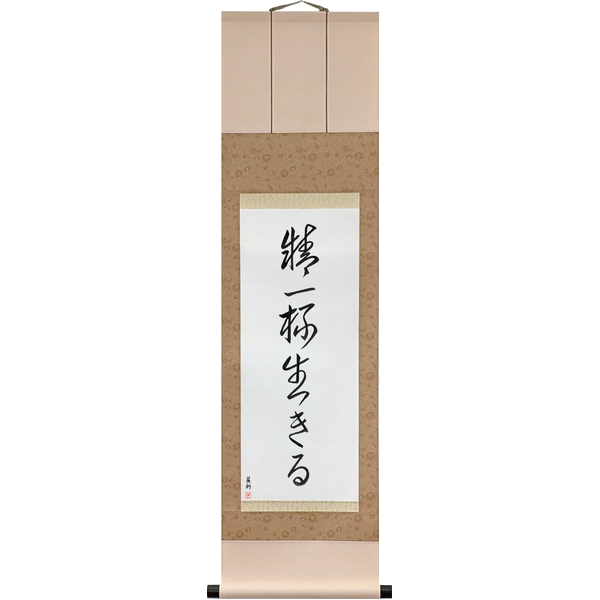
Sold as Live Life · Live Strong · Born Free · Live Laugh Love · Read seiippai ikiru · tsuyoku ikiru · jiyū ni umarete · ikiru warau aisuru · Register plain spoken Japanese, verbs in the dictionary form, which is how a resolution is written · Oldest witness 強く生きる in a 1914 book on the new generation that lists it among the catchwords of the day, and in Yosano Akiko's own hand in 1918; the other three in no Japanese book to 1946 · Sense four ways to say live: with all your strength, strongly, free from birth, and the English poster's three verbs.
The sense: three verbs and a manner
Every phrase here ends in a verb of living, and three of the four are the house's Japanese for an English line. 精一杯生きる, live with all you have, and 生きる笑う愛する, live, laugh, love, are in no Japanese book the library holds to 1946, and neither is 自由に生まれて, born free; they are grammatical, they read at once, and they are what a bilingual calligrapher writes for a customer who brings the English. 強く生きる, live strong, is different: it was a slogan in Japanese before it was one in English. A 1914 book on the young names it among the phrases much used of late, alongside live deeply and the true life; Yosano Akiko wants it for the whole nation in 1918 and takes care to say it does not mean armed strength; the Christian socialist Kagawa Toyohiko shouts it in 1920. A buyer who wants live strong on a scroll is getting a phrase with a Taishō life of its own.
The words
生きる ikiru, to live, is the verb under all four. デジタル大辞泉: 人間・動物などが、生命があり活動できる状態にある。生命を保つ。生存する, to be in the state of having life and being able to act; to keep life; to exist, then to make a living, then to live in or for something, 研究一筋に生きる. 精選版日本国語大辞典 cites it from the 宇治拾遺物語 of about 1221, この里の人々、とく逃げのきて命いきよ, people of this village, flee quickly and live. 笑う warau, to laugh, is cited from 794; 愛する aisuru, to love, from the 大鏡, and the dictionary's note on the word is worth the whole design: in the mid-Meiji period it was adopted as the translation of English love and German lieben, and as a result of being joined to the Western idea of love it came to express, toward persons, affection between equals. The three verbs of 生きる笑う愛する are set side by side in their dictionary forms with no particle, as the English poster sets them. [kotobank.jp/word/生きる · /word/笑う · /word/愛する, text; read by the investigator]
精一杯 seiippai: 持っている力のすべてを出すこと。力のかぎり。できるかぎり, putting out all the strength one has; to the limit of one's strength; as much as one can, an adverb, first cited from a 1766 puppet play. 強く tsuyoku is the adverb of 強い, strong. 自由 jiyū, freedom, is old in the sense as one pleases, cited from 777, and new in the sense the design means: Fukuzawa wrote in 1866 that the translations 自由 for liberty and 通義 for right do not suffice for the original sense, and the Meiji Constitution of 1889 fixed the word in 居住及移転の自由, freedom of residence and movement. 生まれて umarete is the connective form of 生まれる, 子が母親の胎内から出る。…出生する。誕生する, to come from the mother's womb; to be born, cited from the 万葉集, うぐひすの卵の中にほととぎす独り所生て, in the warbler's eggs a cuckoo alone is born; so the phrase is a fragment, born free and …, the way the English title is. [kotobank.jp/word/精一杯 · /word/自由, text, read by the investigator; kotobank.jp/word/生れる-441450, text, read by the seat s49, since the bare address /word/生まれる serves a 2011 television drama of that title]
The English words are the same words. Live covers 生きる exactly; the difference is in what each language does without a subject. English live strong is an imperative and 強く生きる is not: the Japanese dictionary form is a statement of what one does or intends, which is why these phrases read as resolutions rather than commands, and why a rendering should not put an exclamation mark after them. [jisho.org/word/生きる · /word/精一杯 · /word/自由に, text]
A history, from the earliest witness
1914. 強く生きる is already a catchword. A book on the young of the new era lists the phrases everyone is using: 「緊張した生活」とか、「充實した生活」とか、「眞實なる生活、」「深く生きる」「强く生きる」と云ふ類の言葉が近頃盛んに用ゐられて, the tense life, the full life, the true life, live deeply, live strongly: words of this kind have been much used of late, and calls them painful words expressing the demands of the present age. That is the phrase's first appearance in the library, and it appears as something already worn. [石田新太郎『新時代の青年』籾山書店 1914, NDL pid 951972, koma 200, OCR]
1918. Yosano Akiko. In a letter to the young on Japan's attitude in the Ishii–Lansing agreement, the poet writes: 私は日本人の強くなることを欲します。個人としても、國民としても、世界人としても、強く生きることを欲します。併し私は腕力の延長である武力にのみ強いことを以て強く生きることの全部であるとは考へません, I want the Japanese to become strong. As individuals, as a nation, as people of the world, I want us to live strongly. But I do not think that being strong only in armed force, which is the extension of physical force, is the whole of living strongly; the strength she means is 情感的、倫理的、科學的、勞働的、經濟的、藝術的, of feeling, of ethics, of science, of work, of economy, of art. [与謝野晶子『若き友へ』白水社 1918, 日米協約に現れた我國の態度, printed pp. 230–231, NDL pid 959390, koma 122, by eye, the list of strengths running on to koma 123; the leaf prints 強 where the OCR reads 强]
1920. Kagawa. The Christian reformer Kagawa Toyohiko, in a prose poem addressed to his own soul: 私の魂は强く生きる。噴火口の烟の如く海洋の潮の如く、强く生きる。私の靈は自殺することが出來ない, my soul lives strong; like the smoke of a crater, like the tide of the ocean, it lives strong; my spirit cannot kill itself. Between 1914 and 1946 the library holds 207 books with the phrase, most of them of this Taishō kind, essays on how to live. [賀川豊彦『地殻を破つて』福永書店 1920, NDL pid 963084, koma 9, OCR]
The other three, to 1946: nothing. 精一杯生きる, 自由に生まれて and 生きる笑う愛する return no page in the Library's full-text search of its public-domain books. The first is ordinary modern Japanese that happens not to be printed before the war; the second and third are English sentences the house has put into Japanese. [labsearch_house_19.txt, the Lab full-text API, three searches, 0 · 0 · 0]
What is not a source
No Japanese text stands behind any of the four. 強く生きる has witnesses, not an author; it is what the Taishō essayists said to one another. The other three have their sources in English, below, and the Japanese is the house's.
The phrases in English
Born Free is the 1966 British film of Joy and George Adamson raising the lioness Elsa in Kenya and returning her to the wild, and the song John Barry and Don Black wrote for it, which won the Academy Award for Best Original Song; the house's catalogue note names the film, and the design's fragment 自由に生まれて, born free and…, is a fair carrying of the title, which is also a fragment. [en.wikipedia.org/wiki/Born_Free · /wiki/Born_Free_(Matt_Monro_song), text]
Live, Laugh, Love is the three-word slogan of motivational posters and home décor of the late 2000s and early 2010s; the encyclopedia traces it to Bessie Anderson Stanley's 1904 poem Success, he achieved success who has lived well, laughed often, and loved much. The design's three verbs are the slogan's, in order. [en.wikipedia.org/wiki/Live,_Laugh,_Love, text]
Live strong and live life have no source the house names. What a rendering of any of the four must keep is the verb's mood: these are resolutions, not orders, and the Japanese dictionary form says so. The house's Live Life for 精一杯生きる loses the adverb, and the catalogue's own gloss, live life to its fullest, is the better English.
A reading
The one of these four with a Japanese past is the one an English speaker would least expect to have one. 強く生きる was a phrase of the Taishō magazines before it was a wristband, and Yosano Akiko's sentence, that living strongly is not the same as being strong in arms, is a better account of the design than any I could write. The other three are honest house Japanese for English lines, and the pages should say so, because a buyer who is told that live, laugh, love is an old Japanese saying has been told something false, and a buyer who is told it is her English in a master's brush has been told the truth and something worth having. Signed, the philologist, 2026-09-06.
Notes
- The 1914 list. Ishida's sentence places 強く生きる with 深く生きる, live deeply, and 充實した生活, the full life, as the age's catchwords; the encyclopedic sense of live strong in Japanese is a Taishō idealism, not an athletic one.
- 強 and 强. The 1918 leaf prints the standard 強; the OCR layer of every witness here reads the variant 强. The history quotes the OCR where it cites OCR.
- Romaji. The catalogue writes seiippai solid and jiyuu; the page carries the macron form jiyū. Both are one word; sei-ippai with a hyphen is the other common spelling and is not wrong.
- The order of the three verbs in 961 is the English slogan's, and the design keeps it; there is no Japanese order to prefer.
How this was read
A bracket that names a National Diet Library leaf as pid and koma resolves at lab.ndl.go.jp/dl/api/page/<pid>_<koma> for the OCR text and at dl.ndl.go.jp/api/iiif/<pid>/R<koma, seven digits>/full/2400,/0/default.jpg for the image. By eye at the page: Yosano Akiko's 若き友へ at pp. 230–231 (pid 959390, koma 122). By OCR, own-hand at the koma: the 1914 and 1920 books. By the Lab's full-text search, own-hand, the whole result set of each phrase sorted by year (0 · 207 · 0 · 0). By text: the kotobank entries for 生きる, 笑う, 愛する, 精一杯, 強く, 自由 and 生まれる, read whole by investigate-ten on 2026-09-05 and quoted from its reading files, not re-opened by the seat; the EDRDG glosses at jisho; the English Wikipedia articles on Born Free, its song, and Live, Laugh, Love, pulled through the parse API. Not opened: the other 204 pages with 強く生きる; the Livestrong Foundation's own account of live strong; Stanley's poem at a dated address; an English dictionary.
References
- 129 誇りと喜び (164 books; 1937) — F0056
- 164 子供の為に (1,684 books; 1912) — F6000
- 222 家族は永遠 (2 books; 1924) — F6058
- 291 自分を信じる (39 books; 1946) — I6002
- 295 精一杯生きる (0) — I6006
- 299 強く生きる (207 books; 1937) — I6010
- 319 希望は最大の宝 (0) — I6030
- 327 自由に生まれて (0) — I6038
- 331 新たな始まり (1 book; 1948) — I6042
- 415 永遠に心の中に (1 book; 1927) — L5033
- 418 永遠に私の心に (3 books; 1935, 1941) — L5036
- 566 危険を冒す (2,388 books; 1897 among the first five) — M6013
- 961 生きる笑う愛する (0) — S0000
- 968 誕生日おめでとうございます (0) — S0007
- 988 有難う御座います (1,739 books; 1914 among the first five) — S0030
- 1010 ゴルファー (50 books; 日国 初出 1930) — S5009
- 392 禁じられた愛 (1 book; 1924) — L5010
- 834 永遠の若さ (202 books) — P4103
- 627 母なる自然 (85 books) — N4014