

最愛 · saiai · Beloved
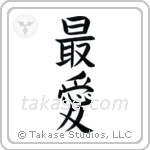
Sold as Beloved · Read saiai, two graphs, a noun that also serves as an adjective with の · Register Sino-Japanese and solemn: the word of the eulogy, the prayer, the will and the love letter, and since 1984 of three hit songs and a television drama · Sense the one you love most, and, in its second sense, the bond between a man and a woman, husband and wife.
The words
最 is the superlative, most of all: the 最 of 最高, the highest, and of 最勝, the Buddha as the most excellent. 愛 is to be partial to someone, to hold them dear, to love. Put together they say most loved, and the Japanese dictionaries add the thing that matters for a design: the word is not only the loving but the person. The great national dictionary's first sense is to love most deeply; also, the one so loved, and its second sense is a different thing altogether: a man and a woman, or husband and wife, being close and loving; that bond. So 最愛 can name a person, and it can name a marriage. The first citation for the first sense is a wife; the first for the second is a marriage that produced a son. Neither meaning is old-fashioned. The current 大辞泉 gives the same two, with the examples my most-beloved child and to lose one's most-beloved wife.
Where it comes from
Both graphs are Chinese, and the pair occurs in Chinese, but only as a phrase that needs an object: what I most love is … Bai Juyi ends his poem on West Lake in spring with 最愛湖東行不足, what I love most is the east shore, and I cannot walk it enough, and the Chinese and Korean verse that Japanese presses reprinted uses the two graphs the same way. The Taiwan Ministry of Education dictionary has no headword for them; in Chinese they are not a word. Japanese made them one. The Utsuho monogatari, written in the last decades of the tenth century, already has さいあひの妻, a most-beloved wife, as a thing a man might have and be gossiped about for; the Heike has Kiyomori 最愛して the dancer Giō; the Gukanshō of 1220 has a couple become 最愛の中, most-loving with each other, and have a son. The Sand and Pebbles of 1283 tells the most famous scene the word is in: Saigyō, on the day he resolved to leave the world, with his most-beloved only daughter clinging to him, kicking her from the veranda and hardening his heart. The same book has a woman inconsolable for her 最愛の一子. By the Muromachi period a lady in a tale さいあひして the governor of Yamato, lives with him as a loving wife, and bears him many children. The word arrived in Japanese as the person one loves most, and from the first that person was most often a wife.
The word in print, to 1949
The National Diet Library's full-text index of Japan's public-domain books holds 14,390 pages that carry the word, and what follows it is the measure of what it meant. In the ten thousand pages the index returns, 最愛の妻, most-beloved wife, appears 1,435 times; the child 591; the husband 365; the daughter 318; the person 158; then the younger brother, the little one, the sister, the friend, the mother. It is the word of the law: an 1897 lecture on inheritance explains that the estate goes to the nearest descendant because a man is presumed to leave what he has to the one he loves most, 最愛の者に. It is the word of the church: a 1912 Japanese translation of Liguori prays 最愛の耶穌よ … 永遠に私の王となり給へ, most-beloved Jesus, be my king for eternity, and a 1910 life of Mary has 最愛の御子. It is the word of the eulogy: a mother who has lost her most-beloved child and visits only the grave (1908); Nogi's most-beloved younger brother killed in the rebellion of 1876 (1917); a woman who has lost her most-beloved husband (1921); a city mourning Schiller as if each had lost a most-beloved friend (1920). And it is the word of the one and only. A 1924 lecture on marriage: if you say to someone "you are my most-beloved man" or "my most-beloved woman," and there are two people you love, you are lying; where there are two, neither can be called 最愛 — and, on the next page, the infinite value of a most-beloved wife, a most-beloved husband, lies in there being only one of them in your heart. A translation of Chopin's letters (1942) opens one 最愛なる人よ, dearest. A Meiji philologist, explaining the oldest Japanese word for one's beloved, the Man'yō poets' 我妹, glosses it わが最愛の妹.
The text in English
The English has not changed since the first Japanese-English dictionary to carry the word. Hepburn's second edition (1872): Most beloved, well beloved. His third (1886), with the Japanese gloss mottomo aisuru: Most beloved, well beloved: — no ko, dearly beloved child. Brinkley (1896): Dearest or most beloved. Sai-ai no ko, dearest child. Saitō's great dictionary of 1928: Dearest; beloved; darling, with the examples a darling child, a beloved friend, and for 最愛の妻 the wife of one's bosom. Kenkyūsha's big dictionary in its wartime American printing (1942): most dear; dearest; beloved; nearest one's heart. Kenkyūsha's college dictionary, 1983 and current: one's dearest [beloved]. The open dictionary every app draws on: beloved; dearest. The house title Beloved is the second word of Hepburn's 1872 line, and a customer's AI that offers my most beloved, dearest, the person I love most deeply is handing him a century and a half of lexicography.
The word now
It is alive, and it stands alone. Japanese Wikipedia carries it on 3,627 pages. Three hit records are titled with the bare word, Kashiwabara Yoshie's single and album of 1984 and the KOH+ song of 2008 that Fukuyama Masaharu wrote as the theme of The Devotion of Suspect X; a TBS drama of 2021 is titled 最愛; national anthems are rendered 最愛の祖国 and 最愛の地; the encyclopedia calls the Prophet's wives 最愛の妻 and the emperor's Fujitsubo in the Genji 最愛の藤壺. It has even become a girl's given name, read Moa: the name dictionary lists it, and a member of the band Babymetal carries it. A word that parents give their daughters and that a network puts alone on a title card is a word that reads as itself on skin.
A reading
Signed 典, 2026-09-11. Yes. 最愛 is the right word, the natural word, and the oldest word Japanese has for the person one loves most, and the first person it was ever recorded of was a wife. It carries, as a second meaning, the bond of a married couple, so a design made for a wife stands inside the word twice. It names the person as well as the love, which is why it can stand alone without の人, and why a network, a songwriter and a thousand parents have used it alone. Its register is the solemn one: it is spoken most often over the greatest losses because it names the greatest love, and it admits only one — a 1924 lecturer said in so many words that you cannot call two people 最愛. A buyer should be told that rather than protected from it; it is exactly what someone means who says for eternity. What the word does not carry is the eternity itself. 最愛 says most beloved and nothing about time; a design that wants forever must add a second word, or let a date beneath it say so, and the two-character form that says one thing whole is the stronger tattoo. The alternatives an AI might offer are each worse: 愛妻 is the domestic wife of the packed lunch; 恋人 is a sweetheart; 愛する人 is a clause, not a word; 永遠の愛 has no person in it; 最愛の人 is this word with a noun it does not need. In Chinese the two graphs are only a verb, what I love most is, so a Chinese reader sees a fragment where a Japanese reader sees a person; that is a fact about two languages, not a flaw in the design. No question for Eri: form, reading and register are settled by the witnesses.
How this was read
By text: the three dictionaries at kotobank and the four at Weblio, both as raw pages; Kroll's entries for the two graphs on the shelf; Bai Juyi at Wikisource; the Taiwan dictionary's API; the Japanese Wikipedia search, the first thirty of 3,627 read. By OCR: the National Diet Library's full-text index, 10,000 of 14,390 pages measured for decade and for the noun that follows; three books opened whole at the leaf (the Sand and Pebbles at koma 8 and 22, a Meiji kagura commentary, a Meiji newspaper broadsheet); Hepburn's 1872 and 1886 and Brinkley's 1896 dictionaries from the shelf; the Meiji, Taishō and wartime witnesses as the index's own snippets, each with its book number. Reported, not read at the text: the Utsuho, the Heike, the Gukanshō and the Muromachi tale, from the national dictionary. Not opened: the Chinese Text Project, which refuses automated reading; the Buddhist canon at CBETA; Hepburn 1867 by eye; the template by eye; Saitō's 1915 Japanese-English and the current Kenkyūsha J-E, neither on the shelf. No customer, letter or name is in this account; the word is.
References
Each witness is cited in the account above, at the frame or entry where it was read. A linked list follows when the record for this text is completed.