無心 mushin No-Mindedness
This is a philological study of 無心 (mushin), the Zen word for the mind that stops nowhere, following it from the 莊子 and the court poets of the ninth century through the sword masters of the seventeenth to the English books that made it no-mind.
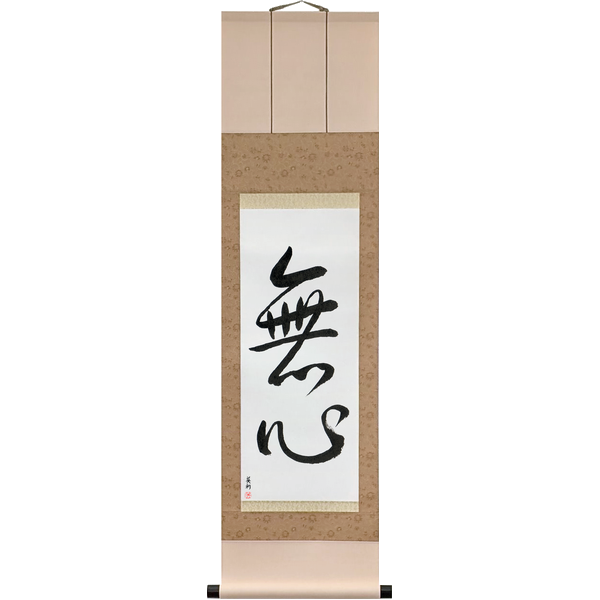
No-Mindedness (mushin) on a traditional Japanese Scroll by Master Eri Takase.
Abstract
無心 (mushin) is a Sino-Japanese compound, 無 no and 心 heart-mind, that has been a Japanese word since the court anthologies of 814 and 818 and has led at least four lives, the insentient, the innocent or artless, the mind free of fixation that the Zen tradition made a term, and the comic register of medieval linked verse, and in modern speech is also the verb for asking someone for money. The Chinese word is older, three times in the 莊子 and a term of art in Guo Xiang's commentary five centuries before the Zen masters took it up, and the history below finds that the sword-Zen definition the design carries, Takuan's and Munenori's, denies the literal reading in so many words, 無心とて一切心なきにあらず、唯平常心也, no-mind does not mean having no mind at all; it is only the ordinary mind, a denial the English translators have had to repeat ever since. The word was an English dictionary headword from 1867, for the begging sense first, while the Zen sense entered English print through Suzuki Daisetsu 鈴木大拙, as no-mind and no-mind-ness, between 1930 and 1938, and the bilingual dictionaries admitted it only decades later. The house title, No-Mindedness, is Kenkyūsha's word.
Overview
The sense. A word of every register, 仏語 in one of its senses and plain speech in the others. デジタル大辞泉 gives nine: 無邪気なこと, innocence; 意志・感情の働きがないこと, without will or feeling; the Buddhist sense in two parts, ㋐ 心の働きが休止した状態, the state in which the mind's working is at rest, and ㋑ 一切の妄念を離れた心, the mind free of all deluded thought, opposed to 有心; the 和歌・連歌の滑稽, the comic mode of waka and renga; 狂歌; three older senses of wanting judgment, taste or sympathy, each with its Heian witness; and the noun-verb 金品をねだること, pestering someone for money or goods [1]. 精選版 日本国語大辞典 sorts these into four families and dates each: (一) the want of discernment, taste or feeling, from the 枕草子 and the 宇津保物語 of the tenth century; (二) the Buddhist mind, 心の働きが休止した状態 and 妄念を離れた心, from the 正法眼蔵 (1231–53) and the 学道用心集 (1234), with the sense of the artless, unintending mind first in the 文華秀麗集 of 818; (三) the insentient, 心のないもの, first in the 凌雲集 of 814; and (四) the comic register of waka and renga, from the 八雲御抄 (about 1242) and the 井蛙抄 (1362–64) [1]. 上条彰次, in the 改訂新版 世界大百科事典, draws the four into one history: the Heian 有心/無心 as discernment and its want, the medieval pair as two literary registers, the Buddhist 無心 as 大乗仏教最高の境地, the highest state of Mahāyāna Buddhism, made an artistic ideal in Zeami's 無心無風の位 and carried on, in his account, in Bashō's 風雅の誠, Ryōkan's 任運 and Sōseki's 則天去私 [1]. English has no word for any of this. No-mind is a calque of the Buddhist sense and nothing else; innocence covers the first family and insentient the third; the comic register and the begging verb have no English at all, and a translator meeting them must explain rather than render. The Japanese words that cover what no-mind leaves out are the word's own neighbors: 無念, no-thought, which the Zen tradition pairs with it and English often collapses into it; 平常心, the ordinary mind, which Munenori says is what 無心 means; and 不動心, the immovable mind, which is Takuan's subject and the design that stands beside this one in the catalogue.
The words. 無 negates and 心 is the heart that thinks and feels, the one word in Japanese for both. The 字通 glosses the compound 自然のまま, as it naturally is [1], and the Kodansha encyclopedia gives its native equivalent, kokoronashi 心なし, lacking heart or depth of feeling, the older Japanese sense [2]. The reading is mushin, the only reading every witness gives; the 日国 notes むじん for one sub-sense of the first family only [1], and a print of 1648 writes the reading out as furigana beside the renga term, むしん, three times on one leaf [3]. The Chinese editions write the first character two ways, 無 and its short form 无; the Kanseki Repository's 莊子 writes 无 throughout, so that the word is 无心 there and 無心 in Guo Xiang's commentary, one word in two glyphs [4][5]. The design writes 無心.
The text in English. The bilingual dictionaries had the word for more than a century before they had the Zen sense. James Curtis Hepburn's dictionary of 1867 enters it for the begging sense only [6]; his second edition of 1872 puts without heart or mind, inanimate; innocent in front of it [7], and his third of 1886 adds unintentional [8]. Brinkley's dictionary of 1896 has without heart or mind: without feeling; senseless; indifferent; unconcerned and the colloquial asking for, begging [9]; Yamaguchi and Irie's of 1907 absence of mind [10]; Inouye's of 1909 innocence; a request [11]; Kenkyūsha's of 1942 innocence … involuntary; mechanical … insentient plants and a request [12]. None of them gives the Buddhist sense. That sense reached English by another road: E. J. Harrison's book on the Japanese martial spirit of 1913 glosses 無念無心 without idea and without mind [13]; Suzuki wrote no-mind-ness in 1930 for a Sanskrit term [14], kept mushin untranslated in his 1935 rendering of Huangbo with a note that it is very difficult to find an English word corresponding to it [15], and in 1938 wrote mushin, "no-mind-ness" and no-mind of the swordsman's mind [16]; his book of 1949 put No-Mind in a title [17], and the 1959 Zen and Japanese Culture fixed the equation mushin (wu-hsin in Chinese), "no-mind" for English readers [18]. The dictionaries caught up late: Kenkyūsha's 新和英中辞典 has 【禅】no-mindedness; mindlessness in its third edition of 1983 [19], and its current text at Weblio keeps that line [20]. JMdict today gives innocence, mind free of obstructive thoughts; detachment; no-mind, insentient and pestering for money [21].
The historical record
Fourth to third century BCE, the 莊子, in the chapters 天地 and 知北遊. The oldest text with the word, in the edition that writes 无: 《記》曰:「通於一而萬事畢。无心得而鬼神服。」, the Record says: penetrate the One and the ten thousand affairs are done; attain no-mind and the ghosts and spirits submit; and, of the sage in 知北遊, 媒媒晦晦,无心而不可與謀, dim and dark, without mind, one you cannot take counsel with [4]. Here the word is a state of the sage: a mind that does not plan.
About 300, Guo Xiang 郭象, the commentary on the 莊子. The word becomes a term. Guo Xiang's headnote to 人間世 reads 唯無心而不自用者為能, only one who has no mind and does not use himself is able, and his headnote to 大宗師 其所宗而師者無心也, what is honored and taken as master is no-mind [5]. Wing-tsit Chan, translating Guo Xiang in 1963, renders it no deliberate mind of one's own and adds that the Zen doctrine is not a Zen invention. It goes back to Taoism, Neo-Taoism, and the Early Seven Schools of Buddhism [22].
405, Tao Yuanming 陶淵明, 歸去來辭. The literary line every later East Asian reader knows: 雲無心以出岫,鳥倦飛而知還, the clouds, with no mind, leave the peaks; the birds, tired of flying, know to return; the apparatus records 而 for 以 in one text [23]. The clouds' 無心 is the insentient thing that acts without intending, and the line was carried into the Zen phrase books, where Victor Sōgen Hori renders it Without a thought, clouds float off the mountain peaks [24].
814, the 凌雲集, the first imperial anthology of Chinese verse in Japan, in the typeset of 1926. The 日国's earliest Japanese witness. 高丘宿禰第越, in a poem on falling blossoms at a palace banquet, 雜言「於神泉侍宴賦落花篇應製」: 無心草木猶餘戀, even the heartless grass and trees still keep some longing [25]. The word is the insentient, given a pathetic turn.
818, the 文華秀麗集, the second imperial anthology, Emperor Saga 嵯峨天皇, 舞蝶. 數羣胡蝶飛亂空。雜色紛紛花樹中。本自不因絃管響。無心處處舞春風, flock on flock of butterflies fly tangled through the air, colors scattered among the flowering trees; not for any sound of strings or pipes, with no mind they dance everywhere in the spring wind [26]. The 日国 files this line under the Buddhist family, for the artless mind; it stands at the edge between the insentient and the innocent.
857, Huangbo Xiyun 黄檗希運, the 傳心法要. The Zen sense, in the sermon that made it a watchword: 供養十方諸佛。不如供養一個無心道人。何故。無心者無一切心也, to make offerings to all the buddhas of the ten directions is not equal to making an offering to one man of the way who has no mind; why? no-mind means having no mind of any kind; and 但能無心。便是究竟, only be without mind, and that is the ultimate [27]. This is the text Suzuki translated in 1935 with the word left in Japanese [15].
A Dunhuang manuscript, the 無心論, attributed to Bodhidharma. A dialogue built to define the term: 今且假立二人共談無心之論矣, let us now set up two persons and have them discuss the doctrine of no-mind [28]. The attribution is the manuscript's; the Princeton dictionary enters the text under Wuxin lun [29].
The 六祖壇經, in the Yuan recension. 有道者得,無心者通, one who has the Way attains it; one who has no mind penetrates it [30], which Yampolsky renders The possessor of Tao will get it and the one with no-mind will penetrate it [31].
1231 to 1253, Dōgen 道元, the 正法眼蔵, and 1234, the 学道用心集. The 日国's earliest Japanese witnesses for the Buddhist family: 三界唯心 有心あり、無心あり, there is having mind and there is no-mind, and 仏法以有心不可得。以無心不可得, the Buddha-dharma cannot be grasped by having mind, nor by having no mind [1]. The second is the tradition's own warning against reading the word as a state to be held.
1362 to 1364, the 井蛙抄, in the print of 1648. The literary register, with the reading in the print. 六条内府被語云後鳥羽院御時柿本栗本とてをかれ柿本はよのつねの哥是を有心と名つく栗本は狂歌是を無心といふ, the Rokujō minister told it: in Go-Toba's time there were the kakinomoto and the kurinomoto; the kakinomoto were the ordinary poems, which they named ushin, and the kurinomoto were the comic poems, which they called mushin, and the print writes うしん and むしん beside the words [3]. The leaf that follows tells the exchange at the Minase poetry office, where the 有心 and 無心 poets sat in two halls with a garden and a great pine between them: Jichin 慈鎮 sent from the 有心 side 心あると心なきとか中に又いかにきけとや庭の松風, between those with heart and those without, how does the wind in the garden pine ask to be heard?, and Muneyuki 宗行 answered 心なしと人はのたまへと耳しあれはきゝさふらふそ軒の松風, heartless, you call us; but we have ears, and we hear the wind in the pine by the eaves [3]. The renga 無心 is 心なし heard as heartless, and the pun is the register's own definition.
About 1424, Zeami 世阿弥, the 花鏡, in the typeset of 1909. In the section 覺習條々: せぬにてはあるへからず、無心の位にて、我心をわれにもかくす安心にて、せぬひまの前後をつなくへし、是則万能を一心にてつなく感力也, it must not be that one does nothing; at the level of no-mind, with a settled mind that hides one's own mind even from oneself, one must bind the moments before and after the interval of not doing; this is the power of feeling that binds all the arts with one mind, followed at once by the Zen verse 生死去來、棚頭傀儡、一線斷時、落々磊々 [32]. Two leaves on, the highest art, the 冷たる曲 that only the finished master reaches, これを心より出來る能とも云、無心の能とも申也, is called the nō that comes from the mind, and also the nō of no-mind [32]. The verse Zeami sets beside the word is the page's own evidence that his 無心 is the Zen word and not only the literary one.
1632, Yagyū Munenori 柳生宗矩, the 兵法家伝書, in the typeset of 1937. The sword's definition, which denies the literal reading: 無心なる時皆あたる也、無心とて一切心なきにあらず、唯平常心也, when one is without mind every stroke lands; but no-mind does not mean having no mind at all; it is only the ordinary mind, hung on the Zen line 木人如對花鳥, a wooden man facing flowers and birds, and on the next page 常の心を無心とは云也, the ordinary mind is what is called no-mind [33].
About the 1630s, Takuan Sōhō 沢庵宗彭, the 不動智神妙録, in the print of 1884. The letter to Munenori sets 有心の心 against 無心の心: 有心の心と申ハ則右申す忘心と同じ事にて候有心とハあるこゝろと書申候何事にても一方に思ひ詰たる所あれバ分別思案が生る程に有心の心と申候無心の心とハ右の本心と同し事にて候止る所がなけれバ心は何もなしなにもなけれバ無心の心にて候, the mind that has mind is the same as the deluded mind spoken of above; 有心 is written "the mind that is there"; wherever there is a place the thought has fixed on, discrimination and deliberation arise, and that is the mind that has mind; the mind of no-mind is the same as the original mind spoken of above; when there is no place it stops, the mind is nothing, and when it is nothing, that is the mind of no-mind; and, on the next leaf, 用の向ふ時出て用を叶ふるなり止心は働らかぬぞ, when a use presents itself it comes out and answers the use; a stopped mind does not work [34]. This print writes 忘心 where the later typesets write 妄心; see the Notes.
The same text in the typesets of 1921 and 1937. The 禅門法語全集 of 1921 heads the passages 本心妄心 and 有心之心無心之心, and closes the definition 心に何もなきを無心の心と申し、又は無心無念とも申候, having nothing in the mind is called the mind of no-mind, and is also called no-mind-no-thought [35]; the 秘籍大名文庫 text of 1937 carries the same headings and the fuller ice-and-water passage, 本心は水の如く一所に留らず、妄心は氷の如くにて, the original mind is like water and stays in no one place; the deluded mind is like ice [36]. 笠井哲, in the one recent Japanese study of Takuan's word, notes that Suzuki's chapter on Zen and swordsmanship quotes nearly eighty percent of the 不動智 and reads its 無心 alongside the concept of the unconscious [37].
1890, 吉本汶蒼, the 俳諧無心の効用. A Meiji haikai writer makes 無心 the principle of Bashō's school and answers the Neo-Confucian objection to the word: 然れとも無心といふ語は人或は枯木死灰の如き思ひを抱かんことを懼る程子人の問に答て曰無心とは謂ふへからす私心なしと謂ふへし, but with the word 無心 one fears people will imagine dead wood and cold ashes; Chengzi, answering a question, said: one should not say "no mind," one should say "no private mind" [38]. The objection Munenori answered in 1632 is answered again, in a haikai book, from the Song.
1925 and 1933, the 故事熟語辞典 and the 俚諺大辞典, two Taishō and early Shōwa phrase dictionaries. How the Chinese literary word was catalogued in Japanese: the 1925 dictionary files Tao Yuanming's 雲無心以出岫 under 雲岫, glosses 槁木死灰 as 人の無爲無心なるをいふ, said of a person's non-action and no-mind, and reads the empty boat of the 莊子 as a figure for 無心なるときは人の感情を害することなし, when one is without mind one injures no one's feelings [39]. The 1933 dictionary heads an entry with the saying 有意花を栽ゑて花發かず、無心柳を挿して柳陰, plant flowers on purpose and they do not bloom; stick in a willow without intending and it gives shade, and in another glosses 誠に無心禽獸も報恩酬德の心有るにや, even the mindless beasts, it seems, have the heart to repay a kindness [40]. Neither is the Zen sense; both are the word as a reader of proverbs met it.
What is not a source. 有心 is the word's antonym in every register, the Buddhist, the literary and the Heian, and each sense of 無心 is the negation of the matching sense of 有心 [1]. 無念, no-thought, is the twin the Zen tradition pairs with it, 無心無念 in Takuan [35]; Yampolsky notes that 無念 is often rendered as the equivalent of wu-hsin [31], and Suzuki writes that mushin and munen are synonymous [18], but they are two words. The koan phrase No mind, no Buddha that an English reader meets first on a Zen page is 非心非佛, Mazu's answer in the 無門関, and not this word [41]. The saying 無心是道, no-mind is the Way, which the Zen records give to Guishan, and Huangbo's no-mind is all minds, are uses of the word, not sources for it; Leighton's note on Dōgen names the 禅学大辞典 entry as the Japanese lexicographic address for both [42].
The word in English
1867, James Curtis Hepburn, A Japanese and English Dictionary, page 294. MU-SHIN, ムシン, 無心, (kokoro nashi). n. Reluctant request for something, begging with reluctance for something which one wants of another, with the phrases — wo iu, to make a request for something and Go — nagara kane wo kash'te kudasare, I feel very reluctant to request you to lend me some money, the dash standing for the headword [6]. The earliest known dictionary entry for the word in English, and the begging sense alone.
1872, Hepburn, second edition, page 342. Without heart or mind, inanimate; innocent; begging with reluctance for something which one wants of another, and at the end mushin na mono, inanimate things [7]. The insentient and the innocent are added in front of the 1867 sense.
1886, Hepburn, third edition, page 424. Without heart or mind, inanimate; (coll.) begging with reluctance for something which one wants of another; unintentional [8]. Unintentional is new, the begging sense is now marked colloquial, and innocent is gone.
1896, Frank Brinkley, Nanjō Bun'yū and Iwasaki Yukichika, An Unabridged Japanese-English Dictionary, page 975. Without heart or mind: without feeling; senseless; indifferent; unconcerned, and second, marked colloquial, Asking for, begging [9].
1907, Yamaguchi Miki and Irie, A New Critical Japanese-English Dictionary. Absence of mind, and Mushin suru, to dun one for [10]. Absence of mind is the English idiom for inattention, and a reader who takes it so is misled.
1909, Inouye Jukichi 井上十吉, Inouye's Japanese-English Dictionary. Innocence (無邪気); a request (依頼) [11].
1913, E. J. Harrison, The Fighting Spirit of Japan, pages 51 and 161–162. The earliest known English printing of the Zen compound from a Japanese source: What is termed munen mushin (literally "without idea and without mind") is an essential factor in kiai, followed by a passage attributed to Takuan's 結縄集 on the state of total absence of mind (munen mushin); and, from an unnamed jūjutsu writer, This conduct is called muga-mushin; it is highly valued [13]. Harrison has the word from the martial arts, seventeen years before Suzuki's first no-mind.
1930, Daisetz Teitaro Suzuki, Studies in the Lankavatara Sutra. No-mind-ness (acittatva), of the Sanskrit term and not yet of the Japanese word [14]. The earliest known English print of the -ness form.
1932, Miyamori Asatarō, An Anthology of Haiku Ancient and Modern, page 26. The renga sense reaches English before the Zen sense: the writers of linked poems were divided into two antagonistic groups called respectively Ushin-ha (有心派) and Mushin-ha (無心派). The Ushin-ha or "Refined School" … The Mushin-ha or "Unrefined School" attached as great importance to the comic and humorous [43]. Unrefined is Miyamori's own English for the word, and no later hand kept it.
1935, Suzuki, Manual of Zen Buddhism. Translating Huangbo, Suzuki keeps the word, when once this state of mushin is attained it completes the Buddhist life, and explains in a note: Wu-hsin, or mu-shin in Japanese. The term literally means "no-mind" or "no-thought". It is very difficult to find an English word corresponding to it. "Unconsciousness" approaches it, but the connotation is too psychological [15]. The translation problem stated by the man who would settle it.
1938, Suzuki, Zen Buddhism and Its Influence on Japanese Culture, Kyoto. The sword-Zen no-mind in Suzuki's own English, twenty years before the book most readers know: the mysterious state of mind known as mushin, "no-mind-ness"; ushin, "mind present" and mushin, "no-mind"; "no-thought" (mushin or munen); and a mind of "no-mind-ness" according to the great Zen master, Takuan [16].
1942, Takenobu Yoshitarō, Kenkyusha's New Japanese-English Dictionary, page 1293. 1. Innocence. ~no a. Innocent; unsophisticated; involuntary; mechanical … insentient plants. 2. A request, the book tagging involuntary with 無意志 in its own brackets [12]. Four years after Suzuki's book, the dictionary still has no Buddhist sense.
1949, Suzuki, The Zen Doctrine of No-Mind, London. The word in a title, on the Platform Sutra's 無念 as much as on 無心 [17]; Yampolsky's note on 無念 sends the reader here, D. T. Suzuki has devoted a book to the general subject [31].
1958, John Blofeld, The Zen Teaching of Huang Po. A translator measuring himself against Suzuki: Compare this with Professor Suzuki's: "That which is known as mind in discursive reasoning is no-mind, though without this Mind cannot be reached", and in his own rendering Mind in itself is not mind, yet neither is it no-mind. To say that Mind is no-mind implies something existent [44].
1959, Suzuki, Zen and Japanese Culture, pages 94, 99, 110–114 and 147. The book that fixed the English: mushin (wu-hsin in Chinese), "no-mind." In Buddhist phraseology, it means going beyond the dualism of all forms of life; a state of no-mind-ness (mushin) or of no-thought-ness (munen) prevails; the section on Takuan titled The Mind of No-Mind (Mushin no Shin), opening A mind unconscious of itself is a mind that is not at all disturbed by affects of any kind. It is the original mind and not the delusive one, and It is also called munen, "no-thought." Mushin and munen are synonymous; and, of the swordsman, "the mind that is no-mind" (mushin no shin) [18]. Suzuki's delusive one renders Takuan's 妄心.
1961, Robert H. Brower and Earl Miner, Japanese Court Poetry, pages 508–509. The critical sense, defined for English readers of waka: MUSHIN. Careless, not serious, comic. The unconventional RENGA or HAIKAI as opposed to the serious (ushin) renga … Term also used as the negative of kokoro ari or ushin in the waka [45].
1963, Wing-tsit Chan, A Source Book in Chinese Philosophy, pages 317, 341 and 790. The one English hand that reads the word from Guo Xiang rather than from Zen: the sage has "no deliberate mind of his own" (wu-hsin) but responds to them spontaneously without any discrimination; on the Platform Sutra, Nor is it a Zen invention. It goes back to Taoism, Neo-Taoism, and the Early Seven Schools of Buddhism, all of which taught "having no mind of one's own"; and in the glossary, wu-hsin is not just "no mind" but "no deliberate mind of one's own" [22].
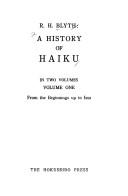
1963, R. H. Blyth, A History of Haiku, volume 1, pages 42–43. The 井蛙抄 anecdote in its one English telling: The words mushin, 無心, and ushin, 有心, were used in the same way. Mushin refers to wit and humour, and was considered to show insincerity as contrasted with ushin poems; then the Minase exchange, with Muneyuki's reply as People say / We are "Mindless," / But we have ears all right, / So we listen to the breeze / In the pine tree of the garden, and Blyth's verdict, This is the spirit of haiku [46].
1965, the Japanese-English Buddhist Dictionary, Daitō Shuppansha, page 204. Mushin 無心 Non-existence of shin (mind, intellect, etc.). This word has a wide variety of meanings. In zen it usually indicates naturalness or freedom from discriminative thinking. It is thus akin to enlightenment. In the Yuishiki, mushin refers to the five states (goi-mushin) in which the ishiki does not function [47]. The first dictionary on this page to set the Yogācāra sense beside the Zen one.
1967, Philip B. Yampolsky, The Platform Sutra of the Sixth Patriarch. The possessor of Tao will get it and the one with no-mind will penetrate it, and the note on 無念: Often rendered as the equivalent of wu-hsin, which the book glosses in its own brackets as no mind, A term widely used in Ch'an, it is considered one of the most important and characteristic elements [31]. The equation of the two words, stated by the sutra's translator.
1969, Chang Chung-yuan, Original Teachings of Ch'an Buddhism, pages 6–7 and 20–22. Niutou Farong 牛頭法融 in English: The moment when the mind is in action is the moment at which no-mind acts … No-mind is that which is in action; it is that constant action which does not act [48].
1971, Suzuki, Sengai: The Zen Master, pages 12 and 182. Bergson's "absent-mindedness" corresponds to Buddhist terms such as no-ego-ness (muga, anatman), no-thought (munen), or no-mind (mushin, acitta), everyday-mindedness (heijō-shin); and of Deshan 徳山, identifies buji, the word supplied in the book's own brackets, with mushin, no-mindedness: "No mind in work, no work in mind" [49]. Suzuki still writing no-mindedness in his last book.
1974, Zenkei Shibayama, Zen Comments on the Mumonkan, pages 152 and 240. An old Zen Master said, "Tao with no-mind is in accord with man. Man with no-mind is in accord with Tao", which is Dongshan's 道無心合人、人無心合道; and, again and again in the same book, No mind, no Buddha, which is 非心非佛 and not this word [41].
1977, John Stevens, One Robe, One Bowl: The Zen Poetry of Ryōkan, page 15. With no-mind, blossoms invite the butterfly; / With no-mind, the butterfly visits the blossoms, with the note In this famous poem "no-mind" is mushin, the mind that abides nowhere, the mind free of contrivance [50]. Ryōkan 良寛, whom 上条彰次's lineage names, in English.
1979, Earl Miner, Japanese Linked Poetry, page 363. Mushin. "Lacking in kokoro, heart." Opposed to Ushin [51].
1983, Ichikawa Shigeharu 市川繁治郎, Kenkyusha's New Collegiate Japanese-English Dictionary, third edition, page 1208. 無心 〈無邪気〉innocence; 〈ねだること〉a request; 【禅】no-mindedness; mindlessness [19]. The earliest edition of the dictionary known to print the Zen sense, and the source of the house title's word.
1984, J. Thomas Rimer and Yamazaki Masakazu, On the Art of the Nō Drama, page 97. Zeami's 無心の位 rendered without the word: The actor must rise to a selfless level of art, imbued with a concentration that transcends his own consciousness, so that he can bind together the moments before and after that instant when "nothing happens" [52].
1985, Sato Hiroaki, The Sword and the Mind, page 117. Takuan's definition: The no-mind (mushin) is the same as the "true mind" (honshin). Neither congealing nor taking definite shape, it is a mind devoid of ideas and judgments, a mind that extends and spreads throughout your body [53].
1986, William Scott Wilson, The Unfettered Mind, page 32. The passage read on the leaf of 1884, in the English most readers know: The mind of the existent mind and the mind of no-mind. The Existent Mind is the same as the Confused Mind and is literally read as the "mind that exists."… The No-Mind is the same as the Right Mind. It neither congeals nor fixes itself in one place… It is also called No-Mind-No-Thought [54]. Confused Mind renders 妄心.
1991, Konishi Jin'ichi, A History of Japanese Literature, volume 3, pages 543–544. Zeami with the word kept: The actor must achieve a state of No-mind, with the romaji mushin no kurai in the book's own brackets, … the realm Zeami designates as the "stage of No-mind" (mushin no kurai) [55].
1991, Ingrid Fischer-Schreiber and others, The Shambhala Dictionary of Buddhism and Zen, pages 149 and 246. Mushin, Jap., colloquial, lit. "innocence", with detachment of mind, and Wu-hsin, Chin. for mushin [56].
1993, Japan: An Illustrated Encyclopedia, Kodansha, page 1022. Mushin (literally, "lacking heart or depth of feeling"). A term used in both literary aesthetics and Buddhism with quite different meanings … In Buddhism the term mushin denotes one who is free from mundane desires or attachments, i.e., one who is enlightened. In the same sense an innocent or guileless child is also described as mushin. The native Japanese equivalent of this borrowed Chinese term is kokoronashi [2].
1993, Onuma Hideharu with Dan and Jackie DeProspero, Kyudo: The Essence and Practice of Japanese Archery, page 22. The archer's denial of the literal reading, Munenori's sentence three centuries on: a state of consciousness known as mushin (no mind). For most of us, the concept of mushin seems foreign because we associate "no mind" with no thought—the equivalent of unconsciousness or even death. But mushin is not the elimination of thought, it is the elimination of the remnants of thought … In mushin, thought and action occur simultaneously [57].
2005, Thomas Cleary, Soul of the Samurai. A third English for Takuan's and Munenori's word: The normal mind is called unminding, and The unminding mind is the same thing as the aforementioned basic mind … Having nothing in mind is called the unminding mind; it is also called having no mind and no thoughts [58].
2012, Wilson, The Life-Giving Sword. Munenori's line of 1632 in English: No-Mind, however, is not a state of having no mind at all. It is simply your ordinary mind [59].
2014, Robert E. Buswell Jr. and Donald S. Lopez Jr., The Princeton Dictionary of Buddhism, page 1005. wuxin. (J. mushin; K. musim 無心). In Chinese, lit. "no-mind." The term wuxin appears in the Chinese classic the Zhuangzi, and a separate entry for the Wuxin lun [29]. The dictionary's claim about the 莊子 resolves at the lines quoted above [4].
2014, Norman Waddell, Poison Blossoms from a Thicket of Thorn, and 2009, Hakuin's Precious Mirror Cave. Hakuin 白隠, in English, against the quietist reading of the word: Those who would tell you that "no-thought, no-mind" is Zen, or "He who has nothing to do is truly noble," will never master the Buddha Way [60], and in the mouth of his teacher Shōju Rōjin 正受老人, seem to believe that Zen consists in merely achieving a state of non-seeking or non-attachment, no-thought, or no-mind. Not one of them seems to be aware that such ideas portend the demise of the Buddha's Dharma [61]. The eighteenth-century Rinzai polemic, which is Munenori's and Takuan's point made from the other side.
2018, A. Minh Nguyen, editor, New Essays in Japanese Aesthetics, pages 5–6 and 47. Nishida Kitarō in English: To empty the self and see things, for the self to be immersed in things, "no-mindedness" (mushin) or effortless acceptance of the grace of Amida (jinen-hōni) … these, I believe, are the states we Japanese strongly yearn for; and Yanagi Sōetsu: the Zen state of mushin ("no mind," "the mind without mind," or "the flowing mind") [62]. The house title's word, in a philosopher's mouth.
2019, Randolph S. Whitfield, Records of the Transmission of the Lamp, volume 7, note 169. The difficulty is the term 無心 wu xin, literally "lacking a … heart" – in 1960's Zen it was translated as "no-mind", which makes no sense to me. I have translated it as "open hearted", the ellipsis and the ending being the book's own bracketed insertions [63]. The dating is wrong by thirty years, as the entries above for 1930, 1935 and 1938 show; the note's own neighbor cites Suzuki's book of 1949.
Today. JMdict gives innocence, mind free of obstructive thoughts; detachment; no-mind (Buddhism), insentient and pestering for money [21], and the current Kenkyūsha 〈雑念のないこと〉【禅】no‐mindedness; mindlessness [20]. The design is sold as No-Mindedness (mushin), which is Kenkyūsha's word and renders the Buddhist family and no other. No-mind, Suzuki's word and the one most English books use, is the literal reading of the two characters, and the reading argued above from Munenori, Takuan, Onuma and Wilson is that the literal reading is what the tradition itself keeps denying. A rendering must keep both: that the negation falls on the fixed, deliberating mind and not on mind itself, and that the word has four other lives in Japanese, none of which the design carries.
A reading
The word is two characters and a negation, and the whole difficulty of it is what the negation falls on. Read literally, 無心 is no mind, and every English hand that took it literally has had to write a second sentence to take it back: Suzuki's it is very difficult to find an English word, Onuma's mushin is not the elimination of thought, Wilson's not a state of having no mind at all, Whitfield's which makes no sense to me. The Japanese tradition wrote that second sentence first. Munenori, in 1632, 無心とて一切心なきにあらず、唯平常心也; Takuan, that the mind of no-mind is the original mind, 本心, with nothing stopped in it; the haikai writer of 1890 reaching back to a Song Confucian for no private mind; and Dōgen, four centuries before them, that the dharma cannot be grasped by having no mind either. What the word denies is 止心, the stopped mind, the 妄心 that has fixed on one thing and so cannot answer the next. The water and ice of Takuan's letter are the whole doctrine: the same substance, one of them able to wash the hands and the other not. That is what a swordsman, an archer and an actor meant by the word, and it is a claim about attention, not about absence.
The history also shows that the Zen word was never only the Zen word. Guo Xiang had it as a philosophical term three centuries before Huangbo, and Chan was right in 1963 to say the Zen doctrine is not a Zen invention; the butterflies of 818 and the clouds of 405 had it as a description of things that act without intending; the poets of Go-Toba's court had it as a joke about themselves, heartless, and answered with their ears; and the Hepburns of 1867 met it first in the mouths of people asking for money, 御無心ながら, the very politeness of one who intends a great deal. A reader who learns only no-mind has learned one of five words. I would put the sense on the scroll as Munenori put it, the ordinary mind, and let the negation do what it does in Japanese: remove what stops the mind, and leave the mind.
On the English I sign this: the word came into English twice, and the second time was the one that stuck. Harrison had it in 1913 from a jūjutsu teacher, Miyamori in 1932 from the renga schools, and neither was heard; Suzuki, between 1930 and 1938, made no-mind the word, and by 1959 it was the only one, so that a translator in 2019 could believe it was born in the sixties. No-mindedness, the house title, is not Suzuki's coinage but it is his form, the -ness he used from 1930 to 1971, which Kenkyūsha's dictionary took in and which Nishida's translators reached for; it is a fair word, and heavier than the Japanese, which is two syllables and a breath.
Notes
- The 1884 print of Takuan's letter writes 忘心, the forgotten mind, three times where the typesets of 1921 and 1937 write 妄心, the deluded mind; the two are homophones, mōshin, and the 1921 edition prints the furigana まうしん. Suzuki's delusive one and Wilson's Confused Mind both render 妄心; no English translator has rendered 忘心, which is that print's own orthography.
- The English phrase No mind, no Buddha, which an English reader meets first on the Zen page, renders 非心非佛, Mazu's answer in the thirty-third case of the 無門関, and not 無心; Shibayama's book of 1974 has it many times against a single use of the word this history is about.
- Whitfield's note of 2019 dates the English no-mind to 1960's Zen; Suzuki printed no-mind-ness in 1930, kept mushin with the gloss no-mind in 1935, and wrote no-mind of the swordsman in 1938; his book of 1949 carries the word in its title, and Whitfield's own preceding note cites it.
- English collapses 無心 and 無念 into one word: Cheng Chien's the doctrine of wu-nien, or no-mind and Yampolsky's note render 無念 as no-mind, and Suzuki's 1949 title does the same. The Japanese witnesses keep them as a pair, 無心無念, two words and not one.
- The romaji has two homographs in the Meiji record that the kanji settle. Hepburn's third edition sets 無心 between 無神者 mushinja, an atheist and 無神論 mushinron, atheism [8], and Basil Hall Chamberlain's handbook of colloquial Japanese of 1898 lists mushin among the words recently adopted from English, as the loanword for a (sewing-) machine [64].
- Miyamori's Unrefined School of 1932 is the only English rendering of the renga sense that reads the word as a judgment on the poets; Brower and Miner's careless, not serious, comic, Miner's lacking in kokoro, and Blyth's wit and humour read it as a register.
Sources not seen
Urs App, "Treatise on No-Mind: A Chan Text from Dunhuang", The Eastern Buddhist, new series 28, no. 1 (1995), pages 70–107, JSTOR 44362048. The English translation of the 無心論 with its argument on the text's date and authorship. It would settle whether the paragraph above on the Dunhuang manuscript can carry a century.
鈴木大拙『無心といふこと』, 大東出版社, 1939, and its reprint of 1942; National Diet Library, not in the digital collection open abroad; the 1952 selected-works volume is Digital Collections item 2969363. Suzuki's own Japanese statement of the word, one year after his English of 1938. It would settle in what Japanese terms Suzuki himself set 無心 beside 無念 and 無意識.
『新和英中辞典』, 研究社, first edition 1933 (岡倉由三郎) and second edition 1963 (増田綱), at 無心. The third edition of 1983 prints no-mindedness; which edition first did so is the date of the house title's word. It would settle the sentence above that calls the 1983 edition the earliest known.
D. T. Suzuki, Zen Buddhism and Its Influence on Japanese Culture, The Eastern Buddhist Society, Kyoto, 1938, whole; Internet Archive zenbuddhismitsin0000dais, a lending copy. The sentences quoted above are from the book's full-text index; the book itself would give their pages and the sentences around them.
A reader with access to any of these is invited to write to Takase Studios at Tim@Takase.com.
References
- 「無心」, デジタル大辞泉, 精選版 日本国語大辞典, 改訂新版 世界大百科事典 (上条彰次), ブリタニカ国際大百科事典, 字通, at kotobank. https://kotobank.jp/word/無心-140497
- Japan: An Illustrated Encyclopedia, Kodansha, Tokyo, 1993, p. 1022, s.v. mushin.
- 『井蛙抄』, print of 1648 (慶安元). National Diet Library pid 2567292, scans 21–22. https://dl.ndl.go.jp/pid/2567292/1/21
- 『莊子』, 天地 and 知北遊, in the Kanseki Repository text KR5c0126 (the CHANT base edition, which writes 无), files 012 and 022. https://raw.githubusercontent.com/kanripo/KR5c0126/master/KR5c0126_012.txt
- 郭象『莊子注』, in the Kanseki Repository text KR5c0138 (四庫全書 edition), files 002 and 003. https://raw.githubusercontent.com/kanripo/KR5c0138/master/KR5c0138_002.txt
- J. C. Hepburn, A Japanese and English Dictionary; with an English and Japanese Index, American Presbyterian Mission Press, Shanghai, 1867, p. 294, s.v. MU-SHIN. Internet Archive japaneseenglishd00hepb. https://archive.org/details/japaneseenglishd00hepb
- J. C. Hepburn, A Japanese-English and English-Japanese Dictionary, 2nd ed., American Presbyterian Mission Press, Shanghai, 1872, p. 342, s.v. MU-SHIN. National Diet Library pid 993689, scan 189. https://dl.ndl.go.jp/pid/993689/1/189
- J. C. Hepburn, A Japanese-English and English-Japanese Dictionary, 3rd ed., Maruya, Tokyo, 1886, p. 424, s.v. MUSHIN; the printing of 1888 at the Internet Archive, japaneseenglishe00hepbuoft, leaf 466. https://archive.org/details/japaneseenglishe00hepbuoft
- F. Brinkley, F. Nanjō and Y. Iwasaki, An Unabridged Japanese-English Dictionary, Sanseidō, Tokyo, 1896, p. 975, s.v. Mushin. Internet Archive cu31924082117288. https://archive.org/details/cu31924082117288
- Miki Yamaguchi and Irie, A New Critical Japanese-English Dictionary, 1907, s.v. Mushin. Internet Archive anewcriticaljap00iriegoog. https://archive.org/details/anewcriticaljap00iriegoog
- 井上十吉, Inouye's Japanese-English Dictionary, Sanseidō, Tokyo, 1909, s.v. Mushin. Internet Archive inouyesjapanesee00inou. https://archive.org/details/inouyesjapanesee00inou
- Takenobu Yoshitarō, Kenkyusha's New Japanese-English Dictionary, American edition, Harvard University Press, Cambridge, 1942, p. 1293, s.v. mushin.
- E. J. Harrison, The Fighting Spirit of Japan, T. Fisher Unwin, London, 1913, pp. 51 and 161–162.
- Daisetz Teitaro Suzuki, Studies in the Lankavatara Sutra, London, 1930. Internet Archive studiesinlankava0000suzu. https://archive.org/details/studiesinlankava0000suzu
- Daisetz Teitaro Suzuki, Manual of Zen Buddhism, Kyoto, 1935, the translation of the 傳心法要 and its first note.
- Daisetz Teitaro Suzuki, Zen Buddhism and Its Influence on Japanese Culture, The Eastern Buddhist Society, Kyoto, 1938. Internet Archive zenbuddhismitsin0000dais. https://archive.org/details/zenbuddhismitsin0000dais
- Daisetz Teitaro Suzuki, The Zen Doctrine of No-Mind, Rider, London, 1949. Open Library OL16769223M. https://openlibrary.org/books/OL16769223M
- Daisetz T. Suzuki, Zen and Japanese Culture, Bollingen Series LXIV, Princeton University Press, Princeton, 1959, pp. 94, 99, 110–114 and 147.
- 市川繁治郎 editor, Kenkyusha's New Collegiate Japanese-English Dictionary, third edition, Kenkyusha, Tokyo, 1983, p. 1208, s.v. むしん 無心.
- 「無心」, 研究社 新和英中辞典, at Weblio 英和・和英辞典. https://ejje.weblio.jp/content/無心
- JMdict, 「無心」, at jisho.org. https://jisho.org/api/v1/search/words?keyword=無心
- Wing-tsit Chan, A Source Book in Chinese Philosophy, Princeton University Press, Princeton, 1963, pp. 317, 341 and 790.
- 陶淵明「歸去來辭並序」, at Wikisource. https://zh.wikisource.org/wiki/歸去來辭並序
- Victor Sōgen Hori, Zen Sand: The Book of Capping Phrases for Kōan Practice, University of Hawai'i Press, Honolulu, 2003, entries 12.34 and 12.35.
- 『凌雲集』, in 与謝野寛等編『日本古典全集 懷風藻・凌雲集・文華秀麗集・經國集・本朝麗藻』, 1926, pp. 68–69. National Diet Library pid 1019711, scan 49. https://dl.ndl.go.jp/pid/1019711/1/49
- 『文華秀麗集』卷下, in the same volume, pp. 98–99. National Diet Library pid 1019711, scan 64. https://dl.ndl.go.jp/pid/1019711/1/64
- 黄檗希運『黄檗山斷際禪師傳心法要』, Taishō 48, no. 2012A, p. 380a17 and 380b1, at CBETA. https://cbdata.dila.edu.tw/stable/juans?work=T2012A&juan=1
- 『無心論』, Taishō 85, no. 2831, p. 1269a24, at CBETA. https://cbdata.dila.edu.tw/stable/juans?work=T2831&juan=1
- Robert E. Buswell Jr. and Donald S. Lopez Jr., The Princeton Dictionary of Buddhism, Princeton University Press, Princeton, 2014, p. 1005, s.vv. wuxin and Wuxin lun.
- 『六祖大師法寶壇經』, Taishō 48, no. 2008, p. 361b19, at CBETA. https://cbdata.dila.edu.tw/stable/juans?work=T2008&juan=1
- Philip B. Yampolsky, The Platform Sutra of the Sixth Patriarch, Columbia University Press, New York, 1967, the translation, sec. 42, and n. 69.
- 吉田東伍校注『世阿弥十六部集』, 1909, 花鏡 覺習條々, pp. 100–101 and 104–105. National Diet Library pid 859394, scans 90 and 92. https://dl.ndl.go.jp/pid/859394/1/90
- 柳生宗矩『兵法家伝書』, in 『秘籍大名文庫』第2, 1937, pp. 24–25. National Diet Library pid 1074542, scan 21. https://dl.ndl.go.jp/pid/1074542/1/21
- 沢庵『剣法不動智神妙録』, 薄井儀一郎, 1884, folios 24–25 and 26. National Diet Library pid 859952, scans 29–30. https://dl.ndl.go.jp/pid/859952/1/29
- 沢庵「不動智神妙錄」, in 『禅門法語全集』, 1921, pp. 20–21. National Diet Library pid 968098, scan 24. https://dl.ndl.go.jp/pid/968098/1/24
- 『沢菴禅師遺訓 (不動智神妙録)』, in 『秘籍大名文庫』, 1937, pp. 100–101. National Diet Library pid 1074542, scan 59. https://dl.ndl.go.jp/pid/1074542/1/59
- 笠井哲「沢庵禅師の『不動智』における「無心」について」『倫理学』37, 筑波大学倫理学研究会, 2020, pp. 15–27. https://tsukuba.repo.nii.ac.jp/record/2003073/files/ETHICS_37-15.pdf
- 吉本汶蒼『俳諧無心の効用』, 1890. National Diet Library pid 875535, scan 4. https://dl.ndl.go.jp/pid/875535/1/4
- 『故事熟語辞典』, 1925, s.vv. 雲岫, 槁木死灰 and 虚舟. National Diet Library pid 969163, scans 179, 228 and 285. https://dl.ndl.go.jp/pid/969163/1/179
- 『俚諺大辞典』, 東方書院, 1933. National Diet Library pid 1453041, scans 35 and 56. https://dl.ndl.go.jp/pid/1453041/1/35
- Zenkei Shibayama, Zen Comments on the Mumonkan, New American Library, New York, 1974, pp. 152 and 240.
- Taigen Dan Leighton and Shohaku Okumura, Dōgen's Extensive Record, Wisdom Publications, Boston, 2010, p. 278, n. 71.
- Asatarō Miyamori, An Anthology of Haiku Ancient and Modern, Maruzen, Tokyo, 1932, p. 26.
- John Blofeld, The Zen Teaching of Huang Po on the Transmission of Mind, Grove Press, New York, 1958, the translator's notes.
- Robert H. Brower and Earl Miner, Japanese Court Poetry, Stanford University Press, Stanford, 1961, pp. 508–509.
- R. H. Blyth, A History of Haiku, vol. 1, Hokuseido Press, Tokyo, 1963, pp. 42–43.
- Japanese-English Buddhist Dictionary, Daitō Shuppansha, Tokyo, 1965, p. 204, s.v. Mushin.
- Chang Chung-yuan, Original Teachings of Ch'an Buddhism, Vintage Books, New York, 1969, pp. 6–7 and 20–22.
- Daisetz T. Suzuki, Sengai: The Zen Master, New York Graphic Society, Greenwich, 1971, pp. 12 and 182.
- John Stevens, One Robe, One Bowl: The Zen Poetry of Ryōkan, Weatherhill, New York, 1977, p. 15.
- Earl Miner, Japanese Linked Poetry, Princeton University Press, Princeton, 1979, p. 363.
- J. Thomas Rimer and Yamazaki Masakazu, On the Art of the Nō Drama: The Major Treatises of Zeami, Princeton University Press, Princeton, 1984, p. 97.
- Hiroaki Sato, The Sword and the Mind, 1985, p. 117.
- William Scott Wilson, The Unfettered Mind: Writings of the Zen Master to the Sword Master, Kodansha International, Tokyo, 1986, p. 32.
- Jin'ichi Konishi, A History of Japanese Literature, vol. 3, Princeton University Press, Princeton, 1991, pp. 543–544.
- Ingrid Fischer-Schreiber, Franz-Karl Ehrhard and Michael S. Diener, The Shambhala Dictionary of Buddhism and Zen, Shambhala, Boston, 1991, pp. 149 and 246.
- Hideharu Onuma with Dan and Jackie DeProspero, Kyudo: The Essence and Practice of Japanese Archery, Kodansha International, Tokyo, 1993, p. 22.
- Thomas Cleary, Soul of the Samurai, Tuttle, Rutland, 2005, the translations of the 兵法家伝書 and the 不動智神妙録.
- William Scott Wilson, The Life-Giving Sword: Secret Teachings from the House of the Shogun, Shambhala, Boston, 2012, the translation and n. 61.
- Norman Waddell, Poison Blossoms from a Thicket of Thorn, Counterpoint, Berkeley, 2014.
- Norman Waddell, Hakuin's Precious Mirror Cave, Counterpoint, Berkeley, 2009, Wild Ivy.
- A. Minh Nguyen, editor, New Essays in Japanese Aesthetics, Lexington Books, Lanham, 2018, pp. 5–6 and 47.
- Randolph S. Whitfield, Records of the Transmission of the Lamp, vol. 7, Books on Demand, 2019, n. 169.
- Basil Hall Chamberlain, A Handbook of Colloquial Japanese, 3rd ed., 1898, the chapter on pronunciation. Internet Archive ahandbookcolloq03chamgoog. https://archive.org/details/ahandbookcolloq03chamgoog
Books Cited
Books this article cites that can be ordered today.