

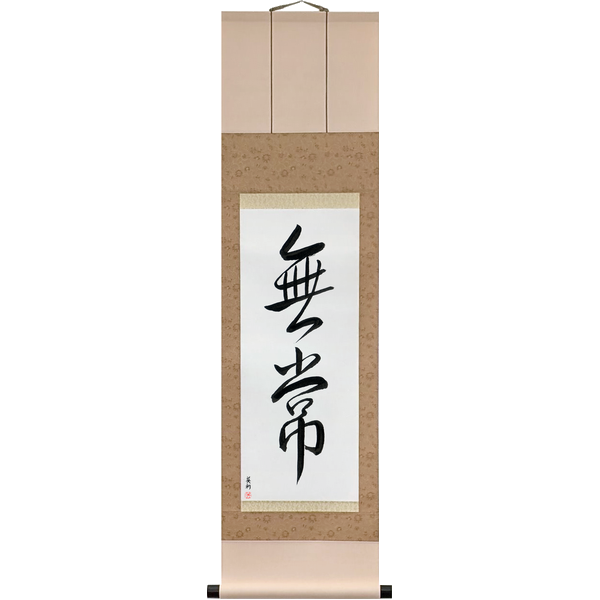
無常 mujō Impermanence
This is a philological study of the word 無常 (mujō), following it from the Chinese classics and the Buddhist sutras through the 萬葉集, the いろは song, the 方丈記 and the 平家物語 into the English of the missionaries, the dictionaries and the translators.
Abstract
無常 (mujō) is the Buddhist word for impermanence, and it was a Chinese word before it was Buddhist: in the 易, the 孫子 and the 莊子 it means having no fixed constancy, and the translators of the sutras used it for the Sanskrit anitya, the first mark of everything that arises. The verse that carries it, 諸行無常 是生滅法 生滅滅已 寂滅為樂, stands in the Pāli canon at the Buddha's death and in a Chinese Āgama without any story, and the 涅槃経 gave it the story of the boy in the Himalaya and the demon. In Japan the word was read in Japanese as 常なし by 750, became the theme of the 方丈記, the 平家物語 and the 徒然草, and was set line by line against the いろは song by the twelfth century. The English dictionaries rendered it inconstant and then uncertain for seventy years while the Buddhist English already said impermanence, and it was Japanese writers in English who brought that word to 無常.
Overview
The sense. A Buddhist term, 仏語, that became an ordinary word. デジタル大辞泉: 《〈梵〉anityaの訳》仏語。この世の中の一切のものは常に生滅流転して、永遠不変のものはないということ。特に、人生のはかないこと, a translation of the Sanskrit anitya: that everything in this world is always arising, perishing and changing, and nothing is eternal and unchanging; in particular the fleetingness of human life, with a second sense, 人の死, a person's death, and the antonym 常住 [1]. 精選版 日本国語大辞典 gives the same first sense, adding いつ死ぬかわからないこと, not knowing when one will die; the second, 特に、人の死をいう; and a third, 連歌・俳諧において、死葬に関する詞、または句, in linked verse and haikai, a word or verse about death and burial, which the rules of the form kept off the opening page [1]. The four-character 諸行無常, all that arises is impermanent, is the first of the three marks of Buddhist teaching and the first line of the verse below [2]. The English word impermanence covers the first sense and nothing else: it does not say death, and it does not carry the mood the Japanese word gathered in its literature, for which the dictionaries have a separate word, 無常感, the feeling of impermanence, beside 無常観, the contemplation of it [1]. What the English has for the rest is mortality and transience, and for the mood, nothing.
The words. 無, without; 常, constant. The reading is むじょう, mujō, in the old spelling むじやう. 常 has two senses in the dictionaries, always the same, unchanging and ordinary, usual, and 無常 is listed under the first: デジタル大辞泉's character entry gives いつも変わらない。いつも同じ状態が続くこと and names 無常 among its examples, the 字通 glosses it つね、ひさしい, and the word's own antonym is 常住, abiding [3]. The word is therefore a negation, not constant, and it says nothing of certainty; the Buddhist sense, that nothing that arises keeps its form, is the Chinese sense narrowed to a doctrine. Two other words share the sound: 無情, heartless, and 無上, supreme, which every bilingual dictionary lists beside it.
The text in English. Hepburn in 1867 gave inconstant, mutable, changing, not lasting; evanescent, fleeting, passing away: death, glossing the word for the reader as tsune nashi, and kept that entry through his editions of 1872 and 1886 [4][5][6]. Brinkley in 1896 followed him, inconstant, mutable, variable, everchanging, fleeting; death [7]. Inouye in 1909 led with uncertainty; frailty; mutability; transitoriness [8], and Kenkyūsha in 1942 with uncertainty; mutability; transiency [9], so that for the first half of the twentieth century the standard English of 無常 was uncertainty, a word about what we can know rather than about what things are. The Buddhist dictionaries of 1965 and 1989 give impermanence and the Sanskrit [10][11], and JMdict gives impermanence as the Buddhist noun and mutable, uncertain, ever-changing, transitory, transient, evanescent for the adjective [12].
The historical record
Warring States period, the Chinese classics. Before Buddhism reached China, 無常 was a phrase of two words, no constant. The 易's commentary on the fourth line of the first hexagram: 上下無常,非為邪也。進退無恆,非離羣也, up or down without constancy, this is not perversity; advancing or retreating without fixity, this is not leaving the group [13]. The 孫子: 故兵無常勢,水無常形, so an army has no constant disposition, as water has no constant shape, and 五行無常勝,四時無常位, no one of the five agents always prevails, no season keeps its place [14]. The 莊子: 量無窮,時無止,分無常,終始無故, measure is without end, time without stop, allotment without constancy, beginning and end without cause [15]. The 韓非子: 國無常强,無常弱, no state is always strong or always weak [16]. In each the phrase describes a thing that has no fixed state, and that is what the Buddhist translators found ready for anitya.
The Pāli canon, the verse at the Buddha's death. In the 大般涅槃経 of the Pāli, when the Buddha dies, the god Sakka speaks a verse: Aniccā vata saṅkhārā, uppādavayadhammino; uppajjitvā nirujjhanti, tesaṁ vūpasamo sukho, in Bhikkhu Sujato's translation Oh! Conditions are impermanent, their nature is to rise and fall; having arisen, they cease; their settling is blissful [17]. The same verse closes a discourse in which the Buddha names a mountain's former names and the peoples who knew them, all gone [18]. This is the verse the Chinese would render as 諸行無常,是生滅法,生滅滅已,寂滅為樂.
c. 402–412, the 遺教経, translated by Kumārajīva 鳩摩羅什. The Buddha's last instruction to his monks, in the sutra the Zen school counts among its founding texts: 當念無常之火燒諸世間,早求自度, think of the fire of impermanence burning every world, and seek your own crossing soon; and 是故當知,世皆無常,會必有離, know therefore that the world is all impermanent, and that meeting must have its parting [19]. Here 無常 is already the Buddhist noun.
Early fifth century, the 涅槃経 in Chinese, and the verse's story. The 大般涅槃經 translated by Dharmakṣema 曇無讖 tells how the god Indra, 釋提桓因, took the form of a rākṣasa and spoke the first half of a verse of a past Buddha, 諸行無常,是生滅法, to a boy practicing in the Himalaya; the boy offered his body for the second half, 生滅滅已,寂滅為樂, and wrote the whole 若石、若壁、若樹、若道, on rocks, on walls, on trees, on the road, before he leapt [20]. The verse is older than its story. In the 別譯雜阿含經, an anonymous Chinese translation the canon's catalogue dates to the fourth century, the Buddha speaks the same discourse on the mountain's names as the Pāli and ends it with the four lines whole, 以是義故,諸行無常,是生滅法,生滅滅已,寂滅為樂, with no god and no demon [21]; and the 長阿含經's account of the Buddha's death renders Indra's verse in other Chinese words altogether, 陰行無有常,但為興衰法;生者無不死,佛滅之為樂 [22]. 諸行無常 is one Chinese wording of the verse among several, and the one that Japan received.
611 by tradition, the 勝鬘經義疏. The commentary on the 勝鬘経 that the tradition gives to Prince Shōtoku 聖徳太子 is the earliest use of the word the 精選版 日本国語大辞典 cites for Japan: the queen 勝鬘, hearing at last of the Buddha's abiding, 常住, turns from what she had trusted before, 所以嘆今日常住眞實。願爲歸依。異於昔日歸依無常, so she praises today the truth of the abiding, and wishes to take refuge in it, unlike the days when she took refuge in the impermanent [23]. The date and the authorship are the tradition's; the encyclopedias say there is no proof of either, and a closely similar text has been found among the Dunhuang manuscripts [24]. Whoever wrote it, the word stands here in its Buddhist sense with its antonym beside it.
750, the 萬葉集, book 19. The first Japanese reading of the word. A long poem headed 悲世間無常歌一首并短歌, a poem grieving the impermanence of the world, with an envoy, among poems dated to the third month of 750, opens 天地の遠き初めよ世間は常なきものと語り継ぎ, from the far beginning of heaven and earth it has been told and told again that the world is a thing without constancy, and its envoy ends 常をなみこそ, because there is no constancy [25]. The Chinese 無常 of the headnote is the Japanese 常なし of the poem, and a manuscript copy of the 万葉集略解 writes the reading beside the characters, つねなき [26]. Book 16 has two more poems headed 猒世間無常歌, found written on the face of a Japanese zither in the Buddha hall of the 河原寺 [27].
984, the 三寶繪. The 雪山童子 story told in Japanese, in the earliest use of 諸行無常 the dictionary cites: 其の時に佛世に不伊坐さりしかは。雪山童子普く大乘經を求むるに不能す。諸行無常是生滅法と云ふ音は。風のかに聞こゆ。驚きて見れば人も無し。羅刹近く立なり, at that time the Buddha was not yet in the world, and the boy of the Himalaya sought the Mahāyāna sutras everywhere and could not find them; the words 諸行無常是生滅法 came faintly on the wind; startled, he looked, and there was no one; a rākṣasa stood near [28][2].
1001, the 権記. The earliest 無常観 the dictionary cites. The courtier Fujiwara no Yukinari 藤原行成, inspecting the ruined 豐樂院 on the fifth day of the third month, writes 破壞尤盛、瓦松垣衣不異華〓之春色、蔓草滋露宛如枯蘇之秋心 … 爲催無常觀到此歟, the ruin is far gone; the roof-tile moss and the wall-weeds are no different from the spring colors of a palace, the creepers and thick dew are the very autumn heart of a withered garden … was it to stir the contemplation of impermanence that I came here? [29][30]. 無常観 is here a meditation a man performs on a ruin, not yet a mood.
Mid-Heian, the いろは song. The forty-seven-syllable poem いろはにほへとちりぬるを … ゑひもせす is first attested in a manuscript of 1079; it was composed after two syllables that Kūkai's generation still distinguished had merged, so the tradition that gives it to him cannot stand; and the handbooks say it is based on a passage of the 涅槃経 [31]. The passage is the verse above, and the reading that pairs them is the next witness.
Twelfth century by tradition, Kakuban 覚鑁 (1095–1143), the 以呂波釋. A commentary on the いろは song, printed in 1909 among his collected works, sets the song's four lines against the verse's four, one to one: 色匂散諸行無常 … 我世誰常、是生滅法、四相遷變不住自性名之無常故、有爲奥山今日超、生滅滅已 … 淺夢不醉、寂滅爲樂, the colors are fragrant and scatter, all that arises is impermanent; who in our world stays constant, this is the law of arising and perishing, for the four marks shift and do not abide in their own nature, and that is what is called impermanence; crossing today the deep mountain of the conditioned, arising and perishing perish; not drunk on a shallow dream, their stilling is bliss [32]. A bibliography of 1902 calls this the oldest of the interpretations of the いろは song [33]. The work is listed among Kakuban's writings in a catalogue compiled before 1318 [34]; the attribution is the tradition's and the collected works', and it has not been tested.
c. 1212, Kamo no Chōmei 鴨長明, the 方丈記. The word at the head of the most famous essay on it: after the river that flows and is never the same water, 生れ死ぬる人、何方より來りて、何方へか去る, those who are born and die, whence do they come, whither do they go?, and then 無常を爭ふ, the dweller and the dwelling contending in impermanence, like the dew on the morning glory [35]. The clause is quoted alone here because the texts of the 方丈記 differ in the words around it.
Thirteenth century, the 平家物語. 祇園精舍の鐘の聲、諸行無常の響あり、沙羅雙樹の花の色、盛者必衰の理を顯す, the sound of the bell of the Jetavana monastery has the ring of "all that arises is impermanent"; the color of the sal tree's flowers shows the law that the flourishing must decline [36]. The bell is the one the dictionaries explain: the 無常院, the hall of the Jetavana where dying monks were laid, whose bells rang the verse [10].
1231–1253, Dōgen 道元, the 正法眼蔵, 出家功徳. The dictionary's witness for the second sense, death: おほよそ無常たちまちにいたるときは、國王、大臣、親暱、從僕、妻子、珍寶、たすくるなし、ただひとり黄泉におもむくのみなり, when impermanence comes suddenly, no king, minister, intimate, servant, wife, child or treasure can help; one goes alone to the underworld [37][1]. The sentence was lifted whole into the 修証義, the text the Sōtō school compiled for lay people in 1890, and so became one of the best-known lines of Japanese Buddhism [38].
1287, Ryōson 了尊, the 悉曇輪略圖抄. A Shingon treatise on the syllabary, dated 弘安10 in the 国書データベース, sets the verse and the song side by side without comment: 諸行無常 色葉匂散 / 是生滅法 我世誰常 / 生滅滅已 有爲奧山今日越 / 寂滅爲樂 淺夢見不醉 [39][40]. This is the pairing in its settled form, and it is the form the Meiji dictionaries and readers repeat.
c. 1330, Kenkō 兼好, the 徒然草. Section 7: あだし野の露消ゆる時なく、鳥部山の煙立ちさらでのみ住み果つる習ひならば、いかに物の哀れもなからむ。世は定めなきこそいみじけれ, if the dew of Adashino never vanished and the smoke of Toribeyama never cleared, and it were our way to live on to the end, how could anything move us? It is because the world is unfixed that it is fine. Section 49: 人はたゞ無常の身に迫りぬる事を心にひしとかけて, a man should only keep it firmly in mind that impermanence presses on his body. Section 59: 無常の來ることは、水火の攻むるよりも速かに, impermanence comes faster than fire or flood attacks. Section 155: 四季はなほ定まれる序あり。死期は序を待たず, the seasons at least keep a fixed order; the hour of death does not wait for its turn [41]. In Kenkō the word is death's approach, and the sense of the 萬葉's lament has turned into an argument for living.
1367, Sōkyū 宗久, the 都のつと. The dictionary's earliest 無常迅速, impermanence is swift: the traveling priest, hearing of a friend's death, 有待の身 … 無常しんそくなる程も、今更思ひ知られ侍し, this body that waits on conditions … how swift impermanence is, I came to know it again [42][43].
1702, the 三冊子. The dictionary's witness for the third sense, the haikai topic: 戀・無常其外嫌ふ古事, love, impermanence and the other old matters to be avoided, which the master ruled should not be shown on the opening page of a sequence [44][1]. By Bashō's time 無常 was a category of verse, the verses of death and burial.
What is not a source. The story of the boy and the demon is the 涅槃経's, and the verse stands without it in the Āgama and the Pāli [21][17]. 無常の風, the wind of impermanence, the wind that ends a life, is the 大智度論's image, 咄世間無常!如水月芭蕉,功德滿三界,無常風所壞, alas, the world is impermanent, like the moon in water, like the plantain; merit fills the three realms, and the wind of impermanence destroys it [45][46]. The adjective はかない, fleeting, is a kin word and not this one: the 精選版 日本国語大辞典 defines one of its senses as 無常である, and marks its use for a person's death [47]. The modern Japanese argument over the word, whether the Japanese 無常観 is a doctrine or a feeling, lives in two books this history names and does not quote, Kobayashi Hideo 小林秀雄's 無常といふ事 of 1946 and Karaki Junzō 唐木順三's 無常 of 1964 [48][49]; the encyclopedia's own summary is that the Japanese 無常観 is often said to be a 無常感 [1].
The word in English
1863, R. Spence Hardy, The Sacred Books of the Buddhists. The Buddhist English before any Japanese dictionary, from Ceylon: These revelations are made that the priests may learn therefrom the impermanence of all things [50]. Impermanence was the missionaries' word for the Pāli anicca four years before Hepburn.
1867, 1872 and 1886, J. C. Hepburn. The first Japanese-English dictionary: MU-JŌ, ムジヤウ, 無常, (tsune nashi.) Inconstant, mutable, changing, not lasting; evanescent, fleeting, passing away: death. (Bud.) [4][5]. The third edition adds the phrase no kaze [6]. Hepburn glossed 常 as tsune, constant, and kept the word's second sense, death, which the later dictionaries dropped.
1871, Samuel Beal, A Catena of Buddhist Scriptures from the Chinese. The 四十二章経 in English: Let one behold heaven and earth, and think, "these are impermanent"—and so the mountains and rivers, all impermanent! [51]. Beal's contents list the section as The impermanence of all around us; the Chinese word behind his English is 無常.
1895, Woman's Work for Woman. A Presbyterian mission magazine, on a Japanese Christian woman's sense of the transitoriness of human life: "Jinsei Mujo"—man's life is uncertain [52]. This is the earliest uncertain for the word here, and it is a missionary's.
1896, F. Brinkley, An Unabridged Japanese-English Dictionary. Mujō 無常 n. Inconstant, mutable, variable, everchanging, fleeting, and then, under the book's own bracketed label for a figurative sense, Death [7].
1899, Lafcadio Hearn, In Ghostly Japan. Among his Japanese Buddhist Proverbs: Mujō no kaze wa, toki erabazu. The Wind of Impermanency does not choose a time [53]. Hearn had the Buddhist word and used it for the proverb where the dictionaries did not.
1902, Keijiro Nakamura, "Japanese Buddhism", The Arena. A Japanese writer explaining the doctrine to American readers: It may be summed up in the following phrases: Shogyo mujo—Impermanence of things; Shoho muga—Non-ego of creatures; and Jakumetsuiraku—Bliss of extinction [54]. The three marks in English, with the word the Buddhist English already had.
1905, Minakata Kumagusu 南方熊楠 and F. Victor Dickins, "A Japanese Thoreau of the Twelfth Century". The 方丈記 in the Journal of the Royal Asiatic Society: Man is born and dieth; whence cometh he, whither goeth he? … Dweller and dwelling are rivals in impermanence, both are fleeting as the dewdrop that hangs on the petals of the morning-glory [55]. 無常を争ふ rendered with the noun, by a Japanese scholar.
1909, Inouye Jukichi, Inouye's Comprehensive Japanese-English Dictionary. Mujō n. Uncertainty; frailty; mutability; transitoriness. —no, a. Vain; uncertain; frail; mutable; transient, with the 平家's opening as the example, The bell of the Gion monastery tolls … the transitoriness of all things, and 諸行無常 as All earthly things are transient [8]. Uncertainty now heads the entry.
1911, Arthur Lloyd, The Creed of Half Japan. The Iroha poem is but a paraphrase of the verse, which he transliterates Shogyo mujo, Zesho meppo … [56]. The twelfth-century pairing, in an English book.
1914, Tasuku Harada, The Faith of Japan. It taught the impermanence of all things, sho-gyo-mujo, a most common Buddhist phrase [57].
1917, August Karl Reischauer, Studies in Japanese Buddhism. All Work is impermanent (Jap. Shogyo mujo) [58]. Work for 行, saṅkhāra, is a rendering the later English did not keep.
1918, A. L. Sadler, "The Heike Monogatari". The first full English of the 平家's opening: The sound of the bell of Gionshoja echoes the impermanence of all things [59]. McCullough quoted the sentence in 1959 as the theme of every war tale [60], and her own Heike of 1988 keeps its shape.
1928, A. L. Sadler, The Ten Foot Square Hut. The 方丈記's clause without its noun: Like the dew on the morning glory are man and his house, who knows which will survive the other? [61].
1942, Kenkyūsha, New Japanese-English Dictionary. mujō (無常) Uncertainty; mutability; transiency … Uncertain; mutable; vain; evanescent; transient, with the examples realize the uncertainty (frailty) of life and Nothing is certain in this world. All is vanity in life [9]. The dictionary that shaped the English of the war and postwar generations kept Inouye's uncertainty and added vanity.
1955, Donald Keene, Anthology of Japanese Literature. The 方丈記: Which will be first to go, the master or his dwelling? One might just as well ask this of the dew on the morning-glory [62]. The image and the question, no noun.
1965 and 1989, the Buddhist dictionaries. Mujō. anitya, anicca. Impermanence. Everything in the world arises, changes, and perishes; nothing remains constant for even a single moment [10]; Mujō 'Impermanence'; Sk. anitya [11].
1975, Hiroshi Kitagawa and Bruce T. Tsuchida, The Tale of the Heike. The bell of the Gion Temple tolls into every man's heart to warn him that all is vanity and evanescence [63]. Vanity for the verse's first line, as the dictionary of 1942 had it.
1988, Helen Craig McCullough, The Tale of the Heike. The sound of the Gion Shoja bells echoes the impermanence of all things [64].
1996, Yasuhiko Moriguchi and David Jenkins, Hojoki. A house and its master / are like the dew that gathers / on the morning glory. / Which will be the first to pass? [65].
2006, Burton Watson, The Tales of the Heike. The bells of the Gion monastery in India echo with the warning that all things are impermanent [66].
2012, Royall Tyler, The Tale of the Heike. The Jetavana Temple bells / ring the passing of all things, with a note that the bells were rung when a disciple died [67]. The verb carries the noun.
2013, Meredith McKinney, Essays in Idleness and Hōjōki. An owner and his home vie in their impermanence, as the vanishing dew upon the morning glory [68]. The noun again, as Minakata and Dickins had it in 1905.
Today. JMdict gives impermanence for the Buddhist noun and mutable, uncertain, ever-changing, transitory for the adjective [12]. The design is sold as Impermanence, which is the word the Buddhist English has used since Hardy and the Japanese Buddhist dictionaries give; the two characters say without constancy, and this history renders them so. A rendering should say what things are and not what we know of them, so impermanence and transience keep the word and uncertainty does not; it should keep in view that in Japanese the word also means death; and it should not make the 平家's bell or the boy's leap the meaning of the word, which is older than both.
A reading
The word has three lives, and the scroll hangs the word, not the verse. In the Chinese classics it is a property of things: an army, a season, a state has no fixed form [14][16]. In the sutras it is a truth to be seen through, and the verse that states it ends not in grief but in stillness, 寂滅為樂 [20][17]. In the Japanese literature it is a mood before it is a doctrine: the 萬葉 poet's tears, Chōmei's dew, the 平家's bell, Kenkō's smoke over Toribeyama, and the dictionaries' second sense, which is simply death [25][35][36][41][1]. The Japanese argument of the last century over whether the country's 無常観 is a way of seeing or a way of feeling is an argument about which of the second and third lives came first, and I do not think the word settles it.
I read the Chinese sense as the one the Buddhists kept and the one a reader should take from the two characters: nothing holds its form. That is a statement about things, and the English that went wrong for seventy years went wrong by making it a statement about us. Uncertainty is what a person feels who does not know; 無常 is what is true whether anyone knows it or not, and the verse's consolation depends on that, since a fact about things can be seen through and a fact about one's own ignorance cannot. Hepburn's inconstant was nearer than Inouye's uncertainty, and the missionaries in Ceylon and the Japanese writers in English were nearer than either. Whether the word on the wall lands as the sutra's stillness or the 平家's bell is not in the word; it is in the reader, and the word has room for both.
Notes
- The four lines 諸行無常,是生滅法,生滅滅已,寂滅為樂 are the 涅槃経's wording of the Pāli verse; the 長阿含經 renders the same verse 陰行無有常,但為興衰法;生者無不死,佛滅之為樂, and the two agree in sense and share no line [20][22].
- The 方丈記's texts differ around 無常を争ふ: 主 or 主人, 栖 or 住家, 朝顔 or 槿. The 1929 print gives one text and appends the other [35].
- 覚鑁's authorship of the 以呂波釋 rests on the 1318 catalogue and the collected works of 1909; no modern study of the attribution was found, and the twelfth-century date is the tradition's [34][32].
- 了尊 dates his own preface 弘安滿數之歳, the year of the full count of Kōan, which is Kōan 10, 1287, and the 国書データベース gives the same [39][40].
References
- 「無常」, デジタル大辞泉, 精選版 日本国語大辞典, 改訂新版 世界大百科事典, 日本大百科全書, at kotobank. https://kotobank.jp/word/無常-140483
- 「諸行無常」, デジタル大辞泉, 精選版 日本国語大辞典, at kotobank. https://kotobank.jp/word/諸行無常-80081
- 「常」, デジタル大辞泉 (漢字項目), 精選版 日本国語大辞典, 字通, at kotobank. https://kotobank.jp/word/常-530514
- J. C. Hepburn, A Japanese and English Dictionary; with an English and Japanese Index, American Presbyterian Mission Press, Shanghai, 1867, p. 290, s.v. MU-JŌ. Internet Archive japaneseenglishd00hepb. https://archive.org/details/japaneseenglishd00hepb
- J. C. Hepburn, A Japanese-English and English-Japanese Dictionary, second edition, American Presbyterian Mission Press, Shanghai, 1872, p. 337, s.v. MU-JŌ, scan 186. National Diet Library pid 993689. https://dl.ndl.go.jp/pid/993689/1/186
- J. C. Hepburn, A Japanese-English and English-Japanese Dictionary, third edition, Maruya and Trübner, 1886, p. 419, s.v. MU-JŌ. Internet Archive japaneseenglishe00hepbuoft (the 1888 printing). https://archive.org/details/japaneseenglishe00hepbuoft
- F. Brinkley and others, An Unabridged Japanese-English Dictionary, Sanseidō, Tokyo, 1896, p. 966, s.v. Mujō. Internet Archive cu31924082117288. https://archive.org/details/cu31924082117288
- Inouye Jukichi, Inouye's Comprehensive Japanese-English Dictionary, Sanseidō, Tokyo, 1909, p. 1079, s.v. Mujō. Internet Archive inouyesjapanesee00inou. https://archive.org/details/inouyesjapanesee00inou
- Takenobu Yoshitarō, ed., Kenkyusha's New Japanese-English Dictionary, American edition, Harvard University Press, 1942, photolithographed from the printing of 1939, p. 1281, s.v. mujō.
- Daitō Shuppansha, Japanese-English Buddhist Dictionary, Tokyo, 1965, p. 202, s.v. Mujō.
- Hisao Inagaki, A Dictionary of Japanese Buddhist Terms, Heian International, 1989, pp. 212–213, s.v. Mujō.
- 無常, JMdict, at jisho.org. https://jisho.org/search/無常
- 『周易』文言傳, 乾 九四, at the Chinese Wikisource. https://zh.wikisource.org/wiki/周易/文言
- 『孫子』虛實篇, 四庫全書本, at the Chinese Wikisource. https://zh.wikisource.org/wiki/孫子_(四庫全書本)
- 『莊子』秋水, at the Chinese Wikisource. https://zh.wikisource.org/wiki/莊子/秋水
- 『韓非子』有度, at the Chinese Wikisource. https://zh.wikisource.org/wiki/韓非子/有度
- Dīgha Nikāya 16, Mahāparinibbānasutta, 6.10, Pāli text with Bhikkhu Sujato's translation, at SuttaCentral. https://suttacentral.net/dn16/en/sujato
- Saṃyutta Nikāya 15.20, Vepullapabbatasutta, Pāli text with Bhikkhu Sujato's translation, at SuttaCentral. https://suttacentral.net/sn15.20/en/sujato
- 鳩摩羅什 譯『佛垂般涅槃略說教誡經』 (遺教経), Taishō 12, no. 389, p. 1111a29–b01 and p. 1112b12–13, at CBETA. https://cbdata.dila.edu.tw/stable/juans?work=T0389&juan=1
- 曇無讖 譯『大般涅槃經』 卷十四 聖行品, Taishō 12, no. 374, p. 450a12–16 and p. 451a01–06, at CBETA. https://cbdata.dila.edu.tw/stable/juans?work=T0374&juan=14
- 『別譯雜阿含經』 卷十六, Taishō 2, no. 100, p. 488c08 and p. 489b02–03, at CBETA. https://cbdata.dila.edu.tw/stable/juans?work=T0100&juan=16
- 佛陀耶舍・竺佛念 譯『長阿含經』 卷四 遊行經, Taishō 1, no. 1, p. 26c20–22, at CBETA. https://cbdata.dila.edu.tw/stable/juans?work=T0001&juan=4
- 『勝鬘經義疏』, Taishō 56, no. 2185, p. 2b17–19, at the SAT Daizōkyō Text Database. https://21dzk.l.u-tokyo.ac.jp/SAT/T2185_.56.0001c10:0019c15.cit
- 「勝鬘経義疏」 and 「三経義疏」, デジタル大辞泉, 精選版 日本国語大辞典, 改訂新版 世界大百科事典, 日本大百科全書, at kotobank. https://kotobank.jp/word/勝鬘経義疏-79872
- 『萬葉集』 巻十九, 4160–4161, at the Japanese Wikisource. https://ja.wikisource.org/wiki/万葉集/第十九巻
- 橘千蔭『万葉集略解』 巻十九, a manuscript copy, scan 18. National Diet Library pid 2570333. https://dl.ndl.go.jp/pid/2570333/1/18
- 『萬葉集』 巻十六, 3849–3850, at the Japanese Wikisource. https://ja.wikisource.org/wiki/万葉集/第十六巻
- 源為憲『三寶繪』 上, in 『大日本佛教全書』 第百十一冊, 仏書刊行会, 1922, p. 385, scan 198. National Diet Library pid 952815. https://dl.ndl.go.jp/pid/952815/1/198
- 藤原行成『権記』 長保三年三月五日, in 『史料大成 続編』 第35, 内外書籍, 1939, scan 113. National Diet Library pid 1207142. https://dl.ndl.go.jp/pid/1207142/1/113
- 「無常観」, デジタル大辞泉, 精選版 日本国語大辞典, at kotobank. https://kotobank.jp/word/無常観-641601
- 「いろは歌」, 日本大百科全書, ブリタニカ国際大百科事典, 山川 日本史小辞典, at kotobank. https://kotobank.jp/word/いろは歌-32577
- 覚鑁『以呂波釋』, in 『興教大師全集』, 加持世界支社, 1909, p. 250, scan 146. National Diet Library pid 819226. https://dl.ndl.go.jp/pid/819226/1/146
- 『国語学書目解題』, 国語調査委員会, 1902, scan 51. National Diet Library pid 991486. https://dl.ndl.go.jp/pid/991486/1/51
- 光宗『溪嵐拾葉集』, 覺鑁上人製作目録, Taishō 76, no. 2410, p. 658c14–659a08, at the SAT Daizōkyō Text Database. https://21dzk.l.u-tokyo.ac.jp/SAT/T2410_.76.0659a01:0659c29.cit
- 鴨長明『方丈記』, 山崎麓 校註, 国民図書, 1929, scan 6 (the appended 彰考館本 at scan 15). National Diet Library pid 1092911. https://dl.ndl.go.jp/pid/1092911/1/6
- 『平家物語(抄) 新訂要註』, 高木武 編, 三省堂, 1934, scan 35. National Diet Library pid 1054802. https://dl.ndl.go.jp/pid/1054802/1/35
- 道元『正法眼蔵』 出家功徳, 鴻盟社, 1926, p. 710, scan 377. National Diet Library pid 1018721. https://dl.ndl.go.jp/pid/1018721/1/377
- 『曹洞教会修証義』, 1890, scan 4. National Diet Library pid 823283. https://dl.ndl.go.jp/pid/823283/1/4
- 了尊『悉曇輪略圖抄』 卷七, Taishō 84, no. 2709, p. 696a26–b03, at the SAT Daizōkyō Text Database. https://21dzk.l.u-tokyo.ac.jp/SAT/T2709_.84.0696a10:0696b20.cit
- 「悉曇輪略図抄」, the work record, 国書データベース, 国文学研究資料館. https://kokusho.nijl.ac.jp/work/2862886
- 兼好『徒然草』, 山崎麓 校註, 国民図書, 1929, scans 5, 15, 19 and 43 (sections 7, 49, 59 and 155). National Diet Library pid 1032684. https://dl.ndl.go.jp/pid/1032684/1/5
- 宗久『都のつと』, in 『平泉旧跡志』, 1895, scan 36. National Diet Library pid 763440. https://dl.ndl.go.jp/pid/763440/1/36
- 「無常迅速」, デジタル大辞泉, 精選版 日本国語大辞典, at kotobank. https://kotobank.jp/word/無常迅速-641616
- 『三冊子』 白双紙, in 『芭蕉俳諧論集』, 岩波書店, 1939, scan 132. National Diet Library pid 1684194. https://dl.ndl.go.jp/pid/1684194/1/132
- 鳩摩羅什 譯『大智度論』 卷二, Taishō 25, no. 1509, p. 69b26–27, at CBETA. https://cbdata.dila.edu.tw/stable/juans?work=T1509&juan=2
- 「無常の風」, デジタル大辞泉, 精選版 日本国語大辞典, at kotobank. https://kotobank.jp/word/無常の風-641622
- 「果無い」, デジタル大辞泉, 精選版 日本国語大辞典, at kotobank. https://kotobank.jp/word/果無い-599832
- 小林秀雄『無常といふ事』, 創元社, 1946, the CiNii Books record. https://ci.nii.ac.jp/ncid/BN13777865
- 唐木順三『無常』, 筑摩書房, 1964, the CiNii Books record. https://ci.nii.ac.jp/ncid/BN08638983
- R. Spence Hardy, The Sacred Books of the Buddhists Compared with History and Modern Science, Wesleyan Mission Press, Colombo, 1863, p. 121. Internet Archive sacredbooksbudd00hardgoog. https://archive.org/details/sacredbooksbudd00hardgoog
- Samuel Beal, A Catena of Buddhist Scriptures from the Chinese, Trübner, London, 1871, p. 197. Internet Archive catenaofbuddhist00beal. https://archive.org/details/catenaofbuddhist00beal
- Woman's Work for Woman, vol. 10, no. 9, Woman's Foreign Missionary Societies of the Presbyterian Church, 1895, p. 244. Internet Archive womansworkforwom109woma_0. https://archive.org/details/womansworkforwom109woma_0
- Lafcadio Hearn, In Ghostly Japan, Little, Brown, Boston, 1899, "Japanese Buddhist Proverbs", no. 59, p. 184. Internet Archive cu31924014202687. https://archive.org/details/cu31924014202687
- Keijiro Nakamura, "Japanese Buddhism. I. Its Philosophic and Doctrinal Teachings", The Arena, vol. 26, no. 5, May 1902, p. 469. Internet Archive sim_arena_1902-05_26_5. https://archive.org/details/sim_arena_1902-05_26_5
- Minakata Kumagusu and F. Victor Dickins, "A Japanese Thoreau of the Twelfth Century", Journal of the Royal Asiatic Society, 1905, p. 238. Internet Archive journalroyalasi09irelgoog. https://archive.org/details/journalroyalasi09irelgoog
- Arthur Lloyd, The Creed of Half Japan, Smith, Elder, London, 1911, p. 253. Internet Archive creedofhalfjapan00lloyrich. https://archive.org/details/creedofhalfjapan00lloyrich
- Tasuku Harada, The Faith of Japan, Macmillan, New York, 1914, p. 81. Internet Archive faithjapan00haragoog. https://archive.org/details/faithjapan00haragoog
- August Karl Reischauer, Studies in Japanese Buddhism, Macmillan, New York, 1917, p. 330. Internet Archive studiesinjapane00reis. https://archive.org/details/studiesinjapane00reis
- A. L. Sadler, "The Heike Monogatari", Transactions of the Asiatic Society of Japan, vol. 46, part 2, 1918, p. 1. Internet Archive in.gov.ignca.26062. https://archive.org/details/in.gov.ignca.26062
- Helen Craig McCullough, The Taiheiki: A Chronicle of Medieval Japan, Columbia University Press, New York, 1959, p. xxv.
- A. L. Sadler, The Ten Foot Square Hut and Tales of the Heike, Angus and Robertson, Sydney, 1928, p. 1 of the Hōjōki (the Tuttle reprint of 1972, same pagination).
- Donald Keene, ed., Anthology of Japanese Literature, Grove Press, New York, 1955, "An Account of My Hut", the opening.
- Hiroshi Kitagawa and Bruce T. Tsuchida, translators, The Tale of the Heike, University of Tokyo Press, 1975, vol. 1, p. 5.
- Helen Craig McCullough, translator, The Tale of the Heike, Stanford University Press, 1988, p. 23.
- Yasuhiko Moriguchi and David Jenkins, translators, Hojoki: Visions of a Torn World, Stone Bridge Press, Berkeley, 1996, the opening.
- Burton Watson, translator, The Tales of the Heike, Columbia University Press, New York, 2006, the opening of book 1.
- Royall Tyler, translator, The Tale of the Heike, Viking, New York, 2012, book 1, chapter 1, "The Jetavana Temple", and its note.
- Meredith McKinney, translator, Essays in Idleness and Hōjōki, Penguin, London, 2013, p. 5.