

水の心 · mizu no kokoro · Heart Like Water
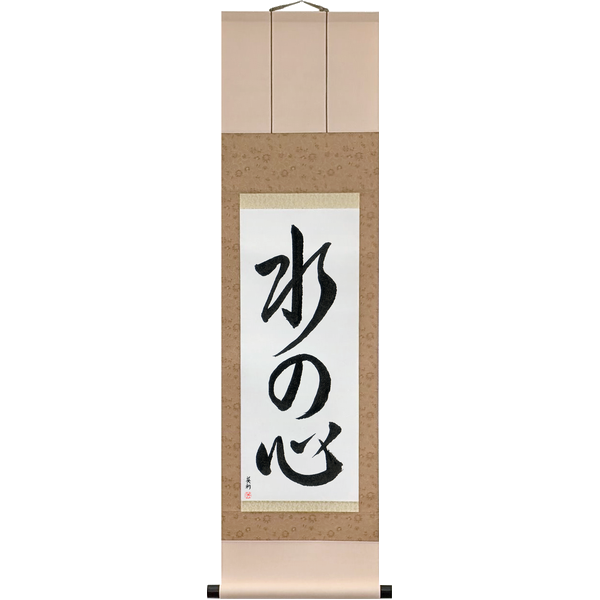
Sold as Heart Like Water · Read mizu no kokoro, three characters and a particle · Oldest witness the 万葉集, where the heart of cold spring water is the poet's clear mind; as a martial term, an Edo archery manuscript of the 竹林派; as the karate teaching, an English book of 1960 · Sense two, and the tradition keeps both: the still water that mirrors whatever comes, which is the 荘子's image and karate's; and the water that flows and takes the shape of any vessel, which is the 老子's, Musashi's and Bruce Lee's
The words
水 is water and 心 is the heart, the mind, the seat of attention; の joins them. The three are not a dictionary headword, and the two characters without the particle are a trap a Japanese reader steps around without noticing: 水心 mizugokoro is a swimmer's know-how (the 発心集, about 1216) and the short form of the proverb 魚心あれば水心, if the fish has a heart for the water, the water has a heart for the fish, goodwill returned (a puppet play of 1767). The scroll's の keeps the phrase out of both. In the oldest Japanese the phrase is the water's own nature: the 万葉集 has a poet clear-minded with the heart of cold water, 寒水の心もけやに, and a thirteenth-century garden is praised for 水の心ばへ, the look of its water. A Zen sermon of 1900 still speaks this way: 山に山の心あり。水に水の心あり, the mountain has the mountain's heart, the water the water's.
A history, from the earliest witness
Two Chinese waters. The phrase has no single source. Behind it stand two images from two books, and they are not the same image. The 荘子 gives the still water: 人莫鑑於流水,而鑑於止水, no one uses running water for a mirror; they use still water, and 水靜則明燭鬚眉…聖人之心靜乎,天地之鑑也,萬物之鏡也, still water shows the beard and eyebrows; the sage's still mind is the mirror of heaven and earth. Japanese fixed this as the four characters 明鏡止水, the bright mirror and the still water, and it is the image the catalogue's Still Water names. The 老子 gives the other: 上善若水。水善利萬物而不爭, the highest good is like water, which benefits all things and does not contend, and the proverb 水は方円の器に随う, water takes the square or round vessel's shape, carries it in Japanese.
1641 and 1645. 宮本武蔵. The swordsman wrote the second water into the sword. His 兵法三十五箇条 says of the mind: 心を水にして折にふれ事に應ずる心也、水にへきたんの色あり、一滴もあり滄海も在り, make the mind water, a mind that answers each thing as it comes; water has the color of the deep pool, and it is a single drop and it is the ocean. The 五輪書 names its second book for it: 第二水の卷、水を本として心を水になすなり、水は方圓の器にしたがひ、一滴と成り蒼海と成る, the Water Book: taking water as the model, one makes the mind water; it follows the square or the round vessel, becomes a drop and becomes the blue sea. Between 1915 and 1944 nine Japanese books quote this line, and their authors are Zen writers and a kendo historian: 釈宗演, 堀内文次郎, 菊池寛. Musashi's water was the water-mind the Japanese reader of those decades knew. 沢庵's letter to the Yagyū, the 不動智神妙録, has the same water without the phrase: a ball thrown on a rushing stream that rides the waves and never stops, 急水上打毬子念々不停留, and the swimmer who forgets the water as a fish does. The Zen of the sword is moving water; the still mirror is the Taoist's.
1320. A Pure Land poem. The oldest Japanese poem to set the heart of water beside the moon is in the 続千載集, the imperial anthology of 1320, among its Buddhist poems: にごりえの水の心はすまずとも やどれる月の影はくもらじ, though the heart of the muddy inlet's water never clears, the moon lodged in it is not dimmed. The Pure Land commentators, who name the poet as 従三位宣子, read it as the nenbutsu said inside deluded thoughts: the water is the believer's heart, which does not clear, and the moon is Amida's light, which does not need it to. It is the karate image before karate, and it forgives the mind for not being still.
Edo to 1931. The archers' term. The oldest martial use of the phrase found is not karate but kyūdō. The 竹林派 school names its highest release 紫部の離, and an Edo manuscript, 射學雜纂, teaches it so: 胸の詰を真中にして水の心を持て五臓五体の精を胸に収る時は其色紫と成此紫の胸の中へ大石を打込如く離の心を付て双四つに搦たる物さつと切て離るゝ心そ, hold the center of the chest as the heart of water, gather the body's essence there until its color is purple, and then, as if a great stone were thrown into it, let the four bindings of the draw part at once. The passage is printed in 1894 and again in 1931 for the Dōshisha kyūdō club: 胸の眞中を水の心にて、其眞中へ大石を打ち込んで. Water here is the still surface a single act breaks.
1900 to 1920. Three Japanese uses, three senses. A Zen sermon of 1900 uses the phrase in the old sense, the water's own nature, preaching on the 山水経: 水の水たる妙用を發揮せんと欲せば。水の心を覺らざるべからす, to bring out the marvelous working of water, one must awaken to the heart of water. A Pure Land tract of 1909 uses it for entrusting oneself to Amida in the swimmer's image: 水の心を知りて、水に任すれば、怒濤の上も尙ほ疊の上に在るが如し, knowing the heart of water and giving oneself to it, one is on raging waves as if on the tatami. And a judo textbook of 1920, telling students how often to train, uses Musashi's water: 春夏と秋と冬との區別無く流れて止まぬ水の心を[以て], with the heart of water that flows without stopping, spring, summer, autumn or winter. The kendo manuals of 1922 to 1941 teach the mirror-mind under its four Chinese characters, 明鏡止水, and never shorten it to 水の心. Among 2,221 Japanese books to 1945 that contain the string, nine are martial, and none of them is karate: the two pre-war karate books in the national library, 船越義珍's of 1922 and 本部朝基's of 1926, were searched whole and do not contain the phrase.
1960. The karate teaching, in English. The phrase as the catalogue means it, a state of mind in the martial arts, is first found in print in English: Nishiyama Hidetaka and Richard Brown, Karate: The Art of "Empty Hand" Fighting, Tuttle, 1960. Mizu no kokoro (a mind like water) … refers to the need to make the mind calm, like [the surface of undisturbed water], and its pair, tsuki no kokoro (a mind like the moon) … the need to be constantly [aware of the whole]. Nishiyama was 船越's student and the Japan Karate Association's; the pairing of water and moon, in these words, is his book's. Within three years the pair was in a science-fiction magazine (I tried hard to force my mind tsuki no kokoro, like the moon, 1963); by 1967 it was in Plée's glossary; Ratti and Westbrook carried it into Secrets of the Samurai in 1973; Hassell's Karate Ideals of 1995 and Rielly's Complete Shotokan Karate of 1998 teach it as Shotokan's; David Allen's Getting Things Done took mind like water into the office in 2001, crediting karate. Japanese dojo pages teach it today in these words, 水の心とは、水は自ら動くことなく、相手の動きに従い、相手に応じて動く, without naming a source.
1971. Bruce Lee. Empty your mind. Be formless, shapeless, like water, written by Stirling Silliphant for Lee in Longstreet from their own conversations, and Be water, my friend, on the Pierre Berton Show of 9 December 1971. This is the other water, the 老子's and Musashi's, the water with no shape of its own, and it is the water most buyers now hear behind the scroll. It is not the karate mirror, and the two have been sold under one phrase ever since.
The sense across time
There is one phrase and it has meant four things. The water's own nature, cold and clear and moving, to the 万葉 poet and the 1900 preacher. The heart that never clears and holds the moon anyway, to the Pure Land poet of 1320 and her commentators. The still surface in the archer's chest that the release breaks like a thrown stone, and the still surface in the karateka's mind that reflects the opponent whole, which is the 荘子's mirror carried by a Japanese phrase. And the water that flows through every season and takes every vessel's shape, which is the 老子's, Musashi's, 沢庵's ball on the stream, the judo teacher's, and Bruce Lee's. The catalogue's Heart Like Still Water names the third; Heart Like Water holds all four.
What is not a source
沢庵's 不動智神妙録 does not contain the phrase; its water flows. 道元's 山水経 is the text the 1900 sermon preaches on, not a source of the phrase (not opened). The kendo manuals say 明鏡止水. The proverb 魚心あれば水心 and the swimmer's 水心 are the same characters and a different word. The Bruce Lee monologue is a screenwriter's, from conversation, and reaches print only as reception.
The text in English
1960. Nishiyama and Brown, Karate: The Art of "Empty Hand" Fighting, Tuttle: mizu no kokoro (a mind like water); tsuki no kokoro (a mind like the moon). [archive.org karateartofempty00nish, dated 1960; snippets, page not derived] 1963. The Magazine of Fantasy & Science Fiction, November: I tried hard to force my mind tsuki no kokoro, like the moon. [Fantasy_Science_Fiction_v025n05_1963-11; story not derived] 1967. H. D. Plée, Karate: Beginner to Black Belt, Foulsham: MIZU NO KOKORO: "the mind like water". [karatebeginnerto0000plee] 1971. Bruce Lee, Longstreet and the Pierre Berton Show: be formless, shapeless, like water … Be water, my friend. [reported from en.wikipedia and Google Arts & Culture; no print] 1973. Ratti and Westbrook, Secrets of the Samurai: tsuki-no-kokoro ("a mind as calm as the moon"). [SecretsOfTheSamuraiTheMartialArtsOfFeudalJapan; Open Library 1973] 1995. Randall Hassell, Karate Ideals, Focus Publications: mizu no kokoro ("a mind like water"), or tsuki no kokoro ("a mind like the moon"). [karateideals0000hass, ISBN 0911921184] 1998. Robin Rielly, Complete Shotokan Karate: Mizu no kokoro (A mind like water) … a mind calm and clear. [complete-shotokan-karate-robin-l.-rielly; Open Library 1998] 2001. David Allen, Getting Things Done: The "Mind Like Water" Simile: In karate there is an image that's used to define the position of perfect readiness. [GettingThingsDoneTheArtOfStressFreeProductivity_201712; date recall] Louis Frédéric's Budo jiten (A mind like water (deep and calm)) and Ohlenkamp's Judo Unleashed (Maintain mizu no kokoro (mind like water)) are undated here.
A reading
Sell it as the karate phrase it is, and say there are two waters. A mind like water is Nishiyama's English of 1960 and has been karate's since; the calm surface that reflects the opponent whole is what the buyer who has trained will recognize, and 月の心, the mind like the moon, is its other half, which the page could name. But the scroll is also Musashi's 心を水になす and Bruce Lee's be water, the water with no shape of its own, and a buyer who wants that sense is not wrong to hang these characters. The 1320 poem is the one I would give a Japanese reader: the heart of the muddy inlet's water never clears, and the moon in it is not dimmed. Heart Like Water is a good English, better than Still Water, because it keeps both. Signed, 典, 2026-09-07.
How this was read
By eye: the template file. By text at the address: the 老子 and 荘子 at ctext (ctext.org/dao-de-jing ¶8; zhuangzi/seal-of-virtue-complete ¶1; zhuangzi/tian-dao ¶1); kotobank for 水心, 魚心あれば水心, 明鏡止水; the 続千載集 at the Nichibunken waka database (lapis.nichibun.ac.jp/waka/waka_i017.html, poem 998); the 万葉集 at Wikisource (16/3875); the National Diet Library's full-text index on 水の心 walked whole (2,221 books) and its neighbors counted; fourteen books at the scan through the page API (lab.ndl.go.jp/dl/api/page/
References
Each witness is cited in the account above, at the frame or entry where it was read. A linked list follows when the record for this text is completed.