

拳禅一如 · kenzen ichinyo · The fist and Zen are one
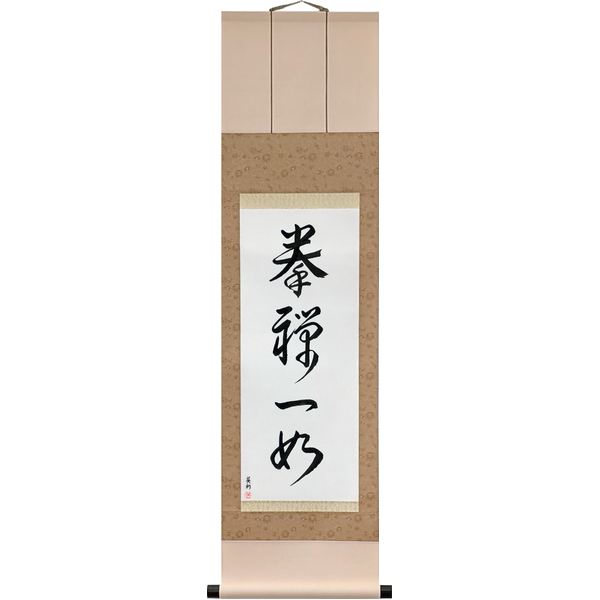
Sold as The Body and Mind are One · Read kenzen ichinyo · Oldest witness the founding of Shorinji Kempo in 1947, which made the phrase its first principle; in print by 1982 · Sense that the striking art and Zen are one and the same discipline, the trained body and the trained mind one thing; a karate maxim made from the swordsman's 剣禅一如 by putting a fist for the sword.
The words
拳 is the fist, and in the names of the striking arts it stands for the art: 拳法, 拳術. 禅 is Zen. 一如 is a Buddhist word twelve centuries old in Japanese, one and the same, not two; the dictionaries give the everyday sense with the example 物心一如, matter and mind one. So the four say the fist and Zen are one and the same. They are modeled on 剣禅一如, the sword and Zen are one, and that on 剣禅一致, the sword and Zen agree, which the big dictionary defines as the stance 沢庵 taught in his letter to the shogun's fencing master: that the last ground of swordsmanship is the same as Zen's ground of no-thought. Both first characters are read ken, so the karate phrase is a pun on the sword's, and a karate man hearing one hears the other beneath it. The house English, The Body and Mind are One, is not a translation of the characters but the teachers' gloss of them, the fist for the body and Zen for the mind; it has been the English of the phrase since a 1982 translation of Musashi explained There is a saying, Ken-Zen Ichi Nyo, ("Body and Mind, Together"). The literal, The fist and Zen are one, is what the karate books print, and the page gives both.
A history, from the earliest witness
Before 1645, 沢庵, the 不動智神妙録, which does not contain the phrase. The Zen master's letter to 柳生宗矩 on the sword and the unmoving mind is where every later writer sends the reader, and the 1921 edition of it, read whole, has neither 剣禅一如 nor 剣禅一致 in the text. 沢庵 taught the thing. The name is three centuries younger.
1908 to 1919, the name. The three phrases for the sword appear in the Meiji and Taishō literature on 山岡鉄舟, 宮本武蔵, 沢庵 and 宗矩, and nothing older carries any of them: 剣禅一味 in 1908, 剣禅一致 in 1909, 剣禅一如 in 1919. The 1919 sentence is a biography of 宗矩 in a collection of Zen anecdotes: he took his mind to the essentials of Zen, paid homage to 沢庵, tasted his angry fist for years, and attained to the sword and Zen being one; 沢庵 gave him an iron sceptre as his certificate, the one kept at 天沢山 in 湯島; and what the world calls the 不動智神妙録 is what 沢庵 taught him. A 1921 edition of 沢庵's works copied the sentence into its preface with the reading けんぜんいちにょ. 徳富蘇峰 used it in 1926; a 1936 essayist called it what 山岡 used to call 剣禅一如; from 1935 吉川英治's newspaper 宮本武蔵 made it the name of what its hero seeks, and in 1940 the first book was titled with it. The 1940s made it a slogan.
1935 to 1968, the fist takes the sword's words. Karate came to the mainland in the 1920s and borrowed the sword's vocabulary. 船越義珍's 空手道教範 (1935), in its 1973 English, speaks of a unity of fist and Zen, the older form 拳禅一致, and the Shōtōkan line kept that form: it hangs in its dojos as the fifteenth of the sayings, and the school cut kenzen-itchi into the monument it raised to 船越 at 円覚寺 in Kamakura in 1968. The Okinawan founder of 剛柔流, 宮城長順, is reported to have set 拳禅一如 as the state karate should aim at, in a lecture of 1936 not opened for this history.
1947, 宗道臣, Shorinji Kempo. The school's official site dates its founding to October 1947 at 多度津 and calls it the 拳禅一如 Shorinji Kempo; the phrase stands first among its six defining features, before 力愛不二, strength and love not two. This is the earliest dated use of the four characters found, and the school is the phrase's home: its magazine's twenty-first number is the way of 拳禅一如.
The 1970s and 1980s, the creed spreads. The manga 空手バカ一代 (1971–77) has 大山倍達 vow not 剣禅一如 but 拳禅一如, the etymology as a joke, and its reissue titles a volume with it. 長嶺将真, founder of 松林流, gave it a chapter of his memoir, Karate and Zen are One, and a section Dedicated to Seeking Ken Zen Ichinyo. A 1982 magazine article, a Kodansha book of 1983 titled The Way of 拳禅一如, and a 1994 Kyushu karate memoir carry it in the national library's catalogue.
Today. No Japanese dictionary has the four characters as a headword; the sword's 剣禅一致 is the only one of the family in the big dictionary. The phrase lives in dojos and their books, in three languages.
The sense across time
One idea, two names, three centuries apart. 沢庵's idea, that the sword's mastery and Zen's are the same mastery, went unnamed until Meiji readers needed a word for it and made three. The karate schools took the third and changed one character, and in doing so changed what the name is for: the sword's phrase describes an attainment, something a master reaches; the fist's phrase describes a method, body and mind trained together from the first day, which is how Shorinji Kempo defines it and how the catalogue reads it.
What is not a source
沢庵, who never wrote the words; the 不動智神妙録 was read whole in the 1921 edition to be sure. Nothing pre-Meiji: the library's nine classical hits on 剣禅 are the two characters as accidental neighbors in lists. Nothing Chinese: neither form in any form. No Meiji bilingual dictionary. Blyth is silent.
The text in English
The sword's phrase came first: a Jesuit Zen teacher wrote in 1966 that the Japanese language has expressions like Ken-zen ichinyo, which means "fencing and Zen are one," and the scholars of Zen and the sword (Hurst 1998, Victoria 1997, Ives 2009, Haskel 2013) have used the romaji since; Victoria records a Zen master who didn't know when the phrase "The sword and Zen are one" had first been used, which this history answers. The fist's came through the karate books: Funakoshi's manual in English (1973, a unity of fist and Zen), a women's self-defense book of 1976 (kenzen itchi — harmony between the fist and Zen), Nakayama's Best Karate (1978, quoting 沢庵 as The sword and Zen are one), Rielly's Shotokan histories (1998, 2000: The fist and Zen are the same, with calligraphy plates), Nagamine's memoir (2000, Karate and Zen are One), Nakamura (2001, the old saying Ken Zen Ichi Nyo), a dojo calligraphy in Rhinoceros Zen (2005, Karate and Zen as One), Bennett on Shorinji Kempo (2009, 2023: unity of ken and Zen, i.e. technique and spirit) and Hall's encyclopedia (2012, boxing and Zen are one). The house title's line runs from a 1982 Bantam translation of Musashi, Ken-Zen Ichi Nyo, ("Body and Mind, Together"), copied since by popular books far from any dojo as an old Zen adage. The house rendering is that gloss in other words and needs no credit.
A reading
The honest history of this text is short and the page should not pretend otherwise. 拳禅一如 is a karate maxim of the middle twentieth century, the first principle of a school founded in 1947 and the creed of the Okinawan and Kyokushin lines, made by putting the fist where the sword had been in 剣禅一如; and that phrase is itself modern, coined in 1919 to name what 沢庵 had taught 宗矩 three centuries earlier without naming it. So the four characters carry a real idea with a long pedigree and a name two generations old, and the pun is the point: ken is both, and 沢庵, 武蔵 and 鉄舟 stand behind the sword the fist replaced. The fist and Zen are one is the right literal; body and mind are one is what the teachers say it means, and it has said that in English since 1982. The page should keep both, name the schools and the model, and claim no antiquity. A person who buys this for a dojo wall is buying the modern karate creed, and it is a good one. Signed, 典, 2026-09-07, s54.
How this was read
As text at the National Diet Library's next-generation digital library, the scan number part of each address: the 1919 近古禅林叢談 (pid 963150, scan 45, by the page API); the 1921 禅門法語全集 (pid 968098, the whole OCR, the phrase at scan 6 and the 不動智神妙録 from scan 14). By the library's index on nine spellings, the classical facet read on each, and the seat's harvest on six; the Meiji and Taishō witnesses (1908 pid 816597; 1909 pid 757708; 1916 pid 944046; 1926 pid 1020405; 1936 pid 1228292) by highlight. A leaf named as pid P, scan N has its text at lab.ndl.go.jp/dl/api/page/P_N. By the NDL Search catalogue API by title and by any-field for both phrases. As text: kotobank's 剣禅一致 and 一如 entries whole, and the 404s for the other two; JMdict; the Chinese Wikisource count on four spellings; the Shorinji Kempo official site at three pages; ja.wikipedia's four pages carrying the phrase, with the sources they cite; the Internet Archive's index on eight English spellings, thirty-one books dated from their records, snippets only. By eye: the standard-script scroll template. Not opened: 船越's manuals in Japanese; 宮城's 1936 lecture; 長嶺's Japanese original; the 1983 book; 吉川's novel at the page; 笠井's 1997 article; the 1968 monument; the three other templates. The full apparatus, with every address, is in the account.
References
- The design (ours) (—) — template M1091SSVB4A, by eye; cultural_works 510; whole_designs.csv:627
- 少林寺拳法, the official site (founded 1947; the pages 2012–2026) — shorinjikempo.or.jp/what/; /federation/compulsory/features; magazine vol. 21 (2012-04-01): 拳禅一如の道を通して教えとしての金剛禅を学び
- 梶原一騎・つのだじろう『空手バカ一代』 (1971–77 (reissue 2004)) — ja.wikipedia 空手バカ一代 (the reissue's 講談社 product pages cited there); NDL any=拳禅一如
- 鈴木義孝『拳禅一如の道』 (1983.10) — NDL catalogue, 講談社, ISBN 406188090X, NDC 789
- 宮田実『拳禅一如 : 宮田実の空手道』 (1994.2) — NDL catalogue, 日本空手協会九州地区本部技術局
- 森大狂『近古禅林叢談』, the 柳生宗矩 entry (1919) — pid 963150 scan 45, page API text; the earliest 剣禅一如 in the Lab
- 後藤亮一 編『禅門法語全集』第1巻, 解題 (1921) — pid 968098 scans 6 · 14–, OCR
- 沢庵『不動智神妙録』 (before 1645) — pid 968098 from scan 14, OCR; the 日国 sources 剣禅一致 to this text as its *stance*, not its words
- 足立栗園『胆力之錬養』 (1909) — pid 757708, highlight; the earliest 剣禅一致 in the Lab
- 常磐大定『釈迦牟尼伝』, an advertisement (1908) — pid 816597, highlight; the earliest 剣禅一味
- 加藤咄堂『剣客禅話』 (1916) — pid 944046, highlight
- 平山蘆江『花柳風景』 (1936) — pid 1228292, highlight
- 結城令聞『剱禅一如 : 沢庵和尚原意』 (1940) — NDL catalogue, 大東出版社; the first book so titled
- 船越義珍, 空手道教範, in Ohshima's English (1935; tr. 1973) — archive.org karatedokyohanma0000gich (2016 reprint), snippet; the Japanese not opened
- 長嶺将真, *Tales of Okinawa's Great Masters* (1986; tr. 2000) — archive.org talesofokinawasg0000naga, snippets
Books Cited
The books this article cites. Buying one supports its author.