

家族は永遠 · 永遠に心の中に · 永遠に私の心に · 永遠の若さ · kazoku wa eien · eien ni kokoro no naka ni · eien ni watashi no kokoro ni · eien no wakasa · Family is forever · Forever in my heart · Forever young
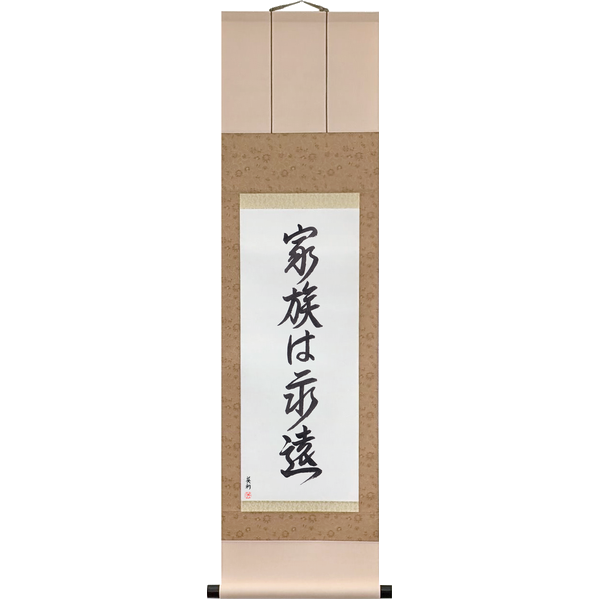
Sold as Family Is Forever · Forever In My Heart (two designs, one with my spelled out) · Forever Young · Read kazoku wa eien · eien ni kokoro no naka ni · eien ni watashi no kokoro ni · eien no wakasa · Register standard written Japanese; 永遠 is a literary and philosophical noun, at home on a gravestone, in a hymn and in a pop lyric · Oldest witness the word 永遠 in Nakamura Masanao's 1871 translation of Self-Help, then the philosophers' dictionary of 1881 for eternity; of the four phrases, 永遠の若さ in a 1912 translation of Eucken, the two forever in my heart lines in 1926 and 1927, and 家族は永遠 only as the head of a longer sentence · Sense four ways of saying that something outlasts time: a family, a person kept in the heart, youth.
The sense: one word, four things it holds
These four designs are one word doing four jobs. 永遠 eien is the Japanese noun for eternity and the adverb for forever, and it is a young word in Japanese for so large a thing: the dictionaries' first citation is Nakamura Masanao's 1871 rendering of Samuel Smiles, and its second sense, eternity as what stands outside time, enters with the Tokyo philosophers' vocabulary of 1881. A buyer who wants forever on a wall is getting the word Meiji Japan chose for it when it began translating the West. 家族は永遠, family is forever, sets the word after a subject as a bare predicate, which is how a motto speaks. 永遠に心の中に and 永遠に私の心に are the same sentence with and without my: forever, in the heart, and forever, in my heart. Japanese drops the possessor when it is obvious, so the shorter is the more natural Japanese and the longer the closer copy of the English. 永遠の若さ, eternal youth, is the one of the four with a literary life of its own in Japanese, in translations of Eucken and Rodin and in a poem on Apollo and the dying Hyacinthus.
The words
永遠 eien. デジタル大辞泉: いつまでも果てしなく続くこと。時間を超えて存在すること, continuing without end; existing beyond time, with the examples 永遠に残る名曲, a song that will last forever, and 永遠のスター. 精選版日本国語大辞典 gives the same first sense with its synonyms 永久, とこしえ, 永劫, and dates it: 永遠無疆の福を望むことなり, to hope for a blessedness without end, in 西国立志編 (1870–71), Nakamura Masanao's translation of Self-Help; the second sense, existence outside time, is cited from the 哲学字彙 of 1881 as the entry Eternity 永遠; the dictionary adds that the compound is older in Chinese, in the 書経. [kotobank.jp/word/永遠, text; read by the investigator]
家族 kazoku, the family: 夫婦・親子を中核として、血縁・婚姻により結ばれた近親者を含む生活共同体, the living community of spouses and children and the kin joined to them by blood and marriage; first cited from 1808 and then from Fukuzawa's 西洋事情, 人間の交際は家族を以て本とす, human society has the family for its base. 心 kokoro, the heart as the seat of feeling and mind, cited from the 古事記 of 712; 中 naka, inside; 私 watashi, I, whose oldest citation is a 古今集 poem of Mibu no Tadamine. 若い wakai, young, is in the 日本書紀 of 720, and 若さ is its noun. [kotobank.jp/word/家族 · /word/心 · /word/中 · /word/私 · /word/若い, text; read by the investigator]
The English side is plainer than the Japanese. Forever is an adverb and 永遠に does the same work; 永遠 alone is also the noun eternity, which English keeps separate. Where the two languages differ is in warmth: forever in English is worn smooth by songs and cards, while 永遠 keeps a slight formality, the word of philosophy and of the Christian hymnal, so that 永遠に私の心に reads a little higher than forever in my heart. The bilingual dictionary gives 永遠 as eternity; perpetuity; permanence; immortality and no more. [jisho.org/word/永遠, text]
A history, from the earliest witness
1912–1921. 永遠の若さ, in translation and in verse. The phrase enters the library in Abe Yoshishige's translation of Rudolf Eucken, where it is what Plato's forms have: 個々物の一切生滅に對して、永遠の若さを以て持續し, against the coming and going of every particular thing they persist with an eternal youth. [オイケン『大思想家の人生観』安倍能成訳 東亜堂書房 1912, NDL pid 949301, koma 35, OCR]
Two years later it is Rodin's, in Kimura Shōhachi's rendering of the conversations with Gsell, and it has turned toward the body: 永遠の若さと美とに戀着し、すげなくも外を蔽ふ肉體の恥づべき醜さに目を落してゐる無智なる人の不斷の惱みである, the constant torment of the ignorant, who are in love with eternal youth and beauty and cast down their eyes at the shameful ugliness of the flesh that covers them. [『ロダンの芸術観』木村荘八訳 洛陽堂 1914, NDL pid 951911, koma 41, OCR]
The poet Kawaji Ryūkō sets it at a dawn: 曉が目覺めた、曉が目覺めた。…そこには永遠の若さ, the dawn has woken, the dawn has woken … and there, eternal youth. [川路柳虹『勝利』曙光詩社 1918, NDL pid 907732, koma 35, OCR]
And Nakajima Kotō's Greek myths give it to Apollo over the dying Hyacinthus: 又お前の體は、花になつて、いつまでも若々しい春を、永遠の若さを、…久遠の生命を、見る人の心に語るだらう, and your body will become a flower and speak forever, to the heart of whoever looks, of youthful spring, of eternal youth, of life without end. By 1921 the phrase can carry a whole mythology, which is why a beauty manual of 1928 could use it as a running head, 永遠の若さ秘事, the secret of eternal youth. [中島孤島『ギリシヤ神話』早稲田大学出版部 1921, NDL pid 963337, koma 78, OCR, with a run of interleaved ruby dropped at the ellipsis; the 1928 manual as the investigator's search returned it, not re-opened]
1922 and 1924. 家族は永遠, as the head of a sentence. The exact string is on two pages before 1946, and on neither is it a sentence of its own. In a life of St Francis it is Christ's promise to the saint that his family, his order, will endure: 汝の家族は永遠に續くものと成り、益々弟子達は增し加へられるであらう, thy family shall become a thing that continues forever, and disciples shall be added more and more. [宮崎安右衛門『聖心』総文館 1922, NDL pid 969546, koma 132, OCR; the match runs on into 永遠に續く]
In a Tochigi women-teachers' record it is a conservative's declaration: 家族は永遠に家族主義、女子は永遠に良妻賢母主義なれ, let the family be family-ist forever and women forever good-wife-wise-mother-ist. Neither is the scroll's sentence; both show the words falling together naturally in the sense the scroll means. [『栃木県女教員研究会研究録』第1輯 1924, NDL pid 918070, koma 103, OCR; the match runs on into 永遠に家族主義; in the page API the line is split across two text boxes at 家族主義、 and a contiguous search misses it]
1926–1941. Forever in the heart. The version with my, 永遠に私の心に, is the older in print, and its three prewar pages are three different hearts. A student of the East Asia Common Culture Academy, coming down the Yangtze, writes of a storm: 豫言的な空恐ろしい天の默示は永遠に私の心におのゝいてゐる, that prophetic, terrifying revelation of the sky trembles forever in my heart. [東亜同文書院第二十二期生編『乗雲騎月』1926, NDL pid 1915533, koma 362, OCR]
A disciple of Shibusawa Eiichi, in a memorial volume, hopes that 先生の心の光が永遠に私の心に灑ぎ…込み, the light of the master's heart may pour forever into my heart. [渋沢青淵述『処世訓言集』東洋生命保険 1935, NDL pid 1110717, koma 48, OCR, with a run of interleaved ruby dropped at the ellipsis]
And Harada Mitsuko's life of Clara Schumann has Clara write, of Robert's songs, the scroll's exact words: 「これ等の歌謠は永遠に私の心に鳴り響いてゐる。今後他の何人に歌はれるのも、最早興味を持てないと云ひたい程である。」, these songs ring forever in my heart; I could almost say I have no interest in hearing anyone else sing them from now on. [原田光子『真実なる女性クララ・シュウマン』第一書房 1941, NDL pid 1238845, koma 119, OCR]
The version without my, 永遠に心の中に, has one prewar page, a teachers' conference of 1927 on what a school motto should do for a child: 永遠に心の中に信念化して宿り彼等に正しき方向を示すやう。そして卒業後の七轉八苦の中に常に甦へる愛の鞭であり力の泉でありたい, may it lodge forever in the heart as a conviction and show them the right direction; may it be a whip of love and a spring of strength that revives in the struggles after graduation. A phrase about what a few words on a wall can do is a fitting first witness for a scroll. [『高等小学教育の研究:第二十九回全国訓導協議会記録』大日本図書 1927, NDL pid 1460507, koma 285, OCR]
What is not a source
None of the four phrases has an author. 永遠の若さ is a translator's phrase for a European idea, eternal youth, and the Japanese pages that carry it are translations and a myth retold. The two forever in my heart lines are what the language produces whenever grief or gratitude needs a sentence, and the three pages show it doing so. 家族は永遠 has no Japanese page as a sentence of its own to 1946, and the history says so rather than lending it the saint's or the schoolteacher's.
The phrases in English
Forever Young is the one title here with a named English life: Bob Dylan's song on Planet Waves, released in January 1974, written, he said, in Tucson thinking of one of his sons and not wanting to be too sentimental; and Alphaville's synth-pop single of 1984, lyrics by Marian Gold, which is the one most buyers born after 1970 will hear. The design's 永遠の若さ is the noun phrase, eternal youth, not the blessing may you stay forever young; the noun is what the Japanese sources use and it is the right choice for a scroll. [en.wikipedia.org/wiki/Forever_Young_(Bob_Dylan_song) · /wiki/Forever_Young_(Alphaville_song), text]
Forever in my heart is an English formula of memorial cards and headstones with no author, and family is forever is a motto with none; the house's titles are those formulas. What a rendering must keep is the adverb: 永遠に is forever, not eternal, and the two heart phrases are adverbial fragments in both languages, a sentence with the verb left off, which is how such things are said on stone. The house's romaji on the pages already carries the macron of the seat's standard, eien.
A reading
Four designs, one word, and the reading is about the word. 永遠 was made for eternity and it has not lost that size; put after 家族 it says something larger than the English family is forever quite means, and that is a gain, not a mistranslation. The two heart phrases are the same sentence, and a buyer choosing between them is choosing between natural Japanese and a closer copy of the English; the shorter is what a Japanese hand would write, the longer is what an English speaker will recognize. 永遠の若さ is the richest of the four: the phrase Japanese translators reached for when Plato's forms and Rodin's models and Apollo's grief needed a word, and a beauty manual borrowed within the decade. A buyer who wants Dylan on the wall is getting that too. Signed, the philologist, 2026-09-06.
Notes
- Two designs, one sentence. 415 and 418 differ only by 私の, my; the catalogue explains the difference and the explanation is right. The page for either should point at the other.
- The substring hits for 222. Both 1922 and 1924 carry 家族は永遠 as the head of 家族は永遠に…; the history quotes them as what they are and does not claim the scroll's sentence for 1922.
- The 1928 beauty manual (東京洋髪研究会『洋髪の結ひ方と美容の秘訣』) is cited only as the s32 search returned it, with 永遠の若さ秘事 as a running head; it was not re-opened and its koma was not derived.
- Romaji. The catalogue's eien already carries the macron form; the wa of 家族は is Hepburn's particle spelling. Nothing to migrate here.
How this was read
A bracket that names a National Diet Library leaf as pid and koma resolves at lab.ndl.go.jp/dl/api/page/<pid>_<koma> for the OCR text and at dl.ndl.go.jp/api/iiif/<pid>/R<koma, seven digits>/full/2400,/0/default.jpg for the image. By text: the kotobank entries for 永遠, 家族, 心, 中, 私 and 若い (デジタル大辞泉 and 精選版日本国語大辞典), read whole by investigate-ten on 2026-09-05 and quoted here from its reading files, not re-opened by the seat; the EDRDG gloss at jisho. By OCR, own-hand at the koma: the ten National Diet Library books named in the brackets, each pulled to the archive and the line found in its zip. By the Lab's full-text search, own-hand, the whole result set of each phrase sorted by year (2 · 1 · 3 · 202 hits). As text: the two English Wikipedia articles on Forever Young, pulled through the parse API. Not opened: any leaf by eye; the 1928 beauty manual; the 200 hits for 永遠の若さ beyond the sorted head; an English dictionary for forever; the 書経 for the Chinese compound.
References
- 129 誇りと喜び (164 books; 1937) — F0056
- 164 子供の為に (1,684 books; 1912) — F6000
- 222 家族は永遠 (2 books; 1924) — F6058
- 291 自分を信じる (39 books; 1946) — I6002
- 295 精一杯生きる (0) — I6006
- 299 強く生きる (207 books; 1937) — I6010
- 319 希望は最大の宝 (0) — I6030
- 327 自由に生まれて (0) — I6038
- 331 新たな始まり (1 book; 1948) — I6042
- 415 永遠に心の中に (1 book; 1927) — L5033
- 418 永遠に私の心に (3 books; 1935, 1941) — L5036
- 566 危険を冒す (2,388 books; 1897 among the first five) — M6013
- 961 生きる笑う愛する (0) — S0000
- 968 誕生日おめでとうございます (0) — S0007
- 988 有難う御座います (1,739 books; 1914 among the first five) — S0030
- 1010 ゴルファー (50 books; 日国 初出 1930) — S5009
- 392 禁じられた愛 (1 book; 1924) — L5010
- 834 永遠の若さ (202 books) — P4103
- 627 母なる自然 (85 books) — N4014