

家内安全 · kanai anzen and 家庭円満 · katei enman · one house, two wishes
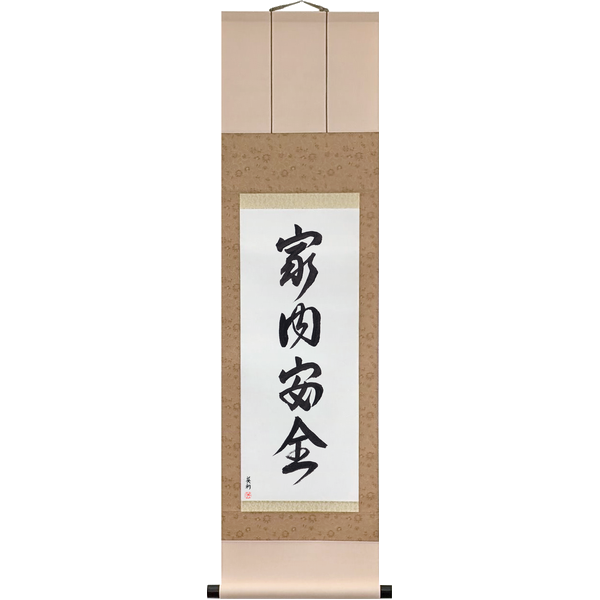
Sold as Peace and Prosperity in the Household and Household Harmony · Read kanai anzen; katei enman · What they are the same house wished for from two sides: 家内安全 is the household kept safe, a prayer said for a family against what comes from outside, and the standard wish on a shrine or temple amulet; 家庭円満 is a harmonious home, said of a family about what happens inside, a Meiji word · Oldest witness the early fifteenth century for 家内安全, in the prayer-book of a Musashi priest born in 1362; 1902 for 家庭円満, in a publisher's advertisement · In the dictionaries 家内安全 listed since 1827 and in every major dictionary today; 家庭円満 in a new-words dictionary of 1919 and in no major dictionary since · Not Chinese — the Chinese amulet says 合家平安 · Signed 典, 2026-09-07.
The words
家内 is the inside of a house and the people in it; a courtier's diary of 1096 already sets a matter of state and of the household side by side. The sense my wife is a late one. The big dictionary's note on the word says the thing that matters for this scroll: until the middle of the Meiji period 家内 and 家 were the words for the home, and when 家庭 replaced them, 家内 survived in fixed phrases like 家内安全. 安全 is the absence of danger, anzen now and ansen in the Middle Ages, when the 平家物語 prayed for the safety of the realm. The phrase means that no one in the family meets accident or illness, that all are well.
家庭 in its present sense is a Meiji word. It appears in an 1871 newspaper for inside the house and in 尾崎紅葉's 金色夜叉 of 1897 for the smallest social group, husband and wife, parents and children; the dictionary's note says it flooded the magazines of the 1890s, when the old feudal house was being reformed toward a Western style of life and people began to think of 家庭 as the translation of home. 円満 is Buddhist, fullness, of merit or of a vow, from a ninth-century text; then round and full of a face; then complete; and last, from about 1905, without corners, getting along — and the dictionary's first sentence for that sense is a novelist's the happiness of the home, the harmony between husband and wife, which is our scroll in eight characters.
家内安全 has three dictionary entries; 家庭円満 has none. The dictionary site that serves the major dictionaries answers not found for it, and for 夫婦円満 too, while answering its two halves and its sibling in full. The open Japanese-English dictionary alone lists it.
A history, from the earliest witness
About 1400: a priest's prayer for a sutra-reading. The oldest witness is a manuscript prayer-book at the National Diet Library, the 私案抄 of 長弁, a priest of 深大寺 in Musashi. On the leaf facing our passage he signs the previous prayer the eighteenth day of the second month of 1383, the Buddhist Chōben of Kanazawa, aged twenty-two, so the book is the work of a man born in 1362. The passage is his statement of intent for a reading of the six-hundred-scroll Great Wisdom Sutra: by the voice of this reading, every illness swiftly scattered and the realm brought to a settled government; every calamity at once extinguished and the household kept safe in its flourishing. The realm and the household, 天下 and 家内, are already a pair, five hundred years before they share an amulet.
The house-building rite. The 簠簋内伝, the manual of yin-yang lore attributed to 安倍晴明 and dated by the encyclopedias to the fourteenth century, has in its chapter on building a house: if the belly-pillar is raised, ten thousand blessings come unsought, the seven demons withdraw unbidden, the descendants flourish and the household is safe; therefore the oral teaching of belly, back, head and foot at the raising of the pillar is the one thing that matters. Read at the page in a 1632 print and in a manuscript copied on Ise in 1611. This is where the phrase and the new house first meet.
The shrine-priest at the teahouse. In the Kyōgen 禰宜山伏 a priest from Ise rests at a roadside teahouse and, thanked for his tea, answers: I too, every day before the god, offer the prayer for your household's safety. The big dictionary cites this line as the phrase's first; it is the older prayer put in the mouth of the man who sells it, which is what the play is about, since a yamabushi arrives next and the two pray against each other for the teahouse's god.
Edo: the amulet, the hearth, the sermon, the joke. From the seventeenth century the phrase is everywhere the prayer-trade is. The trades encyclopedia of 1690 says under the hearth-makers that the world calls the hearth Kōjin, the guardian god of household safety and wealth. A 1756 nenbutsu tract lists what people ask for: recovery from illness, household safety, and every other this-worldly aim. A 1786 morality tract has a sponsor of shrine dances praying the whole formula, peace in the realm, the five grains ripened, the household safe, calamity averted, life prolonged. A comic book of 1793 parodies a shrine legend: believe in the god and household safety, freedom from calamity, long life and every wish are beyond doubt; doubt him and you get household unsafety, calamity, and a household full of want. Two picture-books wear it as a title, 振鷺亭's Theater-mad Household Safety of 1815 and 十返舎一九's Household Safety Collection of 1829. The Kamo shrine's officers pray it in 1824, the Sensōji's donor stones are cut for the household safety of our ancestors, and the Shingaku sermons promise that minding the family trade brings household safety and long life to your descendants. A pocket dictionary of 1827 lists it as a word, and the senryū household safety: being in love with your wife was current enough for three proverb dictionaries to index.
Meiji: the formula fixed, the dictionaries slow. 福沢諭吉's 1878 essay on the household has its master always making 家内安全 his motto and frugality and honesty his rule; a norito formulary of 1880 prints a prayer under that heading; a rhyming dictionary of 1893 gives the festive set entire, peace in the realm, the five grains abundant, the four seas calm, the household safe, the state secure, wealth and long life, the sovereign's reign. 森鷗外 records a country doctor's New Year poem of 1875 built on the four characters as an acrostic. Yet the big dictionaries of 1893 and 1915 give it only as an example under other words, the second with the Kyōgen line; the headword came later. The 1941 Shintō encyclopedia lists it among the kinds of amulet a shrine issues and describes the custom of the thousand visits, each praying for his own household's safety and his shop's prosperity. From the 1910s the National Diet Library's index finds it in over three hundred books a decade.
1902: an advertisement invents 家庭円満. Nothing in the Library's index carries 家庭円満 before 1902, when a Tokyo publisher advertised the eleventh volume of its Home Library, 『家庭の快楽』: of all the pleasures of this world none surpasses the pleasure of the home; how then to obtain the joy of a harmonious home and the delight of the family circle — that is why this book was compiled. The word is built from the two Meiji senses at once, 家庭 as home and 円満 as getting along, which the dictionary first finds in 1905. Within a year it is the stock compliment of the commercial who's-whos: having raised a son, the home is harmonious and the omens auspicious (1903); the lute and zither in tune, the home harmonious (1903, of a woman professor); a family of six, the home harmonious (the Hokkaidō settlers' reports of 1906); the home harmonious and a warm air fills the hall (1906). The moralists take it up: young men today do not want the pleasures of a harmonious home (1904); a preacher offers his sermons as some help toward household harmony (1908); a Chinese-language home-economics text printed in Tokyo the same year makes it the mistress's responsibility. The first dictionary to list it is a new-words dictionary of 1919, a household living round and without complaint; the slang dictionaries of 1930 record the tangerine as its joke-synonym, because the segments all cling together; a 1931 Japanese-Chinese dictionary explains it to Chinese readers; and 研究社 in 1941 gives the sentence they live in such harmony that I never heard their voices ever raised. No national dictionary has given it a headword since.
The sense across time
家内安全 has one sense and one register, the prayer's, from the fifteenth century to the amulet on the shelf; what changed is who said it, priest, then hearth-god, then everyone. 家庭円満 has one sense too, but it was born a compliment and stayed one: something said of a couple, by a biographer, a preacher or a dictionary example. The first is a wish against the world; the second, a report on the home.
What is not a source
Neither is Chinese. Chinese Wikisource has 家內安全 nowhere and 家庭圓滿 only in modern court rulings; the Chinese wish is 合家平安, peace to the whole family, on a Tang stele and in the presidential New Year address alike. 家庭円満 is not a four-character idiom in the sense the page's link describes: it is a modern compound with no dictionary entry.
The text in English
The English for 家内安全 has one lineage. A student's dictionary of 1900 gives the family is happy and peaceful; a 1906 dictionary turns it into a prayer, (Vouchsafe) that our family may be preserved; 武信 in 1918 has peace and prosperity to the family and the family in peace; 研究社 in 1941 keeps both and adds family well-being; the postwar dictionaries settle on to pray for the well-being of one's family. The house title is 武信's phrase as the open dictionary carries it. Prosperity is not in 安全: it came in with 武信 and stayed because the amulet pairs 家内安全 with 商売繁盛. For 家庭円満 there is 研究社's sentence and the open dictionary's family happiness; household harmony; the house title is the second.
A reading
Sell 家内安全 as the oldest prayer in the catalogue: six hundred years old, the words a priest says before the god and an amulet says on the house-shelf, the household kept safe. The page's blurb is right, and the new-house occasion is not a modern guess; the yin-yang manual ties the phrase to the raising of the pillar, and the hearth-god carries it. Keep Peace and Prosperity in the Household if the title must stay, but tell the buyer the word says safe, and that prosperity is the amulet's neighbor. Sell 家庭円満 as the Meiji word it is, a harmonious home, coined when home itself was new and paid as a compliment to couples ever since; it belongs to a wedding and an anniversary more than to a new house, though a new house is where both wishes get said. Together they are one gift: the house kept safe from outside, the home kept warm within.
How this was read
By eye: both template files; twenty pages at the scan — the prayer-book manuscript, the 1611 manuscript and 1632 print of the yin-yang manual, the 1690 trades encyclopedia, the 1756 tract, the 1793 comic book, the 1815 and 1829 title leaves, the 1827 pocket dictionary, the 1880 norito formulary, the 1893 rhyming dictionary and the 1893 大辞書, the 1903 and 1945 Kyōgen prints, the 1906 and 1941 Japanese-English dictionaries, the 1915 大日本国語辞典, the 1902 advertisement, the 1919 new-words dictionary, the 1941 Shintō encyclopedia. By text at the address: the National Diet Library's full-text index on both words pulled whole, every classical hit and every dictionary title windowed at the page and the earliest 家庭円満 books windowed; the local harvest; kotobank for nineteen entries; Chinese Wikisource on twelve strings; Japanese Wikisource; the NDL catalogue for the prayer-book; the open dictionaries. Not read: Hepburn and Brinkley; the 1993 edition of the prayer-book, which would date the sutra prayer itself; the yin-yang manual in its standard edition; the picture-books beyond their title leaves; the 広辞苑 for 家庭円満. Every address is in the account.
References
Each witness is cited in the account above, at the frame or entry where it was read. A linked list follows when the record for this text is completed.