

神のみ我を裁く · 神を信ぜよ · 神を信じる · three scrolls naming God
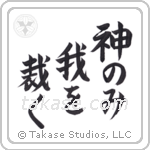
Sold as Only God Can Judge Me · Trust in God · Believe in God · Read kami nomi ware o sabaku · kami o shinzeyo · kami o shinjiru · Oldest witness for the second, the Japanese New Testament of 1881 at Mark 11:22; for the third, a Christian primer of the same year; for the first, none: it is the house's Japanese for an English sentence · Sense God alone judges me; believe in God, as a command; I believe in God, or believe in God.
The sense, across three sentences
Three short sentences about God, and three different kinds of text. 神を信ぜよ is scripture: it is how the first complete Japanese New Testament, printed in 1881, renders Jesus's words at Mark 11:22, Have faith in God, and every Meiji sermon and tract that says it after that is quoting the Bible, whether it knows it or not. The verb is the old conjugation, 信ず, and 信ぜよ is its imperative, a command in the classical register that Japanese scripture kept for a century. 神を信じる is the same verb in its modern conjugation, a plain statement that a Japanese speaker uses today, and a Christian primer of 1881 has it too, in the same year as the Bible, so the two forms have lived side by side since Japanese Christianity began in print. 神のみ我を裁く is neither. It is a motto, in the literary register of 我 and のみ, that no Japanese book carries, because its original is English: Only God Can Judge Me, a sentence that a 1996 rap record made a commonplace of tattoos and T-shirts, and that the house translated into Japanese for the customers who bring it. Each scroll says what its buyer means. The history is here so that a buyer knows which of the three is a verse, which is a sentence, and which is a rendering.
The words
神 kami, God, the word the Japanese Bible chose for the God of the Bible, and also the word for the gods of Japan. 信ず · 信じる shinzu · shinjiru, one verb in two conjugations: the dictionaries define it as 神仏を信仰する, to have faith in a god or buddha, with a citation from 1110, and give the modern form 信じる from 1902; 大辞泉's third sense, 信仰する, gives the example 「キリスト教を信ずる」. 信ぜよ shinzeyo is the imperative of the old conjugation; 信じよ and 信じろ are the imperatives of the new one. 裁く sabaku, 理非を明らかにする。裁判する, to decide right from wrong, to try. のみ nomi, only, and 我 ware, I, the literary pronoun, which make 神のみ我を裁く read as an inscription rather than as speech. The three sentences, word for word: God alone judges me · believe in God · I believe in God, and the third can also be read without its subject as believe in God.
A history, from the earliest witness
1881. The New Testament in Japanese. The Japanese New Testament of the American Bible Society, 『新約全書』, at the gospel of Mark, chapter 11, verse 22:
二二 イエス答て彼等に曰けるハ神を信ぜよ 二三 誠に我なんぢらに告ん誰にても其心に疑ふ事なく… And Jesus answering saith unto them, Have faith in God. For verily I say unto you, That whosoever shall … not doubt in his heart… — 『新約全書』米国聖書会社 1881, 馬可傳第十一章, printed p. 129 [5][5]
That is the sentence on the second scroll, to the character. The 1888 commentary on John by a foreign missionary, taken down by a Japanese hearer, uses it as a formula, 唯神を信ぜよ, only believe in God; a Buddhist lecturer's 1889 address turns it against the Christians, 佛を信ぜよ神を信ぜよと云ふも其れが道理に合はざれば信ずるに足らず, say believe in the Buddha, believe in God as you will, if it does not accord with reason it is not worth believing; and a Christian apologist the same year contrasts it with Christ's own words, 寧ろ神を信ぜよと云いずーて我を信ぜよと云へり (the OCR's ずーて for ずして), he did not say believe in God but believe in me. [7]
The National Diet Library's full-text search finds the sentence in 278 books to 1946. It is the Bible's, and the Meiji writers who use it are answering the Bible.
1881. A primer. In the same year, 原胤昭's 『耶蘇教易知』, Christianity Made Easy, has the modern conjugation: 總で神を信じる者は (the OCR's で for て), all who believe in God, in a passage on prayer and the forgiveness of sins. [6]
The modern form is rarer in print, 100 books to 1946 against 278, and it belongs to speech and to fiction: a Buddhist traveler's 1904 book, 唯神を信じると假定しても, even granting that one believes in God; Ueda Bin's 1909 translation of Andreyev, 神を信じる者には、神に對する罪 (the OCR runs the ruby into the line: 神に對つみそのたひとにんげんたいつみぶんする罪), for one who believes in God, a sin against God; a 1912 novel's 眞實神を信じるのか, do you truly believe in God? [8]
The first scroll's sentence and the second's are one verb in two registers, and the older register is the Bible's.
1996. A record. 神のみ我を裁く has no Japanese witness. The search finds 神のみが, God alone, in 908 books, from Uchimura Kanzō's 1893 神のみが onward, and 我を裁く, judges me, in eight, none of them this sentence; the nearest is a missionary's protest in a Kirishitan history, 汝等は我を裁く權能なし, you have no authority to judge me. [9]
The sentence's original is English. Only God Can Judge Me is the title of a 2Pac track on All Eyez on Me, released in February 1996, and the phrase's popular life as an inscription on skin dates from that record; the verses the tradition sets beside it are 1 Corinthians 4:3–4, he that judgeth me is the Lord, and James 4:12, who art thou that judgest another? [the album article at en.wikipedia; the King James text at en.wikisource]
The house's Japanese for it, with the literary 我 and のみ, is a rendering, made for the scroll, and the page says as much.
The scrolls. The three are one family in the catalogue, brushed as one set, and the second's brushed text reads 神を信ぜよ, the Bible's form, which is also what the house's own romanization, shinze yo, says. [the design images, R0000SSVB6A · R0001SSVB3A · R0002SSVB3A, by eye]
What is not a source
For 886, the two verses are the tradition's pairings, and the rap record is the phrase's popularizer, not its author; the English sentence is older than either, and this history does not date it. For 887, the Meiji tracts are quotations, not sources; the source is Mark 11:22 in its 1881 Japanese. For 888, nothing stands behind the sentence but the verb.
The sentences in English
For 886 the English is the original, Only God Can Judge Me, and the Japanese is the translation. For 887 the King James Bible's Have faith in God is what the Japanese renders, and the house's Trust in God and Believe in God are both fair glosses of 信ぜよ; the page's note that the imperative makes the sentence active is right in spirit and wrong in grammar, since 信ぜよ is a command, believe, not we should believe. For 888 the house gives Believe in God, Trust in God, and notes correctly that Japanese drops its subject, so the sentence reads I believe in God as naturally as believe in God.
A reading
The second scroll is the one with a history worth telling on its page: it is a verse, in the Japanese that Japanese Christians read for a hundred years, and a buyer who wants scripture on the wall is getting it. The third is the same faith in the voice of a person speaking today. The first is a rendering, honest about being one, of an English sentence that came to Japanese by way of a rap record, and its literary register, 我 and のみ, gives it the weight of an inscription, which is what the buyer wants. The one thing to fix is not on the scroll: the catalogue writes 神を信じぜよ for the second, a form that is neither conjugation, while the brushed piece and the romaji both have 信ぜよ. That is a store correction, and it is filed.
Notes
- The 887 catalogue string. The catalogue and the design row write 神を信じぜよ; the brushed piece reads 神を信ぜよ; the romaji reads shinze yo. 信じぜよ puts the modern stem 信じ in front of the classical ending ぜよ, a form no dictionary gives and no book carries (0 of 278 + 32). The typo is in the two data rows, not in the art. Filed to 礎 2026-09-06.
- The 1881 Bible's furigana. The leaf carries ruby throughout; 信ぜよ is printed with しんぜよ beside it, and the OCR runs the ruby into the text, which is why a search for the clean sentence finds the leaf only by its neighbors.
- The 1881 primer's leaf. Opened at the scan the OCR names; the print is faint and small at the resolution served, and the reading 總で神を信じる者は stands on the OCR with the leaf seen, not on the eye alone; the OCR's で is most likely the print's て, and the history quotes the OCR.
- Scan numbers. Every NDL scan number in this history is the koma derived from the book's OCR archive, not the number the Lab search returns as
page; the first draft cited the latter for eight witnesses and the outside check found none of them at their address. Corrected before publication. - Romaji. The house's wo for を on all three; the seat's standard writes o. shinze yo and shinzeyo are one word divided two ways.
- The three scrolls are draft rows. They are not on the live site at their category address as of this writing (2026-09-06, HTTP 404 on all three), so there are no live pages to check the history against; the catalogue explanations are what was read.
How this was read
By eye at the page: the 1881 New Testament at Mark 11:22 (NDL pid 992682, scan 67); the three design images. As OCR with the leaf opened: the 1881 primer (pid 824028, scan 13). By OCR: the 1887 reference Bible, the 1888 John commentary, the 1889 Buddhist address and Christian apology, the 1893 Uchimura, the 1904, 1909, 1912 and 1930 hits, all as the NDL Lab's full-text search returns them, six spellings, with the counts. As text: kotobank for 裁く, 信ずる and 信じる (大辞泉, 日国); the album article; the two King James verses at Wikisource. Not opened: any Meiji hit beyond the two leaves; the 2Pac lyric; a grammar's conjugation table for 信ず; the English sentence only God can judge me before 1996. The full apparatus, with every address, is in the account.
References
- The three scrolls (ours) (—) — R0000 · R0001 · R0002
- The house's own romaji for 887 (—) — cultural_works 887; whole_designs 655
- 原胤昭『耶蘇教易知』 (1881) — NDL pid 824028
- 『雄氏演説筆記』 · 田村直臣『真神を信ずる理由』 (1889) — NDL pids 817471, 824133, snippets
- 『新約全書』米国聖書会社, 馬可傳第十一章 二二 (1881) — NDL pid 992682 scan 67 = printed p. 129, by eye s47; https://dl.ndl.go.jp/api/iiif/992682/R0000067/full/full/0/default.jpg; the 1887 引照 edition pid 992572 scan 71, OCR ↩
- 原胤昭『耶蘇教易知』第1, the leaf (1881) — NDL pid 824028 scan 13 = printed p. 22; https://dl.ndl.go.jp/api/iiif/824028/R0000013/full/full/0/default.jpg ↩
- 約翰伝註釈 (ラールネデ 述) · 雄氏演説筆記 (オルコット) · 伊勢時雄『神の顕現』 (1888 · 1889 · 1889) — pids 825699 scan 158 · 817471 scan 35 · 824147 scan 97, OCR (lab search s47) ↩
- 河口慧海『生死自在』 · 上田敏 訳『心』(アンドレイエフ) · 江見水蔭『飛行の女』 (1904 · 1909 · 1912) — pids 816688 scan 16 · 896864 scan 19 · 887898 scan 65, OCR ↩
- 内村鑑三『基督信徒の慰』 · 姉崎正治『切支丹伝道の興廃』 (1893 · 1930) — pids 824356 scan 62 · 1918428 scan 209, OCR ↩
- The three design images (ours) (—) — `takase-images/templates/scrolls/christian/R0000SSVB6A-…-template.jpg` · `R0001SSVB3A-…-template.jpg` · `R0002SSVB3A-…-template.jpg`, by eye s47
- NDL corpus (to 1946) — counts