

一路順風 · ichiro junpū and 順風満帆 · junpū manpan · one wind, two scrolls
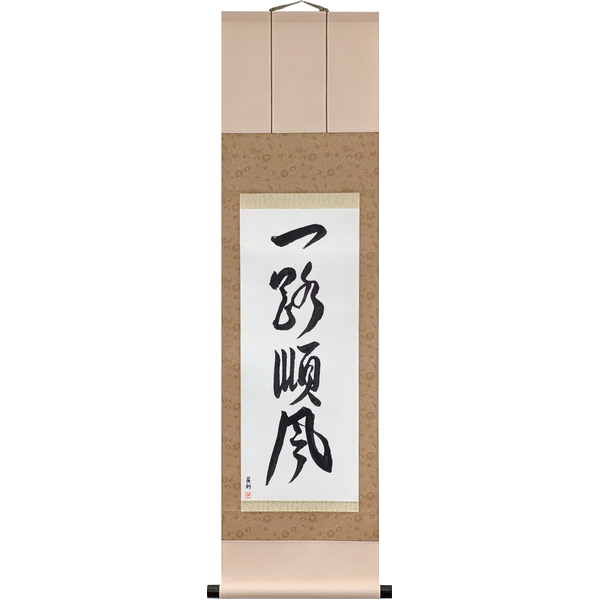
Sold as Everything is Going Well and Smooth Sailing · Read ichiro junpū; junpū manpan (also manpo) · What they are the same fair wind seen twice: 一路順風 is Chinese, a fair wind the whole way, the blessing said to a traveler; 順風満帆 is Japanese, fair wind, full sail, the medieval proverb 順風に帆を上げる pressed into four characters · Oldest witness 858 for the Chinese phrase, a Tang governor's thanksgiving for the wind that carried him out of a mutiny; 1876 in print for the Japanese one, a legation ship's log · In the dictionaries never, for 一路順風, in any Japanese dictionary opened; from 1983 for 順風満帆 · In English both house titles are JMdict's glosses, word for word.
The words
順風, the wind that blows the way you are going, is in the 続日本紀 for the year 700 and in the 史記's like shouting with the wind. 満帆 is a sail filled to the full. 一路 in Japanese is a single road or, as an adverb, straight on; in the Chinese phrase it means all along the road, the whole way, the same 一路 as in 一路平安, which the Japanese dictionaries do list and gloss as Chinese for "a safe journey." The catalogue's travel; journey is neither language's sense.
The two readings of 順風満帆 are a live quarrel. The dictionaries rule manpan and call manpo wrong; a 1980 broadcaster's survey found about five in ten saying manpan and three in ten manpo, and the open Japanese-English dictionary lists manpo first. The catalogue's manpan is the ruling.
A history, from the earliest witness
858: the Tang governor's wind. The oldest text with 一路順風 is a thanksgiving to a mountain god. 鄭薰, governor of 宣州, was driven out by a mutiny in 858 and fled by boat with his household of a hundred; five commoners risked their lives to bring him food, money and vessels, and from there north, a fair wind the whole way, as if something held the boat, no obstruction at all. A voice told him to take the shallow lake road instead of the river; he did, and learned afterward that the rebels had blocked the river. The phrase is literal there: wind, boat, the whole road. The Ming and Qing novels make it the stock sentence of any journey that goes well, a fair wind and fair water the whole way, from the 醒世恆言 of 1627 through 李漁 and the 鏡花緣 of 1827, and by the late Qing it is the thing said at a parting: a courtesan, eyes reddening, says softly "一路順風" and turns away; a wife says a fair wind the whole way, and pass every examination and cannot finish. That is where the modern Chinese bon voyage stands.
1881 to 1925: Chinese, in Japan. Every Japanese witness before 1925 is Chinese text or a Chinese dictionary. Two nautical vocabularies of 1881 and 1884 give it as the Chinese for fair wind, whole voyage. The shogunate's record of foreign relations preserves a Chinese ship-master's note from Nagasaki thanking two officials because both ships came in last night, by your grace, a fair wind the whole way and everyone safe. And at Shimonoseki on the twentieth of March 1895, in the Chinese secretaries' record of the peace talks, Itō Hirobumi's first words to Li Hongzhang were did Your Excellency have a fair wind the whole way?, and Li's answer that the wind was fair except for a day's halt at Chengshan. A fortune-teller's manual of 1901 uses it in its oracles; a design manual of 1925 explains the Chinese rebus behind it, one egret flying with the wind, since 一鷺 and 一路 sound alike, among motifs almost all come from China.
1931 onward: absorbed into the proverb. The first Japanese sentences with the phrase are a Diet speech of 1931, raising sail on a fair wind the whole way, and a 1936 novel of 鄭成功's ship; then the company histories of the 1940s, the company did not sail the whole way on a fair wind. Nearly every one attaches 一路順風 to raise sail or ride, which is the native proverb's grammar. Japanese took the Chinese blessing as an ornament for a saying it already had, and never gave it a headword.
Before 1880: the Japanese word. 順風満帆 is not Chinese. The only Chinese text with the four characters in sequence is one line of a Qing poet, the fair wind fills the sail's breadth, where the phrase breaks across the words; the Chinese idiom for the wish is 一帆風順, one sail, fair wind. In Japan the word begins in ships' logs, meaning exactly what it says. A legation vessel's log printed in the government gazette in 1876: at 1:45 p.m. weighed anchor, fair wind, full sail; at 7:35 reached Chefoo and anchored. A manuscript log a day out of San Francisco: morning southwest wind, afternoon northwest; fair wind, full sail spread; before ten the wind uncertain and the ship rolled hard; by afternoon calm, and the ship went like an arrow. A general's Pacific crossing of 1886: fair wind, full sail, as yesterday; 244 miles. The figure appears first in kanbun, in the Tsu Confucian 土井聱牙, who died in 1880, telling his pupils what reading is like once the four gates of the classics are passed: fair wind, full sail; the greatest speed and the greatest joy; those who know it know it, and those who do not, do not. Then in prose from 1894: a magazine's filled with fair wind and full sail, a sick man's letter of 1898 hoping for a fair-wind, full-sail recovery, a 1904 book on Japan itself under fair wind and full sail, with high hopes for the road ahead, a 1910 text on the world economy.
1929 to 1983: the cliché and the dictionary. The Library's count of books with the word goes from five in the 1910s to fourteen in the 1920s to ninety-six in the 1930s, and the books are company histories and regional who's-whos: a fair-wind, full-sail development, a fair-wind, full-sail season. The dictionaries' first citation, a baseball history of 1929, sits in that genre. No pre-war dictionary has the word; the 広辞苑 admitted it in 1983, and the four-character dictionaries call it a postwar word. In print it is fifty years older than its dictionary, and in kanbun a hundred.
The sense across time
一路順風 has one sense, the traveler's, in two moods: literal in 858, a formula in the novels, a farewell by 1900, a metaphor in Japan after 1931. 順風満帆 has two: the sailor's plain report, which is where it starts and which the dictionaries now cite second, and the figure, which is what everyone means by it now. The Japanese word is the proverb's grammar removed: 順風に帆を上げる is something you do, 順風満帆 is a state you are in.
What is not a source
一路順風 is not a Japanese four-character idiom: no Japanese dictionary lists it, and the Japanese uses lean on a different proverb. 順風満帆 is not Chinese: the Chinese say 一帆風順. Neither is a proverb with a moral; both are wishes. Happily ever after is in no dictionary found and describes neither.
The text in English
Both house titles are the open dictionary's glosses verbatim: everything is going well for 一路順風, given after sailing before the wind, and smooth sailing for 順風満帆. 研究社 has he had exceedingly smooth sailing as a financier; a learners' corpus has he is on a roll. No Japanese-English dictionary opened gives 一路順風 as the farewell it is; its English lives in the Chinese-English dictionaries as bon voyage, and the 1881 nautical vocabulary is the trace of that lane. Nothing in print supports happily ever after.
A reading
Sell the pair as one wind. 一路順風 is the wish at the gangway, a fair wind the whole way, Chinese and twelve centuries old, said by a governor of his escape, by a courtesan to her lover, by Itō to Li Hongzhang; it belongs to a departure and a graduation, and the page's opening does not fit it. Keep Everything is Going Well if the title must stay, but put a fair wind the whole way beside it and say it is Chinese. 順風満帆 is the wish for the voyage, fair wind, full sail, Japanese, a sailor's log entry before it was anyone's metaphor, and the page should drop happily ever after, which nothing supports, and may say the word is Japanese and that the Chinese say something else. No question for Eri: both designs write the modern glyphs as every dictionary does. 典, 2026-09-07.
How this was read
By eye: both template files; six pages at the scan — the 1876 gazette log, 聱牙's kanbun in its 1892 print, the 1895 Itō–Li exchange in its 1896 print, the 1925 design manual, the Nagasaki letter in the 1940 通航一覧, the manuscript log. By text at the address: the National Diet Library's full-text index on both words, pulled whole, with every hit before 1912 windowed at the page and the classical facet read; the local harvest; kotobank for twelve entries including the proverb, 一路平安 and four biographies; Chinese Wikisource on nine strings, with every title for 一路順風 and 一帆風順 listed and the 858 text parsed whole; Japanese Wikisource; the English through EDRDG and Weblio. Not read: Hepburn and Brinkley; the Qing poem whole; the novels beyond their lines; the dictionaries' 1929 and 1953 citations at the page; whose voyage the manuscript log records.
References
Each witness is cited in the account above, at the frame or entry where it was read. A linked list follows when the record for this text is completed.