

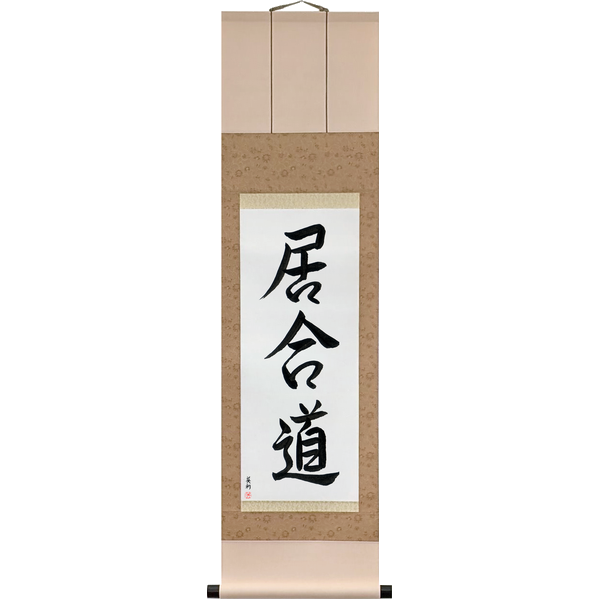
居合道 iaidō Iaido
This is a philological study of the word 居合道 (iaidō), following 居合 from a sword master's license of the sixteenth century through the Edo encyclopedias and fiction, the name 居合道 from its first appearance in 1939, and both into English.
Abstract
居合道 (iaidō) joins two words of different ages. 居合, the art of drawing the sword and cutting in the same act, is first known in 1579, written 居相, and through the Edo period it named a broad art: the root of all sword fighting, done seated or standing, sometimes with grappling, and by the early eighteenth century a street performance as well. The name 居合道 is first known as the title of a book of 1939; the national bodies took it up from 1954, and until then the art's titles were 居合術. English dictionaries have had iai since 1896 and English print iaido since 1964, and the gloss now common in English, the way of mental presence and immediate reaction, was written for an English encyclopedia in 2006 and is not a sense any dictionary gives the characters.
Overview
The sense. A standard word, the name of a modern martial discipline. デジタル大辞泉 defines 居合 as 《座った姿勢から瞬時に刀を抜き、敵を斬る剣技》, a sword technique of drawing in an instant from a seated posture and cutting the enemy, begun, it is said, by Hayashizaki Jinsuke Shigenobu 林崎甚助重信 of Ōshū in the years 1570–1591; 精選版 日本国語大辞典 adds that in the early modern period it came to mean the drawing of a long sword with a shout as well, and today includes drawing and cutting from standing [1]. 日本大百科全書 (ニッポニカ) states the aim that all its schools share: 《鋒(きっさき)が鞘を離れる瞬間に勝敗を決することを本旨としている》, its principle is that victory is decided at the moment the point leaves the scabbard [2]. 居合道 is the same art as practiced now: forms performed alone, within a time limit, judged by referees [3]. English has no word of its own for the art. It describes it (the art of drawing a long sword, below) or borrows the Japanese.
The words. 居合 is read いあい, in the old kana ゐあひ; the 精選版 日本国語大辞典 also records いやい as a spoken form of it [1], and an Edo print of 1716 glosses the art's name イヤヒ [4]. The word was coined against 立合 (tachiai), the fight begun standing, and the dictionaries read its first character two ways. デジタル大辞泉: 《「居」は座ることの意》, 居 means sitting [1]. ニッポニカ reads it as 敵と居合わせる, being there when the enemy is [2], and ブリタニカ says the correct reading is 居合わす, to happen to be present [1]. Wada Tetsuya 和田哲也 finds the older spellings 居合, 居相 and 坐合 all made of a character meaning to sit and one meaning to meet [5]. Other names for the art were 抜刀, 抜剣, 抜合, 利方 and 鞘の中 [1][2]. 道 (dō) is a way, as in 剣道 and 弓道; 居合道 replaces the older 居合術 (iaijutsu), in which 術 is a technique or art.
The text in English. Brinkley's Japanese-English dictionary of 1896 heads it Iai, the art or the act of drawing a long sword at a short distance from an enemy [6], and Kenkyūsha's of 1939 the art of drawing a long sword [7]. JMdict gives 居合道 as iaido (art of drawing the Japanese sword) [8]. What each keeps and loses is the subject of the English section below.
The historical record
1579, Yagyū Munetoshi 柳生宗厳, a license of the 新陰流. The earliest known use is in a certificate of mastery dated 天正7, as Wada prints it: 円太刀,向上,極意,人取手,居相分候, the round sword, the ascent, the secret, the taking of men and 居相, I have passed on [5]. Wada sets 居相 beside the school's 立相, the standing fight, so the pair already names the two situations in which a swordsman meets an enemy [5].
1630 and 1641, a title and a scroll. A work titled 一伝流居合之序 is recorded under the date 寛永七 (1630) [9], and a transmission scroll of 寛永十八 (1641) in the National Diet Library lists its forms as 居相(合)表六ツ, six outer forms of 居相, the 合 written beside the 相 [10]. Neither is known to be digitized.
1646, 鴉鷺俳諧, a book of linked verse edited by Ryūho 立圃. The first use the 精選版 日本国語大辞典 cites: 放家師(ほうかし)の手にとる玉は月にみえて〈立圃〉 はやき居あひは露もぬからず〈宗利〉, the ball in the juggler's hand looks like the moon / the swift iai does not fail by so much as a drop of dew [1][11]. Within seventy years of its first known writing the word is at home in comic verse, beside a street performer.
1671, 居合師弟問答, a dialogue on the art. As Wada quotes it: 或ハ曰、居合ハ囲合也、其ノ身ヲ囲リテ其ノ不意ニ合フ也, some say that 居合 is 囲合: one guards one's body and meets what comes unforeseen [5]. A play on the sound, and a third reading of the first character, to enclose.
1682 and 1688, Ihara Saikaku 井原西鶴, fiction. In 好色一代男: 其比は捕手居合はやりて, in those days arresting holds and iai were the fashion [12]. In 日本永代蔵, among the things that ruin a merchant, 町人の居合兵法, a townsman's iai and swordplay [13]. The art has reached the townsmen and become a fashion.
1690, 人倫訓蒙図彙, an illustrated encyclopedia of occupations. Under the head 居合, ruby ゐあひ: ゐあひは太刀討の根元なり兵法といふは敵に向て太刀をあはするは腰より, iai is the root of all sword fighting; what is called swordsmanship, crossing swords with an enemy, starts from the hip, and the sentence ends that swordsmanship comes only once the sword is out; the entry goes on to say that without drawing there is no swordsmanship, that the manner of drawing varies with the length of the weapon, the size of the place and the lie of the ground, and that it is done seated and standing; of its many schools, 関口流 is the most famous [14]. The encyclopedia does not confine the art to a seat.
1716, Hinatsu Shigetaka 日夏繁高, 本朝武芸小伝, lives of the martial artists. 林崎甚助重信者奥州人也祈林崎明神悟刀術精妙此人中興拔刀之始祖也, Hayashizaki Jinsuke Shigenobu was a man of Ōshū; praying to the deity of Hayashizaki, he attained the subtlety of the sword; he is the founder of the revival of 拔刀, and beside 拔刀 the print sets the ruby イヤヒ, iyahi [4]. The book writes the art 拔刀, drawing the sword, and reads it as the spoken form of iai. It quotes the 北条五代記 for the legend: 長柄刀のはじまる子細は明神老翁に現し長つかの益あるを林崎勘助勝吉といふ人に傳へ給ふ, the long-hilted sword began when the deity appeared as an old man and taught its use to a man called Hayashizaki Kansuke Katsuyoshi, and notes that the 五代記 gives him the name 勝吉 where the transmission scrolls give 重信 [4]. The founder is known from legend, and the legend already disagrees on his name.
1717, 書言字考節用集, a dictionary. 居合〔ヰアヒ〕劒術、林崎重信末派也、又謂之利方, iai: a sword art of the school descended from Hayashizaki Shigenobu; also called 利方 [15].
1830, Kitamura Nobuyo 喜多村信節, 嬉遊笑覧, a miscellany. Reading the seventeenth-century books, it concludes: 居合は、とりてにも大刀拔ことにもいふべきこと知らる, it is plain that 居合 could be said both of arresting holds and of drawing the long sword [15]. Among its early senses the word covered grappling.
1895–1941, the Dai Nippon Butokukai 大日本武徳会. The national association of the martial arts, founded in 1895, gave its titles in the art under the name 居合術, and Nakayama Hakudō 中山博道 received the highest of them, 居合術範士, in 1920 [2]. Its directory of holders of 1937 heads its sections 居合術範士 and 居合術教士 [16], and ニッポニカ counts its titles in March 1941 as 居合術の称号, two 範士, fifty 教士 and 178 錬士 [2]. In 1933 Nakayama arranged the forms he taught as the 夢想神伝流 [2].
1939, Kōno Minoru 河野稔, 無双直伝英信流居合道. The earliest known use of the name 居合道 is the title of this book of 318 pages, published by 日本武道通信社 [17]. Kōno's own book on the same school six years earlier was titled 無雙直傳英信流居合術 [18]. He published 大日本居合道図譜 in 1943 [19].
1942, 南津軽郡町村誌, a local history of Aomori. Among a man's honors: 昭和十一年に於ては、古來傳はれる武道大會に於て、秩父宮殿下御台覽の光榮に浴し、靑森縣古武道振興會から感謝され、大日本居合道五段鍊士稱號を授與され, in 1936, at a martial arts tournament of the old traditions, he had the honor of performing before Prince Chichibu, received the thanks of the Aomori Society for the Revival of the Old Martial Arts, and was granted the title of fifth-grade 錬士 of 大日本居合道; he is further named an officer of a 大日本居合道研修會 [20]. The sentence opens on 1936, but it is written in the words of 1942 and does not show which name the title carried when it was given.
1954–1968, the national bodies. The 全日本居合道連盟 was founded in May 1954 and set its five common forms, the 全日本居合道刀法, in October 1956; ニッポニカ dates from these years the settling of the name: 《このころから居合術にかわって居合道の名が定着してきたといえる》, from about this time the name 居合道 took the place of 居合術 [2]. The All Japan Kendo Federation set up a section for the art in 1956, held the first national 居合道 tournament in 1966 and fixed its own common forms in 1968 [1].
What is not a source. 居合抜き, the street show of the Edo period, in which peddlers of medicine and tooth powder drew very long swords to gather a crowd, is a descendant of the art, not its origin [1]. The ordinary verb 居合わせる, to happen to be present, shares the characters and gives ニッポニカ and ブリタニカ their reading of the name; it is not attested as the art's source [2][1].
The word in English
1896, Brinkley, An Unabridged Japanese-English Dictionary. Iai, 居合, n. The art or the act of drawing a long sword at a short distance from an enemy. Iai wo suru, to perform the above feat. [6]. The next entry, for the one who performs it, adds the street peddler of tooth powder and plasters who draws a long sword to gather customers [6].
1939, Kenkyūsha's New Japanese-English Dictionary, edited by Takenobu Yoshitarō. iai (居合) n. The art of drawing a long sword, the word long set in the book's own brackets; no headword for 居合道 [7]. Saito's English-Japanese dictionary of 1915 had given 居合 for sword-play [21].
1959, G. W. Sargent, The Japanese Family Storehouse, a translation of 日本永代蔵. On Saikaku's 町人の居合兵法: 'sword-drawing' and 'duelling'. The former was the art of drawing a sword quickly, in any position. The latter was the general art of sword fighting. Both arts, essential to samurai, were becoming increasingly popular as pastimes for young townsmen [22]. The note reads the word in a seventeenth-century text and keeps the breadth the 1690 encyclopedia gives it.
1964, Sasamori Junzō and Gordon Warner, This Is Kendo. In the latter part of the 13th century Shigenobu Hayashizaki, second son of Yasutoki Hojo, founded a new kind of school of swordsmanship; the samurai's new way of wearing the sword allowed the swordsman to draw his blade and to cut with a one-motion stroke [23]. The century is an error: every Japanese source cited here places Hayashizaki in the second half of the sixteenth century [1][4], and his descent from Hōjō Yasutoki is given by none of them. The same year the magazine Black Belt reported a tournament of the Zen-Nippon Iai-do Renmei and ranks of Iai-do 8th Degree, the word's first known appearances in English [24].
1973, Donn F. Draeger, Classical Budo. The designation of "sword-drawing technique" as a distinct budo form, iai-do, was made only in the twentieth century. Of the founder: There are all sorts of ideas as to the details of his life, but most of them are pure fiction … He was born in Sagami (present Kanagawa Prefecture) in the mid-sixteenth century [25]. The first sentence agrees with the Japanese record. The birthplace is an error against it: the 1716 lives and the dictionaries make him a man of Ōshū, in the north [4][1].
1982, Gordon Warner and Donn F. Draeger, Japanese Swordsmanship. The very term "iai-do" first appeared in 1932 and was popularized by Nakayama Hakudo, and the same passage dates Nakayama's Muso Shinden Ryu batto-jutsu to 1932 [26]. No Japanese witness of 1932 for 居合道 is known; the Butokukai's directory of 1937 and its titles to 1941 say 居合術, the name is first known in 1939, and ニッポニカ dates Nakayama's 夢想神伝流 to 1933 [16][2][17]. The book glosses the characters: 居 represents the actual physical manifestations of the human body and mind, and 合 is an ideogram that infers the ability of a person to quickly adapt himself [26].
1993, Japan: An Illustrated Encyclopedia. iai 居合: Technique of swordsmanship that includes the skill of cutting one's adversary on the draw … believed to have been founded by Hayashizaki Jinsuke Shigenobu (b 1542) [27].
2006, the English Wikipedia. On 27 August 2006 an editor added to the article Iaido the gloss approximately "the art of mental presence and immediate reaction", each of its three parts a link to the Wiktionary entry for one character, 道 art, 居 mental presence, 合 immediate reaction, with no source [28]. On 18 June 2007 the art of became the way of [29]. The article now carries the phrase with a citation to Warner and Draeger and to a book of 1999, and gives the term "iaido" appears in 1932 on Warner and Draeger alone [30]. Warner and Draeger's gloss of the characters is in other words [26].
Today. JMdict gives iaido (art of drawing the Japanese sword) [8]. The design is sold as Iaido, the Japanese word as English has taken it. This history's gloss, the way of drawing the sword, gives what the word names rather than what its first two characters say, since the dictionaries read 居 two ways. A rendering should keep way for 道 and drawing for what the art is, and should not give 居 as mental presence, which is an encyclopedia editor's gloss of 2006 and no dictionary's.
A reading
The scholarship divides over the first character. デジタル大辞泉 and Wada read 居 as sitting, the art's own posture set against 立合 [1][5]; ニッポニカ and ブリタニカ read it as being there, the situation of a man attacked before his sword is out [2][1]; and the dialogue of 1671 punned it into 囲, guarding [5]. I read the two main readings as one situation seen from two sides. 居 is the state of rest, seated in a room or simply standing where one is, and 合 is the meeting that interrupts it. The 1690 encyclopedia, which says the art is done seated and standing, and the 1579 license, which sets 居相 beside 立相, both describe a swordsman who has not yet drawn [14][5]. That is what separates the art from fencing, and it is why the older English, at a short distance from an enemy, is closer to the Japanese than mental presence.
The name is younger than the art by three and a half centuries. 居合 was an Edo word with wide edges: the root of all sword fighting, a fashion among townsmen, a street show, sometimes a hold [14][13][1][15]. 居合道 is a name of the Shōwa years [1], first known in print in 1939, not in 1932 [17]. It became general only with the federations of the 1950s [2]. A buyer who hangs these three characters hangs the modern discipline's name, standing on a word first written in a license of 1579.
Notes
- The National Diet Library catalogue gives the scroll of 1641 the title 居合道伝書, and says that the title was supplied by the cataloguer; the scroll's own forms are written 居相 [10].
- The 1646 book is catalogued under two titles, 鴉鷺俳諧 and 鵜鷺誹諧, according to the holding library [11].
Sources not seen
- Kōno Minoru 河野稔, 無双直伝英信流居合道, 日本武道通信社, 1939, National Diet Library pid 1117217, served to readers in Japan only. The first book known to carry the name 居合道 in its title; its preface would show whether the author explains the name or knew it from earlier use [17].
- 立圃 編, 鴉鷺俳諧, 1646, five copies in libraries in Japan (天理図書館 綿屋文庫, 京都大学 潁原文庫 and a third under 鴉鷺俳諧; 宮城県図書館 伊達文庫 and 柿衞文庫 under 鵜鷺誹諧), none digitized. The verse the 精選版 日本国語大辞典 cites as the word's first use; the leaf would confirm its form [11].
A reader with access to any of these is invited to write to Takase Studios at Tim@Takase.com.
References
- 「居合」, デジタル大辞泉, 精選版 日本国語大辞典, 改訂新版 世界大百科事典, 百科事典マイペディア, ブリタニカ国際大百科事典 小項目事典, at kotobank. https://kotobank.jp/word/居合-29725
- 「居合術」, 日本大百科全書 (ニッポニカ), at kotobank. https://kotobank.jp/word/居合術-1503201
- 「居合道」, 共同通信ニュース用語解説, at kotobank. https://kotobank.jp/word/居合道-899745
- 日夏繁高『本朝武芸小伝』, 享保元年 (1716), the copy of the 国文学研究資料館, canvas 137. https://kokusho.nijl.ac.jp/biblio/200005446/137 · the typeset edition of 1920, scan 104: https://dl.ndl.go.jp/pid/927114/1/104
- 和田哲也「居合の成立と技法的変遷に関する一考察」, 『武道学研究』 14(1), 1981, pp. 27–35, p. 27 and n. 1. https://doi.org/10.11214/budo1968.14.1_27
- F. Brinkley and others, An Unabridged Japanese-English Dictionary, Sanseidō, Tokyo, 1896, p. 399. Internet Archive cu31924082117288. https://archive.org/details/cu31924082117288
- Takenobu Yoshitarō, ed., Kenkyusha's New Japanese-English Dictionary, American edition, Harvard University Press, 1942, photolithographed from the printing of 1939, p. 567.
- 居合道, JMdict, at jisho.org. https://jisho.org/word/居合道
- 「一伝流居合之序」, the work record, 国書データベース, 国文学研究資料館. https://kokusho.nijl.ac.jp/work/1972152
- 居合道伝書, a title supplied by the cataloguer, a scroll with the colophon 寛永十八年 (1641), the catalogue record, National Diet Library Search. https://ndlsearch.ndl.go.jp/books/R100000136-I1971149384832559744
- 「鴉鷺俳諧」 (鵜鷺誹諧), the work record, 国書データベース, 国文学研究資料館, with its holdings. https://kokusho.nijl.ac.jp/work/102136
- 井原西鶴『好色一代男』, 1682, the copy of the 国文学研究資料館, scan 33. https://kokusho.nijl.ac.jp/biblio/200003076/33
- 井原西鶴『日本永代蔵』, 1688, the copy of the 国文学研究資料館, scan 49. https://kokusho.nijl.ac.jp/biblio/200015843/49
- 『人倫訓蒙図彙』, 1690, vol. 2, scan 14. National Diet Library pid 2592440. https://dl.ndl.go.jp/pid/2592440/1/14
- 『古事類苑』 武技部, 神宮司庁, 1914, s.v. 居合, scan 37, quoting 書言字考節用集 (1717) and 嬉遊笑覧 (1830). National Diet Library pid 897736. https://dl.ndl.go.jp/pid/897736/1/37
- 大日本武徳会『武道範士教士錬士名鑑』, 1937, p. 269, scan 146. National Diet Library pid 1055514. https://dl.ndl.go.jp/pid/1055514/1/146
- 河野稔『無双直伝英信流居合道』, 日本武道通信社, 1939, 318 pp., the catalogue record, National Diet Library Search. https://ndlsearch.ndl.go.jp/books/R100000002-I000000734269
- 河野稔『無雙直傳英信流居合術』, 1933, the catalogue record, National Diet Library Search. https://ndlsearch.ndl.go.jp/books/R100000136-I1970867909883106470
- 河野稔『大日本居合道図譜』, 1943, the catalogue record, National Diet Library Search. https://ndlsearch.ndl.go.jp/books/R100000136-I1971712334726058759
- 『南津軽郡町村誌』, 1942, p. 325, scan 177. National Diet Library pid 1042081. https://dl.ndl.go.jp/pid/1042081/1/177
- Hidesaburo Saito, Saito's Idiomological English-Japanese Dictionary, S.E.G. Publishing Department, Tokyo, 1915, s.v. Sword.
- G. W. Sargent, trans., The Japanese Family Storehouse, or The Millionaires' Gospel Modernised, Cambridge University Press, 1959, p. 180, commentary on book III, chapter 1, n. 8.
- Junzo Sasamori and Gordon Warner, This Is Kendo: The Art of Japanese Fencing, Charles E. Tuttle, Rutland and Tokyo, 1964, pp. 43–44.
- Black Belt, March 1964. Internet Archive blackbelt-1964-03. https://archive.org/details/blackbelt-1964-03
- Donn F. Draeger, Classical Budo: The Martial Arts and Ways of Japan, vol. 2, Weatherhill, New York and Tokyo, 1973, p. 85.
- Gordon Warner and Donn F. Draeger, Japanese Swordsmanship: Technique and Practice, Weatherhill, New York and Tokyo, 1982. Internet Archive japaneseswordsma0000warn. https://archive.org/details/japaneseswordsma0000warn
- Japan: An Illustrated Encyclopedia, Kodansha, Tokyo, 1993, p. 579, s.v. iai.
- "Iaido", English Wikipedia, revision of 27 August 2006. https://en.wikipedia.org/w/index.php?oldid=72181780
- "Iaido", English Wikipedia, revision of 18 June 2007. https://en.wikipedia.org/w/index.php?oldid=138981730
- "Iaido", English Wikipedia, revision of 23 June 2026. https://en.wikipedia.org/w/index.php?oldid=1360815357