

不名誉より死 · 常に忠誠を · 決して降伏しない · 決して諦めない · 保護と奉仕 · 備えよ常に · fumeiyo yori shi · tsune ni chūsei wo · kesshite kōfuku shinai · kesshite akiramenai · hogo to hōshi · sonae yo tsune ni · Death before dishonor · Always faithful · Never surrender · Never give up · To protect and to serve · Be prepared
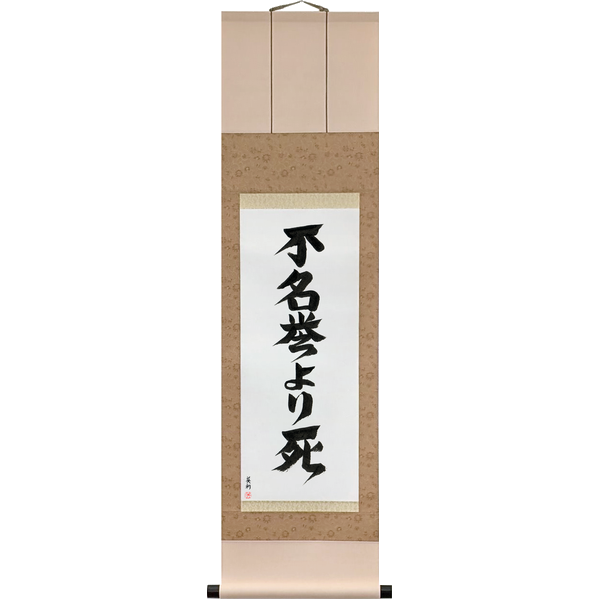
Sold as Death Before Dishonor · Semper Fi · Never Surrender · Never Give Up · To Serve and Protect · Be Prepared · Read fumeiyo yori shi · tsune ni chūsei wo · kesshite kōfuku shinai · kesshite akiramenai · hogo to hōshi · sonae yo tsune ni · Register the Japanese of mottos: noun phrases without their verbs, an imperative, two plain negatives; all standard, none a set expression in a dictionary · Oldest witness in their own languages, a Neapolitan order's Latin of 1464, the Marines' Latin of 1883, Churchill's English of 1940 and 1941, a Los Angeles police magazine of 1955, and Baden-Powell's Scouting for Boys of 1908; in Japanese, 決して降伏しない in a 1921 Hugo, 決して諦めない in a 1922 Maeterlinck, 備へよ常に in a 1924 camping manual, 保護と奉仕 in a 1934 Christian memoir, and 常に忠誠を in twenty-five prewar books of its own · Sense what a soldier, a Marine, a police officer and a Scout say they are for.
The sense: six mottos, and whose they are
These six scrolls carry other people's mottos, and each belongs to an institution or a speaker before it belongs to a wall. Death before dishonor is a Latin sentiment of the Renaissance and an American tattoo; Semper fidelis is the United States Marine Corps' since 1883; never surrender and never give in are Churchill's, June 1940 and October 1941; to protect and to serve was chosen by a Los Angeles police officer in a magazine contest in 1955; be prepared is Baden-Powell's pun on his own initials. The Japanese on the scrolls is the house's for four of them and the Japanese Scouts' own for the fifth. For the sixth, 常に忠誠を, the reading found something the page does not know and a Japanese reader over eighty would: the words have a Japanese home, and it is the wartime creed literature, where a 1943 citizens' field code opens its first article with them. The history says so plainly, because a Marine who hangs the scroll should know what a Japanese veteran will see in it.
The words
不名誉 fumeiyo, dishonor: 名誉を傷つけること, the damaging of one's honor; the word's first citation is Futabatei's 浮雲 of 1887–89, the first modern novel, so it is a Meiji noun. より yori, rather than; 死 shi, death: rather than dishonor, death, a noun phrase with no verb, which is what a crest says. 忠誠 chūsei: 忠実で正直な心。また、忠義を尽くすこと, a faithful and honest heart; devotion to one's lord, with the dictionary's examples 国家に忠誠を尽くす and 忠誠を誓う; first cited from a 1530 commentary on Zhuangzi. The scroll's 常に忠誠を, always, loyalty, ends on the particle を and leaves the verb, 尽くす or 誓う, unsaid, which is how Japanese makes an object-phrase into a vow. [kotobank.jp/word/不名誉-620397 · /word/忠誠-97330, text; read by the investigator]
降伏 kōfuku, surrender: 戦いに負けたことを認めて、相手に従うこと, to admit defeat and submit, the word of 無条件降伏; first cited from the 続日本紀 for 740. 諦める akirameru, to give up: もう希望や見込みがないと思ってやめる。断念する, to stop because one sees no hope; the older dictionary's 仕方がないと思い切る, to resign oneself, is the verb's Buddhist shade, since 諦 is to see clearly; first cited from a 1693 puppet play. 決して kesshite with a negative is never. 保護 hogo, protection; 奉仕 hōshi, service, the word for church service and volunteer work, with a note of devotion. 備えよ sonae yo, the imperative of 備える, to make ready; 常に tsune ni, always. [kotobank.jp/word/降伏-63085 · /word/諦める-423240, text; read by the investigator]
The English and the Japanese fit closely in five of the six, and the one misfit is small and interesting. Semper fidelis is an adjective, always faithful; Japanese has no adjective for the Marine's virtue and says the noun instead, loyalty, always, with the verb withheld. Never give up on the fourth scroll is the tattoo tradition's smoothing of Churchill's never give in; the Japanese 諦めない renders give up exactly. To protect and to serve keeps its order in the Japanese and loses it in the house's English title, To Serve and Protect, which is the order the motto is usually misquoted in.
A history, from the earliest witness
1464. The Latin behind death before dishonor. The English motto has no article of its own in the encyclopedia, only a page of albums, a band and a regiment's crest. Its Latin ancestor is the badge of the Order of the Ermine, founded in 1464 by Ferdinand I of Naples: Malo mori quam foedari, I would rather die than be dishonored. The English motto's own first use was not found, and the Japanese sentence is in no prewar book: it is the house's, in a noun that entered Japanese in 1887. [en.wikipedia.org/wiki/Order_of_the_Ermine_(Naples), text; labsearch, 不名誉より死, 0 hits, re-run own-hand s32]
1883. Semper fidelis. The Marine Corps adopted the motto in 1883 on the initiative of Colonel Charles McCawley, its eighth commandant, after three earlier mottos; the phrase has older European lives on family crests and city arms, which this history did not open. [en.wikipedia.org/wiki/Semper_fidelis, text]
1908 and 1924. Be prepared, and the Japanese Scouts' 備へよ常に. Baden-Powell wrote that the Scouts' motto is founded on my initials, B. P., and glossed it: readiness in mind and body to do one's duty, in mind by discipline and forethought, in body by strength. The Japanese form was in print by 1924: Nakano Chūhachi's camping manual, written after he took fifty Kyoto Boy Scouts to see Tokyo three days before the great earthquake, says 「備へよ常に」とはボーイ、スカウトの標語である, "be prepared, always" is the Boy Scouts' motto, and applies it to packing for camp. The Scout Association of Japan writes the motto today in kana, そなえよつねに, with the scroll's kanji beside it; the historical spelling is in 69 prewar books, the modern in 4, the kana in 4. [gutenberg.org/files/65993/65993-h/65993-h.htm, text; 中野忠八『テント生活の仕方』創文社 1924, NDL pid 981704, koma 10, OCR; scout.or.jp/member/tagline, text]
1921 and 1922. Churchill's two sentences, already Japanese. We shall never surrender closes the speech of 4 June 1940 after Dunkirk; never give in, never give in, never, never, never is the Harrow speech of 29 October 1941, which continues except to convictions of honour and good sense, a clause the motto drops. Neither Japanese sentence renders Churchill in anything opened. Their oldest prints are translations of French authors a generation earlier: 決して降伏しない in a 1921 Hugo, in a speech about exiles standing in the breach 決して降伏しない決心で, resolved never to surrender; 決して諦めない in a 1922 Maeterlinck, of a woman's devotion that 決して諦めないであらう, will never give up. Ordinary Japanese, in print before Churchill said it in English. [winstonchurchill.org, the two speeches, text; 『ユーゴー全集』1921, NDL pid 1718764, koma 440, OCR; 鷲尾浩訳『マーテルリンク全集』冬夏社 1922, NDL pid 962806, koma 414, OCR]
1934 and 1955. To protect and to serve, and a church steward's Christmas. The Los Angeles Police Department's own page tells the motto's story: a contest in the department's BEAT magazine in February 1955 for a police-academy motto, won by Officer Joseph S. Dorobek with To Protect and to Serve; adoption by the academy, then the department, and on 4 November 1963 a City Council ordinance placing it on the patrol cars beside the city seal. The Japanese pairing was already in print in 1934, and not about police: a collector of anecdotes of Japanese Christendom describes a village church's Christmas celebration to which 私は保護と奉仕の任務を帶びて出張したのである, I went out charged with the duty of protection and service, and the duty turns out to be keeping the draft off the children and the candle in the lavatory lantern from setting fire to anything. Eight prewar books carry the pairing; none renders the American motto. [lapdonline.org/lapd-motto/, text; 『天使の手記:日本基督教界の落穂拾ひ』報恩会 1934, NDL pid 1035744, koma 7, OCR]
1941 and 1943. 常に忠誠を, and where a Japanese reader has met it. The Marines' motto has no received Japanese, and the scroll's 常に忠誠を is in 25 prewar books on its own account, incidentally. The one that matters is a 1943 book by Nakashiba Suejun titled 『国民戦陣訓』, a Field Service Code for the citizen, modeled on the army's 戦陣訓 of January 1941, the code that told soldiers not to be taken alive. Nakashiba's first article, on reverence, reads: 身を修め、心を正しうし、篤く敬神の「まこと」を致し、常に忠誠を心に念じ、誓て神明の心に通ふべし, cultivate the self, set the heart right, render the sincerity of reverence, hold loyalty always in mind, and vow to reach the heart of the gods. The army's own 1941 text, read by eye, has the same sentence with a different noun: 心を正し身を修め篤く敬神の誠を捧げ、常に忠孝を心に念じ, hold loyalty and filial piety always in mind. So the scroll's exact words, 常に忠誠を, are the 1943 civilian imitation's and not the army's, and the s32 account that said otherwise is corrected here. Either way, the phrase's Japanese home is the wartime creed, and a page should say so without drama: the words are honest Japanese for the Marine's virtue, and they were once the words of the other side's. [中柴末純『国民戦陣訓』二見書房 1943, NDL pid 1039440, koma 17, the 原典, and koma 70, the commentary, OCR; 『新体制問題資料 附録:戦陣訓』北陸昭徳会 1941, NDL pid 1266774, koma 29, 本訓其の二 第一 敬神, printed pp. 46–47, by eye; labsearch 常に忠誠を心に念じ, 1 hit, the 1943 book, run own-hand s49]
What is not a source
None of the six Japanese sentences renders its motto in any book opened; four are the house's Japanese, one is the Japanese Scouts' own, and one has a prewar Japanese life that is its own and not the Marines'. The Hugo and Maeterlinck pages are the oldest prints of two ordinary Japanese sentences, not translations of Churchill. The 1943 creed is where 常に忠誠を lives in Japanese, and this history names it so that no page later claims the army's 1941 code for it; the army wrote 忠孝.
The phrases in English
Five of the six English titles are the mottos themselves, and the sixth, To Serve and Protect, has the words in the wrong order; the department says To Protect and to Serve, and the Japanese has it right. Never Give Up is the tattoo's form of Churchill's never give in. What a rendering must keep: the crest's verblessness in 不名誉より死; the withheld verb in 常に忠誠を, which is the Japanese vow; the plain negatives in the two Churchill scrolls, which are resolutions, not shouts; the order in 保護と奉仕; and the imperative first in 備えよ常に, which is how the Japanese Scouts say it. The house's romaji on the pages carries the macrons of the seat's standard; the catalogue's chuusei, koufukushinai and houshi are the wapuro forms.
A reading
Six mottos, and the reading is about ownership. Five of the scrolls say in good Japanese what an institution says in Latin or English, and their pages should name the institution and the date, because a Marine or a Scout wants to know the scroll is theirs. The sixth is the one I would put a sentence on the page for: 常に忠誠を is fair Japanese for semper fidelis, and it is also the opening of a 1943 Japanese creed written to make civilians think like soldiers. That is not a reason against the design; it is the kind of thing a buyer deserves to be told, and the kind of thing a Japanese guest will notice on the wall. The two Churchill scrolls are the pleasure here: their Japanese was in print in 1921 and 1922, in translations of Hugo and Maeterlinck, before the English was spoken. Signed, the philologist, 2026-09-06.
Notes
- The correction. The s32 account for 488 said the 1941 戦陣訓 carried 常に忠誠を心に念じ, on a search snippet from the 1943 book. The 1941 leaf reads 忠孝; the 1943 book is Nakashiba's own text, modeled on the code. Both accounts of the phrase are now in the 488 account's supersession.
- Two Churchill scrolls, two dates. 4 June 1940, the Commons; 29 October 1941, Harrow, with the clause except to convictions of honour and good sense.
- The house title for 976 reverses the motto's order; the Japanese does not. A page fix for 照, from the account.
- Romaji. chūsei, kōfuku shinai (two words), hōshi, tsune ni (two words) under the seat's standard; the catalogue's forms are wapuro.
How this was read
A bracket that names a National Diet Library leaf as pid and koma resolves at lab.ndl.go.jp/dl/api/page/<pid>_<koma> for the OCR text and at dl.ndl.go.jp/api/iiif/<pid>/R<koma, seven digits>/full/2400,/0/default.jpg for the image. By eye at the page: the 1941 Field Service Code at pp. 46–47 (pid 1266774, koma 29). By OCR, own-hand at the koma: the 1943 creed (komas 17 and 70), the 1934 memoir (koma 7), and, through the page API re-opened in the accounts, the 1921 Hugo, the 1922 Maeterlinck and the 1924 camping manual. By the Lab's full-text search, own-hand: 不名誉より死 (0), 常に忠誠を (25), 常に忠誠を心に念じ (1), 戦陣訓 (326), 決して降伏しない (4), 決して諦めない (7), 保護と奉仕 (8), 備へよ常に (69) with its two other spellings. By text: the two Churchill speeches at the International Churchill Society; the LAPD's page; Baden-Powell at Gutenberg; the Scout Association of Japan's page; the English Wikipedia on the Order of the Ermine and on Semper fidelis; the kotobank entries for 不名誉, 忠誠, 降伏 and 諦める, read by the investigator s32 and quoted from the accounts. Not opened: a dated source for the English death before dishonor; the Marine Corps University's own history page, which refused; the 1908 first edition of Scouting for Boys at a dated title page; the Japanese Scouts' 1922 founding documents; the other prewar pages for each phrase; any Japanese translation of Churchill.
References
Each witness is cited in the account above, at the frame or entry where it was read. A linked list follows when the record for this text is completed.