

不動心 · fudōshin · steadfast
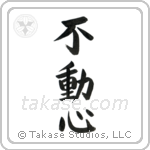
Sold as Steadfast · Read fudōshin · What it is three characters — not, move, heart — for the mind that cannot be moved from outside · Oldest witness Mencius, fourth century BC: at forty I attained an unmoved mind · In Japan Yagyū Munenori's sword manual of 1632, where it means being exactly as you always are · In English D. T. Suzuki, 1959, as immovable mind · The thing worth knowing four separate authorities across twenty-three centuries stop to say it does not mean being like a stone · Signed 典, 2026-09-07.
The words
不 (fu) is the negative: not. 動 (dō) is to move. 心 (shin) is the heart, the mind, the spirit — one word in Japanese for all three. Together, the mind that does not move.
Only one Japanese dictionary of the several we checked carries 不動心 as its own entry, and it is brief. The Digital Daijisen has: 「他によって動かされることのない心。動揺することのない精神。」 — a heart not moved by anything outside it; a spirit that does not waver. The great historical dictionary of Japanese, the Nihon Kokugo Daijiten, has no entry for the compound at all. It does define the first half: 不動 in the sense of a settled conviction is attested in Kūkai's collected writings by 1079, and in Dōgen's Shōbōgenzō between 1231 and 1253 in the sense of a thing that simply does not move.
The English dictionary of Japanese used across the web, JMdict, gives two senses: imperturbability, steadfastness, and — marked as martial arts — a cool head in an emergency, keeping one's calm. The house's title, Steadfast, is the first of those word for word.
A history, from the earliest witness
The phrase is Mencius's, and it is one of the most famous passages in the book. In Gongsun Chou I, around the fourth century BC, the disciple asks whether high office would perturb his master's mind. Mencius answers: 「否。我四十不動心。」 — No. At forty, I attained an unmoved mind. James Legge, translating in 1861, gave it as an unperturbed mind, and that is still the standard English of the passage.
What follows matters, because it is the whole meaning of the phrase and almost nobody carries it forward. The disciple asks whether there is a way to such a mind. Mencius weighs two kinds of courage — one man who flinched at nothing, another who simply had no fear — and sets above both the courage of Zengzi: if on self-examination I find I am upright, I will go against thousands. Then he names what he is actually good at: nourishing the vast, flowing 氣, which he says is supremely great and supremely strong, is grown by accumulated right action and not seized by an occasional one, and is ruined by forcing. The chapter ends with the famous farmer of Song who pulled up his seedlings to help them grow, and killed them.
So the founding text does not describe a still mind. It describes a mind that cannot be moved because of what has been put under it — and it names the failure as forcing, not as agitation.
In Japan, for a thousand years, the phrase travels as Chinese. In the Diet Library's full-text index of pre-modern books, the three characters appear in 362 classical volumes, and their titles are a Confucian shelf: collected commentaries, the Four Books, Mencius Explained, the Reflections on Things at Hand, with a Buddhist minority where the string sits in a different construction. Through the 1860s, 70s and 80s the pattern is unchanged — the hits are school editions of the Four Books with Japanese reading marks, the Mencius line moving through the Meiji classroom. The 1880s carry more of them than any decade before 1900.
The Japanese word — 不動心 as a thing a Japanese writer says in Japanese — is Yagyū Munenori's, and it is in his own book. Heihō Kadensho, the sword manual he completed in 1632 for his house, uses it twice.
The first time he is discussing no-mind, and he says: 「諸佛の不動心といへる事、實に殊勝に覺ゆ」 — this thing called the fudōshin of the buddhas strikes me as truly excellent. Note where he thinks it comes from: the buddhas, not Mencius.
The second time he is explaining footwork, and someone is flicking a fan at a man's eyes:
「不動心と云は常のごとくにして、目のあたりへ物がくれば、何となく目まぢする也、是が動轉せぬ位也 … うごくまいとするは、うごいたる物也、うごくはうごかぬ道理也、水車はめぐるが常也、めぐらずは常にたがふた者也、人の目まぢは常也、目まぢせぬは心がうごくなり」
What is called fudōshin is being just as you always are: when something comes at your eyes, you blink without thinking about it, and that is the state of not being shaken. … Trying not to move is itself having moved. Moving is the principle of not moving. A waterwheel's normal condition is to turn; not turning is what departs from normal. A man's blink is normal; not blinking means the mind has moved.
The man who did not blink is the one who has been rattled. That is the tradition's own definition, in the tradition's own book, and it is the opposite of what the English word immovable suggests.
Takuan's word is a different word, and this is where the internet gets it wrong. The Zen priest Takuan Sōhō wrote a famous letter to Munenori on swordsmanship and Zen, the Fudōchi Shinmyōroku — and his term is 不動智, immovable wisdom, not 不動心. We checked his text in two separate printings: in one whole volume of his collected sermons, 不動智 occurs twenty-five times and 不動心 does not occur once. His definition is worth having beside Munenori's:
「不動とは、うごかずといふ文字にて候。智は智慧の智にて候。不動と申し候ても、石か木かのやうに無性なる義理にてはなく候。向ふへも左へも右へも、十方八方へ心は動き度きやうに動きながら、卒度も止らぬ心を不動智と申し候。」
Fudō is the character meaning does-not-move. Chi is the chi of wisdom. But when I say fudō, I do not mean being insentient like a stone or a tree. The mind moves as it pleases — ahead, to the left, to the right, in all ten directions — and never stops for an instant: that is what I call fudōchi.
He takes the word from the deity Fudō Myōō, the Immovable Wisdom King, and says that what does not move in him is the place in a person's one mind that does not move — and that not moving means not sticking. He also quotes Mencius by name in the same letter, so the sword-Zen tradition was reading the book the phrase came from, even while thinking of the phrase as Buddhist.
The martial reading is built in the Meiji and Taishō presses, and it fuses the two words. The earliest budō printing we found is an 1887 manual of jūjutsu, sword and staff: there is only the suppressing of the moved mind; suppress it and you have the original fudōshin — already the frame Munenori refuses. By 1905 a judo primer can say what the jūjutsu men call fudōshin or no-self or no-mind. A 1917 kendo handbook welds the two words outright: 「是レ之ヲ寂然タル不動心ト謂フ。佛法ニ所謂不動明王ノ智ナリ」 — this is what we call the still fudōshin; it is what Buddhism calls the wisdom of Fudō Myōō. And in 1925 a history of kendo prints the sentence the whole internet now repeats: 「武藏の所謂平常心、澤庵禪師の所謂不動心」 — Musashi's so-called everyday mind, Takuan's so-called fudōshin. Both attributions are wrong, and both are a century old.
One 1938 schoolbook is the strangest witness of all. A judo textbook for Toyama prefecture's schools gives 不動心 a whole chapter. It defines it as the mind of a great man who is not startled by any turn of events; it says fudōshin is a form of courage; and it gives three rules for cultivating it: do not anticipate success; do not let the mind forget it; do not add outside force to help it along. Those three are Mencius, clause for clause, from the very passage where the phrase was born — do not aim at it, do not forget it, do not help it grow — together with his supremely great and supremely strong, nourished by uprightness and unharmed. The word 孟子 does not appear anywhere in the book. Twenty-three centuries of carriage, the cargo intact and the label lost.
The sense across time
The phrase has three lives, and they run alongside each other rather than in sequence. It is Mencius's, from the fourth century BC, carried into Japan as a Chinese classic and taught in Meiji classrooms. It is Yagyū Munenori's, from 1632, carried into the modern dojo by the Meiji and Taishō sword and judo manuals, which quietly merge it with Takuan's immovable wisdom. And, entirely separately, it is what the Meiji translators chose for a Greek idea. A Japanese Dictionary of Philosophy of 1905 has the headword outright: ἀπάθεια. 不動心. Apathie. Apathy — the Stoic virtue — and sets the Epicurean ataraxia beside it as its cousin. A self-cultivation book of 1907 puts all three lives in a single paragraph: the Zen tag the eight winds blow and it does not move, Wang Yangming, the poet Saigyō, Saigō Takamori — and then, flatly, what we are calling fudōshin here is roughly the same as the Stoics' apatheia.
That mixture, not the martial sense alone, is what the word is in Japanese print. Of the roughly two thousand modern books in the index that use it, the Confucian-flavored titles outnumber the martial ones ten to one.
After the war the word goes everywhere. A Daitoku-ji priest ran a popular series on it from 1973. In 1985 the Meditations of Marcus Aurelius appeared in Japanese under the title 『不動心』 — the Stoic strand surfacing as a book cover. A shōgi grandmaster wrote Win! Fudōshin in 2010; a 2012 business book teaches fudōshin and heijōshin together. And the single book that put the word in most Japanese hands is Hideki Matsui's 『不動心』 of February 2007 — a memoir by the Yankees slugger, published the year he was playing through injury in New York. Scholars, meanwhile, keep both roots open: a 2014 paper asks whether nirvāṇa is apatheia, and a 2024 paper reads Mencius's at forty, an unmoved mind through Song and Yuan Daoist thought. In 2025 a report on the Honinbō go title match said simply: cornered, and still fudōshin.
What is not a source
Takuan did not write 不動心. He wrote 不動智, and the two are different words in his own text; the attribution to him is a Japanese misreading first printed in 1925, not an English one.
It is not a four-character idiom (yojijukugo); it is three characters, and it is not in the idiom dictionaries.
It is not primarily a karate word, whatever the English internet suggests. Both pre-war karate books in the Japanese public-domain corpus — Funakoshi's of 1922 and Motobu's of 1926 — use it zero times, as do four kendo manuals of 1922–41 and two judo books. The word is well attested in pre-war martial print; it is not universal in it.
The text in English
The English term is D. T. Suzuki's, and it is 1959. In Zen and Japanese Culture he writes of the swordsman who has no thought of life and death:
"His is 'immovable mind' (fudō-shin). The fudō-shin is like the moon reflected in the stream. The waters are in motion all the time, but the moon retains its serenity. The mind moves in response to the ten thousand situations but remains ever the same."
Two things are worth noticing on that page. Suzuki gets the attribution right — he credits Yagyū Munenori, not Takuan. And he immediately heads off the misreading: a reader might imagine, he says, that Munenori "wishes us to be reduced to a stage of mental atrophy or imbecility. But the fact is far from this." The phrase is not in his earlier 1938 book on the same subject; it enters English with the 1959 expansion.
And the romanized fudoshin, which is how the English-speaking world writes it, is in none of the scholarly translations. Hiroaki Sato, who translated Munenori's book — the one text that actually contains the word — renders it immovable mind and never romanizes it. William Scott Wilson's translation of Takuan, Thomas Cleary's, and Kenneth Kushner's Immovable Wisdom all carry immovable wisdom and fudōchi, and none of the four carries fudoshin. The English word came in through the dojo, not through the translators — it is thick in the martial-arts trade literature from the 1980s on, and the Internet Archive holds it in some five hundred books.
There is one more English lineage, and nobody joins it to the others: Legge's unperturbed mind of 1861, which is how every English Mencius has rendered the same three characters for a hundred and sixty years.
A reading
Signed 典, 2026-09-07.
Mencius builds this mind out of accumulated right action and warns that forcing it kills it. Munenori says trying not to move is having moved, and that a waterwheel which stops turning has betrayed its own nature. Takuan says it is not being insentient like a stone or a tree. Suzuki, handing the word to English, stops to say he does not mean mental atrophy. Four authorities, twenty-three centuries, four separate traditions — and every one of them takes the trouble to refuse the same misreading, which tells you exactly what everybody's first guess is.
So immovable is a good gloss for the character and a poor one for the word. It recruits the reader's first guess, the one every source pushes away. Steadfast is better, and it is the house's own: a person can be steadfast at a run. What the word names is not stillness but the absence of a snag — the mind free to go anywhere and stuck nowhere, which is why the man who does not blink is the one who has been rattled.
And it belongs to three traditions, not one. A page that offers it as a martial-arts term has given a buyer a third of the word; the phrase was old when Munenori borrowed it, and a Meiji lexicographer independently chose it for what a Stoic meant by living undisturbed. It fits a sensei, and it fits a person who has been through something and did not bend, and those are not the same gift.
Notes
The three characters are brushed in their modern forms in every design; there is no old-form question here.
Fudōshin with the macron is the reading standard for this history; the catalogue and the image filenames use the keyboard form fudoushin, which is a store question and not a textual one.
How this was read
The Diet Library's full-text index of public-domain books, counted on eight forms with the pre-modern books separated out, the whole result for 不動心 walked to 2,319 records and profiled by decade and by genre; eighteen individual books opened at the leaf through the same library's page interface, including both printings of Takuan's letter and the only surviving typeset of Munenori's manual; the Mencius chapter read whole in Chinese with Legge's English beside it; six dictionary entries at kotobank and one at JMdict; Suzuki's 1959 book read at the passage from the Internet Archive's text; six English books tested term by term at the Archive's full-text interface, with a control run to prove the instrument; the Archive's dated hits for the romanized word; the National Diet Library catalogue on all 121 books titled 不動心; the store rows, the live page and the design itself, by eye.
Not opened, and named because it would sharpen this: Munenori's manual in any witness but the 1937 typeset, so both of his sentences rest on one editor's base text; the Edo manuscripts of Takuan's letter; the classical commentaries on the Mencius chapter at the leaf; the four modern English translations beyond a presence test, since all four are lending-locked; Matsui's book and every other post-war Japanese title, for which we have the catalogue record only; two recent scholarly papers, one on the Mencius phrase and one on nirvāṇa and apatheia; and the house's own record of when Eri brushed this design.
References
Each witness is cited in the account above, at the frame or entry where it was read. A linked list follows when the record for this text is completed.