

大胆不敵 · daitan futeki · Fearless
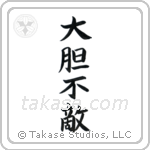
Sold as Fearless · Read daitan futeki, four graphs, a compound adjective-noun · Register spoken Japanese since the 1560s, the popular stage and popular fiction; praise of nerve, shading into insolence · Sense one, with an edge: bold and afraid of no one.
The words
大胆 is having the nerve to do what ordinary people fear to do, and, in its second sense, being thick-skinned about it. 不敵 is the word that gives the compound its history. In Chinese the two characters mean no match for: an army whose strength 不敵 is the one that loses and runs. The Japanese dictionaries head the word the other way, so strong that no one can stand against you, and then bold and fearless, or violent and lawless; the shortest modern gloss is not treating an enemy as an enemy. The bridge between the two languages is a line of the Xunzi that the national dictionary cites, with a might that nothing can match, where the unmatched one is the winner; Japanese kept that reading, unrivaled, and turned it inward into fearing no rival. A Meiji dictionary of 1896 still lists both senses side by side, bold, fearless; daring, rude, audacious and matchless, unrivalled. Put together, 大胆不敵 is having nerve and knowing no fear, and the dictionary of four-character idioms illustrates it twice: once with a burglar who dozes off in the bed he has just robbed, once with students who break the rules. The word praises nerve, and it praises it on both sides of the law. English fearless is the absence of fear, audacious is fearlessness that oversteps, bold sits between, dauntless holds under pressure; the Japanese word covers all four.
Where it comes from
The four characters are Japanese, not Chinese. The Chinese Text Project returns nothing for them in the whole post-Han corpus, and its hits for 大膽 alone are nearly all the Ming novel Journey to the West; the older Chinese idiom for a big heart is the gall bladder as big as a peck measure that was found in the general Jiang Wei when he was cut open. In Japan 不敵 arrives first in its Chinese sense, in an eleventh-century letter-writing manual, and has turned by the time the Tale of Hōgen (c. 1220) draws its great archer Minamoto no Tametomo: from childhood he was 不敵, deferred to no elder brother, and behaved as if no one else existed, so his father sent him off to Kyushu at thirteen; the 1913 editor read here glosses the word as 大胆. The compound is on record by 1563, in a Zen monk's lecture-notes, as a word people already used: people call a game man a daitan-futeki-mono. Chikamatsu put it on the puppet stage in 1715, in The Battles of Coxinga, where the old father presents his son to the Ming princess: big-boned as you see, born daitan futeki and a man of great strength; he will restore the Ming once more. Santō Kyōden's illustrated novel of 1813, read here at the print, has a lone rider who resolves to ride into the enemy camp and pick off its general, a daitan futeki thing to do. Bakin uses it of bandits and villains as readily as of heroes; the villain of the Yotsuya ghost story is by nature a daitan futeki man. Fukuzawa, in the third part of An Encouragement of Learning (December 1873), uses it of foreigners as the timid Japanese townsman meets them: no wonder such minions of the god of cowardice have the gall knocked out of them when they meet those daitan futeki foreigners. By then it was a stock word of kabuki scripts, storytellers' histories and Meiji novels; the local archive of prewar books returns over nine hundred that use it, rising decade by decade to the 1920s, and three Meiji dictionaries define 不敵 by quoting the compound.
The text in English
The English of this design is the oldest there is. The English index of Hepburn's first Japanese dictionary (1867) has one Japanese word under FEARLESS, and it is futeki. His 1886 edition reads fearless; bold; having no fear of man; daring; audacious (always in a bad sense), and gives the compound as its example for 大胆. Brinkley (1896) is the first to render the four characters as a unit, very bold; extraordinarily audacious or impudent, with the sentence a bold and audacious fellow. Saitō (1928) has audacious; daring; presumptuous and Confound his audacity!; the current Kenkyūsha has fearless; undaunted; dauntless; audacious. Japanese today sends the word back the other way: Japanese Wikipedia renders General Patton's motto Be audacious! with it, glosses the French destroyer L'Audacieux with it, and titles the Hindi film Dabangg with it; the word appears in nearly five hundred of its articles. The house's Fearless is Hepburn's equation of 1867, and its gloss fearless; daring; audacious keeps the edge, which a rendering must: fearless alone is the hero's half.
A reading
Signed 典, 2026-09-08. The word is Japanese, old and deep. Its two halves are Chinese, but Chinese never joined them, and its 不敵 names the loser of a fight, while Japanese had made the same two characters mean a man who treats no one as his match by the time it drew Tametomo. That sense fixed the compound in the mouths of the 1560s, on Chikamatsu's stage, in Kyōden's print and in a thousand prewar books, and it is the sense Hepburn met when he set futeki under FEARLESS. So the design is exact and its title is the first English the word ever had. What a buyer should feel is the edge. This is not the stillness of 不動心 or the virtue of 勇気; it is nerve, and Japanese has always used it of the burglar and the rebel as readily as of the hero, which is why Hepburn thought it always in a bad sense, why Brinkley added impudent, and why the modern dictionaries illustrate it with a thief asleep in a stranger's bed. A person who wears 大胆不敵 is saying I fear no one, with the swagger the words have carried since a puppet general said them of his son. The page's three-word gloss already holds that and should keep audacious; its word line should show the characters 大胆 rather than bare romaji. No question for Eri: the reading and the register are settled by the witnesses.
How this was read
By eye: the template; five pages at the National Diet Library's image host, the 1813 print of Kyōden's novel, Chikamatsu's play in the 1896 collected edition, the Tale of Hōgen in a 1913 annotated edition, and the entries for 不敵 in two Meiji dictionaries; Hepburn's 1867 English index and 1886 entry and Brinkley's two entries from the shelf PDFs. By text: three dictionary pages at kotobank; four searches at the Chinese Text Project; two Chinese dictionaries for 不敵; Weblio's bilingual dictionaries; the four-character idiom dictionary at jitenon; the Japanese Wikipedia search; Fukuzawa at Aozora. By OCR: the local harvest archive of 9,873 prewar books on twelve forms; Hepburn's 1872 edition; the 1917 national dictionary; the Bakin, Yotsuya and Meiji-novel witnesses. Not opened: the 1563 lecture-notes at the leaf; the eleventh-century manual and the 1422 poem the national dictionary cites; the 1715 print of Chikamatsu; the Library's own index, which waits on Tim's run. Every address is in the account, marked by eye, OCR or text.
References
- 禮記 曲禮下 · 荀子 王制 · 新書 過秦 · 淮南子 主術 · 史記 高祖本紀 (ctext search) (pre-Qin · Han) — ctext.org/pre-qin-and-han?searchu=不敵
- 藝文類聚 卷十七 引 世說 (ctext search) (7th c. quoting 5th) — ctext.org/post-han?searchu=膽大 (36 / 34)
- 西遊記 (ctext search) (Ming) — ctext.org/post-han?searchu=大膽 (114 / 109)
- ctext post-Han for 大膽不敵 (—) — ctext.org/post-han?searchu=大膽不敵
- moedict · zdic 不敵 (current) — moedict.tw/raw/不敵 · zdic.net/hans/不敵
- 明衡往来 上本 (日国) (11th c.) — kotobank 不敵-619585
- 保元物語 上, 鳥野幸次 評釈 (c. 1220; 1913 print) — pid 925166 k46, p. 55, by eye
- 旱霖集 虎臣 (日国) (1422) — kotobank 大胆-557758
- 玉塵抄 一二 (日国) (1563) — kotobank 大胆不敵-557761; leaf not opened
- 近松 国性爺合戦, 饗庭篁村 校訂 近松時代浄瑠璃集 (1715; 1896 print) — pid 1883014 k33, p. 45, by eye; 1907 pid 1884308 k33 and 1923 全集 pid 1884369 k244 by OCR
- 山東京伝 双蝶記 巻一 (1813 print) — pid 2554013 k14, 辰-53, by eye
- 滝沢馬琴 南総里見八犬伝 (1814–42; 1886–87, 1909–30 prints) — pid 879352 k25 · 879213 k219 · 878201 k180 · 1181419 k69, OCR
- 福沢諭吉 学問のすすめ 三編 (1873年12月 (Aozora; 1880 print)) — aozora 47061_29420; pid 808242 k27 OCR
- 四ツ谷雑談 (今古実録) (1884 print) — pid 882268 k18, OCR
- 山田美妙 日本大辞書 (1893) — pid 902835 k639, opened; wording OCR
- 藤井乙男・草野清民 帝国大辞典 (1896) — pid 2387590 k628, by eye
- 落合直文 ことばの泉 (1898) — pid 862875 k423, OCR
- 上田万年・松井簡治 大日本国語辞典 (1917) — pid 954647 k201, OCR
- Hepburn, 1st ed. (1867) — shelf PDF page 612 = index p. 34 by eye; OCR 9800
- Hepburn, 2nd ed. (1872) — OCR 55223–55229, 355388
- Hepburn, 3rd ed. (1886) — shelf PDF page 144 = p. 102 by eye; OCR 13416–17
- Brinkley (1896) — shelf PDF pages 191 = p. 159 and 260 = p. 228 by eye
- 横光利一 火の点いた煙草 (日国) (1927) — kotobank 大胆不敵-557761
- 舟橋聖一 雪夫人絵図 · 井伏鱒二 駅前旅館 (四字熟語を知る辞典) (1948–50 · 1956–57) — kotobank 大胆不敵-557761
- 斎藤和英大辞典 · 研究社 新和英中辞典 · JMdict (Weblio; gokanji.db) (1928 · current) — ejje.weblio.jp/content/大胆不敵 · gokanji.db 1786190
- ja.wikipedia full-text (current) — ja.wikipedia.org search
- The local archive, twelve forms (to 1953) — search_ndl_archive.py, local_archive_counts.txt