

忠義礼誠名誉仁勇義 · chūgi rei makoto meiyo jin yū gi · The seven virtues of bushidō
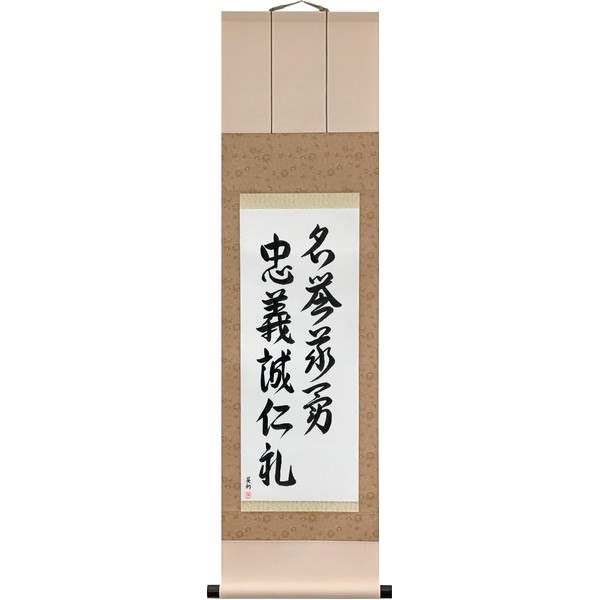
Sold as Seven Virtues of Bushido · Read chūgi · rei · makoto · meiyo · jin · yū · gi, nine characters, seven words · Oldest witness an English book, Nitobe Inazō's Bushido: The Soul of Japan, Philadelphia, 1900 · Sense the seven virtues a Japanese scholar chose to explain his country to the West, given their Japanese names by his translators, and brushed here in an order that is the house's own.
The sense, across one century
This design is a list, and the list is younger than it looks. Nitobe Inazō wrote Bushido: The Soul of Japan in English, in Pennsylvania, in the last month of 1899, in answer to a question a Belgian jurist had put to him ten years before: No religion! How do you impart moral education? He never writes the words seven virtues. Seven of his seventeen chapters treat one virtue each, and every list of the seven virtues of bushidō in any language is a reading of his table of contents. The Japanese words came afterward, from his translators: in 1908 Sakurai Ōson gave the chapters two-character titles, 正義, 勇氣, 仁愛, 禮儀, 至誠, 名譽, 忠節; in 1938 Yanaihara Tadao, whose Iwanami translation is the one Japanese readers know, cut them to 義, 勇, 仁, 禮, 誠, 名譽, 忠義. Those are the seven the design brushes, to the character. No Japanese book printed before 1945 lists them together. In English the phrase seven virtues of bushido is in print from 1998, common from 2008, and this house has sold the seven since 2000, first in Nitobe's order, rectitude first and loyalty last, and now in an order of its own, loyalty first. The design is a Western book's chapter headings, in a Japanese translator's words, in an American calligrapher's order. None of that is a fault. It is what the thing is.
The words
Nine characters, seven words. 忠義 chūgi, loyalty: the dictionaries say 私欲をさしはさまないで、まごころを尽くして主君や国家に仕えること, to serve one's lord or country wholeheartedly, without self-interest, first attested in the 続日本紀 for the year 783. 礼 rei, propriety, the modern form of 禮. 誠 makoto, sincerity. 名誉 meiyo, honor, the modern form of 名譽. 仁 jin, benevolence. 勇 yū, courage. 義 gi, rectitude: 五常の一, one of the five constant virtues of Confucian ethics, 仁・義・礼・智・信. Two of the seven are compounds and five are single characters, so 義 stands twice, bound in 忠義 at the head and alone at the foot. The reading follows the design's order; Nitobe's order, which is also Yanaihara's, is gi, yū, jin, rei, makoto, meiyo, chūgi.
A history, from the earliest witness
1899–1900. An English book. Nitobe signed his preface at Malvern, Pennsylvania, in the Twelfth Month of 1899, and the Leeds & Biddle Company of Philadelphia printed Bushido: The Soul of Japan: An Exposition of Japanese Thought in 1900, copyright 1899. Its contents, from the first edition's own page, where the OCR reads Etishido for the first word: Bushido as an Ethical System · Sources of Bushido · Rectitude or Justice · Courage, the Spirit of Daring and Bearing · Benevolence, the Feeling of Distress · Politeness · Veracity or Truthfulness · Honor · The Duty of Loyalty · Education and Training of Samurai · Self-Control · The Institutions of Suicide and Revenge · The Sword, the Soul of the Samurai · The Training and Position of Woman · The Influence of Bushido · Is Bushido Still Alive? · The Future of Bushido. [archive.org bushidosouljapa00nitogoog, the text file, title page and contents]
The book prints no Japanese script. Where Nitobe gives a Japanese word he romanizes it, and the one list of virtues he does give is not this one:
The tripod that supported the framework of Bushido was said to be Chi, Jin, Yu, respectively Wisdom, Benevolence, and Courage. — the chapter titled Education and Training of Samurai in the first edition and Education and Training of a Samurai in the tenth, revised edition; the sentence is the same in both [archive.org, the same text file; Project Gutenberg 12096, the tenth edition's text]
That is the Confucian triad 智仁勇, and it has three members. The seven are the chapters, and the chapters are Nitobe's plan for a Western reader: rectitude first, then the courage to act on it, benevolence to temper it, politeness as its form, veracity, honor, and loyalty last, as the virtue that binds the rest to a lord.
1908. The first Japanese translation. Sakurai Ōson's 『武士道』 (丁未出版社) gave the seven chapters Japanese titles. On its contents page, read at the leaf:
第三章 正義 · 第四章 勇氣 ⟨敢爲堅忍の精神⟩ · 第五章 仁愛 ⟨不忍の心⟩ · 第六章 禮儀 · 第七章 至誠 ⟨信實⟩ · 第八章 名譽 · 第九章 忠節 — 新渡戸稲造 著・櫻井鷗村 譯『武士道』1908, contents, printed p. 21 [4]
Two-character words, every one, and for loyalty 忠節, not 忠義. The body of the translation uses both words, 忠義 twenty-four times and 忠節 thirty, by the OCR's count. The design's seven are not yet here.
1938. The translation Japan reads. Yanaihara Tadao's translation appeared as 岩波文庫 1795 in 1938, 148 pages. Its contents, as the National Diet Library catalogues its digitized copy of that printing:
第三章 義 · 第四章 勇・敢爲堅忍の精神 · 第五章 仁・惻隱の心 · 第六章 禮 · 第七章 誠 · 第八章 名譽 · 第九章 忠義 — 新渡戸稲造 著・矢内原忠雄 譯『武士道』岩波書店 1938 [6]
Here the seven become the seven of the design: single characters for five of them, 名譽 and 忠義 for the other two, in Nitobe's order. The list 義勇仁礼誠名誉忠義 that Japanese web pages today credit to Nitobe is Yanaihara's table of contents. The Iwanami edition was revised, the Japanese Wikipedia reports, by his son Yanaihara Isaku in 1974, and it is in print as 岩波文庫 青118-1.
Japanese print to 1945. The National Diet Library's full-text search, run on eleven spellings, finds no Japanese book before 1945 that prints these seven as a list: 忠義礼誠名誉仁勇義 in the design's order, none; 義勇仁礼誠名誉忠義 in Nitobe's, none, in either character form. What the search does find is a homonym: 七徳, the seven virtues, appears in 9,531 books, and it means the seven martial virtues of the Zuo zhuan, 武の七つの徳, which the dictionaries spell out: 暴を禁じ、兵を治め、大を保ち、功を定め、民を安んじ、衆を和せしめ、財を豊かにすること, to forbid violence, lay up arms, keep the great, fix merit, settle the people, harmonize the many, and enrich the treasury. [7][7]
That list has nothing to do with Nitobe, and a Japanese reader who meets 武士道の七徳 hears it first.
1998–2011. The phrase in English print. The Internet Archive's full-text index finds the phrase seven virtues of bushido first in a 1998 novel, where a character promises to bore his listener with them later, and its first appearances with the Japanese names in two children's series of 2008: Sandy Fussell's Samurai Kids, which prints the list GI YU JIN REI MAKOTO MEIYO CHUSEI, with 忠誠 for the seventh, and Chris Bradford's Young Samurai, where a master recites rectitude, courage, benevolence, respect and the rest. [archive.org full-text search, 74 hits, the earliest whenangelsrest00hari, 1998; samuraikids1whit0000sand, 2008; wayofwarrior0000brad, 2008; snippets only, the books not opened]
After 2008 the phrase is a commonplace of martial-arts writing, self-help and fiction. The English Wikipedia article on bushidō today counts eight virtues as defined by Nitobe Inazō, adding 自制 jisei, self-control, the title of his eleventh chapter, and its list otherwise matches Yanaihara's seven.
2000–today. This house. The Wayback Machine has the house's martial-arts gallery from February 1999 with no seven in it, and a page titled Bushido: Seven Virtues from August 2000: There are seven virtues associated with Bushido [the way of the Warrior]. These are depicted in Block Script below, then Gi, The Right Decision, Rectitude · Yu, Valor · Jin, Benevolence · Rei, The Proper Behavior, Courtesy, Respect · Makoto, Complete Honesty · Meiyo, Honor and Glory · Chugi, Devotion and Loyalty. Nitobe's order. [web.archive.org, takase.com/MartialArts/Bushido/Bushido.htm, captures 2000-08-17, 2002-06-05, 2004-12-04]
The 2004 page adds the credit the pages carry to 2011, For an excellent book on the subject see Bushido, The Soul of Japan by Inazo Nitobe, with the wrong year, 1908. A round design image from September 2000 sets the seven in a circle, 仁 at the top, 忠義 and 名誉 in the center, and writes 真 for makoto, a form the house later dropped for 誠. [takase.com/TattooDesign/images/SevenVirtues_00A.gif, capture 2000-09-02, by eye]
By 2006 the seven were tattoo designs, four of them the whole set; by 2011 the single designs were listed loyalty first, which is the order of the catalogue string and of the page's list for the nine-character scroll sold today; the designs themselves set the seven in two columns or a ring, not in a line (see Notes). Today's pages give Loyalty, Respect, Honesty, Honor, Benevolence, Valor, Rectitude and do not name Nitobe.
What is not a source
The 七徳 of the Chinese classics is a homonym, seven martial virtues from a speech in the Zuo zhuan, and the Meiji dictionaries define only that. Nitobe's own triad 智仁勇 is a different list with three members. The five constants 仁義礼智信 give the design its 仁, 義 and 礼, but as members of a list of five. The Hagakure and Yamaga Sokō, whom the Japanese dictionaries name as the two poles of the word 武士道, were not opened for this account and are not behind the list. Nothing older than 1899 carries these seven together.
The list in English
The English here is the original. Nitobe's chapter titles, Rectitude or Justice, Courage, Benevolence, Politeness, Veracity or Truthfulness, Honor, The Duty of Loyalty, are what every later list translates back and forth. The house's 2000 glosses kept two of his words, Rectitude and Benevolence, and chose Valor, Respect, Honesty, Honor, Loyalty for the rest; the 2008 children's books and the Wikipedia list use the same set, with Righteousness and Heroic Courage for the first two. A rendering of this design has one job: seven English words that a reader can match one to one against the seven Japanese ones, in the design's order. The house's page does that. What it does not do is say where the seven come from.
A reading
The design is Yanaihara's seven in the house's order, and the page should say so in a sentence: seven virtues drawn from the chapters of Nitobe Inazō's Bushido (1900), in the Japanese of its 1938 translation. That sentence is the whole provenance, and it is a good one. The two things I would put to Tim are design questions, not textual ones. First, the order: loyalty first inverts Nitobe's argument, which ends on loyalty because everything before it is what loyalty is owed with; a buyer who wants Nitobe's seven in Nitobe's order wants 義勇仁礼誠名誉忠義. Second, the doubled 義: a native eye may read nine characters as a list of seven without pause, or may not, and that is Eri's to say, not mine.
Notes
- The designs set the seven in columns, not a line (str-terasu s325, 2026-09-06, all eight served scroll variations of M1040SS and two word designs read by eye): seven scroll variations and one word design set two columns, right 忠義誠仁礼 and left 名誉義勇; VS5A sets 誠義礼勇仁 beside 名誉忠義, loyalty last; the word design VD4B sets a ring with 仁 at the top and 忠義 at the center; all in the modern forms 礼, 誠, 名誉, and 誠 for makoto on every one. Loyalty first is therefore the catalogue string's and the page's order, which the history above describes; on the paper 忠義 leads nine of the ten read and ends one. Added s48 from her FYI.
- The 1908 titles are two characters each, with subheads. The typeset prints 勇氣, 仁愛 and 至誠 as the chapter titles and sets 敢爲堅忍の精神, 不忍の心 and 信實 beside them in small type. An earlier reading of this page from the OCR alone ran title and subhead together and reported the chapter titles as long phrases; the leaf corrects it.
- The 1938 contents are quoted from the catalogue, not the leaf. The National Diet Library's record of its digitized 1938 printing carries the contents field in the old character forms (道德體系, 敢爲, 惻隱, 禮, 名譽, 敎育); the copy itself is reading-room only. The 1974 revision and the current Iwanami printing were not opened; whether the revision changed a chapter title is not known from anything read here.
- The English list has a variant seventh member. Fussell's 2008 Samurai Kids prints CHUSEI, 忠誠, where Nitobe's chapter is The Duty of Loyalty and Yanaihara's is 忠義. Both words mean loyalty; the house's 忠義 is the translator's.
- The house's 2000 image writes 真 for makoto. 真 is shin, truth, and reads makoto only as a name-reading; the later designs and the scroll use 誠. The 2004 page's originally published in 1908 is also the house's error: the book is 1900, and the free text the page linked is the tenth edition.
- Nitobe's book in Japan. The Japanese Wikipedia article reports a 1900 Japanese reprint by 裳華房 selling fifteen thousand copies, citing the publisher's own history page; neither was opened, and the claim is reported here as the encyclopedia's.
How this was read
By eye at the page: the 1908 contents leaf (NDL pid 758905, scan 12, and scan 13 for chapters 10–17); the house's 2000 design image. As text: Nitobe's first edition (archive.org, the text file of bushidosouljapa00nitogoog, title page, contents, and the tripod passage) and the tenth edition (Project Gutenberg 12096, the same passage); the 1908 translation's OCR (the NDL full-text zip, 296 files, for the counts of 忠義 and 忠節); the National Diet Library catalogue record of the 1938 printing (the contents field, seventeen chapters); kotobank for 武士道, 七徳, 忠義 and 義 (大辞泉 and 日国, whole entries); 辞林 1907 by OCR; the Internet Archive full-text index (74 hits, the snippets only); the English Wikipedia article's source text; the Wayback Machine's captures of the house's pages of 1999, 2000, 2002, 2004, 2006 and 2011; both live pages. Not opened: the 1938 printing itself, the 1974 revision, and the current Iwanami edition; the 1904 Teibi and 1905 Putnam printings; the 1998, 2008 and 2009 English books at the page; the Japanese web pages that credit the seven to Nitobe today, seen in search results only; the Hagakure, Yamaga Sokō, and any Western martial-arts book of the 1990s that may have carried the list before 1998. The full apparatus, with every address, is in the account.
References
- The design (ours) (—) — cultural_works 463
- Nitobe, *Bushido: The Soul of Japan*, chapter titles (1900 (Gutenberg text: tenth revised ed.)) — gutenberg.org/files/12096 (TEXT)
- Nitobe, the body (1900) — same; investigate-ten's scan
- 櫻井鷗村 譯『武士道』丁未出版社, contents (1908) — NDL pid 758905 scan 12 = printed p. 21, by eye s47; scan 13 = p. 22 chapters 10–17 (武士の敎育 · 克己 · 切腹及び敵討 · 刀 ⟨武士の魂⟩ · 婦人の敎育と地位 · 武士道の感化 · 武士道の命脈 · 武士道の將來), by eye; https://dl.ndl.go.jp/api/iiif/758905/R0000012/full/full/0/default.jpg ↩
- Nitobe, *Bushido: The Soul of Japan*, FIRST EDITION, Leeds & Biddle, Philadelphia (1900 (copyright 1899; preface Malvern, Pa., Twelfth Month 1899)) — https://archive.org/download/bushidosouljapa00nitogoog/bushidosouljapa00nitogoog_djvu.txt (OCR text; the title page reads THE LEEDS & BIDDLE CO. … Philadelphia, Pa. 1900 · COPYRIGHTED, 1899 BY INAZO NITOBE), s47
- 矢内原忠雄 譯『武士道』岩波文庫 1795, contents (1938 (NDL: 昭13; 148p 16cm)) — NDL Search https://ndlsearch.ndl.go.jp/books/R100000002-I000000706001 (pid 1225232, 国立国会図書館内限定公開, 個人送信対象外), the 目次 field of the digitized copy, read s47 from the page's data payload (24 entries); the leaf NOT opened ↩
- 七徳, the homonym (左伝 宣公十二年 (per 日国); Meiji dictionaries) — https://kotobank.jp/word/七徳-520881 (大辞泉 · 日国, whole entries, s47) · 辞林 1907 NDL pid 863016 scan 341 (koma from the OCR zip; the Lab's page field said 877), OCR ↩
- 忠義 · 義, the dictionaries (current) — https://kotobank.jp/word/忠義-567299 · https://kotobank.jp/word/義-49809, s47
- The Internet Archive full-text index, *seven virtues of bushido* (1998–) — https://be-api.us.archive.org/fts/v1/search?q=%22seven%20virtues%20of%20bushido%22&size=100 (snippets; identifiers whenangelsrest00hari · samuraikids1whit0000sand · whitecrane0000fuss_n1f1 · wayofwarrior0000brad); the books NOT opened; `archive.org/advancedsearch.php` metadata search 0
- English Wikipedia, *Bushido* § Eight virtues of bushido (as defined by Nitobe Inazō) (2026-09-06) — https://en.wikipedia.org/w/index.php?title=Bushido&action=raw, s47 (the list cites a samurai-archives wiki page and the book)
- The house, 1999–2011 (Wayback Machine) (1999-02-23 · 2000-08-17 · 2000-09-02 · 2002-06-05 · 2004-12-04 · 2006-08-15 · 2011-09-16) — web.archive.org captures: `19990223192120/www.takase.com/MartialArts.htm` · `20000817201004/www.takase.com/MartialArts/Bushido/Bushido.htm` · `20000902065506/www.takase.com/TattooDesign/images/SevenVirtues_00A.gif` · `20020605073244/…/Bushido.htm` · `20041204034001/…/Bushido.htm` · `20060815190124/www.takase.com/shop/Tattoo_Japanese_Seven_Virtues_Bushido.asp` · `20110916172241/takase.com/MartialArts/Bushido/SevenVirtuesOfBushido.htm`; CDX index `web.archive.org/cdx/search/cdx?url=takase.com/*&filter=original:(?i).*virtues.*`