

仏陀 / 佛陀 budda Buddha
This is a philological study of 仏陀 (budda), the Japanese word for the Buddha, following it from a Sanskrit title heard in Chinese as 浮屠 and 佛 into the Buddhist canon, into Japan's two shapes of its first character, and into English, where the dictionaries learned to call the one-character word a shortening of the two.
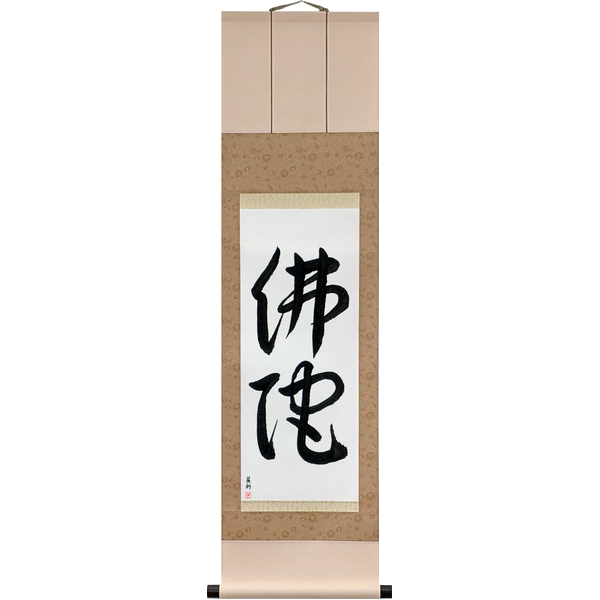
Abstract
仏陀 (budda, also butsuda) is the Sanskrit buddha, the one who has woken, carried into Chinese by its sound and into Japan with the Buddhist books. The Chinese first heard the title as 浮屠 and as 佛 standing alone; the two-character 佛陀 is a later and fuller transcription, rare before the fourth century and common under the Tang, and the strongest argument in the scholarship makes 佛 the transcription of a one-syllable Central Asian form of the word, not a clipping of 佛陀. Japanese writes the first character in two shapes, 佛 and the short 仏, which Chinese stonecutters were already using in the sixth century and Japanese scribes in the eighth; 佛 was the form of Japanese type until the tables of 1946 and 1949 made 仏 the standard. English met the Japanese word through its dictionaries, which from 1922 onward call butsu a shortening of butsuda, the view this history finds the evidence against.
Overview
The sense. A Buddhist term, and in ordinary Japanese the title of Śākyamuni. The 精選版 日本国語大辞典 labels the word Sanskrit, 梵語, in its own brackets, then gives Buddha の音訳。覚者、知者の意。「ぶつだ」とも … 正しい悟りを得た者。仏。特に、釈迦如来をさすことが多い, a transcription of Buddha, meaning one who is awake, one who knows; also read butsuda; one who has attained true awakening; a buddha; most often Śākyamuni in particular, and デジタル大辞泉 has 釈迦牟尼の称。のちには、修行を積み正しい悟りを得た人の意にも用いられる, a title of Śākyamuni; later also used of anyone who has practiced and attained true awakening [1]. The word names a title, not a person: the 世界大百科事典 notes that 〈仏陀〉は多数存在することができ, there can be many buddhas, and that the founder of Jainism, Mahāvīra, was also called by it [1]. The English Buddha is the same Indian word, and it covers the Japanese word's range in the same two ways, the title of one man and of anyone who has woken; English keeps both by capital and article, the Buddha and a buddha. The Japanese word for the Buddha in everyday speech is not this one but the native ほとけ, which the dictionaries derive, with a question mark, from the Chinese sound of the same word [2].
The words. The word is two characters that carry a sound and nothing else. 佛 existed before Buddhism, with a meaning of its own: the Han character dictionary 說文解字 defines it 見不審也, seen but not distinctly, as in 彷彿, faintly resembling, and the character dictionary 字通 adds 字はのち仏陀の仏の字に用いる, the character was later used for the 仏 of 仏陀 [3][2]. 陀 is a syllable of transcription. 仏 is the short form of 佛, with ム for the phonetic 弗, as 払 is of 拂; the short form is older than Japan's use of it, and its history is in the record below [2]. The reading has two forms. The 日国 heads the word ぶっだ and adds 「ぶつだ」とも; 大辞泉 heads it ぶつだ and refers ぶっだ to it; JMdict gives both [1][4]. Neither dictionary says which is more common. A Japanese reader also meets the word in katakana, ブッダ, which JMdict lists as its first form [4].
The text in English. J. C. Hepburn's dictionaries of 1867, 1872 and 1888 give the Buddha as BUTSU, 佛, with hotoke beside it, and have no 佛陀 [5][6][7]. F. Brinkley's dictionary of 1896 is the first to enter Butsuda, 佛陀, Buddha, with BUTSU and HOTOKE as synonyms [8]; Inouye's of 1909 sets the two side by side as one headword, Butsu, Butsuda (佛陀), n. The Buddha [9]. Kenkyūsha's of 1942 makes Butsuda the entry and sends Budda to it [10]; its edition of 1974 enters both, each written 仏陀, each Buddha [11]. JMdict gives Buddha; Buddhahood [4]. What the bilingual dictionaries add, from 1922, is a history: that butsu is the short form of butsuda. That is below, under the English.
The historical record
About 100, the 說文解字 of Xu Shen 許慎, the first Chinese dictionary arranged by radicals. In the 人 section: 佛:見不審也。从人弗聲, 佛: seen but not distinctly; from 人, with 弗 for its sound [3]. The character before the Buddha: a word for the faint and the indistinct, the sense it keeps in 彷彿. When the translators needed a character for the sound of the Buddha's title, they took one that already existed.
The edict of 65, as the 後漢書 records it, a history of the Later Han compiled by Fan Ye 范曄 in the fifth century. On Liu Ying 劉英, the king of Chu, who 晚節更喜黃老,學為浮屠齋戒祭祀, in his later years delighted in the Yellow Emperor and Laozi, and learned the fasts and sacrifices of 浮屠; the emperor's edict of the eighth year of Yongping says 楚王誦黃老之微言,尚浮屠之仁祠, the king of Chu recites the subtle words of the Yellow Emperor and Laozi and honors the benevolent shrines of 浮屠 [12]. The earliest datable mention of the Buddha in a Chinese history, and the name is 浮屠, two syllables. The commentary of Li Xian 李賢 quotes the fourth-century 後漢紀 of Yuan Hong 袁宏 on the word: 浮屠,佛也 … 佛者,漢言覺也,將以覺悟羣生也, 浮屠 is 佛 … 佛 in the Chinese language is 覺, awakening, for he would awaken all living beings [12]. The gloss is the one the modern dictionaries give: the Buddha is the one who has woken.
The late second century, the translations attributed to Lokakṣema 支婁迦讖. The 道行般若經, the earliest Chinese version of the Perfection of Wisdom, opens 佛在羅閱祇耆闍崛山中, the Buddha was on Vulture Peak at Rājagṛha, and goes on 佛告須菩提, the Buddha said to Subhūti [13]: the title is 佛, one character, standing alone. In the texts that modern scholarship accepts as Lokakṣema's or his school's, the two characters 佛陀 occur only inside longer names: 三耶三佛陀, the fully and perfectly awakened one, a transliterated epithet, and 佛陀師利菩薩, the name of a bodhisattva [14][15]. In these texts the Buddha is 佛; 佛陀 is a syllable string in a transliteration.
Dated by the canon to the Wu kingdom (222–280), and by the scholarship to after 445: the 撰集百緣經, a collection of a hundred stories that the canon attributes to Zhi Qian 支謙. Here 佛陀 stands alone as a name to call on: 稱南無佛陀,以救苦厄, call out "Homage to the Buddha" to be saved from distress [16]. The attribution is the canon's alone: the oldest manuscript the Taishō collates, the Shōsōin copy, carries no translator's name [16], and the twenty-three translations that, in Jan Nattier's survey, scholars generally accept as Zhi Qian's do not include this one [15]. Demoto Mitsuyo 出本充代 showed in 1995 that its stories borrow the wording of the 賢愚經, compiled in 445: 『賢愚經』を利用している『百縁經』の訳出年代は5世紀中頃以降ということになる … それでも,5世紀より古くはならないであろう, the translation of the 百縁經, which uses the 賢愚經, dates from the mid-fifth century or later … even so, it will not be older than the fifth century [17]. So it is not an early witness for the standalone word. The earliest standalone uses in the canon, as the CBETA edition dates them, are then of the Western Jin, in a dhāraṇī and in the 阿育王傳, the legend of King Aśoka: 號曰佛陀, he is called 佛陀 [14].
The early fifth century, the 大智度論, a commentary on the Perfection of Wisdom translated by Kumārajīva 鳩摩羅什. Among the Buddha's epithets: 復名佛陀,秦言「知者」。知何等法?知過去、未來、現在,眾生數、非眾生數,有常、無常等一切諸法。菩提樹下了了覺知,故名為佛陀, he is also called 佛陀, which in the language of Qin is "the knower." What does he know? He knows all things, past, future and present, the living and the not living, the permanent and the impermanent. Under the bodhi tree he knew and woke to them clearly; therefore he is called 佛陀 [18]. The treatise glosses the word as knower and explains it by waking to, the two senses the 日国 gives in one phrase, 覚者、知者の意 [1]. Under the Later Qin and after, the standalone 佛陀 is common in the canon, and under the Sui and the Tang it runs to hundreds of fascicles [14].
554, the 魏書, the history of the Northern Wei compiled by Wei Shou 魏收, the treatise on Buddhism and Daoism. 浮屠正號曰佛陀,佛陀與浮圖聲相近,皆西方言,其來轉為二音。華言譯之則謂淨覺, the proper name of 浮屠 is 佛陀; 佛陀 and 浮圖 are close in sound, both words of the West, which came to us as two pronunciations; rendered in Chinese, it means pure awakening [19]. By the sixth century a Chinese historian knew 浮屠 and 佛陀 as two transcriptions of one foreign word, and called the fuller one the proper name. The same treatise retells the second-century memorial of 襄楷 with 佛陀 in it, a later writer's word for what the 後漢書 had written 浮屠 [19][1].
1947 and 1989, Ji Xianlin 季羨林, on 浮屠 and 佛. In 1947 Ji argued that the 佛 of the oldest translations came not from the Sanskrit buddha but from a Tocharian form, pät or pud; in a paper finished in 1989 and published in Japanese in 2007 he revised the source and kept the conclusion. Bactrian wrote the word bodo, boddo, boudo, two syllables, and that is 浮屠; the other Iranian languages of Central Asia had cut it to one, Buddhist Sogdian pwt, Uighur but, and that is 佛: 「浮屠」の出現は前で、「佛」の出現は後である, 浮屠 appeared first and 佛 after [20]. He quotes and endorses Franz Bernhard: 漢語の「佛」は、古代トカラ語のbut-…を音写したことは明らかである——このことから「佛陀」は二次的な(遅い)語形だと分かる, it is clear that the Chinese 佛 transcribes an old Tocharian *but-; from this it follows that 佛陀 is a secondary, late form* [20]. On this account the order is 浮屠, then 佛, then 佛陀, and 佛 is not a shortening of anything Chinese; the translators of the paper note that they do not agree with every point in it, and do not say which [20].
The sixth to eighth centuries, the short form 仏. Kikuchi Keita 菊地恵太, in a study of the short form's history: 「仏」は和製の字体というわけではなく、中国において6世紀頃の石刻文や敦煌写本等に複数見られる, 仏 is not a Japanese-made form; it is seen in Chinese inscriptions and Dunhuang manuscripts of about the sixth century, the earliest a stone of 525; but the court sutra copies of the Sui and Tang write 佛, and 仏 appears in a Dunhuang sutra of 576 only in the colophon, not in the text [21]. In Japan it is in eighth-century books and documents, and in the Heian and early Muromachi periods 仏僧が書記に携わった古文書や写本において広く略字「仏」の使用が見られる, the short form 仏 is widely used in documents and manuscripts written by Buddhist monks, while the courtiers' diaries use it unevenly [21].
The eighth century, ほとけ. The native word for a buddha. The 日国 gives as its first example the 日本書紀 of 720, 所祭りし仏(ホトケ)の神之心に祟れり, it is the curse of the spirit of the Buddha they worshipped, with the reading ホトケ from the glosses of the 前田本 manuscript, and the 萬葉集, 仏造る真朱足らずは, if there is not enough cinnabar to make a buddha [2]. Its etymology is uncertain. The 日国 has 「ほと」は … Buddha、さらに、それの漢訳「仏」の音の変化したもの、「け」は「気(け)」か, with Buddha labeled Sanskrit in the dictionary's brackets, ほと is the Sanskrit Buddha, or a change in the sound of its Chinese rendering 仏; け is perhaps 気, with other proposals beside it [2]; the 日本大百科全書 derives it from 浮図 read ふと, with け added [1].
828, Kūkai 空海, in the 性霊集. The first example the 日国 gives for 仏陀 in Japanese writing, from a eulogy on a portrait of the monk Gonzō: 仏陀々々是何色, the Buddha, the Buddha, what is his form?, dated by the dictionary 1079, the date of the collection's restored books [1]. The eulogy itself closes on its own date, 天長五年四月十三日, the thirteenth day of the fourth month of 828, and a print of the collection that the National Diet Library dates from the Keichō era (1596–1615) writes the line 佛陀々々是何色, the first character in its full form [22]. Its note on ほとけ adds that the 性霊集 writes the word 仏陀, 仏駄, 没駄 and 没度, and that 仏陀 later became the usual Japanese transcription [2]. The 日国's first example for ぶつ, the one-character word, is the 往生要集 of 984–985, 華開則見仏, when the flower opens he sees the Buddha, entered under the sense 「ぶっだ(仏陀)」の略, short for 仏陀 [2].
About 1100, the 類聚名義抄, a Japanese character dictionary, in the 観智院本 copy of the mid-Kamakura period. In the 人 section, the short form as its own headword: 仏 俗佛字 又見別字, 仏: the vulgar form of 佛; also seen as a separate character [23][21]. The dictionary's word is 俗, vulgar, the lexicographer's term for a form in use but not correct. Kikuchi finds it the only early Japanese character dictionary that enters 仏 as a headword [21].
1807, 椿説弓張月, a novel by Kyokutei Bakin 曲亭馬琴 with pictures by Katsushika Hokusai 葛飾北斎. Of a character who 神明を崇敬し。佛陀を念誦し, revered the gods and recited the name of the Buddha, printed 佛陀 with the ruby ぶつだ [24]. A reading of the word in a popular book, glossed for readers who needed the sound.
1867 and 1869, France. The one-character 佛 served Meiji Japanese as the short name of France, from 佛蘭西: Hepburn's dictionary of 1867 enters FUTSZ, フツ, 佛, n. France. — go, the French language [5], and a Keiō Gijuku translation of 1869 writes 英佛 for England and France, 此ニ於テ英佛ノ兵ハ両側ニ分列シ, here the English and French troops divided to the two sides [25]. France was 佛 in the type of that day, as every other use of the character was, and became 仏 after 1949 with the rest.
1946 and 1949, the government's character tables. The 当用漢字表 of 1946 lists the character as 佛 [26]. The 当用漢字字体表 of 1949 sets the new standard form beside the old, 仏(佛), and 仏 has been the form taught in schools since [27][2]. The form Japanese type printed until then was 佛.
Today, the sects that keep 佛. Two schools of Japanese Buddhism keep the older form in their own names: the 真宗佛光寺派, whose head temple writes itself 本山佛光寺, and the 本門佛立宗 [28][29]. The dictionaries write both names in the modern form, 仏光寺派 and 本門仏立宗 [30].
What is not a source. The 日国's classification of ぶつ as 「ぶっだ(仏陀)」の略 is a statement about how the one-character word stands in Japanese beside the two-character one, and it is true of Japanese usage; it is not a history of the word, and the 世界大百科事典's two entries disagree on the point, one calling 仏 the 略語 of 仏陀 and the other, in the 日本大百科全書, writing なお仏は仏陀の略ではなく、伝来の過程でBuddhaがBudとなったものと推定される, 仏 is not a shortening of 仏陀; it is thought that Buddha became Bud in the course of transmission [2][1]. The France sense of 佛 and 仏 is a Meiji borrowing of the character for its sound, 佛蘭西, and has nothing to do with the Buddha [5][25].
The word in English
1867, J. C. Hepburn, A Japanese and English Dictionary, p. 36. BUTSZ, ブツ, 佛, (Hotoke,) n. The supreme being of the Buddhists, Buddha [5]. The earliest known entry of the Japanese word for the Buddha in an English dictionary, and it is the one-character word; the column runs to BUTSZ-DAN and BUTSZ-DŌ and has no 佛陀. The supreme being makes the Buddha a god, which the Buddhist texts above do not.
1870, F. Max Müller, the Dhammapada, translated from the Pali, in T. Rogers, Buddhaghosha's Parables, chapter XIV. The chapter is titled The Awakened (Buddha), and the translator's note on verses 179–180: 'Buddha,' the Awakened, is to be taken as an appellative rather than as the proper name of the 'Buddha.' It means, anybody who has arrived at complete knowledge [31]. The gloss the Awakened in an English translation from Pali; Müller's complete knowledge is the 大智度論's knower [18].
1872, Hepburn, second edition, p. 43. BUTSU, ブツ, 佛, (hotoke,) n. The supreme being of the Buddhists, Buddha, or Shaka [6]. Still no 佛陀.
1872, Samuel Johnson, Oriental Religions and their Relation to Universal Religion: India, p. 592. And here is his joyful cry of release at the moment of becoming The Buddha, or Enlightened One [32]. The rendering Enlightened One, which became the common English gloss beside Müller's Awakened.
1888, Hepburn, fourth edition, p. 49. BUTSU ブツ 佛 (hotoke) n. The supreme being of the Buddhists; Buddha, or Shaka; Buddhism, then its compounds, butsudan, butsudō, butsugo, butsuji and the rest, with no 佛陀 among them [7].
1896, F. Brinkley, An Unabridged Japanese-English Dictionary, p. 102. Butsuda, ぶつだ, 佛陀, n. Buddha. Syn. BUTSU, HOTOKE [8]. The first English dictionary to enter the word, as a synonym of the one-character word and not its source.
1909, Inouye Jūkichi, Inouye's Comprehensive Japanese-English Dictionary, p. 132. Butsu, Butsuda (佛陀), n. The Buddha [9]. The two words share one entry and one gloss.
1922, A. J. Koop and Hogitarō Inada, Japanese Names and How to Read Them, p. 235. Under 佛, FUTSU, BUTSU … As Futsu, esp. 'France, French'; as Butsu, 'a Buddha, Buddhistic', and among the compounds, 佛陀 butsuda (full form of butsu, 'a Buddha') [33]. The earliest known English statement that butsuda is the full form and butsu the short one.
1942, Kenkyūsha's New Japanese-English Dictionary, pp. 116 and 130. Budda (佛陀) refers the reader to Butsuda, and Butsuda (佛陀) n. The Buddha [10]. Butsuda is the entry.
1974, Kenkyūsha's New Japanese-English Dictionary, fourth edition, pp. 107 and 121. Budda 仏陀 n. Buddha and Butsuda 仏陀 n. Buddha, two entries of equal weight, both in the new form 仏 [11]. Between the two editions the reading budda came up level with butsuda, and 佛 became 仏.
1989, Hisao Inagaki, A Dictionary of Japanese Buddhist Terms, p. 19. Butsu 佛 Abbr. of butsuda 佛陀; Sk. buddha, 'an enlightened one'; and Butsuda 佛陀 Sk. buddha; see butsu [34]. The shortening, now in the entry itself.
2008, Gene Reeves, The Lotus Sutra, glossary of terms, p. 457. Under buddha, 佛, fó, butsu/hotoke: One who has become fully and completely awakened. An abbreviation of "butsuda" (佛陀), which does not occur in the Lotus Sutra [35]. Reeves's own observation that the sutra has no 佛陀 is the pattern of the Han translations above; his abbreviation is the dictionaries' account, and the history of the transcription runs the other way [14][20].
2014, Robert E. Buswell Jr. and Donald S. Lopez Jr., The Princeton Dictionary of Buddhism, p. 303. Under fo, 佛/佛陀/浮屠: Fo, the first syllable of the transcription, is ubiquitous in premodern Buddhist Chinese. (In premodern Chinese, the full transcription fotuo is more often found in the names of Indian figures, such as Buddhabhadra, Buddhayaśas, etc.); and of the early forms, several competing transcriptions of buddha were in use, such as the archaic form futu … These were eventually superseded by fo when Buddhist translators and exegetes active in the region of the Chinese capital of Luoyang adopted it in their court-sponsored translations [36]. The field's standard English reference calls 佛陀 the full transcription and 佛 its first syllable, the dictionaries' framing, and in the same entry records the order this history reads in the canon: 浮屠 first, 佛 after it, and the two-character form kept mostly for names [14][20].
2016, Kazuaki Tanahashi, Heart of the Brush, p. 44. The character 佛 under the title Awakened One: Etymology: "Human" on the left, plus "fu" (representing a sound meaning "indistinguishable") on the right. A simplified form for the ideographs 佛陀 (fótuó in Chinese and butsuda in Japanese—transliterations of the Sanskrit word Buddha) [37]. The first sentence is the 說文's [3]. The second is an error on two counts: 佛 is one character and not a simplified form of two, and on the evidence above it is not a shortening of 佛陀 at all [20].
Today. JMdict: ブッダ, 仏陀 ぶっだ, 仏陀 ぶつだ, Buddha; Buddhahood [4]. The word is sold as Buddha (budda), the house's title, which this history renders the same way, in both forms, 仏陀 and 佛陀. A rendering should keep what every witness above keeps: the word is a title, the one who has woken, and not a name.
A reading
The word is a sound, and the question worth asking of it is which sound came first. The Japanese dictionaries answer from inside Japanese, where ぶつ does stand beside ぶっだ as a short word beside a long one, and the English dictionaries took that answer over from 1922 and wrote it as history: butsu, the abbreviation of butsuda [33][34][35]. The Princeton dictionary keeps the framing, 佛 the first syllable of a full transcription, while recording the order that undoes it [36]. The Chinese evidence points the other way. The Han translators call the Buddha 佛 and write 佛陀 only inside epithets; 佛陀 standing alone comes a century or more later and spreads under the Tang; and the best linguistic account has 浮屠 and 佛 as two hearings of two Central Asian forms of the word, one of two syllables and one of one [13][14][20]. I read 佛 as the older word and 佛陀 as the fuller transcription made after it, and so the short word is not short for anything; what the Japanese dictionaries call its 略 is how it stands in the language now, not how it came to be. The evidence for the order is strong; the account of the Central Asian forms behind it is one scholar's, argued and endorsed, and its translators name that they part with it on points they do not specify [20].
The meaning is not in doubt. Every witness, from the fourth-century gloss 覺 to Müller's the Awakened, says the same thing: the Buddha is the one who has woken [12][31]. The 大智度論 adds the knower and explains it by waking, and the English Enlightened One is a Victorian's paraphrase of the same idea with light in place of sleep [18][32]. I prefer the one who has woken, because the Sanskrit is a verb of waking and the Chinese chose 覺.
The two shapes of the first character are a matter of register and of date. 佛 is the form of the canon, of every Chinese reader, and of Japanese type until 1949; 仏 is a short form as old as the sixth century, which Japanese monks wrote freely for a thousand years before the government made it the standard [21][27]. Neither is an error. A piece written 佛陀 says the word as the sutras write it; a piece written 仏陀 says it as Japanese is written now.
Notes
- The 世界大百科事典 has the 仏 entry call 仏 the 略語 of 仏陀, and the 日本大百科全書 says the opposite in its entry on 仏陀; the two are separate encyclopedias on the same site, and this history quotes each under its own name [2][1].
- Brinkley's 1896 entry prints the reading in hiragana as ぶつだ; the other Meiji dictionaries give romaji only [8].
- Hepburn spells the romaji BUTSZ in 1867 and BUTSU from 1872 [5][6].
- The epithet 南無無量清淨三藐三佛陀, homage to the immeasurably pure, fully and perfectly awakened one, is in the 無量清淨平等覺經 (T0361), which the canon gives to Lokakṣema and Nattier reads as a revision by Zhi Qian of an older text, so it is not counted above among the Han witnesses [14][15].
References
- 「仏陀」, 精選版 日本国語大辞典, デジタル大辞泉, 改訂新版 世界大百科事典 (定方晟), 日本大百科全書 (三枝充悳), 普及版 字通, at kotobank. https://kotobank.jp/word/仏陀-125215
- 「仏」, 精選版 日本国語大辞典, デジタル大辞泉, 普及版 字通, 改訂新版 世界大百科事典, at kotobank. https://kotobank.jp/word/仏-133711
- 許慎『說文解字』 卷八上, 人部, at Chinese Wikisource. https://zh.wikisource.org/wiki/說文解字/08
- 仏陀, JMdict, at jisho.org. https://jisho.org/search/仏陀
- J. C. Hepburn, A Japanese and English Dictionary; with an English and Japanese Index, American Presbyterian Mission Press, Shanghai, 1867, p. 36, s.v. BUTSZ, and p. 69, s.v. FUTSZ. Internet Archive japaneseenglishd00hepb. https://archive.org/details/japaneseenglishd00hepb
- J. C. Hepburn, A Japanese-English and English-Japanese Dictionary, second edition, American Presbyterian Mission Press, Shanghai, 1872, p. 43, s.v. BUTSU. Internet Archive japaneseenglishe00hepb_0. https://archive.org/details/japaneseenglishe00hepb_0
- J. C. Hepburn, A Japanese-English and English-Japanese Dictionary, fourth edition, Z. P. Maruya, Tokyo, 1888, p. 49, s.v. BUTSU. Internet Archive japaneseenglishe00hepbuoft. https://archive.org/details/japaneseenglishe00hepbuoft
- F. Brinkley, An Unabridged Japanese-English Dictionary, Sanseidō, Tokyo, 1896, p. 102, s.v. Butsuda. Internet Archive cu31924082117288. https://archive.org/details/cu31924082117288
- Inouye Jūkichi, Inouye's Comprehensive Japanese-English Dictionary, Sanseidō, Tokyo, 1909, p. 132, s.v. Butsu, Butsuda. Internet Archive inouyesjapanesee00inou. https://archive.org/details/inouyesjapanesee00inou
- Takenobu Yoshitarō, editor, Kenkyusha's New Japanese-English Dictionary, Harvard University Press, Cambridge, 1942 (a photolithographic reproduction of the Tokyo printing of 1939), p. 116, s.v. Budda, and p. 130, s.v. Butsuda.
- Masuda Koh, editor, Kenkyusha's New Japanese-English Dictionary, fourth edition, Kenkyūsha, Tokyo, 1974, p. 107, s.v. Budda, and p. 121, s.v. Butsuda.
- 范曄『後漢書』 卷四十二, 光武十王列傳, 楚王英, with the commentary of 李賢, at Chinese Wikisource. https://zh.wikisource.org/wiki/後漢書/卷42
- 『道行般若經』 卷第一 (T0224), 後漢 支婁迦讖譯, CBETA edition, T08, p. 425c. https://cbdata.dila.edu.tw/stable/juans?work=T0224&juan=1
- 佛陀, full-text search of the CBETA edition of the Buddhist canon, with its dynasty facet: T0458 (p. 435c) and T0280 (pp. 445b, 446b) for the Later Han; T0361 (p. 298c); T0585 and T2042 (p. 109c) for the Western Jin. https://cbdata.dila.edu.tw/stable/search/facet/dynasty?q=佛陀
- Jan Nattier, A Guide to the Earliest Chinese Buddhist Translations: Texts from the Eastern Han 東漢 and Three Kingdoms 三國 Periods, Bibliotheca Philologica et Philosophica Buddhica X, International Research Institute for Advanced Buddhology, Soka University, Tokyo, 2008, pp. 80, 84, 121 and 139. https://iriab.soka.ac.jp/en/publication/bppb.html
- 『撰集百緣經』 (T0200), 吳 支謙譯, CBETA edition, T04, pp. 209a, 209c, 244b, and the apparatus note to p. 203a05, (吳月…譯)九字【大】,〔-〕【聖】. https://cbdata.dila.edu.tw/stable/search?q=稱南無佛陀
- 出本充代「『撰集百縁經』の訳出年代について」, パーリ学仏教文化学 8, 1995, pp. 99–108 (pp. 106–107 quoted). https://doi.org/10.20769/jpbs.8.0_99
- 『大智度論』 卷第二 (T1509), 後秦 鳩摩羅什譯, CBETA edition, T25, p. 73a. https://cbdata.dila.edu.tw/stable/juans?work=T1509&juan=2
- 魏收『魏書』 卷一百一十四, 釋老志, at Chinese Wikisource. https://zh.wikisource.org/wiki/魏書/卷114
- 季羨林, 辛嶋静志・裘雲青 訳「「浮屠」と「佛」再論」, 創価大学国際仏教学高等研究所年報 (ARIRIAB) X, 2007, pp. 461–470 (pp. 461, 464, 465 quoted); first published as 「再談「浮屠」與「佛」」, 中華佛學學報 5, 1992, pp. 19–30 (pp. 23 and 24 read against the translation). https://chinesebuddhiststudies.org/wp-content/uploads/chbj0502.pdf
- 菊地恵太「位相論的略字体史の試み―仏家と非仏家の対立―」, 日本漢字能力検定協会, 2018 award paper, pp. 40–41, 44 and 53; printed in 漢字文化研究 9, 2019. https://www.kanken.or.jp/project/data/investigation_incentive_award_2018_kikuchi.pdf
- 空海『遍照發揮性靈集』 巻十, 故贈僧正勤操大徳影讃并序, a print dated by the National Diet Library from the Keichō era, scan 43. National Diet Library pid 2543949. https://dl.ndl.go.jp/pid/2543949/1/43
- 『類聚名義抄』 観智院本, 仏上 (人部), 貴重図書複製会 facsimile, 1937, scan 6. National Diet Library pid 2586891. https://dl.ndl.go.jp/pid/2586891/1/6
- 曲亭馬琴 作, 葛飾北斎 画『椿説弓張月』, from 1807, volume 3, scan 70. National Diet Library pid 2557124. https://dl.ndl.go.jp/pid/2557124/1/70
- 松田晋斎 訳, 福沢諭吉 閲『清英交際始末』, 慶応義塾同社, 1869, scan 20. National Diet Library pid 785584. https://dl.ndl.go.jp/pid/785584/1/20
- 当用漢字表 (内閣告示第32号, 1946), at Japanese Wikisource. https://ja.wikisource.org/wiki/当用漢字表
- 当用漢字字体表 (内閣告示第1号, 1949), 〔人〕, at Aozora Bunko. https://www.aozora.gr.jp/kanji_table/jitaihyou.pdf
- 真宗佛光寺派 本山佛光寺, the temple's own site. https://www.bukkoji.or.jp/
- 本門佛立宗, 「本門佛立宗とは」, the school's own site. https://www.honmon-butsuryushu.or.jp/pg/about
- 「仏光寺派」 and 「本門仏立宗」, at kotobank. https://kotobank.jp/word/仏光寺派-619193 · https://kotobank.jp/word/本門仏立宗-386015
- F. Max Müller, translator, Buddha's Dhammapada, or "Path of Virtue", in T. Rogers, Buddhaghosha's Parables, Trübner, London, 1870, chapter XIV, "The Awakened (Buddha)", note on verses 179–180. Internet Archive dli.csl.5749. https://archive.org/details/dli.csl.5749
- Samuel Johnson, Oriental Religions and their Relation to Universal Religion: India, James R. Osgood, Boston, 1872, p. 592. Internet Archive orientalreligio00johngoog. https://archive.org/details/orientalreligio00johngoog
- A. J. Koop and Hogitarō Inada, Japanese Names and How to Read Them, Eastern Press, London, 1922, p. 235. Internet Archive japanesenameshow00koopuoft. https://archive.org/details/japanesenameshow00koopuoft
- Hisao Inagaki, A Dictionary of Japanese Buddhist Terms, first American edition, Heian International, Union City, 1989, p. 19, s.v. Butsu and Butsuda.
- Gene Reeves, translator, The Lotus Sutra: A Contemporary Translation of a Buddhist Classic, Wisdom Publications, Boston, 2008, glossary of terms, p. 457, s.v. buddha.
- Robert E. Buswell Jr. and Donald S. Lopez Jr., The Princeton Dictionary of Buddhism, Princeton University Press, Princeton, 2014, p. 303, s.v. fo.
- Kazuaki Tanahashi, Heart of the Brush: The Splendor of East Asian Calligraphy, Shambhala, Boulder, 2016, p. 44.